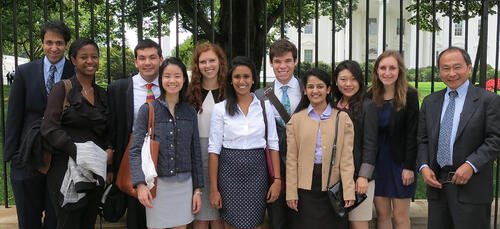
Rules of War
CISAC Senior Fellow Scott Sagan and Affiliated Faculty Member Allen Weiner of the Stanford Law School teach "Rules of War," a Thinking Matters course that investigates the legal rules that govern the resort to, and conduct of war, and study whether these rules affect the conduct of states and individuals. The class will confront various ethical, legal, and strategic problems as they make decisions about military intervention and policies regarding the threat and use of force in an international crisis. The class culminates in one of CISAC's signature simulations in which students are assigned roles within the presidential cabinet.
Why Policy Interventions and Foreign Aid Have Yielded So Little: The Origins and Impact of Long-Run Political and Economic Institutions
Professors Morris, Ober, and Scheidel examine the long-term institutional constraints on economic development. The panel will discuss their GDP project and how “big history” can inform the effectiveness and impact of foreign aid and technical innovation in developing countries and how their might provide insights for policy makers about the conditions under which particular aid projects and innovations will have a positive payoff.
State Fragility and Extreme Poverty: What Can be Done?
Please note that this CDDRL seminar will be held on Wednesday.
Abstract:
Recent estimates place half of the world’s poorest people in fragile and conflict-affected states by 2015. As the world moves towards the next phase of global development goals, which includes a central emphasis on eradicating extreme poverty, it will be necessary to understand the challenges for countries in the most difficult contexts. Is addressing and resolving fragility a condition (or precondition) for successfully addressing poverty? Or, are there ways to significantly and sustainably reduce poverty even while countries remain fragile?
USAID is seeking to answer these questions as it recommits to working with its partners to end extreme poverty by 2030. And while we acknowledge that ending extreme poverty will not be easy, progress and gains already achieved over the past couple of decades have made us certain that it is possible. As the global community coalesces around this goal, USAID seeks to increase shared understanding of the nature of extreme poverty, where there has been success and why, and what we are already doing and will need to do differently to catalyze and invest in global solutions.
Speaker Bio:
Alex Thier
Philippines Conference Room
Encina Hall, 3nd Floor
616 Serra St
Stanford, CA 94305
Towards a Post-9/11 Foreign Policy
Before his appointment as Ambassador to NATO by President Obama in 2009, Daalder was a senior fellow in foreign policy studies at the Brookings Institution, specializing in American foreign policy, European security and transatlantic relations, and national security affairs. Prior to joining Brookings in 1998, he was an Associate Professor at the University of Maryland’s School of Public Policy and director of research at its Center for International and Security Studies. Ambassador Daalder was educated at Oxford and Georgetown Universities, and received his PhD in political science from the Massachusetts Institute of Technology.
Market Growth, Environmental Conservation and Poverty Reduction: Connecting the Dots
Forward-thinking companies, government organizations, and NGOs are beginning to link their efforts to build markets, promote environmental conservation, and reduce poverty in developing economies.
Join GDP for a discussion that explores potential synergies and challenges associated with linking these efforts. The panelists will share their own experiences and other promising models currently employed by companies, NGOs and government organizations around the world.
Rosamond L. Naylor
The Jerry Yang and Akiko Yamazaki
Environment and Energy Building
Stanford University
473 Via Ortega, Office 363
Stanford, CA 94305
Rosamond Naylor is the William Wrigley Professor in Earth System Science, a Senior Fellow at Stanford Woods Institute and the Freeman Spogli Institute for International Studies, the founding Director at the Center on Food Security and the Environment, and Professor of Economics (by courtesy) at Stanford University. She received her B.A. in Economics and Environmental Studies from the University of Colorado, her M.Sc. in Economics from the London School of Economics, and her Ph.D. in applied economics from Stanford University. Her research focuses on policies and practices to improve global food security and protect the environment on land and at sea. She works with her students in many locations around the world. She has been involved in many field-level research projects around the world and has published widely on issues related to intensive crop production, aquaculture and livestock systems, biofuels, climate change, food price volatility, and food policy analysis. In addition to her many peer-reviewed papers, Naylor has published two books on her work: The Evolving Sphere of Food Security (Naylor, ed., 2014), and The Tropical Oil Crops Revolution: Food, Farmers, Fuels, and Forests (Byerlee, Falcon, and Naylor, 2017).
She is a Fellow of the Ecological Society of America, a Pew Marine Fellow, a Leopold Leadership Fellow, a Fellow of the Beijer Institute for Ecological Economics, a member of Sigma Xi, and the co-Chair of the Blue Food Assessment. Naylor serves as the President of the Board of Directors for Aspen Global Change Institute, is a member of the Scientific Advisory Committee for Oceana and is a member of the Forest Advisory Panel for Cargill. At Stanford, Naylor teaches courses on the World Food Economy, Human-Environment Interactions, and Food and Security.
Mark C. Thurber
Program on Energy and Sustainable Development
616 Jane Stanford Way
Encina Hall East, Rm E412
Stanford, CA 94305
Mark C. Thurber is Associate Director of the Program on Energy and Sustainable Development (PESD) at Stanford University, where he studies and teaches about energy and environmental markets and policy. Dr. Thurber has written and edited books and articles on topics including global fossil fuel markets, climate policy, integration of renewable energy into electricity markets, and provision of energy services to low-income populations.
Dr. Thurber co-edited and contributed to Oil and Governance: State-owned Enterprises and the World Energy Supply (Cambridge University Press, 2012) and The Global Coal Market: Supplying the Major Fuel for Emerging Economies (Cambridge University Press, 2015). He is the author of Coal (Polity Press, 2019) about why coal has thus far remained the preeminent fuel for electricity generation around the world despite its negative impacts on local air quality and the global climate.
Dr. Thurber teaches a course on energy markets and policy at Stanford, in which he runs a game-based simulation of electricity, carbon, and renewable energy markets. With Dr. Frank Wolak, he also conducts game-based workshops for policymakers and regulators. These workshops explore timely policy topics including how to ensure resource adequacy in a world with very high shares of renewable energy generation.
Dr. Thurber has previous experience working in high-tech industry. From 2003-2005, he was an engineering manager at a plant in Guadalajara, México that manufactured hard disk drive heads. He holds a Ph.D. from Stanford University and a B.S.E. from Princeton University.
Larry Diamond on global crisis hotspots
In a recent interview with NPR, Larry Diamond provides insights and analysis on some of the most pressing political developments confronting the world today.
Edward Geist
CISAC
Stanford University
Encina Hall
Stanford CA 94305-6165
Edward Geist received his Ph.D. in history from the University of North Carolina in May 2013. Previously a Stanton Nuclear Security Fellow at the RAND Corporation in Washington DC, he is a native of Oak Ridge, Tennessee. His research interests include emergency management in nuclear disasters, Soviet politics and culture, and the history of nuclear power and weapons. His dissertation, a comparative study of Soviet and U.S. civil defense during the Cold War, draws upon previously unexamined archival sources to examine the similarities and differences in how the two superpowers faced the dilemmas of the nuclear age. Edward is also interested in the potential uses of simulation and modelling for historians and is developing a piece using these techniques to explore the potential historical implications of the the U.S. and Soviet Union's use of qualitatively different technical assumptions to model strategic nuclear exchanges. A previous recipient of fellowships from Fulbright-Hays and American Councils to conduct research in Moscow and Kyiv, he has published articles in the Journal of Cold War Studies, Russian Review, and the Bulletin of the History of Medicine.
FSI's Mike McFaul on the 'judo master' in the Kremlin
In this week's Politico, David Remnick has written a lengthy piece about former U.S. Ambassador to Russia Michael McFaul's rocky tenure in Moscow, as Vladir Putin came back into power as president and U.S.-Russia relations began to deteriorate.
Michael A. McFaul, a FSI senior fellow and CISAC affiliated faculty member, writes in this Center on Democracy, Development, and the Rule of Law that while the U.S. and Europe maintain pressure on Putin through sanctions, the West also needs to get serious about strengthening Ukraine.
"So far, Ukrainians have done more to thwart Mr. Putin than any action by outside powers," says McFaul. "The West can likewise do more to help the Kiev government win hearts and minds in eastern Ukraine."
And in a Politico magazine piece by McFaul earlier this week, he argues that Putin today sees a path to glory that does not involve democratic governance and ignores international norms.
"Putin dreams of comparisons with Peter the Great or the Catherine the Great," writes McFaul, who was ambassador in Moscow from January 2012 until this February, when he returned to Stanford as a political science professor at FSI's New Yorker.
"But if we judge him by his ability to achieve even his own stated goals, his record is not so great. He has achieved some objectives aimed at restoring Russia to the position of global greatness he believes it deserves, but failed at achieving those most important to him. And the future looks even darker."
Calculating the risk of slowing crop yields
According to a new study co-authored by Stanford professor David Lobell, the chance of a worldwide slowdown in agricultural yield growth in the next two decades is significantly higher due to global warming.
Lobell and co-author Claudia Tebaldi, a senior researcher at the National Center for Atmospheric Research, set out to estimate the odds of a steep drop in global wheat and corn yield progress under several climate scenarios. The study, “Getting caught with our plants down: the risks of a global crop yield slowdown from climate trends in the next two decades” appeared in Environmental Research Letters.
Lobell said he was motivated to pursue the study based on questions posed by stakeholders and decision makers in governments and the private sector.
“I’m often asked whether climate change will threaten food supply, as if it’s a simple yes or no answer,” Lobell said. “The truth is that over a 10 or 20 year period, it depends largely on how fast the Earth warms, and we can’t predict that very precisely. So the best we can do is try to determine the odds.”
Lobell and Tebaldi calculated the chance of a 10 percent global yield loss from climate change over the next 20 years, which would represent a severe impact on food supply, enough to roughly halve the rate of yield growth.
The short time frame of the study was deliberate, Lobell said. “Many studies have looked at climate and agriculture trends over the coming 50 or 100 years. But the next two decades are when most of the global population growth, and dietary shifts driven by a growing middle class, will occur. The growth rate of food demand will be higher during this time than at any other time in the next century.”
Without human-induced global warming – in other words, in a world with only natural climate variability – the likelihood of a yield drop that large is only 1 in 200. But when the team accounted for global warming, they saw the odds jump to 1 in 10 for corn and 1 in 20 for wheat. “In this study, we did not try to estimate the most likely impacts of climate change on crops,” Lobell said. “Rather, we estimated the likelihood of a really major impact, not because we want to scare people, but because there are many people who want to be prepared for all contingencies.”
“The point of the paper is to move from hand-waving about scenarios of what could go wrong, to specific and transparent estimates of the actual odds,” Lobell said. “The odds are not very high, but they are significant and a lot bigger than they used to be. The people asking these questions are accustomed to planning for scenarios with much less than a 10 percent chance of happening, so it will be interesting to see whether this study has any effect on how they operate.”
Lobell adds that organizations working toward global food security, and related issues such as conflict prevention, are most interested in the next 20 years because their decisions rarely consider the more distant future. “As scientists, we might prefer to work on time scales in which the answers are clearer, but we also want to be responsive to the actual concerns and questions that decision makers have.”
Lobell is associate professor of Environmental Earth System Science at Stanford and associate director of the Center on Food Security and the Environment. He is also a senior fellow at the Stanford Woods Institute for the Environment and the Freeman Spogli Institute for International Studies.
Contact:
David Lobell: dlobell@stanford.edu
Laura Seaman, Communications and External Relations Manager, Center on Food Security and the Environment: lseaman@stanford.edu