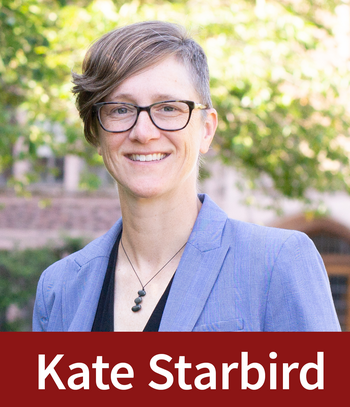
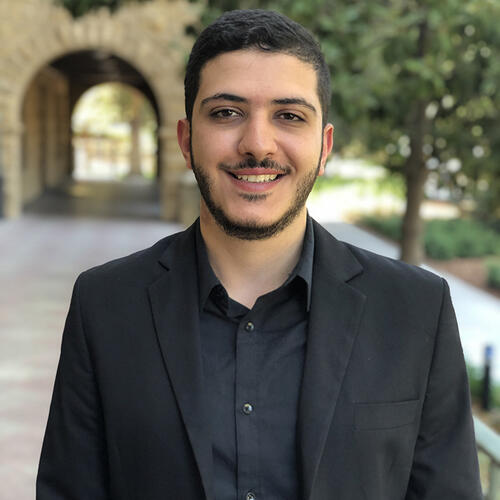
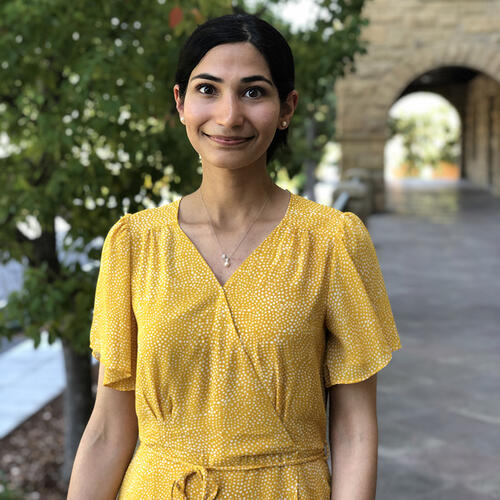
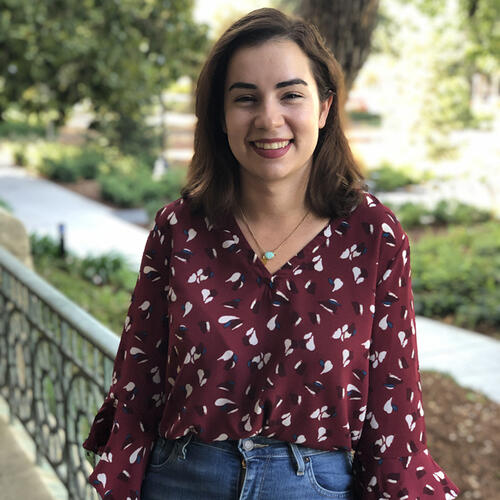
Authors
News Type
News
Date
Paragraphs

Every summer, the Draper Hills Summer Fellows Program brings together international leaders who are pioneering new approaches to advance social and political change in some of the most challenging global contexts. The fellows spend three weeks living and taking classes on the Stanford campus, visiting Silicon Valley tech companies and building a network.

Representing business, government and the nonprofit sector, fellows are working on the frontlines of democratic change to combat the global rise of authoritarianism and populism. The Freeman Spogli Institute for International Studies spoke to five of the fellows about the impact of the Draper Hills program on their work and activism. These are their stories.

Shaili Chopra, India

shaili3 Shaili Chopra, founder of SheThePeopleTv. Photo: Alice Wenner
“I run a platform called SheThePeopleTv. It's a platform for women, and it aims to share news, opinions, data and statistics through a gendered lens. Women are a critical part of democracy — from where I come, in India, we have 600 million women. That's half of the country's population. I think they must also have half of the country’s voice, which they don't.

“I think a big plus of a program like Draper Hills is that when we are all working in the general construct of democracy, we have shared problems, and we also look for shared solutions. It's very empowering to be around people who understand these situations, or have found solutions or overcame them in their countries, or are going through similar problems. You can discuss them and get a sense of solidarity and a sense of empathy.”

Wiem Zarrouk, Tunisia

wiem1 Wiem Zarrouk, senior advisor to the Minister of Development, Investment and International Cooperation in Tunisia. Photo: Alice Wenner

“I’ve been working for the Tunisian government for three years as an advisor to the Minister of Development, Investment and International Cooperation. I am leading the government reforms to improve Tunisia's ranking in the World Bank Competitiveness Report - Doing Business.

“In Tunisia, we’ve set up most of our democratic institutions, and now we want to improve the business environment to attract more investment in local businesses. Eight years ago, the people went into the streets demanding more jobs. The challenge in Tunisia right now is economic, that’s why economic reforms are important to our government.

“I think the impact of the Draper Hills program will be immediate. I’ve learned a lot here about the link between development and democracies, so it really covers the scope of my work. And it's been great to learn about the theoretical side — the professors are really speaking about things that impact our daily work.” 


Ujwal Thapa, Nepal

ujwal1 Ujwal Thapa, president of the BibekSheel Nepali youth movement. Photo: Alice Wenner

“Bibeksheel Nepali is basically a political startup. It’s a youth-led movement, and we’re focused on changing the norms and mindsets of the culture in Nepal. We work a lot with citizens to instill the values of transparency, empathy and humility because we think democracy needs to be more emotional instead of just logical. I think liberal democracy needs to be understood more in the context of humanity. So it’s an experiment that we're doing in Nepal.

“When we started with the experiment, we decided not to focus only on the state, but thought about a few more components: one is our citizens, another is the society and the third is the government. Nepal recently came out of a violent civil war, and we just built a new constitution that is much more tolerant. Transparency is another value that we want to instill, because of the long isolationist and autocratic dictatorship that has existed in the past.

“Draper Hills is bringing all of these practitioners together who are experimental and innovative. And the world needs better collaboration from people who really believe in the ideals of the 21st century, which are liberal, democratic and more humanistic. That’s one of the strongest aspects of the Draper Hills program.”


N.S. Nappinai, India

nappinai1 N.S. Nappinai, senior practitioner in the Supreme Court of India and Bombay High Court. Photo: Alice Wenner

“I'm a lawyer — I specialize in cyber laws. My work throughout my career has been focused on ensuring responsible technology and the use of technology to fight crime. Two years ago I was appointed by the Supreme Court of India as Amicus Curiae on a matter related to protecting against the uploading of videos and images of gang rape and child pornography online.

“Some of the social media platforms had very good reporting mechanisms, whereas it was more hidden on other platforms. So we ensured that this issue was brought to the forefront so that people know that these are things that can be reported and some action can be taken. The whole idea was that as long as you identify such content at the earliest possible time, then you help the victim that much more.

“For me, balancing victims' rights with free speech is very important. This was a big dilemma that I faced, in terms of ‘How much of what I am doing is likely to stifle free speech?’ A lot of discussions at Draper Hills have helped formulate and structure my thoughts, and it's very nice to get the perspective from people from 26 other countries.”


Hinda Bouddane, Morocco

hinda1 Hinda Bouddane, the first vice president of the elected provincial council of the city of Fez. Photo: Alice Wenner

“I'm involved in women's empowerment and education for girls in Morocco. And especially for women in rural areas — they are less privileged, and many of them don't know their rights. So my fight through JA Worldwide and my activism is to empower these women and to raise awareness about their rights and the importance of education for girls.

“Education for girls is really important in fighting discrimination against women. Education empowers women to become financially independent, say no to violence, and to get engaged in the public sphere. Through that, women can be a part of the democratic process not only by voting, but also by taking part from within and running for office.

At Draper Hills, we're deepening our knowledge about topics like the rule of law, democracy and human rights, and hearing many different perspectives. And importantly, we are building a great network to connect many intelligent people from around the world, and we will work together to foster democratic values.”


Hero Image
draper hills for web
The 2019 Draper Hills Class of 2019 at the Freeman Spogli Institute for International Studies. Photo: Stanford Center on Democracy, Development and the Rule of Law
All News button
1
0
Former Postdoctoral Scholar, Stanford Internet Observatory
Daniel Bush PhD

Daniel Bush is a Postdoctoral Fellow at the Stanford Internet Observatory, where he studies internet culture in Russia and Ukraine. He received his PhD in Stanford’s Department of Slavic Languages and Literatures in 2018 and was previously a Postdoctoral Scholar at the Poetic Media Lab, a research and pedagogy lab at Stanford’s Center for Spatial and Textual Analysis. His research has been published in Canadian Slavonic Papers and The Journal of Interactive Technology and Pedagogy.

-
Abstract: Russia is a major energy exporter and has used those exports to advance its geopolitical goals. Based on her book "The New Geopolitics of Natural Gas” (Harvard UP, 2017), Dr. Agnia Grigas will discuss the recent transformation in global energy markets and the resulting shift in the geopolitics of energy, specifically relations between key producing and competing states such as Russia and the United States, and key consuming regions such as Europe and developing Asia. Focusing on natural gas, Dr. Grigas will address Russia’s energy challenge to European security and steps the United States can and should take to mitigate this challenge.
 
Seminar Recording: https://youtu.be/EImxZfGJN9o
 
Speaker Biography: 
 
Image
Dr. Agnia Grigas is a strategic advisor on energy and geopolitical economy for US government institutions and multinational corporations. She is the author of three acclaimed books: "The New Geopolitics of Natural Gas,"​  "​Beyond Crimea: The New Russian Empire,"​ and "The Politics of Energy and Memory between the Baltic States and Russia."  She serves as nonresident Senior Fellow at the Atlantic Council, Associate at Argonne National Laboratory and advisory board member for the McKinnon Center for Global Affairs at Occidental College, the Vilnius Institute for Policy Analysis and LITGAS.  She holds a Master’s and Doctorate in International Relations from the University of Oxford and a BA in Economics and Political Science from Columbia University. Follow via: @AgniaGrigas & grigas.net


Agnia Grigas Strategic Advisor
Authors
News Type
Q&As
Date
Paragraphs

Brett McGurk, the former Special Presidential Envoy for the Global Coalition to Counter ISIL, has had a busy summer. Between working on a new book contract, travelling to international security conferences on two continents and prepping for his upcoming class — “Presidential Decision-Making in Wartime” — which will be taught this fall at Stanford, the Payne Distinguished Lecturer at the Center for International Security and Cooperation sat down with the Freeman Spogli Institute to reflect on what he’s learned about Middle Eastern politics this summer.

FSI: You recently attended a number of conferences focused on international security. Tell us a little about where you’ve been and the conferences you participated in.

Sure. I was recently at a conference in Beijing sponsored by the Carnegie Foundation for International Peace that focused on China in the Middle East. This was a good opportunity to reconnect with former officials and experts on China and also to discuss with Chinese officials and academics how Beijing views its emerging role in the Middle East region. This is an important topic, and we intend to develop it further here at Stanford FSI through a combination program with CISAC and the Shorenstein Asia-Pacific Research Center. I recently published an article in the Atlantic on some of the themes from Beijing.

I also attended the Oslo Forum in Norway, which brings together top diplomats from around the world engaged in mediating the most difficult conflicts. UN envoys from Syria and Libya, for example, participate, as do leaders working on Yemen and other seemingly intractable crises. The main takeaway from that important conference was that there is a window of opportunity right now for active U.S. diplomacy to help de-escalate what are in effect proxy wars between regional powers. Libya is increasingly a conflict between long-time U.S. allies, with Turkey and Qatar on one side and UAE and Egypt on the other side. Yemen is a humanitarian catastrophe and UN mediation has opened the door to ceasefires and a path for winding down the war, which some of our key allies now support. 

Iran and extremists like al Qaeda and ISIS take advantage of proxy wars and vacuums – so it’s in our interests both from a humanitarian, geostrategic, and national security perspective to use diplomacy and other tools to end these conflicts. That was the focus of the Norway meetings.

In spectacular #Oslo today for the 2019 #OsloForum. Look forward to reconnecting with former counterparts and friends from around the globe, many trying largely on their own to mediate some of the world’s most intractable conflicts. @NorwayMFA pic.twitter.com/0DmTY7swW6

— Brett McGurk (@brett_mcgurk) June 18, 2019

To what extent did the U.S. participate in the Oslo Forum?

I was struck that the United States was largely absent. There were no U.S. officials at the Forum, for the first time as I can recall, and total lack of clarity on U.S. goals and objectives. On Syria, the top UN Envoy, Geir Pederson, attended as did a number of parties to the Syrian conflict, including from the Syrian Democratic Forces, which played a key role in defeating ISIS. 

There is some hope that Syria is approaching a stage for a meaningful political settlement; I’ve expressed some skepticism on that, again, due largely to questionable U.S. intent and commitment and the facts on the ground and in the region, which leave Washington with few good options. The sooner we acknowledge that reality the better because the situation can still get much worse. My recent article in Foreign Affairs delves into those issues in some detail.

You were at the Herzliya Conference in Israel. Did Iran’s nuclear program dominate the agenda? What else was top of mind for the conference organizers, presenters, and people in attendance?

Yes, I attended the annual security conference sponsored by Israel’s Institute for Policy and Strategy. It’s become a go-to event for assessing the direction of Middle East politics and Israeli policies in a difficult part of the world. I used to attend as a sitting official and it was great to be there as a private citizen.

Flying from San Francisco to Tel Aviv for the annual @HerzliyaConf which has become a go-to event for thinkers and practitioners on the Middle East. Look forward to reconnecting with former colleagues and new friends. @FSIStanford @CarnegieMEC pic.twitter.com/0se7WvGCG1

— Brett McGurk (@brett_mcgurk) June 28, 2019

Much of the focus this year, of course, was on Iran – but also on the internal situation inside Israel, President Donald Trump’s much-delayed Middle East peace plan, and the rift I mentioned earlier between Egypt, Saudi Arabia, and UAE on one side, with Turkey and Qatar on the other side. 

There was also an open question and significant discussion over whether current U.S. policies are worsening tensions in the region. Much of that will depend on whether the core White House assumption driving its Iran policy is correct. That assumption holds that maximum pressure against Iran will force Iran back to the negotiating table that Trump himself left and result in a better nuclear deal and more responsible Iranian behavior in the region. If that assumption is false, and Iran reacts to unilateral American pressure by forging stronger ties with China and Russia, restarting its illicit nuclear activities, and increasing its malign behavior in the region – then U.S. policy may have precisely the opposite effect than its stated intent. That would require Trump to either double down on pressure, to include military pressure, or back down from what is now a zero-sum bargaining position. 


For more on Brett McGurk’s policy recommendations on Iranian nuclear ambitions, read his Op-Ed in Bloomberg News.

On stated U.S. intent, there was also quite a bit of discussion about U.S. objectives, given that Trump says one thing and his national security team says something else, often within the same 24-hour time span.  This uncertainty, I would argue, is breeding more instability, not less.

There was an interesting “war game” conducted at the Herziliya Conference, which simulated direct negotiations between U.S. and Iranian officials. The game ended without producing an agreement. What do you make of that?

I participated in that war game. Having confronted the Iranians from the shadows and in direct face-to-face negotiations, I would say this simulation was fairly accurate and its findings important. My first conclusion was that it’s highly unlikely the Iranians are going to return to the table under the current circumstances and without some up-front concession (such as reinstating some waivers to allow limited export of oil) by the Trump administration.  Nobody likes that answer, but it’s a realistic assessment of Iranian decision-making and important if the U.S. objective is truly – as Trump says – to get back to the negotiating table for a better nuclear deal. 

I read recently that the Emir of Qatar, who visited Trump in the Oval Office in mid-July, told the president the same thing.  So even our close friends in the region have this assessment. It means, if you want to get back to the negotiating table, then you need to create a pretext with some up-front steps, to be taken both from Washington and from Tehran.  A creative package, for example, might offer some limited sanctions relief and also demand release of Americans held in Iranian prisons. Absent something like that, relying on pressure alone, there are unlikely to be any talks.

How did the simulated negotiations between the U.S. and Iran unfold?

Presuming you get to the stage of talks, which was the focus of the simulation, the position of the two sides are irreconcilable. Iran was willing to consider some amendments to the Joint Comprehensive Plan of Action – but from the U.S. side, that was insufficient. We demanded, as Secretary of State Mike Pompeo has demanded, a total abandonment of Iran’s enrichment program, defunding proxy militias throughout the region, cabining the ballistic missile program, and other measures. The talks totally broke down after a number of rounds, and risks of a conflict increased significantly. It’s better to have no talks than ill-prepared talks where the U.S. is not even clear on what it’s hoping to achieve or has demands that are known non-starters.

The only silver lining was that if the goal is a strengthened nuclear deal that truly blocks Iran’s path to a weapon in perpetuity, while allowing a civilian program, then it’s achievable. Trump has said that’s the goal. If so, there is a path. But that’s a far more limited goal than what has been discussed by his national security team. The more ambitious objectives are unlikely to be met, and without a realistic objective, the talks themselves are unlikely to get off the ground.

A more comprehensive approach for Iran: 1) Naval coalition to protect shipping; 2) On-ramp to strengthen nuke deal; 3) Diplomacy to de-escalate proxy wars; 4) Treat Iranian people as allies (end travel ban); 5) Keep focus on ISIS: don't leave Iraq/Syria. https://t.co/BBNVtbLEhn

— Brett McGurk (@brett_mcgurk) June 26, 2019

Have you participated in “war games” like this one before?

I don’t like the phrase “war game” because it suggests something trite like a game or reenactment; in fact, simulations like this are among the best tools we have to predict the future and prepare for contingencies in foreign policy. Even with all the tools and information available to a policy-maker at the most senior level, humans can’t predict the future. Well-run simulations alert you to policy adjustments that may be necessary. We used them quite a bit during the campaign to defeat ISIS and to good effect. A famous war game, SIGMA II, run out of the Pentagon in 1965 predicted perfectly what would happen if the U.S. pursued its graduated pressure campaign against North Vietnam – a quagmire that sucked in multiple U.S. divisions.

So these simulations are important. I hope the administration is conducting them on Iran, though I tend to doubt they are, at least not at the highest levels. Sound foreign policy depends on setting clear and achievable objectives, marshaling the resources for achieving them, and regularly testing assumptions to make adjustments as circumstances warrant.

I recently published an essay in Foreign Affairs on the misalignment of ends and means with respect to Trump’s foreign policies in Syria, Venezuela, and Iran. That’s generally a recipe for either a failed policy or unintended consequences that box presidents into decisions they don’t want to make: either double down on resources or ratchet back objectives.

Did you have a chance to reconnect with old friends from your many years as a U.S. diplomat in the Middle East?

I did, and I also caught up with a number of former colleagues still serving in the Trump administration. They are a dedicated group and doing all they can under difficult circumstances. I could not hide my enthusiasm for being out of Washington and out here at Stanford. Stanford is just an incredible place to think deeply and differently about the issues now confronting our nation and the world.

You start teaching in the Ford Dorsey Master’s in International Policy program in the fall quarter.  Can you tell us a bit about your course?

Sure. In the fall I will teach “Presidential Decision-Making in Wartime.” It’s a course about how the most consequential decisions – war and peace – are made in reality, particularly since 9/11. We will dive into the essential laws of strategy such as setting clear objectives, aligning ends, ways, and means, and what happens when those essential laws are ignored. I hope it will give students the tools to ask the right questions if they are ever in the Situation Room with a chance to influence the course of history for the better. 

Most debacles have this same basic flaw of ignoring what I call the iron law of strategy and alignment of ends, ways, and means. Even for students not heading towards a national security career, the tools and elements of strategic thinking are broadly applicable. 


Hero Image
brett
Former Special Presidential Envoy for the Global Coalition to Counter ISIL Brett McGurk at the 2019 Oslo Forum in Norway. Photo: Oslo Forum
All News button
1
Authors
News Type
Commentary
Date
Paragraphs

This piece originally appeared in The National Interest.

Significant progress has been made in improving the defense situation in the Baltic states since 2014, but NATO can take some relatively modest steps to further enhance its deterrence and defense posture in the region, according to a report by Michael O’Hanlon and Christopher Skaluba, which was based on an Atlantic Council study visit to Lithuania. The Atlantic Council was kind enough to include me on the trek, which began in Lithuania’s capital, Vilnius, and included visits to troops in the field and the port of Klaipeda. I largely concur with Mike and Chris’s comments and supplement them below with several additional observations.

First, one can understand the preoccupation of Lithuania’s senior political and military leadership with the country’s security situation. Lithuania has had a difficult history with the Soviet Union and Russia. Some in Vilnius believe that Moscow regards the Baltic states as “temporarily lost territory.”

A Russian military invasion of the Baltic states is not a high probability. However, the Lithuanians cannot ignore a small probability, especially in light of the Kremlin’s recent rhetoric, the Russian military’s ongoing modernization of its conventional forces and exercise pattern of the past five years, and Russia’s use of military force to seize Crimea and conduct a conflict in Donbas.

When the Lithuanian Ministry of National Defense (MNOD) looks around its neighborhood, it can see specific reasons for concern. Russia is upgrading its military presence in the Kaliningrad exclave on Lithuania’s southwestern border. The MNOD now counts Kaliningrad as hosting some twenty thousand Russian military personnel, including a naval infantry unit and substantial anti-access, area denial capabilities, such as advanced surface-to-air missiles. The Lithuanians assess that the Russian military could mount a large ground attack from Belarus, to the east of Lithuania (the border is less than twenty miles from downtown Vilnius). These forces are backed by an additional 120,000 personnel in Russia’s Western Military District, including a tank army. Russia has substantial air assets in the region as well as warships in the Baltic Sea.

For its part, Lithuania can muster fourteen thousand soldiers and sailors (four thousand of whom are conscripts serving just nine months). They are backed up by five thousand volunteers, similar to the U.S. National Guard. Under NATO’s enhanced forward presence program, a German-led NATO battlegroup adds 1,300 troops, mainly from Germany, the Netherlands and the Czech Republic. In addition, NATO member air forces rotate small fighter squadrons into Lithuania to provide air policing for the Baltic states.

Second, Lithuania has a logical plan to enhance its defense capabilities. The MNOD is making good use of its defense dollars (Lithuania now meets NATO’s two percent of gross domestic product goal, having tripled its defense expenditures over the past six years). Eschewing shiny objects such as F-16 jets, the MNOD focuses on upgrading the capabilities of its two primary ground units, a mechanized brigade and a recently-established motorized brigade. The main procurement programs of the past three years have purchased infantry fighting vehicles, self propelled artillery and short-range surface-to-air missiles to equip the brigades.

In the event of war, the forces in Lithuania would likely fight a defensive holding action while awaiting NATO reinforcements. The MNOD and Ministry of Transport are working together to enhance the country’s ability to flow in NATO forces, including by upgrading the rollon/roll-off capacity at the port of Klaipeda and building a European standard gauge railroad line from Poland to the main base of Lithuania’s mechanized brigade. The railroad line, which o obviates the need to change the railroad gauge at the Polish-Lithuanian border, a cumbersome process involving changing out the wheels of railcars, ultimately will be extended north to Latvia and Estonia.

Third, the Lithuanians value NATO’s enhanced forward presence in the form of the NATO battlegroup. The battlegroup is fully integrated into Lithuania’s Iron Wolf Brigade, and in wartime would come under the tactical control of the brigade. The rotational NATO force is based with and trains side-by-side with major elements of that brigade.

One potential question is, if Russian forces were to cross the border and the Iron Wolf Brigade deployed, then how quickly would the NATO battlegroup take the field with it? The latter would need a NATO command to do so, and likely also national authorizations from Berlin, The Hague and Prague. Hopefully, those authorizations would be transmitted early as a crisis developed so that the NATO battlegroup could deploy immediately. It adds significantly to Lithuanian combat capabilities, including by providing the only armor unit in the country.

Fourth, as pleased as Vilnius is to have a NATO military presence, the Lithuanians very much would like to add a U.S. component to it. With a U.S. armored brigade combat team deployed in Poland on a rotational basis, the U.S. military has the assets to consider periodically rotating an armored company to Lithuania (and to Latvia and Estonia). These rotations would be useful military exercises in case there is a crisis that requires a reinforcement move from Poland to Lithuania through the Suwalki Gap.

Lithuania is moving in the right direction in bolstering its defense capabilities, with prudent steps taken over the past six years and sensible plans for the future. As Mike and Chris point out, modest steps by NATO and, I would argue, the United States could significantly add to the Alliance’s deterrence and defense posture in the Baltics.


Hero Image
steven pifer 0
All News button
1
Authors
News Type
News
Date
Paragraphs

Did the Russian-affiliated groups that interfered with the 2016 U.S. presidential election want to be caught?

“There’s a reason why they paid for Facebook ads in rubles,” Nathaniel Persily, who is a senior fellow at FSI and co-director of the Cyber Policy Center, told FSI Director Michael McFaul on the World Class podcast. “They wanted to be open and notorious.”

Since the election, Americans have become more suspicious of fake news, but they have also become suspicious of real news and journalists in general. Another problem with the Russians’ success in influencing the 2016 election, said Persily, is that Americans will automatically assume that the Russians will do the same thing during the 2020 race.

“Everyone is going to be looking for nefarious influences and shouting them from the rooftops, and that actually serves the [bad actors’] purposes just as much,” Persily said. “Many of the attempts in 2016 were about fostering division and doubt, and I think there’s a lot of appetite for doubt right now in America.”

Sign up for the FSI Newsletter to get stories like this delivered straight to your inbox.

Since 2016, Facebook, Twitter and Google have made some important changes to the way they handle advertising, including adding a requirement that all candidate ads and other ads of “national legislative importance” be identified as advertisements on users’ feeds.

But there are no standardized rules or regulations that dictate how tech companies should handle advertisements or posts that contain disinformation, Persily said, and because of this, it is up to those respective companies to make those decisions themselves  — and they aren’t always in agreement. For example, when a video of Nancy Pelosi that was slowed down to make her seem drunk was posted in late May on YouTube and Facebook, YouTube took the video down, but Facebook decided to leave it up.

“The standards that are going to be developed in test cases like these — under conditions which are not as politically incendiary as an election — are going to be the ones that will be rolled out and applied in elections in the U.S. and around the world,” Persily said.

When it comes to election security, the 2020 presidential race will be the next big test for the U.S. government and private-sector companies. But other countries should also be on the lookout for activity from foreign agents and actors in their elections.

“The 2016 election was not just an event, it was a playbook that was written by the Russians,” warned Persily. “That playbook is usable for future elections in the United States as well as around the world, whether it’s between India and Pakistan or China and Taiwan.”


Hero Image
world class logo soundcloud notag 1
All News button
1
News Type
Commentary
Date
Paragraphs

In the honor of publication of Larry Diamond's "Ill Winds: Saving Democracy from Russian Rage, Chinese Ambition, and American Complacency" Foreign Affairs are providing past the paywall article "Democracy Demotion: How the Freedom Agenda Fell Apart" by Larry Diamond. Read here


Hero Image
iraqi voters inked fingers
All News button
1
Authors
News Type
Commentary
Date
Paragraphs

On Tuesday [June 4], the House Subcommittee on Strategic Forces debated the draft Fiscal Year 2020 National Defense Authorization Act.

It voted out, on party lines, language that prohibits deployment of a low-yield warhead on the Trident D5 submarine-launched ballistic missile.  That makes sense:  The rationale for the warhead is dubious, and the weapon likely would never be selected for use.

Read the rest at The Hill


Hero Image
steven pifer 0
All News button
1

Encina Hall
616 Jane Stanford Way
Stanford, CA  94305
 

0
Visiting Postdoctoral Scholar at The Europe Center, 2019-2020
tinka_schubert.jpg

Tinka Schubert is a Postdoctoral Research Fellow at the Social and Organizational Analysis Research Group (http://www.analisisocial.org/index.php/en/) at the University Rovira i Virgili and member of the Community of Researchers on Excellence for All (http://creaub.info/) at the University of Barcelona, Spain. She earned her PhD in Sociology at the University of Barcelona in 2015 with the first dissertation on gender violence prevention in Spanish universities, embedded in the broader research agenda on preventive socialization of gender violence developed by CREA. In the frame of her doctoral thesis she has been a visiting scholar at the Harvard School of Public Health to broaden her agenda with the public health perspective as well as at the Graduate Center at the City University New York to focus on the role of social movements in the prevention of violence against women. She has further served as a Lecturer at the Universidad Loyola Andalucía and was awarded a Juan de la Cierva Postdoctoral Research Fellowship at the University Rovira i Virgili. Tinka Schubert is Co-Editor of the International and Multidisciplinary Journal of Social Sciences.

At The Europe Center, Tinka is working with Professor Norman Naimark on the mass rapes by the Soviet Army on women in the Eastern territories at the end of World War II to research the implications of silencing this part of our history for the understanding of violence against women in present times.

Subscribe to Russia and Eurasia