Authors
Noa Ronkin
News Type
Q&As
Date
Paragraphs

This week in Hanoi, the city’s streets are lined with Vietnam’s ruling Communist Party flags and posters to promote the 13th Party Congress, the most important political event in the state. Held every five years, the weeklong congress meets to approve future policy and help select Vietnam’s highest-level leaders. This time, the announcement of the next leadership team will determine key questions that will have major implications for the evolution of the role of the state’s legislative body, the Vietnam National Assembly (VNA), says Paul Schuler, APARC’s former Lee Kong Chian fellow on Southeast Asia and former Shorenstein postdoctoral fellow.

Schuler, an assistant professor of political science at the University of Arizona’s School of Government and Public Policy, is an expert on politics in Vietnam and the author of the new book United Front: Projecting Solidarity through Deliberation in Vietnam’s Single-Party Legislature (Stanford University Press, in its monograph series with APARC). In this volume, Schuler examines the past and present functioning of the VNA. Applying a diverse range of social science methods on a wealth of original data, his findings shed light on the role of institutions in Vietnam as well as in authoritarian regimes more broadly.

Here, Schuler explains how the electoral process works in Vietnam’s one-party system, discusses the ways in which the VNA differs from the conventional image of single-party legislatures, and offers insights into how the 13th Party Congress currently underway is poised to shape Vietnam’s future.


[Sign up for APARC's newsletters to get the latest updates from our scholars.]

Your book explores why Vietnam, a single-party state, has well-developed electoral and legislative institutions. How is the state’s legislative body, the Vietnam National Assembly, organized and how has it evolved in recent years?

Schuler: Vietnam’s electoral and legislative institutions are some of the most open and active in the communist world. Unlike China, Cuba, and North Korea, as well as most former communist countries in Eastern Europe, Vietnam allows direct elections for National Assembly candidates with more candidates than seats available. Additionally, the legislature allows public debate, including televised queries of high-ranking government officials, including the prime minister.

In terms of its evolution, the legislature has gradually become more professionalized and active since the Doi moi economic opening in 1986 largely to deal with the increased legal complexity required to integrate with the global economy. The electoral process, however, has not changed as much, meaning that the party exerts tremendous control over who is nominated to participate in the elections. The control over the election process is key, because this gives the party a key lever it can use to moderate debate in the legislature. 

How does the electoral process work in a one-party system like Vietnam’s and what does your research reveal about Vietnamese voting behavior?

Schuler: Vietnam’s electoral system is somewhat unique compared to other communist regimes, past and present. Cuba, for example, allows direct elections for its legislature, but only one candidate is allowed to compete for each seat. China’s National People’s Congress elections are indirect, with lower-level legislatures essentially choosing the candidates for the national level. In Vietnam, by contrast, more candidates are allowed than seats. Furthermore, some non-party members are allowed to compete in these direct elections.

Despite this relative openness, the elections are limited in important ways. First, local election committees retain veto power over who gets to run. This means that while in the past few elections, some independent voices have tried to run, they have been barred from competing. Second, there are strict limits on campaigning. Candidate lists are only finalized a few weeks before the elections, and candidates are not allowed to reach out to voters independently and draw contrasts between themselves and their opponents. They are only allowed to campaign in a handful of party-controlled events with a limited number of attendees.

This has several implications for voting behavior. Because of the vetting process, voters may perceive the candidates as indistinguishable. Furthermore, even where there might be differences between the candidates, voters have little opportunity to learn about these differences. Hence, voters have low levels of awareness of their candidates and representatives and are forced to rely on observable cues such as gender, age, or party membership when voting. Interestingly, voters actually prefer party member candidates to independents. Other research I have done with Professor Edmund Malesky suggests that this is because voters at least have some information about the ideological orientation of party member candidates and because they presume these candidates will have better access to government resources.

An important question is whether the party continues its policy of merging party and government positions and bolstering party policymaking organs.
Paul Schuler

According to your research, what is the primary role of the VNA? How do your findings differ from the conventional wisdom about legislative institutions under authoritarian rule?

Schuler: Recent research challenges the conventional image of single-party legislatures as rubber stamps, suggesting that legislatures can provide some constraints on leaders in these regimes and provide regime leaders with information about citizen preferences. In terms of the VNA, I don’t find evidence that its main role is to constrain the party. Furthermore, it rarely provides information that the party doesn’t already have through other channels. Instead, the role of the VNA, since 1986, has been to take some of the increasing lawmaking burden that resulted from opening Vietnam’s economy from the party and the government. VNA participation lends legitimacy to these laws.

How, then, do we explain cases where the legislature appears active and critical? For example, how do we explain the case in 2010 where a delegate challenged the prime minister to a vote of no confidence? More recently, ahead of the current party congress, how do we explain a delegate challenging a deputy prime minister to explain the government’s delayed investigation of a company’s producing fraudulent fertilizer? I suggest these incidences are best seen as efforts by party leaders to restrain government officials through the VNA. This, in turn, reflects a key difference between Vietnam and other communist regimes, which is the relative balance of power between the prime minister and general secretary. Given this greater separation, the party has greater use for the VNA to challenge the government than the Chinese party leadership does.

The 13th National Congress of the Vietnamese Communist Party is taking place this week. What are its expected outcomes and how will they shape Vietnam’s future?

Schuler: The Party Congress is the most important national political event in Vietnam, as this is when the top-ranking positions for the next five years are selected. The announcement of the next leadership team will answer three key questions that will have implications for the evolution of the role of the VNA. First, will Nguyen Phu Trong continue as general secretary? If he does, this will likely mean the continuation of Vietnam’s anticorruption campaign. Just as important, it will also contravene an important norm, which is a two-term limit for the general secretary. While age exceptions have been made in the past, the term limit exception could set a precedent for future leaders to remain in power.

Second, will the presidency once again be separate from the general secretary position? Unlike China and other communist nations, in Vietnam, the presidency has traditionally been held by separate officials. This has contributed to an overall more balanced distribution of power in the Politburo than in other contexts, where the general secretary is a far more powerful position. This separation ended with the death of Tran Dai Quang in 2018, when Trong was appointed to replace him. If the position is once again handed to a different leader, this signals that the party will remain committed to some degree of power sharing at the top.

Third, to what degree will the party move to merge state and party functions? Consistent with the decision to merge the positions of the general secretary and president, one of the contenders for power in the Politburo, Pham Minh Chinh, experimented during his leadership of Quang Ninh province with merging party and state positions at the local level. Vietnam has also reestablished party committees, such as the Central Economic Committee, which could exert more direct control over the government. An important question, therefore, is whether the party continues its policy of merging party and government positions and bolstering party policymaking organs.

The answers to these last two questions have particular importance for the VNA. Given that the party uses the VNA to ensure the government is following its direction, if the party bolsters its own direct control mechanisms, either by empowering party committees or merging party and state positions, this could render legislative institutions increasingly superfluous. We could thus see a less visible legislature, and one focused mainly on ironing out technical details of legislation rather than playing a visible role in challenging the government.

View Schuler's New Book

Read More

Barack Obama addresses a crowd of young leaders from ASEAN nations.
Commentary

A Global Town Hall Welcomes America Back

Despite the reversals of the Trump era, a flurry of online diplomacy served as a reminder that the U.S. is welcome in Southeast Asia writes Donald K. Emmerson in The Diplomat.
A Global Town Hall Welcomes America Back
A loaded shipping liner sails out of port.
Commentary

Let's Keep it the 'Free and Open' Indo-Pacific

Both Japan's Suga and the incoming Biden administration should maintain the language of the "free and open Indo-Pacific" for consistency and to signal their ongoing commitment to maintaining a firm policy stance on China's ambitions.
Let's Keep it the 'Free and Open' Indo-Pacific
Stanford campus, main quad with cloudy sky
News

APARC Offers Fellowship and Funding Opportunities to Support, Diversify Stanford Student Participation in Contemporary Asia Research

The Center has launched a suite of offerings including a predoctoral fellowship, a diversity grant, and research assistant internships to support Stanford students interested in the area of contemporary Asia.
APARC Offers Fellowship and Funding Opportunities to Support, Diversify Stanford Student Participation in Contemporary Asia Research
Hero Image
Portrait of Paul Schuler and the cover of his book, 'United Front'
All News button
1
Subtitle

As the 13th National Congress of Vietnam's Communist Party is selecting a new leadership team that will set the country’s course for the next five years, Vietnamese politics expert Paul Schuler discusses his new book on the state’s single-party legislature.

Shorenstein APARC Encina Hall E301 Stanford University
0
Shorenstein Postdoctoral Fellow in Contemporary Asia, 2020-2021
nhu_truong_resize.png Ph.D.

Nhu Truong joined the Walter H. Shorenstein Asia-Pacific Research Center (APARC) as Shorenstein Postdoctoral Fellow for the 2020-2021 academic year. Her research focuses on authoritarian politics and the nature of communist and post-communist regimes, particularly pertaining to regime repressive-responsiveness, dynamics of social resistance, repertoires of social contention, and political legitimation. As a Shorenstein Fellow, Nhu Truong worked to develop her dissertation into a book manuscript. More specifically, she worked on buttressing the theory by contrasting Cambodia with China and Vietnam, as well as exploring the variable outcomes and knock-on effects of authoritarian responsiveness as groundwork for her next comparative project.

Nhu Truong’s dissertation explains how and why the two most similar communist, authoritarian regimes of China and Vietnam differ in their responsiveness to mounting unrest caused by government land seizures. Authoritarian regimes manage social unrest not merely by relying on raw coercive power, but also by demonstrating responsiveness to social demands. Yet, not all authoritarian regimes are equally responsive to social pressures. Despite their many similarities, Vietnam has exhibited greater institutionalized responsiveness, whereas China has been relatively more reactive. Theory and empirical findings based on 16 months of fieldwork and in-depth comparative historical analysis of China and Vietnam illuminate the divergent institutional pathways and the nature of responsiveness to social pressures under communist and authoritarian rule.

Nhu Truong obtained her Ph.D. in comparative politics in the Department of Political Science at McGill University, with an area focus on China, Vietnam, and Southeast Asia. She received an MPA in International Policy and Management from New York University, Wagner Graduate School of Public Service, an MA in Asian Studies from the University of Texas at Austin, and a BA in International Studies from Kenyon College. Prior to embarking on her doctoral study, she had work experience in international development in Vietnam, Cambodia, and policy research on China.

Authors
Noa Ronkin
News Type
News
Date
Paragraphs

APARC’s Southeast Asia Program recently hosted the U.S. Ambassador to Vietnam Dan Kritenbrink, who joined faculty members from the Freeman Spogli Institute for International Studies and other Stanford experts for a roundtable discussion about U.S.-Vietnam relations and U.S. strategy in Southeast Asia.

Ambassador Kritenbrink outlined the priorities of the U.S. Mission Vietnam and commended the Vietnamese leadership on its cooperation on a range of issues that span economic development, nuclear nonproliferation, regional security, and people-to-people ties.

The year 2020 marks a quarter of a century since the United States and Vietnam established diplomatic relations. Vietnam is now the fastest-growing economy in Southeast Asia and has emerged as a U.S. partner in pushing back against Beijing's claims in the South China Sea. Yet there are limits to the partnership, as Vietnam is not a democracy and its communist government, having adopted a hedging strategy, is pursuing a multi-country foreign policy, including advancing defense ties with Russia. 

Five men seated at a table in a conference room Roundtable discussion participants listening to Ambassador Kritenbrink..

Roundtable participants listening to Ambassador Kritenbrink. Photo credit: Noa Ronkin.

The issues considered during the roundtable discussion with the Ambassador included some of the challenges and opportunities for Vietnam, which has more leverage to engage the region this year as it serves as chair of the Association of Southeast Asian Nations (ASEAN). It certainly has a full agenda for its chairmanship amid geopolitical tensions in the region, the need to balance the U.S.-China friction, the spread of COVID-19, a slowdown in global trade, and the looming environmental and social impacts posed by the threats to the Mekong river.

Ambassador Kritenbrink began his posting in Vietnam in November 2017 and has served as an American diplomat since 1994. He has completed multiple assignments related to Asia, including the roles of senior advisor for North Korea policy at the Department of State; senior director for Asian affairs at the National Security Council, where he worked on Vietnam and oversaw the negotiation of two Joint Statements regarding the U.S. Comprehensive Partnership with Vietnam; seven years in senior roles in the U.S. Embassy Beijing; and three prior diplomatic postings in Japan.

Hero Image
Ambassador Dan Kritenbrink and Donald Emmerson seated at a conference room during a group discussion
Ambassador Dan Kritenbrink (right) and Southeast Asia Program Director Donald K. Emmerson.
Noa Ronkin
All News button
1
Authors
Noa Ronkin
News Type
News
Date
Paragraphs

Southeast Asia, home to over 640 million people across 10 countries, is one of the world’s most dynamic and fastest growing regions. APARC just concluded the year 2019 with a Center delegation visit to two Southeast Asian capital cities, Hanoi and Bangkok, where we spent an engaging week with stakeholders in the academic, policy, business, and Stanford alumni communities.

Led by APARC Director Gi-Wook Shin, the delegation included APARC Deputy Director and Asia Health Policy Program Director Karen Eggleston, Southeast Asia Program Director Donald Emmerson, and APARC Associate Director for Communications and External Relations Noa Ronkin. Visiting Scholar Andrew Kim joined the delegation in Bangkok.

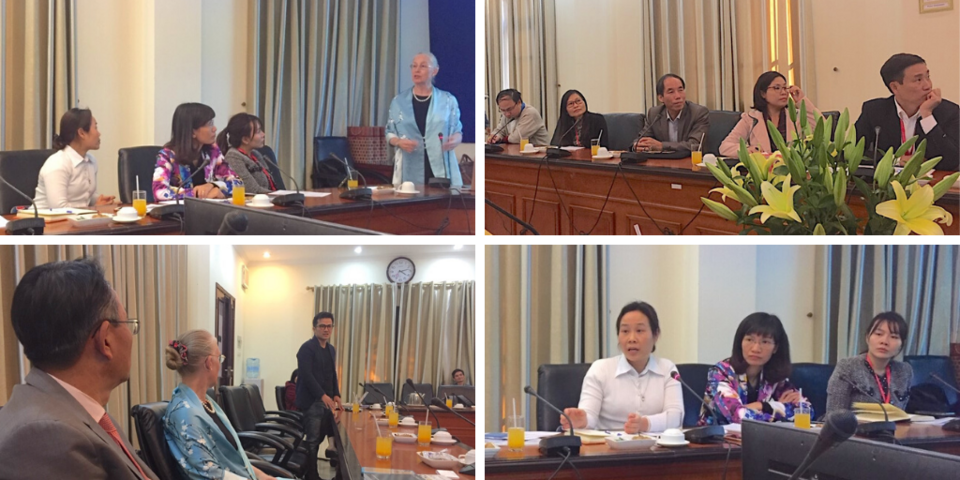
With a focus on health policy, our first day in Hanoi included a visit to Thai Nguyen University, a meeting with government representatives at the Vietnam Ministry of Health, and a seminar on healthy aging and innovation jointly with Hanoi Medical University.

Image
Collage of four images showing participants at a roundtable held at Hanoi Medical University with APARC delegation members

Karen Eggleston and participants at the roundtable held at Hanoi Medical University, December 9, 2019.

Throughout the day, Eggleston presented some of her collaborative research that is part of two projects involving international research teams: one that assesses public-private roles and institutional innovation for healthy aging and another that examines the economics of caring for patients with chronic diseases across diverse health systems in Asia and other parts of the world. We appreciated learning from our counterparts about the health care system and health care delivery in Vietnam.

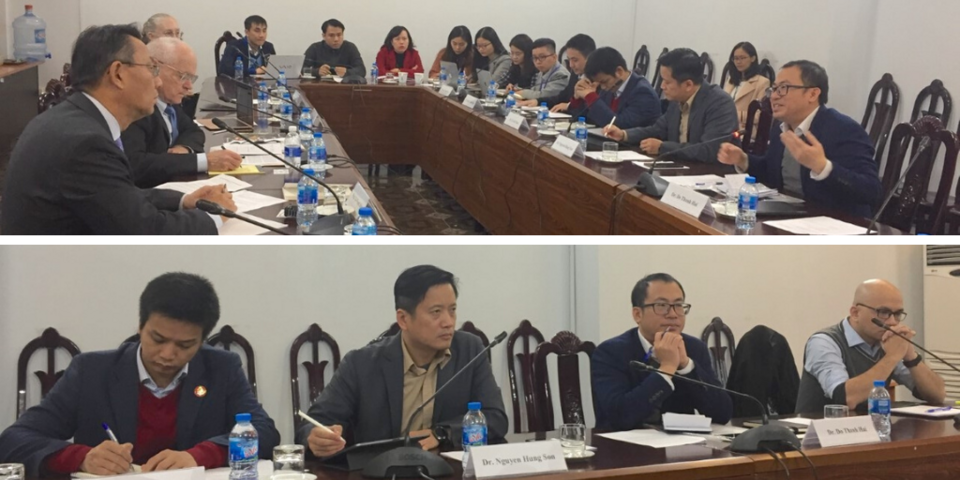
Shifting focus to international relations and regional security, day 2 in Hanoi opened with a roundtable, “The Rise of the Indo-Pacific and Vietnam-U.S. Relations,” held jointly with the East Sea Institute (ESI) of the Diplomatic Academy of Vietnam (DAV). Following a welcome by ESI Director General Nguyen Hung Son, the program continued with remarks by Shin, Emmerson, ESI Deputy Director General To Anh Tuan, and Assistant Director General Do Thanh Hai.

Image
Participants at a roundtable held at the Diplomatic Academy of Vietnam with APARC delegation members

Roundtable at the Diplomatic Academy of Vietnam, December 10, 2019.

The long-ranging conversation with DAV members included issues such as the future of the international order in Asia; the U.S. withdrawal from multilateralism; the concern about a lack of U.S. engagement in Southeast Asia, sparked by President Trump’s absence from the November 2019 summit of the Association of Southeast Asian Nations (ASEAN) at a time when China is bolstering its influence in the region and when ASEAN hopes to set a code of conduct with China regarding disputed waters in the South China Sea; the priorities for Vietnam as it assumes the role of ASEAN chair in 2020; and the challenges for the Vietnam-U.S. bilateral relationship amid the changing strategic environment in Southeast Asia.

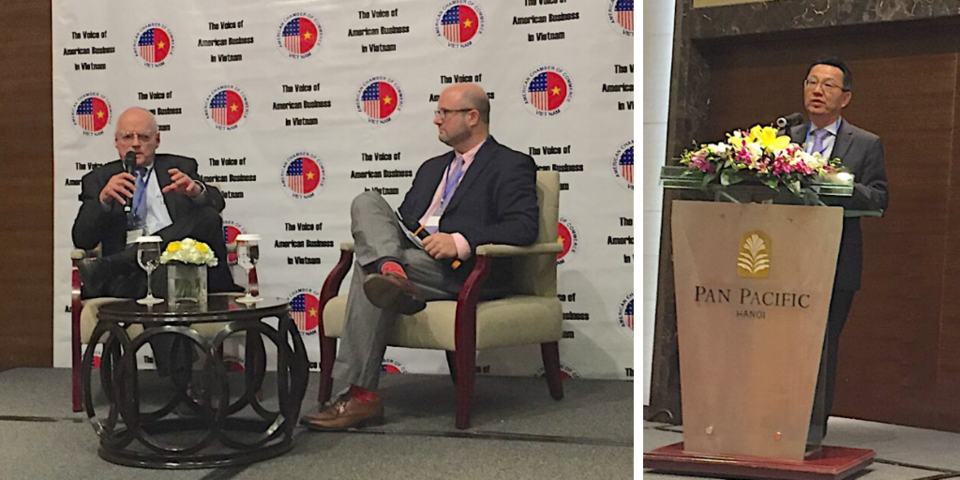
In the afternoon we were joined by members of the American Chamber of Commerce in Hanoi at an AmCham-hosted Lunch ‘n’ Learn session on Vietnam's challenges and opportunities amid the U.S.-China rivalry. The event featured Emmerson in conversation with AmCham Hanoi Executive Director Adam Sitkoff.

Image
Two men in conversation seated on stage and a man speaking at a podium

(Left) Donald Emmerson in conversation with Adam Sitkoff; (right) Gi-Wook Shin welcomes AmCham Hanoi members; December 10, 2019. 

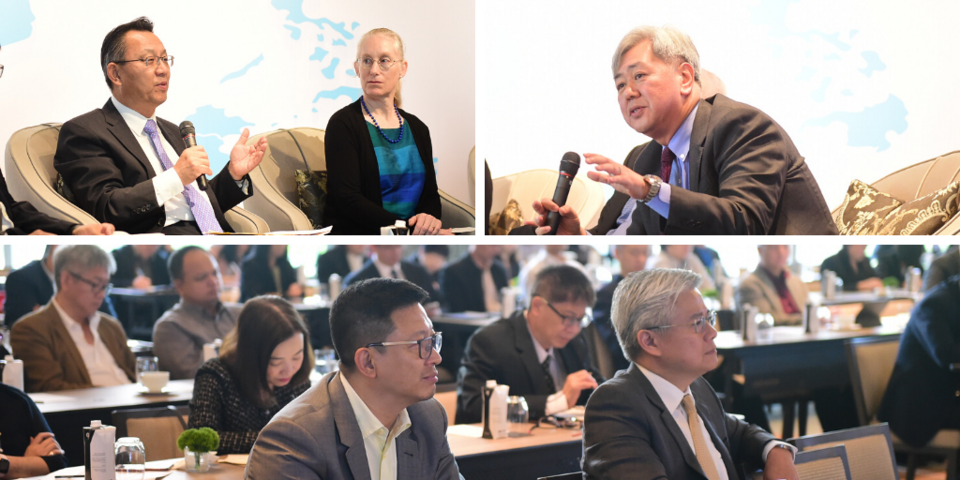
Moving to Bangkok, delegation members Shin, Eggleston, Emmerson, and Kim spoke on a panel for executives of the Charoen Pokphand Group (C.P. Group), one of Thailand’s largest private conglomerates, addressing some of the core issues that lie ahead for Southeast Asia in 2020 and beyond in the areas of geopolitics, innovation, and health.

Image
Participants at a panel discussion with APARC delegation hosted by the C.P. Group, Thailand

Top, from left to right: Gi-Wook Shin, Karen Eggleston, Andrew Kim; bottom: C.P. Group executive listening to the panel, December 12, 2019.

We also enjoyed a tour at True Digital Park, Thailand’s first startup and tech entrepreneur’s campus. Developed by the C.P. Group, True Digital Park aspires to be an open startup ecosystem that powers Thailand to become a global hub for digital innovation.

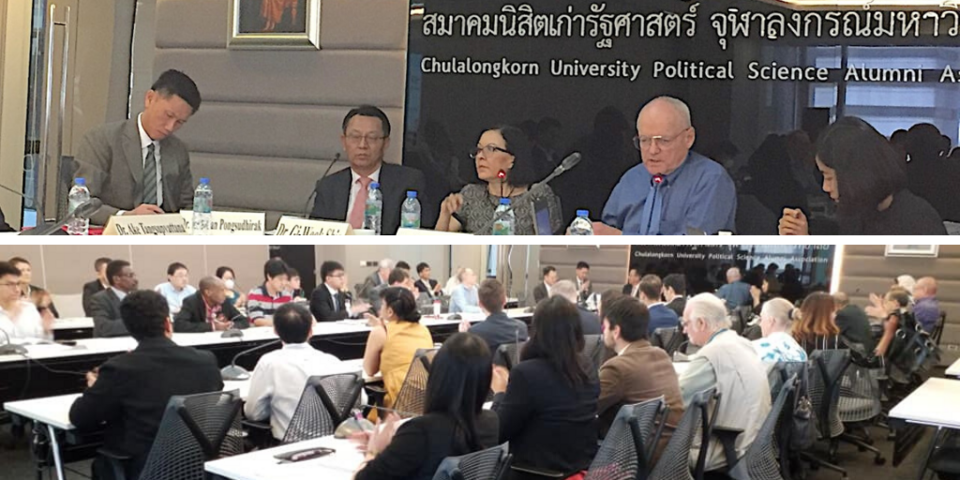
The following day, Shin and Emmerson participated in a public forum hosted by Chulalongkorn University’s Institute of Security and International Studies (ISIS Thailand), "Where Northeast Asia Meets Southeast Asia: The Great Powers, Global Disorder and Asia’s Future.” They were joined by ISIS Thailand Director Thitinan Pongsudhirak and Chulalongkorn University Faculty of Political Science Associate Dean for International Affairs and Graduate Studies Kasira Cheeppensook. The panel was moderated by Ms. Gwen Robinson, ISIS Thailand senior fellow and editor-at-large of the Nikkei Asian Review.

Image
Panelists and participants at a public forum held at Chulalongkorn University

ISIS Thailand forum participants and panelists, from left: Pngsukdhirak, Shin, Robinson, Emmerson, Cheeppensook; December 13, 2019.

As part of that discussion, Emmerson speculated that – driven by deepening Chinese economic and migrational involvement in Southeast Asia’s northern tier – Cambodia and Laos, less conceivably Myanmar, and still less conceivably Thailand could become incorporated de facto into an economically integrated “greater China” that could eventually reduce ASEAN to a more-or-less maritime membership in the region’s southern tier. Emmerson’s speculation was made in the context of his critique of ASEAN’s emphasis on its own “centrality” to the neglect of its lack of the proactivity that would serve as evidence of centrality and of a desire not to be rendered peripheral by the growing centrality-cum-proactivity of China. The event was covered by the Bangkok Post (although that report’s headline and quote of Emmerson are inaccurate, as neither the panel nor Emmerson predicted the “break-up of ASEAN.”)

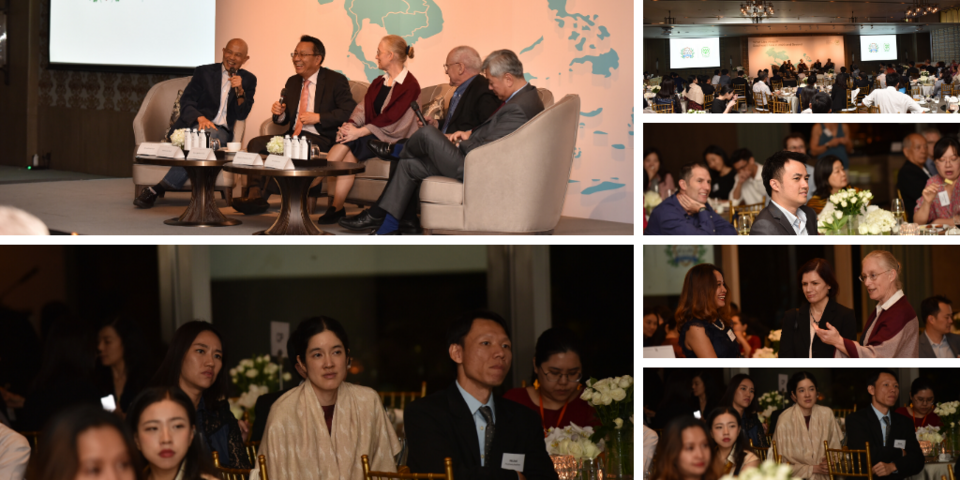
Our delegation visit in Bangkok concluded with a buffet dinner reception and panel discussion jointly with the Stanford Club of Thailand.

Image
alumni event

Stanford and IvyPlus alumni listening to the panel, December 13, 2019.

Moderated by Mr. Suthichai Yoon, a veteran journalist and founder of digital media outlet Kafedam Group, the conversation focused on the changing geopolitics of Southeast Asia, innovation and health in the region, and the opportunities and challenges facing Thailand-U.S. relations. It was a pleasure to meet many new and old friends from the Stanford and IvyPlus alumni communities.

APARC would like to thank our partners and hosts in Hanoi and Bangkok for their hospitality, collaboration, and the stimulating discussions throughout our visit. We look forward to keeping in touch!

Hero Image
APARC delegation speaking to Stanford and IvyPlus alumni, Bangkok
All News button
1
Paragraphs

Shorenstein APARC's annual overview for academic year 2018-19 is now available.

Learn about the research, events, and publications produced by the Center's programs over the last twelve months. Feature sections look at U.S.-China relations and the diplomatic impasse with North Korea, and summaries of current Center research on the socioeconomic impact of new technologies, the success of Abenomics, South Korean nationalism, and how Southeast Asian countries are navigating U.S.-China competition. Catch up on the Center's policy work, education initiatives, and outreach/events.

Read online:

All Publications button
1
Publication Type
Annual Reports
Publication Date
Shorenstein APARC Stanford University Encina Hall E301 Stanford, CA 94305-6055
0
2019-2020 Shorenstein Postdoctoral Fellow in Contemporary Asia
hannah_kim.jpg Ph.D.

Hannah June Kim joined the Walter H. Shorenstein Asia-Pacific Research Center (Shorenstein APARC) as Shorenstein Postdoctoral Fellow in Contemporary Asia for the 2019-20 academic year.  She researches public opinion, political behavior, theories of modernization, economic development, and democratic citizenship, focusing on East Asia.

Dr. Kim completed her doctorate in the Department of Political Science at the University of California, Irvine, in 2019.  Her dissertation examined how and why people view democracy in systematically different ways in six countries: China, Japan, Korea, Singapore, Taiwan, and Vietnam. Developing unique categories of democratic citizenship that measure the cognitive, affective, and behavioral patterns of individuals, she found that state-led economic development limited the growth of cultural democratization among middle class groups in all three dimensions. The results implied that the classic causality between modernization and democratization may not be universally applicable to different cultural contexts.

At Shorenstein APARC, Hannah worked on developing her dissertation into a book manuscript and making progress on her next project exploring democratization and gender empowerment in East Asia. Hannah received an MA in International Studies from Korea University and a BA from UCLA. Her work has been published, or is forthcoming, in The Journal of Politics, PS: Political Science & Politics, and the Japanese Journal of Political Science.

News Type
Q&As
Date
Paragraphs

We sat down with our 2018-19 Shorenstein Postdoctoral Fellow in Contemporary Asia Ketian Zhang to discuss China's use of coercion in foreign policy; her research on  South China Sea disputes; her forthcoming articles; and the fellowship experience in general. To hear more from Ketian, RSVP for her April 16 seminar "Killing the Chicken to Scare the Monkey: Explaining Coercion by China in the South China Sea."

Hero Image
Ketian Zhang participating in Q&A Thom Holme, APARC
All News button
1
Authors
Gi-Wook Shin
News Type
Commentary
Date
Paragraphs

President Trump caught the world by surprise once again yesterday with a decision not to sign a deal with his North Korean counterpart, Chairman Kim Jong-un, in Hanoi, Vietnam. While walking away is a common tactic in working-level negotiation, what happened in Hanoi was a rare case and the least expected outcome.

Read the full article on Axios.

Hero Image
President Trump waves to camera at Hanoi Summit
President Trump at a news conference following his second summit with North Korean leader Kim Jong-un.
Tuan Mark via Getty Images
All News button
1
Authors
Gi-Wook Shin
News Type
Commentary
Date
Paragraphs

This post was originally published on Axios.

While President Trump and North Korean leader Kim Jong-un’s June 2018 meeting ended with a broad statement — committing to “establish new U.S.-DPRK relations” for “a lasting and stable peace regime on the Korean Peninsula” — they will aim to take more concrete steps forward at their second summit in Hanoi this week.

Between the lines: To keep up the diplomatic momentum, Trump and Kim will need to minimize existing ambiguities and divergences on key issues — including the definition of denuclearization — and produce a comprehensive road map that lays out the specifics of their proclaimed shared vision. Without these agreements, the Hanoi summit could be easily denigrated as “just another show.”

Where it stands: Trump and Kim each face immense pressure, both international and domestic, to make progress.

  • Trump needs to earn political trust back in Washington to continue negotiating with North Korea. His strategy so far has been to convince Kim that North Korea’s denuclearization would bring the country a “bright future.”
  • At the same time, Trump must address Kim’s concerns about whether any agreement reached with his administration will withstand the Democrat-controlled House and survive the post-Trump era.

Between the lines: Successful diplomacy sometimes entails purposeful ambiguities, and the ambiguities of the first Trump-Kim summit might indeed have been strategic. At this critical juncture, however, a failure on Trump’s and Kim’s part to commit to defined objectives could hurt the bilateral relationship.

The bottom line: Trump and Kim need support more than ever to advance their diplomatic endeavors. While spectators have good reason to be skeptical, and one can only be cautiously hopeful with North Korea, a return to confrontation or "strategic patience" is in no one’s interest.

Gi-Wook Shin is the William J. Perry Professor of Contemporary Korea and director of the Walter H. Shorenstein Asia-Pacific Research Center at Stanford University.

Hero Image
Banner welcoming Kim and Trump to Vietnam
A banner hung opposite the Marriott Hotel in Hanoi, Vietnam, where President Trump is expected to stay during his summit with Kim Jong-un, on Feb. 25.
Carl Court via Getty Images
All News button
1
News Type
Commentary
Date
Paragraphs

What does it take to make progress on the denuclearization of the Korean Peninsula? Five FSI scholars offer their perspective.

Siegfried S. Hecker, FSI Senior Fellow Emeritus, with Elliot A. Serbin, at the Center for International Security and Cooperation (CISAC)
Looking back at 2018, we judge the first Trump-Kim summit in Singapore to have been a step in the right direction and bought time and space for diplomacy. But since the first summit, little progress has been made toward new relations and a peace regime in part because the Trump administration continues to insist on maximum pressure and sanctions until North Korea denuclearizes, in contrast with Pyongyang’s insistence on a step-by-step process requiring corresponding U.S. actions. At the same time, North Korea has not denuclearized, but it has halted key elements of what was a rapidly expanding nuclear and missile program in 2017. This halt represents an important step in the right direction as explained in our recent update on North Korea’s nuclear history, which examines the trade-offs and interplay between key components of the nuclear program. Our findings show that North Korea has been expanding its bomb fuel inventory, allowing it to potentially increase the size of its arsenal. But the end of nuclear and missile testing has reduced the overall threat posed by the North’s arsenal, significantly limiting the potential sophistication, destructive power and reach of the arsenal by impairing the North’s ambitions for hydrogen bombs and nuclear-tipped intercontinental ballistic missiles, both of which are still very much in the developmental stage. At the upcoming summit Washington should push to further reduce the threat posed by North Korea’s arsenal. A key goal is to lock in the end of nuclear and missile testing and have North Korea agree to end the production of bomb fuel in a verifiable manner. Clearly, this will require Washington to move decisively toward normalization, with some form of sanction relief.

Gi-Wook Shin, FSI Senior Fellow, Director of the Walter H. Shorenstein Asia-Pacific Research Center (APARC) and founding Director of the Korea Program
The leaders of the United States and North Korea should use the Vietnam summit as an opportunity to minimize existing ambiguities and divergences in central questions, before they can make any meaningful progress toward denuclearization and whatever measures for the progress of denuclearization. The most basic yet urgent task is to come to a shared understanding of what denuclearization would entail. The ambiguity and obscurity of the term “denuclearization” only exacerbates the skepticism about both the U.S. and North Korean commitments to denuclearization. The future of the U.S.-Republic of Korea (ROK) alliance is another critical issue that needs to be addressed, not avoided, in Hanoi. The Vietnam meeting should leave no ambiguity in its affirmation that the U.S.-ROK alliance is not to be jeopardized in the context of U.S.-DPRK (Democratic People’s Republic of Korea) rapprochement; nor is it to be used as a reward for North Korea’s denuclearization. Lastly, the Trump administration’s vision for a “more stable and peaceful, and ultimately, a more legal peace regime” in Korea will need to be explained fully to, and understood clearly by, the North Korean leadership. Whether the means used to establish this regime will be a peace treaty, a formal end to the armistice, a combination of both, or something yet unknown is an issue that needs to be discussed and agreed upon up front in order to avoid further confusions and complications. Only bold and meaningful moves that resolve these ambiguities will enable a timely, historic breakthrough on the Korean Peninsula and will add much-needed momentum to the diplomatic endeavors of all countries involved.

Yong Suk Lee, SK Center Fellow and Deputy Director of the Korea Program at Shorenstein APARC
To hypothesize about the outcomes of the second Trump-Kim summit and what lies ahead for U.S.-North Korea relations, we should reflect on how the two leaders met in the first place. One could argue that their first meeting was somewhat accidental, an artifact of Trump’s spontaneity following a period of heightened hostility between the U.S. and North Korea. The first summit between the two leaders was historic in its own right and it put on a good show. However, there hasn’t been much progress on denuclearization since then. Despite little progress the two are meeting again, and this second meeting is no accident. After their first meeting Trump and Kim must have struck a chord. In fact, Trump mentioned that the two had “fallen in love” after receiving a “beautiful” letter from Kim last October. What triggers their mutual attraction? Certainly not their distaste for nuclear weapons. The common interest that brings the two together is their desire for development – economic development in the case of Kim Jong Un and property development in the case of Donald Trump. Of the many unconventional aspects in the Trump-Kim relationship, what I find most extraordinary is Trump’s showing of a short film on North Korea’s potential for property development during their first summit meeting. It was truly an unusual diplomatic pitch. I believe that economic and property development will be on their agenda when they meet in Hanoi. There may even be a sequel to that short film. Trump and Kim may emerge with a joint property development agenda, while deferring denuclearization to be sorted out by their diplomatic teams.

Colin Kahl, FSI Senior Fellow and Co-director at CISAC
Diplomacy is essential for resolving the nuclear crisis on the Korean Peninsula, and President Trump should get credit for keeping the high-level dialogue with Kim Jong Un going. However, last year’s Singapore summit, while producing great theater, produced little of substance. North Korea has frozen its missile and nuclear testing, but its program continues to grow. In the eight months since the two leaders met in Singapore, little tangible progress has been made, and the two sides still appear very far apart on basic concepts like the meaning of “denuclearization” and the proper sequencing among nuclear steps, moves toward normalization, the signing of a peace treaty and sanctions relief. The big worry going into the summit is that it will produce either “too little” or “too much.” One fear is that President Trump will accept “too little” – that is, more diplomatic symbolism to continue the appearance of progress while North Korea takes few concrete steps to roll back its nuclear program. Another risk is that President Trump will give “too much” in exchange for North Korean actions, in particular by taking steps that weaken the alliance with South Korea or drastically downsize the U.S. military presence on the Peninsula (which Trump has never liked).

Thomas Fingar, Shorenstein APARC Fellow
The issues dividing the United States and the DPRK are so complicated and our mutual animosity so deep that resolution will take time and require extensive negotiations to build trust and deepen understanding of one another’s concerns and objectives. The most that should be expected from the Hanoi summit is agreement – and commitment – to continue the process of engagement by instructing and empowering subordinates to meet regularly, listen carefully and seek ways to both build a better relationship and to resolve specific issues in the context of transforming the relationship from one of distrust and animosity to one that identifies mutual interests and manages issues that cannot be resolved immediately.

Related: Andrew Kim on North Korea Denuclearization and U.S.-DPRK Diplomacy
Former head of the CIA’s Korea Mission Center Andrew Kim, currently the William J. Perry Visiting Scholar at APARC, provides insights into the process of diplomatic engagement with the DPRK and outlines a roadmap for achieving the U.S. goal of North Korea denuclearization.

This post is based on the Stanford News article What’s next for North Korea? Stanford scholars discuss the diplomacy of denuclearization, published February 25, 2019.

Hero Image
T-shirts with Trump and Kim for sale in Vietnam Linh Pham/Getty Images
All News button
1
Subscribe to Vietnam