Authors
News Type
News
Date
Paragraphs

On May 16-17 FSI will be co-sponsoring a conference with the Department of History and the Center for East Asian Studies on Same-Sex Desire and Union in China: Interdisciplinary and Historical Perspectives.

OVERVIEW

Same-sex desire and union are themes of basic importance to multiple fields of Chinese studies, notably Ming-Qing literature, but also history, anthropology, and contemporary cultural and political studies. After long occlusion by mainstream scholarship, these themes have recently become a central focus for a growing number of international scholars. In a complementary development, queer activism and cultural production are highly visible features of the increasingly robust civil societies that have emerged in the People’s Republic of China (PRC), Taiwan, and Hong Kong over the past decade or two. The following is a brief overview of just a few of the questions and challenges that scholars face today.

A rich body of homoerotic literature survives from Late Imperial China (especially the 17th-19th centuries), but much of this material has been neglected until very recently (in part because censorship by successive political regimes made once famous works obscure and hard to find). Indeed, a prominent part of elite male discourse and lifestyle was a homoerotic sensibility that focused in part on cross-dressing boy actors as objects of aesthetic idealization and sexual desire. By the eighteenth century, as commercial opera in Beijing achieved its mature form, to consort with boy actors had become a fashionable (if controversial) status symbol for elite men, and a high-class homosexual brothel/escort scene flourished in close connection with the theater. This world is richly documented in the drama, vernacular fiction, and literati jottings of the era, and it is now a rising priority for literary scholars and historians. But we have barely scratched the surface of this material, and mainstream scholarship has hardly begun to take account of its implications. A handful of scholars have also begun to explore drama and verse written by women, which contain many homoerotic themes; but this exciting body of texts remains largely unknown to the wider field of Chinese literature.

During the same era, a skewed sex ratio and shortage of wives among the poor meant that increasing numbers of marginalized males lived outside the normative family system. In that context, same-sex union (often framed by chosen kinship forms such as ganqin adoption or sworn brotherhood) was the dominant mode of alliance, although there is also evidence of widespread wife-sharing and other non-normative family forms. Although organized according to age hierarchy, such same-sex unions appear to have been far more symmetrical and consensual than anything found in the elite homoerotic scene. Judicial anxiety focused on the security threat supposedly posed by this growing underclass of marginal males, who were stereotyped as sexual predators threatening the women and adolescent boys of established families; legal prohibitions of male-male sodomy (fully developed in the eighteenth century) focused on suppressing this threat. As a result of these prohibitions, China’s vast legal archives from the eighteenth and nineteenth centuries contain masses of evidence about male same-sex relations that scholars have only just begun to investigate.

At the same time, there is considerable evidence in legal sources that male same-sex relations were also widespread within settled peasant communities. A common – if seldom openly acknowledged – pattern was for a young male, in the years leading up to marriage, to play the penetrated role in a sexual relationship with an older man. The penetrated role was stigmatized, but it was also understandable and largely tolerated as a stage of the maturation process on the path to full social adulthood, which came with marriage. This way of understanding and experiencing same-sex relations has much in common with practice in other premodern societies, but it seems radically different from the modern egalitarian template of sexual orientation.

The fall of the empire in 1912 ushered in a new era in which anxious elites promoted a Westernized vision of modernity in order to resist and catch up with the developed imperialist powers. A notable feature of this vision was a re-imagination of same-sex desire in terms of the newly imported concept of “homosexuality,” which implied pathology. This modernity involved the active suppression of longstanding forms of elite self-expression (for example, patronage of cross-dressing actors), but also the emergence of new images and self-conscious identities (for example, the concept of the lesbian as a social figure). Something similar happened in Japan and many other parts of the world during roughly the same era. This transformational process continues in China to this day; questions of identity and social role, in particular, remain open and fluid. A key issue now, in our era of accelerated globalization, is the ways in which imported concepts and vocabulary will articulate with locally emerging forms of identity, politics, and cultural expression.

The contemporary queer scene in “Greater China” (including the PRC, Hong Kong, and Taiwan) serves as a revealing barometer of wider political and social change. In Taiwan since the end of martial law (1987), queer politics and culture have become among the most striking and visible dimensions of a new democratic society. In a less open but no less dramatic way, the PRC in the post-Mao era (since 1978) has also witnessed an efflorescence of queer associations, social life, and cultural production. In cities like Beijing, such activity takes place within a broad, ambiguous grey area that enjoys no legal protection, but in practice is often tolerated by authorities. The underground film scene is especially lively. In both Taiwan and the PRC, queer life is a prominent feature of the fledgling civil societies that have emerged with the demise of more repressive political regimes.

The contemporary Chinese queer scene is characterized by a vital transnational cross-fertilization that takes in Western countries and overseas Chinese as well – for example, some of the key activists in Taiwan, Hong Kong and the PRC have spent long stints in North America, Australia, or Europe for education or work, and in that setting have been able to network with Western activists and scholars, and with other Chinese living abroad. By the same token, the study of homosexuality in Chinese history and culture (like the broader field of Chinese studies) has become an increasingly transnational enterprise, involving scholars in all parts of Greater China, together with North Americans, Australians, and Europeans, as well as Chinese expatriates who teach on foreign campuses.

The purpose of this two-day conference is to bring people together for a conversation across boundaries of discipline, period, and geography. Scholars in separate fields (and locations) have conducted enough work by now that we are reaching something like a critical mass. But so far, most of us have focused on our own narrow disciplines and topics of research – and at this point, we would all benefit from cross-fertilization and synthesis. What bigger picture emerges when we cast our separate findings in historical and interdisciplinary light? How do historical and comparative perspectives help to illuminate contemporary developments?

The conference will consist of five panels of speakers (three per panel), followed by a round table discussion among four prominent scholars (two historians and two literature specialists) from outside the field of Chinese studies, to highlight comparative and theoretical issues that have emerged from the conference papers. If, as I expect, the event is a success, I hope to edit a conference volume for publication.

The conference is free and open to the public.

Hero Image
desire china
All News button
1
-

How might one think about Chinese power, its dimensions, its effects, and its implications for change in the United States and elsewhere? Dr. David M. Lampton will put China's current trajectory and its conceptions of power in their historical contexts, discuss how China's neighbors are responding to the PRC's growing strength, and explore the vulnerabilities and uncertainties that lie ahead not only for China but the outside world.  
 
Dr. Lampton's work is based on interviews in China, in countries along the PRC's long periphery, and in the United States, as well as extensive documentary research. His book, The Three Faces of Chinese Power: Might, Money, and Minds, was just published by the University of California Press. 

David M. Lampton, Dean of Faculty, is George and Sadie Hyman Professor and Director of China Studies at the Johns Hopkins School of Advanced International Studies and Senior International Advisor on China for the law firm of Akin Gump. Before assuming the post at SAIS in December 1997, he was president of the National Committee on United States-China Relations in New York City for a decade. Dr. Lampton is the author of numerous books and articles on Chinese domestic and foreign affairs. His most recent book is, The Three Faces of Chinese Power: Might, Money, and Minds (University of California Press, 2008), and his articles have appeared in the American Political Science Review, The China Quarterly, Foreign Affairs, Foreign Policy, The New York Times, The Washington Post, and other venues academic and popular. Earlier books and edited volumes include: Same Bed, Different Dreams: Managing U.S.-China Relations, 1989-2000 (University of California Press, 2001) and (editor) The Making of Chinese Foreign and Security Policy in the Era of Reform (Stanford University Press, 2001).

Lampton received his PhD and undergraduate degrees from Stanford University and has lived in the Peoples Republic of China, Taiwan, and Hong Kong. He has an honorary doctorate from the Russian Academy of Sciences' Institute of Far Eastern Studies and is consultant to the Aspen Institute's Congressional Program, the Kettering Foundation, and various corporations and government agencies.

Levinthal Hall

David M. Lampton George and Sadie Hyman Professor and Director of China Studies Speaker the Johns Hopkins School of Advanced International Studies
Conferences
-

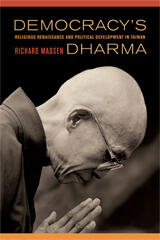
This is a CDDRL's Special Event within our Democracy in Taiwan Program. It is also co-sponsored by the Public Diplomacy/Emerging Publics Project of the Center for the Pacific Rim at University of San Francisco. In this seminar, Dr. Richard Madsen will talk about his new book that explores the religious renaissance that has reformed, revitalized, and renewed the practices of Buddhism and Daoism in Taiwan and how this religious renaissance embraces democracy modernity.  

Image
10896
Richard Madsen is distinguished professor and chair of the sociology department at the University of California, San Diego and a co-author (with Robert Bellah et al.) of The Good Society and Habits of the Heart which received the Los Angeles Times Book Award and was jury nominated for the Pulitzer Prize. He has authored or co-authored five books on China, including Morality and Power in a Chinese Village for which he received the C. Wright Mills Award; China's Catholics: Tragedy and Hope in an Emerging Civil Society; and China and the American Dream.  He also co-edited (with Tracy B. Strong) The Many and the One: Religious and Secular Perspectives on Ethical Pluralism in the Modern World. His latest book is Democracy’s Dharma: Religious Renaissance and Political Development in Taiwan.

Richard Madsen received an MA in Asian studies and a Ph.D. in sociology from Harvard.

"Madsen is a genial and well-informed guide, both to social-political change in Taiwan and to the ins and outs of religious movements. His engaging writing skillfully interweaves profound insights and themes into the descriptive analytical narrative. Democracy's Dharma presents new material based on recent research while offering a fresh spin on thinking about Asian religions."–Thomas Gold, editor of Social Connections in China: Institutions, Culture, and the Changing Nature of Guanxi

Philippines Conference Room

Richard Madsen Distinguished Professor Speaker Department of Sociology at the University of California, San Diego
Conferences
News Type
News
Date
Paragraphs
Larry Diamond has been appointed as a Senior Fellow in the Freeman Spogli Institute for International Studies (FSI). Currently a Senior Fellow at the Hoover Institution, a renowned scholar of democratization, and prolific in both editorial and policy work, Diamond is an active member of FSI’s Center on Democracy, Development, and the Rule of Law (CDDRL). He coordinates the Program on Democracy - Completed, which examines the comparative dynamics of democratic functioning and change in the contemporary world, with a particular focus on the countries of Africa, the Middle East, Asia, Latin America, and the post-communist world. He has also established the offshoot program, The Taiwan Democracy Project, in 2006, and is a central participant in the The Taiwan Democracy Project.

Primarily an Africanist, Diamond received his Ph.D. in Sociology from Stanford University in 1980. He currently serves as the co-director for the National Endowment for Democracy’s International Forum for Democratic Studies in Washington DC, as a member of U.S. Agency for International Development (USAID) Advisory Committee on Voluntary Foreign Aid, and as adviser and lecturer at the World Bank, the United Nations, and the U.S. Department of State. Previously he was senior adviser to the Coalition Provisional Authority in Iraq and consultant to USAID.

He is also founding co-editor of the Journal of Democracy, the premier journal in the field, and a co-director of the International Forum for Democratic Studies of the National Endowment for Democracy. He has an impressive record of public service, which includes numerous board memberships and government appointments, and he has published widely. In his prolific portfolio of books and papers, he has advanced the knowledge on the conceptualization, determinants, and importance of democracy by examining the relationship between development and democracy, the multidimensional nature of the democratization process, and the significance of democratic consolidation.

Diamond’s commitment and contributions to teaching are also reflected in his receipt of Stanford’s 2007 Lloyd W. Dinkelspiel Award for Distinctive Contributions to Undergraduate Education, a strong testament to the breadth and depth of his engagement at the University.
All News button
1
-
Teh-wei Hu is a Professor Emeritus of health economics at the University of California, Berkeley.  At Berkeley, he served as associate dean (1999-2002) and department chair (1990-1993) in the School of Public Health.  He received his PhD in Economics from the University of Wisconsin.  

During the past 40 years, Professor Hu has been teaching and conducting research in health economics, particularly in healthcare financing and the economics of tobacco control.  Hu was a Fulbright scholar in China. He has served as consultant or advisor to the World Bank, the World Health Organization, the National Institutes of Health, the Institute of Medicine, the Rand Corporation, the Ministry of Health in the People's Republic of China, Department of Health and Welfare in Hong Kong, Department of Health in the Republic of China (Taiwan), and many private research institutions and foundations. 

Professor Hu will speak to us immediately after an April trip to China, sharing his research and perspectives on the economics of tobacco control and the debate about healthcare system reforms in China (including a possible link between the two through financing expansions in coverage through increased tobacco taxation).

Philippines Conference Room

Teh-wei Hu Professor Emeritus Speaker University of California, Berkeley, School of Public Health
Seminars
-

This is a CDDRL's Special Seminar within our Democracy in Taiwan Program. In this seminar, Alan Romberg will analyze the impacts of Taiwan’s recent elections on the three legs of the U.S.-PRC-Taiwan triangle.

Alan D. Romberg is Distinguished Fellow and Director of the East Asia Program at the Henry L. Stimson Center. He served in the U.S. government for over 25 years, including as Principal Deputy Director of the State Department’s Policy Planning Staff (1994-98) and Principal Deputy Assistant Secretary of State for Public Affairs and Deputy Spokesman of the Department (1981-85). Romberg was C.V. Starr Senior Fellow for Asian Studies at the Council on Foreign Relations (1985-1994). He has written extensively on U.S. policy toward the People’s Republic of China, Taiwan, Korea and Japan and is author of Rein In at the Brink of the Precipice: American Policy Toward Taiwan and U.S.-PRC Relations (Washington, D.C.: The Henry L. Stimson Center, 2003).

Romberg holds an MA from Harvard University and a BA from the Woodrow Wilson School of Public and International Affairs at Princeton University.

His post-election analysis of the cross-strait relations issue can be seen on Hoover's China Leadership Monitor, No.25.

Philippines Conference Room

Alan Romberg Distinguished Fellow and Director of the East Asia Program Speaker Henry L. Stimson Center
Seminars
-

This is a CDDRL's Special Seminar within our Democracy in Taiwan Program. In this seminar, Dr. Chia-hung Tsai will present up-to-date survey data regarding Taiwan’s 2008 presidential election. He will also discuss the dynamics of the presidential campaign and their implications for prospective voters.  

Chia-hung Tsai is Associate Research Fellow of the Election Study Center at the National Chengchi University. He received his PhD in political science from the Ohio State University, 2003, and he worked at the Election Study Center since then. Chia-hung Tsai’s research interest lies in voting behavior and methodology, especially Bayesian statistics. Winner of the “NCCU Outstanding Research Award,” he has published articles in various professional journals including Party Politics, International Political Science Review, Journal of Election Studies (Chinese), and so forth. Currently, he is conducting a multi-year project on voting behavior, public opinion, and public policies in Taiwan. The main focus of this project is to examine the quality of Taiwan’s young democracy. Specifically, this project investigates the extent to which public policies respond to public opinion.  

Philippines Conference Room

Chia-hung Tsai Associate Research Fellow Speaker Election Study Center, National Chengchi University
Seminars
-

This is a CDDRL's Special Research Seminar within our Democracy in Taiwan Program.

Chang-Ling Huang is an associate professor of political science at the National Taiwan University. She received her Ph. D. from the University of Chicago. Her research interests are gender politics and labor politics. She has published in various journals including Developing Economies, Anthropology of Work Review, American Journal of Public Health and Issues & Studies. Her current research project is a comparative study on state feminism in South Korea and Taiwan. She examines how the newly democratized states in these two countries have been actively promoting gender equality.

Professor Huang received the Outstanding Teaching Award in 2007 at the National Taiwan University. In addition to her academic career, since 2000 she has been a board member of the Awakening Foundation, the earliest established feminist organization in post-war Taiwan. Between 2004 and 2007, she was the president of the foundation. She has also been a civilian member of various government committees and commissions in Taiwan.

Professor Huang is a visiting scholar at Stanford's Political Science Department in the academic year of 2007-2008.

Philippines Conference Room

Chang-Ling Huang Associate Professor of Political Science Speaker National Taiwan University
Seminars
Subscribe to Taiwan