-

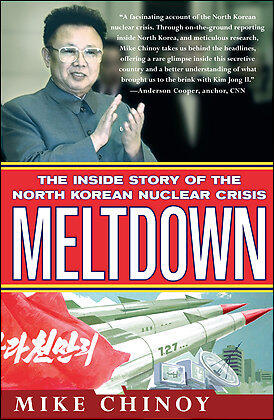
Mike Chinoy, the Pacific Council’s Edgerton Senior Fellow for Asia and author of the just-published and critically-received book, Meltdown: The Inside Story of the North Korean Nuclear Crisis will discuss the main themes in his book, update us on the recent developments in the Bush administration’s policy toward North Korea and assess what other policy options the next U.S. president might pursue.

Image
MELTDOWN The Inside Story of the North Korean Nuclear Crisis
Drawing on over 200 interviews conducted in Washington, Seoul, Tokyo and other Asian capitals – as well as insights gained from Mr. Chinoy’s 14 trips to Pyongyang – Meltdown provides a detailed account of the behind-the-scenes policy debates within the Bush administration and other governments that drove the recent confrontation over North Korea’s nuclear weapons program.  It also offers important new details of the impact the crisis had on U.S. relations with its key regional allies – Japan and South Korea – and on Washington’s fraught relationship with Beijing. 

» Washington Post’s review of the "Meltdown: The Inside Story of the North Korean Nuclear Crisis"

Mike Chinoy is one of America’s keenest observers of Asian affairs, having reported on the most important events in the region for almost thirty years. He previously served as CNN’s senior Asia correspondent (2000-06), its Hong Kong bureau chief (1996-2000), and Beijing bureau chief (1987-95).  Earlier, he spent four years as a reporter with NBC’s Hong Kong Bureau, and from 1975-78 he was a Hong Kong-based freelance reporter, contributing to CBS News as well as Newsday, The Far Eastern Economic Review and other publications.

Mr. Chinoy received an Emmy Award, an ACE Award, a Dupont Award and a Peabody Award for his coverage of the 1989 Tiananmen Square crisis.  His critically-acclaimed reporting during those weeks has been credited with strengthening CNN as an authoritative force in international news coverage. Mr. Chinoy has also covered North Korea extensively, traveling there 14 times since 1989.  In April 1994, he became the first broadcaster to file live TV reports from North Korea, and was the only journalist to travel with former U.S. President Jimmy Carter on his historic trip to Pyongyang in June of that year.

Philippines Conference Room

Mike Chinoy Edgerton Senior Fellow Speaker Pacific Council on International Policy
Seminars

Shorenstein APARC
Stanford University
Encina Hall E301
Stanford, CA 94305-6055

(650) 724-5648 (650) 723-6530
0
POSCO NGO Fellow, 2008-09
Hye-Jeong_Kim.JPG

Hey-jeong Kim joined Korea Federation for Environment Movement in 1989 and worked for 18 years in establing the grass root environmental NGO in South Korea. She became the Secretary General of the organization, and has been working as a committee member of the Ministry of Environment in Korea.

-

This talk will examine the challenges and problems that South Korea faces on its way to full-fledged democracy. The ideological composition of Korean society, the role of political parties, civil society and media as well as the attitude of public intellectuals will be assessed.

Se Il Park is a 2008-09 visiting scholar at APARC’s Korean Studies Program, and a professor of law and economics in the Graduate School of International Studies at Seoul National University. He is the founder and the chairman of the board of Hansun Foundation for Freedom and Happiness, an independent, non-partisan think tank based in Seoul devoted to providing innovative and practical public policy recommendations to South Korean society at large.

Park is the author of many books, including Communitarian Liberalism (2008); National Strategy for Sunjinwha in Korea (National strategy to make Korea a world-class nation) (2006); Blueprint for Tertiary Education Reform in Korea (2003); Strategy for Presidential Success: Authority, Role, and Responsibility (2002); Growth, Productivity, and Vision for Korean Economy (2001); Reforming Labor Management Relations: lessons from the Korean experience: 1996-1997 (2000); and Law and Economics (2000).

Park served as Senior Secretary to the President for policy planning and social welfare in the Office of the President of the Republic of Korea from 1995 to 1998, and was a member of National Assembly of the Republic of Korea from 2004 to 2005. He also worked at the Korea Development Institute as a Senior Fellow from 1980 to 1985. Park received his B.A. from Seoul National University and his M.S. and Ph.D. from Cornell University.

This event is supported by the generous grant from Academy of Korean Studies in Korea.

Philippines Conference Room

Shorenstein APARC
Stanford University
Encina Hall,Room E301
Stanford, CA 94305-6055

(650) 724-5668 (650) 723-6530
0
Visiting Scholar, 2008-09
Seil_Park.JPG PhD

Park, Se-Il is a professor of law and economics in the Graduate School of International Studies at Seoul National University. He is the founder and chairman of the board of Hansun Foundation for Freedom and Happiness, which is an independent, non-partisan think tank based in Seoul devoted to high-quality public policy research. The Foundation works to provide innovative and practical policy recommendations to the South Korean government.

Dr. Park is the author of many books including Communitarian Liberalism (2008); National Strategy for Sunjinwha in Korea (National strategy to make Korea to become a world class nation)(2006); Blueprint for Tertiary Education Reform in Korea (2003); Strategy for Presidential Success: Authority, Role, and Responsibility (2002); Growth, Productivity, and Vision for Korean Economy (2001); Reforming Labor Management Relations: lessons from the Korean experience: 1996-1997 (2000); Law and Economics
(2000).

Park is currently writing a book on globalization in which he plans to research several important political, social, and economic challenges, stemming from globalization. Based on that research he hopes to make comprehensive strategic recommendations for Korea to become a successful advanced nation in the age of globalization. The tentative title is Creative Globalization: Korean strategy for globalization.

Park has taught for more than 20 years at Seoul National University, College of Law and Graduate School of International Studies. He served as Senior Secretary to the president for policy planning and social welfare in the Office of the President of the Republic of Korea
from 1995 to 1998, and was a member of National Assembly of the Republic of Korea from 2004 to 2005. He also worked at the Korea Development Institute as a Senior Fellow from 1980 to 1985. He received the Chung-Nam Award from the Korean Economic Association in 1987 for his outstanding publications in economics. He served as President of the Korean Labor Economic Association (2001-2002), President of the Korean Law and Economic Association (2000-2003), and President of the Korean Institutional Economic Association (2002-2003). Park received his BA from Seoul National University and his MS and PhD from Cornell University.

Se-Il Park Visiting Scholar, APARC Speaker
Seminars

Shorenstein APARC
Stanford University
Encina Hall,Room E301
Stanford, CA 94305-6055

(650) 724-5668 (650) 723-6530
0
Visiting Scholar, 2008-09
Seil_Park.JPG PhD

Park, Se-Il is a professor of law and economics in the Graduate School of International Studies at Seoul National University. He is the founder and chairman of the board of Hansun Foundation for Freedom and Happiness, which is an independent, non-partisan think tank based in Seoul devoted to high-quality public policy research. The Foundation works to provide innovative and practical policy recommendations to the South Korean government.

Dr. Park is the author of many books including Communitarian Liberalism (2008); National Strategy for Sunjinwha in Korea (National strategy to make Korea to become a world class nation)(2006); Blueprint for Tertiary Education Reform in Korea (2003); Strategy for Presidential Success: Authority, Role, and Responsibility (2002); Growth, Productivity, and Vision for Korean Economy (2001); Reforming Labor Management Relations: lessons from the Korean experience: 1996-1997 (2000); Law and Economics
(2000).

Park is currently writing a book on globalization in which he plans to research several important political, social, and economic challenges, stemming from globalization. Based on that research he hopes to make comprehensive strategic recommendations for Korea to become a successful advanced nation in the age of globalization. The tentative title is Creative Globalization: Korean strategy for globalization.

Park has taught for more than 20 years at Seoul National University, College of Law and Graduate School of International Studies. He served as Senior Secretary to the president for policy planning and social welfare in the Office of the President of the Republic of Korea
from 1995 to 1998, and was a member of National Assembly of the Republic of Korea from 2004 to 2005. He also worked at the Korea Development Institute as a Senior Fellow from 1980 to 1985. He received the Chung-Nam Award from the Korean Economic Association in 1987 for his outstanding publications in economics. He served as President of the Korean Labor Economic Association (2001-2002), President of the Korean Law and Economic Association (2000-2003), and President of the Korean Institutional Economic Association (2002-2003). Park received his BA from Seoul National University and his MS and PhD from Cornell University.

Professor Thompson builds on Barrington Moore's insight that there are different "paths to the modern" world. Thompson's manuscript explores alternatives to the familiar South Korean-and Taiwan-based model of "late democratization." According to that model, political pluralism follows a formative period of economic growth during which labor is demobilized and big business, religious leaders, and professionals depend upon and are co-opted by the state.

The Vietnamese government legalized strikes in 1995. Since then Vietnamese workers have gone on strike more than 1,500 times. Most of these actions have erupted in factories established by capital investments from South Korea and Taiwan. Far fewer have been reported in factories relying on private investments from other countries or in publicly funded and state-owned enterprises (SOEs). When labor protests do occur in SOEs, they tend to be less confrontational, involving petitions and letters of complaint sent to local labor newspapers and relevant officials.

Authors
Donald K. Emmerson
News Type
News
Date
Paragraphs

As a 2007-08 Shorenstein Fellow at Shorenstein APARC, John D. Ciorciari pursued a full and varied agenda of research and writing on Southeast Asia.

Fellowships are more often won on the promise of completing a book than books are finished before the fellowships end. Dr. John Ciorciari broke this “rule” by completing his book manuscript in Spring 2008 and submitting it to a university press for possible publication.

Based on his Oxford dissertation, the work is provisionally entitled “Hedging: Using Southeast Asian States as Case Studies.” In it, he examines the range of options that secondary states possess between outright alignment with and neutrality toward the great powers. He argues that secondary states normally seek to "hedge" by limiting their alignments. They do so to avoid the risks of tight security cooperation with the great powers, including diminished autonomy and entrapment, while reaping sufficient rewards in the form of protection. He presented his findings at a Southeast Asia Forum seminar on May 28, 2008 titled “Dating but Not Married: Southeast Asian Security Responses to the Rise of China.” See the link below for an audio file of the seminar.

In addition to finishing his book on hedging, Ciorciari used his fellowship period to pursue his research interest in Asian financial cooperation, which is increasingly central to broader political relations in the region. He focused on the Chiang Mai Initiative (CMI), an effort by China, Japan, South Korea, and the ten members of the Association of Southeast Asian Nations (ASEAN) to develop economic resilience by establishing regional mechanisms for balance-of-payments support.

Ciorciari collaborated on this study with Jennifer Amyx, a professor of political science at the University of Pennsylvania and herself a former Shorenstein Fellow and speaker for the Southeast Asian Forum (SEAF) at Shorenstein APARC. Ciorciari and Amyx acknowledge that establishing an effective financing mechanism under the CMI has proven to be a challenging task. Nevertheless, by fostering regular interaction among Asian central bankers and finance ministry officials, the CMI has begun to yield a range of spillover benefits conducive to regional financial resilience. (Schedules permitting, Ciorciari and Amyx may present some of their findings at a SEAF seminar at Stanford in the upcoming academic year.)

As a Shorenstein Fellow in 2007-08 Ciorciari also worked on two projects on Cambodia: a book chapter on the international politics surrounding the long-delayed and finally ongoing Khmer Rouge Tribunal, and an article on China’s relations with the Khmer Rouge regime during the late 1970s. The article argues that the Pol Pot regime effectively punched above its weight in an otherwise asymmetrical relationship by exploiting China's rigid conception of its security interest in Indochina. In studying the Sino-Cambodian alliance, Ciorciari was able to test and illustrate some of the arguments in his book manuscript as to how small states pursue leverage and autonomy in their relations with major powers.

All News button
1
News Type
News
Date
Paragraphs

In 2007 Shorenstein APARC and The Asia Foundation chose Dennis Arroyo to be the first Shorenstein APARC/Asia Foundation Visiting Fellow.  Arroyo spent the 2007-08 academic year researching and completing a monograph on "The Political Economy of Successful Reform:  Asian Stratagems."  An edited abstract follows:

Major economic reforms are often politically difficult, causing pain to voters and provoking unrest.  They may be opposed by politicians with short time horizons. They may collide with the established ideology and an entrenched ruling party.  They may be resisted by bureaucrats and by vested interests.  Obstacles to major economic reform can be daunting in democratic and autocratic polities alike.
 
And yet, somehow, past leaders of today's Asian dragons did implement vital economic reforms. "The Political Economy of Successful Reform:  Asian Stratagems" recounts the political maneuvers used by Asian leaders of economic reform in these countries at these pivotal times:  Thailand under General Prem Tinsulanonda; Vietnam during Doi Moi (or Renovation); Singapore under Lee Kuan Yew; China under Deng Xiaoping; India in the 1990s; and South Korea under Park Chung Hee.


The paper classifies these maneuvers as responses to the main political barriers to reform and develops a "playbook" of tactics for economic reformers.  To overcome ideological obstacles, for example, the reformers packaged and presented reforms as ways of strengthening the party in power. Reformers proceeded gradually.  Initially they sought win-win compromises. They blessed pro-market violations as pilot projects. They even created new provinces in order to dilute the anti-reform vote.

The full text of Arroyo's monograph has been published by the Stanford Center for International Development in its working paper series.

Arroyo came to Stanford well qualified to study economic reform techniques.  In 2005 he was named director for national planning and policy at the National Economic and Development Authority (NEDA) of the Philippines.  His duties included building public support for the economic reforms championed by NEDA.  He has consulted for the World Bank, the United Nations, and the survey research firm Social Weather Stations, and has written widely on socioeconomic topics.  His critique of the Philippine development plan won a mass media award for "best analysis."  He has degrees in economics from the University of the Philippines.

In May 2008 Arroyo presented his findings in a SEAF lecture entitled "The Foxy Art of Herding Dragons: How Sly Asian Leaders Pulled off Politically Difficult Economic Reforms."

All News button
1
Authors
David Straub
News Type
Commentary
Date
Paragraphs
Korean Studies Program associate director David Straub argued in The Nelson Report, a top Washington, D.C. policy newsletter, that Korea needs to take a strategic approach toward the controversy with Japan over the Dokdo Islets ("Takeshima" in Japanese). Widely reported in Korea, Straub's message urged Korea to base its policy on the fact that it has effective control of the islets.

After the events of the past few days, I felt a need to update and expand on my note to you of last week about Dokdo.

First, as a preface for all that is to follow, I fully understand why Koreans feel very strongly about the Dokdo issue and, frankly, I personally sympathize with the ROK claim to the islets.

My basic understanding of the issue is as follows:

(1) The ROK has actual possession of the islets. Japan cannot take the matter to the international court unless the ROK agrees, and the ROK won't. Japan will not attempt to use force to take the islets. As far as I know, not a single country in the world wishes to get involved in the controversy between the ROK and Japan over Dokdo, and thus none will support Japan. In other words, there is no prospect that possession of the islets will ever change from the ROK to Japan (in fact, former Prime Minister Abe made a statement acknowledging this situation a few years ago).

(2) Because of (1) above, however, probably no country, much less the international community as a whole, is likely for the foreseeable future to formally support ROK sovereignty (as opposed to not challenging its actual possession) over Dokdo.

(3) Logically, therefore, the ROK's goals should be to (a) maintain actual physical possession of Dokdo, which, as explained above, is not a problem, (b) in the mid-term, persuade others in the international community that Korea's claim outweighs Japan's, and (c) thereby lay the basis, in the long run, for Japan's eventual dropping its claim and/or the international community actively supporting the ROK's claim.

(4) Given all of the above, tactically the ROK should take a confident, low-key, long-term, strategic approach toward Dokdo.

(a) Overreacting to offending Japanese steps or actions can play into the hands of the Japanese right-wing, both domestically in Japan where those Japanese not particularly interested in Dokdo may be offended and energized by Korean criticism of all "Japanese" and "Japan," and in the international community, where strong Korean reactions are widely reported and thus unintentionally result in increased publicity for the Japanese claim.

(b) Similarly, the ROK should take care not to "demand" that foreign countries support its position on Dokdo-for the time being that will not work and it risks offending those countries and thus hurting Korean interests overall-but confidently, diplomatically publicize its position based on the very best objective research on the issue.

(5) Regarding the recent controversy concerning the U.S., I agree fully that it was wise of President Bush to reverse the recent step by the Board on Geographic Names; the timing of the BGN step last week was extremely unfortunate. But for the ROK to develop a good strategy and good tactics on Dokdo for dealing with all countries, including the U.S., it is critically important for the ROK to correctly and fully analyze both the actions and the intentions of foreign countries.

As far as I can reconstruct what happened-and I caution that, as a former U.S. official, I have no access to confidential information and I am not a representative of the U.S. government-the BGN made a policy decision a year or more ago to note which territories are the subject of disputes around the globe.

Why then, the Korean media asks, did the BGN decide only last week to change the listing for Dokdo but not for other territories in the region, as has been asserted? It appears that bureaucratic procedures and resource limitations resulted in the BGN being very slow to make the actual changes mandated by its policy decision to specify territorial disputes.

What has not been noted in Korea, where the focus naturally is on the Dokdo issue, is that the BGN database has a huge number of errors and inconsistencies in its geographical listings, including territorial disputes, all over the world. Top U.S. government officials have publicly indicated that the BGN move was made by relatively low-level, technical officials who did not seek policy input from senior levels of the U.S. government. Clearly that was very unfortunate, and, for the U.S., the incident highlights the need for the BGN to seek such policy guidance in all cases.

As for the timing of the BGN change, it appears, ironically, that BGN officials were alerted to the controversy by media reporting about the strong Korean reaction to the latest Japanese step. (The Japanese step itself would have received virtually no coverage in the U.S. media if it had not been for the strong Korean reaction.) Acting without policy guidance related directly to Dokdo, the BGN officials apparently thought they were updating the database in response to the general policy change made a year or so earlier. I am aware of no indication that Japanese "lobbying" was behind the BGN move last week.

(6) I can thus easily understand why Koreans, based on their concerns and the information available to them, would construe the BGN action as "siding with" the Japanese position. But, in terms of developing ROK strategy and tactics, it is important, as I noted above, that the Korean government and people fully and accurately understand foreign intentions. In the U.S. case, it is clear that the U.S. government did not and does not intend to change its long-standing policy of not taking a position regarding Dokdo.

What happened in the U.S. was largely the result of pedestrian bureaucratic incompetence and failure to communicate internally within the government-not the result of a basic policy change, much less a conspiracy to support Japan. (I am reminded of the old and very wise saying that one should "never ascribe to conspiracy that which can be explained by stupidity.")

While Koreans of course want all countries, particularly their U.S. ally, to support their position on Dokdo, they should also recognize the fundamentally favorable situation of the ROK in regard to Dokdo: the international community, including the U.S., is not challenging and will not challenge the ROK's actual possession of Dokdo. Thus, as former Prime Minister Abe indicated, Dokdo will remain Korean, and Koreans can say confidently, "Dokdo is our land."

All News button
1
News Type
News
Date
Paragraphs

Pantech Fellow

  • Don Keyser: Former Deputy Assistant Secretary of State for East Asian and Pacific Affairs

Koret Fellow

  • Byung Kwan Kim: General (Ret.), former Deputy Commander of ROK-US Combined Forces Command

POSCO NGO Fellows

  • Hye-jeong Kim: Korea Federation for Environmental Movement
  • Hyun Gon Jung: Korean Council for Reconciliation and Cooperation

Visiting Scholars, Korean Studies Program

  • Seil Park: Professor of Law and Economics, Seoul National University
  • Jongsuk Lee: Former Deputy Secretary General, National Security Council, ROK
  • Hyung Joon Ahn: Reporter, MBC, Korea
  • Gug-Hyeon Cho: Director, Public Relations, Northeast Asia History Foundation, Korea
  • Oh Eul Kwon: Policy deputy-chairman, Grand National Party, Korea

Visiting Scholars, Center for East Asian Studies

  • Hakjoon Kim: President, Dong-a Ilbo, Korea
  • Hyung Chan Kim: Assistant Professor of Philosophy, Korea University
All News button
1
Subscribe to South Korea