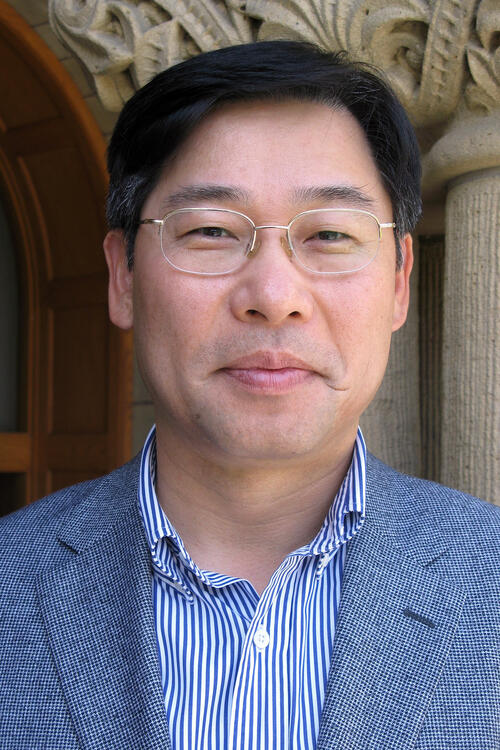
Authors
Gi-Wook Shin
News Type
Commentary
Date
Paragraphs

John Roos, U.S. Ambassador to Japan, conducted a historic visit in August 2010 to Peace Memorial Park in Hiroshima. What is the possibility of and the implications for a similar U.S. Presidential visit? Gi-Wook Shin, director of Shorenstein APARC and the Korean Studies Program, explores this question and suggests that the U.S. must play a role in the reconciliation of World War II memories in Northeast Asia.

Hero Image
obamaunheader photo
All News button
1
Paragraphs

". . . History, values, memory, and identity are significant elements that can influence the 'soft power' of an alliance built on 'hard power,' and policy makers of both nations should not overlook their importance," says Gi-Wook Shin, director of the Walter H. Shorenstein Asia-Pacific Research Center and the Stanford Korean Studies Program, in the chapter that he contributed to the recently published book U.S. Leadership, History, and Bilateral Relations in Northeast Asia.

In his chapter "Values and History in U.S.-South Korean Relations," Shin discusses developments in the types of issues that the United States and South Korea have collaborated on in recent years--including free trade agreements, Iraq and Afghanistan military operations, and policy coordination toward North Korea--and the significance of issues of history, values, memory, and identity--such as inter-Korean reconciliation and memories of U.S. military maneuvers in Korea--that have given the U.S.-South Korea relationship a "more complex and multidimensional" nature.

Published by Cambridge University Press in October 2010, the book was edited by Gilbert Rozman of Princeton University's Department of Sociology.

All Publications button
1
Publication Type
Books
Publication Date
Journal Publisher
Cambridge University Press in "Issues of History, Values, Memory, and Identity in the U.S.-South Korea Relationship"
Authors
Gi-Wook Shin
Authors
News Type
News
Date
Paragraphs

The ‘fair society' motto has been the centerpiece in the second half of the Lee Administration.

-Gi-Wook Shin, director of Shorenstein APARC and KSP


On August 8, 2010, South Korean President Lee Myung-bak put into place the largest cabinet reorganization since he took office, nominating 48 year-old Kim Tae-ho as prime minister. However, after only 21 days, failing to pass a confirmation hearing of Parliament, Kim Tae-ho took the initiative to declare his resignation while waiting for Parliament to take action following the vote on his prime minister nomination. South Korea's prime minister [post] is without any real power; however, with a high parliamentary status, it is also in reality an important auxiliary to the president. Now into the second half of Lee Myung-bak's term, confronted with the dilemma of needing to identify a prime minister for a fourth time, one cannot help but raise the question: what is going on with South Korean politics?

The ruling Grand National Party hoped to pariah Kim Tae-ho, who in the prime of life, would have been able to give Li Myung-bak's government an infusion of "reform," "communication," and a "fresh" approach, but the opposition party also questioned Kim Tae-ho's political qualifications. From August 24-25, when the Parliament confirmation hearings convened, the Democratic Party also threw in several heavy accusations-Kim Tae-hoe's receiving bribes and illegal loans to raise campaign funds, having a public bus for his personal use, ordering full-time civil servants to do housework, and his wife accepting bribes and improperly managed properties-and strongly opposed Kim Tae-ho as Prime Minister. Gi-Wook Shin, director of Stanford University's Shorenstein Asia-Pacific Research Center, says: "These allegations are not new. Though the prosecution has cleared Kim of bribery charges, I think the fact that he lied about his ties with Park Yeon-cha, a convicted businessman at the center of a high-profile bribery scandal, was the last straw. A photo also surfaced after the hearing showing Kim standing next to Park at a date several months earlier than Kim testified to having made his first acquaintance with Park." Park Yeon-cha is the former chairman of Taekwang Industrial. By the end of 2008's "Park Yeon-cha Gate" [scandal], numerous South Korean political figures were involved in the bribery scandal,  and former President Roh Moo-hyun also committed suicide.

"Kim Tae-ho's ambiguous statements have also left the ruling party and the public feeling disappointed. Kim Tae-ho was not widely known outside of his South Gyeongsang Province office. President Li Myung-bak praised him to South Korean society for being young, for having strength and charisma, and for being an honest, reliable politician. Now voters naturally are questioning his integrity and this has become a barrier for Lee Myung-bak's administration," says Dr. Insung Lee, director of Yonsei University's East Asia International Studies Institute.

Kim Tae-ho believes there are some accusations that are not very fair. Dr. Shin suggests: "What Kim meant by "unfair" was the fact that his confirmation hearing focused in large part on making personal attacks on Kim, and throwing harsh criticism of the ruling party, rather than serving its purpose to prove he was unqualified for the PM position." This no doubt exposed the intense power struggle between South Korea's political factions, and even differences within the Grand National Party.

"Lee Myung-bak should not introduce the subject of Kim Tae-ho when talking about matters of the next presidential election," says Dr. Lee. In 2004, Kim was elected governor of South Gyeongsang Province, becoming the youngest governor. During the time that he was the provincial governor, he actively promoted the "South Coast Sunbelt" development plan as a national project. Through word of mouth, he easily won the 2008 local government re-elections. According to the Constitution, Lee Myung-bak is unable to run for president again. Because of this, public opinion holds that he had the intention to train Kim Tae-hoe for the 2012 presidential candidacy. "The opposition party members at the hearing increasingly attacked Kim Tae-ho, in part to prevent this kind of arrangement from taking place," says Dr. Lee.

Dr. Chung-In Moon, professor of political science at Yonsei University pointed out: "People believe that Lee Myung-bak selected Kim Tai-ho to compete in the 2012 general election against in-party rival Park Geun-hye. Since this card is obsolete, Lee Myung-bak now cannot help but stand with Park Geun-hye. I cannot decide for certain how long this will last-the Lee camp will certainly find their own candidate." The internal struggle between the Grand National Party's inner factions was exposed in the battle of the recent Sejong City construction plan amendment. Park Geun-hye, the daughter of the leading "Second Faction's" former president Park Chung-hee, publicly sang a different tune towards Lee Myung-bak, displaying a hope to follow up with the plan to promote the construction of Sejong City. At the time of Parliament's vote, 50 of the ruling party's 168 members voted against the pro-Park opposition party. After former Prime Minister Chung Un-chan announced he would resign, Park Geun-hye raised the issue, holding Lee Myung-bak to be the primary lead of the Sejong City amendment and the one who should bear the responsibility.

On the day that Kim Tae-ho made his declaration to resign the prime minister nomination, those nominated to be the Minister of Culture, Sports, and Tourism and Minister of Education and Economics, also took the initiative to resign because of the suspicion of having accepted bribes. After several days, Foreign Minister Yu Myung-hwan was also forced to resign due to the incident of his daughter's receiving "special admission" to become a senior civil servant. President Lee Myung-bak expressed: "I accept their resignation. I believe this will lead to the starting point of a fair society." Dr. Gi-Wook Shin believes: "The 'fair society' motto has been the centerpiece in the second half of the Lee Administration. As President Lee said in his liberation day speech in August 2010, 'A fair society is where each individual has to take responsibility for the outcome of his or her undertakings . . . A fair society constitutes the ethical and practical infrastructure for the advancement of the Republic.' To this effect, Lee reportedly instructed his secretariat to toughen the screening of ethical backgrounds of candidates for top government posts. Putting emphasis on higher ethical and moral standards can be seen as a positive sign of Korea's democratic advancement. It is not the only measure, but it is also an important measure for the betterment of South Korean politics."    

Translation by Sarah Lin Bhatia


Hero Image
SeoulBlueHouse2
All News button
1

On August 8, South Korea’s President Lee Myung-bak reshuffled his Cabinet and nominated Kim Tae-ho as Prime Minister; Kim resigned the nomination 21 days later following corruption allegations. Gi-Wook Shin, Director of Shorenstein APARC and the Korean Studies Program, spoke with Sanlian Life Weekly about the current state of South Korea’s politics.

Shorenstein APARC
Encina Hall E301
616 Jane Stanford Way
Stanford, CA 94305-6055
(650) 724-8480 (650) 723-6530
0
Senior Fellow at the Freeman Spogli Institute for International Studies
Professor of Sociology
William J. Perry Professor of Contemporary Korea
Professor, by Courtesy, of East Asian Languages & Cultures
Gi-Wook Shin_0.jpg PhD

Gi-Wook Shin is the William J. Perry Professor of Contemporary Korea in the Department of Sociology, senior fellow at the Freeman Spogli Institute for International Studies, and the founding director of the Korea Program at the Walter H. Shorenstein Asia-Pacific Research Center (APARC) since 2001, all at Stanford University. In May 2024, Shin also launched the Taiwan Program at APARC. He served as director of APARC for two decades (2005-2025). As a historical-comparative and political sociologist, his research has concentrated on social movements, nationalism, development, democracy, migration, and international relations.

In Summer 2023, Shin launched the Stanford Next Asia Policy Lab (SNAPL), which is a new research initiative committed to addressing emergent social, cultural, economic, and political challenges in Asia. Across four research themes– “Talent Flows and Development,” “Nationalism and Racism,” “U.S.-Asia Relations,” and “Democratic Crisis and Reform”–the lab brings scholars and students to produce interdisciplinary, problem-oriented, policy-relevant, and comparative studies and publications. Shin’s latest book, The Four Talent Giants, a comparative study of talent strategies of Japan, Australia, China, and India to be published by Stanford University Press in the summer of 2025, is an outcome of SNAPL.

Shin is also the author/editor of twenty-seven books and numerous articles. His books include The Four Talent Giants: National Strategies for Human Resource Development Across Japan, Australia, China, and India (2025)Korean Democracy in Crisis: The Threat of Illiberalism, Populism, and Polarization (2022); The North Korean Conundrum: Balancing Human Rights and Nuclear Security (2021); Superficial Korea (2017); Divergent Memories: Opinion Leaders and the Asia-Pacific War (2016); Global Talent: Skilled Labor as Social Capital in Korea (2015); Criminality, Collaboration, and Reconciliation: Europe and Asia Confronts the Memory of World War II (2014); New Challenges for Maturing Democracies in Korea and Taiwan (2014); History Textbooks and the Wars in Asia: Divided Memories (2011); South Korean Social Movements: From Democracy to Civil Society (2011); One Alliance, Two Lenses: U.S.-Korea Relations in a New Era (2010); Cross Currents: Regionalism and Nationalism in Northeast Asia (2007);  and Ethnic Nationalism in Korea: Genealogy, Politics, and Legacy (2006). Due to the wide popularity of his publications, many have been translated and distributed to Korean audiences. His articles have appeared in academic and policy journals, including American Journal of SociologyWorld DevelopmentComparative Studies in Society and HistoryPolitical Science QuarterlyJournal of Asian StudiesComparative EducationInternational SociologyNations and NationalismPacific AffairsAsian SurveyJournal of Democracy, and Foreign Affairs.

Shin is not only the recipient of numerous grants and fellowships, but also continues to actively raise funds for Korean/Asian studies at Stanford. He gives frequent lectures and seminars on topics ranging from Korean nationalism and politics to Korea's foreign relations, historical reconciliation in Northeast Asia, and talent strategies. He serves on councils and advisory boards in the United States and South Korea and promotes policy dialogue between the two allies. He regularly writes op-eds and gives interviews to the media in both Korean and English.

Before joining Stanford in 2001, Shin taught at the University of Iowa (1991-94) and the University of California, Los Angeles (1994-2001). After receiving his BA from Yonsei University in Korea, he was awarded his MA and PhD from the University of Washington in 1991.

Selected Multimedia

Director of the Korea Program and the Taiwan Program, Shorenstein Asia-Pacific Research Center
Director of Stanford Next Asia Policy Lab, APARC
Date Label
Gi-Wook Shin Speaker
Seminars
-

War Photographer is director Christian Frei's 2001 film that followed photojournalist James Nachtwey. Natchtwey started work as a newspaper photographer in New Mexico in 1976 and in 1980, he moved to New York to begin a career as a freelance magazine photographer. His first foreign assignment was to cover civil strife in Northern Ireland in 1981 during the IRA hunger strike. Since then, Nachtwey has devoted himself to documenting wars, conflicts and critical social issues. He has worked on extensive photographic essays in El Salvador, Nicaragua, Guatemala, Lebanon, the West Bank and Gaza, Israel, Indonesia, Thailand, India, Sri Lanka, Afghanistan, the Philippines, South Korea, Somalia, Sudan, Rwanda, South Africa, Russia, Bosnia, Chechnya, Kosovo, Romania, Brazil and the United States.

The film received an Academy Award Nomination for "Best Documentary Feature" and won twelve International Filmfestivals.

Annenberg Auditorium

Brendan Fay Andrew W. Mellon Fellow in the Humanities Speaker Stanford University
Seminars
-

Professor Lee will examine why South Korean labor unions have engaged in militant activism since the country's transition to democracy in 1987.  This situation contrasts with Taiwan, to which Korea's economic and political development is otherwise very similar.   Professor Lee will argue that the militant unionism reflects the weakness of Korea's democratic institutions, particularly its political parties.

Professor Lee received her doctoral degree in political science from Duke University and has been teaching at the State University of New York at Binghamton since 2006.  Her research has appeared in Studies in Comparative International Studies, Critical Asian Studies, Asian Survey, Korean Observer, and Asia-Pacific Forum.  Her book, tentatively entitled Democratic Politics and Labor Activism in East Asia, is forthcoming from Stanford University Press in 2011.

Philippines Conference Room

Yoonkyung Lee Assistant Professor, Sociology and Department of Asian and Asian-American Studies, State University of New York at Binghamton Speaker
Seminars
News Type
News
Date
Paragraphs

Image
Earn Key Joo, a vice president with the Human Resources Development Center of Samsung Electronics, is a current fellow with the Corporate Affiliates Program of the Walter H. Shorenstein Asia-Pacific Research Center (Shorenstein APARC) at Stanford University. Joo, who has worked with Samsung for 25 years, is based at the company's headquarters in Seoul, South Korea. He has extensive auditing experience, including evaluating the management and operational business units and investigating the illegal activities of employees.

While Samsung's headquarters are based in Seoul, the larger research and development and operational offices are located in Suwon, a city in close proximity to Seoul. Samsung is the current leader of the global electronics market, manufacturing everything from televisions to refrigerators, and semiconductors to mobile phones. It is especially strong in the LED television, color monitor, memory chip, and LCD panel product sectors. Samsung is now trying to advance in the mobile phone market with the introduction of its Galaxy S smartphone, which is available in the United States.

Joo is currently researching ways for Samsung to maintain its market lead. Even as the current leader, he said, market changes could affect the company's success. Joo is studying the case of Sony, a previous electronics market leader, and the factors that led to the loss of its position. His advisor for the project is Gi-Wook Shin, director of Shorenstein APARC and the Korean Studies Program.

In addition to his research project, Joo is taking advantage of his time at Stanford University to improve his English-language skills. He is proficient at reading English, and is using the opportunity to strengthen his speaking ability. He also hopes in the coming months to attend more events, especially in order to learn about the systems of other companies. Joo has already participated in site visits to Cisco, the Federal Reserve Bank of San Francisco, and Palo Alto Utilities.

Joo, who has previously not had the experience of living abroad and has had few opportunities to engage with people from other countries, says, "This is a very good time for me to widen my global perspective." He wants to interact as much as possible with the other fellows-who come from diverse work sectors and different countries in Asia-to exchange information, including best practices, based on each fellow's unique professional experience.

After he returns to Korea, Joo plans to take some of the information he has gained from his research and his exchange of knowledge with other fellows and share it with different development and marketing teams at Samsung, in addition to applying it in his own job. Samsung, Joo believes, is in need of creativity now and he is exploring ways it can develop this in its employees.

In between research and company visits, Joo has been able to spend valuable time with his family, which has traveled with him from Korea. They are planning to visit as many places as possible in the United States and have already visited Yellowstone National Park and are planning a trip to Alaska.


Hero Image
JooEarnKey2
All News button
1

616 Jane Stanford Way
Encina Hall, C332
Stanford, CA 94305-6060

(650) 725-1480 (650) 723-6784
0
jonas_edman.jpg

Jonas Edman is a Curriculum Writer for the Stanford Program on International and Cross-Cultural Education (SPICE). In addition to writing curriculum, Jonas coordinates SPICE’s National Consortium for Teaching About Asia (NCTA) professional development seminars on East Asia for middle school teachers, and collaborates with FSI and other Stanford colleagues on developing curricula for community college instructors as part of Stanford Human Rights Education Initiative (SHREI). Prior to joining SPICE in 2010, Jonas taught history and geography in Elk Grove, California, and taught Theory of Knowledge at Stockholm International School in Stockholm, Sweden.

Jonas' professional interests lie in curriculum and instruction and teacher professional development, with a special interest in online education development. He received his Single Subject Teaching Credential in Social Science from California State University, Sacramento in 2010, and a bachelor degree in History from Stockholm University in 2008. He graduated high school from the American School in Japan in 1996.

Jonas has presented teacher seminars nationally for the National Consortium for Teaching about Asia in Omaha, Nebraska; the California Council for Social Studies in Anaheim and Burlingame, California; the National Council for the Social Studies in Washington D.C.; the Midwest Conference on Asian Affairs in East Lansing, Michigan; and the National Association for Multicultural Education in Oakland, California. He has also presented teacher seminars internationally for the East Asia Regional Council of Overseas Schools in Kota Kinabalu, Malaysia, and Bangkok, Thailand; and the European Council of International Schools in Nice, France.

Instructor, Stanford e-Tottori
Instructor, Stanford e-Yamaguchi
Instructional Designer
Date Label
Subscribe to South Korea