


Organization of Disaster Aid Delivery: Spending Your Donations
Paragraphs
This article examines how different organizational structures in disaster aid delivery affect house aid quality. We analyze three waves of survey data on fishermen and fishing villages in Aceh, Indonesia, following the 2004 tsunami. We categorize four organizational structures based on whether and to whom donors contract aid implementation. Compared to bilateral contracting between donors and implementers, donors that vertically integrate and do their own implementation offer the highest-quality housing as rated by village heads and have fewer counts of faults, such as leaky roofs and cracked walls, as reported by fishermen. However, they shade in quality as they lose dominance as the leading aid agency in a village. Domestic implementers and the government agency that was responsible for significant portions of aid delivery provide significantly lower-quality aid. We also examine how the imposition of shared ownership, the primary social agenda for boat aid agencies, affects boat aid quality. We find that village and fishing leaders steer poor-quality boats toward those whom shared ownership was imposed upon, often lower-status fishermen.
All Publications button
1
Publication Type
Journal Articles
Publication Date
Journal Publisher
Economic Development and Cultural Change
Number
4
Next steps in Indonesia-US relations
News Type
Commentary
Date
Paragraphs
Indonesian President Joko “Jokowi” Widodo was recently in Washington, D.C., for his first-ever presidential visit to the United States. In an op-ed for the East Asia Forum, Stanford scholar Donald Emmerson examines what the two countries can do to continue to build cooperation gained on the trip.
The op-ed can be viewed by clicking here, and an archive of Emmerson’s editorials on the East Asia Forum can be found by clicking here.
Hero Image

All News button
1
Global Governance: What to Expect from the G20
Montek Singh Ahluwalia is an economist who trained at Oxford as a Rhodes Scholar. He spent several years at the World Bank before returning to India to serve as the Economic Advisor to the Finance Minister. The Government of India then appointed him to several senior positions, including Secretary of Commerce and Secretary in the Department of Economic Affairs at the Ministry of Finance. In 1998, he was appointed as a Member of the Planning Commission and Advisory Council to the Prime Minister of India. In 2001, he became the Director of Independent Evaluation Office at the International Monetary Fund, resigning this position in 2004 to become the Deputy Chairman of the Planning Commission.
He has written widely about India and the world economy, co-authoring Redistribution with Growth: An Approach to Policy, and editing Macroeconomics and Monetary Policy: Issues for Reforming the Global Financial Architecture with Y.V. Reddy and S.S. Tarapore.
The Payne Distinguished Lectureship is named for Frank and Arthur Payne, brothers who gained an appreciation for global problems through their international business operations. This lectureship, hosted by the Freeman Spogli Institute for International Studies, brings speakers with an international reputation for leadership and visionary thinking to Stanford to deliver a major public lecture.
This event is carried out in partnership with the Stanford Center for International Development (SCID).
A public reception will follow the lecture.
Montek Singh Ahluwalia
Deputy Chairman, Planning Commission 2004-2014, Government of India
Deputy Chairman, Planning Commission 2004-2014, Government of India
Lectures
The Possible Approaches for Defusing Tensions in the South China Sea: A Taiwanese Perspective
-
In this talk, Wellington Shih will provide a historical and legal overview of the Republic of China’s territorial claims in the South China Sea. He will also review the latest developments in the ongoing dispute between the People’s Republic of China, the ROC on Taiwan, and other claimants in the region, including the Philippines, and discuss the South China Sea Peace Initiative proposed by the administration of President Ma Ying-jeou.
The Possible Approaches for Defusing Tensions in the South China Sea: A Taiwanese Perspective
Download pdf
Visiting scholar
Ministry of Foreign Affairs, Republic of China (Taiwan)
Lectures
Poverty Alleviation through Sustainable Palm Oil Production
This project focuses on private and public sector strategies for promoting sustainable palm oil, with sustainability defined by environmental, social, and economic objectives. The main goals are:
Indonesia must embrace its 'middle power' status, Emmerson says
News Type
News
Date
Paragraphs
Stanford scholar Donald Emmerson urged Indonesia to realize its role as a rising "middle power" at a conference in Jakarta on June 13, 2015. Some 2,000 Indonesians gathered to hear analysts and diplomats discuss Indonesian foreign policy. Emmerson argued that Indonesia could and should implement its foreign policy goals without passively acquiescing in China’s drive for regional dominance.
As reported in the Jakarta Post, Emmerson advised Indonesians to seek solutions to the disputes over the hotly contested South China Sea without waiting for the long-delayed signing of a code of conduct with China. The article is accessible by clicking here.
Hero Image

All News button
1
New grant for palm oil research
News Type
News
Date
Paragraphs
A research team led by FSE director Rosamond Naylor has won a $400,000 multi-year grant to study how to create sustainable palm oil supply chains that promote economic growth and environmental sustainability in Indonesia and West Africa.
Palm oil has become one of the world’s fastest growing and most valuable agricultural commodities. Global production of palm oil doubled in both volume and area each decade between 1970 and 2010, and is expected to double again by 2025. The windfall profits from this rapid expansion have come at a cost of tropical deforestation, biodiversity loss and rising greenhouse gas emissions, and in many cases the economic benefits have bypassed local smallholder farmers.
"When we talk about sustainability in the palm oil industry, we mean more than saving trees," said Naylor. "The question we are getting at with this project is how can the industry boost rural incomes and alleviate poverty among smallholder farmers, while also reducing deforestation and carbon emissions. We are able to tackle this problem from social, economic and environmental angles because we have a truly cross-disciplinary group of researchers. That's a key strength of this team, and a key strength of Stanford."
Naylor and her team of Stanford faculty, scholars and students will undertake the three-year project with funding from the Stanford Global Development and Poverty Initiative (GDP), launched in Spring 2014. GDP aims to transform Stanford’s capacity to speak to the challenges of poverty and development. This year, GDP awarded more than $2 million to 13 faculty research teams from across the university.
The new project marks the first venture that connects Stanford’s expertise in sustainability with the Graduate School of Business’ experience in value chain innovations. The team will conduct an evaluation of value chain opportunities for sustainable palm oil production, build corporate partnerships to improve smallholder incomes, and engage in policy advising.
GDP is a joint initiative of the Stanford Institute for Innovation in Developing Economies (SEED) and the Freeman Spogli Institute for International Studies (FSI). SEED is housed within the Stanford Graduate School of Business.
Rosamond Naylor is William Wrigley Professor of Earth System Science and Senior Fellow at the Stanford Woods Institute for the Environment and at FSI.
Hero Image

All News button
1
Economists suggest how to better allocate donations for disaster relief
News Type
News
Date
Paragraphs
As people around the world look to support earthquake relief efforts in Nepal, scholars from Stanford and the London School of Economics and Political Science offer new research that can help donors make better decisions about where and how to contribute their money.
“NGO reports tend to focus on quantity in delivery, such as numbers of homes and people served—but not on quality,” write Yong Suk Lee (Stanford) and J. Vernon Henderson (LSE).
In a forthcoming paper, the coauthors evaluate reconstruction efforts in Indonesia following the 2004 earthquake and tsunami, and find two trends: aid agencies that directly execute their services—point-to-point—perform the highest quality work. And, when agencies contract their services, higher quality work is performed when a global, not domestic, implementer completes the work.
Knowing this reality, and with improved disclosure of outcomes, the coauthors hope that donors would be able to make more informed choices.
Fishing village survey
 Figure 1. A map details the survival rate of the population and flood damage within northern Indonesia in 2004. Darker shaded areas show a higher survival rate, lighter shaded areas show a lower survival rate. Striped areas denote flooding, largely on the northeastern border. Boundaries marked with thicker lines are ‘kabupaten,’ or county divisions, and lightly colored lines are ‘kecamatan,’ or sub-county units larger than a village alone. (Courtesy of Yong Lee).
Through fieldwork and three rounds of surveys – in 2005, 2007 and 2009 – Henderson and Lee investigated aid work in Aceh, an area of coastal villages in northern Indonesia (Figure 1).
Humanitarian efforts there focused on “hard aid” such as construction of houses and fishing boats. Total aid delivered amounted to $7.7 billion and was implemented by international and domestic aid agencies—some directly and some as contractors—as well as the Indonesian government.
First, Henderson and Lee conducted a pilot survey, and then with a cohort of surveyors from the University of Indonesia, held interviews with village leaders and fishing families. Participants were asked to rate their housing accommodation, and if applicable, how their fishing activity compared to before the disaster.
“Mostly, we sat with villagers to see how willing they were to talk about aspects of aid,” Lee said. “Since it was several years after the tsunami hit, people were pretty open throughout the process.”
Data from those surveys was combined with information from the Recovery Aceh-Nias relief project database maintained by the government and the U.N., as well as demographic information provided by participants.
Delivering aid: Global v. local
Empirical analysis revealed that aid agencies such as the Red Cross and Catholic Relief Services reflected higher quality aid delivery (at a mean quality near 3.00), while agencies such as Save the Children and Concern Worldwide reflected lower quality (at a mean quality between 1.0-1.5).
“What’s surprising is that reputation didn’t really line up with what was expected,” Lee said, citing a few renowned agencies that didn’t receive high marks.
Lee said this could be explained by the fact that aid agencies that specialize in disaster recovery are better equipped, while a learning curve might exist for agencies with wider missions.
Global aid agencies are more likely to have logistical experience given their reach across multiple disaster situations. And while all NGOs face reputational costs for their results, global aid agencies are greater exposed to criticism because, by size, they’re more visible.
Yet, while global aid agencies and implementers may have the raw skills, local implementers have the cultural know-how.
“Local implementers might not have the most experience – like how to construct a house or manufacture a fishing boat – but they will likely know what’s actually desired,” Lee said. “So, there are obvious tradeoffs at play.”
For example, villagers reported bad ventilation in houses. This was because some aid agencies used small windows and concrete instead of wood material more traditionally used in Indonesia. Some boats were impossible to use because of improper design; they sank upon first use or fell apart after a few months.
Image
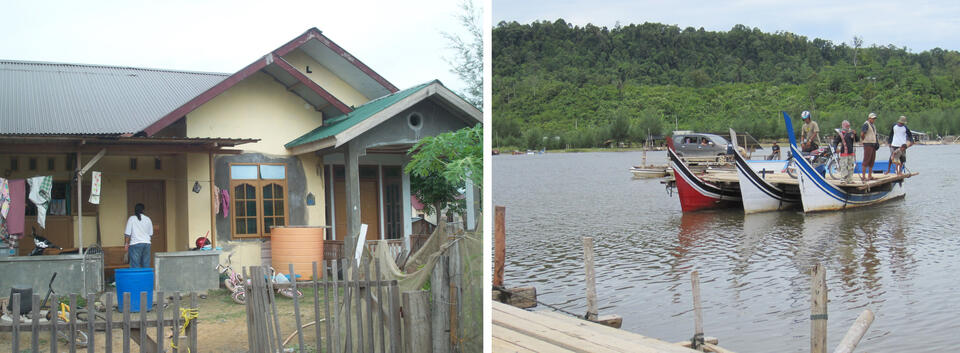
 Collection of photos from fieldwork in Aceh, Indonesia, provided courtesy of Yong Lee. Upper left: A house built in an aid project village shows windows retrofitted after initial construction. Upper right: Boats constructed by aid agencies for fishing activity are refashioned to serve as water taxis for people and cars. Lower: Fishing boats sit unused on the side of the road many of them impossible to use, according to villagers surveyed.
Logistics and oversight
Aid delivery depends in many ways on the location and scale of the disaster. But, a few main aspects can determine if an aid agency doing its own work or operating as an implementer meets or exceeds expectations.
Henderson and Lee suggest that agencies that were highly supervisory had greater positive outcomes from their workers. In the case of Aceh, better monitoring and insistence on quality by leadership is a likely corollary between construction of better quality homes and boats.
“Rather than just give money, NGOs need to really oversee the projects. Organization and management are essential facets,” Lee said. “And that requires a lot of additional effort on their part.”
Oversight is especially relevant in disaster situations because of the often-overwhelming need for reconstruction. A flood of less-skilled workers enters the market to fill this gap, and on average the quality of work degrades.
“It’s much more difficult to impose quality control at this point,” Lee said. “So the implication that comes out of it is how does the implementer effectively utilize less-skilled workers.”
Getting to know the implementers and evaluating their work in-progress would help ensure quality on behalf of the aid agency. And, better dissemination of information about aid outcomes would help assure donors that their monies are being applied in the best possible way.
Future study
Most “hard aid” delivered to Aceh’s villages had finished by 2010, but “soft aid” such as democracy promotion and women’s empowerment stayed longer.
Henderson and Lee conducted one final survey in 2011. The data has been offered as open source material for researchers along with the larger data set.
Noting this, Lee said, “We’re thrilled that people are looking into the data further. It’s exactly what we wanted.”
Research projects applying the data include the impact of the tsunami on Aceh’s local economies and health effects on the population, among other areas.
Hero Image

All News button
1
The Role of Markets, Technology, and Policy in Generating Palm-Oil Demand in Indonesia
Paragraphs
Indonesia produces more palm oil and consumes more palm oil per capita than any country in the world. This article examines the processes through which Indonesia has promoted palm-oil consumption and some of the consequences of that promotion. Partial equilibrium modelling shows that Indonesia's remarkable increase in palm-oil consumption since 1985 is not largely attributable to population and income growth. Instead, much of this consumption growth has resulted from substitution away from coconut oil, facilitated by government policies on technology, pricing, distribution, and trade. The switch from coconut oil to palm oil in Indonesia was associated with increased land conversions to agriculture and diminished smallholder competitiveness. Despite lower rates of cooking-oil substitution in the future, simulations suggest that Indonesia's total palm-oil consumption in 2035 will be at least double that of 2010.
All Publications button
1
Publication Type
Journal Articles
Publication Date
Journal Publisher
Bulletin of Indonesian Economic Studies
Number
1