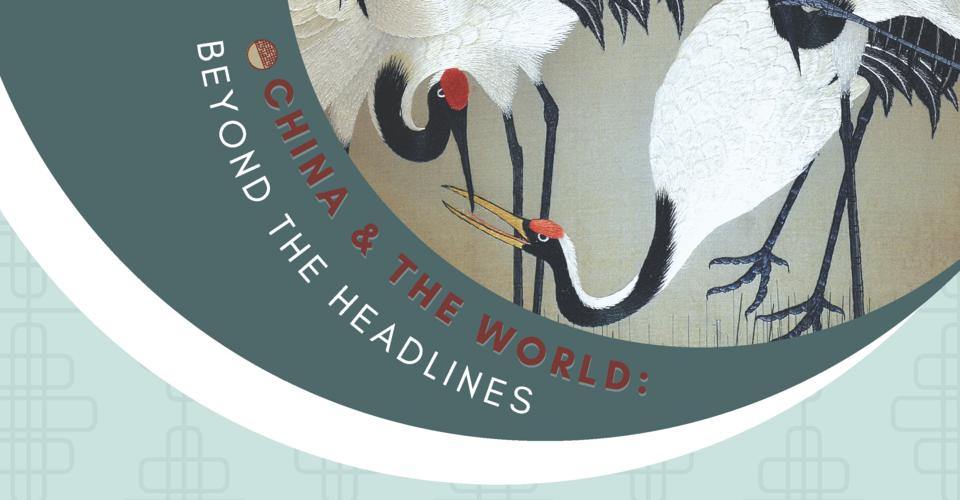
News on China dominates the headlines. In this panel program, however, panelists dig beneath the headlines to discuss research findings rarely discussed by mainstream media. Organized in collaboration with Michigan State University’s (MSU’s) Office of China Program, speakers highlight China’s monumental conservation efforts, based on their years of collaboration. Faculty from Stanford, MSU, and the Chinese Academy of Sciences will discuss the impact and implications of their own and related research in this field.
OPENING REMARKS
Scott Rozelle, Co-Director, Stanford Center on China's Economy and Institutions
Douglas Gage, Vice President, Office of Research and Innovation, Michigan State University
SPEAKERS
Gretchen Daily is Bing Professor of Environmental Science in the Stanford Department of Biology and a Senior Fellow at the Woods Institute for the Environment. She is also Co-founder and Faculty Director of the Stanford Natural Capital Project. Daily’s work is focused on understanding human dependence and impacts on nature and the deep societal transformations needed to secure people and nature. She has published several hundred scientific and popular articles, and a dozen books. She has received numerous international honors. Daily is also a fellow of the U.S. National Academy of Sciences, the American Academy of Arts and Sciences and the American Philosophical Society.
Zhiyun Ouyang is a professor of ecology and the Director of the Research Center for Eco-Environmental Sciences at the Chinese Academy of Sciences. He is the president of the Ecological Society of China and the vice-president of the Ecological Economic Society of China. He has played an active role in conservation policy innovation in China since 2000. His research is notable for its influence on policymaking for ecosystem conservation, restoration, and land management from local to national levels in China. He has published 11 books and hundreds of peer-reviewed papers.
Hua Zheng is a professor at the Research Center for Eco-Environmental Sciences at the Chinese Academy of Sciences. His research focuses on the relationships between and policy applications of ecosystem structure-process, ecosystem services, and ecosystem service assessment. His past research has explored how forest ecosystem structures and processes impact ecosystem services through long-term ecological research. He has coauthored numerous peer-reviewed papers in international journals in his field.
Tong Wu is the Co-director of the China & Environment Program at the Stanford Center on China’s Economy and Institutions. His scientific and policy interests focus on the achievements, challenges, and prospects for sustainable development in China. He has conducted research on the mainstreaming of ecosystem services in management and planning, the role of nature in improving public health outcomes, and strategies for climate change mitigation and adaptation. Wu has coauthored numerous peer-reviewed papers in international journals.
Jiaguo Qi is the Director of the Asia Hub Network which features over 20 partner institutions across Asia, focusing on Water-Energy-Food nexus research. He is also Co-Director of MSU’s Office of China Programs. His research focuses on two main areas: 1) integrating biophysical and social processes and methods in understanding land use and land cover change, and 2) transforming data into information and knowledge. Understanding the coupling of nature and human systems is important in his global change research. Dr. Qi directed the Center for Global Change and Earth Observation for many years.
Peilei Fan is the interim director at Center for Global Change and Earth Observation and professor of Urban and Regional Planning at Michigan State University. Dr. Fan has served as a consultant/economist for the United Nations University –World Institute of Development Economics Research and the Asian Development Bank. She is the Secretary General of International Association of Landscape Ecology (IALE), the Deputy of Landscape Ecology Working Party of International Union of Forest Research Organizations (IUFRO), and a Public Intellectuals Program Fellow of the National Committee on US-China Relations. She is passionate about achieving sustainability for cities and regions through efficient, just, and green processes and outcomes. Her work focuses on environment, innovation, and human well-being.
Jianguo "Jack" Liu, a human-environment scientist and sustainability scholar, holds the Rachel Carson Chair in Sustainability, is a University Distinguished Professor at Michigan State University, and director of the Center for Systems Integration and Sustainability. Liu takes a holistic approach to addressing complex human-environmental challenges through systems integration, such as the integration of ecology with social sciences, policy and advanced technologies. He is particularly keen to connect seemingly unconnected issues such as telecoupling (human-nature interactions over distances, e.g., among China, US, and Brazil).
Steve Pueppke is a faculty member in the Center for Global Change and Earth Observations, the Center for European, Russian and Eurasian Studies, and Professor of Plant, Soil and Microbial Sciences at MSU. Dr. Pueppke was trained as a plant scientist and spent much of his professional career as a laboratory researcher/research administrator, including several years as Director of MSU AgBioResearch and Associate Vice-President for Research and Graduate Studies at MSU. He currently serves on the Board of Directors of the National Center for Food and Agricultural Policy in Washington and is Section Editor for Water, Agriculture, and Aquaculture for the journal Water.