-

Image


Abstract:

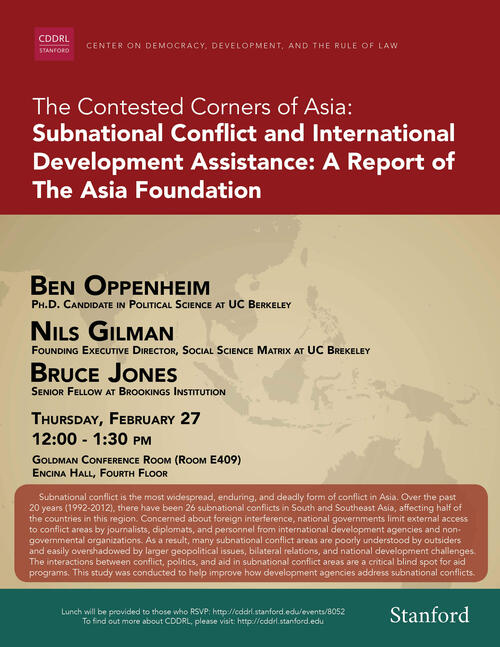
Subnational conflict is the most widespread, enduring, and deadly form of conflict in Asia. Over the past 20 years (1992-2012), there have been 26 subnational conflicts in South and Southeast Asia, affecting half of the countries in this region. Concerned about foreign interference, national governments limit external access to conflict areas by journalists, diplomats, and personnel from international development agencies and non-governmental organizations. As a result, many subnational conflict areas are poorly understood by outsiders and easily overshadowed by larger geopolitical issues, bilateral relations, and national development challenges. The interactions between conflict, politics, and aid in subnational conflict areas are a critical blind spot for aid programs. This study was conducted to help improve how development agencies address subnational conflicts.


Speaker Bios:

Ben Oppenheim is a Fellow (non-resident) at the Center on International Cooperation at New York University. His research spans a diverse set of topics, including fragile states, transnational threats (including pandemic disease risks and terrorism), and the strategic coherence and effectiveness of international assistance in fragile and conflict-affected areas.

Oppenheim has consulted for organizations including the World Bank, the United Nations, the Asia Foundation, the Institute for the Future, and the Fritz Institute, on issues including organizational learning, strategy, program design, foresight, and facilitation. In 2009, he served as Advisor to the first global congress on disarmament, demobilization, and reintegration, supported by the World Bank and the UN.

In 2013, Oppenheim was a visiting fellow at the Uppsala University Forum on Democracy, Peace, and Justice. His research has been supported by a Simpson Fellowship, and a fellowship with the Institute on Global Conflict and Cooperation. He was also a research fellow with UC Berkeley's Institute of International Studies, affiliated with the New Era Foreign Policy Project.


Nils Gilman is the Executive Director of Social Science Matrix. He holds a B.A., M.A. and Ph.D. in History from the University of California, Berkeley. Gilman’s first scholarly interest was in American and European intellectual history, with a particular focus on the institutional development of the social sciences, the lateral transfer and translation of ideas across disciplinary boundaries, and the impact of social scientific ideas on politics and policy.

Gilman is the author of Mandarins of the Future: Modernization Theory in Cold War America (Johns Hopkins University Press, 2004), the co-editor of Staging Growth: Modernization, Development, and the Global Cold War (University of Massachusetts Press, 2003) and Deviant Globalization: Black Market Economy in the 21st Century (Continuum Press, 2011), as well as the founding Co-editor of Humanity: An International Journal of Human Rights, Humanitarianism, and Development. He also blogs and tweets.

Prior to joining Social Science Matrix in September 2013, Gilman was research director at Monitor 360, a San Francisco consultancy that addresses complex, cross-disciplinary global strategic challenges for governments, multinational businesses, and NGOs. He has also worked at a variety of enterprise software companies, including Salesforce.com, BEA Systems, and Plumtree Software. Gilman has taught and lectured at a wide variety of venues, from the Harvard University, Columbia University, and National Defense University, to PopTech, the European Futurists Conference, and the Long Now Foundation.


Bruce Jones is a senior fellow and the director of the Project on International Order and Strategy in the Foreign Policy program at the Brookings Institution. He is also the director of the Center on International Cooperation at New York University.

Jones served as the senior external advisor for the World Bank’s 2011 World Development Report, Conflict, Security and Development, and in March 2010 was appointed by the United Nations secretary-general as a member of the senior advisory group to guide the Review of International Civilian Capacities. He is also consulting professor at the Center for International Security and Cooperation at Stanford University and professor (by courtesy) at New York University’s department of politics.

Jones holds a Ph.D. from the London School of Economics, and was Hamburg fellow in conflict prevention at Stanford University.

He is co-author with Carlos Pascual and Stephen Stedman of Power and Responsibility: Building International Order in an Era of Transnational Threats (Brookings Press, 2009); co-editor with Shepard Forman and Richard Gowan of Cooperating for Peace and Security (Cambridge University Press, 2009); and author of Peacemaking in Rwanda: The Dynamics of Failures(Lynne Reinner, 2001).

Jones served as senior advisor in the office of the secretary-general during the U.N. reform effort leading up to the World Summit 2005, and in the same period was acting secretary of the Secretary-General’s Policy Committee. In 2004-2005, he was deputy research director of the High-level Panel on Threats, Challenges and Change. From 2000-2002 he was special assistant to and acting chief of staff at the office of the U.N. special coordinator for the Middle East peace process. 

Richard and Rhoda Goldman Conference Room

Ben Oppenheim Ph.D. Candidate in Political Science Speaker UC Berkeley
Nils Gilman Founding Executive Director, Social Science Matrix Speaker UC Berkeley
Bruce Jones Senior Fellow Speaker Brookings Institution
Seminars
-

Abstract:
The peoples of Burma/Myanmar have faced military rule, human rights violations, and poor health outcomes for decades. The country Is now undergoing a political liberalization, and multiple changes in political, social and economic life. The human rights and health situation of the country's many ethnic nationalities remain challenging, and represent one of the clearest threats to the prospect of successful transition to peace, and to democracy. We will explore the current health and human rights situation in the country, the ongoing threats to peace, and ways forward for this least developed nation as it emerges from 5 decades of military rule.

Chris Beyrer MD, MPH, is a professor of Epidemiology, International Health, and Health, Behavior, and Society at the Johns Hopkins University Bloomberg School of Public Health. He is the founding Director of the University¹s Center for Public Health and Human Rights, which seeks to bring the tools of population-based sciences to bear on Health and rights threats. Dr. Beyrer also serves as Associate Director of the Johns Hopkins Centers for AIDS Research (CFAR) and of the Center for Global Health. He has been involved in health and human rights work with Burmese populations since 1993. Prof. Beyrer is the author of more than 200 scientific papers, and author or editor of six books, including War in the Blood: Sex, Politics and AIDS in Southeast Asia, and Public Health and Human Rights: Evidence-Based Approaches. He has served as a consultant and adviser to numerous national and international institutions, including the National Institutes of Health, the World Bank, WHO, UNAIDS, the Open Society Foundations, the Walter Reed Army Institute for Research, amfAR The Foundation for AIDS Research, Physicians for Human Rights and Human Rights Watch. Dr. Beyrer received a BA in History from Hobart and Wm. Smith Colleges, his MD from SUNY Downstate in Brooklyn, NY, and completed his residency in Preventive Medicine, public health training, an MPH and a Infectious Diseases Fellowship at Johns Hopkins University in Baltimore. He received an honorary Doctorate (PhD) in Health Sciences from Chiang Mai University in Thailand, in 2012, in recognition of his 20 years of public health service in Thailand

Building 200 (History Corner)
Room 205
Stanford University

Chris Beyrer Director Speaker Johns Hopkins Center for Public Health & Human Rights
Seminars
Authors
News Type
News
Date
Paragraphs

Ben Rudolph was an ambitious computer science major planning to remain in Silicon Valley and join one of the many start-ups eager for young Stanford grads. But in his senior year he took a class, “Rethinking Refugee Communities,” which knocked him off his path and got him thinking about how to use that ambition for the greater good.

The class was co-taught by Tino Cuéllar, a Stanford Law School professor and director of the Freeman Spogli Institute for International Studies. Cuéllar led the class while co-director of FSI's Center for International Security and Cooperation (CISAC), which had just launched a collaboration with the United Nations High Commissioner for Refugees. The agency was looking for innovative ideas to support and protect the more than 42 million refugees, internally displaced and stateless people around the world.

When Rudolph graduated in June, he turned down offers in local tech firms and headed to Geneva as an intern for UNHCR’s nascent innovation lab. He joined Stanford alumna and CISAC faithful, Alice Bosley, in the small office with a big mission: to aid refugees by driving innovation using the latest tools of technology. 

“I get to make a difference in the lives of some of the most vulnerable people in the world: refugees,” said Rudolph, a 23-year-old from Naperville, Ill., who came to Stanford on a gymnastics scholarship. “And I love that I get to meet such a diverse group of people with wildly different opinions about so many things.” 

Rudolph has now joined UNHCR Innovation full time and has traveled to Ecuador to pilot one of his projects and to Thailand for an innovation workshop. On a recent trip to Esmeraldas on the northwestern coast of Ecuador, he tested out an SMS program that would help displaced people get information from the UNHCR and its partner organizations. 

Bosley, the associate operations officer at UNHCR Innovation, first joined the U.N. as an intern speechwriter at the Permanent Mission of East Timor to the United Nations in New York. She was visiting some CISAC colleagues in the spring of 2012 when she learned about the burgeoning collaboration between the center and UNHCR. She volunteered for the project and became an intern with the newly formed UNHCR Innovation team, where she was later offered a full-time position.

Alice Bosley crossing a river near the Dollo Ado UNHCR refugee camp in Ethiopia.

Alice Bosley crosses a river by the Dollo Ado UNHCR refugee camp in Ethiopia.           Photo: UNHCR Innovation


“UNHCR Innovation is my dream job; I am constantly traveling to new and interesting locations to work on projects and I’m able to support some of the most creative and impressive people in the organization,” said Bosley, 25, who graduated in 2011 with a degree in international relations. “It’s challenging and sometimes overwhelming. But I wouldn’t pick anything else to do at this point in my life.” 

Rudolph and Bosley are models of the CISAC mission: to train the next generation of experts who will make the world a safer place. While not entrenched in the policy arena or at the forefront of arms control or Track II diplomacy, they are quietly, doggedly fulfilling the CISAC pledge to improve lives around the world. 

"One of CISAC's greatest strengths over the years has been its record of attracting enormously talented students and fellows from a diverse array of disciplines and giving them a chance to work on problems that affect lives around the world,” said Cuéllar. 

The UNHCR came to Cuéllar in early 2012 asking to collaborate. That initial request has led to an array of projects across campus and around the world. Cuéllar last year co-taught the class, “Rethinking Refugee Communities,” with Leslie Witt of the Palo Alto-based global design firm IDEO. That class in turn led to research trips in Ethiopia and Rwanda with UNHCR and the International Rescue Committee to test out some of the student projects to improve food security, communications, camp design and an SMS platform that Rudolph later tested with the innovation lab. 

“Ben and Alice were attracted to the refugee project because of its focus on improving conditions for forced migrants,” said Cuéllar. “Both of them are brimming with intellectual curiosity, ability, and dedication, so it's no surprise that UNHCR has put them at the center of its innovation work." 

The collaboration now extends far beyond CISAC. Cuéllar, CISAC visiting professor Jim Hathaway of the University of Michigan Law School, Roland Hsu of the Stanford Humanities Center and the NGO Asylum Access are convening a winter quarter working group on refugee rights. Stanford faculty will come from many departments to talk about the tension between providing emergency care and protecting refugee rights. 

CISAC led the UNHCR to the Stanford Geospatial Center, where students are working on four mapping projects to help refugees, including an interactive map that displays the density for refugees seeking shelter in that conflict. 

“Working with the UNHCR was truly a unique experience for us,” said Patricia Carbajales, geospatial manager at the Branner Earth Sciences Library who linked the students with the UNHCR advisers in Geneva and field offices around the world. “The students were completely engaged, understanding the importance that their projects had for UNHCR and, most importantly, for the refugees themselves.” 

The popularity of the projects has led to a new class in the spring, “GIS for Good: Applications for GIS for International Development and Humanitarian Relief.” 

Cuéllar and Elizabeth Gardner, associate director for partnerships and special projects at FSI, are working with UNHCR architects and the New York-based Ennead Architects Lab to develop new tools to expedite the complex process of laying out new refugee camps. 

Stanford’s Haas Center for Public Service and the student-led Stanford in Government is making moves to permanently place interns or postgraduate fellows at UNHCR. FSI Senior Fellow Paul Wise, a professor of pediatrics at Stanford’s School of Medicine, will mentor that intern in the coming year. 

Meanwhile, out in the field, Rudolph doesn’t know if his UNHCR experience has forever changed his career path. He may come back to the valley and pick up where he left off; he may continue his humanitarian work. 

Either way, he says, “This work has really opened me up to a world of problems that are so vast it’s hard to grasp. It will be forever difficult to go back to my ignorant bliss.”

Ben Rudolph, center, with Sudanese refugees in a UNHCR refugee camp in Ethiopia, March 2013.

Stanford students Parth Bhakta, left, and Ben Rudolph, talk with Sudanese refugees at the UNHCR camp in Bambasi, on Ethiopia's eastern border with Sudan. Photo: Beth Duff-Brown  


Hero Image
1 Alice Dola
All News button
1
-

Abstract:

Taiwan's system of neighborhood-level governance has origins in institutions of local control employed by both the Republican-era Kuomintang and the Japanese colonizers. In more recent times, the neighborhood wardens (lizhang, 里長) have come to play a complex set of roles, including state agent, political party operative, and community representative. Wardens of a new generation, with more women in their ranks than ever before, have adopted new practices and built different relationships with their communities, parties, and city governments compared to those of the older, often clan-based bosses.

Focusing on Taipei with glances at other locales, this paper draws on ethnographic research, interviews, surveys, public records, and other sources. It explores the particular kind of political and civic engagement that the neighborhood governance system elicits. It is statist; though independent in many respects, wardens have government-mandated duties and work closely with city and district officials. Community development associations (shequ fazhan xiehui), as well as other neighborhood groups and wardens themselves, compete for and receive government funding. Warden elections are also deeply democratic in ways that, in global perspective, are unusual for such ultra-local urban offices. Over the past 25 years, elections have become hotly contested, voter turnout has risen to remarkably high rates, and KMT dominance has partially given way to political pluralization. Citizens’ participation in this setting, like others, often shows deep divisions along partisan lines, with wardens and local associations split by party loyalties. Finally, civic engagement with the neighborhood system shows an inverted class bias. Residents with less education, for example, are more likely to know their wardens and vote in warden elections. Politics in Taiwan’s li thus has evolved substantially over time, and also contrasts in multiple ways with Western images of neighborhood politics.

Speaker Bio:

Benjamin L. Read is an Associate Professor of Politics at UC Santa Cruz. His book, Roots of the State: Neighborhood Organization and Social Networks in Beijing and Taipei (Stanford University Press, 2012) uses surveys, interviews, and participant observation to compare the ways in which constituents perceive and interact with the urban administrative structures found in China, Taiwan, and elsewhere in the region. He edited Local Organizations and Urban Governance in East and Southeast Asia: Straddling State and Society (Routledge, 2009), also on the role of state-sponsored organizations, and has published research on civil society groups as well, particularly China's nascent homeowner associations. Read's next book, Field Research in Political Science: Practices and Principles, co-authored with Diana Kapiszewski and Lauren Morris MacLean, will be published in 2014 by Cambridge University Press. His articles have appeared in the Journal of Conflict Resolution, Comparative Political Studies, the China Journal, the China Quarterly, the Washington Quarterly, and several edited books. He earned his Ph.D. in Government at Harvard University in 2003.

Daniel and Nancy Okimoto Conference Room

Benjamin L. Read Associate Professor of Politics Speaker University of California, Santa Cruz
Seminars
-

Co-sponsored by the Stanford Center for International Development

Under what conditions is decentralization most likely to foster development and reduce poverty?  Plausible answers include:  a sufficiently committed central government; local checks against corruption; and sufficiently resourced actors able to deliver public services effectively. Indonesia is a good place to explore the explanatory power of these and other propositions, thanks to the country’s diverse local conditions and the rapid and sweeping (“Big Bang”) decentralization that it underwent in the late 1990s.  In his disaggregation of the Indonesian case since then, Dr. Sumarto will examine whether, how, and why poverty alleviation has been helped or hurt by particular economic, social, and political variations in the context and character of local governments across the archipelago.

Sudarno Sumarto was an Asia Foundation Visiting Fellow at APARC in 2009-2010.  In 2001-2009 he was the director of SMERU, a highly regarded independent institute for research and public policy studies in Jakarta.  He has served as a consulting economist for the World Bank, the Asian Development Bank, among other organizations, and has taught in Indonesia’s leading universities. His latest publication is Explaining Regional Heterogeneity of Poverty:  Evidence from Decentralized Indonesia (co-authored, 2013).  Earlier titles include more than sixty co-authored books, working papers, articles, chapters, and reports on topics such as poverty, decentralization, employment, vulnerability, and economic growth.  His degrees in economics include a PhD and an MA from Vanderbilt University and a BSc from Satya Wacana Christian University (Salatiga).

Lunch will be served.

Philippines Conference Room

Sudarno Sumarto Senior fellow Speaker SMERU Research Institute
Seminars
-

 Abstract:

That the Cairo Conference has been overshadowed by the wartime summits at Teheran and Yalta is understandable given the start of the Cold War in Europe almost immediately after the German surrender in May 1945. To understand the collapse of relations between the Anglo-American allies on the one hand and the Soviet Union on the other, it is important to look at the conferences at Teheran and Yalta, the interactions between Churchill, Roosevelt, and Stalin, the understandings they reached, and their misunderstandings. That said, the Cairo Conference also marked an important turning point in the relations between the allies in the war against Japan: China, Great Britain, and the United States, the consequences of which were critical to the defeat of Japan and the post-war order in East Asia.

The interaction of Churchill, Roosevelt, and Chiang in Cairo is every bit as compelling from a human interest perspective as the interplay between Churchill, Roosevelt, and Stalin at Teheran and Yalta, albeit less studied, and offers a sobering reminder of what can happen when policy is made at the very highest level by individuals who know relatively little about the culture of their partners and are not able to separate myths and stereotypes from realities. Summit conferences may make for good theater, but do not necessarily result in good policies as an examination of the Cairo Conference reveals.

Each of the parties at the Cairo Conference came with their own agendas, frequently contradictory. Generalissimo and Madame Chiang hoped to obtain a commitment to make the China-Burma-India theater of war the focal point in the war against Japan, a matter not only of strategic importance to them but also of poetic justice. They also sought to redress grievances against Japan and Great Britain in the post-war era. Roosevelt hoped to buoy the ego and spirits of Chiang and to insure that the Kuomintang regime would not make a separate peace with Japan thus allowing the Japanese to redeploy the nearly one million troops they had stationed in China. Churchill had no real interest in meeting with Chiang and his wife at Cairo at all, but felt obliged to humor Roosevelt and to make sure that no agreements would be reached in Cairo that would in any way prejudice British colonial interests in Southeast Asia in the post-war era. Given these conflicting agendas, it is no wonder that none of the participants would be satisfied with the results of their labors in Cairo.


Speaker Bio:

Ronald Heiferman is Professor of History and Director of the Asian Studies Program at Quinnipiac University in Hamden, Connecticut, and a Fellow of Berkeley College at Yale University. He has also taught at Connecticut College and the City University of New York. Dr. Heiferman was educated at Yale and New York University (Ph.D.). Professor Heiferman has authored or co-authored more than a dozen books, including Flying Tigers (New York: Ballantine, 1971), World War II (London: Hamlyn, 1973), Wars of the Twentieth Century (London: Hamlyn, 1974), The Rise and Fall of Imperial Japan (New York: Military Press, 1981), the Rand-McNally Encyclopedia of World II (New York: Rand-McNally, 1978), and The Cairo Conference of 1943: Roosevelt, Churchill, Chiang Kai-shek and Madame Chiang (McFarland, 2011). His latest book, The Chinese Idyll of Franklin D. Roosevelt, will be published in 2014. Professor Heiferman was a Yale-Lilly Fellow in 1978, a Yale-Mellon Fellow in 1984, and has also been the recipient of five National Endowment for the Humanities Fellowships: Duke University (1974), University of Chicago (1977), Stanford University (1980), Harvard University (1987), and the University of Texas (1991).

CISAC Conference Room

Ronald Heiferman Professor of History and Director of the Asian Studies Program Speaker Quinnipiac University
Seminars
-

Abstract:

Nipah virus lives in large fruit bats in South and Southeast Asia. When people become infected with Nipah virus over half of them die. Nipah virus can also be transmitted from person to person. This talk will describe how this bat virus occasionally infects human populations and causes outbreaks through person-to-person transmission. It will explore the risk of a global pandemic of Nipah virus and consider appropriate policy responses.

Speaker bio:

Stephen Luby is Professor of Medicine in the Division of Infectious Diseases and Geographic Medicine; Deputy Director for Research at the Center for Global Health Innovation; Senior Fellow at the Woods Institute for the Environment and Senior Fellow at the Freeman Spogli Institute for International Studies at Stanford University.

Dr. Luby studied philosophy and earned a Bachelor of Arts summa cum laude from Creighton University. Dr. Luby earned his medical degree from the University of Texas Southwestern Medical School at Dallas and completed his residency in internal medicine at the University of Rochester-Strong Memorial Hospital. He studied epidemiology and preventive medicine at the Centers for Disease Control and Prevention.

Dr. Luby's former positions include leading the Epidemiology Unit of the Community Health Sciences Department at the Aga Khan University in Karachi, Pakistan for 5 years and working as a Medical Epidemiologist in the Foodborne and Diarrheal Diseases Branch of the Centers for Disease Control and Prevention exploring causes and prevention of diarrheal disease in settings where diarrhea is a leading cause of childhood death.  Immediately prior to his current appointment, Dr. Luby served for eight years at the International Centre for Diarrheal Diseases Research, Bangladesh (ICDDR,B), where he directed the Centre for Communicable Diseases. Dr. Luby was seconded from the US Centers for Disease Control and Prevention (CDC) and was the Country Director for CDC in Bangladesh.

Dr. Luby's research has focused on clarifying the burden of several communicable diseases in low income countries and developing and evaluating practical strategies to mitigate their impact. He is currently exploring circumstances where economic and political forces encourage environmental degradation that exerts substantial disease burden in low income countries, with a view to developing and evaluating interventions.

CISAC Central Conference Room

Stephen Luby Senior Fellow, Stanford Woods Institute for the Environment; Sr. Fellow, Freeman Spogli Inst. for International Studies; Research Deputy Director for the Stanford Univ. Center for Innovation in Global Health; Prof. of Medicine, Infectious Diseases Speaker
Seminars
News Type
News
Date
Paragraphs

Japan Program at Shorenstein Asia-Pacific Research Center received a grant from Sasakawa Peace Foundation in Japan for the New Channels project.  Hideichi Okada, Senior Advisor at NTT Data Institute of Management and Consulting has joined the Japan Studies Program at APARC as the 2013-14 Sasakawa Peace Fellow to play a leading role in organizing the annual New Channels Dialogue.

On October 8th, Hideichi Okada spoke on “Japan’s Energy Challenge” at a Shorenstein APARC seminar in the Philippines Conference Room at Encina Hall.  As the world watches with great interest on how Japan will overcome its energy challenges, Okada highlighted the importance of formulating a new energy policy and reducing the cost of renewable and imported hydrocarbon.  He also pointed out the challenges of decommissioning damaged nuclear power plants and cleaning contaminated soil and water, which would require a new technology as well as an international cooperation.  The talk was followed by active discussion with the participants.

Hero Image
logo
Hideichi Okada, 2013-14 Sasakawa Peace Fellow, gave a talk on "Japan's Energy Challenge" on October 8, 2013.
Meiko Kotani
All News button
1
News Type
News
Date
Paragraphs
The core of Islamism:  Contested Perspectives on Political Islam (Stanford University Press, 2010), ed. Richard Martin and Abbas Barzegar, is a debate between Hofstra University anthropologist Daniel Varisco and SEAF director Donald K. Emmerson on the (dis)utility of the word "Islamism," with comments by other analysts of Islam.   Writing in the Journal of Islamic Studies, 23: 2 (2012), Thomas Hegghammer (Norwegian Defence Research Establishment, Oslo) concluded his review of the book by arguing that it would "have been interesting to get a perspective from at least one scholar not invested in the study of the Muslim world.  A mainstream political scientist or language philosopher might have refreshed this distinctly in-house debate.  On the whole, however, this is an important book and a valuable contribution to the literature on political Islam."
 
Writing in the online review journal Plurilogue:  Politics and Philosophy Reviews on 23 April 2013, Meryem Akabouch (LUISS University, Rome) concludes her review of Islamism by noting that "there is still no consensual definition of the real intention and message of Islam as a religion.  The difficulty of defining Islam as a spiritual and social doctrine or as a political and economic programme makes it particularly hard to define 'Islamism', let alone decide whether or not to abandon the use of it.  Nonetheless, the book remains a brilliant contribution to the ongoing debates between the Muslim world and the West about Islam and violence, providing the reader with a valuable framework for understanding multiple dimensions and challenges facing the modern Muslim community."
 
Ten experts on Southeast Asian affairs contributed to Hard Choices:  Security, Democracy, and Regionalism In Southeast Asia (Institute of Southeast Asian Studies, Singapore, 2009), ed. Donald K. Emmerson.  In the Canadian Journal of Political Science, 43: 1 (March 2010), Richard Stubbs (McMaster University) described the book as "an invaluable collection of analyses."  He regretted its not having covered "the rise of China as a regional power and particularly China's decision in 2003 to sign ASEAN's Treaty of Amity and Co-operation (TAC). ...  Yet this is a minor point.  Overall, this is an important set of essays that helps to shed light on the continuing evolution of one [of] the world's most intriguing regions and one of its most important regional organizations [ASEAN[."
Hero Image
islamism book
All News button
1
Subscribe to Southeast Asia