The historic rivalry between China and Japan, the source of two wars since the late 19th century and the catalyst for the wider war in the Pacific, is once again a matter of growing concern to scholars and policy makers. Why does the past continue to shape the present relationship between these two Asian powers? And can they build a new, more forward-looking, relationship? We examine these and other questions in this seminar series.
This volume collects 22 articles by Masahiko Aoki, selected from writings published over the course of his 45-year academic career. These fascinating essays cover a range of issues, including mechanism design, comparative governance, corporate governance, institutions and institutional change, but are tied together by a focus on East Asia and a comparative institutional framework.
Specific topics include the early stages of mechanism design theory, comparative analysis of vertical, horizontal and modular industrial coordination and its applications, cooperative game-theoretic approaches to the diversity of corporate government structure, the endogenous nature of institutions, and comparative and historical analysis of institutions in Japan, China and Korea.
Students, professors and scholars with an interest in comparative institutional studies and East Asian studies will find this book a useful and illuminating resource.
This paper contributes to the discussion of how Public Private Interplay (PPI) can be used to foster Next Generation Access (NGA) buildouts in Europe by introducing the experience of Japan. Japan, which succeeded in both promoting nationwide network buildouts and fostering competitive dynamics that led to the world's fastest and cheapest broadband services and deploying them nationwide. The process entailed deregulation, which unleashed new entrepreneurial private actors, and re-regulation that protected them from incumbent carriers. The resulting market dynamics lowered Digital Subscriber Line (DSL) prices, influencing the market price for Fiber-To-The-Home (FTTH), for which the government had heavily subsidized carriers. Central government initiatives, combined with local incentives, led to an almost 100% broadband accessibility within a few years. However, Japan quickly discovered that taking advantage of the broadband environment to produce innovation, productivity growth, and economic dynamism, was far more difficult than facilitating its creation. It discovered regulatory barriers for the use of Information and Communications Technology (ICT) in various areas of the economy. Like Europe, Japan was not home to the ICT lead-user enterprises and industries that drove the ICT revolution, producing innovation and productivity gains. Moreover, the advent of US-centered cloud computing services potentially decreases the minimum bandwidth requirement to access global-scale computing power. The development of wireless technologies far cheaper than Japan's nationwide FTTH also merits serious consideration for European policy discussions.
Phillip Y. Lipscy and Lee Schipper examine energy efficiency in the Japanese transportation sector since the 1970s. Comparisons with the United States and other developed economies illustrate that Japan primarily stands out due to low activity levels and modal structure rather than modal energy intensity. On-road automobile energy intensity has shown little improvement, albeit from a low base, over the past four decades. They also consider policy measures undertaken by the Japanese government. Political arrangements in Japan after World War II made it attractive for politicians to pursue energy conservation by making transportation, particularly by automobile, expensive for the average Japanese citizen. The revenues raised from various fees and taxes on automobile transportation were redistributed to core supporters of the ruling Liberal Democratic Party. These political arrangements have come under fire in recent years, calling into question Japan's traditional approach towards transportation sector energy efficiency.
The Year of the Horse will run (so to speak) from 31 January 2014 to 18 February 2015. Many domestic, regional, and global issues will occupy the attention of Southeast Asian leaders and societies and their counterparts in the US, China, and Japan among other countries. In conversation with SEAF director Don Emmerson, Ernie Bower will highlight the most important of these policy issues and their implications. Possible topics may include the repercussions of Chinese muscle-flexing over the East and South China Sea, political strife in Thailand, quinquennial elections in Indonesia, and Myanmar's leadership of ASEAN including the plan to declare an ASEAN Community in 2015.
Ernest Z. Bower is one of America's leading experts on Southeast Asia, founding president and CEO of the business advisory firm BowerGroupAsia, a former president of the US-ASEAN Business Council, and a policy adviser to many private- and public-sector organizations in the US interested in Southeast Asia.
Daniel and Nancy Okimoto Conference Room
Ernest Z. Bower
Senior Adviser and Sumitro Chair for Southeast Asian Studies
Speaker
Center for Strategic and International Studies, Washington, DC
William J. Perry was only 18 when he found himself surrounded by death, a young U.S. Army mapping specialist in Japan during the Army of Occupation. The atomic bombs had been dropped on Hiroshima and Nagasaki and World War II had just come to an end.
“The vast ruins that once had been the great city of Tokyo – nothing, nothing had prepared me for such utter devastation that was wrought by massive waves of firebombing rained down by American bomber attacks,” said Perry, who was then shipped off to the island of Okinawa in the aftermath of the last great battle of WWII.
More than 200,000 soldiers and civilians had been killed in that closing battle of 1945, codenamed Operation Iceberg.
“Not a single building was left standing; the island was a moonscape denuded of trees and vegetation,” Perry told a rapt audience during a recent speech. “The smell of death was still lingering.”
The young man quickly understood the staggering magnitude of difference in the destruction caused by traditional firepower and these new atomic bombs.
“It had taken multiple strikes by thousands of bombers and tens of thousands of high explosive bombs to lay waste to Tokyo,” he recalls. “The same had been done to Hiroshima and then to Nagasaki with just one plane – and just one bomb. Just one bomb.
“The unleashing of this colossal force indelibly shaped my life in ways that I have now come to see more clearly,” said Perry, who would go on to become the 19th secretary of defense. “It was a transforming experience. In many ways – I grew up from it.”
William J. Perry in 1945 in his U.S. Army Air Corps uniform.
William J. Perry in 1945 in his U.S. Army Air Corps uniform. Photo Credit: U.S. Army
Now, nearly seven decades later, the 86-year-old Perry has come full circle. His new winter course will take students back to his fateful days in Japan after the United States became the first – and last – nation to use atomic weapons. He’ll go through the Cold War, the arms race and expanding nuclear arsenals, and today’s potential threats of nuclear terrorism and regional wars provoked by North Korea, Iran or South Asia.
Living at the Nuclear Brink: Yesterday & Today (IPS 249) – to serve as the backdrop for an online course at Stanford next year – concludes with the declaration Perry made in 2007: The world must rid itself entirely of nuclear weapons. And students will get a primer on how to get involved in organizations that are working on just that.
“They did not live through the Cold War, so they were never exposed to the dangers and therefore it doesn’t exist to them; it’s just not in their world,” Perry said of millennial and younger students. “I want to make them aware of what the dangers were and how those dangers have evolved.”
Perry and former U.S. Sen. Sam Nunn, both Democrats, joined former Republican Secretaries of State George P. Shultz and Henry A. Kissinger in launching a series of OpEds in The Wall Street Journal (the first in 2007) that went viral. Together they outlined how nations could work together toward a world without nuclear weapons.
“I think I have some responsibility since I helped build those weapons – and I think that time is running out,” Perry said in an interview.
Perry helped shore up the U.S. nuclear arsenal as undersecretary of defense for research and engineering, procuring nuclear weapons delivery systems for the Carter administration. Later, as secretary of defense for President Bill Clinton, his priority became the dismantling of nuclear weapons around the world.
Taubman, a consulting professor at CISAC, will guest lecturer in Perry’s class, along with CISAC’s Siegfried Hecker, David Holloway, Martha Crenshaw and Scott Sagan. Other speakers are expected to include Shultz, a distinguished fellow at Stanford’s Hoover Institution; Andrei Kokoshin, deputy of the Russian State Duma; Ashton B. Carter, who just stepped down as deputy secretary of defense; Joseph Martz of the Los Alamos National Laboratory; and Joeseph Cirincione, president of the Ploughshares Fund.
The world is far from banning the bomb. According to the Ploughshares Fund, an estimated 17,300 nuclear weapons remain in the global stockpile, the majority of which are in Russia and the United States.
President Barack Obama declared shortly after taking office in his first foreign policy speech in Prague that because the United States was the only country to have used nuclear weapons, Washington “has a moral responsibility to act.”
“So today, I state clearly and with conviction, America’s commitment to seek the peace
and security of a world without nuclear weapons,” Obama said back in May 2009.
Perry – a senior fellow at CISAC who received his BS and MS from Stanford and a PhD from Pennsylvania State University, all in mathematics – laments the regression of the movement to dismantle the nuclear legacy of the Cold War.
Obama has so far not acted on his pledge in his contentious second term, as China and Russia expand their stockpiles. North Korea and Iran are attempting to build nuclear weapons and India and Pakistan are building more fissile material. The U.S. Senate still has not ratified the Comprehensive Test Ban Treaty and the U.S. and Russia have not moved forward on a follow-up to the New START Treaty.
Perry recognizes that the issue is slipping from the public conscience, particularly among young people. So he’s putting his name and experience behind a Stanford Online course slated to go live next year. It will correspond with the release of his memoir, “My Journey at the Nuclear Brink” and will take a more documentary approach, weaving together key moments in Perry’s career with lectures, archival footage and interviews and conversations between Perry and his colleagues and counterparts.
"Bill Perry has had a remarkable career and this project draws on his unparalleled experience over a pivotal period in history," said John Mitchell, vice provost for online learning. "We hope his brilliant reflections will be useful to everyone with an interest in the topic, and to teachers and students everywhere."
At the heart of his winter course, online class and memoir are what Perry calls the five great lessons he learned in the nuclear age. The first four are grim remnants of what he witnessed over the years: the destructive nature of the atomic bombs on Japan; his mathematical calculations about the number of deaths from nuclear warfare; his work for the CIA during the Cuban Missile Crisis; and one pre-dawn call in 1978 from the North American Aerospace Defense Command saying there were 200 missiles headed toward the United States from the Soviet Union. That turned out to be a false, but terrifying alarm.
His fifth final lesson is hopeful, if not cautionary. It goes like this:
As secretary of defense from 1994 to 1997, Perry oversaw the dismantling of 8,000 nuclear weapons in the former Soviet Union and the United States and helped the former Soviet states of Ukraine, Kazakhstan and Belarus to go entirely non-nuclear. In that mission, he often visited Pervomaysk in the Ukraine, which was once the Soviet Union’s largest ICBM site, with 700 nuclear warheads all aimed at targets in the United States.
On his final trip to Pervomaysk in 1996, he joined the Russian and Ukrainian defense ministers to plant sunflowers where those missiles had once stood.
“So reducing the danger of nuclear weapons is not a fantasy; it has been done,” Perry said. “I will not accept that it cannot be done. I shall do everything I can to ensure nuclear weapons will never again be used – because I believe time is not on our side.”
Taiwan's system of neighborhood-level governance has origins in institutions of local control employed by both the Republican-era Kuomintang and the Japanese colonizers. In more recent times, the neighborhood wardens (lizhang, 里長) have come to play a complex set of roles, including state agent, political party operative, and community representative. Wardens of a new generation, with more women in their ranks than ever before, have adopted new practices and built different relationships with their communities, parties, and city governments compared to those of the older, often clan-based bosses.
Focusing on Taipei with glances at other locales, this paper draws on ethnographic research, interviews, surveys, public records, and other sources. It explores the particular kind of political and civic engagement that the neighborhood governance system elicits. It is statist; though independent in many respects, wardens have government-mandated duties and work closely with city and district officials. Community development associations (shequ fazhan xiehui), as well as other neighborhood groups and wardens themselves, compete for and receive government funding. Warden elections are also deeply democratic in ways that, in global perspective, are unusual for such ultra-local urban offices. Over the past 25 years, elections have become hotly contested, voter turnout has risen to remarkably high rates, and KMT dominance has partially given way to political pluralization. Citizens’ participation in this setting, like others, often shows deep divisions along partisan lines, with wardens and local associations split by party loyalties. Finally, civic engagement with the neighborhood system shows an inverted class bias. Residents with less education, for example, are more likely to know their wardens and vote in warden elections. Politics in Taiwan’s li thus has evolved substantially over time, and also contrasts in multiple ways with Western images of neighborhood politics.
Speaker Bio:
Benjamin L. Read is an Associate Professor of Politics at UC Santa Cruz. His book, Roots of the State: Neighborhood Organization and Social Networks in Beijing and Taipei (Stanford University Press, 2012) uses surveys, interviews, and participant observation to compare the ways in which constituents perceive and interact with the urban administrative structures found in China, Taiwan, and elsewhere in the region. He edited Local Organizations and Urban Governance in East and Southeast Asia: Straddling State and Society (Routledge, 2009), also on the role of state-sponsored organizations, and has published research on civil society groups as well, particularly China's nascent homeowner associations. Read's next book, Field Research in Political Science: Practices and Principles, co-authored with Diana Kapiszewski and Lauren Morris MacLean, will be published in 2014 by Cambridge University Press. His articles have appeared in the Journal of Conflict Resolution, Comparative Political Studies, the China Journal, the China Quarterly, the Washington Quarterly, and several edited books. He earned his Ph.D. in Government at Harvard University in 2003.
The digital information technology (IT) revolution currently underway is profoundly reshap- ing economic activity, influencing politics, and transforming societies around the world. It is also forcing a reconceptualization of the global and local: many of the technologies, platforms, and fundamental disruptions are global in nature, but national or local contexts critically influence the uses and effects of IT.
The Asia-Pacific region provides a fascinating array of countries for examination of the political, economic, and sociocultural effects of digital media on the modern world. Economies range from developing to advanced. Governments include varied democracies as well as one-party regimes. The press enjoys relative freedom in some countries, undergoes limited constraints in others, and is tightly controlled in a few. Populations range from dense to sparse, and from diverse to relatively homogenous.
Held September 12–13, 2013, in Kyoto, Japan, the fifth Stanford Kyoto Trans-Asian Dialogue focused on the catalyzing effects of digital media for change in the Asia-Pacific. Four major themes were addressed:
Japan’s first decade of the twenty-first century was both disappointing and bewildering, producing wildly contrasting evaluations. Many have come to call this period the “second lost decade,” characterized by policy paralysis and overall lackluster economic growth.
For those studying Japan more closely, however, the same decades reveal nothing short of a broad transformation in numerous core tenets of Japan’s postwar political economy. How can we best capture this transformation?
Each chapter in this volume examines a different aspect of Japan’s political economy within a longer historical trajectory, from multiple angles, to depict a flexible but resilient system. We characterize Japan’s process of change as syncretism—practices foreign, domestic, old and new were selectively adopted, mixed and matched, along the way creating a new and unique hybrid system.
Examination copies: Desk, examination, or review copies can be requested through Stanford University Press.
All Publications button
1
Publication Type
Books
Publication Date
Subtitle
The Politics of Economic Restructuring and System Reform in Japan

 William J. Perry in 1945 in his U.S. Army Air Corps uniform.

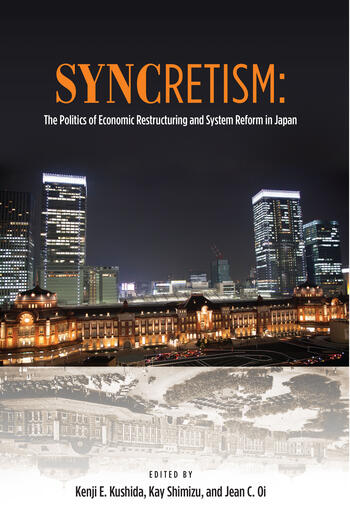 SYNCRETISM front cover