


Managing Open Innovation: Lessons from Harnessing Silicon Valley
-
For firms around the world, the question of how to harness Silicon Valley's innovation engine is increasingly important. The answers are not obvious, since the entrepreneurial dynamism and disruptive innovations and business models of Silicon Valley are often at odds with large firms' internal dynamics and processes. This is especially the case for firms that grew up outside Silicon Valley and began as outsiders here.
This panel brings together expertise from multiple vantages-- SAP from Germany, which has a major presence in Silicon Valley, World Innovation Lab (WiL) which works with large Japanese companies in a variety of ways, and Core Venture Group, a boutique San Francisco venture capital firm co-founded by a Japanese and our panelist with extensive experience working with Japanese firms.
Please join us to get both broad perspectives and specific insights into how large outside firms can harness Silicon Valley.
PANELISTS:
Joanna Drake Earl, General Partner, Core Ventures Group
Image

After joining Vice President Gore and Joel Hyatt to co-found Current TV in 2001, Joanna spent 11 years with the company including stints as President of New Media, pioneering the world's first social media platform, as well as Chief Operating Officer and Chief Strategy Officer, overseeing Sales, Marketing, Distribution, Technology, and International Operations. Earlier Joanna held executive positions at several leading technology and media start-ups, including MOXI and ReacTV. She started her career at Booz Allen & Hamilton in the Media, Entertainment and Technology consulting practice, working closely with the world's leading entertainment conglomerates and the largest Silicon Valley technology companies.
Gen Isayama, Co-Founder and CEO, World Innovation Lab
Image

Kenji Kushida, Research Associate, Stanford University
Image

David Swanson, Executive Vice President, Human Resources, SAP SuccessFactors
Image

Swanson is a keynote speaker and panelist on the Future of HR focusing on how HR can make an impact in the business through analytics and big data not just activity reporting. He is actively involved in the human resources community as a board member of the Bay Area Human Resources Executive Council (BAHREC), on the innovation advisory board of HULT the global business school, an adjunct lecturer with the University of California, Santa Cruz Extension, and a regular presenter and facilitator with the Society of Human Resources Management (SHRM) and the Northern California Human Resources Association (NCHRA).
AGENDA:
4:15pm: Doors open
4:30pm-5:30pm: Panel Discussion
5:30pm-6:00pm: Networking
RSVP REQUIRED
Register to attend at http://www.stanford-svnj.org/svnj-public-forum
For more information about the Silicon Valley-New Japan Project please visit: http://www.stanford-svnj.org/
Panel Discussions
Big Data: Lessons from the Field
-
 Gaurav Kataria is a Big Data leader at Google who is responsible for driving Production Adoption initiatives across various Google for Work product lines - Gmail, Drive, G+, Hangouts, Google Docs, Drive, Android and Chrome. His group employs sophisticated machine learning and data mining techniques to understand the usage patterns across different products, and based on that creates programs to improve user engagement.
Gaurav holds a guest lecturer appointment at Stanford Business School where he co-teaches a course on 'Data-Driven Decision Making.' He actively supports the startup community in the Bay Area and is an advisor to multiple startups in mobile space. Prior to Google, he was a senior manager at Booz Allen and a researcher at Cylab - Carnegie Mellon. He has a Masters and PhD in Information Security Risk Management from Carnegie Mellon University and Bachelors in Electrical and Computer Engineering from Indian Institute of Technology. He currently lives in Palo Alto, California and enjoys hiking the Bay Area mountain ranges in his spare time.
Gaurav will share his perspective on how to create a data-driven organization and the specific capabilities businesses need to develop to harness the power of machine intelligence.
AGENDA:
4:15pm: Doors open
4:30pm-5:30pm: Talk and Discussion
5:30pm-6:00pm: Networking
RSVP REQUIRED
Register to attend at http://www.stanford-svnj.org/svnj-public-forum-may-18-2016
For more information about the Silicon Valley-New Japan Project please visit: http://www.stanford-svnj.org/
Gaurav Kataria, Head of Product Adoption Google for Work
Seminars
Keikoh Ryu
616 Jane Stanford Way
Encina Hall, E005
Stanford, CA 94305-6060
0
k-ryu@fc.ritsumei.ac.jp
img_8514.jpg
PhD
Keikoh Ryu is an Advisory Committee Member for the Stanford e-China Program at SPICE. He was also a visiting scholar at the Shorenstein Asia-Pacific Research Center (APARC) from 2016–17. Dr. Ryu is the director of the Japan Society for Business Ethics and an affiliate professor at Beijing Normal University, Lanzhou University and Hubei University in China. His research spans the areas of political science, economic sociology, and public management. Currently, his research has primarily dealt with cross-cultural research methodology in Education Economics and Management.
In 2010, Waseda University Press published Dr. Ryu’s book titled Creating Public Value (in English), which was also selected as a winner of the 2010 Emerald/EFMD Outstanding Doctoral Research Awards. Recently, Fudan University Press published his Redefining Business–Society Relationship for Japanese Corporations in China (in Chinese), and Oxford University Press published his Globalization and Economic Nationalism in Asia (in English). Dr. Ryu’s research also has published in Journal of International Business, Corporate Communication Studies, and other scholarly academic journals.
Advisory Committee Member, Stanford e-China Program
2016–17 Visiting Scholar at the Shorenstein Asia-Pacific Research Center
Stanford historical memory project seeks WWII reconciliation in Asia
News Type
News
Date
Paragraphs
From atomic bombs to harsh military occupations in the World War II period, the past is very much the present in the Asia Pacific region.
Stanford scholars are striving to help heal these wounds from yesteryear. Helping old enemies better understand each other today is the aim of the Divided Memories and Reconciliation project, a multi-year comparative study of the formation of historical memory regarding the wartime period in countries such as China, Japan, South Korea, Taiwan and the United States.
Left unattended, misguided wartime narratives may exacerbate current disputes to the point of armed conflict, said Daniel Sneider, associate director of research at Stanford's Shorenstein Asia-Pacific Research Center. He leads the Divided Memories project along with Gi-Wook Shin, a Stanford sociology professor and the Shorenstein center director.
Sneider points out the critical importance of textbooks and what is taught in schools – especially given the rise of nationalism among youth in China, Japan, Taiwan and South Korea.
"Dialogue among youth of the different nations is needed, along with an appreciation for the diversity of views and the complexity of history," he said.
Shin said, "Each nation in northeast Asia and even the U.S. has selective or divided memories of the past, and does not really understand the views of the other side."
Education and history
Launched in 2006, the Divided Memories project has published research findings, issued recommendations and convened conferences. In the early days, the researchers examined high school history textbooks in China, Japan, Korea, Taiwan and America.
Image
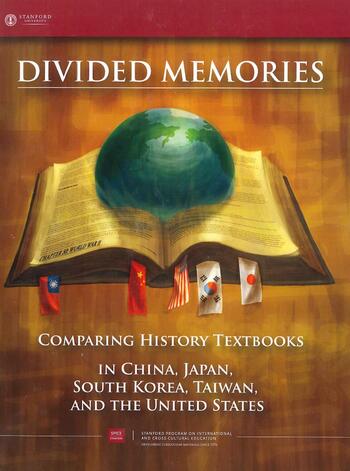
"Formal education is a powerful force in shaping our historical understandings," Sneider noted. "We wanted to look at the textbooks that have the most impact and usage."
A 2014 book, Confronting Memories of World War II: European and Asian Legacies, which was co-edited by Shin, Sneider and Daniel Chirot, a sociologist with the University of Washington, compared successful European WWII reconciliations with lagging Asian efforts. Another book, Divided Lenses, published earlier this year, examined the impact of dramatic film and other forms of popular culture on wartime memory. A new book is due out this summer, Divergent Memories: Opinion Leaders and the Asia-Pacific War, which focuses on leaders in politics, the media and academia in Japan, China, South Korea and the U.S.
The Divided Memories project aims to generate discussions and collaborations among those who create "historical memories" – educators, policymakers and government leaders. One report that grew out of such dialogues included suggestions for reconciliation:
- Create supplementary teaching materials on the issue.
- Launch dialogues among Asian, American and European historians.
- Offer educational forums for journalists, policymakers and students.
- Conduct museum exchanges and create new museums, such as one wholly dedicated to WWII reconciliation in Asia.
- Increase student exchanges among all the countries involved.
History is reflected in today's geopolitics, as noted in the revived disputes by these nations over rival claims to islands in the South China Sea and elsewhere. Without resolution, these disagreements can flare up into military conflicts, Sneider wrote.
"The question of history taps into sensitive and deeply rooted issues of national identity," he noted.
Whether recounting Japanese atrocities in China, China's exaggerated account of its Communist fighters' role in World War II, or the U.S. decision to drop atomic bombs on Japan, no nation is immune to re-creating the past to further its own interests today, Sneider wrote.
For example, Divided Memories research on Chinese textbooks shows how the Chinese government in recent decades embarked on a "patriotic education" campaign to indoctrinate young people by exaggerating its role in Japan's WWII defeat. This narrative suits the nationalistic desires of a Chinese government no longer exclusively motivated by communist ideology, Sneider said.
One project of APARC and its Japan Program that was also an outgrowth of Divided Memories involved Stanford scholars urging Japanese Prime Minister Shinzo Abe to show "clear, heartfelt remorse" in a 2015 speech on the 70th anniversary of the end of WWII. A 15-page report featured hypothetical statements suggesting what Abe might say to make amends for Japanese actions in China and Korea.
"While we cannot claim to have directly influenced the prime minister, his statement did go further in the direction of an expression of remorse over the war and the need to continue to look clearly and honestly at the past than many expected," said Sneider.
Image
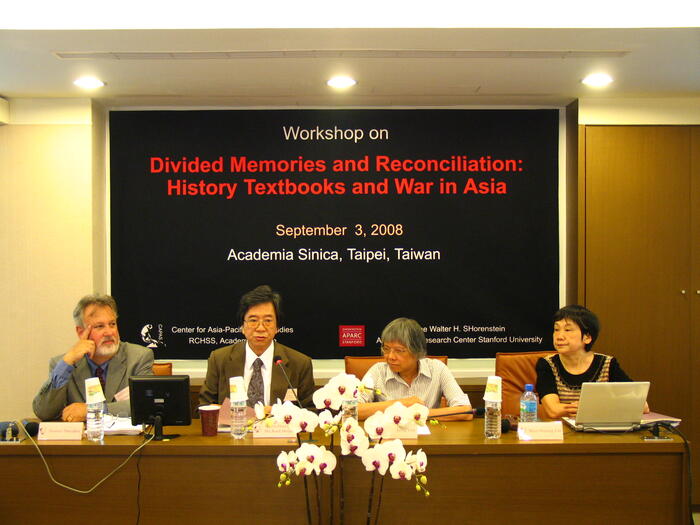
A workshop on history textbooks co-hosted by Shorenstein APARC and Academia Sinica's Center for Asia-Pacific Area Studies takes places in Taipei, Sept. 3, 2008.
Generations and grievances
Consciousness-raising on other fronts, however, is getting results, thanks to Stanford's Divided Memories project. A 2015 landmark agreement between Japan and South Korea over the WWII "comfort women" dispute was reached due to extensive U.S. involvement. Comfort women were women and girls who were forced into sexual slavery by the Imperial Japanese Army in occupied territories before and during World War II.
In an article, Sneider explained how the U.S. perceived that the dysfunctional relationship between South Korea and Japan over this issue, among others, threatened to undermine American strategic interests in Asia.
Shin highlights the importance of U.S. involvement. "The U.S. is not just an outsider to historical and territorial disputes in the region," he said. "From a geopolitical perspective, the U.S. has done a wonderful job in reviving the devastated region into a prosperous one after 1945, but from a historical reconciliation perspective, the U.S. has done a poor job."
He suggests that America should "play a constructive role in promoting historical reconciliation" among the countries involved. And so, the Divided Memories project has included the United States in its efforts.
According to Sneider, Divided Memories is unique among all reconciliation projects for its emphasis on the inclusion of the U.S.; comparative analyses across countries; and real-world policy impacts. As part of the Shorenstein research center, it is housed within Stanford's Freeman Spogli Institute for International Studies.
"This project reflects what Stanford, our center and the Freeman Spogli Institute are all about – true interdisciplinary research and engagement," Sneider said.
Clifton Parker is a writer for the Stanford News Service.
Hero Image

All News button
1
Advancing U.S.-Japan-ROK Trilateral Cooperation: A U.S. Perspective
Paragraphs
An analysis of the foundations and future of the trilateral relationship from a U.S. perspective, highlighting the critical role the United States has played in mediating tensions between the Republic of Korea and Japan.
The essay is also part of an expanded NBR Special Report with co-authors Yul Sohn and Yoshihide Soeya that offers insights into both the past and future of trilateral cooperation and provides recommendations for leaders in all three nations to move relations foward.
All Publications button
1
Publication Type
Policy Briefs
Publication Date
Journal Publisher
National Bureau of Asian Research (NBR)


Five years later, remembering Tohoku
News Type
News
Date
Paragraphs
My daughter, Emily, was teaching English at a middle school in Asahi City, Chiba Prefecture, on the Japan Exchange and Teaching (JET) Program when the 2011 Tohoku earthquake struck on March 11, 2011. Tohoku is a region in the northeast portion of the island of Honshu, the largest island in Japan. Though Asahi City, a coastal city, is not in the Tohoku region, it was still heavily damaged by the resulting tsunami. Several of Emily’s students lost their homes. She was emotionally shaken, of course, but was fortunate not to sustain any injuries.
With the fifth anniversary of the 2011 Tohoku earthquake and tsunami approaching, I have been reflecting upon the tremendous anxiety that I felt that day about Emily’s safety, my wife’s family in Tohoku, and the people of Japan in general. My reflections deepened last week while observing the interaction of SPICE’s Reischauer Scholars Program (RSP) students (American high school students studying about Japan) with SPICE’s Stanford e-Japan students (Japanese high school students studying about the United States) in an informal online “social hour.” The RSP and Stanford e-Japan are distance-learning courses that are offered by SPICE.
Stanford e-Japan instructor Waka Brown and RSP instructor Naomi Funahashi organized the social hour to help to build bridges between youth in Japan and the United States. During the latter part of the social hour, RSP student, David Jaffe (Mesa, Arizona), posed the question, “How is 3.11 remembered today?” Among the many Stanford e-Japan students who spoke was Minoru Takeuchi (Sakura City, Chiba Prefecture), who stated, “When the earthquake happened, I was an elementary school student (12 years old). I still remember very well… at that time, I was in school. Some students were very afraid and crying… Maybe after the earthquake, many Japanese noticed the importance of working together, the preciousness that they could meet their friends…” The Japanese students’ sharing of their experiences related to 3.11 extended the social hour far beyond the hour, and the gratitude expressed by the American students to their counterparts in Japan flowed for many minutes in a text-chat box.
Observing the students was one of the most rewarding experiences of my career at SPICE. The Japanese students’ remembrances of 3.11 brought back poignant and difficult memories for me but also provided me with hopeful thoughts on the future of the U.S.–Japan relationship as I witnessed students from across the Pacific forming budding friendships and discussing topics of mutual relevance.
Resources for the classroom
My hope is that teachers will carve out some time in their curriculum to engage their students in a study of 3.11 as well as its legacies. The study of natural hazards ought to be a core part of school curriculum. SPICE has undertaken many curricular projects related to 3.11. I would recommend that teachers show the film, After the Darkness, which was produced by Risa Morimoto and Funahashi. After the Darkness is a documentary film that touches upon the events of the disaster itself but also focuses on the experiences of two survivors in particular. It is accompanied with free curricular lessons that are accessible to students of various ages. I also recommend a lecture by Professor Emeritus Daniel Okimoto, Stanford University, on “Japan’s Geological Factors,” which is accompanied by a free lesson plan. Another recommended curricular unit is SPICE’s Examining Long-term Radiation Effects, which was produced prior to 3.11 but can help students understand the radiation-related concerns following the Fukushima Daiichi nuclear disaster. In addition, the film, Live Your Dream: The Taylor Anderson Story, is about one of two American JET Program teachers who lost their lives during 3.11. SPICE developed a teacher’s guide for the film that can be freely downloaded from the Live Your Dream: The Taylor Anderson Story website. Lastly, I recommend the use of the films from the 113 Project in classrooms. Earlier this week, I moderated a panel discussion that included Wesley Julian (director of the 113 Project), Andy Anderson (father of Taylor Anderson and board member of the Taylor Anderson Memorial Fund) as well as other Americans and Japanese who continue to contribute to relief efforts in the Tohoku region.
Hero Image

All News button
1