Authors
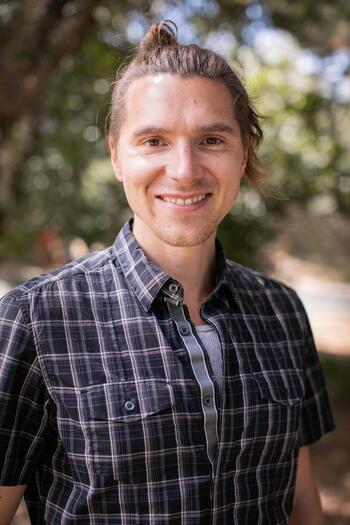
Jonas Edman
News Type
Blogs
Date
Paragraphs

Stanford e-Tottori is a distance-learning course sponsored by the Tottori Prefectural Board of Education and the Stanford Program on International and Cross-Cultural Education (SPICE) at Stanford University. Tottori Governor Shinji Hirai and Superintendent Hitoshi Yamamoto of the Tottori Prefectural Board of Education were instrumental in its establishment. Offered for the first time in 2016, Stanford e-Tottori presents a creative and innovative approach to teaching Japanese high school students about U.S. society and culture. Stanford e-Tottori Instructor Jonas Edman recently wrote these reflections on his work with students in Tottori.


While visiting Tottori Prefecture during the summer, I came to realize that Tottori, which once seemed like a distant and isolated place in my mind, has become a central part of my life’s neighborhood. In early August, I attended the closing ceremony for the third-year course offering of Stanford e-Tottori. On the same day, I attended the opening ceremony for the fourth-year course offering of Stanford e-Tottori. During the ceremonies, student representatives from several high schools in Tottori—Seishokaichi High School, Tottori Nishi High School, and Yonago Higashi High School—offered very meaningful messages. While listening to them, I felt so fortunate to be living in a time when technology affords me the opportunity to work in real time with students on the other side of the Pacific.

We are now in the midst of the fourth-year course offering, and I am already noticing significant growth in the English abilities and critical thinking skills of my 30 students. We have discussed topics ranging from studying at universities in the United States to the popularity of Japanese manga (comics or graphic novels) in the United States. My colleagues Rylan Sekiguchi and Naomi Funahashi led a very engaging discussion on studying at universities in the United States, and my students shared thoughts on what they perceive to be similarities and differences in studying at universities in Japan. The discussion of manga led to feelings of pride among my students, having come to realize the prevalence of Japanese manga in the United States. Tottori is very famous for its manga artists.

Whenever I work with my students in online classes from Stanford on topics like manga, I feel like I have been transported back to Tottori as I see the 30 familiar faces of students whom I first met in Tottori. This inevitably prompts me to reflect upon several key observations that I have made during my several visits to Tottori. First, while traveling in Tottori, one can almost feel that Tottori is the least populated prefecture in Japan. Perhaps correlated with this fact is how I have always been struck by the attention the students receive from their teachers. This infectious dedication to educating the next generation of leaders has had a ripple effect across the Pacific to us at SPICE and my guest speakers for Stanford e-Tottori. For example, Silicon Valley entrepreneur Takeshi Homma, who hails from Tottori, puts his heart and soul into his talk on “Entrepreneurship and Silicon Valley” each year. Second, Tottori is known for its nature and agriculture, and the importance of preserving the environment seems foremost on people’s minds. This is a global mindset that I wish others in the United States and Japan would share. Our online class on the environment has always prompted spirited discussions. Third, since I spent 16 years of my youth in Tokyo, I cannot help but notice the slower pace of life in Tottori. Magically, the slower pace helps me to take notice of each valuable moment that I spend with my students not only in person but virtually as well. Topics like aging and population decline are ones that have drawn interest and critical attention not only in Tottori but across Japan.

In closing, I would like to especially thank Takuya Fukushima, Office Director of the English Education Advancement Office, and Tomoya Minohara, Teachers’ Consultant, Tottori Prefectural Board of Education, for their unwavering support of Stanford e-Tottori and for bringing Tottori into my life’s neighborhood.


To stay informed of SPICE-related news, join our email list and follow SPICE on Facebook, Twitter, and Instagram.


Related articles:


Hero Image
Opening ceremony for the fourth-year course offering of Stanford e-Tottori
Opening ceremony for 2019 Stanford e-Tottori, courtesy Takuya Fukushima, Officer Director of the English Education Advancement Office, Tottori Prefectural Board of Education
All News button
1
-
Title: Why Do Data-Use Agreements Take So Long? A Study of Top-50 Research Universities
 
Dr. Michelle M. Mello, M.Phil., Ph.D., J.D.
 
Professor of Law
Professor of Medicine (Health Services Research)
 
Michelle Mello is a leading empirical health law scholar. Her research is focused on understanding the effects of law and regulation on health care delivery and population health outcomes. She has authored over 190 articles and book chapters on the medical malpractice system, medical errors and patient safety, public health law, regulation of pharmaceuticals, biomedical research ethics and governance, obesity policy, in addition to other topics. She was elected to the National Academy of Medicine at the age of 40 and is the recipient of a number of awards for her research.
 
Dr. Mello teaches courses in torts and public health law. She received a J.D. from the Yale Law School, a Ph.D. in Health Policy and Administration from the University of North Carolina at Chapel Hill, an M.Phil. from Oxford University, where she was a Marshall Scholar. She also holds a B.A. from Stanford University.
 
 
David M Studdert, LLB, ScD, MPH
 
Professor of Law
Professor of Medicine (PCOR)
 
 
David M. Studdert is a distinguished expert in the fields of health law and empirical legal research. His scholarship explores how the legal system influences the health and well-being of populations. A prolific scholar, he has authored more than 150 articles and book chapters, and his work appears frequently in leading international medical, law, and health policy publications.
 
Professor Studdert joined Stanford Law School faculty on November 1, 2013, in a joint appointment as Professor of Medicine (PCOR/CHP) and Professor of Law. Before joining the Stanford faculty, Professor Studdert was on the faculty at the University of Melbourne (2007-13) and the Harvard School of Public Health (2000-06). He has also worked as a policy analyst at the RAND Corporation, a policy advisor to the Minister for Health in Australia, and a practicing attorney.
 
Professor Studdert has received the Alice S. Hersh New Investigator Award from AcademyHealth, the leading organization for health services and health policy research in the United States. He was awarded a Federation Fellowship (2006) and a Laureate Fellowship (2011) by the Australian Research Council. He holds a law degree from University of Melbourne and a doctoral degree in health policy and public health from the Harvard School of Public Health.
 

CHP/PCOR Conference Room
Encina Commons, Room 119
615 Crothers Way, Stanford, CA 94305

Seminars
-

Image
Ashish Goel
Abstract:

While the Internet has revolutionized many aspects of our lives, there are still no online alternatives for making democratic decisions at large scale as a society. In this talk, we will describe algorithmic and market-inspired approaches towards large scale decision making that our research group is exploring. We will start with a model of opinion dynamics that can potentially lead to polarization, and relate that to commonly used recommendation algorithms. We will then describe the algorithms behind Stanford's participatory budgeting platform, and the lessons that we learnt from deploying this platform in over 70 civic elections. We will use this to motivate the need for a modern theory of social choice that goes beyond voting on candidates. We will then describe ongoing practical work on an automated moderator bot for civic deliberation (in collaboration with Jim Fishkin's group), and ongoing theoretical work on deliberative approaches to decision making. We will conclude with a summary of open directions, focusing in particular on fair advertising. 

Ashish Goel Bio

Lunch Seminar Series Flyer
  • E207, Encina Hall
  • 616 Jane Stanford Way, Stanford, CA 94305
 
0
ashish_goel.jpg
Ashish Goel is a Professor of Management Science and Engineering and (by courtesy) Computer Science at Stanford University, and a member of Stanford's Institute for Computational and Mathematical Engineering. He received his PhD in Computer Science from Stanford in 1999, and was an Assistant Professor of Computer Science at the University of Southern California from 1999 to 2002. His research interests lie in the design, analysis, and applications of algorithms; current application areas of interest include social networks, participatory democracy, Internet commerce, and large scale data processing. Professor Goel is a recipient of an Alfred P. Sloan faculty fellowship (2004-06), a Terman faculty fellowship from Stanford, an NSF Career Award (2002-07), and a Rajeev Motwani mentorship award (2010). He was a co-author on the paper that won the best paper award at WWW 2009, and an Edelman Laureate in 2014. Professor Goel was a research fellow and technical advisor at Twitter, Inc. from July 2009 to Aug 2014.
Ashish Goel Professor of Management Science and Engineering
Seminars
Authors
News Type
News
Date
Paragraphs

In front of a crowd of more than 750 people, Susan Rice, national security advisor in the Obama administration, sat down with Michael McFaul to talk about her new memoir “Tough Love: My Story of the Things Worth Fighting For.” McFaul, the director of the Freeman Spogli Institute for International Studies, is also a  former member of the Obama administration, having served as the U.S. Ambassador to Russia. Together they discussed her service under President Obama, the political divisions in the U.S., and her book’s focus on family and the importance of learning from your mistakes.

Rice devoted a significant portion of the book to describing the experiences of her family members, including her great-grandfather, a slave in South Carolina who went on to found a private school for African American students; and her mother, who was instrumental in establishing the Pell Grant, which has enabled 80 million Americans from low-income backgrounds to attend college.

[Get stories like this delivered to your inbox by signing up for FSI email alerts]

“Their history and experience truly defines who I am,” Rice told McFaul. “As the granddaughter of immigrants from Jamaica who went to Portland, Maine, in 1912 with literally nothing — no education, just the hunger and ambition that so many immigrants bring to this country. My grandfather was a janitor, my grandmother was a maid. They saved and they scraped, and they sent all five of their kids to college.”


Rice explained that her decision to attend Stanford over the east coast Ivy League schools“wasn’t popular” with Rice’s mother, a Radcliffe College alumna.

“For me, the exposure to the west coast, to the Pacific, and to the history and culture of this part of the world was quite eye-opening,” Rice said. “I made wonderful friends that I’ve kept to this day. My only regret, frankly, is that I only had four years here.”


The former diplomats also discussed Rice’s time serving in the Obama Administration. Five days after the 2012 terrorist attack on the U.S. consulate in Benghazi, Libya, Rice was tasked with representing the administration on political talk shows, an experience for which she felt she was “characterized and mischaracterized,” she said.

“I was compelled as a senior administration official and public servant to speak only on behalf of our country and on behalf of the president, which was my job and I accepted it,” Rice explained. “That was the right thing to do. But I couldn’t in any way, shape, or form tell my own story in my own words. So writing this book — it was something I felt I needed to do.”


Rice shared one of her most memorable experiences of “tough love” with the audience, which took place at the end of her first year at the State Department. Howard Wolpe, then a Congressman from Michigan, took Rice out to lunch and gave her some career advice, which included a suggestion that she make more of an effort in listening to the views and experiences of others.

“It was critical in enabling me to learn, to grow, and to change, and to become a more effective leader — to learn that leadership is a team sport, not an individual sport,” she said. “And I got there, but not without making some mistakes along the way.”


[Subscribe to the FSI YouTube channel to be notified of new videos with leading policymakers.]

Hero Image
susan rice  cropped
Former National Security Advisor Susan Rice discussed her memoir “Tough Love: My Story of the Things Worth Fighting For” with Michael McFaul on November 12 at Stanford University. Photo: Rod Searcey
All News button
1
Authors
News Type
Commentary
Date
Paragraphs

Image
screen shot 2019 11 20 at 9 08 20 am

Given much of the recent coverage surrounding security and the fifth generation (5G) of cellular networks, you would be forgiven for assuming that security concerns are largely limited to China in general and Huawei in particular.

This is not the case.

Equally important are the concerns for United States’ security that extend beyond Huawei’s role in the development and deployment of 5G technology. Notably, while Huawei amplifies many pre-existing areas of concern, 5G would represent a significant challenge for American national security even if China was not a peer competitor in the market. 


Read the rest at The Wilson Center

Hero Image
melissa griffith 0
All News button
1
Authors
News Type
News
Date
Paragraphs

A project 20 years in the making officially came to completion with the dedication of the restoration of Encina Commons and new Bechtel Courtyard on November 7.

The new space will be shared by the Freeman Spogli Institute for International Studies and two departments in the School of Humanities and Sciences: Stanford Global Studies and the Department of Political Science. Philanthropic support played a key role in the renovations.

“I am thrilled that we now have this stunning courtyard for our faculty and students to use and enjoy,” said FSI Director Michael McFaul, professor of political science. “There is no doubt that FSI needs the space, as do our partners in the School of Humanities and Sciences, and I am confident that our Master’s in International Policy students will make the most of it.” Professor McFaul is also the Ken Olivier & Angela Nomellini Professor in International Studies.

The space will help establish an international studies hub at FSI by connecting Encina Commons and Encina Hall: the large courtyard is accessible by stairs from Bechtel Conference Room in Encina Hall and from a new lobby area in Encina Commons.

In her remarks during the dedication ceremony, Dean Debra Satz, Vernon R. and Lysbeth Warren Anderson Dean of the School of Humanities and Sciences and
Marta Sutton Weeks Professor of Ethics in Society, emphasized how the new area reflects Stanford’s commitment to promoting collaboration between academic departments and interdisciplinary research.

“The space people are in can really facilitate or inhibit what happens,” Satz said. “At Stanford, we place a strong emphasis on interdisciplinary research and teaching, and I think of this space as a material embodiment of that commitment. We have a lot of faculty who are shared between the School of Humanities and Sciences and FSI and this symbolizes and valorizes that sharing of people.”

Provost Persis Drell and Vice Provost and Dean of Research Kathryn Moler also made remarks at the ceremony, while University Architect and Director of Campus Planning David Lenox spoke about the history of Encina Hall, which was originally a men’s dorm, and described the transformation of the once “not-so-nice-looking” courtyard to the new and improved present-day space.


Also new to Encina Commons is an atrium and bridge across the new open lobby, which connects both of the second-floor wings. Several conference rooms have also been added to the first floor as part of the new Moghadam Conference Center.

Across the courtyard, in Encina Hall, the main lobby has been renamed the Coit D. Blacker lobby in honor of FSI’s director, affectionately known as Chip, from 2003 to 2012, who championed the renovation project.

“Chip understood that we needed a space for international studies, and that we needed a space to allow FSI to grow,” said McFaul. “It was his vision and his dedication to working with campus partners that got us here today.”
 

The space around Encina Commons and the Bechtel Courtyard is a material embodiment of Stanford’s commitment to interdisciplinary research. Today we inaugurated this beautiful space, a project 20-years in the making. pic.twitter.com/mvehzOtwY9

— FSI Stanford (@FSIStanford) November 8, 2019


A New Look for MIP and International Relations
The ground floor of Encina Hall, which houses the Ford Dorsey Master’s in International Policy (MIP) program, has been remodeled and is now open. Renovations to the academic space, which is adjacent to the Bechtel Courtyard, will allow students more space for collaboration and will bring all of the MIP staff offices together in a centralized location. 

Another big change for the MIP program was announced last summer: Professor Francis Fukuyama, one of the most well-known and respected social scientists in the world, took over as the program’s director in August.

The International Relations program also has a new space on the ground floor of Encina Hall, which will foster academic collaboration and enhance the MIP student experience, and the space is also home to the Center for Human Rights and International Justice within the Stanford Global Studies division.

“This is a critical time to prepare our students to be policy leaders in government, civic society, and the private sector,” said Fukuyama, who is the Mosbacher Director at the Center for Democracy, Development and the Rule of Law and Olivier Nomellini Senior Fellow at FSI. “Our curriculum aims to be among the best in international policy education, and continues to get stronger with new faculty, courses, and terrific students.”

The following donors made the Bechtel Courtyard and Encina Commons renovation possible:
The S.D. Bechtel, Jr. Foundation and Stephen D. Bechtel, Jr.
Laurie Dachs
Ken Olivier and Angela Nomellini
Hamid and Tina Gwatkin Moghadam


Watch the evening’s complete dedication ceremony on the FSI YouTube channel:

Hero Image
courtyard cropped
A dedication ceremony was held on November 7, 2019 to celebrate the opening of Bechtel Courtyard and Encina Commons at the Freeman Spogli Institute for International Studies. Photo: Rod Searcey
All News button
1
Authors
Gary Mukai
News Type
News
Date
Paragraphs

This fall, the Stanford Program on International and Cross-Cultural Education (SPICE) began its ninth offering of Stanford e-Japan, an online course that introduces U.S. society and culture and U.S.–Japan relations to high school students in Japan. Stanford e-Japan is made possible through the support of the Yanai Tadashi Foundation, Tokyo. The fall 2019 Stanford e-Japan online course has continued the tradition of enrolling students from various parts of Japan; engaging students with leading American and Japanese academics, entrepreneurs, and community leaders as guest speakers; and encouraging students to study in the United States.

The 28 students of the fall 2019 cohort were selected from among a competitive group of applicants from throughout Japan. The selected students represent the prefectures of Chiba, Ehime, Gunma, Hiroshima, Hyogo, Ibaraki, Kanagawa, Kyoto, Mie, Miyagi, Nara, Okayama, Saitama, and Tokyo. Stanford e-Japan Instructors Meiko Kotani and Waka Brown have noted that their students not only continue to learn important content and perspectives from the guest speakers but also important perspectives from their fellow students. Brown recalled, “…last year, I was particularly struck by the impact a student from Okinawa had on the other students in his cohort as he shared insights on the U.S. military presence in Okinawa from his personal experiences.”

The fall 2019 course recently featured guest speaker Suzanne Basalla, who has become a regular speaker for Stanford e-Japan. Basalla is Chief of Staff at the Toyota Research Institute in Silicon Valley and a former officer (Lieutenant Commander) of the U.S. Navy. Following her naval career, Basalla served as Director for Japan in the Office of the Secretary of Defense and as Senior Advisor to U.S. Ambassador to Japan John Roos, serving at the U.S. Embassy in Tokyo from 2010 to 2012. During her talk with the students, she touched upon her work with security-, economic-, political-, and cultural-related issues in the U.S.–Japan relationship and also offered keen insights into her current work as a leading entrepreneur in Silicon Valley.

Speakers like Basalla as well as Instructors Brown and Kotani have been encouraging Japanese students to consider studying in the United States. Many Stanford e-Japan alumni have enrolled in summer programs in the United States, spent a year studying abroad in the United States, and several have enrolled in four-year colleges in the United States. Among the latter are Jun Yamasaki (Fall 2017 Stanford e-Japan cohort) and Hanako “Hannah” Tauchi (Spring 2017 Stanford e-Japan cohort), who are recipients of Yanai Tadashi Foundation Scholarships. The following is noted on the scholarship’s website.

[The] Yanai Tadashi Foundation Scholarship aims to provide promising young people with leadership potential the opportunity to study at world-class universities in the United States. The scholarship enables recipients to mix with an internationally diverse student body to cultivate their entrepreneurial skills and enhance their global perspective, encouraging their development as future drivers of a better society.

Yamasaki, a freshman at Northwestern University, and Tauchi, a freshman at the University of California, San Diego, recently commented on how Stanford e-Japan helped them as high school students to prepare for undergraduate studies in the United States. Their comments follow.

Yamasaki: As an institution, Northwestern places a great emphasis on interdisciplinary studies and learning—a characteristic that is apparent in both its research and the academic interests and aspirations of its students. The structure of the Stanford e-Japan program itself encouraged me to examine the U.S.–Japan relationship through multiple perspectives, ranging from sports to entrepreneurship. In addition to furthering my understanding of the dynamics of the U.S.–Japan relationship, Stanford e-Japan helped me identify the intersection between my past interests and the potential future needs and topics pertaining to the U.S.–Japan relationship, and construct my future goals accordingly. This in turn has allowed me to better plan out how I can take full advantage of Northwestern’s unique characteristics and offerings, which I am extremely thankful for. 

Tauchi: The Stanford e-Japan Program was an amazing opportunity for me both to consider undergraduate studies in the U.S. as a realistic option and to improve my English skills overall. As a student who was schooled in Japanese for my entire life, the course—lectures, reading assignments, discussions, and essays—was at first quite challenging, but looking back the half a year I worked on the program, I would definitely say that the program is one of the most important experiences that I had during my high school life. Offered by one of the most renowned colleges in the world, I could feel and imagine how college life in the U.S. would be like. Of course, the contents of the course—things that students do not normally learn in Japanese high school—were all interesting and motivated me to learn more about the U.S.–Japan relationship and beyond. 

Kotani and Brown hope that Stanford e-Japan alumni like Yamasaki and Tauchi will continue to play roles in U.S.–Japan relations beyond their college years. Kotani recently shared that “the Stanford e-Japan guest speakers like Suzanne Basalla, with such fascinating careers, are such excellent role models for the students. My hope is that many alumni of Stanford e-Japan will consider working for businesses in places like Silicon Valley and other organizations in Japan and the United States that focus on the U.S.–Japan relationship.” Brown, who will be recognized with the Elgin Heinz Outstanding Teacher Award at a ceremony at Stanford University on December 5, 2019, has noted that, “I feel so honored to be recognized with the 2019 Elgin Heinz Outstanding Teacher Award for my work as the Instructor of Stanford e-Japan and am especially looking forward to seeing one of my former Stanford e-Japan students, Ryoga Umezawa, who is studying at the Minerva Schools at Keck Graduate Institute in San Francisco.”

Image
Meiko Kotani
Kotani recently assumed the role of Co-Instructor of Stanford e-Japan with Brown. She concurrently works as a Program Manager for NTT Physics & Informatics Laboratories and brings on-the-ground experiences in Silicon Valley to her students. Kotani is a graduate of the University of Oregon (international relations) and obtained a master’s degree from the Schiller International University in Paris (international relations and diplomacy). Kotani, who is multilingual (English, Japanese, and French), was born in Japan and lived in China, Oman, Pakistan, France, and Russia before coming to the United States.

To stay informed of SPICE-related news, join our email list and follow SPICE on Facebook, Twitter, and Instagram.


Related articles:


Hero Image
Stanford e-Japan alumni Jun Yamasaki and Hanako “Hannah” Tauchi
Stanford e-Japan alumni and Yanai Tadashi Scholarship recipients, Jun Yamasaki and Hanako Tauchi; photos courtesy of Jun Yamasaki and Hanako Tauchi
All News button
1
Authors
News Type
News
Date
Paragraphs

Two former Department of Defense (DoD) officials shared the stage at the Freeman Spogli Institute for International Studies (FSI), where they discussed the decision to remove U.S. troops from northern Syria, women in the military, and the importance of public service.

Ash Carter — who served as secretary of defense from 2015 to 2017 — told Joe Felter — former deputy assistant secretary of defense for South and Southeast Asia — that he emphasized the importance of tradition and had high standards for good conduct from his employees when he was at the head of the DoD, which had 1.3 million active-duty employees in 2016, and is the largest employer in the world.

[Get stories like this delivered to your inbox by signing up for FSI email alerts]

“Even if you come into an organization and take over and your judgement is that it’s really quite broken, it’s still worth finding the things that it is good at and making the people proud of the things that they are already good at,” Carter said.


Felter asked Carter about a topic on the minds of some in Silicon Valley — the possible development of autonomous weapons — and whether the liability for harm should lie with the developer of technology, or those who make the decision to execute the use of the weapon.

“It’s going to be a shared responsibility,” Carter said. “The key thing is not to get lost in AI is human responsibility — AI is an aid to human decision-making, but at the end of the day, somebody is responsible.”


When asked about the relationship between tech companies and the government, Carter said he had encountered some tech leaders who didn’t think government mattered during the earlier days of his government service, but added that he has noticed a different attitude from young people today.

“My students know that something’s wrong in the relationship between tech and society… it brings a lot of great stuff, but it has brought some real darkness too, and we need to get on top of that,” Carter said. “And that’s how they want to spend their lives.”


When Felter asked Carter what he would say to a graduating Stanford student to encourage him or her to pursue a career in public service, Carter didn’t have to think twice before responding.

“I’d say, ‘Look, the building smells like your high school, the pay is terrible, and work conditions can be awful. But the mission is the best. And you’ll wake up every morning and be a part of something that is meaningful.’”


[Find more upcoming events with experts on international affairs on the FSI website]

Hero Image
ash carter cropped
Former Secretary of Defense Ash Carter talks to former Deputy Assistant Secretary of Defense for South and Southeast Asia Joe Felter about his career in service at the Freeman Spogli Institute for International Studies. Photo: Alice Wenner
All News button
1

616 Jane Stanford Way
Encina Hall, E005
Stanford, CA 94305-6060

0
kasumi_yamashita.jpeg AM

Kasumi Yamashita is an Instructor for the Stanford Program on International and Cross-Cultural Education (SPICE), currently teaching an online course for high school students in Oita Prefecture, Japan, called Stanford e-Oita. Kasumi’s academic interests are in cultural anthropology, international education, and language technologies, and her research focuses on the Japanese diaspora in the United States and Latin America. While conducting fieldwork for her PhD in Anthropology at Harvard University, she spent a year at the University of São Paulo, as a Fulbright Scholar. She explored narrations of memory and migration, and community involvement in the emergence of Japanese diaspora museums throughout Brazil, including the Museu Histórico da Imigração Japonesa no Brasil (Historical Museum of Japanese Immigration to Brazil). Kasumi researched Nikkei Latin American communities in Japan while at Hitotsubashi University on a Japanese government scholarship. She earned an AM in Regional Studies–East Asia from Harvard University. 

Kasumi received a BS in Studio Art from New York University. She was a University Scholar and spent her junior year in Spain at the Instituto Internacional in Madrid. After graduating from NYU, she taught English as an Assistant Language Teacher (ALT) and later worked as a Coordinator for International Relations (CIR) on the Japan Exchange and Teaching (JET) Program. As a CIR at Yukuhashi City Hall, Fukuoka Prefecture, she founded a Japan–U.S. student and teacher exchange program between middle schools in Yukuhashi City and the Grace Church School in New York. More than 500 students and teachers from the United States and Japan have participated in the program since she launched it in 1994. That year, she published a book of essays chronicling her experiences as a Japanese American woman in a small Japanese town, Kasumi no Yukuhashi Nikki (Kaichosha Press).

In New York, she served as a member of the local staff of the Permanent Mission of Japan to the United Nations under the leadership of Ambassador Hisashi Owada. She also served on the Executive Committee of the Convención Panamericana Nikkei (COPANI XI) in New York and has been involved in past conferences across the Americas, most recently COPANI XX in San Francisco (CA) in 2019.

Kasumi also teaches and develops web-based curricula for the Translation and Interpretation Program at Bellevue College (WA). Kasumi frequently interprets for Japanese delegations in various fields (including education, technology, international relations, film, art, and museums) and serves on the Board of the Japanese Cultural and Community Center of Washington (JCCCW).


Instructor, Stanford e-Oita
Instructor, Stanford e-Fukuoka
-

This event is cosponsored with the Stanford Woods Institute for the Environment


Seminar Recording: https://youtu.be/yMVJu1gmRFk


Abstract: Joshua Busby, University of Texas-Austin, will present the main argument and empirical work from his draft book manuscript. Over the past decade, a rich literature on the connections between climate change and security emerged, much of it quantitative on the links between climate change and violent internal conflict. In this book manuscript, Busby seeks to widen the aperture of security concerns to include major humanitarian emergencies. Through the study of paired cases, he explores why countries that face similar physical exposure to climate hazards experience different outcomes. His argument combines state capacity, the degree of political inclusion, and the role of international assistance to explain differences between countries as well as within countries over time. Countries with low state capacity, high political exclusion, and where assistance is denied or delivered in a one-sided manner are expected to have the worst security outcomes in the wake of exposure to climate hazards. While assistance can sometimes compensate for weak state capacity, improvements in capacity and inclusion can diminish the risks of climate-related emergencies and conflict. In this talk, Busby will compare the experience of Bangladesh, India, and Myanmar to cyclones.


Speaker's Biography:

Joshua Busby is an Associate Professor at the LBJ School of Public Affairs at the University of Texas-Austin. He is also a Senior Research Fellow at the Center for Climate and Security. He has been part of two U.S. Department of Defense-funded research projects on climate and security and his work on the topic has been published in Foreign Affairs, World Development, Climatic Change, Political Geography, International Security, Security Studies, among other publications.


Joshua Busby Associate Professor University of Texas-Austin
Seminars
Subscribe to The Americas