-

For spring quarter 2022, CISAC will be hosting hybrid events. Many events will offer limited-capacity in-person attendance for Stanford faculty, staff, fellows, visiting scholars, and students in accordance with Stanford’s health and safety guidelines, and be open to the public online via Zoom. All CISAC events are scheduled using the Pacific Time Zone. 


About the Event: Existing literature posits that the main challenge for nuclear security guarantees lies in making the promise of protection sufficiently credible. If allies do not believe their guarantor will actually come to their aid, they may seek alternate means of protection, including by investing in nuclear infrastructure. Credible security guarantees, on the other hand, are thought to reassure allies. In contrast to this approach, Dr. Sukin argues that credible nuclear guarantees can backfire. These guarantees can cause clients to fear that their guarantors will drag them into a precipitous nuclear conflict. Fears of nuclear escalation by their guarantor can drive clients to distance themselves from their alliance or seek stronger independent nuclear capabilities. Using survey experiments and case studies of U.S. alliances in East Asia and Europe, this project explores the risks of credible U.S. nuclear security guarantees.


About the Speaker: Dr. Lauren Sukin is currently a MacArthur Nuclear Security Fellow at Stanford University’s Center for International Security and Cooperation. In September 2022, she will join the Department of International Relations at the London School of Economics and Political Science as an Assistant Professor of International Relations. Dr. Sukin holds a Ph.D. (2021) and M.A. (2020) from the Department of Political Science at Stanford University. She also holds A.B.s from the Departments of Political Science and Literary Arts at Brown University (2016). Dr. Sukin’s research examines issues of international security, focusing on the role of nuclear weapons in international politics.

Virtual to Public. Only those with an active Stanford ID with access to William J Perry Conference Room in Encina Hall may attend in person. 

Lauren Sukin
Seminars
-

For spring quarter 2022, CISAC will be hosting hybrid events. Many events will offer limited-capacity in-person attendance for Stanford faculty, staff, fellows, visiting scholars, and students in accordance with Stanford’s health and safety guidelines, and be open to the public online via Zoom. All CISAC events are scheduled using the Pacific Time Zone. 

About the Event: Artificial intelligence (AI) has enormous potential for both positive and negative impact, especially as we move from current-day systems towards more capable systems in the future. However, as a society we lack an understanding of how the developers of this technology, AI researchers, perceive the benefits and risks of their work, both in today's systems and impacts in the future. In this talk, Gates will present results from over 70 interviews with AI researchers, asking questions ranging from "What do you think are the largest benefits and risks of AI?" to "If you could change your colleagues’ perception of AI, what attitudes/beliefs would you want them to have?"


About the Speaker: Dr. Vael Gates is a postdoctoral researcher at the Institute for Human-Centered Artificial Intelligence (HAI) and the Center for International Security and Cooperation (CISAC) at Stanford University. They study perceptions of AI safety, and are currently interviewing technical AI researchers to understand their views about risks from AI. They previously completed their PhD at UC Berkeley, formalizing and testing computational models of social collaboration.

Virtual

Vael Gates
Seminars
-

For spring quarter 2022, CISAC will be hosting hybrid events. Many events will offer limited-capacity in-person attendance for Stanford faculty, staff, fellows, visiting scholars, and students in accordance with Stanford’s health and safety guidelines, and be open to the public online via Zoom. All CISAC events are scheduled using the Pacific Time Zone. 

SEMINAR RECORDING

Virtual to Public. Only those with an active Stanford ID with access to William J Perry Conference Room in Encina Hall may attend in person. 

Gorakh Pawar
Seminars
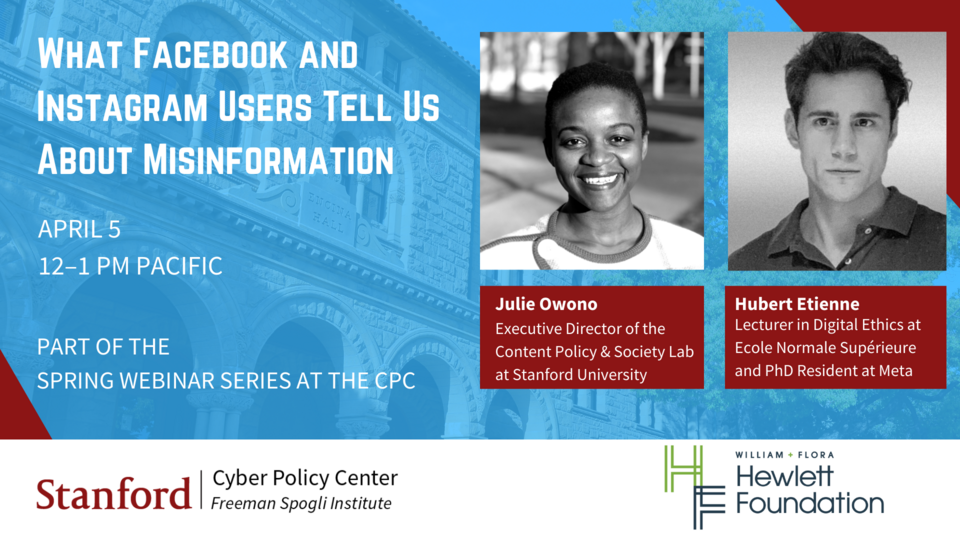
image of encina hall at stanford with blue overlay and headshots of Valerie Shen of Third Way and Aman Nair of CIS

Join us on Tuesday, March 15th from 12 PM - 1 PM PT for “Global Perspectives on Crypto-Asset Regulation” featuring Valerie Shen of Third Way, Aman Nair of the Centre for Internet and Society, in conversation with Kelly Born of the Hewlett Foundation. This weekly seminar series is jointly organized by the Cyber Policy Center’s Program on Democracy and the Internet and the Hewlett Foundation’s Cyber Initiative.

About The Seminar: 

Since the launch of Bitcoin, the world’s first cryptocurrency, just over 10 years ago, the cryptocurrency market has grown to over $2.4 trillion, tripling in value in the last year alone. In addition to its many purported benefits, cryptocurrency poses challenges to the environment, privacy, financial stability, and more. Cryptocurrencies have played an increasing role in the rise of cybercrimes, including ransomware and money laundering. In light of this the Biden Administration, European Union, Indian government, and countries around the world are actively exploring regulatory options to address these and other concerns. On March 15 join Aman Nair of India’s Centre for Internet and Society and Valerie Shen of Third Way, in conversation with Kelly Born of the Hewlett Foundation, to discuss the use cases and limitations of crypto-assets, compare relevant regulatory regimes from around the world, discuss the debate over the proper legal and regulatory framework for crypto-enabled crime, and explore how to govern crypto-assets while supporting widespread financial stability.

Speakers:

Image
Valerie Shen
Valerie Shen directs Third Way's National Security Program and Cyber Enforcement Initiative, a nonpartisan dedicated to strengthening governments’ abilities to identify, stop, and bring malicious cyber actors to justice. Third Way’s National Security program focuses on cutting edge policy ideas and to keep our country safe  against foreign adversaries in the ever-changing and developing cyber ecosystem.  Valerie served as the Chief National Security Counsel to the House Oversight and Reform Committee for Chairman Elijah E. Cummings. She oversaw all national security and homeland security matters from cyber operations and federal law enforcement, to counterterrorism, defense, and counterintelligence. Valerie was also an investigative counsel for the Select Committee on Benghazi and the Senate Homeland Security and Governmental Affairs Committee. Valerie was also a post-doctoral fellow at Georgetown University’s Center for National Security focusing on China’s social media and influence operations. Valerie earned her J.D. from Georgetown University Law Center and her bachelor's degree in Politics from Pomona College.

Image
Aman Nair
Aman Nair is a policy researcher at the Centre for Internet and Society, India (CIS). He leads the financial technologies research agenda at CIS and has been focusing on research on crypto-assets and blockchain technology. He also works on issues of data governance and access to justice. 

Authors
Amy Zegart
News Type
Commentary
Date
Paragraphs

Russia’s invasion of Ukraine looks like a horrific Cold War throwback. Once again, a strongman rules in Moscow, Russian tanks are rolling across borders, and a democratic nation is fighting for its survival, street by street, day by day, armed with little more than Molotov cocktails and a fierce belief in freedom. For all the talk of emerging technologies and new threats, the violence in Ukraine feels raw and low-tech, and the world suddenly looks old again.

And yet, amid all these echoes of the past, Russia’s invasion has ushered in one development that is altogether new and could dramatically change geopolitics in the future: the real-time public disclosure of highly classified intelligence.

Read the rest at The Atlantic

Hero Image
Two hands, one with US flag and one with the Russian flag Yaorusheng/ GettyImages
All News button
1
Subtitle

Never before has the United States government revealed so much, in such granular detail, so fast and so relentlessly about an adversary, Amy Zegart writes. What are the implications of this new strategy?

Authors
News Type
News
Date
Hero Image
Kathryn Stoner and Leopoldo López
All News button
1
Subtitle

Leopoldo López expressed fear about the global rise of a “network of autocracies." He encouraged Stanford students to champion democracy and freedom across the globe.

-

For winter quarter 2022, CISAC will be hosting hybrid events. Many events will offer limited-capacity in-person attendance for Stanford faculty, staff, fellows, visiting scholars, and students in accordance with Stanford’s health and safety guidelines, and be open to the public online via Zoom. All CISAC events are scheduled using the Pacific Time Zone. 


About the Event: Freddy Chen has developed a domestic political theory to explain the consequences of economic shocks for foreign policy. He argues that political leaders have incentives to improve their perceived competence by linking economic grievances to foreign countries. This linkage, in turn, increases public desire for more hawkish foreign policy. Nonetheless, leaders’ ability to make such connections depends on whether they can successfully manipulate information about the culpability for economic shocks. Therefore, the extent to which leaders can control the information environment determines whether an economic shock leads to more aggressive foreign policy. Survey experiments fielded on the American public and a unique sample of U.S. foreign policy analysts show that the information environment shapes elites’ expectations about leaders’ political behavior, public perceptions of leader competence, perceived culpability for the economic shock, and public preferences over foreign policy. Moreover, a cross-national analysis demonstrates that an economic shock tends to increase foreign policy hawkishness if the shock is more foreign-related or if the public has less access to a potential voice of the opposition. This article advances our understanding of the relationship between economic shocks, foreign policy, and public opinion as well as the interactions between domestic politics and international relations, with important implications for both political science research and policymakers.

About the Speaker: Frederick Chen is a Ph.D. Candidate in the Department of Political Science at the University of Wisconsin–Madison and currently a Pre-doctoral Fellow at the Center for International Security and Cooperation at Stanford University. His research focuses on how economics and security can interact to influence international relations, particularly through domestic political mechanisms. His work has appeared in the Journal of Politics and Conflict Management and Peace Science. He received the David A. Lake Award for best paper from the International Political Economy Society. He earned his M.A. in International Relations from Peking University (2016) and B.A. in International Politics from Tsinghua University (2013).

Virtual to Public. Only those with an active Stanford ID with access to William J Perry Conference Room in Encina Hall may attend in person. 

Frederick R. Chen CISAC
Seminars
0
narayan_headshot_-_ashray_narayan.jpg

Ashray Narayan is an M.A. candidate in International Policy at Stanford’s Freeman Spogli Institute whose work bridges technology policy, media, and democracy. He previously managed programs at Stanford’s Center for International Security and Cooperation with Professor Andrew Grotto, led marketing and launch strategy for the Sequoia‑backed startup Rox, and held senior creative roles at Buck Mason and Bode. Earlier experiences include the U.S. Department of State’s Bureau of Economic and Business Affairs and research at UC Berkeley. Ashray earned a B.A. in Economics from USC. 

Master's in International Policy Class of 2027
Date Label

Image
Facebook's Faces event flyer on blue and red background with photo of Chinmayi Arun
Join us on Tuesday, March 1 from 12 PM - 1 PM PT for a panel discussion on “Facebook’s Faces” featuring Chinmayi Arun, Resident Fellow at the Yale Law School in conversation with Nate Persily of the Stanford Cyber Policy Center. This weekly seminar series is jointly organized by the Cyber Policy Center’s Program on Democracy and the Internet and the Hewlett Foundation’s Cyber Initiative.

About The Seminar: 

Scholarship about social media platforms discusses their relationship with states and users. It is time to expand this theorization to account for differences among states, the varying influence of different publics and the internal complexity of companies. Viewing Facebook’s relationships this way includes less influential states and publics that are otherwise obscured. It reveals that Facebook engages with states and publics through multiple, parallel regulatory conversations, further complicated by the fact that Facebook itself is not a monolith. Arun argues that Facebook has many faces – different teams working towards different goals, and engaging with different ministries, institutions, scholars and civil society organizations. Content moderation exists within this ecosystem.
 
This account of Facebook’s faces and relationships shows that less influential publics can influence the company through strategic alliances with strong publics or powerful states. It also suggests that Facebook’s carelessness with a seemingly weak state or a group, may affect its relationship with a strong public or state that cares about the outcome.

To be seen as independent and legitimate, the Oversight Board needs to show its willingness to curtail Facebook’s flexibility in its engagement with political leaders where there is a real risk of harm. This essay hopes to show that Facebook’s fear of short-term retaliation from some states should be balanced out by accounting for the long-term reputational gains with powerful publics and powerful states who may appreciate its willingness to set profit-making goals aside in favor of human flourishing.

About the Speakers:

Image
Chinmayi Arun
Chinmayi Arun is a resident fellow of the Information Society Project at Yale Law School, and an affiliate of the Berkman Klein Center of Internet & Society at Harvard University. She has served on the faculties of two of the most highly regarded law schools in India for over a decade, and was the founder Director of the Centre for Communication Governance at National Law University Delhi. She has been a Human Rights Officer with the United Nations and is a member of the United Nations Global Pulse Advisory Group on the Governance of Data and AI, and of UNESCO India’s Media Freedom Advisory Group.

Chinmayi serves on the Global Network Initiative Board, and is an expert affiliated with the Columbia Global Freedom of Expression project. She has been consultant to the Law Commission of India and member of the Indian government’s multi stakeholder advisory group for the India Internet Governance Forum in the past.

Image
Nate Persily
Nathaniel Persily is the James B. McClatchy Professor of Law at Stanford Law School, with appointments in the departments of Political Science, Communication, and FSI.  Prior to joining Stanford, Professor Persily taught at Columbia and the University of Pennsylvania Law School, and as a visiting professor at Harvard, NYU, Princeton, the University of Amsterdam, and the University of Melbourne. Professor Persily’s scholarship and legal practice focus on American election law or what is sometimes called the “law of democracy,” which addresses issues such as voting rights, political parties, campaign finance, redistricting, and election administration. He has served as a special master or court-appointed expert to craft congressional or legislative districting plans for Georgia, Maryland, Connecticut, New York, North Carolina, and Pennsylvania.  He also served as the Senior Research Director for the Presidential Commission on Election Administration. His current work, for which he has been honored as a Guggenheim Fellow, Andrew Carnegie Fellow, and a Fellow at the Center for Advanced Study in the Behavioral Sciences, examines the impact of changing technology on political communication, campaigns, and election administration.  He is codirector of the Stanford Cyber Policy Center, Stanford Program on Democracy and the Internet, and the Stanford-MIT Healthy Elections Project, which supported local election officials in taking the necessary steps during the COVID-19 pandemic to provide safe voting options for the 2020 election. He is also a member of the American Academy of Arts and Sciences, and a commissioner on the Kofi Annan Commission on Elections and Democracy in the Digital Age.


Seminars
-

Image
David Molitor
David Molitor is an Associate Professor of Finance and Economics at Gies College of Business, University of Illinois at Urbana-Champaign, and a Research Associate at the National Bureau of Economic Research (NBER). His research explores how location and the environment shape health and health care delivery in the United States. He is a Principal Investigator of the Illinois Workplace Wellness Study, a large-scale field experiment of workplace wellness conducted at the University of Illinois. His work has been supported by the National Institutes of Health, the National Science Foundation, the Social Security Administration, JPAL North America, and the Robert Wood Johnson Foundation. Molitor's research has been published in leading academic journals including The American Economic Review, The Quarterly Journal of Economics, and The Review of Economics and Statistics and has been covered by media outlets including The New York Times, The Wall Street Journal, and The Washington Post.

You are invited to a Zoom meeting. 

Zoom Link 

Meeting ID: 990 6232 4907

Password: 764436

Seminars
Subscribe to The Americas