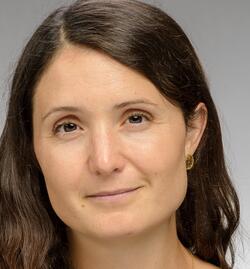
A native metro-Detroiter, Gabby moved to west Michigan to attend Grand Valley State University where she earned her bachelor’s degree in Health Communications and minored in Philosophy.
Prior to Stanford, she worked for Spectrum Health, now Corewell Health, as a Communications Specialist, where she was responsible for managing the execution of the sponsorships funded by the health system, assisted in the project management of various community events and highlighted the work of the Community Relations team in the form of news and blog posts on the internal intranet site.
In her spare time, you can find her enjoying the outdoors from hiking, camping and kayaking or just reading on the beach!
Valeria Gracia Olvera (she/her) is a Health Policy PhD student in the Decision Sciences track and a Fulbright scholar. Prior to starting her PhD at Stanford in 2022, she worked as a research assistant at the Center for Research and Teaching in Economics (CIDE) in Mexico. In 2020, she joined the Stanford-CIDE COronavirus Simulation MOdel (SC-COSMO) (https://www.sc-cosmo.org/) consortium where she worked on high-impact projects to estimate the health effects of nonpharmaceutical interventions to control the spread of the COVID-19 epidemic in Mexico. Additionally, as a member of the Cancer Intervention and Surveillance Modeling Network (CISNET), Valeria worked on a project to model HPV transmission and cervical cancer disease at a state level in the United States. Her research interest is identifying cost-effective air pollution mitigation strategies to support decision making. Valeria holds a bachelor’s degree in Environmental Engineering from Autonomous University of San Luis Potosi (UASLP) in Mexico, a Diplôme d’ingénieur from École Centrale Paris in France, and a master’s degree in Environmental Economics from CIDE.
Stanford Medicine's new Department of Health Policy held its inaugural departmental symposium on October 6, convening thought leaders and experts in medicine, law, economics and data science. Speakers discussed innovative policy work and scalable solutions for improving health equity. Panelists addressed how to reduce persistent health disparities from three angles: social determinants of health, technology and innovation, and access and affordability.
Discover the powerful role health policy can serve in ensuring the health of all people, not just a privileged few.
***
Keynote Speaker: Kirsten Bibbins-Domingo, PhD, MD
Talk Title: Building Equity in the Research Enterprise
Editor in Chief, Journal of the American Medical Association (JAMA) and JAMA NetworkProfessor of Epidemiology & Biostatistics and Medicine, University of California, San Francisco
Remarks
Terrance Mayes
Associate Dean for Equity and Strategic Initiatives;
Executive Director of the Commission
On Justice and Equity at Stanford Medicine.
This activity expired on November 20, 2025. Participation records may still be available, but CME/CE credit can no longer be claimed, and certificates are no longer issued for this activity.
Rep. Marjorie Taylor Greene’s Twitter account struck an urgent tone the Sunday after the Supreme Court’s historic abortion ruling. She implored her 968,000 followers to have the “fortitude to act” against Department of Defense leaders for refusing to recognize the court’s decision, which eliminates the constitutional right to an abortion.
But DOD leaders never stated they would ignore the court’s ruling in the Dobbs v. Jackson case.
Taylor Greene, a Georgia Republican, repeated a trope that appears to have originated on a now suspended Twitter channel known as BNN Newsroom a day prior. The BNN post erroneously said the Pentagon would not recognize abortion laws implemented in the wake of Dobbs. It was shared more than 26,000 times before being deleted, the Associated Press reported.
While Taylor Greene’s call to her followers said DOD leadership had “wage(d) an insurrection against the Supreme Court,” the anodyne statement fromDefense Secretary Lloyd Austin III was anything but that.
This bland statement spawned the BNN story which, in turn, led to the Taylor Greene tweet exclaiming that DOD leadership “must be removed.”
(Taylor Greene’s office did not return an email seeking comment).
Disinformation scholars said this incident exemplifies why the abortion issue, both polarizing and emotional, is a perfect vessel for spreading divisive falsehoods. Herb Lin, a senior research scholar for cyber policy and security at Stanford University, said he worries these qualities will make the mounting abortion wars an easy target for foreign interference. He pointed to how Russian influence operators hoping to provoke violence simultaneously promoted pro- and anti-Muslim rallies held at the same time and place during the run up to the 2016 election.
Abortion rights activists protest in the street near the U.S. Supreme Court on the last day of their term on June 30, 2022, in Washington, DC. | Kevin Dietsch/Getty Images
All News button
1
Subtitle
The abortion issue, both polarizing and emotional, is a perfect vessel for spreading divisive falsehoods.
Dr. Sanne Verschuren has been awarded the 2022 Kenneth Waltz Outstanding Dissertation Award from the International Security Section of the American Political Science Association for her dissertation titled "Imagining the Unimaginable: War, Weapons, and Procurement Politics".
The Kenneth N. Waltz Dissertation Award is awarded to a successfully defended doctoral dissertation employing any approach (historical, quantitative, theoretical, policy analysis, etc.) to any topic in the field of security studies. Manuscripts are judged according to (1) originality in substance and approach; (2) significance for scholarly or policy debate; (3) rigor in approach and analysis; and (4) power of expression.
Dr. Sanne Verschuren received her Ph.D. in Political Science from Brown University and her research focuses on the development of military technology, shifts in military strategy and tactics, and the role of ideas and norms therein. She was a Stanton Postdoctoral Fellow for CISAC during the 2021-2022 academic year.
Dr. Sanne Verschuren has been awarded the 2022 Kenneth Waltz Outstanding Dissertation Award from the International Security Section of the American Political Science Association for her dissertation titled "Imagining the Unimaginable: War, Weapons, and Procurement Politics".
Harry is a PhD student in Health Policy (Health Economics) at the Stanford School of Medicine. His research interests include pricing and market competition among hospitals, innovation and adoption of medical technologies, and wasted spending in the U.S. healthcare system. Harry earned a BS in Industrial Engineering from Cal Poly, San Luis Obispo and an MS in Management Science & Engineering from Stanford University. During his master’s, he conducted research with the Clinical Excellence Research Center (CERC), Systems Utilization Research for Stanford Medicine (SURF), and Health Equity Advancement through Research and Technology (Heart Lab). He was also a Summer Fellow for the Market Oversight & Transparency team at the Massachusetts Health Policy Commission. During his undergrad, he gained experience in the medical device, hospital, and biotech industries through internships with Medtronic, Stanford Health Care, and Cepheid.
Nova Bradford is a PhD candidate studying management and organizations at Stanford’s Department of Health Policy, where she is a Knight-Hennessey Scholar (Stanford’s equivalent of Rhodes). She studies how leaders and organizations respond to environments that are constrained, uncertain, or in flux. Her dissertation—advised by Sara Singer, Hayagreeva Rao, and Melissa Valentine—examines innovation, strategic decision-making, and artificial intelligence using ethnographic and computational methods. Bradford received the “Outstanding Paper Based on a Dissertation” award from the Academy of Management’s Health Care Management division. During her PhD, she taught courses in the Graduate School of Business and Department of Health Policy. Outside of her PhD, she is a stand-up comedian, playwright, and theater director, with work that has been featured in Rolling Stone, The New York Times, The Washington Post, and more.
Eliza Ennis is a Health Policy PhD student in the Decision Sciences track, a Knight-Hennessy Scholar, and NSF Graduate Research Fellow. She uses simulation modeling, causal inference, and mixed social science research methods to answer questions about the effectiveness of health policies and programs. Her work spans substance use, infectious disease, and reproductive, maternal, and infant health. She has been awarded two Lee B. Lusted awards in Applied Health Economics and Health Services, Outcomes, and Policy Research by the Society for Medical Decision Making. Previously, she worked on global health strategy at Dalberg Global Development Advisors. There, she designed structures for health financing reform, supported U.S. policy response to the Covid-19 pandemic, and developed a quantitative model to evaluate iron deficiency reduction approaches in sub-Saharan Africa and South Asia. She graduated from Harvard University with a bachelor’s degree in social studies with a focus on international relations and the Modern Middle East and a secondary in Global health and health policy. She was awarded the Stanley H. Hoffman Undergraduate Research Fellowship and also established and led the Women’s Media Center research team in Washington, D.C. She aims to drive equitable health outcomes by scaling effective health system design.
James C. Dickerson, MD is a current oncology fellow at Stanford University, as well as a AHRQ health services research fellow. He is interested in understanding the extent of health disparities in cancer care, both in the United States and in low income countries. His prior research has focused on these domains, working on projects in Belize, Nigeria, and California. He received his B.A. from Vanderbilt University, and then returned home to receive his M.D. from the University of Mississippi. He completed his internal medicine residency at Stanford in 2021 and stayed at Stanford for his hematology/oncology fellowship.
The Russian nuclear saber-rattling that has accompanied the invasion of Ukraine represents a level of nuclear risk unprecedented since the end of the Cold War. One wonders how global nuclear politics will adapt to these changing circumstances. The ongoing Russia-Ukraine war poses major challenges for several core international institutions and issues, from the upcoming Non-Proliferation Treaty review conference to President Biden’s proposed arms control efforts with Russia and China. Read more at thebulletin.org
Hero Image
Image credit: Thomas Gaulkin, from thebulletin.org
All News button
1
Subtitle
The Russian nuclear saber-rattling that has accompanied the invasion of Ukraine represents a level of nuclear risk unprecedented since the end of the Cold War.