Professor Sharon Zukin's talk will describe how, in cities across the world, the everyday spaces of local shopping streets are undergoing dramatic transformations.  Globalization brings new products and people, while different types of gentrification reshape the street's aesthetics and atmosphere.  How do we "read" these changes?  Do they destroy the sense of the "local" to make every street, in every city, more alike?

Professor Zukin is the author of a number of books on cities, culture and consumer culture, and urban, cultural and economic change.  She received the Lynd Award for Career Achievement in urban sociology from the American Sociological Association, and the C. Wright Mills Book Award for Landscapes of Power.  You can learn more about her work here: http://www.brooklyn.cuny.edu/web/academics/faculty/faculty_profile.jsp?faculty=420

Presented by the Program on Urban Studies and co-sponsored by the Anthropology Department, Center for East Asian Studies, Center on Poverty and Inequality, The Europe Center, Walter H. Shorenstein Asia-Pacific Research Center, Sociology Department, Stanford in Government and Urban Beyond Measure.

Building 200
Room 002

Sharon Zukin Professor of Sociology Speaker Brooklyn College, CUNY
Lectures
News Type
News
Date
Paragraphs

In war zones, private contractors can outnumber U.S. troops. But who controls them? NPR's Rachel Martin speaks with CISAC senior research scholar and Ret. U.S. Army Col. Joseph Felter, and journalist Pratap Chatterjee about current safeguards. Four military contractors with the firm Blackwater were convicted for killing 17 Iraqis back in 2007. The verdict on Oct. 22, 2014, has again put military contractors in the spotlight and raised questions about where and when the U.S. uses them.

Felter argues that as the U.S. draws down its military operations in Iraq and Afghanistan, outsourcing safety will continue, but that the U.S. military should start to integrate the paid security units into its command and control structures and include them in military preparations.

You can listen to the story here, on NPR's website.


Hero Image
felter
All News button
1
News Type
News
Date
Paragraphs

Watch the live-streaming of the conference: "Intelligence Reform and Counterterrorism After a Decade: Are We Smarter and Safer?"

FSI's Tom Fingar will be a panelist and the keynote address will be given by James Clapper, director of national intelligence.

The conference is being held at the University of Texas at Austin's and sponsored by the Clements Center.

The panel can be watched live on CISAC's Facebook Page at 3 p.m. on Thursday, Oct. 16.


Hero Image
ni logo
All News button
1
-

**WE ARE AT FULL CAPACITY - PLEASE ARRIVE EARLY FOR A SEAT**

Japan has long been known as a technology giant, and remains highly entrepreneurial, despite slowed competiveness in the years following the financial crisis of the 1990s. How can Japan continue to reinvigorate its economy? What steps can Japanese and Silicon Valley-based actors take to facilitate long-term, beneficial partnerships?

Ambassador John Roos, who served as U.S. ambassador to Japan from 2009-13, will explore trends of entrepreneurship in Japan, and compare it to those in Silicon Valley. Roos will address the networks, knowledge sharing patterns, and key challenges, such as political and societal barriers to growth, that both Japan and the United States face. During his tenure as ambassador, Roos focused on innovation and trade issues, including Japan’s announcement to join the Trans-Pacific Partnership (TPP). He built many relationships and established constructed dialogue surrounding those issues.

This event will feature Roos in conservation with Ambassador Michael H. Armacost, a Shorenstein Distinguished Fellow, who also served as a U.S. ambassador to Japan (1989-1993).


Image

Ambassador John Victor Roos was the U.S. Ambassador to Japan from August 2009-13, a pivotal period in U.S.-Japan relations. Shortly after presenting his credentials to Japan's emperor, power shifted from the Liberal Democratic Party to the Democratic Party of Japan for essentially the first time in 50 years, and Roos played a key role in managing the U.S.-Japan relationship through the transition. Three and a half years later, power shifted back to the LDP, and once again, Roos was called upon to help manage the relationship through a major shift in government.

During his almost four years in Japan, Roos built relationships and established a rich and active dialogue with government leaders, businesspeople, media, and students over the course of his travels through all 47 of Japan's prefectures. In addition to addressing the security, economic, and global challenges that Japan and the United States faced, Roos put specific focus on innovation and entrepreneurship as well as trade issues, including Japan's announced intent to join the TPP. Roos' work with the business sector resulted in his being recognized, along with his wife Susie, as the 2012 American Chamber of Commerce Japan's Persons of the Year.

Prior to his ambassadorial appointment, Roos served as Chief Executive Officer and Senior Partner at Wilson, Sonsini, Goodrich, & Rosati, a leading law firm in the United States in the representation of technology, life sciences, and emerging growth companies. There he helped lead his firm through multiple waves of innovation in Silicon Valley, from the growth of software and communications, to the Internet Age, to the emergence of biotechnology, clean technology and renewable energy, and to the social media revolution.

Roos is a graduate of Stanford University and Stanford Law School.

Bechtel Conference Center
Encina Hall
616 Serra St., 1st floor
Stanford University
Stanford, CA 94305

Ambassador John Roos Former U.S. Ambassador to Japan
Seminars
Authors
News Type
News
Date
Paragraphs

In a recent speech, Stanford professor Rosamond Naylor examined the wide range of challenges contributing to global food insecurity, which Naylor defined as a lack of plentiful, nutritious and affordable food. Naylor's lecture, titled "Feeding the World in the 21st Century," was part of the quarterly Earth Matters series sponsored by Stanford Continuing Studies and the Stanford School of Earth Sciences. Naylor, a professor of Environmental Earth System Science and director of the Center on Food Security and the Environment at Stanford, is also a professor (by courtesy) of Economics, and the William Wrigley Senior Fellow at the Freeman Spogli Institute for International Studies and the Stanford Woods Institute for the Environment.

"One billion people go to bed day in and day out with chronic hunger," said Naylor. The problem of food insecurity, she explained, goes far beyond food supply. "We produce enough calories, just with cereal crops alone, to feed everyone on the planet," she said. Rather, food insecurity arises from a complex and interactive set of factors including poverty, malnutrition, disease, conflict, poor governance and volatile prices. Food supply depends on limited natural resources including water and energy, and food accessibility depends on government policies about land rights, biofuels, and food subsidies. Often, said Naylor, food policies in one country can impact food security in other parts of the world. Solutions to global hunger must account for this complexity, and for the "evolving" nature of food security.

As an example of this evolution, Naylor pointed to the success of China and India in reducing hunger rates from 70 percent to 15 percent within a single generation. Economic growth was key, as was the "Green Revolution," a series of advances in plant breeding, irrigation and agricultural technology that led to a doubling of global cereal crop production between 1970 and 2010. But Naylor warned that the success of the Green Revolution can lead to complacency about present-day food security challenges. China, for example, sharply reduced hunger as it underwent rapid economic growth, but now faces what Naylor described as a "second food security challenge" of micronutrient deficiency. Anemia, which is caused by a lack of dietary iron and which Naylor said is common in many rural areas of China, can permanently damage children's cognitive development and school performance, and eventually impede a country’s economic growth.

Hunger knows no boundaries

Although hunger is more prevalent in the developing world, food insecurity knows no geographic boundaries, said Naylor. Every country, including wealthy economies like the United States, struggles with problems of food availability, access, and nutrition. "Rather than think of this as 'their problem' that we don't need to deal with, really it's our problem too," Naylor said.

She pointed out that one in five children in the United States is chronically hungry, and 50 million Americans receive government food assistance. Many more millions go to soup kitchens every night, she added. "We are in a precarious position with our own food security, with big implications for public health and educational attainment," Naylor said. A major paradox of the United States' food security challenge is that hunger increasingly coexists with obesity. For the poorest Americans, cheap food offers abundant calories but low nutritional value. To improve the health and food security of millions of Americans, "linking policy in a way that can enhance the incomes of the poorest is really important, and it's the hard part,” she said.” It's not easy to fix the inequality issue."

Success stories

When asked whether there were any "easy" decisions that the global community can agree to, Naylor responded, "What we need to do for a lot of these issues is pretty clear, but how we get after it is not always agreed upon." She added, "But I think we've seen quite a few success stories," including the growing research on climate resilient crops, new scientific tools such as plant genetics, improved modeling techniques for water and irrigation systems, and better knowledge about how to use fertilizer more efficiently. She also said that the growing body of agriculture-focused climate research was encouraging, and that Stanford is a leader on this front.

Naylor is the editor and co-author of The Evolving Sphere of Food Security, a new book from Oxford University Press. The book features a team of 19 faculty authors from 5 Stanford schools including Earth science, economics, law, engineering, medicine, political science, international relations, and biology. The all-Stanford lineup was intentional, Naylor said, because the university is committed to interdisciplinary research that addresses complex global issues like food security, and because "agriculture is incredibly dominated by policy, and Stanford has a long history of dealing with some of these policy elements. This is the glue that enables us to answer really challenging questions." 


Hero Image
img 0529
All News button
1
-

Following the end of World War II, Japan achieved remarkable economic growth, rising to be on par with the levels of the United States and Europe. With particular strength in manufacturing, Japan attracted much attention from around the world for its technological capabilities and ability to produce high quality products. Can Japan restore its glories such as those that garnered global attention in the 1980s? In 2006, Bill Emmott, a former editor of The Economist, published "Hi wa Mata Noboru (The Sun Also Rises)", which predicts that someday Japan will restore its competitiveness by increasing productivity through economic structural reforms.

However, so far, we do not see the clear picture of The Sun’s rising again. This talk is based on Motohashi’s new book, “Hi ha Mata Takaku (The Sun Rises Again)” from Nikkei, for explaining the way Japan should proceed to regain its industrial competitiveness. He has analyzed the shift of sources of industrial competitiveness, taking into account science revolutions (IT, life science etc.) and growing presence of emerging economies such as China and India, and explained new model of innovation lead growth by the concept of “science based economy”. His talk also touches on the subject of differences of economic institutions among nations, and proposes new model of Japanese innovation system in 21st century with the importance of labor market liberalization to proceed structural reforms to adjust new environment. Please refer to the following link for more detail description of the book. http://www.rieti.go.jp/en/columns/a01_0391.html

Image
motohashi
Kazuyuki Motohashi joins the Walter H. Shorenstein Asia-Pacific Research Center (Shorenstein APARC) during the period of September 2014 to March 2015 as Sasakawa Peace Fellow, from the University of Tokyo where he serves as a professor at the Department of Technology Management for Innovation, Graduate School of Engineering. Until this year, he had taken various positions at the Ministry of Economy, Trade and Industry of the Japanese Government, economist at OECD and associate professor at Hitotsubashi University.

His research interest covers a broad range of issues in economic and statistical analysis of innovation, including economic impacts of information technology, international comparison of productivity, national innovation system focusing on science and industry linkages and SME innovation and entrepreneurship policy. He has published several papers and books on above issues, including Productivity in Asia: Economic Growth and Competitiveness (2007). At Shorenstein APARC, he conducts research project, “New Channles: Reinventing US-Japan Relationship”, particularly focusing on innovation in silicon valley and its linkage with Japanese innovation system.

Mr. Motohashi was awarded Master of Engineering from University of Tokyo, MBA from Cornell University and Ph.D. in business and commerce from Keio University.

Slides_The Sun Rises Again? Regaining INdustrial Competitiveness of Japan in Science Based Economy Era
Download pdf

Philippines Conference Room

Encina Hall
616 Serra St., 3rd floor
Stanford University
Stanford, CA 94305


Shorenstein Asia-Pacific Research CenterEncina Hall E301616 Serra StreetStanford, CA 94305-6055
(650) 723-1434 (650) 723-6530
0
kazuyuki_motohashi.jpg Ph.D.

Kazuyuki Motohashi joins the Walter H. Shorenstein Asia-Pacific Research Center (Shorenstein APARC) during the period of September 2014 to March 2015 as this year's Sasakawa Peace Fellow, from the the University of Tokyo, where he serves as a professor at the Department of Technology Management for Innovation, Graduate School of Engineering. Until this year, he had taken various positions at the Ministry of Economy, Trade and Industry of the Japanese Government, economist at OECD, and associate professor at Hitotsubashi University.

His research interest covers a broad range of issues in economic and statistical analysis of innovation, including economic impacts of information technology, international comparison of productivity, national innovation systems focusing on science and industry linkages, and SME innovation and entrepreneurship policy. He has published several papers and books on the above issues, including Productivity in Asia: Economic Growth and Competitiveness (2007). At Shorenstein APARC, he is conducting the research project, “New Channles: Reinventing US-Japan Relationship”, particularly focusing on innovation in Silicon Valley and its linkage with the Japanese innovation system.

Mr. Motohashi was awarded his Master of Engineering degree from the University of Tokyo, MBA from Cornell University, and Ph.D. in business and commerce from Keio University.

Sasakawa Peace Fellow, 2014-2015
Seminars
Authors
News Type
News
Date
Paragraphs

The heated debate over the line between liberty and national security took center stage as Gen. Michael Hayden, former director of the National Security Agency and CIA, defended government surveillance programs at Stanford’s launch this week of “The Security Conundrum” speaker series.

If such surveillance methods were further restricted, “that smaller box, in my professional judgment, would make the job of the NSA harder and would probably make you less safe,” Hayden told a packed audience at the event co-sponsored in part by the university’s Freeman Spogli Institute for International Studies (FSI) and the Center for International Security and Cooperation (CISAC).

Hayden admitted to being “prickly” as he discussed privacy concerns over NSA’s collection and storage of phone and email metadata covering billions of calls and messages by American citizens. The surveillance programs, which were exposed last year by leaks from NSA contractor Edward Snowden, were only used after the Sept. 11 terrorist attacks, given “the totality of the circumstances,” Hayden explained.

Hayden was director of the NSA from 1999 to 2005. He then led the CIA from 2006 to 2009.


The metadata collection “is something we would have never done on Sept. 9 or Sept. 10. But it seemed reasonable after Sept. 11,” he said. “No one is doing this out of prurient interests. No, it was a logical response to the needs of the moment.”

Amy Zegart, CISAC’s co-director and a senior fellow at the Hoover Institution, led the conversation with the four-star general. She pointed out that a majority of Americans distrusts the NSA and believes the agency is lying.

Hayden stressed that the phone records were similar to billing statements – detailing who made the calls and when. “There is no content. It is not electronic surveillance. Not at all.”


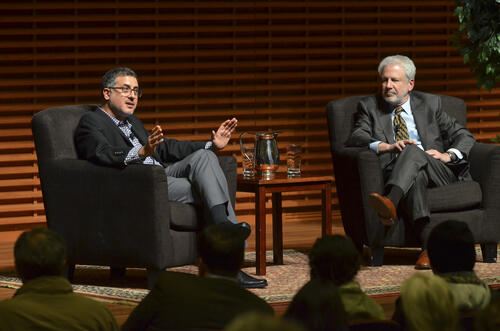
zegart hayden CISAC Co-Director Amy Zegart leaders a talk with former NSA and CIA Director Michael Hayden at the inaugural "Security Conundrum" speakers series on Oct. 8, 2014.


Though he understands why the operation is “theoretically frightening,” in reality, it’s designed to aid in the capture of terrorists within the United States, Hayden said.

“To listen to the content of the calls would violate the laws of the United States. It would violate the laws of physics,” he said. He challenged if anyone could offer “concrete evidence” of harm stemming from the phone data collection.

In defining the right to privacy, Hayden cited his philosophy behind the balancing act between security and liberty.

“Privacy is the line we continually negotiate for ourselves as unique creatures of God and as social animals,” he said. “There are some things that the community has the right to know – and there are other things that they clearly do not have the right to know.”

The debate is over where that line is drawn, between “what is mine” and “what is owed the collective,” he said.

Hayden noted that the phone and email metadata collection programs are only a small part of the larger issues the nation faces as it deals with increasingly adept enemies and the surveillance abilities of other nations.


“I’m just simply saying – who knows more about you? One of the least of your worries is the government,” he said, half-jokingly. He noted that Google knows more about Americans than does the U.S. government, and the Silicon Valley company uses that data for commercial purposes.

Addressing how tech companies are becoming more reluctant to cooperate with government requests for email communication data, Hayden said he didn’t have an answer about how to address the relationship.

There is a call for transparency of what the government is doing, but Hayden said “translucency” might be the better option, so as to not reveal all that the U.S. does for foreign intelligence.

“This is an enterprise that’s based on absolute secrecy,” he said of the NSA.

Image
“We have to give American people enough information to be at least tolerant, if not supportive, of what the American government is doing.”

But to achieve that, “it’s not transparency,” he said. “We actually have to be translucent … where you have the glass … and you get the broad patterns of movemen

The danger of not being able to target emails, Hayden said, would be that emails become a safe haven for enemies. “If we don’t’ do it, if you’re not going to let us do this stuff … over the long term, it puts your liberty at risk because bad stuff will happen.”

“The Security Conundrum” speaker series looks behind and beyond the headlines, examining the history and implementation of the NSA operations, the legal questions generated by them, the media’s role in revealing them, and the responsibility of Congress to oversee them.

Each guest speaker, in conversation with Stanford scholars, will probe the problems from different vantage points to explain the political, legal and technological contours of the NSA actions, as well as outline ways to preserve the nation’s security without sacrificing our freedoms.

On Nov. 17, journalist Barton Gellman will be the featured speaker. He is known for his Pulitzer Prize-winning reports on the 9/11 attacks and has led the Washington Post's coverage of the NSA. On April 10, Reggie Walton, the former presiding judge of the Foreign Intelligence Surveillance Court, will take the stage as the speaker on April 10.

Along with FSI and CISAC, the series is also co-sponsored by the Hoover Institution, Stanford Continuing Studies, Stanford in Government, and the Stanford Law School.

Image
hayden packed

Hero Image
14341 security news
All News button
1
News Type
News
Date
Paragraphs

The Europe Center Graduate Student Grant Competition

Call for Proposals:

The Europe Center is pleased to announce the Fall 2014 Graduate Student Grant Competition for graduate and professional students at Stanford whose research or work focuses on Europe. Funds are available for Ph.D. candidates from across a wide range of disciplines in the humanities and social sciences to prepare for dissertation research and to conduct research on approved dissertation projects. The Europe Center also supports early graduate students who wish to determine the feasibility of a dissertation topic or acquire training relevant for that topic. Moreover, funds are available for professional students whose interests focus on some aspect of European politics, economics, history, or culture; the latter may be used to support an internship or a research project. Grants range from $500 to $5000.

Additional information about the grants, as well as the online application form, can be found here.  The deadline for this Fall’s competition is Friday, October 17th. Recipients will be notified by November 7th. A second competition is scheduled for Spring 2015.
 

Highlights from 2013-2014:

In the 2013-2014 academic year, the Center awarded grants to 26 graduate students in departments ranging from Linguistics to Political Science to Anthropology. We would like to introduce you to some of the students that we support and the projects on which they are working. Our featured students this month are Michela Giorcelli (Economics) and Orysia Kulick (History).

Giorc

Image
elli’s project, “The Effects of Management and Technology on Firms’ Productivity: Lesson from the US Marshall Plan in Italy,” explores the role of productivity in the process of economic growth and development. It is typically difficult to isolate the causal effect of management training programs and technology transfer programs on business productivity because these measures are often endogenous to other unobservable factors. To overcome this concern, Giorcelli employed a unique research design to analyze the effects of the Marshall Plan’s transfer of US management and technology to Italian firms in the aftermath of WWII. 

Image
Image of Archivio
Giorcelli collected and digitized balance sheets data for 6,035 Italian firms eligible to receive the US management and technology support between 1930 to 1970. She then exploited an exogenous change in policy implementation that randomly determined which firms actually received Marshall Plan support. Preliminary results show that all firms that received either support significantly increased their productivity. Moreover, firms that received both sets of support simultaneously showed an additional increase in productivity, suggesting that management and technology are complementary in production. (Inset: The archives where Giorcelli conducted her research)

Image
Kulick’s project, “Regionalism in Ukraine and the Long Collapse of the Soviet Union, 1954--2014,” used original historical evidence collected from Ukrainian archives to study the political nexus between party elites in Kiev and in Moscow. For example, Kulick gleaned insights about the political economy of postwar industrial reconstruction from local archives in Dnipropetrovsk, a metallurgical powerhouse in the region. Previously inaccessible primary sources indicate that as the Soviet economy grew more complex, the state apparatus became more independent. Consequently, managerial specialists needed more autonomy to meet deadlines and quotas, making them--rather than the party--the source of innovation in postwar Ukraine. 

Image
According to Kulick, “my research this summer opened up new ways of thinking about the relationship between the party and the institutions that made up the Soviet state and economy.” Kulick used insights from Soviet-era KGB documents to shed new light on the current propaganda emanating out of the Kremlin. For example, she found that the long-term pull toward greater improvisation has had ongoing consequences. The current conflict is not just about Ukraine’s geopolitical orientation; it is also the byproduct of the dissolution of intransigent and poorly understood late Soviet-era institutions. (Inset: Kulick documents military mobilization during her summer in Ukraine)


Undergraduate Internship Program: Highlights

The Europe Center sponsored four undergraduate student internships with leading think tanks and international organizations in Europe in Summer 2014.  Laura Conigliaro (International Relations, 2015) joined the Centre for European Policy Studies (CEPS), while Elsa Brown (Political Science, 2015), Noah Garcia (BA International Relations and MA Public Policy, 2015), and Jana Persky (Public Policy, 2016) joined Bruegel, a leading European think tank. Our featured student this month is Laura Conigliaro.

Image
During her time at CEPS, Conigliaro worked on a 68-page research paper on genetically modified organisms (GMO) policy in the European Union. In the paper, she traces E.U. legislation and policy development on GMOs from 1990 onward, and also offers conclusions for the future trajectory of the E.U.’s GMO policy. Conigliaro argues that the evolution of the E.U.’s GMO policy is a topic of extreme relevance--and difficulty--because it is the source of high-level trade conflicts between Europe and the United States. Consequently, the study of GMO policymaking can help advance our understanding of E.U. institutions, E.U. “comitology” (policy process), and E.U.-U.S. bilateral relations. 

Image
Image of CEPS signage.
Conigliaro plans to incorporate the summer fellowship experience into her Stanford academic career, for example, by presenting research findings at Stanford’s Symposia of Undergraduate Research and Public Service (SURPS). Looking ahead, she writes: “I hope to use the knowledge and experience gained of the E.U. Institutions and policy process through the lens of the GMO issue to broaden and diversify my potential career opportunities and areas from my traditional area of concentration, East Asia, to also include the European Union.”


Recap:  Panel on Europe-Russia Relations and EU expansion

On September 30, 2014, Miroslav Lajčák, the Deputy Prime Minister and the Minister of Foreign and European Affairs of the Slovak Republic, participated in a panel discussion in which he shared his thoughts and opinions about Europe’s relationship with Russia, and about the E.U.’s management of its future membership and associations. The Minister’s viewpoints were of particular interest, given his role in the E.U. foreign policy establishment, and the Slovak Republic’s role in the E.U. and NATO.

“The fact is that E.U.-Russia relations have worsened dramatically. That cannot be denied. But it’s not E.U. enlargement that played a major role in this.”  According to the Minister, Russia did not view E.U. enlargement with hostility, in part, because enlargement remained a transparent process. “But it all changed when Europe decided to enter into Russia’s immediate neighborhood...the former Soviet Republics. And this was something that

Image
Miroslav Lajčák
was seen by Russia as a hostile activity, and this was what Russia fiercely resisted.” The Minister spoke candidly about the potential conflicts of concepts between the E.U.’s Eastern Partnership policy, Russia’s Near Abroad policy, and the idea of a Eurasian Union. A fundamental and ongoing source of tension pertains to the geopolitical position of Russia’s immediate neighbors: “The fact is that Russia never accepted the full sovereignty of the former Soviet Republics.” Apart from discussing the escalation of tensions between the E.U. and Russia, the Minister spoke about the role of sanctions and reforms as a path for moving forward and achieving lasting peace in Europe.

Minister Lajčák’s brought a variety of experiences to the panel. He served as the European Union Chief Negotiator for the E.U.-Ukraine and E.U.-Moldova Association Agreements, and was the European Union Special Representative for Bosnia and Herzegovina, and Sarajevo. Additionally, he was previously the Ambassador of the Slovak Republic to the Former Republic of Yugoslavia, Albania and the Former Yugoslav Republic of Macedonia. 

After Minister Lajčák spoke, he was followed by comments by Michael McFaul, Professor of Political Science and Senior Fellow, Hoover Institute and Freeman Spogli Institute; Norman Naimark, the Robert and Florence McDonnell Professor in East European Studies in the History Department and The Director of Stanford Global Studies; and Kathryn Stoner, Senior Fellow at the Freeman Spogli Institute and Faculty Director of the Susan Ford Dorsey Program in International Studies.


Introducing “Immigration and Integration in Europe” Policy Lab

The Europe Center would like to introduce a new research project entitled, “Immigration and Integration in Europe:  A Public Policy Perspective,” led by Professors David Laitin and Jens Hainmueller. Duncan Lawrence has recently joined Stanford University to help direct the project. The project is part of the new Policy Implementation Lab at the Freeman Spogli Institute for International Studies.

The social and economic integration of its diverse and ever growing immigrant populations is one of the most fundamental and pressing policy issues European countries face today. Success or failure in integrating immigrants is likely to have a substantial effect on the ability of European countries individually and collectively as members of the European Union to achieve objectives ranging from the profound such as sustaining a robust democratic culture to the necessary such as fostering economic cooperation between countries. Various policies have been devised to address this grave political dilemma, but despite heated public debates we know very little about whether these policies achieve their stated goals and actually foster the integration of immigrants into the host societies. (Inset: David Laitin)

Professor Jens Hainmueller.The goal of this research program is to fill this gap and create a network of leading immigration scholars in the US and Europe to generate rigorous evidence about what works and what does not when it comes to integration policies. The methodological core of the lab’s research program is a focus on systematic impact evaluations that leverage experimental and quasi-experimental methods with common study protocols to quantify the social and economic returns to integration policies across Europe, including polices for public housing, education, citizenship acquisition, and integration contracts for newcomers. This work will add to the quality of informed public debate on a sensitive issue, and create cumulative knowledge about policies that will be broadly relevant. (Inset: Jens Hainmueller)


The Europe Center Sponsored Events

We invite you to attend the following events sponsored or co-sponsored by The Europe Center:

Additional Details on our website
October 8-10, 2014
“War, Revolution and Freedom: the Baltic Countries in the 20th Century”
Stauffer Auditorium, Hoover Institution
9:00 AM onward

Save the Date
April 24-25, 2015
Conference on Human Rights

A collaborative effort between the International Human Rights and Conflict Resolution Clinic at Stanford Law School (IHRCRC), the Research Center for Human Rights at Vienna University (RCHR), and The Europe Center. The conference will focus on the pedagogy and practice of human rights. 

Save the Date
May 20-22, 2015
TEC Lectureship on Europe and the World 
Joel Mokyr
Robert H. Strotz Professor of Arts and Sciences, and Professor of Economics and History, Northwestern University

We welcome you to visit our website for additional details.

All News button
1
Subscribe to The Americas