Authors
News Type
News
Date
Paragraphs

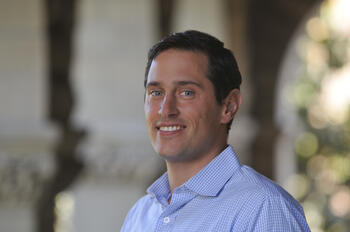
Jeff Decker knows what war can do to a person. He lived it for four deployments, as an Army special operations squad leader in Iraq and Afghanistan who twice earned the Army Commendation Medal for valorous conduct in combat.

Decker, who now serves as a research assistant in Stanford’s Center for International Security and Cooperation under Joe Felter, is the founder of March on Veteran, an organization that supports veterans suffering from mental health issues, such as post-traumatic stress disorder, or PTSD. March on Veteran is a free, online program available to any former member of the military.

Decker joined CISAC in September, about a year after he launched March on Veteran. Felter, a special forces veteran, is a senior research scholar who studies counterinsurgencies, terrorism and political violence for CISAC.

Decker, after his military service, struggled with the transition to civilian life due to the anger, anxiety, chronic pain, and sleeplessness that PTSD caused. On top of this, he did not have access to a Veteran Affairs treatment facility. That’s when the native of Buffalo, N.Y. turned to self-educating himself on mental health treatments available to veterans.

“When I studied for my doctorate in Australia, I cobbled together a mental health program to help myself. Now I’m sharing that and making those resources available to other veterans with the same needs,” said Decker, who earned his doctorate in international relations from Bond University, where he wrote his dissertation “Enhancing the Effectiveness of Private Military Contractors.”

So far, about 83 veterans have begun March on Veteran’s pilot program, which is a web-based and self-directed study. Decker handles almost all of the human contact. He is currently expanding the program to incorporate the veteran-to-veteran peer element with the help of other veteran volunteers.

Image
jeff decker

March on Veteran is, as Decker calls it, “support for veterans by veterans.” It is a recovery program personalized to one’s particular needs and is provided by people who have lived experience. It is not affiliated with any government organization like the VA or Department of Defense to maintain the veteran’s confidentiality. Veterans can access the program or sign-up to meet other veterans online.

“This program focuses on trying to help veterans reach their personal goals instead of focusing on ‘fixing’ them,” Decker said. “We are all about improving veteran quality of life, and a big part of that is connecting with other veterans.”

With Felter, Decker will be mostly working on his Hacking for Defense class project, which uses startup methodology to innovate and find solutions for critical challenges facing America’s defense and intelligence agencies.

Before arriving on campus, Decker conducted national security and international affairs research as a RAND Corporation summer associate for two summers in Washington, D.C.

Hero Image
gettyimages 124644169
U.S. Army soldiers salute during the national anthem during the an anniversary ceremony of the 9/11 terrorist attacks on Sept. 11, 2011 at Bagram Air Field, Afghanistan. CISAC research associate Jeff Decker, a former Army veteran, has launched a support group for veterans suffering from mental health issues, such as post-traumatic stress disorder, or PTSD.
John Moore/Getty Images
All News button
1
News Type
Commentary
Date
Paragraphs

CDDRL Mosbacher Director Francis Fukuyama participated the screening of the Children of Men, the 2006 film adaptation of PD James’ dystopian novel, at the event organized by the Future Tense - “My Favorite Movie” series, in which thought leaders host screenings and discussions on their favorite movies with science and technology themes. Children of Men is set in the year 2027, 18 years after the last child was born, due to worldwide infertility. In the video at the top of this post, filmed Sept. 21, Fukuyama expanded on the thoughts he shared at the screening. Watch here

Hero Image
screen shot 2016 10 09 at 19 45 00 copy Future Tense/ Slate.com
All News button
1
Authors
News Type
News
Date
Paragraphs

The consequences of state collapse anywhere in the world can be devastating and destabilizing for neighboring and even distant countries.

The complexity of each situation demands a tailored response, according to Stanford scholars embarking on a new American Academy Arts & Sciences project to identify the best policy responses to failing states embroiled in civil wars.

A failed state is that whose political or economic system has become so weak that the government is no longer in control. Such instability has already threatened or affected Syria, Libya, Yemen and other polities.

The project, Civil Wars, Violence and International Responses, is led by Stanford’s Karl Eikenberry and Stephen Krasner. Eikenberry is a faculty affiliate at Stanford’s Center for International Security and Cooperation (CISAC) and the former U.S. ambassador to Afghanistan. Krasner is a faculty member in the political science department and a senior fellow at the Freeman Spogli Institute for International Relations and Hoover Institution.

Other Stanford scholars involved include Francis Fukuyama and Steve Stedman of the Center on Democracy, Development, and the Rule of Law; CISAC's Martha Crenshaw, political scientist James Fearon; Paul Wise of the Center for Health Policy and the Center for Health Policy and the Center for Primary Care and Outcomes Research; and Michele Barry, the senior associate dean for global health at the medical school.

The effort will culminate in a two-volume issue in AAAS’s journal Dædalus. On Nov. 2-4, the academy will hold an authors’ workshop in Cambridge, Mass., to discuss journal content.

Different approaches

In an interview, Eikenberry said the problematic U.S. interventions in Iraq and Afghanistan make it clear that different approaches must be used for different countries.

“The robust counterinsurgency campaign that the U.S. employed for periods of time in both Afghanistan and Iraq was premised on the viability of the standard development model that aims to put countries on the path to economic well-being and consolidated democracy,” he said.

However, such an approach assumes that decision makers in those states have the same objectives as the intervening states, which typically seek to improve the lives of people in those countries, said Eikenbery. Prior to serving as the U.S. ambassador to Afghanistan from 2009 until 2011, Eikenberry had a 35-year career in the U.S. Army, retiring in 2009 with the rank of lieutenant general.

As Krasner points out, when intervention occurs, the hope is that improvements in one area – such as the quality of elections, rule of law, economic growth, or military recognition of civilian authority – would lead to improvements in other areas, according to Eikenberry.

But opposition and a constrained sense of “limited opportunities” can arise to thwart a well-meaning intervention, Eikenberry said.

He added, “Information asymmetries and the absence of mutually compatible interests between national and external elites, make it impossible to put target countries on a rapid path to prosperity and consolidated democracy. External actors must have much more modest goals.”

Syrian consequences

As for the case of Syria, Eikenberry noted that such civil wars can actually become more lethal and dangerous to global order than inter-state conflicts.

These types of conflicts like that in Syria tend to escalate into high levels of violence because of the costs that the losing parties believe they will incur, he said.

“This in turn leads to state fragmentation and the possibility of transnational groups with international ambitions getting involved,” he said. “Civil wars can result in an enormous number of civilian casualties, which generates large scale refugee flows” and puts huge pressure on neighboring states.

Eikenberry said Syria is being “internationalized by entangling regional and great powers in proxy wars,” which is exacerbating that conflict beyond Syria and throughout the greater Middle East. As for the immediate, direct threat to the U.S., that debate still continues, he added. 

On that note, one project goal is to assess risks to other countries that may emanate from civil wars and protracted intrastate violence like that in Syria, Eikenberry said. He and his colleagues will examine the effects of  international terrorism, massive displacements of people, proxy wars that escalate to interstate warfare, criminal organizations that displace governments, and pandemics. 

Policy implications

Eikenberry is hopeful the project influences policy and practice toward countries experiencing civil war and violence.

“Facilitating dialogue among a variety of constituencies with knowledge on the dynamics and impact of civil wars that might not normally or directly interact, including government and military officials, human rights organizations, academic and scholarly experts, and the media, will be one outcome of the project,” he said.

The idea is to allow “new ideas to emerge” regarding how to handle such states, as well as methods of applying such findings, he said.

“Exploring ways to create stability and more lasting peace, taking into consideration voices from academic and practical fields, should prove valuable to the policy community,” Eikenberry said.

Following publication of the volumes, the project will convene international workshops aimed at developing better regional perspectives. Such outreach activities will provide the feedback for the publication of another AAAS paper aimed at informing U.S. and international policy and research on the subject. A series of roundtable discussions in Washington is also planned.


Hero Image
Policy responses to failed states, civil war
Syrians walk amid the rubble of destroyed buildings following air strikes in Douma, Syria, in 2015. Stanford scholars Karl Eikenberry and Stephen Krasner are leading an American Academy Arts & Sciences project that seeks to understand the consequences of civil wars and state collapses and how best to respond to them through policy.
ABD DOUMANY/AFP/Getty Images
All News button
1
616 Serra StreetEncina Hall E301Stanford, CA94305-6055
(650) 725-2507 (650) 723-6530
0
ke_wang.jpg Ph.D.

Dr. Ke Wang is visiting APARC for the fall semester in 2016-2017 school year during her sabbatical leave from her current post at the Federal Reserve Board of Governors in Washington D.C. where she serves as a Senior Economist in the Division of Banking Supervision and Regulation.

At the Fed, Dr. Wang is responsible for policy analysis and regulation oversight of U.S. bank holding companies as well as conducting academic research in economics and finance fields. In her five-year tenure as a Fed staff economist, she participated in international Basel framework of capital regulation, quantitative credit model assessment for U.S. Stress Testing practice, and policy initiatives on liquidity regulation for Systemically Important Financial Institutions.

Dr. Wang’s research interests span from credit analysis to monetary policy. She has published in top academic journals such as Journal of Financial Economics and has wide citations for her previous works which covered topics such as corporate bond default prediction, impact of banking structure on monetary policy, and relationship banking in pre-war Japan.

Her current working papers focus on how liquidity in Over-The-Counter market is impacted by broker-dealers’ funding costs and information asymmetry. She provides empirical evidence using comprehensive bond transaction data that broker-dealers’ own financial health will quantitatively impact the liquidity and price discovery process of distressed assets. At Stanford, Dr. Wang will collaborate with other APARC research fellows on studies about both U.S. and Japan banking regulations, particularly the impact of regulation on systemic risk of financial institutions. 

Dr. Wang holds a Ph.D. in Economics from Stanford University and a B.A. in International Economics from Peking University. She once worked as an Assistant Professor in Finance in the Faculty of Economics at the University of Tokyo, teaching graduate courses on Money and Banking as well as Corporate Finance. 

Visiting Scholar
Date Label
616 Serra StreetEncina Hall E301Stanford, CA94305-6055
(650) 736-9958 (650) 723-6530
0
anju_patwardhan.jpg

Anju Patwardhan is a Fulbright Fellow and Visiting Scholar at Stanford. Her research is focused on the use of technology and innovation to support financial inclusion, especially small business lending.

She is also a Venture Partner with CreditEase Fintech Fund from China (fund of c.USD 1 billion). She is a member of the World Economic Forum (WEF) Global Future Council on Blockchain and on the WEF steering committees for “Internet for All” and “Disruptive Innovation in Financial Services”. 

She has been appointed as a FinTech Industry Expert with UC Berkeley (SCET) and an Innovation Fellow with the NUS.  She serves on the advisory board of Government of Estonia’s e-residency program

She was in banking until July 2016 and has over 25 years of experience with Citibank and Standard Chartered Bank (SCB) in global leadership roles across Asia, Africa and Middle East.  She was a member of SCB’s global leadership team, global risk management group and global technology & operations management group. She was also a Director on various banking subsidiaries and non-profits boards.

She is an alumnus of the IIT Delhi and IIM Bangalore, and holds further professional qualifications is board directorship and art appreciation.

She moved from Singapore to the Bay Area in August 2016 with her family. 

Fulbright Fellow
Visiting Scholar
News Type
News
Date
Paragraphs

Watch Live: Health Policy through 2020: The ACA, Payment Reform and Global Challenges.

The event begins at 1 p.m. PST and will end at approximately 5:45 p.m. PST. For details about the speakers and agenda, please see this page.

The stream will be turned on about 30 minutes before the event begins. Be sure Adobe Flash is turned on and updated.


Hero Image
healthpolicy2020
All News button
1
Authors
News Type
News
Date
Paragraphs

When Harold Trinkunas joined CISAC in September, it was like coming home again.

Trinkunas will serve in the concomitant role of senior research scholar and associate director for research. One of the nation’s leading Latin America experts, he comes to CISAC from the Brookings Institution, where he was the Charles W. Robinson Chair and senior fellow as well as director of the Latin America Initiative in the Foreign Policy program.

“This is a great opportunity to work in collaborative ways with exceptional scholars around some very important themes in today’s world,” Trinkunas said, noting the urgency of such issues as risks posed emerging technology, the future of the global order, and international security.

CISAC co-directors Amy Zegart and David Relman wrote in their introduction of Trinkunas that his “leadership will continue to advance the center's mission of training the next generation of international security specialists; developing original policy-relevant scholarship; and extending our outreach to global policymakers to improve the peace and security of our world.”

Evolving global realities

Born and raised in Venezuela, Trinkunas earned his doctorate in political science from Stanford University in 1999 and has been a predoctoral fellow and later a visiting professor at CISAC.  His first exposure to CISAC took place when he served as a teaching assistant to Scott Sagan in 1992.

Image
trinkunas harold

Through the years, CISAC has evolved and adjusted its focus to reflect the global security realities, Trinkunas said. “CISAC has successfully adapted to the changing times since its inception.” Research at CISAC spans such topics, including biosecurity and global health, terrorism, cybersecurity, governance, and nuclear risk and cooperation, to name a few.

Trinkunas is looking forward to the mentoring aspect of working with predocs and postdocs while tapping into the CISAC alumni network to open doors for those rising scholars.

“The Center has developed so many positive connections to scholars, policymakers, foundations, and civil society and the private sector more broadly, both in this country and around the word. One of my goals will be to build on those relationships in a way that’s rewarding for all parties,” said Trinkunas, who also served as an associate professor and chair of the National Security Affairs Department at the Naval Postgraduate School.

Security and governance

His newest book, Aspirational Power: Brazil's Long Road to Global Influence, co-authored with David Mares of UC San Digo, was published this summer by Brookings Institution Press. 

Trinkunas is especially interested in the intersections of security and governance. In his research, he has examined civil-military relations, ungoverned spaces, terrorist financing, emerging power dynamics, and global governance.

“Latin America is the part of the world that I know most about,” he said, adding that the region particularly stands out due to the decreasing number of wars and conflicts between states over the past few decades, even as problems of criminal violence have become more salient.

Part of the reason for region-wide stability, Trinkunas explained, is that democratization led many elected leaders to de-emphasize the role of military responses to interstate disputes in an effort to reduce the importance of the armed forces in domestic politics.

In a region with a history of military dictatorship, many democratic leaders saw their own armed forces as a more significant threat to their permanence in power than their neighbors’ militaries, he said.

In addition, the U.S. foreign policy toward the region has tended to become less interventionist over time and has focused instead on minimizing the use of force as a solution to interstate disputes in the region. Recent efforts to normalize of the U.S.-Cuba relationship are a reflection of this trend, Trinkunas added.


Hero Image
encina CISAC
All News button
1
Authors
News Type
News
Date
Paragraphs

CISAC's William J. Perry created a free, public 10-week course for people to learn more about the looming dangers of nuclear catastrophe. His new MOOC, developed with the support of Stanford’s Office of the Vice Provost for Teaching and Learning, offers a chance to take that message to a much larger audience.


Living at the Nuclear Brink: Yesterday and Today is an online course (a "MOOC") taught by former Defense Secretary William J. Perry and a team of international experts. 

“I believe that the likelihood of a nuclear catastrophe is greater today than it was during the cold war,” said Perry, who recently wrote a New York Times op-ed on why America should dismantle its ICBM missile systems.

Because the continued risk of nuclear catastrophe isn’t widely recognized, Perry believes, “our nuclear policies don’t reflect the danger. So I’ve set off on a mission to educate people on how serious the problem is. Only then can we develop the policies that are appropriate for the danger we face.” 

The course offers participants the chance to ask questions and participate in discussions via an online forum, which Perry and his fellow experts will address during weekly video chats. Each week, Perry will be joined in conversation by top thinkers, including CISAC's Martha Crenshaw, David Holloway and Siegfried Hecker, Scott D. Sagan, and Philip Taubman. George Shultz, the former secretary of state, will also participate. Outside experts include Ploughshares Fund president Joseph Cirincione, nuclear negotiator James Goodby, former Russian Deputy Minister of Defense Andre Kokoshin, and Joseph Martz of the Los Alamos National Laboratory.

Learn more about "Living at the Nuclear Brink" in this story or watch a video. Register for the course here. It is now open for enrollment and begins Oct. 4.  

Hero Image
nuclear danger
William J. Perry has created a new, free online course for people to learn about the risk of nuclear catastrophe.
CISAC
All News button
1
Authors
News Type
News
Date
Paragraphs

Many people dread dealing with health insurance. Choosing the right plan, navigating benefits and understanding premiums, copays and deductibles can leave you frustrated and confused. Even in economic research, health insurance markets pose some of the most challenging questions.

But Maria Polyakova, a faculty fellow at the Stanford Institute of Economic Policy Research and core faculty member at Stanford Health Policy, is motivated to find the answers.

Intrigued by the shifting dynamics of the industry and inspired partly by her own experience of finding health care coverage during graduate school, Polyakova has joined a small group of health economists who are at the forefront of examining the increasing complexities surrounding the provision of medical insurance.

Changes under the Affordable Care Act have deepened the connection between public and private players, Polyakova says. There’s a rise in health care plans that are publicly funded but privately run. And many people using public plans, like Medicare, are supplementing their coverage with private add-on insurance.

The intertwined relationship raises a host of policy challenges, which Polyakova outlines in this detailed policy brief.

“We're moving toward this world where we think competition in health insurance is good because that somehow increases efficiencies and provides consumers with choices that they like,” Polyakova says. “But on the other hand, there has been a lot of debate on whether health insurance is the right place to have choice.”

Polyakova, an assistant professor of health research and policy at the School of Medicine, joined Stanford in 2014. Her ongoing economic research looks at the impact of government policies in social insurance  on consumer behavior, insurer behavior and market outcomes, including risk protection and redistribution.

By investigating the design of health insurance systems, Polyakova’s work could inform policymakers on the extent the government should facilitate competition among insurers that are providing social insurance benefits, or the steps public and private insurers can take to reduce risks and costs for consumers. Her early forays have gained recognition.

For her doctoral thesis on Medicare Part D — the prescription drug component of the federal health insurance program — Polyakova won the 2015 Ernst-Meyer Prize, which recognizes original research about risk and health insurance economics. She also received the John Heinz Dissertation Award from the National Academy of Social Insurance in 2015.

Her findings included evidence of substantial inertia among enrollees, despite significant changes in about 40 plans under Medicare Part D.

“If no one actually ever reacts to changes in products,” Polyakova says, “it could defeat the purpose of having competition.”

Polyakova continues to drill into details where answers may lie. Her empirical research in progress ranges from examining new ways of calculating risk to the effects of word choice in insurance plan descriptions.

“Policies are labeled silver, gold, platinum — theoretically to simplify the plans. But in reality, those simplifications may lead people to choose plans that are not the best for them,” she says. “Assessing the implications of their choices for the overall efficiency of the health insurance system is tricky”

The health care system appeared much more straightforward in Germany, where she worked for a year after graduating in 2008 from Yale with a bachelor’s degree in economics and mathematics.

Then while attending graduate school at the Massachusetts Institute of Technology, Polyakova went through the hassles of figuring out the health insurance system and how insurers reimburse medical providers. She recalls thinking, “Why is this so complicated?”

Polyakova turned her focus to health economics after taking some courses with MIT Professor Amy Finkelstein, a pioneer in the field who became Polyakova’s primary advisor.

“It was very contagious,” Polyakova says.

 
Hero Image
485140622
All News button
1
Subscribe to The Americas