In the face of information pollution, legislators in seven states have drafted bills to mandate courses in "media literacy" and “digital citizenship.” But what if the problem is not the lack of media literacy--but that the media literacy we do teach is the wrong kind? Drawing on a survey of 7804 middle, high school and college students, along with a focused study of Stanford undergraduates, academics from universities in California and Washington, and professional fact checkers at the nation’s most esteemed publications, I’ll argue that our approaches to information pollution may not only be ineffectual but may exacerbate the problem. Based on promising pilot data, I’ll suggest more comprehensive and effective solutions, and how we might address this issue here on our own Stanford campus.
Speaker Bio:
Image
Sam Wineburg is the Margaret Jacks Professor of Education and, by courtesy, of History & American Studies. Educated at Brown and Berkeley, he holds a doctorate in Psychological Studies in Education from Stanford and an honorary doctorate from Sweden’s Umeå University. In 2004, Wineburg founded the Stanford History Education Group (sheg.stanford.edu), whose curriculum and assessments have been downloaded five million times. His latest work focuses on how people judge the credibility of digital content, research that has been reported in the Wall Street Journal, New York Times, Washington Post, NPR, BBC, Die Zeit and translated into dozens of languages.
Wineburg’s scholarship sits at the crossroads of three fields: the psychology of learning, history, and education, and his articles have appeared in such diverse outlets as Cognitive Science, Journal of American History, Smithsonian Magazine, Washington Post and the Los Angeles Times. In 2002 his book, Historical Thinking and Other Unnatural Acts: Charting the Future of Teaching the Past won the Frederic W. Ness Award from the Association of American Colleges and Universities for work that makes the most important contribution to the “improvement of Liberal Education and understanding the Liberal Arts.” In 2013, he was named the Obama-Nehru Distinguished Chair by the US-India Fulbright Commission and spent four months crisscrossing India giving lectures about his work. His new book, Why Learn History When It’s Already on Your Phone (Chicago), will be available in September.
Sam Wineburg
The Margaret Jacks Professor of Education and, by courtesy, of History & American Studies
The following is a statement by CISAC Affiliate and Professor Emeritus William J. Perry on potential talks between President Donald Trump and Kim Jong Un. It was originally posted on the website of the William J. Perry Project.
I was very encouraged to hear that a summit meeting is being planned for May to deal with the dangerous North Korea nuclear program. This is a major improvement over diplomacy that consisted of shouting insults at each other.
But there are two key questions about this meeting:
First: what will we talk about? That is, what does the U.S. expect to get, and what is the U.S. willing to give?
Second: what will we and North Korea be doing while we are talking? Are the U.S. and its allies going to sustain the pressure presently on North Korea? And will North Korea continue the development and testing of missiles and nuclear weapons?
Statements from the administration suggest that the U.S. goal is for North Korea to dismantle its nuclear arsenal and become a non-nuclear power. There is every reason to doubt that North Korea would be willing to go that far; but even if they are, there remains a fundamental question: How could we possibly verify such an agreement?
We don’t know how many nuclear weapons they have operational or under construction; we don’t know where all their nuclear facilities are; and we have never implemented a treaty that counts warheads, simply because it is so difficult to verify (and so easy to cheat on). Our nuclear treaties with the Soviet Union and Russia counted missiles, not warheads (the number of operational warheads was assumed based on the number of operational missiles counted). We still do not know how many total nuclear warheads the Russian have, in the field, in their labs, and in their storage facilities, and our estimates may be off by thousands. So it is a fundamental error to think that we could reliably verify a treaty by which North Korea agreed to dismantle all of their nuclear weapons.
We could verify an agreement that banned testing of nuclear weapons and long-range missiles, and such an agreement would be very much in our interest. It would be equally in our interest to have an agreement stopping the proliferation of North Korean nuclear components and technology, although such an agreement would be much harder to verify than a test agreement.
There is good reason to talk, but only if we are talking about something that is worth doing and that could be reasonably verified - otherwise we are setting ourselves up for a major diplomatic failure.
Finally, to hedge against such failure, it would be wise to have a prior agreement that limited objectionable actions such as like nuclear tests while we are talking, as North Korea has suggested that it would. (Before Clinton agreed to begin the diplomatic talks that led to the Agreed Framework, he required North Korea to stop all processing at their nuclear facility at Yongbyon.)
I highly favor talks, but such talks must be based on realistic expectations of what can be negotiated and what can be verified. As I have written before: “We must deal with North Korea as it is; not as we would wish it to be.” That remains true.
The following are remarks delivered by Professor Thomas Fingar at the John Lewis Legacy conference on January 13, 2018.
We've heard many characterizations and word picture descriptions of John. My own image is that of John as the Energizer Bunny wearing a Nike tee shirt that says, “Just Do It.” The bunny is also wearing a huge grin. My memory of John Lewis includes all of the scholarly and other attributes described by previous speakers, but at the core there is a wonderful human being who touched many lives in many ways. Things that others have said today prompt me to use my time to relate a series of little vignettes that I think help capture who and what John was.
The first was prompted by the discussion of getting Siri to call Bob Carlin. The world entered an exciting new era when John Lewis was mated with a cell phone. From that time on, it was possible for John to act instantaneously whenever he had an idea or wanted to do something. I've traveled a lot, and for many years had worried that when the phone rang in the middle of the night, it probably was to report bad news from home. John’s acquisition of a cell phone changed that. Time and time again, the 3:00 am phone calls were from John. He seemed never to remember—or never to care—that I was traveling. When he had an idea, telling me about it was always more important than the fact that I was in New Zealand or some other distant land. This happened so often that I was almost surprised and disappointed when I made it through the night without a call from John.
John didn't watch the clock. With John, everything was urgent. His unique combination of vision, passion, commitment, and urgency came with a blind spot for the possibility that not everyone might share the vision, the passion, or the urgency. And, as was noted earlier, if you didn't share John’s vision, passion, and urgency, you might as well head to the outer darkness.
There is much about John that I admired greatly, but my long and wonderful relationship with him never clarified when or why he would switch from all-in exuberance to total disinterest. I have been described by a former boss as having an emotional range that goes from A almost all the way to B. I don’t get very excited about anything. John was either very excited about an idea or opportunity, or utterly dismissive. But with the ideas that excited him, he was quite prepared to give them away so others could take credit or figure out how to act on the idea. Over the years, when John would call me in, or phone me on the other side of the world, my normal response was to listen. The excitement in his voice caused me to visualize him hovering a few inches from the ceiling. He had long ago figured out that we had different scales of excitement and that I would treat the idea seriously until I had determined that it simply would not fly. Or would not fly without more effort than I was willing to expend. If I said, “let me think about it,” John would move on to something else because we both knew that I had effectively made a commitment to run with the idea. If I did so more slowly than he thought necessary, he would prod me with a question about where things stood. He cared about the idea, not who had proposed it. Addressing the underlying problem was more important than the specific way in which it was to be addressed.
John’s de facto delegation of tasks to me and to others, and greater focus on developing ways to deal with problems than on specific solutions reminds me of one of his favorite Chinese words and concepts. That word is jizhi or mechanism. John was always looking for ways to build connections and arrangements that would endure beyond a one-time meeting or conference. His constant query asking “How are we going to solve this problem?” was always followed by some version of “How do we put in place arrangements-- people, procedures, relationships—that are enduring? That don't solve the problem once, but that are there when that solution proves to be inadequate or when a new challenge comes up?”
The people in this room, and many, many more who are not here today, are part of the activist network that John developed. I don't know how conscious or self-conscious it was on his part. Regardless of how deliberately John tried to instill in us a model approach to tackling problems, the fact is, we found a model worthy of emulation. We saw what worked for John and thought it was a good idea to try something approximating what he did. As I look around at friends in this room, I see not just fantastically successful academic scholars. I also see people who have run things—run big organizations and made significant things happen.
John created a network of people. We're all part of it. And I think he probably left feeling pretty good about that aspect of his legacy. He had an uncanny ability to spot people with abilities and potential—he often saw more in us that we saw in ourselves—but he was also remarkably effective at putting people in place to “do something important.” Along the way, he taught us how to approximate doing what he did.
Mention was made of his first Rottweiler. It was an enormous dog. I think his name was Amigo. I was in awe of John from the time I first encountered him as an undergraduate until the last time I saw him. But awe was infused with a degree of intimidation when I was a junior graduate student. I had a meeting with John in his Owen House office. Amigo was there, alertly lying under the conference table. The dog was even more intimidating than John, probably because he looked like he would eat anything smaller than he was. Something on or in the sole of my shoe caught Amigo’s attention. I was sitting at the table discussing a research paper with John. Amigo was underneath. And he was eating my shoe. That dog was so damn big, I certainly wasn't going to kick him. I thought to myself, the dog is going consume my shoe and eat my leg. To say the least, I was distracted, but I was not about to tell the professor that his dog was eating my shoe. We finished our conversation and I departed with a very unbalanced pair of shoes. If I had told John, he would have laughed like hell, told Amigo to stop, and would not have been upset that I was dismayed by his dog. But I did not realize that in 1969.
I want to shift gears in the remainder of my time to provide illustrations of the way John built teams and institutions to refine and implement his ideas. Several have mentioned the book on the United States and Vietnam that John wrote with George Kahin. I was introduced to the arguments in that book in a classroom lecture before the book was published. The lecture and the book evolved into a series of teach-ins on the Vietnam War. It also led to the establishment of the Stanford chapter of the Committee of Concerned Asian Scholars, and to a much larger series of teach-ins and the incorporation of more information on Asia into national security courses across the United States.
I think it was in 1968 that the US was about to deploy the Safeguard anti-ballistic missile system. The stated purpose was to protect us from the Chinese, who, it was asserted, had no respect for human life. The basis for the assertion was a statement by Mao Zedong about how many deaths China could sustain in a nuclear war. Debate about whether deployment of the ABM system would increase security more than it increased uncertainty and instability was conducted during China’s “Cultural Revolution,” which certainly looked pretty irrational to the outside world. It is easy to find echoes of statements about China in the 1960s in contemporary arguments about the need for missile defense to protect us from “irrational” leaders in Iran and North Korea. John worried that the proposed “solution” would make the situation less stable and more dangerous. Acting on that concern, he reached out to physicists and others who knew more than he did about the situation and the systems. This led, again, to a series of teach-ins. The teach-ins led to a team-taught multidisciplinary course. And that led to a book on arms control compiled by Chip Blacker and Gloria Duffy. The story continues. Later fruits of John’s initial efforts to “do something” include the CISAC Honors Program and Post-Doctoral Fellows. Today what John launched includes a very large and diverse group that continues to build upon John’s idea, and missions.
Earlier speakers have mentioned SPICE. SPICE is the descendant of BACEP—the Bay Area China Education Project. Another dimension of John’s reaction to assertions that Chinese don't care about human life that played out in a public debate about the need for an anti-missile system was his effort to address the poor quality, indeed the almost total absence, of information about China and Asia more broadly, in American textbooks. World history was all about Europe. John was determined to “fix” that. He raised money from the Wingspread Foundation to convene a meeting to talk about what needed to be done. He enlisted the assistance of more people here at Stanford, notable David Grossman and others in the school of education. Asian Studies grad students deployed around the Bay Area and beyond to do public panels, public lectures, and workshops for teachers. The initial focus was on California, because that is where we are but also because it is the gateway to Asia and, more strategically, because the California textbook market is so large that changes to California textbooks are likely to be incorporated into books used in many other states. The program has evolved, is now much larger, and has had a tremendous impact.
Would these—and many other—things have happened without John? Maybe. But maybe not. In the event, the way that they happened bears the imprint of John's activism and organizational skills..
My final observation is to underscore a point made by others, John was almost always more interested in results than in who got credit. But he sometimes craved more recognition for his role than he, in fact, received. There was always an element of ambiguity here. Getting it done, accomplishing the goal, solving the problem—these were always first and foremost in his thinking. Except for those times where it would have been easier to tackle the next problem if he had received greater recognition for what he had already done. John could—and did—harbor resentments that sometimes got in the way of accomplishing even more.
Despite flaws and foibles, John’s legacy of seminal books, new courses, mechanisms to ensure continuing work on a problem, etc. is extraordinary. So are the interdisciplinary friendships, collaborative relationships, and international ties that he helped establish. So too was his ability to raise money. He made the time to cultivate and inform funding organizations about what he was doing and always had a proposal ready to go. When he saw a problem, he had a template, wrote a proposal, and phoned the potential funder to make it a part of the process. The lessons he taught were not difficult to learn. A number of people in this room learned them and apply them. The activist and organizational parts of John’s legacy will live on. Thank you.
The following are remarks delivered by Professor David Holloway at the John Lewis Legacy conference on January 13, 2018.
John was a founder – CISAC, APARC, and Center for East Asian Studies at Stanford, to name but a few of his creations. And we honor founders. There is a passage somewhere in Montesquieu where he explains why we do so. It goes something like this: When institutions are first founded, it is the men who make the institutions; once the institutions have been created, it is they that make the men. In other words the founder’s ideas and values, embodied in the institution, shape those who come later. In that way John’s values are transmitted not only by his students, but also by the institutions he created.
One of the crucial values John embedded in CISAC was the need for dialogue with adversaries of the United States. It was important to talk to one’s potential enemies and to try to understand how they thought and why they thought the way they did. Only then could one pursue genuine cooperation. And John acted on this belief with great determination in arranging meetings and dialogues with Chinese, North Koreans, and Russians. This is a tradition that CISAC continues to this day. Tom Fingar and Bob Carlin and I are continuing work that John began in his last round of Track 2 efforts.
I first met John at the very end of 1982. He came on a visit to Edinburgh where I was teaching at the time. I had already accepted an invitation to spend three years at CISAC. The invitation had come from Condi Rice, whom I knew, but John must have approved the invitation. Jackie was with John in Edinburgh. I invited them to our home for a haggis dinner, but John declined, so I did not meet Jackie until we arrived in Palo Alto in August 1983.
I was bowled over by CISAC when I came to Stanford. John and Sid Drell had created a very active interdisciplinary community. I had never come across anything like it. It was a real treat to be working there. I feel very fortunate to have been able to spend a large part of my career here at Stanford, connected to CISAC.
John Lewis at his 80th birthday party.
I was struck when I first met John by how much he fitted my image of a certain type of American: tall and broad-shouldered, with a friendly manner and a big smile. He was almost a comic-book character. But of course he knew a great deal and he had a subtle mind. I used to watch with interest how Chinese and Russian specialists would respond to him. Those who knew him well knew, of course, what kind of mind he had, but it was interesting to watch Chinese and Russian interlocutors come to that realization. I know mainly from Russian colleagues how much they appreciated John’s genuine attempts to understand Russian views. He avoided the all too common trap of conveying to them that he knew better than they did what their true interests were.
here is an amusing short essay by CISAC’s first fellow from the Soviet Union. Arsenii Berezin, a physicist from Leningrad, came to CISAC in the fall of 1989. John and I had travelled to Moscow three times in the mid-1980s in an effort to build contacts with Soviet institutions, and Berezin’s stay at CISAC was a result of that. Berezin did not continue with work on arms control and went into business when he returned to Leningrad. He achieved modest fame as a writer of feuilletons. I want to quote two passages from an essay entitled “Keep Smiling Attitude.” Berezin captures a certain side of John’s character. It’s a slightly ironic but also affectionate tribute to John and to America (or at least California).
“After a week, the director of the Center, Professor Lewis, called me to his office. He sat me down in an armchair, offered me a cup of coffee, made a worried face, and asked:
‘Bad news from home?
‘No, nothing bad.’
‘Then jetlag?
I had no jetlag. A couple of bottles of Californian wine over two evenings and my biorhythms had adjusted.
‘Which wine?’ John Lewis wanted to know.
‘Chardonnay from Sonoma Valley.’
‘That’s fine. A good wine. Then it must be the climate. It’s hot. The eucalyptus trees give off a scent, everything is strange.’
‘No, no again. The scent of the eucalyptus is in general healthy. I walk in the grove on purpose to breathe.
‘So everything is fine? John asked gloomily.
‘Simply great!’
‘Then, if all at home are well, the jetlag has passed, the climate suits you, and in general everything is wonderful, why are you so sad, so gloomy? Look at yourself – my colleagues can’t work. ‘Why is Arsenii so sad here? What has happened to him, how can we help him? If nothing bad has happened, don’t traumatize people, smile – smile. It’s even written in our Rules of the Road: Be friendly! Keep a smiling attitude! The first policeman will take you to the police station for breaking that rule.
Look out the window! The sky is blue, the sun is shining, the hummingbirds are flying, your office is comfortable, the coffee tastes good, the stipend is good – smile, for God’s sake, just the way I’m doing.’
He stretched out his jaw in an immense smile. I also, with a creak, drew my cheeks up to my ears and like that left him, holding the smile the whole length of the corridor to my office door. After that, every morning, going out to work, I looked in the mirror, stretched my mouth, grinned and continued that exercise in mimicry for several minutes. It was as strange for me as holding awkward positions when I took up fencing. But in the end I got used to it and even had some success. This was a task I couldn’t shirk! After two weeks I was already walking around like a normal Californian. I kept my idiotic smiling attitude and didn’t inspire in anyone the desire to give me humanitarian first aid.”
Berezin was here during the Loma Prieta earthquake. He describes in the essay how people responded. They were disciplined. The traffic lights weren’t working, so people got out of cars and took off their red and green shirts to direct the traffic – and drivers followed their instructions. Shopkeepers offered free food for victims of the earthquake. At one point Berezin acquired a trolley full of fruit and other food and brought it to Galvez House, where CISAC was then housed. He was even given a box of Pedigree dog food, so he was able to feed John’s dog.
Berezin concludes his essay as follows:
“And so, when someone somewhere says how greedy Americans are, how soulless, how cruel, I remember the San Francisco earthquake, the volunteers at the crossroads naked to the waist, the shopkeepers of the small shops who, not waiting for appeals or orders, wheeled out their goods to give them to victims for free. The words ‘Are you a victim of the earthquake? Take this, whatever you want.’ still ring in my ears. They write, and they say, that it was different in New Orleans. I don’t know. I wasn’t in New Orleans. I was in the San Francisco Bay Area in 1989 and remember with wonder what I witnessed. The most astonishing thing was that, in spite of the terrible natural disaster, they kept their smiling attitude, in accordance with the Rules of the Road of the state of California.”
I think this essay brings out several things: John’s concern for visiting fellows at the Center; his American-ness, as seen by Russian eyes; and also his wholeness – this is the same John Lewis that his former students have been describing. The same John Lewis who cared for those of us who fell under his wing and whom we all admired so much.
The following are remarks by Professor David Holloway at the Sid Drell Symposium on Fundamental Physics given at SLAC on 12 January 2018.
I want to thank the organizers for inviting me to speak at this conference. It’s a particular pleasure for me as a historian and political scientist to be a speaker at a symposium on Fundamental Physics. More seriously it is an honor for me to speak at a symposium in memory of Sid Drell, with whom I had the privilege to work for over thirty years. Sid agreed with Einstein that politics was much harder to study than physics. “The laws of physics stay the same,” he said. “The laws of politics change. And besides, you are supping with the Devil.”
Sakharov
My topic is Sid’s friendship with Andrei Sakharov, whom Sid greatly admired and more than once referred to as a saint. Sakharov was born in Moscow in 1921, five years before Sid. He died in 1989. I don’t want to go through Sakharov’s life, but I do want to mention a couple of things to provide context for Sid’s meetings with him and for their friendship. Sakharov’s mentor, Igor Tamm – a Nobel Prize-wining physicist – drew Sakharov into work on the design of thermonuclear weapons in 1948. From 1950 to 1968 Sakharov lived and worked in Arzamas-16 (now Sarov), the Soviet equivalent of Los Alamos. He played a key role in the development of Soviet thermonuclear weapons.
In 1968 Sakharov was removed from secret work after an essay he had written – Reflections on Progress, Peaceful Coexistence, and Intellectual Freedom – was published abroad. In the opening paragraph Sakharov states that his views were formed in the milieu of the scientific-technical intelligentsia, which was very worried about the future of humankind. Their concern, he continued, was all the stronger because what he called "the scientific method of directing politics, economics, art, education, and military affairs" had not yet become a reality. What did he mean by the "scientific method" in this context? His answer: "We consider 'scientific' that method which is based on a profound study of facts, theories, views, presupposing unprejudiced and open discussion, which is dispassionate in its conclusions." In other words, Sakharov wanted open discussion of important policy issues – something that did not happen in the Soviet Union.
Image
In his essay Sakharov expressed ideas he had been coming to for some time, but the immediate stimulus to his writing the essay appears to have been that he was refused permission to publish an article about ABM systems. He (and other senior scientists at Arzamas-16) had come to the conclusion that “creating ABM defenses against massed attacks is not realistic, while for individual missiles it is difficult but possible.” Sakharov had written to Mikhail Suslov, an ideologically rigid Politburo member, whom he had met, expressing this view and asking for permission to publish an article on ABM systems. Suslov had denied him permission.
The publication of the essay abroad converted Sakharov from a scientist engaged in secret work into a world-famous figure. The essay sold 18 million copies in one year (it was printed in full in many newspapers).
I mention this episode and this essay to show that Sakharov, like Sid, was interested not only in physics but also profoundly interested in the application of science to policy, something that Sid had begun to do, starting in 1960 with Panofsky’s encouragement. It was the publication of the essay abroad that got Sakharov expelled from secret work. It is only then that he began to turn his attention to the defense of human rights in the Soviet Union, especially after 1970, when he met Elena Bonner, whom he married in 1972. In 1975 he was awarded the Nobel Peace Prize for his work for human rights. In his 1968 essay he had seen intellectual freedom as crucial for progress – how else could we deal with environmental degradation and the danger of thermonuclear war? In his Nobel lecture, Peace, Progress, and Human Rights, he named over one hundred of the political prisoners being held in the Soviet Union. He also made the general point that peace, progress, and human rights were indissolubly linked. For progress to be beneficial and peace secure, human rights (freedom of conscience, freedom of assembly, freedom of expression etc.) had to be protected. Thus the rights of the individual were intimately linked to our capacity to deal with global problems facing the human race.
Sid and Sakharov meet
In the early 1970s Sakharov was under intense pressure to curtail his activities, This came from the authorities and also from fellow members of the Academy of Sciences. That was the state of affairs in 1974 when he and Sid had their first meeting, which took place in Moscow, at a small conference on composite nucleon structure. Sid recalled “what I considered a great compliment to me, he apparently knew enough about me through whomever to sit down next to me at the meeting.” In his memoirs Sakharov writes of this meeting that Sid was a “young man,” “already a very well-known physicist.” They exchanged notes because Sakharov’s English was very poor and Sid’s Russian even worse. They could both get along a little bit in German. Sakharov then asked Sid about people in the West and invited Sid (and Viki Weisskopf) to dinner at his apartment on Chkalov Street (ulitsa Chkalova) where they met Elena Bonner and Bonner’s daughter Tanya Yankelevich, who was probably the person who made the conversation possible.
At that first meeting Sid and Sakharov formed a bond. They met again two years later at a High Energy International Meeting in Tbilisi. Sakharov and Bonner were both there. Sid spent a week with them, forming a close and warm rapport.
Sid maintained a steady correspondence with both Sakharov and Bonner. In the late 1970s much of this correspondence had to do with the repression of human rights in the Soviet Union and the persecution of physicists (and others). Sid was particularly helpful to Elena Bonner’s children in Boston, Efrem and Tanya Yankelevich. He also did what he could to keep Sakharov’s name – and his plight – in the news. He made sure Sakharov’s papers were published in the West; he helped to organize conferences on Sakharov, and to keep Sakharov’s name in the public mind. He was not alone in this – there was an organization called SOS (Sakharov, Orlov, and Shcharansky) founded at Berkeley – but he was one of a few, and he was persistent.
There is a touching letter from Sakharov to Sid in June 1981:
“Dear Sidney, I want to write to you this time not an ‘open’ but a most ordinary letter, to thank you from the bottom of my heart. Lusia [Elena Bonner] and I feel all the time that in that infinitely distant world to which our children have been mislaid and where they now live, there are some (very few) people who have not forgotten them or us, and you are one of them.” And then Sakharov writes, perhaps rather slyly in view of Sid’s liking for Madras jackets: “I sense that almost physically, seeing you in my mind’s eye in your check suit (although perhaps you now dress differently.)”
In 1978 Sid wrote N.N. Bogoliubov to explain that he would not take part in a Dubna-sponsored symposium on Elementary Particle Theory because of the way the physicist Yuri Orlov was being treated. Orlov had been condemned to seven years in the GULAG for documenting Soviet infringements of human rights, contrary to Soviet commitments in the Helsinki Final Act of 1975. Sid told Bogoliubov that he was very sorry to miss what would doubtless be a stimulating symposium and that he hoped the conditions would soon return for normal scientific collaboration.
The “Open Letter”
Sakharov was arrested in January 1980 and exiled to Gorkii for criticizing the Soviet intervention in Afghanistan. Gorkii was a closed city; foreigners could not travel there. Up to that point Sakharov had been able to use the prestige he had won by his role in nuclear weapons development to avoid arrest, though he had been under considerable social and political pressure from the authorities. In Gorkii he was cut off from Moscow, though Elena Bonner was able, at least initially, to travel back and forth from Gorkii to Moscow.
In 1982 Sid was invited by the Soviet government to visit Moscow to talk to high-level government and military officials about arms control. He made it a condition that he be allowed to see Bonner; and in fact he did so in a meeting arranged by the American Embassy. Sid gave her papers and copies of recent speeches he had made about arms control to take back to Gorkii.
Among those papers was a lecture Sid had given at Grace Cathedral and also recent Congressional testimony. Those statements prompted Sakharov to write one of his most important papers: “On the Danger of Thermonuclear War – an open letter to Dr. Sidney Drell,” which was published in the Summer 1983 issue of Foreign Affairs. The paper caused a great stir, because it intervened on a particular issue in an American debate about strategic weapons policy. Sakharov expressed qualified support for deployment by the US of the heavy MX ICBM.
Sid replied in a letter to Sakharov, pointing out the many areas of agreement between them that Sakharov had discussed in his letter: the dangers and the scale of disaster of nuclear war, which would be an act of suicide with no winners; the sole purpose of nuclear weapons being to deter nuclear aggression; the importance of parity in conventional arms in order not to feel driven to a nuclear “first use” policy; the grave dangers of escalation once the nuclear threshold was crossed; the overriding importance of arms negotiations and reductions; and the unlikelihood that a “star wars” ABM system would be practical.
Sid justified his opposition to the MX by noting that the silo-based system would be vulnerable to destruction in a Soviet first strike and therefore was essentially a first-strike weapon itself, because it would have to be used first if it were to be used at all.
In his memoirs Sakharov wrote: “I consider [Drell] a friend. For many years Drell was an advisor to the US government on questions of nuclear policy and disarmament. In a series of articles and presentations in recent years he has formulated his position on these questions. I fully share Drell’s basic principled positions, but I can’t completely agree with those assertions relating to recent actions, to assessments of the existing military and political situation, to the ways of attaining the goal of all reasonable people of eliminating the danger of nuclear war.” Then, in a note added in October 1983, he wrote that after reading Sid’s response he thought their differences were not so great after all.
After 1986
Through the years of Sakharov’s exile to Gorkii Sid kept up his activities on Sakharov’s behalf. In January 1986 he wrote an eloquent letter to Mikhail Gorbachev, who had become General Secretary in March the year before, urging him to allow Sakharov to return to Moscow from Gorkii. Gorbachev allowed Sakharov to come back to Moscow in December 1986. That Sid’s letter played a role in this decision seems unlikely, but the campaign for Sakharov in which Sid played such a large part surely was an important factor in Gorbachev’s decision, for it kept Sakharov in the public eye and meant that Gorbachev had to make a decision. Sid visited Moscow in the summer of 1987, seeing Sakharov for the first time in eleven years.
Sid made the comment that if you met Sakharov you would know he was an extraordinary person. Thanks to Sid, I had the opportunity to spend an evening with Sakharov in Moscow in June 1987, and my impression confirms Sid’s judgment. I talked to Sakharov about his role in the nuclear weapons program. I remember as I approached his front door thinking, “What am I doing here? This man has very important things to do in Russian public life. Why am I bothering him with my historical research?” Within a minute of his opening the door that feeling was gone. His personal charm made me feel totally at ease and he seemed very happy to talk about his life at Arzamas-16. Two impressions from that meeting: first, Sakharov did not speak quickly. If you asked a question, you could sense his mind turning like a searchlight and illuminating the issue you had brought up. Second, he had a clear, but detached, understanding of his own importance in Soviet history. I recalled at the time that one of the characteristics the Catholic Church looks for in a candidate for sainthood is the person’s awareness of their own holiness, but that awareness should be devoid of all arrogance. Humility does not mean denying one’s own gifts or role in life, but it does mean not taking the credit for oneself.
Drell, Sakharov, and Panofsky at Stanford,1989
In August 1989 Sakharov and Bonner visited Stanford. There was a physics meeting, I think, but what I remember is the talk Sakharov and Elena Bonner gave at CISAC, in Galvez House. 1989 was a tempestuous year in Soviet politics. Sakharov had been elected in March to the new Congress of People’s Deputies and at the first session of the Congress he had been the focal point of several tumultuous debates. He and Elena Bonner talked about that and discussed three broader issues: the constitutional issue; the question of nationalities; and the question of property. It was an extraordinary session. Four months later Sakharov died in his sleep in his apartment, a huge loss for the Soviet Union and the world.
Conclusion
The friendship between Sid and Sakharov was a genuine and close one, though they did not meet often. But they had maintained a correspondence during the difficult years between 1976 and 1987, and Sid had done whatever he could to help Sakharov and his family. The two men were in some ways alike. Physicists of course, and theoretical physicists. They had similar views on nuclear weapons. They were both greatly interested in the implications of new technologies.
The main similarity that strikes me, however, is their integrity. They both took their ethical responsibilities seriously. They thought about what was right, but once they decided what that was, they stuck with it, even if it looked like stubbornness to others. They had a commitment to do what they thought was right, and that was especially important when you engaged in policy or in politics – for then, in Sid’s words, you were “supping with the Devil.” The situations in which Sid and Sakharov found themselves were of course very different, but I think that integrity was there in both of them. Sid greatly admired Sakharov’s moral courage – he saw it as heroic, tantamount to sainthood. And my sense is that Sakharov recognized the same quality in Sid.
I want to end by reading from a poem by Boris Pasternak, which I think captures that quality. It was written in 1956 and addressed to himself. But it can be applied to physicists too. Sakharov organized his obituary of his mentor, Igor Tamm, around this poem. And I hope you will agree that the qualities Sakharov admired in Tamm are qualities we saw in Sid too. It is a short poem, and I will read only part of it, in my own (inadequate) translation.
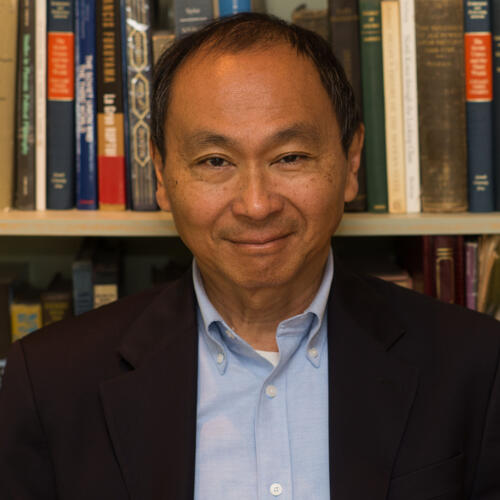
CDDRL Mosbacher director Francis Fukuyama spoke with Alexander Görlach for The WorldPost about U.S. President Donald Trump, the populist wave sweeping Europe and “fake news.” Read here.
Francis Fukuyama is the Olivier Nomellini Senior Fellow at the Freeman Spogli Institute for International Studies (FSI) and the Mosbacher Director of FSI's Center on Democracy, Development, and the Rule of Law (CDDRL). He is also a professor by courtesy in the Department of Political Science. He was previously at the Paul H. Nitze School of Advanced International Studies (SAIS) of Johns Hopkins University, where he was the Bernard L. Schwartz Professor of International Political Economy and director of SAIS' International Development program.
Image
Bushra Bataineh is a PhD student in the Civil and Environmental Engineering department at Stanford University. Her research focuses on innovative project delivery mechanisms for water infrastructure worldwide. Her current research, conducted under the Global Projects Center at Stanford, is on private sector participation in water infrastructure projects in developing countries and the emergence of local private sector players. She is also analyzing cases of water sector public private partnerships in the United States in order to draw lessons learned with regards to innovative financial structuring.
Image
Michael Bennon is a Managing Director at the Stanford Global Projects Center, developing new initiatives for the GPC and managing our student programs and industry affiliations. Michael’s research areas of interest for the center and work experience are in Public Sector finance, infrastructure and real estate investment, and project organization design. Michael served as a Captain in the US Army and US Army Corps of Engineers for five years, leading Engineer units, managing projects, and planning for infrastructure development in the United States, Iraq, Afghanistan, and Thailand. Michael received a bachelor’s degree in Civil Engineering from the United States Military Academy at West Point and received an MSCE and MBA from Stanford University.
Encina Hall, C148
616 Jane Stanford Way
Stanford, CA 94305
0
f.fukuyama@stanford.edu
Olivier Nomellini Senior Fellow at the Freeman Spogli Institute for International Studies
Director of the Ford Dorsey Master's in International Policy
Research Affiliate at The Europe Center
Professor by Courtesy, Department of Political Science
yff-2021-14290_6500x4500_square.jpg
Francis Fukuyama is the Olivier Nomellini Senior Fellow at Stanford University's Freeman Spogli Institute for International Studies (FSI), and a faculty member of FSI's Center on Democracy, Development and the Rule of Law (CDDRL). He is also Director of Stanford's Ford Dorsey Master's in International Policy, and a professor (by courtesy) of Political Science.
Dr. Fukuyama has written widely on issues in development and international politics. His 1992 book, The End of History and the Last Man, has appeared in over twenty foreign editions. His book In the Realm of the Last Man: A Memoir will be published in fall 2026.
Francis Fukuyama received his B.A. from Cornell University in classics, and his Ph.D. from Harvard in Political Science. He was a member of the Political Science Department of the RAND Corporation, and of the Policy Planning Staff of the US Department of State. From 1996-2000 he was Omer L. and Nancy Hirst Professor of Public Policy at the School of Public Policy at George Mason University, and from 2001-2010 he was Bernard L. Schwartz Professor of International Political Economy at the Paul H. Nitze School of Advanced International Studies, Johns Hopkins University. He served as a member of the President’s Council on Bioethics from 2001-2004. He is editor-in-chief of American Purpose, an online journal.
Dr. Fukuyama holds honorary doctorates from Connecticut College, Doane College, Doshisha University (Japan), Kansai University (Japan), Aarhus University (Denmark), the Pardee Rand Graduate School, and Adam Mickiewicz University (Poland). He is a non-resident fellow at the Carnegie Endowment for International Peace. He is a member of the Board of Trustees of the Rand Corporation, the Board of Trustees of Freedom House, and the Board of the Volcker Alliance. He is a fellow of the National Academy for Public Administration, a member of the American Political Science Association, and of the Council on Foreign Relations. He is married to Laura Holmgren and has three children.
(October 2025)
Global Populisms
A new project examining the global surge in populist movements and what it means for established democratic rules and institutions.
"Although peace was the prevailing theme of the opening night at the Pyeongchang Winter Olympics, the air in the VIP box was charged with awkwardness and intimidation," said researchers at the Shorenstein Asia-Pacific Research Center in a recently published article. "The real test for Moon's leadership begins now."
The full article in East Asia Forum is available here.



 John Lewis at his 80th birthday party.

 Drell, Sakharov, and Panofsky at Stanford,1989