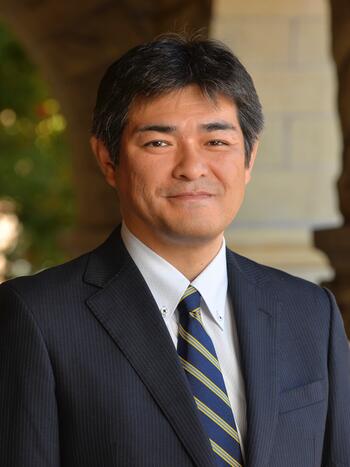
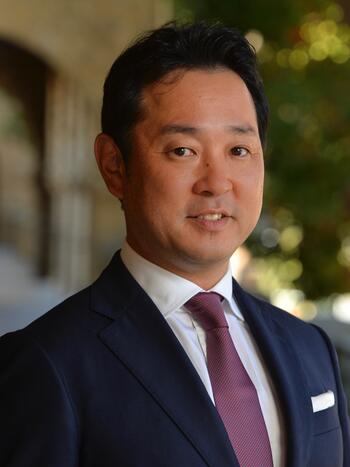
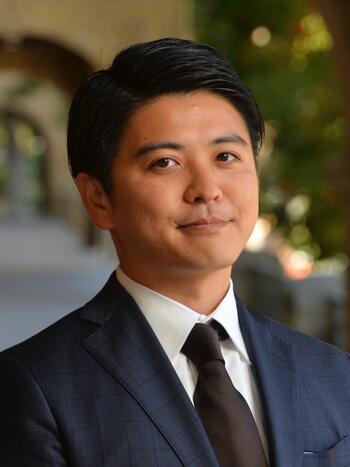
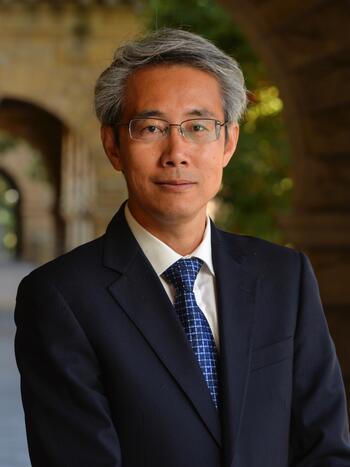
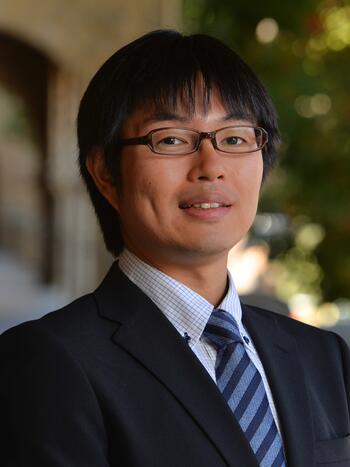
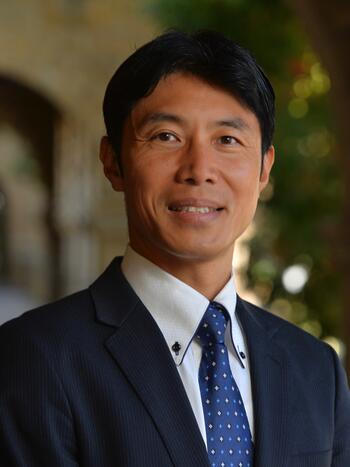
Shorenstein APARC Introduces New Journalism Award Selection Committee, Seeks 2019 Award Nominations
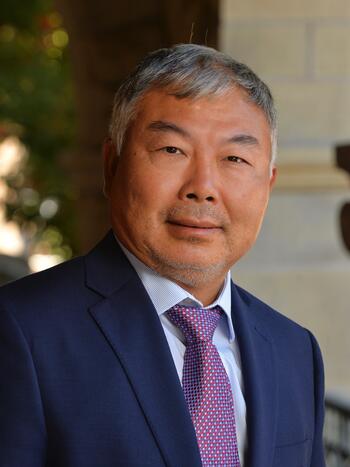
Lijun Zhang is a global affiliate visiting scholar at the Walter H. Shorenstein Asia-Pacific Research Center (Shorenstein APARC) for 2018-19. Dr. Zhang is the Chairman of the Board of V1 Group Ltd., one of the top 100 internet companies in China and has been engaged in economic system reform, entrepreneurship and innovation in the fields of telecom, internet and media. Additionally, he served as a member and Chairman of the APEC Business Advisory Council for 14 years contributing to regional economic development. Prior to joining Shorenstein APARC, Dr. Zhang was a research scholar in the department of engineering at Stanford researching the theory of disruptive innovations. While at Shorenstein APARC, he will continue his research on the innovation development of countries in the Asia-Pacific region. Dr. Zhang earned both his masters and PhD in world economics from Nankai University.
A group of 20 faculty and fellows participate in an orientation visit to Indo-Pacific Command headquarters, Honolulu, Hawaii, February 21–22, 2019, organized and sponsored by the U.S.-Asia Security Initiative. Photo courtesy of the U.S.-Asia Security Initiative
On February 21–22, faculty and fellows from Stanford University traveled to Oahu, Hawaii for an orientation visit at the United States Indo-Pacific Command (INDOPACOM), the U.S. military command responsible for the conduct of the U.S. military’s missions throughout the Indian and Pacific Oceans, and Asia.
The visit brought together scholars and researchers from Stanford, the Massachusetts Institute of Technology, the Council on Foreign Relations, and Macquarie University, Australia. Organized by the U.S.-Asia Security Initiative (USASI) and the Shorenstein Asia-Pacific Research Center at the Freeman Spogli Institute for International Studies (FSI), the visit included meetings with the commanders and staffs of INDOPACOM and five of its subordinate commands (U.S. Army Pacific, U.S. Pacific Fleet, U.S. Air Forces Pacific, U.S. Marine Forces Pacific, and U.S. Special Operations Command Pacific), and a tour of Arleigh Burke-class Aegis destroyer USS John Paul Jones (DDG-52).
The visitors also interacted with the U.S. Army’s 25th Infantry Division’s leadership and the unit’s Jungle Training Center. The busy itinerary provided the group a superb opportunity to learn about INDOPACOM’s and its subordinate units’ threat assessments, capabilities, doctrine, regional partnerships, and readiness challenges.
These trips offer great access to America’s armed forces to those whose research focuses on or relates to national security issues, says Karl Eikenberry.
Karl Eikenberry, Director of the U.S.-Asia Security Initiative (USASI), a former U.S. ambassador to Afghanistan and himself a retired U.S. Army lieutenant general said: “USASI has over the past five years organized annual trips to U.S. military commands for Stanford FSI faculty and fellows. These trips offer great access to America’s armed forces to those whose research focuses on or relates to national security issues. The insights gained inform analysis, while the host organizations gain fresh perspectives different from those found within their commands.”
Discussions began on February 21st at Camp H.M. Smith, the Headquarters of INDOPACOM. Brigadier General Jonathan Braga, U.S. Army, SOCPAC Commander and his staff discussed his command’s unique capabilities and roles in both conventional and counterterrorist/counterinsurgency warfare operations. Major General Michael Minihan, U.S. Air Force, INDOPACOM Chief of Staff, then hosted a wide-ranging session on his organization’s implementation of the National Security Strategy and National Defense Strategy at a time of dynamic change within the region.
This was followed by a working lunch at the INDOPACOM Flag Mess with key staff members of MARFORPAC who explained U.S. Marine force posture and contingency missions throughout the Pacific Region. The Stanford group then proceeded to Hickam Field and met with General Charles Brown, Commander, PACAF, and his Deputy Commander, Major General Russell Mack. General Brown detailed the critical role played by airlift and airpower in the vast Indo-Pacific region, and the development of new concepts for the employment of U.S. Air Force capabilities in joint (inter-service) and combined (inter-allied) operations.
The visiting faculty and fellows then transited to Pearl Harbor for a tour of USS John Paul Jones led by Commanding Officer, Commander Jesse Mink, United States Navy, and Executive Officer, Commander Robert Watts, USN. Noteworthy was the destroyer’s sophisticated integrated air, surface, and underseas warfare systems, and the emphasis placed on resilience in high-end combat situations. Following the ship tour, the group attended a PACFLT command briefing chaired by the Commander, Admiral John Aquilino.
The dialogue made clear PACFLT’s emphasis on a holistic approach to deterrence and decisive operations, with an eye on future requirements. The first day of the trip ended with a working reception at the historic “Nimitz House” hosted by Admiral Aquilino, offering the attendees a chance to engage in conversations with the Commander and his staff.
The second day of the trip began with an introduction to the Daniel K. Inouye Asia-Pacific Center for Security Studies (APCSS), followed by expert presentations and breakout sessions on select topics including the Chinese One Belt One Road plan, the security of Taiwan, pandemic threats in the Indo-Pacific region, and cyber operations. The Stanford team then traveled to Fort Shafter for a meeting with Brigadier General Pete Andrysiak, U.S. Army and Chief of Staff, USARPAC. BG Andrysiak and the USARPAC staff elaborated on the evolving U.S. Army’s regional doctrine and extensive partnership activities.
A highlight of the group’s time in Oahu came with a visit to the U.S. Army’s 25th Infantry Division at Schofield Barracks, and the 25th ID Jungle Training center via UH-60 Blackhawk Helicopters. There Brigadier General J.B. Vowell, Assistant Division Commander, 25th Infantry Division and U.S. Army Hawaii (himself a former FSI Senior Military Fellow), discussed the division’s extensive missions throughout the region, including in the Korean Peninsula.
Faculty and fellows were also able to “get their boots (or at least tennis shoes) muddy” in the U.S. Army’s rugged training area in northern Oahu, with highly skilled soldiers demonstrating jungle warfare tactics and techniques. The trip ended with the participants hosting a reception at the Hale Koa Hotel Warriors Lounge for their many hosts over the past two days.
The trip to INDOPACOM Headquarters provided a rare opportunity for participants to talk directly with senior U.S. military leaders in the most important region of the world and to gain a better understanding of their perspectives and the many challenges that they are addressing. Faculty and fellows interacted with junior leaders at the tactical level, helping them gain an appreciation of the ethos of those serving at the cutting edge. The hosts all commented on the benefit of learning the views of scholars, many of whom have spent their academic careers writing about national security issues.
The trip provided fascinating insights into how the U.S. military views the rapidly evolving national security challenges in the Indo-Pacific region, says Larry Diamond.
“The trip provided fascinating insights into how the U.S. military views the rapidly evolving national security challenges in the Indo-Pacific region, and how it is organized to defend against the threats. You can read about much of this in the media and the journals, but there is just no substitute for being there, seeing our facilities on the ground, and engaging directly with the remarkable men and women (and one thing that struck me is that there are quite a number of women) who are responsible for our defense,” said Larry Diamond, senior fellow at the Hoover Institution and at the Center on Democracy, Development & the Rule of Law (CDDRL) at FSI.
FSI scholars particularly valued the opportunity to connect one-on-one.
“It was invaluable to meet and hear directly from the individuals and organizations who are working so hard to ensure our security,” said Center for International Security and Cooperation (CISAC) Senior Research Scholar Megan Palmer. For CISAC Pre-doctoral Fellow Erik Lin-Greenberg, “the opportunity to interact with decision-makers from tactical to strategic levels was incredibly valuable and helped inform my own research.”
This post was originally published on Axios.
While President Trump and North Korean leader Kim Jong-un’s June 2018 meeting ended with a broad statement — committing to “establish new U.S.-DPRK relations” for “a lasting and stable peace regime on the Korean Peninsula” — they will aim to take more concrete steps forward at their second summit in Hanoi this week.
Between the lines: To keep up the diplomatic momentum, Trump and Kim will need to minimize existing ambiguities and divergences on key issues — including the definition of denuclearization — and produce a comprehensive road map that lays out the specifics of their proclaimed shared vision. Without these agreements, the Hanoi summit could be easily denigrated as “just another show.”
Where it stands: Trump and Kim each face immense pressure, both international and domestic, to make progress.
Between the lines: Successful diplomacy sometimes entails purposeful ambiguities, and the ambiguities of the first Trump-Kim summit might indeed have been strategic. At this critical juncture, however, a failure on Trump’s and Kim’s part to commit to defined objectives could hurt the bilateral relationship.
The bottom line: Trump and Kim need support more than ever to advance their diplomatic endeavors. While spectators have good reason to be skeptical, and one can only be cautiously hopeful with North Korea, a return to confrontation or "strategic patience" is in no one’s interest.
Gi-Wook Shin is the William J. Perry Professor of Contemporary Korea and director of the Walter H. Shorenstein Asia-Pacific Research Center at Stanford University.
Abstract: Multilateral conferences are the bread-and-butter of international politics. In such settings, countries may pursue their interests individually, but most of the time they prefer to act through coalitions. Such coalitions are overlapping, creating a network structure. States build and utilize networks to get agenda items pushed through or to block unfavorable ones. While sometimes they are formed on the basis of formal institutions (such as the NAM or the EU), frequently their membership is based on either ad hoc cooperation, or existing informal bodies (such as the NSG, New Agenda Coalition, or Zangger Committee). The attention to such networks is, however, still in its infancy. This paper looks at how state networks within one of the most important recurring diplomatic conferences – the quinquennial NPT Review Conference – develop and transform over time. By doing so, the paper maps the existing networks, and explains their transformation as an instrument of global governance.
Speaker Bio: Michal Onderco is a Junior Faculty Fellow at CISAC (2018-2019), and his research focuses on politics of multilateral nuclear diplomacy. His current project tries to understand how states build coalitions in multilateral diplomacy, and why are some coalitions more successful than others.
Michal is currently on leave from Erasmus University Rotterdam, where he is Assistant Professor of International Relations. Previously, he was a Max Weber Fellow at the European University Institute, Fulbright Visiting Researcher at Columbia University in New York, and a short-term Stanton Fellow at Fundação Getúlio Vargas in São Paulo. He received his LLM in Law and Politics of International Security and PhD in Political Science from Vrije Universiteit Amsterdam. His earlier work was published in International Studies Quarterly, European Journal of Political Research, Cooperation & Conflict, The Nonproliferation Review, and European Political Science Review.
Shorenstein APARC is pleased to announce the selection of two scholars as postdoctoral fellows for the 2019-20 academic year. They will begin their appointments at Stanford in the coming Autumn quarter.
The Center offers the Shorenstein Postdoctoral Fellowship on Contemporary Asia to recent doctoral graduates dedicated to research and writing on contemporary Asia, primarily in the areas of political, economic, or social change in the Asia-Pacific region, or international relations and international political economy in the region. The Center’s Asia Health Policy Program sponsors the Asia Health Policy Postdoctoral Fellowship, supporting young scholars who pursue original research on contemporary health or healthcare policy of high relevance to low- and middle-income countries in the Asia-Pacific region
Fellows develop their dissertations and other projects for publication, present their research, and participate in the intellectual life at the Center and at Stanford at large. Our postdoctoral fellows often go on to pursue careers at top universities and research organizations around the world and continue to contribute to APARC research and publications.
Meet our new postdoctoral scholars:
What are the conditions necessary to ensure the effectiveness of public health insurance programs?
Radhika Jain is completing her doctorate in the Department of Global Health at Harvard University. She studies the role of the private sector in the health system, frictions in health care markets, and the incidence of public health policy benefits.
Radhika’s dissertation examines the extent to which government subsidies for health care under insurance are captured by private hospitals instead of being passed through to patients, and whether accountability measures can help patients claim their entitlements. Radhika’s research has been supported by grants from the Weiss Family Fund and the Jameel Poverty Action Lab (JPAL). She has worked on impact evaluations of health programs in India and on the implementation of HIV programs across several countries in sub-Saharan Africa. She also held a doctoral fellowship at the Center for Global Development.
At Shorenstein APARC, Radhika will refine her dissertation research for publication in academic journals and start new work on the structure of health care markets in India and the impacts of measures to increase the effectiveness of public health insurance.
How does modernization influence cultural democratization in East Asia?
Hannah June Kim is completing her doctorate in the Department of Political Science at the University of California, Irvine. She researches public opinion, political behavior, theories of modernization, economic development, and democratic citizenship, focusing on East Asia.
Hannah’s dissertation examines how and why people view democracy in systematically different ways in six countries: China, Japan, Korea, Singapore, Taiwan, and Vietnam. Developing unique categories of democratic citizenship that measure the cognitive, affective, and behavioral patterns of individuals, she finds that state-led economic development limited the growth of cultural democratization among middle class groups in all three dimensions. The results imply that the classic causality between modernization and democratization may not be universally applicable to different cultural contexts.
At Shorenstein APARC, Hannah will work on developing her dissertation into a book manuscript and make progress on her next project that explores democratization and gender empowerment in East Asia. Hannah received an MA in International Studies from Korea University and a BA from UCLA. Her work has been published, or is forthcoming, in The Journal of Politics, PS: Political Science & Politics, and the Japanese Journal of Political Science.
Since its establishment, DNX Ventures (formerly Draper Nexus Ventures) has acted as a bridge between growing Silicon Valley businesses and large Japanese firms. Since 2011, DNX Ventures has created more than 100 partnerships between its portfolio companies and its over 25 large Japanese corporate LPs. During this seminar, Managing Director of DNX Ventures Hiro Rio Maeda will extrapolate from his over 15 years of experience in both corporate venture capital and venture capital and extensive experience working with both startups and large Japanese corporations to discuss the basics of venture capital, and how Japanese corporations leverage venture capital to push forward open innovation initiatives. From a VC perspective: how are decisions about strategic investments made? How does money flow? What ratio of successful investments to non-successful investments do VCs aim for? From a large Japanese corporate perspective: how do large Japanese firms use VC to achieve open innovation goals? What are some of the obstacles to Japanese large firm-startup partnerships, and what are some of the ways to overcome these challenges? Maeda will answer these questions and more, as well as share examples of successful partnerships and large Japanese firms that are successfully harnessing Silicon Valley to further open innovation efforts.
Hiro Rio Maeda, Managing Director, DNX Ventures (formerly Draper Nexus)
Hiro Rio Maeda is a Managing Director at venture capital firm DNX Ventures (formerly Draper Nexus). Rio focuses on investing in innovative companies in Cyber Security, mobile, storage, and retail tech area that could work on a global scale. His portfolio companies include Cylance, SafeBreach, JASK, vArmour, AppDome, Ayasdi, Remotium, Klout, Fyde, JoyMode, and Hom.ma.
Prior to joining DNX Ventures (formerly Draper Nexus), Rio spent six years at Globespan Capital Partners where he had put his resource on both investment and business development of Japan/US portfolio companies. Palo Alto Networks(NYSE: PANW) was a good example portfolio company that he took a lead on taking them to the Japanese market.
Prior to Globespan, Rio spent seven years at Sumitomo Corporation, a Japanese conglomerate trading company in which he had built expertise his international business skill in IT technologies and consumer web services in Tokyo and his capitalist career at Presidio Ventures (Sumitomo’s corporate venture capital arm) in Santa Clara.Japanese conglomerate trading company in which he had built expertise his international business skill in IT technologies and consumer web services in Tokyo and his capitalist career at Presidio Ventures (Sumitomo’s corporate venture capital arm) in Santa Clara.
4:15pm: Doors open
4:30pm-5:30pm: Talk and Discussion
5:30pm-6:00pm: Networking
Register to attend at http://www.stanford-svnj.org/22819-public-forum
The event is jointly sponsored by the Japan Program at the Shorenstein Asia-Pacific Research Center and the Japan Foundation Center for Global Partnership.
The Heisei era started in 1989, with high hopes for Japan to contribute to the international order. As the Heisei era draws to an end, Japan is once again expected to “step up” with increased urgency, given the current US administration’s withdrawal from, and challenge to the international order. In this talk, I will first look back at the thirty years of Heisei, and discuss why Japan did not take the “internationalist” path in a way that some had expected. Looking forward, I discuss how the domestic institutional changes, together with the geopolitical challenges in Asia, have prompted Japan to seek active leadership in the region and beyond. I will elaborate on the evolution of the “Free and Open Indo-Pacific Vision,” with focus on how exactly Japan seeks to achieve “free and open” in the region, and challenges and limitations going forward.
In May 2018, Stanford Center for International Security and Cooperation (CISAC) scholars Siegfried Hecker, Robert Carlin, and Elliot Serbin released an in-depth report analyzing the nuclear history of North Korea between 1992 and 2017 alongside a historical research-based “roadmap” for denuclearization.
Since then, tensions between North Korea and South Korea have thawed. United States President Trump met with Kim Jong-un in Singapore in June, and another U.S.-North Korea summit is planned for later this month.
Today, the CISAC researchers release a 2018 update to their report, chronicling and analyzing historic developments in North Korea over the past year. In this Q&A with Katy Gabel Chui, CISAC Senior Fellow and former Director of the Los Alamos National Laboratory Siegfried Hecker shares what the team learned:
Your research demonstrates that South Korean, North Korean, and U.S. efforts in 2018 were able to lower tensions and the threat of war on the Korean Peninsula. How? What actions were most effective toward this end?
At the end of 2017, the Moon Jae-in administration in South Korea made secret overtures to the Kim Jong-un regime. Kim Jong-un responded positively in his 2018 New Year Speech, proposing to send North Korean athletes to the South as part of a joint delegation for the 2018 Winter Olympics in Seoul. He also initiated serious diplomatic overtures to Washington. These efforts led to the North/South Summit in April and the historic Singapore Summit in June.
Yet, in spite of these positive initiatives, you did not rate U.S. and North Korean diplomacy at your highest level, why is that?
We stopped one level short for both (a G2 instead of a G3) because progress in talks that followed the summit quickly hit a wall when the US side called for the North to produce a full declaration of its nuclear weapons program, to which Pyongyang responded angrily. The rest of the year was up and down. Nevertheless, the Singapore Summit took the critical step away from the brink of war. The North and South also continued to make remarkable progress toward reconciliation with two more presidential summits.
Most of the focus in the U.S. has been on an apparent failure of North Korea to denuclearize. But you note in your research that the Singapore summit pledged normalization and denuclearization. Why has progress stalled?
First, denuclearization is a poorly defined concept. We should focus on the elimination of the North’s nuclear weapons, the means of production and means of delivery. Second, Washington has so far not taken steps toward normalization. It has insisted on maintaining maximum pressure and sanctions, which Pyongyang considers incompatible with normalization.
Nevertheless, you claim that the threat posed by North Korea was substantially reduced. What about the North’s nuclear capabilities – were these reduced in 2018?
The diplomatic initiatives have greatly reduced the threat. Our study, which looks at the details of how the capabilities have changed in 2018, concludes that the rapid escalation of overall capabilities in 2017 and prior years was halted and in some cases rolled back.
But your research also shows North Korea continued to operate its nuclear weapons complex in 2018, and that it is still producing plutonium and highly enriched uranium.
We are not surprised that North Korea has not halted its fissile materials production in absence of formal negotiations. Our analysis of open-source satellite imagery of the Yongbyon complex led us to estimate they may have added sufficient plutonium and highly enriched uranium for an additional 5 to 7 nuclear weapons on top of our 2017 estimate of approximately 30 weapons.
There have also been reports that it has continued to maintain, produce, and deploy its land-based ballistic missiles. These activities don’t look like the North is denuclearizing.
In our study, we look at the three requisites for a nuclear arsenal – fissile materials, weaponization (that is design, build, and test), and delivery. The North did continue to produce fissile materials. But it took the remarkable step to end nuclear testing and long-range missile testing at a time during which North Korea had been rapidly increasing the sophistication of its nuclear weapons and missiles and their destructive power and reach. Therefore, we conclude that the North not only halted that rapid advance but also rolled back the threat we judged the North’s nuclear and missile programs to pose in 2017.
It sounds like there is a long way to go to denuclearize. In May of last year, you released a framework for denuclearization of North Korea based around a “halt, roll back and eliminate” process. Where does North Korea stand, if anywhere, in that process today?
Our color charts track the progress. Contrary to what we have heard in the media, North Korea has actually halted and rolled back some nuclear activities, with the most important being the end of nuclear and missile testing, which in turn, has significant consequences. In fact, in 2018 it did not flight test missiles of any range. However, the road to final elimination will be long and difficult, especially because of the serious trust deficit between Washington and Pyongyang. We suggested a 10-year time frame last year.
Haven’t you also suggested a way to speed up that process?
Yes, we propose that North Korea, South Korea, and the U.S. explore cooperative efforts to demilitarize North Korea’s nuclear and missile programs and convert them to civilian nuclear and space programs. Such cooperation has the potential of accelerating the elimination of nuclear weapons and nuclear weapons program. It will, in the long term, also greatly improve the prospects of adequate verification.
How do you get North Korea to go along with any of these ideas?
That’s the job of our negotiators. When Special Representative Stephen Biegun was here at Stanford recently, he showed a lot of flexibility to have the U.S. phase denuclearization with normalization. I think that’s what it will take. But a lot of hard work lies ahead.
Full Report: A Comprehensive History of North Korea's Nuclear Program: 2018 Update
Stanford e-Tottori is a distance-learning course sponsored by the Tottori Prefectural Board of Education and the Stanford Program on International and Cross-Cultural Education (SPICE), Freeman Spogli Institute for International Studies at Stanford University. Tottori Governor Shinji Hirai and Superintendent Hitoshi Yamamoto of the Tottori Prefectural Board of Education were instrumental in its establishment. Offered for the first time in 2016, Stanford e-Tottori presents a creative and innovative approach to teaching Japanese high school students about U.S. society and culture.
Hana Hirosaka of Tottori Higashi High School with SPICE Director Gary Mukai
Stanford e-Tottori instructor Jonas Edman recently recognized three of his top performing students for their exceptional coursework. They are James Banville (Tottori Keiai High School; Principal Shigeo Nikaido), Hana Hirosaka (Tottori Higashi High School; Principal Masato Omuro), and Kosei Kamada (Tottori Nishi High School; Principal Eiju Yamamoto). Since the launching of Stanford e-Tottori, Edman has encouraged his students to think in an internationally minded manner—that is, to consider different points of view and to realize the importance of diversity and cross-cultural communication. Reflecting upon his former students over the first two years of Stanford e-Tottori, Edman noted that “James, Hana, and Kosei were always open-minded to various points of view and demonstrated strong critical thinking skills… and I was also impressed with their regular attendance in class despite their extremely busy schedules. I am so proud of all of the Tottori students’ accomplishments, but those of James, Hana, and Kosei especially stood out.”
James Banville with Principal Shigeo Nikaido of Tottori Keiai High School
Each of the honorees received a plaque from SPICE/Stanford University, and Edman expressed his hope that this honor would help them with university admissions as well as inspire them to someday study in the United States. As part of the admissions process to Waseda University, Banville spoke about what he learned in Stanford e-Tottori during an interview. He was admitted to Waseda and will begin his freshman year this spring. Hirosaki and Kamada are now in the midst of the university application process and they, too, plan to showcase their participation in Stanford e-Tottori.
Takuya Fukushima, Office Director of the English Education Advancement Office of the High School Division at the Tottori Prefectural Board of Education, expressed his profound gratitude to Edman and feels that these honors have made Stanford e-Tottori more visible in Tottori Prefecture. “With wonderful guidance and skilled facilitation, Edman-sensei has done a great job to foster the students’ interest and participation in discussions… the students’ positive attitude and willingness to participate in lessons was something that I had been long waiting for. It was the moment when I could feel, ‘Oh, Stanford e-Tottori rose one step higher.’”
To stay informed of SPICE news, join our email list or follow us on Facebook and Twitter.
Related articles: