
News Type
News
Date
Paragraphs

A new Shorenstein APARC event series will explore the complex ties between identity and the social, political, and economic status of Asia's Muslim minorities, with a focus on China, India, the Philippines, and Thailand.

Hero Image
Uighur1 NEWSFEED
An elderly Uighur woman in China's northwestern province of Xinjiang, Sept. 2010.
Flickr/Preston Rhea
All News button
1
News Type
News
Date
Paragraphs
What are the right questions the president should ask — and we as his employers should ask — when deciding whether going to war is (a) justified and (b) worth it, asks Bill Keller in the New York Times. Karl Eikenberry, who served in Afghanistan both as a military commander and as ambassador, put it this way: “If we do not in the future better align ends, ways and means, historians may find that in the aftermath of the wars in Iraq and Afghanistan the United States was compelled to contract its global posture similar to the British when they announced their ‘East of Suez’ policy in the late 1960s.”

What are the right questions the president should ask — and we as his employers should ask — when deciding whether going to war is (a) justified and (b) worth it, asks Bill Keller in the <i>New York Times</i>. Karl Eikenberry, who served in Afghanistan both as a military commander and as ambassador, put it this way: “If we do not in the future better align ends, ways and means, historians may find that in the aftermath of the wars in Iraq and Afghanistan the United States was compelled to contract its global posture similar to the British when they announced their ‘East of Suez’ policy in the late 1960s.”

All News button
1
Authors
News Type
News
Date
Paragraphs

North Korea’s government announced it will launch a long-range rocket to orbit a satellite within a few days of the 100th anniversary of founder Kim Il Sung’s birthday on Apr. 15.

The statement comes on the heels of an important U.S.-North Korea agreement on Feb. 29, in which the United States promised to provide North Korea with 240,000 tons of food aid over the next year while North Korea would refrain from nuclear and long-range missile tests and allow international inspection of its declared nuclear facilities. The situation echoes that of 2009, when North Korea also gave advance notice of a "peaceful" long-range rocket launch. North Korea’s 2009 missile test prompted a United Nations condemnation, after which North Korea conducted its second test of a nuclear device.

David Straub, associate director of Stanford’s Korean Studies Program and a former State Department Korea expert, speaks about North Korea’s latest statement.

Why is the new North Korea announcement of possible concern?

This type of launch is something the U.N. Security Council earlier condemned and forbade North Korea to do again. There is a large overlap in the technologies used for such a rocket and for a long-range ballistic missile, and the international community is deeply suspicious that North Korea will use what it learns from such launches to develop long-range missile technology.

The larger concern is that North Korea intends eventually to pair long-range missiles with nuclear warheads, creating a much greater threat to other countries, including the United States.

Was there any indication North Korea would issue this statement?

Given North Korea’s history of reneging on deals, the Obama administration wisely noted at the time of the Feb. 29 announcement that it was a "limited" agreement. Secretary of State Hillary Clinton warned that North Korea’s upholding of its side of the agreement would be the key to the deal’s overall success.

There is no doubt the U.S. government would not have announced this agreement if it had anticipated that North Korea would almost immediately have declared its intention to launch another long-range rocket.

Why would North Korea decide to announce a rocket launch?

At this point, we can only speculate about North Korea’s motivations for the announcement. It could be related to the recent leadership succession in North Korea. Kim Jong Un, the grandson of Kim Il Sung, is an inexperienced leader still in his 20s. He and his advisors may feel it is necessary to defy the United States so blatantly to demonstrate at home how strong a leader he is. 

Or perhaps, after testing two nuclear devices and several long-range missiles, the North Korean government has become more confident about its diplomatic ability to withstand international condemnations and sanctions.

In any event, it is a stunning slap in the face of the Obama administration, which will need to react firmly. Already, less than 24 hours after the North Korean announcement, the Department of State has publicly said that the entire Feb. 29 agreement, including the delivery of food aid, has been put on hold.  

What should we expect to happen next?

A real danger is that the events of 2009 will be repeated. The North Korean government reacted angrily to the U.N. Security Council’s presidential statement against it three years ago, and withdrew from the Six-Party Talks. Pyongyang then proceeded to conduct a nuclear test only a month later.

The most worrisome aspect is the possibility that the new leadership in North Korea feels insecure at home and thus obliged to act tough, and also has poor judgment about the United States and the international community as a whole. If so, the North Korea issue could become significantly more confrontational—and dangerous—in the coming months.

ADDITIONAL RESOURCES

U.S. Department of State: North Korean announcement of missile launch

Reuters: North Korea’s missile and "satellite" programs

Hero Image
StatueKimIlSung NEWSFEED
A bronze statue of North Korean founder Kim Il Sung, Sept. 2007. North Korea will celebrate the 100th anniversary of Kim's birth this year on Apr. 15.
Flickr/Will De Freitas
All News button
1
-

Abstract:

The hegemony of the democratic ideal may be waning. Until recently, even the custodians of dictatorships claimed democratic status for their regimes. Many still do. But other rulers now drop the pretense of democracy and claim that their nondemocratic regimes provide the people with conditions that are superior to those found in democracies. They portray themselves as demophiles rather than democrats, and claim that their concern for their people provides a superior alternative to popular control over the state. What is more, some actually do pursue policies that differ meaningfully from the predation that characterizes the behavior of elites in many nondemocratic regimes. How may we understand contemporary demophily, and how does it challenge democracy?

Speaker Bio:

M. Steven Fish is a comparative political scientist who studies democracy and regime change in developing and postcommunist countries, religion and politics, and constitutional systems and national legislatures. He is the author of Are Muslims Distinctive? A Look at the Evidence (Oxford, 2011). He is also author of Democracy Derailed in Russia: The Failure of Open Politics (Cambridge, 2005), which was the recipient of the Best Book Award of 2006, presented by the Comparative Democratization Section of the American Political Science Association, and Democracy from Scratch: Opposition and Regime in the New Russian Revolution (Princeton, 1995). He is coauthor of The Handbook of National Legislatures: A Global Survey (Cambridge, 2009) and Postcommunism and the Theory of Democracy (Princeton, 2001). He served as a Senior Fulbright Fellow and Visiting Professor at the Airlangga University, Surabaya, Indonesia, in 2007 and at the European University at St. Petersburg, St. Petersburg, Russia, in 2000-2001. In 2005, he was the recipient of the Distinguished Social Sciences Teaching Award of the Colleges of Letters and Science, University of California-Berkeley.

CISAC Conference Room

M. Steven Fish Political Scientist Speaker UC Berkeley
Seminars
Authors
News Type
Q&As
Date
Paragraphs

A Wake-up Call for America: We Must Connect with the World

Former U.S. Sen. Russ Feingold, currently the Mimi and Peter E. Haas Distinguished Visitor at Stanford’s Haas Center for Public Service, uses an anecdote in his new book, While America Sleeps: A Wake-up Call for the Post-9/11 Era, to illustrate his concern that Americans have become too insular as a result of the 2001 terrorist attacks. While teaching at Marquette University Law School during the Arab Spring of last year, an undergraduate penned a column lamenting that so many students not only could not find Tunisia on the map – they could spell Kardashian before Kazakhstan.

Feingold writes that he admired this student for his confession about his lack of knowledge on global affairs, then quotes the final thought of the young columnist: “We are connected to the rest of the world in ways few of us can fully fathom, from the shoes we wear and coffee we drink to the cell phones we carry and the tweets we post.”

In a recent interview, CISAC Co-Director Mariano-Florentino Cuéllar and Feingold discuss steps to be taken to ensure that all Americans – young and old, inside the Washington beltway and out on the farm in Wisconsin – take a patriotic stand by engaging with the world to restore our national unity and regain global respect.    

Senator Feingold, what prompted you to write this book now?

Feingold: For me, as for many Americans, 9/11 was a life-changing event, the wake-up call in which we all understood that we no longer could be safe just assuming the world would take care of itself. We got misdirected with things like Iraq and we developed this sort of invade-one-country-at-a-time approach. There was also exploitation of the fears from 9/11 for domestic agendas, from the Patriot Act to the way that Muslims and Arabs are treated in this country. And then, finally, with the rise of the tea party, I feel like we went back to sleep. But there are signals all over the place, of the continued presence of al-Qaida and the continued potency of al-Qaida, not to mention so many other trends from the Chinese influence in Africa to the Iranian influence in Latin America. We aren’t connecting as a government or as a people in a way that I think is commensurate with our place in the 21st century. I’m trying to issue a warning that we’re going to get fooled or surprised again if we think we can just go back to being just sort of safely over here across the oceans. That’s just not the world anymore.

So how do you wake up Americans and make them realize we cannot, as you say, survive as a nation without being active and aware of global events and trends? 

Feingold: It’s at all levels. I happen to think we have a good president and I think he’s going to be a great president by the end of his second term. And I think he’s started the process of alerting Americans to the need to connect to all places in the world; he’s leading us toward a global vision of the kind that I think we have to have to be safe and to be competitively successful and to be well perceived by the rest of the world. The president and other leaders should call on each of us to try and become citizen diplomats. Three hundred million people should be urged as part of their patriotic duty not just to go to the moon as we once were, but go to the rest of the world. This isn’t Pollyanna; this is about being safe. I don’t think this country is geared up to make that connection and I think it’s a fatal flaw. The Russians, the Chinese and the Iranians, they’re all over the world and they have a plan for what they’re doing. We don’t.

What do you see as the most pressing global security issues today?

Cuéllar:  The United States is confronting a changing world, where countries like India, Brazil, and China are evolving and assuming greater importance. Engaging these countries to address problems like nuclear proliferation will be critical in the years ahead.  The world also faces a persistent problem involving failed or failing states. In places like Somalia, piracy is not only a regional problem in the Gulf of Aden.  The problem is an example of how threats can affect multiple countries and impact flows of commodities, disrupting the rule of law, highlighting the challenges of governing common resources such as international sea lanes. Another challenge is the enormous potential of technology to change people’s lives for the better, coupled with risks that arise which we are only in a very imperfect and incomplete way managing; risks of vulnerabilities in our infrastructure; risks of theft of intellectual property, risks of disruption of organizations.

Feingold: I like this answer because Prof. Cuéllar did not just say, “Well, it’s Russia and Iran and Colombia.” There’s this tendency to just speak of countries. We’re just trained to say, “OK what’s the hot spot and let’s just worry about that.” Like right now it’s Iran; a few months ago it was Yemen. In my book what I’m trying to point out is that you have to look at trends and overall tendencies around the world and somehow we have to have the capacity to deal with more than one thing at a time.

Senator Feingold, you called the Bush Administration’s terrorist surveillance program – the wiretapping and surveillance of emails and financial records without court approval – one of the worst assaults on the Constitution in American history. How does the government protect our constitutional rights to privacy and probable cause while monitoring criminal and terrorist networks in a digital age?

Feingold: The assault on the Constitutional by the administration was not about whether we could do those things, its whether or not the president would basically make up his own laws just because we’re in a crisis. That to me is completely unconstitutional. We understand that a president might have to take emergency action and he may have to come to Congress and say, you know I did this, it may be beyond the law, would you please pass a law to approve it, or I’ll stop doing it. That’s not what Bush did. Bush hid it. Bush hid what he was doing on torture; Bush hid what he was doing on wiretapping. That’s a very dangerous thing that completely saps our strength from within and is completely unnecessary to stop the terrorists.

Cuéllar: The challenge of living up to our constitutional values while we secure the country is always critical. It requires organizations that can learn from their mistakes to be honest with each other enough and recognize when they have overstepped their bounds, that make good use of entities like inspectors-general, that leverage the ability of Congress to do oversight. These are all elements of making our constitutional values relevant. So me the challenge has always been how to you leverage all the information technology and all our ability to make smart, thoughtful, careful decisions – including decisions that do permit appropriate degrees of surveillance and intelligence – in order to avoid superficial reactions against individuals who simply appear threatening.

What key steps should the U.S. government take to improve its counter-terrorism efforts both at home and abroad?

Feingold: The first thing is to recognize the nature of the threat. One of the chapters in the book is called A Game of Risk, where we seem to think the way to counter terrorism is to invade a country and stay there forever and say we have to stay there or the terrorist are going to come back. But this isn’t the nature of al-Qaida or similar organizations. President Bush used to say there were 60 countries where al-Qaida was operating and, of course, one thing that was embarrassing about it was that Iraq wasn’t one of them. But we’re still in this place today. Al-Shabab in Somalia; al-Qaida and the Islamic Maghreb in northern Africa; a group called Boko Haram in Nigeria, which looks very much like an al-Qaida group, has pulled off some 70 attacks in the last year. So this is an international organization that communicates with each other and they’re not done just because Osama bin Laden is gone. So let’s not get caught unawares again.

Senator Feingold, what was your most memorable, defining challenge in Congress and how did that change the way you see yourself and the world around you?

It had to do with recognizing when 9/11 occurred that there really was a group of people out there who would love to kill all of us and, despite the fact that I’m progressive and I voted against most military interventions, just saying to myself: look, there are times when threats are real. And it caused me to actually seek to be on the Intelligence Committee which is something I never wanted to do; I was not sure of the importance of intelligence in the post Cold War era and it was a real change for me. I remember having an emotional response, saying, “You know what? This is real; what these folks did was real and they have intimidated an entire country if not the world.” I wanted to know everything I could about how they came to be and what they were planning next, and to be a person who could try to think ahead for other kinds of threats so we as Americans can get ahead of threats instead of being the people who are reacting.


All News button
1

Center for Chinese Agricultural Policy,
Chinese Academy of Sciences
Room 3830, Anwai Datun Road, 11A
Beijing, 100101, P. R. China

0
REAP Project Manager for Keeping Kids in School
JC_REAP.jpg MA

James Chu manages the Keeping Kids in School projects at REAP. He has five years of experience researching educational issues in China. His research experience involves extensive quantitative and qualitative fieldwork in Shaanxi province and Beijing migrant schools. He has also designed and implemented several projects in Beijing benefiting migrant students. He is fluent in Mandarin and received his MA in Sociology at Stanford University.

Authors
Karen Eggleston
Jean C. Oi
Scott Rozelle
Ang Sun
Xueguang Zhou
News Type
News
Date
Paragraphs

As China's economy grows so does the prevalence of social inequality. In a YaleGlobal Online article, a team of Shorenstein APARC China experts says the country must invest more now in education and public health programs for its rural children or it will face major growth challenges in the near future.

Hero Image
childclassroom
School children in Gansu province in western China.
Adam Gorlick
All News button
1
Authors
Scott Rozelle
Karen Eggleston
Jean C. Oi
Xueguang Zhou
Ang Sun
News Type
News
Date
Paragraphs

Full text available at YaleGlobal.

Children of China's Future – Part II

 
Aging population and poverty require stronger investment in China’s rural youth
Karen Eggleston, Jean Oi, Scott Rozelle, Ang Sun, Xueguang Zhou
YaleGlobal, 14 March 2012
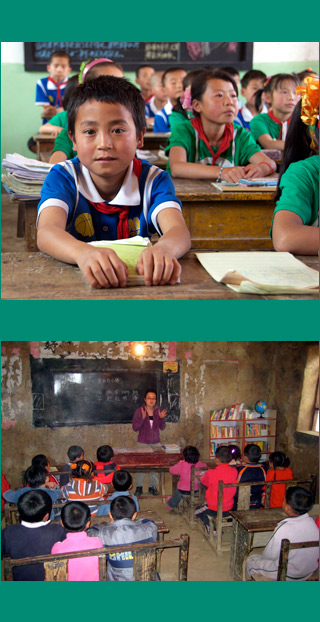
Poor education mortgaging the future? Students in a Gansu province school, where many are anemic (top); another class room in Loess Plateau. (Top Photo: Adam Gorlick)

DINGXI PREFECTURE: Wang Hongli, 8 years old, lives in a remote rural village on the Loess Plateau in one of China’s poorest and most agricultural provinces, Gansu. His prospects for living the good life are as bleak as the landscape. He is not on track to become part of China’s emerging middle class, the free-spending, computer-savvy, person-of-the-world often featured in the western media.

Hongli is a pseudonym. His parents work in a faraway industrial zone, coming home for only three weeks at Chinese New Year. His grandmother takes care of him and his siblings on the weekends, and during the week he lives in a dorm, three to a bed with 36 other students in an unheated room 4 by 4 meters.

Hongli suffers from iron-deficient anemia, but neither his family nor his teacher knows he is sick. Even if his anemia is discovered and treated by the researchers who have documented 30 percent anemia among children in poor rural areas, it likely will recur after he finishes the study, with furnished dietary supplements. Despite educational pamphlets, he’ll likely revert to a diet of staple grains and bits of pickled vegetables.

Unsurprisingly, Hongli’s grades are not good. In China’s competitive school system, he has only a slight chance of attending high school, much less college. In China’s future high-wage economy, all Hongli can hope for is a menial job in the provincial capital, Lanzhou, or as a temporary migrant elsewhere. Without urban permanent residency, hukou, he will have limited access to urban social services. He may suffer chronic unemployment, or resort to the gray economy or crime. He also may never marry – one of the millions of “forced bachelors” created by China’s large gender imbalance.

In China’s future high-wage economy, 
all the rural poor can hope for is menial jobs in a provincial capital.

Hongli is not alone. In fact, he’s one of 50 million school-age youth in China’s vast poor rural hinterlands. Recent studies by Stanford and Chinese collaborators show that 39 percent of fourth-grade students in Shaanxi Province are anemic, with similarly high rates elsewhere in the northwest; up to 40 percent of rural children in the poor southwest regions, e.g., Guizhou, are infected with intestinal worms. Millions of poor rural students throughout China are nearsighted, but do not wear glasses.

Because China’s urbanites have fewer children, poor rural kids like Hongli represent almost a third of China’s school-aged children, a large share of the future labor force. These young people must be healthy, educated and productive if China is to have any chance of increasing labor productivity to offset the shrinking size of its aging workforce.

Many observers presume that China’s growth will continue unabated, drawing upon a vast reservoir of rural labor to staff manufacturing plants for the world. In fact, to a considerable extent, China’s rural areas have already been emptied out, leaving many villages with only the old and the very young. The growth of wages for unskilled workers exceeds GDP growth.

Better pay should be good news for poverty alleviation. However, rising wages push up the opportunity cost of staying in school – especially since high school fees, even at rural public schools, are among the highest in the world.

It’s myopic to allow rural students to drop out of junior high and high school – mitigating the current labor shortage, but mortgaging their futures. Recent studies demonstrate that eliminating high school tuition – or reducing the financial burden on poor households – improves junior high achievement and significantly increases continuation on to high school. Yet unlike many other developing countries, China does not use incentives to keep children in school, such as conditional cash transfers. The public health and educational bureaucracies also do not proactively cooperate to remedy nutritional and medical problems – including mental health – that school-based interventions could address cost effectively.

Less than half of youth in China’s poor rural areas go to academic high school; less than 10 percent head to college.

The educational system, based on rote memory and drill, doesn’t teach children how to learn. The vocational education system is ineffective. Instead, China’s schools tend to focus resources on elite students. Tracking starts early, and test scores are often the sole criterion for success. A recent comparative study documents that China’s digital divide, with lower access to computers in poor rural areas, is among the widest in the world.

China’s government is increasing expenditures for school facilities and raising teacher salaries. However, these steps are far from adequate. During South Korea’s high growth, almost all Korean students finished high school. Today, less than half of youth in China’s poor rural areas go to academic high school, and the percent going to college remains in the single digits.

Greater investment in public health and education for the young people in China’s poor rural areas is urgent. If the government waits 10 years, it may be too late to avert risks for China’s stability and sustained economic growth.

Surely China could easily address this problem? A third of Chinese were illiterate in the early 1960s; now, fewer than 5 percent are. By 2010, about 120 million Chinese had completed a college degree. Chinese also enjoy a relatively long life expectancy compared to India and many other developing countries, and basic health insurance coverage is almost universal.

But the pace of change and citizens’ expectations are higher as well. Most Chinese assume that basic nutritional problems and intestinal worms were eradicated in the Mao era. China’s mortality halved in the 1950s; fertility halved in the 1970s. As a result, China will get old before it gets rich. Population aging, rapid urbanization and a large gender imbalance represent intertwined demographic challenges to social and economic governance. The policy options are complicated, the constraints significant, the risks of missteps real and ever-present.

China’s prosperity depends on youth mastering skills to thrive in a technology-driven world.

Timely policy response is complicated by competition for resources – pensions, long-term care, medical care for the elderly and more – as well as significant governance challenges arising from a countryside drained of young people. The well-intentioned programs for what government regards a “harmonious society” create large unfunded mandates for local authorities. Attempts to relocate rural residents to new, denser communities provoke anger at being uprooted and skepticism that local authorities simply want to expropriate land for development.

Millions of migrant workers – like Wang Hongli’s parents – return to their rural homes during economic downturns. Urbanization weakens this capacity to absorb future economic fluctuations. Government efforts at “social management” – strengthening regulatory control of informal social groups and strategies for diffusing social tensions – expand the bureaucratic state, a central target of popular discontent.

Premier Wen Jiabao’s announcement of a 7.5 percent growth target – the lowest in two decades – has been expected. Future economic growth will moderate partly because of demographics, but mostly because productivity gains slow as an economy runs out of surplus rural labor and converges on the technological frontier. Costly upgrading of industrial structure will squeeze the government’s ability to deliver on its promise of a better future for all, stoking social tensions.

China’s stability and prosperity, and that of the region and the globe, depends on how well today’s youth master the knowledge and skills that enable them to thrive in the technology-driven globalized world of the mid-21st century. Resilient public and private sector leaders of the future must be able to think creatively. Therefore, China’s government should respond to population aging by acting now to invest more in the health and education of youth, especially the rural poor.


Hero Image
5734696609 a3b10b4c8f z
All News button
1
Authors
News Type
News
Date
Paragraphs

Along with the speeches and ceremonies to mark the opening of the Stanford Center at Peking University, Stanford scholars from the Freeman Spogli Institute for International Studies are showcasing their work examining China’s promises, challenges and increasingly important role in the world.

The Shorenstein Asia-Pacific Research Center held a two-day workshop examining China’s relationships with its neighbors. The event draws on work being done by Thomas Fingar, FSI’s Oksenberg-Rohlen Distinguished Fellow, who is leading a new initiative to explore the nuances and complexity of China’s foreign relations and domestic issues.

Scott Rozelle, co-director of the Rural Education Action Project, planned a conference on Thursday exploring the impacts of technology on China’s health and education systems. For years, Rozelle has studied how basic medicine and better meals improve children’s performance in school. He’s lately been evaluating the best and most affordable ways to use new technology in rural Chinese schools.

On March 26 and 27, the Asia Health Policy Program will focus on the challenges China’s growing tobacco-control movement faces against a multibillion-dollar government-run industry. Anthropologist Matthew Kohrman, a specialist on tobacco in China, will lead the workshop examining the connections woven over the past 60 years between marketing and cigarette gifting, production and consumer demand, government policy and economic profit, and the other forces behind China’s smoking culture.

All News button
1
-

You're invited!
 

Advance Screening of "A Whisper to a Roar"

A new feature documentary film on the global struggle for democracy
 

 Inspired by Larry Diamond's book

"The Spirit of Democracy"

 Presented by The Moulay Hicham Foundation

 Directed and produced by Ben Moses, creator of "Good Morning, Vietnam"


THURSDAY, APRIL 12, 2012

7:00pm
A discussion with the filmakers will follow screening

Cemex Auditorium
Knight Management Center
Stanford University

CDDRL
Stanford University
Encina Hall, C147
616 Jane Stanford Way
Stanford, CA 94305-6055

(650) 724-6448 (650) 723-1928
0
Mosbacher Senior Fellow in Global Democracy at the Freeman Spogli Institute for International Studies
William L. Clayton Senior Fellow at the Hoover Institution
Professor, by courtesy, of Political Science and Sociology
diamond_encina_hall.png MA, PhD

Larry Diamond is the William L. Clayton Senior Fellow at the Hoover Institution, the Mosbacher Senior Fellow in Global Democracy at the Freeman Spogli Institute for International Studies (FSI), and a Bass University Fellow in Undergraduate Education at Stanford University. He is also professor by courtesy of Political Science and Sociology at Stanford, where he lectures and teaches courses on democracy (including an online course on EdX). At the Hoover Institution, he co-leads the Project on Taiwan in the Indo-Pacific Region and participates in the Project on the U.S., China, and the World. At FSI, he is among the core faculty of the Center on Democracy, Development and the Rule of Law, which he directed for six and a half years. He leads FSI’s Israel Studies Program and is a member of the Program on Arab Reform and Development. He also co-leads the Global Digital Policy Incubator, based at FSI’s Cyber Policy Center. He served for 32 years as founding co-editor of the Journal of Democracy.

Diamond’s research focuses on global trends affecting freedom and democracy and on U.S. and international policies to defend and advance democracy. His book, Ill Winds: Saving Democracy from Russian Rage, Chinese Ambition, and American Complacency, analyzes the challenges confronting liberal democracy in the United States and around the world at this potential “hinge in history,” and offers an agenda for strengthening and defending democracy at home and abroad.  A paperback edition with a new preface was released by Penguin in April 2020. His other books include: In Search of Democracy (2016), The Spirit of Democracy (2008), Developing Democracy: Toward Consolidation (1999), Promoting Democracy in the 1990s (1995), and Class, Ethnicity, and Democracy in Nigeria (1989). He has edited or coedited more than fifty books, including China’s Influence and American Interests (2019, with Orville Schell), Silicon Triangle: The United States, China, Taiwan the Global Semiconductor Security (2023, with James O. Ellis Jr. and Orville Schell), and The Troubling State of India’s Democracy (2024, with Sumit Ganguly and Dinsha Mistree).

During 2002–03, Diamond served as a consultant to the US Agency for International Development (USAID) and was a contributing author of its report, Foreign Aid in the National Interest. He has advised and lectured to universities and think tanks around the world, and to the World Bank, the United Nations, the State Department, and other organizations dealing with governance and development. During the first three months of 2004, Diamond served as a senior adviser on governance to the Coalition Provisional Authority in Baghdad. His 2005 book, Squandered Victory: The American Occupation and the Bungled Effort to Bring Democracy to Iraq, was one of the first books to critically analyze America's postwar engagement in Iraq.

Among Diamond’s other edited books are Democracy in Decline?; Democratization and Authoritarianism in the Arab WorldWill China Democratize?; and Liberation Technology: Social Media and the Struggle for Democracy, all edited with Marc F. Plattner; and Politics and Culture in Contemporary Iran, with Abbas Milani. With Juan J. Linz and Seymour Martin Lipset, he edited the series, Democracy in Developing Countries, which helped to shape a new generation of comparative study of democratic development.

Download full-resolution headshot; photo credit: Rod Searcey.

Former Director of the Center on Democracy, Development and the Rule of Law
Faculty Chair, Jan Koum Israel Studies Program
Date Label
Larry Diamond Director Speaker CDDRL
Conferences
Subscribe to Asia-Pacific