-

The Korea Program at Stanford will mark its 20-year anniversary with a conference focused on North Korean issues and South Korea’s pop culture wave (Hallyu), two aspects of Korea that continue to intrigue the public, exploring how to translate this public attention into an increased academic interest in Korea.

This event is made possible by generous support from the Korea Foundation and other friends of the Korea Program.

Bukchon Hanok village and text about Stanford's Korea Program 20th anniversary conference on May 19-20, 2022.

Featuring a keynote address by
Ban Ki-moon, former Secretary-General of the United Nations


DAY 1: Thursday, May 19, 9:00 a.m. - 5:15 p.m.

9:00-9:15 a.m.
Opening and Welcome Remarks

Gi-Wook Shin, Director of Asia-Pacific Research Center and Korea Program, Stanford
Michael McFaul, Director of the Freeman Spogli Institute for International Studies, Stanford
Gabriella Safran, Senior Associate Dean of Humanities and Arts, Stanford


9:15-10:45 a.m.
Panel on North Korea

Moderated by Yumi Moon, Associate Professor of History, Stanford

Siegfried Hecker, Professor Emeritus, Management Science and Engineering; Senior Fellow Emeritus, FSI, Stanford
Kim Sook, former ROK Ambassador to UN; Executive Director, Ban Ki-moon Foundation for a Better Future
Joohee Cho, Seoul Bureau Chief, ABC News


11:00-11:50 a.m. 
Korea Program at Stanford: Past, Present, and Future 

Moderated by Kelsi Caywood, Research Associate, Korea Program, APARC, Stanford

Paul Chang, Associate Professor of Sociology, Harvard University
Joon-woo Park, former ROK Ambassador to EU and Singapore; 2011-12 Koret Fellow
Jong Chun Woo, former president of Stanford APARC-Seoul Forum; Professor Emeritus, Seoul National University
Megan Faircloth, Senior in East Asian Languages and Cultures, Stanford


11:50 a.m.-12:30 p.m.        Lunch Break


12:30-1:30 p.m.
Keynote Address by Ban Ki-moon, former Secretary-General of the United Nations

Image
portrait of UN Secretary General Ban Ki-moon

Introduction by H.R. McMaster, former National Security Advisor; Fouad and Michelle Ajami Senior Fellow, Hoover Institution, Stanford

Moderated by Gi-Wook Shin, Director of APARC and Korea Program, Stanford


2:00-3:30 p.m.
Panel on the Korean Wave

Moderated by Dafna Zur, Associate Professor of East Asian Languages and Cultures; Director of Center for East Asian Studies, Stanford

SUHO, Leader of EXO
Angela Killoren, CEO of CJ ENM America, Inc.
Marci Kwon, Assistant Professor of Art and Art History, Stanford


3:45-5:15 p.m.
Documentaries on K-pop
 and North Korean Human Rights (teaser)*

Moderated by Haley Gordon, Research Associate, Korea Program, APARC, Stanford

Introduction of the films by Director Hark Joon Lee and Director of Photography Byeon Jaegil 

Vivian Zhu, Junior in International Relations and East Asian Studies, Stanford
Youlim Kim, Third-year PhD student in Microbiology & Immunology, Stanford
*The documentaries will not be shown on the livestream


Conference speakers
Conference speakers include (from left to right) Ban Ki-moon, Kathryn Moler, SUHO, Soo-Man Lee, Marci Kwon, Michael McFaul, Siegfried Hecker, Kim Hyong-O, Dafna Zur, H.R. McMaster, Michelle Cho, Gabriella Safran.

Day 2: Friday, May 20, 9:00 a.m. - 12:00 p.m.

9:00-10:30 a.m.
How to Translate Interest in North Korea and K-pop into Korean Studies

Moderated by Gi-Wook Shin, Director of Asia-Pacific Research Center and Korea Program

David Kang, Professor of International Relations and Business, USC
Yumi Moon, Associate Professor of History, Stanford
Michelle Cho, Assistant Professor of East Asian Studies, University of Toronto
Dafna Zur, Associate Professor of East Asian Languages and Cultures; Director of Center for East Asian Studies, Stanford


10:45 a.m.-12:00 p.m.
Future Visions of K-pop

Image
Soo-Man Lee
Keynote speech by Soo-Man Lee, Founder and Chief Producer of SM Entertainment

Introduction by Gi-Wook Shin, Director of Asia-Pacific Research Center and Korea Program

Conversation with:
Dafna Zur, Associate Professor of East Asian Languages and Cultures; Director of Center for East Asian Studies, Stanford
SUHO, Leader of EXO

Conferences
-


Image
Shorenstein APARC Japan Program April 18 Webinar information card: Japan's Foreign Policy in the Aftermath of the Russian Invasion of Ukraine, including photo portraits of speakers Hiroyuki Akita, Yoko Iwama, and Kiyoteru Tsutsui

April 18, 5:00 p.m - 6:30 p.m. PT / April 19, 9:00 a.m. - 10:30 a.m. JT

Russia’s invasion in Ukraine has transformed the landscape of international security in a multitude of ways and reshaped foreign policy in many countries. How did it impact Japan’s foreign policy? From nuclear sharing to the Northern Territories, it sparked new debates in Japan about how to cope with Putin’s Russia and the revised international order. With NATO reenergized and the United States having to recommit some resources in Europe, how should Japan counter an expansionist China, an emboldened North Korea, and a potentially hamstrung Russia to realize its vision of Free and Open Indo-Pacific? What might be the endgame in Ukraine and how would it impact the clash of liberal and authoritarian forces in the Indo-Pacific region? Featuring two leading experts on world politics and Japan’s foreign policy, this panel tackles these questions and charts a way forward for Japan.

Square photo portrait of Yoko Iwama

Yoko Iwama is Professor of National Graduate Institute for Policy Studies (GRIPS). She is also the director of Security and Strategy Program and Maritime Safety and Security Program at GRIPS. 

She graduated from Kyoto University in 1986 and earned her PhD in Law. Having served as Research Assistant of Kyoto University (1994–97), Special Assistant of the Japanese Embassy in Germany (1998–2000), and Associate Professor at GRIPS (2000), she was appointed Professor at GRIPS in 2009. She was a student at the Free University of Berlin between 1989-1991, where she witnessed the end the reunification of the two Germanies. 

Her specialty is international security and European diplomatic history centering on NATO, Germany, and nuclear strategy. 

Her publications include John Baylis and Yoko Iwama (ed.) Joining the Non-Proliferation Treaty: Deterrence, Non-Proliferation and the American Alliance, (Routledge 2018); “Unified Germany and NATO,” (in Keiichi Hirose/ Tomonori Yoshizaki (eds.) International Relation of NATO, Minerva Shobo, 2012). 

Her newest book The 1968 Global Nuclear Order and West Germany appeared in August 2021 in Japanese. She is working on a co-authored book on the origins and evolution of the nuclear-sharing in NATO and a co-authored book on the Neutrals, the Non-aligned countries and the NPT.  

Square photo portrait of Hiroyuki Akita

Hiroyuki Akita is a Commentator of Nikkei. He regularly writes commentaries, columns, and analysis focusing on foreign and international security affairs. He joined Nikkei in 1987 and worked at the Political News Department from 1998 to 2002 where he covered Japanese foreign policy, security policy, and domestic politics. Akita served as Senior & Editorial Staff Writer from 2009 to 2017, and also worked at the “Leader Writing Team ” of the Financial Times in London in late 2017. 

 Akita graduated from Jiyu Gakuen College in 1987 and Boston University (M.A.). From 2006 to 2007, he was an associate of the US-Japan Program at Harvard University, where he conducted research on US-China-Japan relations. In March 2019, he won the Vaughn-Ueda International Journalist Award, a prize for outstanding reporting of international affairs. He is an author of two books in Japanese: “Anryu (Power Game of US-China-Japan)”(2008), and “Ranryu (Strategic Competition of US-Japan and China)”(2016). 

Square photo portrait of Kiyoteru Tsutsui

Kiyoteru Tsutsui is the Henri H. and Tomoye Takahashi Professor, Professor of Sociology, Senior Fellow at the Freeman Spogli Institute for International Studies, and Deputy Director of the Walter H. Shorenstein Asia-Pacific Research Center, where he is also Director of the Japan Program. He is the author of Rights Make Might: Global Human Rights and Minority Social Movements in Japan (Oxford University Press, 2018), co-editor of Corporate Responsibility in a Globalizing World (Oxford University Press, 2016) and co-editor of The Courteous Power: Japan and Southeast Asia in the Indo-Pacific Era (University of Michigan Press, 2021).  


Kiyoteru Tsutsui
Kiyoteru Tsutsui

Via Zoom Webinar

Yoko Iwama Professor & Center Director National Graduate Institute for Policy Studies (GRIPS)
Hiroyuki Akita Commentator Nikkei
-

Image
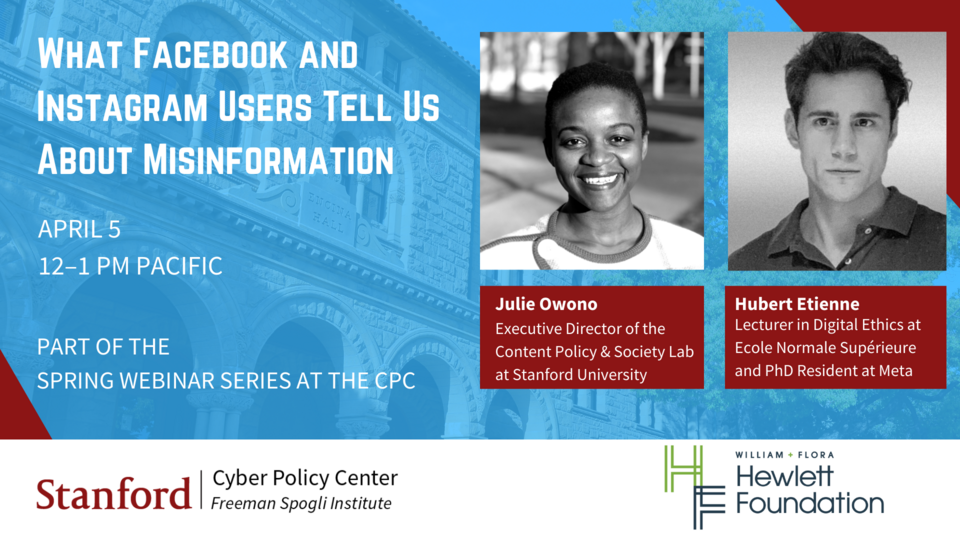
image of julie owono and hubert etienne on flyer
Join us on Tuesday, April 5th from 12 PM - 1 PM PT for “What Facebook and Instagram Users Tell Us About Misinformation” featuring Hubert Etienne, Philosopher and Researcher, Ecole Normale Supérieure and Meta AI in conversation with Julie Owono, Executive Director of the Content Policy & Society Lab. This weekly seminar series is jointly organized by the Cyber Policy Center’s Program on Democracy and the Internet and the Hewlett Foundation’s Cyber Initiative.

About The Seminar: 

Social media users who report content are key allies in the management of online misinformation. However, no research has been conducted yet to understand their role and the different trends underlying their reporting activity. Hubert Etienne presents an original approach to studying misinformation by examining it from the reporting users’ perspective at the content-level and comparatively across regions and platforms. This leads Etienne to propose the first classification of reported content pieces, resulting from a review of items reported on Facebook and Instagram in France, the UK, and the US in June 2020 to observe meaningful distinctions regarding misinformation reporting between countries and platforms as it significantly varies in volume, type, topic, and manipulation technique. Etienne identifies four reporting behaviors, from which he derives four types of noise capable of explaining the majority of the inaccuracy in misinformation reporting. He finally shows that breaking down the user reporting signal into a plurality of behaviors allows us to build a simple classifier trained on a small dataset with a combination of basic users-reports capable of identifying these different types of noise.

Speakers:

Hubert Etienne is a philosopher conducting research in AI ethics and computational philosophy at École Normale Supérieure and Meta AI. His research focuses on social interactions, especially the moderation of problematic interactions in cyberspace. He is a lecturer in AI ethics à Sciences Po, in data economics at HEC Paris and in digital regulation at the National School of Administration. He is currently a visiting fellow at Harvard University.


Julie Owono is the Executive Director of the Content Policy & Society Lab (CPSL) and a fellow of the Program on Democracy and the Internet (PDI) at Stanford University. She is also the Executive Director of digital rights organization Internet Sans Frontières, one of the inaugural members of the Facebook Oversight Board, and an affiliate at the Berkman Klein Center at Harvard University. She holds a Master’s degree in International Law from la Sorbonne University in Paris, and practiced as a lawyer at the Paris Bar.

Hubert Etienne
Seminars
-

Register: https://bit.ly/3Ncvj7B

AHPP “Aligning incentives” series final webinar: May 12th 6pm PDT, May 13th 9am in Hong Kong and Singapore

How has Myanmar’s health system dealt with the devastation caused by the coup and the pandemic, and what are the current opportunities and challenges for response and recovery? In this panel of two experts, Dr. Thin Zaw will first discuss how Myanmar’s health system and health workforce are endeavoring to respond to the syndemic crisis, a deadly combination of the global pandemic, the military coup, and post-coup civil conflicts. She will also discuss how stakeholders are working together to try to mitigate the crisis, and how a federal health system could be built up to align incentives for effective collaboration among ethnic health organizations. Second, Dr. Tun will provide a grassroots medical humanitarian perspective on what is happening in Myanmar. He will present results of a mixed-methods survey conducted in non-military-controlled areas from October to December 2021, discussing how Myanmar professionals including healthcare workers are spearheading the Civil Disobedience Movement, helping internally displaced people, and trying to address the healthcare needs of populations in conflict areas.

Image
Phyu Phyu Thin Zaw 051222
Phyu Phyu Thin Zaw (MBBS, MPP, PhD), who is a Burmese national, is a medical doctor, epidemiologist and health systems researcher currently working as a Lecturer in the School of Public Health in the Li Ka Shing Faculty of Medicine, University of Hong Kong. She is also a member of the Steering Committee of the Science in Exile initiative, which brings together at-risk, displaced and refugee scientists along with like-minded organizations who work together to strengthen systems that support, protect and integrate such affected scientists. Phyu Phyu’s research interests are equity, health and education policies, Southeast Asia health systems and policies, sexual and reproductive health, gender equality, poverty eradication, and human rights issues. Dr. Thin Zaw is also a public health and policy consultant giving technical advice to think tanks and non-governmental organizations.

Image
Nay Lin Tun 051222
Nay-Lin Tun (MD, MPP) is a medical doctor by training, and recently earned a Master in Public Policy from the National University of Singapore. He works as a program manager for a local organization that focuses on social cohesion and pluralism among diverse communities. In this role, he manages programs that help vulnerable communities in remote, hard-to-reach, and conflict-affected areas of Myanmar to get access to health services and provide financial assistance to injured civilians who need emergency referrals to private hospitals. Dr. Tun experienced a turning point in his career in 2017 when he went to the conflict-riven northern Rakhine areas. Witnessing people’s suffering and discrimination firsthand compelled him to initiate mobile health clinics and speak out in the media about health care challenges. On a voluntary basis, he is coordinating international donations and grants to field medical teams in conflict-affected areas of the country.

Karen Eggleston

Via Zoom Webinar.

Phyu Phyu Thin Zaw Lecturer, University of Hong Kong
Nay Lin Tun Physician and Medical Humanitarian in Singapore
Seminars
-

Register: bit.ly/3tymltK

Gender and socioeconomic differences affect a country's ability to support its older adult population. Specifically, the longevity risk associated with females' longer life expectancy entails different needs between genders in old age. In the first project, we aimed to quantify gender differences in the aging experience of OECD countries. Our second project compares differences in projections of disability and chronic diseases among future cohorts of older adults, including disparities by educational attainment. The model projected future chronic diseases and disability trends in Singapore and South Korea from 2020 to 2050. This presentation focuses on gender and socioeconomic differences in aging.

Cynthia Chen 042722

Dr. Cynthia Chen joins the Walter H. Shorenstein Asia-Pacific Research Center (APARC) as visiting scholar with the Asia Health Policy Program during the 2022 winter and spring quarters. She is an Assistant Professor at the National University of Singapore (NUS). Her current research focuses on the well-being and older adults, healthcare financing, and the economics of ageing. She is interested in how demographic, economic and social changes can affect the burden of care, financing needs and optimal resource allocation in the future. Her research has been supported by the Singapore’s Ministry of Health, Ministry of Education, the US National Institutes of Aging, and the Thai Health Promotion Foundation among others. To date, she has published more than 45 internationally peer-reviewed journals on societal ageing, the burden of chronic diseases, and cost-effectiveness research. Dr. Chen obtained her Ph.D. in Public Health, Masters and BSc in Statistics from NUS.


Karen Eggleston

 Via Zoom Webinar.

Shorenstein APARC Encina Hall E301 Stanford University
1
Visiting Scholar at APARC, 2021-2022
huijun_cynthia_chen.jpeg Ph.D

Dr. Cynthia Chen joined the Walter H. Shorenstein Asia-Pacific Research Center (APARC) as visiting scholar with the Asia Health Policy Program during the 2022 winter and spring quarters. She is an Assistant Professor at the National University of Singapore (NUS). Her current research focuses on the well-being and older adults, healthcare financing, and the economics of ageing. She is interested in how demographic, economic and social changes can affect the burden of care, financing needs and optimal resource allocation in the future. Her research has been supported by the Singapore’s Ministry of Health, Ministry of Education, the US National Institutes of Aging, and the Thai Health Promotion Foundation among others. To date, she has published more than 45 internationally peer-reviewed journals on societal ageing, the burden of chronic diseases, and cost-effectiveness research. Dr. Chen obtained her Ph.D. in Public Health, Masters and BSc in Statistics from NUS.

2022 Walter H. Shorenstein Asia-Pacific Research Center Visiting Scholar
Seminars
-

Register: bit.ly/3wpm8uB

Most studies on China’s relations with Southeast Asian states focus on China’s power and how such power has been used to achieve influence in the region. The emphasis is on intention and causation: how China willingly uses its power to coerce, coopt, or persuade others to behave in a certain way. Professor Han will acknowledge but go beyond this conventional approach to explore the unintended outcomes and ripple effects that are also associated with China’s presence in Southeast Asia. His talk will feature a typology for use in thinking about China’s regional presence and the various everyday forms that it takes. He will argue that we need to understand such nuance and complexity if we are to make sense of China’s relations with Southeast Asia and what they imply.

Image
Enze Han 042622
Enze Han is APARC's 2021-2022 Lee Kong Chian NUS-Stanford Fellow on Contemporary Southeast Asia for the spring quarter of 2022. Dr. Han is also an associate professor at the University of Hong Kong's Department of Politics and Public Administration. His research interests include ethnic politics in China, Southeast Asia’s relations with China, and the politics of state formation in the borderland area shared by China, Myanmar, and Thailand. His many publications include “Non-State Chinese Actors and Their Impact on Relations between China and Mainland Southeast Asia,” ISEAS Trends in Southeast Asia (2021); Asymmetrical Neighbours: Borderland State Building between China and Southeast Asia (2019); and Contestation and Adaptation: The Politics of National Identity in China (2013). Positions and affiliations prior to his professorship at UHK include the University of London (SOAS), Princeton University, the Institute for Advanced Study (Princeton), and the East Asia Institute (Seoul).  His 2010 doctorate in Political Science is from George Washington University.

Donald K. Emmerson

Via Zoom Webinar.

2021-2022 Lee Kong Chian NUS-Stanford Fellow on Contemporary Southeast Asia
Seminars
-

Myanmar’s junta is more than a year old.  The vast majority of the country’s people oppose the junta and favor democracy.  But the devil is in the details.  Many in the opposition want some form of multi-ethnic federal democracy.  But levels of disagreement and distrust among different communities, including some of the Ethnic Armed Groups, are impeding a unified vision to push the military out of power and establish civilian rule.  This webinar will examine the choices and challenges faced by the opponents of the regime as they try to unite these communities against it on behalf of a better future for Myanmar.

Image
Nyantha Maw Lin 041922
Nyantha Maw Lin is an independent analyst with more than a decade of interdisciplinary experience in government affairs, public policy, and political risk assessment related to Myanmar. Prior to the February 2021 coup, he supported community and stakeholder engagement efforts in Myanmar’s Rakhine State and served on a voluntary panel of industry and civil society representatives who advised the government on initiatives to fight corruption. He also helped to lead several innovative non-profit entities based in Yangon engaged in philanthropy, business, and social-impact activity. In addition to convening multi-sectoral dialogues with government, the private sector, and civil society in Myanmar, Nyantha has also participated in semi-official conversations elsewhere in Southeast Asia. A former Eisenhower Fellow (2018), he earned his BA in Political Science/International Relations from Carleton College (2008).  

Image
Marciel 041922
Scot Marciel has had a long career as an American diplomat serving in multiple countries, most recently as US Ambassador to Myanmar (2016-2020).  Earlier postings included as Ambassador to Indonesia (2010-2013) and concurrently as Ambassador for ASEAN affairs and Deputy Assistant Secretary of State for Southeast Asia (2007-2010).  He has also served in the Philippines and Vietnam.  His assignments at the State Department in Washington DC have included as Principal Deputy Assistant Secretary of State for East Asian Affairs and as Deputy Assistant Secretary of State of Southeast Asia.  Based on these experiences, he has been writing a book entitled “Imperfect Partners: The United States and Southeast Asia.”  He earned his MA at the Fletcher School of Law and Diplomacy (1983) and his BA in International Relations at the University of California at Davis (1981).

Donald K. Emmerson

 Via Zoom Webinar.

Nyantha Maw Lin Independent Analyst
1
Oksenberg-Rohlen Fellow
scot_marciel.jpg

Scot Marciel was the Oksenberg-Rohlen Fellow at the Freeman Spogli Institute for International Studies, affiliated with the Walter H. Shorenstein Asia-Pacific Research Center from 2022-2024. Previously, he was a 2020-22 Visiting Scholar and Visiting Practitioner Fellow on Southeast Asia at APARC.  A retired diplomat, Mr. Marciel served as U.S. Ambassador to Myanmar from March 2016 through May 2020, leading a mission of 500 employees during the difficult Rohingya crisis and a challenging time for both Myanmar’s democratic transition and the United States-Myanmar relationship.  Prior to serving in Myanmar, Ambassador Marciel served as Principal Deputy Assistant Secretary for East Asia and the Pacific at the State Department, where he oversaw U.S. relations with Southeast Asia.

From 2010 to 2013, Scot Marciel served as U.S. Ambassador to Indonesia, the world’s fourth most populous country.  He led a mission of some 1000 employees, expanding business ties, launching a new U.S.-Indonesia partnership, and rebuilding U.S.-Indonesian military-military relations.  Prior to that, he served concurrently as the first U.S. Ambassador for ASEAN Affairs and Deputy Assistant Secretary of State for Southeast Asia from 2007 to 2010.

Mr. Marciel is a career diplomat with 35 years of experience in Asia and around the world.  In addition to the assignments noted above, he has served at U.S. missions in Turkey, Hong Kong, Vietnam, Brazil and the Philippines.  At the State Department in Washington, he served as Director of the Office of Maritime Southeast Asia, Director of the Office of Mainland Southeast Asia, and Director of the Office of Southern European Affairs.  He also was Deputy Director of the Office of Monetary Affairs in the Bureau of Economic and Business Affairs.

Mr. Marciel earned an MA from the Fletcher School of Law and Diplomacy, and a BA in International Relations from the University of California at Davis.  He was born and raised in Fremont, California, and is married with two children.

Date Label
Visiting Practitioner Fellow on Southeast Asia, APARC, Stanford University
Panel Discussions
0
CDDRL Honors Student, 2021-22
avalonwolfeheadshot_-_nicole_avalon_wolfe.jpeg

Major: Political Science
Minor: Computer Science; Ethics and Technology 
Hometown: Fort Worth, TX
Thesis Advisor: Francis Fukuyama

Tentative Thesis Title: Examining Why Countries With Little Histories of Privacy Enact Data Privacy Laws

Future aspirations post-Stanford: I'm not sure precisely what I want to do after college, but I hope to work at the intersection of technology and law/policy.

A fun fact about yourself: I'm a vegetarian from Texas (and my hometown is actually referred to as Cowtown).

0
CDDRL Honors Student, 2021-22
michal_skreta_-_michal_skreta.jpg

Major: Economics and Political Science   
Hometown: Warsaw, Poland
Thesis Advisor: Larry Diamond

Tentative Thesis Title: Babies, Money, and Power: Estimating Causal Effects of the “Family 500+” Child Benefit Program in Poland using the Synthetic Control Method

Future aspirations post-Stanford: I hope to ultimately pursue a career at the intersection of private and public sectors with a strong international focus as well as to continue my interdisciplinary education in graduate school.

A fun fact about yourself: I once got lost on a volcano in Guatemala.

0
CDDRL Honors Student, 2021-22
headshot_-_alexandra_julianna_popke.jpg

Major: International Relations
Minor: Art History, Spanish
Hometown: Euless, TX   
Thesis Advisor: Kathryn Stoner

Tentative Thesis Title: On the Road to Authoritarianism: China’s Belt and Road Initiative as an Explanation for Eastern European Democratic Decline

Future aspirations post-Stanford: I plan to obtain a JD/MBA with the intent of working at the intersection of business and law in the private sector.

A fun fact about yourself: I studied under a portrait artist in high school and competed nationally with my art!

Subscribe to Asia-Pacific