After two years, North and South Korea have agreed to resume official meetings with one another. Gi-Wook Shin suggests that the North could also be interested in reopening dialogue with the United States.
Hero Image
A reunification arch over the highway between Pyongyang and Panmunjom Peace Village, where the resumed inter-Korean talks will take place this week.
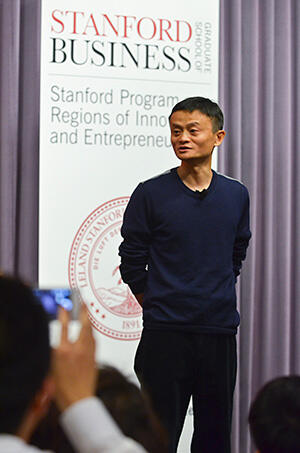
Jack Ma spoke at Stanford University on May 4, 2013 at an event co-hosted by the Stanford Program on Regions of Innovation and Entrepreneurship (SPRIE) and Alibaba Group.
Speaking without notes or visual aids on May 4th at Stanford University's NVIDIA Auditorium, founder and former CEO of Alibaba Group Jack Ma unspooled a farewell talk that at moments turned highly personal and deeply reflective: Ma spoke openly about his persistent failures in school, including spending seven years in elementary school and being rejected by Harvard ten times, and about his struggles to jumpstart Alibaba with only 50,000 RMB.
Less than two minutes into his talk at the event co-hosted by Alibaba Group and the Stanford Program on Regions of Innovation and Entrepreneurship (SPRIE) of the Stanford Graduate School of Business, Ma touched on the trials and travails he had faced early on as an internet and e-commerce pioneer in China. "Back in 1995," revealed Ma, "I felt I was a loner and people thought I was a cheater. They said I was trying to make something out of nothing.” In fact, added Ma, his first interview with CCTV was censored at the behest of the producer, who feared Ma's talk about giving the Chinese government internet access was "not a positive influence" and made Ma "look like a bad guy."
Ma's personal struggles, however, began well before he knew anything about e-commerce—in elementary school—where Ma confessed to being such a bad pupil that no school in his hometown of Hangzhou wanted him. In high school, he spent three years taking the college entrance exam before scoring high enough to enroll in a local teachers college. Harvard rejected him ten times. "Nobody said that I would be a very capable person that would do something significant or meaningful in the future," Ma admitted to a silent and still audience of about 100 people. Ma also recalled his father asking him to focus and do calligraphy. "I couldn't really do it—I didn’t have good penmanship," he said.
Image
It's clear the former English teacher turned internet billionaire never let the doubts of his detractors or the rejections from Harvard spoil his high aspirations—in fact, Ma credited the Silicon Valley for inspiring him to bring internet innovation to China amid the setbacks: "I knew nothing about technology, but every time I came to Silicon Valley, on the weekends I would see cars fill each and every parking lot… I saw the lights were on at each and every office building. When everyone spoke, their eyes were filled with sparkles. They were really hopeful about the future. So I was really inspired when I went back to China—I thought that I should do an internet business."
So Ma did, founding Alibaba Group in 1999 with 17 other co-founders. Today, Alibaba is China's largest e-commerce firm, something Ma readily admitted exceeded his wildest dreams: "I never thought that Jack Ma would have, in the future, a day like today. I never thought that Alibaba or Taobao or any type of transaction developed by Taobao would have a day like today. I never thought the internet would have a day like today."
Midway through the speech, the 49-year-old seasoned entrepreneur also struck a philosophical and political chord, making tacit references to god, social conflict, war, and generational change. He encouraged the audience to be grateful for living in an era of great opportunity, adding "the worst thing is that mankind experiences war… if we can actually solve problems through economic development, we will not need wars and we can actually use economic development to influence many people." He warned, nonetheless, that in the next 30 years the world would face a host of unknown vicissitudes, including "lots of social conflicts," which Ma described as opportunities for young people. "If everything stays stable, we are not going to have any opportunities."
Ma also gave the audience his views on the state of China's present social milieu: "This is the best of times, this is the worst of times," remarked Ma. “Nobody is happy in China… there's a lack of trust and nobody is happy. The poor people are unhappy; the rich people are unhappy. The government doesn't trust media; the media doesn't trust government. We are in an era of constant change."
Image
At least twice during his speech, the founder of China's most profitable e-commerce company also took spirited swipes at some of his personal critics. "You know, we are experiencing economic and political restructuring and they want me to commit suicide. Lots of people are asking, 'why are you not advocating for political restructuring?' I don't feel that's actually something that can be done. I feel that lots of people encouraging me to do that have foreign passports. And they aren't going to stay in China as long as they see the situation changing. They're going to flee the country." Ma also took to task those that ask why he runs a technology company if he knows so little about technology. He said it's like asking a real estate developer "you know nothing about constructing a house—how can you be a real estate developer?"
Fourteen years removed from when he founded Alibaba, Ma's personal belief is that one shows respect and admiration for technology and the people that develop it. "That you don't know about technology," said Ma, "doesn't mean you don't respect technology."
Daniel Limón is a senior in East Asian Studies at Stanford University and a research assistant for SPRIE.
China is North Korea's most important ally, but relations between the two countries have appeared strained in recent months. David Straub spoke to Radio Free Asia about Pyongyang's decision to send a special envoy to Beijing in May.
Hero Image
An Air Koryo plane parked at the Beijing Capital International Airport, September 2012. China is one of the few countries that the North Korean state-operated airline flies into.
From executive boardrooms to national capitols, leaders are debating the relative merits of contending models and strategies for attracting, developing, and empowering innovation talent--the people who drive economic growth and value creation through innovation.
On June 28, 2013, the Stanford Program on Regions of Innovation and Entrepreneurship (SPRIE) convened a circle of over 50 policymakers, executives and Stanford community members from 12 countries for an interactive roundtable on innovation talent at the Stanford Graduate School of Business.
Topics of discussion included:
What are key data and trends for innovation talent in Silicon Valley?
What strategies are places such as London, Taiwan and Israel employing to become hotbeds of innovation that attract innovation talent?
Image
How can companies successfully manage and empower their innovation talent? What best practices have been learned?
What insights and implications into innovation talent can be gathered from recent research?
How are universities innovating through programs such as Stanford's StartX and the d.school?
Agenda
8:30 – 8:45
Registration
8:45 – 9:00
Welcome & Opening Remarks
9:00 – 10:15
“The Right Talent, Essentially” Evan Wittenberg, Senior Vice President, People, Box Kyung H. Yoon, CEO, Talent Age Associates Moderator: Greg McKeown (MBA '08), CEO, THIS, Inc.
10:15 – 11:10
“The Rx for Innovation” Baba Shiv, Sanwa Bank, Limited, Professor of Marketing, Stanford Graduate School of Business
11:10 – 11:30
Break
11:30 – 12:30
“Innovation Talent Spanning Boundaries” Chunyan Zhou, Director, International Institute of Triple Helix (IITH) Morten Petersen, Assistant Professor, Aalborg University Kung Wang, Chair Professor, China University of Technology Moderator: Henry Etzkowitz, Senior Researcher, H-STAR Institute, Stanford University
12:30 – 1:30
Lunch
1:30 – 2:10
“Accelerating the Next Generation of Innovation Talent” Cameron Teitelman (BS '10), Founder & CEO, StartX Divya Nag, Founder, StartX Med
2:10 – 2:40
“Silicon Valley Perspective” Russell Hancock, President & CEO, Joint Venture Silicon Valley
2:40 – 3:00
Break
3:00 – 4:30
“Global Policy Perspectives” Sigal Admony-Ravid, Consul for Economic Affairs to the West Coast, State Of Israel Chao-Han Liu, Vice President, Academia Sinica Priya Guha, British Consul General in San Francisco Angus Lapsley, Director European & Global Issues, Cabinet Office, United Kingdom
Shorenstein APARC
Stanford University
Encina Hall, Room E301
Stanford, CA 94305-6055
(650) 724-0051
(650) 723-6530
0
dongsung@stanford.edu
2013 Visiting Scholar
IMG_3810.jpg
Dong Sung Kim, a lawyer, is a 2013 visiting scholar in the Korean Studies Program. Mr. Kim, former member of the National Assembly in South Korea, served in the national defense committee of the Assembly.
Mr. Kim was an adjunct professor at the Graduate School of Public Administration and Local Autonomy, Hanyang University, 2010–2011. He began his career in law as judge in the district of Incheon in 2000.
Mr. Kim holds a BA in Law from Seoul National University and an MA in Business Administration from Yonsei University, Korea.
Shorenstein APARC
Stanford University
Encina Hall, Room E301
Stanford, CA 94305-6055
(650) 724-0051
(650) 723-6530
0
hancp@stanford.edu
Visiting Scholar
HAN,_Chungpung_3x4.jpg
MA, PhD
Chunping Han is currently a visiting assistant professor at the Walter H. Shorenstein Asia-Pacific Research Center (Shorenstein APARC). Prior to joining Shorenstein APARC, she was an assistant professor of sociology at the University of Texas at Arlington.
Her research interests include perceptions of inequality, subjective well-being, and health in the context of immense social changes. During her time at Shorenstein APARC, she will study how ordinary people define, describe, and explain the sources of life satisfaction, happiness, and psychological distress in transitional China based on in-depth interviews.
Han participated in two national surveys on popular attitudes toward inequality and distributional issues in China. She has also published journal articles and a book chapter on distributive injustice feelings, redistribution attitudes, and livelihood satisfaction in contemporary China.
Han earned her PhD in sociology from Harvard University and her MA in education from Stanford University. She also received an MA from Beijing Foreign Studies University and a BA from Fudan University, China.
Barack Obama and Chinese leader Xi Jinping met in California recently for a two-day summit -- their first since Xi took office as president. Shorenstein APARC experts weigh in on key issues surrounding the visit.
Hero Image
A Chinese pavilion at Sunnylands, the estate where President Barack Obama will meet with Chinese leader Xi Jinping.
Policies seeking to end deflation, the most pressing issue for the Japanese economy, have been put into effect. In this issue of the NIRA Policy Review, Takeo Hoshi points out that deflation is a monetary phenomenon, and as such is a problem which can be solved by monetary policy.
Policies seeking to end deflation, the most pressing issue for the Japanese economy, have been put into effect. In this issue of the NIRA Policy Review, Takeo Hoshi points out that deflation is a monetary phenomenon, and as such is a problem which can be solved by monetary policy.
China’s impressive economic growth over the last three decades and increasing political influence and military capabilities have caused people around the world to wonder or worry about how China will use its new-found power. More specifically, they wonder whether, and how, China might attempt to transform the international system that has enabled it to become the world’s second largest economy and potential contender for global leadership.
Thomas Fingar, the Oksenberg-Rohlen Distinguished Fellow at Stanford’s Freeman Spogli Institute for International Studies, addressed these and related questions during the Walter H. Shorenstein Asia-Pacific Research Center’s annual Oksenberg Lecture on May 22.
After describing how China has benefitted from participation in the liberal order led and maintained by the United States, Fingar argued that China has neither the will nor the ability to lead or transform the existing system, and that its continued “rise” will increase its stake in the system and make it even less willing to seek changes that could jeopardize its own success. He also suggested that other nations benefitting from the existing order would constrain China from attempting radical change even if it wanted to.
Following Fingar’s remarks, Jia Qingguo, associate dean of the School of International Studies at Peking University, said it is important to recognize that China is in the midst of a major transition. It is both a developed and a developing country, he said.
Thomas Christensen, director of Princeton University’s China and the World Program, added that due to China’s weight in the world, it will be called on more and more to collaborate on critical global issues, such as climate change and disease.
Fingar’s keynote remarks drew on “China's Vision of World Order,” a chapter published in Strategic Asia 2012–13: China's Military Challenge (National Bureau for Asian Research), as well as Shorenstein APARC’s research initiative on China’s interactions with its neighbors.
Since 2002, Shorenstein APARC has held the Oksenberg Lecture Series as a tribute to the legacy of Michel Oksenberg, a pioneer in the field of Chinese politics and an important force in shaping American attitudes toward China.
An audio podcast of the May 22 event is available on the Shorenstein APARC website.
Hero Image
"One World, One Dream" opening ceremony presentation at the 2008 Summer Olympics in Beijing, China.
Abstract: Dr. Wang will be discussing some of the formal governmental and non-governmental collaborative mechanisms between Taiwan, China, Hong Kong, and other countries (including the US) on survaillance and reporting for flu. He will also discuss lessons learned from SARS, including the development of specific policies, protocols, or procedures, and new technologies deployed for public health preparedness.
C. Jason Wang, M.D., Ph.D. is an Associate Professor of Pediatrics at the Center for Policy, Outcomes, and Prevention at Stanford University. He received his B.S. from MIT, M.D. from Harvard, and Ph.D. in policy analysis from RAND. After completing his pediatric residency training at UCSF, he worked in Greater China with McKinsey and Company, during which time he performed multiple studies in the Asian healthcare market. In 2000, he was recruited to serve as the project manager for the Taskforce on Reforming Taiwan's National Health Insurance System. His fellowship training in health services research included the Robert Wood Johnson Clinical Scholars Program and the National Research Service Award Fellowship at UCLA. Prior to coming to Stanford in 2011, he was an Assistant Professor of Pediatrics and Public Health (2006-2010) and Associate Professor (2010-2011) at Boston University and Boston Medical Center.
Among his accomplishments, he was selected as the student speaker for Harvard Medical School Commencement (1996). He received the Overseas Chinese Outstanding Achievement Medal (1996), the Robert Wood Johnson Physician Faculty Scholars Career Development Award (2007), the CIMIT Young Clinician Research Award for Transformative Innovation in Healthcare Research (2010), and the NIH Director’s New Innovator Award (2011). He was recently named a “Viewpoints” editor and a regular contributor for theJournal of the American Medical Association (JAMA). He served as an external reviewer for the 2011 IOM Report “Child and Adolescent Health and Health Care Quality: Measuring What Matters” and as a reviewer for AHRQ study sections.
Dr. Wang has written two bestselling Chinese books published in Taiwan and co-authored an English book “Analysis of Healthcare Interventions that Change Patient Trajectories”. His essay, "Time is Ripe for Increased U.S.-China Cooperation in Health," was selected as the first-place American essay in the 2003 A. Doak Barnett Memorial Essay Contest sponsored by the National Committee on United States-China Relations.
Currently he is the principal investigator on a number of quality improvement and quality assessment projects funded by the Robert Wood Johnson Foundation, the National Institutes of Health (USA), Health Resources and Services Administration (HRSA), and the Andrew T. Huang Medical Education Promotion Fund (Taiwan).
Dr. Wang’s research interests include: 1) developing tools for assessing and improving the quality of healthcare; 2) facilitating the use of innovative consumer technology in improving quality of care and health outcomes; 3) studying competency-based medical education curriculum, and 4) improving health systems performance.
Encina Commons Room 180,
615 Crothers Way,
Stanford, CA 94305-6006
(650) 736-0403
(650) 723-1919
0
cjwang1@stanford.edu
LCY: Tan Lan Lee Professor
Professor, Health Policy
Professor Pediatrics (General Pediatrics)
jason_wang_profile_2019.jpg
MD, PhD
C. Jason Wang, M.D., Ph.D. is a Professor of Pediatrics and Health Policy and director of the Center for Policy, Outcomes, and Prevention at Stanford University. He received his B.S. from MIT, M.D. from Harvard, and Ph.D. in policy analysis from RAND. After completing his pediatric residency training at UCSF, he worked in Greater China with McKinsey and Company, during which time he performed multiple studies in the Asian healthcare market. In 2000, he was recruited to serve as the project manager for the Taskforce on Reforming Taiwan's National Health Insurance System. His fellowship training in health services research included the Robert Wood Johnson Clinical Scholars Program and the National Research Service Award Fellowship at UCLA. Prior to coming to Stanford in 2011, he was an Assistant Professor of Pediatrics and Public Health (2006-2010) and Associate Professor (2010-2011) at Boston University and Boston Medical Center.
Among his accomplishments, he was selected as the student speaker for Harvard Medical School Commencement (1996). He received the Overseas Chinese Outstanding Achievement Medal (1996), the Robert Wood Johnson Physician Faculty Scholars Career Development Award (2007), the CIMIT Young Clinician Research Award for Transformative Innovation in Healthcare Research (2010), and the NIH Director’s New Innovator Award (2011). He was recently named a “Viewpoints” editor and a regular contributor for the Journal of the American Medical Association (JAMA). He served as an external reviewer for the 2011 IOM Report “Child and Adolescent Health and Health Care Quality: Measuring What Matters” and as a reviewer for AHRQ study sections.
Dr. Wang has written two bestselling Chinese books published in Taiwan and co-authored an English book “Analysis of Healthcare Interventions that Change Patient Trajectories”. His essay, "Time is Ripe for Increased U.S.-China Cooperation in Health," was selected as the first-place American essay in the 2003 A. Doak Barnett Memorial Essay Contest sponsored by the National Committee on United States-China Relations.
Currently he is the principal investigator on a number of quality improvement and quality assessment projects funded by the Robert Wood Johnson Foundation, the National Institutes of Health (USA), Health Resources and Services Administration (HRSA), and the Andrew T. Huang Medical Education Promotion Fund (Taiwan).
Dr. Wang’s research interests include: 1) developing tools for assessing and improving the quality of healthcare; 2) facilitating the use of innovative consumer technology in improving quality of care and health outcomes; 3) studying competency-based medical education curriculum, and 4) improving health systems performance.
Director, Center for Policy, Outcomes & Prevention (CPOP)
Co-Director, PCHA-UHA Research & Learning Collaborative
Co-Chair, Mobile Health & Other Technologies, Stanford Center for Population Health Sciences
Co-Director, Academic General Pediatrics Fellowship