News Type
News
Date
Paragraphs


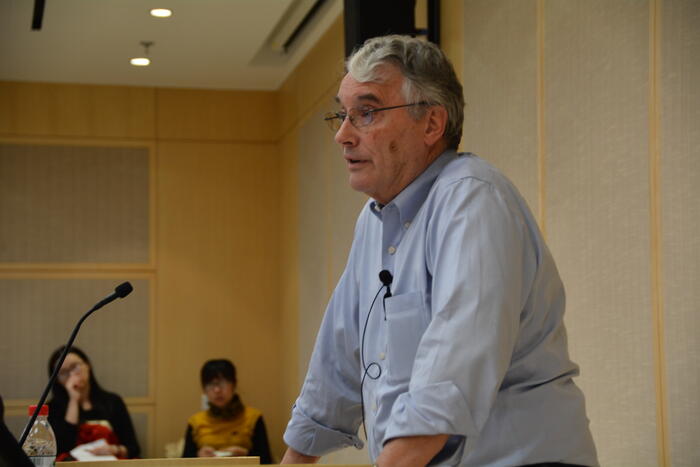
Michael McFaul, the next director of the Freeman Spogli Institute for International Studies who recently returned from his position as U.S. Ambassador to Russia, joins Karl Eikenberry, the former U.S. Ambassador to Afghanistan and the William J. Perry Fellow in International Security at CISAC, to discuss the current state of foreign policy. The Nov. 11, 2014, talk was part of the fall course, "State of the Union,"  which examined major themes that contribute to the health, or disease, of the U.S. body politic.

Led by Rob Reich (Political Science), David Kennedy (History), and James Steyer (CEO, Common Sense Media), the course brought together distinguished analysts of American politics who noted that we live in an age of rising inequality, dazzling technological innovation, economic volatility, geopolitical uncertainty, and the accumulating impact of climate change. These conditions confront our political leaders and us as citizens of a democracy plagued by dysfunction.

Hero Image
screen shot 2014 11 24 at 12 34 43 pm
All News button
1
Authors
News Type
Commentary
Date
Paragraphs

Asia-Pacific leaders recently met in Beijing at the annual APEC summit, and after two days of discussion, concluded with some significant pledges and remarkable moments. President Xi Jinping of China and Prime Minister Shinzo Abe of Japan held a landmark meeting, and the United States and China discussed two agreements that are both symbolic, and lay groundwork for regional progress, say Stanford scholars.

High-level intergovernmental meetings are often more theatre than substance, but this year the 21-member Asia-Pacific Economic Cooperation, the oldest trans-Pacific regional organization, delivered important messages and may spur actions by member governments.

“Any summit is a ‘hurry up, get this done’ motivator,” says Thomas Fingar, the Oksenberg-Rohlen Distinguished Fellow at the Freeman Spogli Institute for International Studies. “The head of state goes to the meeting – and generally speaking – he doesn’t want to arrive and say ‘my guys were asleep for the last year.’”

Fingar says the APEC summit prodded countries to work on “deliverables,” particularly the goals and projects on the agenda from previous meetings. He recently returned from Beijing, and shared his perspectives with students in the Asia-Pacific Scholars Program.

Writing for the East Asia Forum, Donald Emmerson, director of the Southeast Asia Program at the Walter H. Shorenstein Asia-Pacific Research Center, said many of the commitments declared at the APEC summit, and at the subsequent meetings of the G20 in Australia and the Association of Southeast Asian Nations in Myanmar, will have implications for global governance, particularly as China holds a more influential role in the region.

APEC countries account for over 40 percent of the world’s population and nearly half of global trade – and true to form, the grand vision of the summit is to advance regional economic integration.

Yet, “the ancillary things – things that went on in the margins – are in many ways more important,” Fingar says, referring to areas outside of the summit’s obvious focus, and what’s discussed on the sidelines of the public talks.


Image
apec economic leaders meeting cropped


Key outcomes from the 2014 gathering include:

  • The leaders of Japan and China met for the first time since coming into office, afterward acknowledging that the two countries have “disagreements” in their official statements. Of the Xi-Abe meeting, Fingar says, “it helps clear the way for lower level bureaucrats to go to work on real issues."


  • The United States and China announced a proposal to extend visas for students and businesspeople on both sides. While the immediate effects would be helpful, the change is symbolically superior. “You don’t give 5-10 year visas to adversaries,” he says, it shows that “‘we’re in [the relationship] for the long-term.’”


  • China proposed the development of a new “Silk Road,” pledging $40 billion in resources toward infrastructure projects shared with South and Central Asian neighbors. “It’s tying the region together and creating economy-of-scale possibilities for other countries,” he says. “A real win-win situation.”


  • The United States and China, the world’s two largest energy consumers, announced bilateral plans to cut carbon emissions over the next two decades. “It’s significant because those two countries must be the ones to lead the world in this area. Unless we are seen to be in basic agreement, others will hold back.”


  • China codified the Asian Infrastructure Investment Bank (AIIB), a global financial institution intended as an alternative to institutions like the World Bank. “China has been frustrated with its role in existing international institutions,” Fingar says, explaining a likely motivation behind the AIIB’s creation.

Emmerson said the outcomes of the APEC summit from the U.S.-China standpoint were better than expected, speaking to McClatchy News. The visa and climate deals, as well as their commitment to lowering global tariffs on IT products, will lessen chances of conflict between the two countries. 

However, the summit did leave some areas unsolved. One of the most important is the Trans-Pacific Partnership (TPP), a trade pact proposed by the United States that includes 11 others countries in the region, but does not yet include China.

Leaders “made positive noises” coming out of the TPP discussions, Fingar says, but nothing was passed. The gravity and complexity of trade-related issues, especially agriculture and intellectual property, is likely to blame for slow action.

Hero Image
apec economic leaders meeting headline
Leaders pose for a group photo at the 22nd APEC Economic Leaders' Meeting in Beijing, China. | APEC/(Xinhua/Yao Dawei)
All News button
1
-

X

Center

members

and their family

are cordially invited to

Shorenstein APARC‘s

annual holiday party.

Celebrate the season and the

New Year with colleagues and friends.

Libations and heavy hors d’oeuvres

fused with festive music will tantalize

your senses and invigorate your holiday spirit.

XX

XXX

XXXXX


Stanford Faculty Club

Red & Gold Lounges

439 Lagunita Dr.

Stanford, CA

Authors
Gi-Wook Shin
News Type
Commentary
Date
Paragraphs

The city of Cupertino, California, is only about 15km from Stanford University, where I teach and live. It is home to the headquarters of Apple, a global leader in the computer and smartphone industries. It is also home to many Indian and Chinese engineers who are essential to Silicon Valley's technological innovation. One can easily find a variety of Asian restaurants and shops along the palm tree-lined streets -- an interesting Californian scene with a distinctly Asian flavor.

Many Asians -- businesspeople, officials and experts -- visit Silicon Valley hoping to unlock its secrets, to learn why it is such a hotbed of innovation. One known "secret" here, often overlooked by Asian visitors, is the importance of cultural diversity. More than half of the area's startups, including Intel, Yahoo, eBay and Google, were established by immigrants, and these companies owe much of their success to the contributions of Chinese and Indian engineers. Cultural diversity can be found throughout the schools, stores and streets, as well as the enterprises, there.

In Israel, too

The circumstances are quite similar in Israel, another economy known for technological innovation. Following the collapse of the Soviet Union in the early 1990s, Israel admitted about 850,000 immigrants. More than 40 percent of the new arrivals were college professors, scientists and engineers, many of whom had abundant experience in research and development. These people played a critical role in promoting economic development and scientific and technological innovation in Israel. Many languages besides Hebrew can be heard on the streets of Tel Aviv, one of the country's largest cities.

It is no accident that Silicon Valley and Israel have become global high-tech centers. They opened their doors to a wide range of talented immigrants. Above all, an atypical sociocultural ecosystem -- a culture that respects and promotes the value of diversity -- is alive in both places.

In the United States, diversity is a key criterion in college admissions and faculty recruitment. Although "affirmative action" has disappeared in many parts of the country, diversity has come to play a key role in American university policies. Most American colleges, including Stanford, have a "diversity office" to promote diversity among students, faculty and staff. At Stanford, white students constitute less than 40 percent of the student body, and almost a quarter of the faculty come from minority groups. Similarly, only five of the 16 staff members at our Shorenstein Asia-Pacific Research Center are Caucasian, with the rest from ethnic and national minorities.

 The same can be said of leading American corporations, many of which have institutionalized "diversity management" to capitalize on the range of individual differences and talents to increase organizational effectiveness. Of course, basic knowledge and skills are prerequisites. But Americans seem to firmly believe that having a variety of backgrounds and experiences can help hatch new ideas and innovative technologies. Perhaps this is why they say that culture accounts for 90 percent of the innovation in products from Silicon Valley, with technology claiming only 10 percent.

The power of diversity

Scott E. Page, professor of complex systems, political science and economics at the University of Michigan, shows in his book "The Difference" how "the power of diversity creates better groups, firms, schools, and societies." In his view, collections of people with diverse perspectives and heuristics outperform collections of people who rely on homogeneous ones, and the key to optimizing efficiency in a group is diversity. In this work, Page pays particular attention to the importance of "identity diversity," that is, differences in race, ethnicity, gender, social status and the like.

To be sure, Asian countries such as Japan and South Korea are different from settler societies such as the U.S. With the influx of foreigners, however, even such ethnically homogeneous Asian societies are becoming multiethnic. In addition to unskilled labor and foreign brides, the number of overseas students and professors is rising at Japanese and South Korean universities, while Japanese and South Korean companies are actively hiring foreign professionals. Both countries are opening their doors to foreigners, though in limited numbers, and have made multiculturalism a key policy objective.

Still, they fall far short of recognizing the value of diversity. While Japanese and South Korean institutes of higher learning have been trying to attract more foreign students, they have been doing so mainly to make up for the declining student population at home and because university ranking agencies use the ratio of foreign students and professors as a key yardstick for measuring internationalization. The approaches of these two countries to multiculturalism are also largely focused on assimilating foreigners into their own cultures and systems. People from abroad are seldom accepted as "permanent" members of their societies or regarded as valuable assets. Japan and South Korea may have become multiethnic, but they are not multicultural.

One of the biggest challenges facing foreign residents in Japan and South Korea is the lack of understanding of their religious and cultural beliefs. Indian engineers working in South Korea complain of the poor acceptance of Indians by the local population, and of an especially poor understanding of their religion and culture. Foreign professors teaching at Japanese universities tell me they live as "foreigners," never accepted into the "inner" circles. It is unlikely that these talented people would like to work long term for universities and enterprises that are unable to embrace differences in skin color and culture. Under these circumstances, even if some foreign professionals happen to be hired, they may not be able to realize the full potential of their abilities, let alone bring about innovation.

All these people with different ethnic and national backgrounds should no longer be regarded simply as "temporary" residents to fill particular needs. Rather, by promoting the cultural diversity of Japanese and South Korean society, they should be viewed as important assets and potential sources of innovation. It is an urgent but difficult task to institutionalize the value of diversity in societies long accustomed to the notion of a single-race nation.

Born on campuses

A country's global competitiveness can hardly be improved if its society is reluctant to respect differences and understand other groups. Universities, in particular, should help their students experience diversity through the regular curriculum and extracurricular activities. Foreign students can serve as excellent resources for promoting diversity. Universities are ideal settings for various groups of students to meet, generate new ideas and interact with one another. It is no accident that many of the innovative ideas associated with Microsoft, Yahoo, Google and Facebook were all born on American university campuses, where diversity is embraced.

Empirical research should be carried out to examine how cultural diversity can bring about technological innovation in Japanese and South Korean society. Based on such studies, governments and private enterprises should take into account diversity in personnel hiring, training, management and evaluation. These same institutions should also systematically work to create and support an organizational culture that values diversity.

Could those Indian and Chinese engineers working in Silicon Valley have brought about the same kind of technological innovation if they had remained in their own countries? Could they accomplish the same feat in Japan and South Korea? How can Asian countries create the kind of ecosystem necessary for promoting a flexible culture of accommodating a broad spectrum of talents? We first need to reflect deeply on these questions before trying to emulate the success of Silicon Valley.


Shin recently coauthored the paper, "Embracing Diversity in Higher Education: Comparing Discourses in the U.S., Europe, and Asia" with Yonsei University Professor Rennie J. Moon. It is one outcome of their research project, Diversity and Tolerance in Korea and Asia. This Nikkei Asian Review article was originally carried on Nov. 20 and reposted with permission.

Hero Image
flickr google convention
Tech enthusiasts and entrepreneurs talk with Google employees at a convention booth. | Flickr/Kevin Lim
All News button
1
Authors
Donald K. Emmerson
News Type
Commentary
Date
Paragraphs

On 10 Nov. 2014 a summit of the Asia-Pacific Economic Cooperation (APEC) forum will convene in Beijing, followed in rapid succession by the East Asia Summit in Naypyidaw and the G20 in Brisbane.

Much of what will be said and done at these events will implicate the tectonics of nascent global governance set in motion by China’s campaign for greater influence in Asia.

At the APEC summit, Chinese president Xi Jinping will stress the need for massive spending on infrastructure in Asia. He will tout China’s sponsorship of a Beijing-based Asian Infrastructure Investment Bank (AIIB) that would operate outside of, and potentially compete with, the American-led World Bank and the Japanese-led Asian Development Bank (ABD).

Many will welcome the AIIB as evidence of China’s willingness to assume responsibility for public goods in a rebalanced post-Cold War world whose needs exceed the resources of existing global institutions. But will ‘public’ goods benefit the public if their terms are not made public? In 2014 China ranked 68th of 68 donors in the Aid Transparency Index compared with the 5th-place ADB and the 7th-place World Bank. Given the commercial importance of cyberspace, it is also concerning that China is the worst violator of the rights of internet users in the latest Freedom House ranking of 60 countries on that variable.

In the ADB as of 2013, Tokyo held respective 16 and 13 per cent shares of subscribed capital and voting power. Understandably, at the AIIB’s inception, Beijing’s shares will be far larger. But how soon and by how much will China allow its initial dominance to be diluted by other contributing members? Concerns over Beijing’s intentions may already underlie the wait-and-see attitudes of Tokyo, Seoul, and Canberra as to whether to join the new bank.

Another alternative to international lending by traditional sources is the New Development Bank (NDB) recently innovated by the BRICS. Headquartered in Shanghai, it will be led first by an Indian.

In the formal sessions of APEC, lip service will be paid to its hopes for free and open trade and investment worldwide by 2020. But in the corridors delegates will debate whether China’s AIIB and the BRICS’s NDB will further ‘responsible stakeholding’ and shared governance by emerging states in a global economy no longer centred on the West. Some may fear that Xi wants to use these new institutions to tie Asia more tightly and deferentially to Beijing in a web of ‘Silk Roads’ that will disproportionally serve Chinese interests.

China’s ambitions will also be questioned at the East Asia Summit in Myanmar, especially regarding the South China Sea (SCS). China will again be asked to clarify its generously self-serving U-shaped line: Does Beijing really want to possess or control nearly all of that body of water? Southeast Asians will again urge China to implement the Document on Conduct (DOC) in the South China Sea that it signed with all ten members of ASEAN in 2002. China will again be implored to accept a future Code of Conduct (COC) regulating state behaviour in the SCS. But Beijing will likely continue to delay and demur, while ASEAN’s historic centrality to Asian region-formation continues to diminish.

It is symbolic of ASEAN’s plight that the group has been too divided to express more than ‘serious concern’ over ‘developments’ in the SCS — untethered abstractions that leave China happily uncharged. In ASEAN’s field of vision, the COC has become an entrenched mirage. Calls for a code are repetitively embedded in ASEAN’s communiqués because it is one of the few things the members can agree should happen. Thanks to Chinese foot-dragging, however, the goal keeps receding and Beijing keeps doing whatever it wants to in the SCS.

Chinese activity now includes a unilateral land-reclaiming and construction work at the specks that China already controls — actions that violate the spirit if not the letter of the DOC.

Some US$5.3 trillion in goods are shipped annually across the SCS, including US$1.2 trillion to or from the United States. China has unilaterally declared and begun to enforce a monopoly on fishing in more than half of the SCS. If multilaterally negotiated limitations are being flouted or forestalled in this key regional instance, how much confidence can one have that Xi will cooperate in Asia on behalf of a rules-based order at the global level?

None of this means denying the overdue need to restructure existing institutions to accommodate the voices and priorities of rising powers. But time is running out. Convincingly dire warnings in the just-released UN report on climate change render existential the need for concerted global action. Nationalism and nationalistic regionalism — by Beijing, Moscow or Washington — must not derail progress toward the constructive rebalancing and sharing of global governance. Shifting power to emerging actors should facilitate not frustrate that process. The twenty-fifth anniversary of the fall of one wall in Berlin should not be spent building another in Asia.

This article was originally carried by the East Asia Forum on Nov. 7 and reposted with permission.

Hero Image
flickr apec 2014
Leaders meet at the 2014 Asia-Pacific Economic Cooperation (APEC) Ministerial meeting in Beijing on Nov. 7, 2014. | Flickr/U.S. Department of State
All News button
1
-

This past May, India, a country of over 1.2 billion people, elected Narendra Modi, the leader of the Bharatiya Janata Party (BJP) as the new prime minister, shifting leadership away from an incumbent party that held power for the past few decades. This new government, set in the context of shifting political and security dynamics, brings new challenges for dialogue in a region that sees unresolved border disputes and historical tensions, particularly between China and India.

What impact will India’s new leadership have in Northeast Asia? How do historical relationships continue to shape the present? What is the outlook for policy priorities between India and countries in Northeast Asia? 

Scholars from the Walter H. Shorenstein Asia-Pacific Research Center at Stanford University and the Brookings Institution’s India Center will offer perspectives in a panel discussion. This event is Shorenstein APARC’s inaugural event in New Delhi.

Participant Bios

Image
gi wook shin   2014
Gi-Wook Shin is the director of the Walter H. Shorenstein Asia-Pacific Research Center; the Tong Yang, Korea Foundation, and Korea Stanford Alumni Chair of Korean Studies; the founding director of the Korea Program; a senior fellow of the Freeman Spogli Institute for International Studies; and a professor of sociology, all at Stanford University. As a historical-comparative and political sociologist, his research has concentrated on social movements, nationalism, development, and international relations. Shin is the author/editor of sixteen books and numerous articles, the most recent including Criminality, Collaboration, and Reconciliation: Europe and Asia Confronts the Memory of World War II (2014) and New Challenges for Maturing Democracies in Korea and Taiwan (2014). Before coming to Stanford, Shin taught at the University of Iowa and the University of California, Los Angeles. After receiving his bachelor's degree from Yonsei University in Korea, he was awarded his master's degree and doctorate from the University of Washington.

Image
vikram s mehta
Vikram S. Mehta currently serves as the executive chairman of Brookings India in New Delhi and a senior fellow at the Brookings Institution. Mehta started his career with the Indian Administrative Service in 1978. He resigned in 1980 to join Phillips Petroleum in London as their senior economist. In 1984, he returned to India to join the government company Oil India Ltd. as an advisor for strategic planning. He joined Shell International in London in 1988. He was appointed managing director of Shell Markets and Shell Chemical Companies in Egypt in 1991, and chairman of the Shell Group of Companies in India in 1994.

Image
Portrait of Michael Armacost
Michael Armacost is the Shorenstein Distinguished Fellow at the Shorenstein Asia-Pacific Research Center at Stanford University. He graduated with a bachelor’s degree from Carleton College as well as a master’s and doctorate in public law and government from Columbia University. He began his professional life as an instructor of government at Pomona College in 1962. Armacost entered the State Department in 1969 as a White House Fellow, and remained in public service for twenty-four years. During that time he held sensitive international security positions in the State Department, Defense Department, and the National Security Council. These included Ambassador to the Philippines from 1982-84, Undersecretary of State for Political Affairs from 1984-89, and Ambassador to Japan from 1989-1993. Armacost subsequently served as president of the Brookings Institution from 1995-2002. 

Image
Karl Eikenberry
Karl Eikenberry is the William J. Perry Fellow in International Security at the Center for International Security and Cooperation and is a Distinguished Fellow with the Shorenstein Asia-Pacific Research Center at Stanford University. He served as the U.S. Ambassador to Afghanistan from May 2009 until July 2011 and had a 35-year career in the United States Army, retiring with the rank of lieutenant general. His military assignments included postings with mechanized, light, airborne, and ranger infantry units in the continental United States, Hawaii, Korea, Italy, and Afghanistan as the Commander of the American-led Coalition forces from 2005–07. He is a graduate of the U.S. Military Academy, has earned master’s degrees from Harvard University in East Asian studies and Stanford University in political science, was awarded an Interpreter’s Certificate in Mandarin Chinese from the British Foreign Commonwealth Office, and earned an advanced degree in Chinese History from Nanjing University. 

Image
wps sidhu
W.P.S. Sidhu is a senior fellow with Brookings India in New Delhi and Foreign Policy at Brookings. He is also a nonresident senior fellow at New York University’s Center on International Cooperation. His research focuses on India’s evolving grand strategy; the role of India and other emerging powers in the global order; addressing nuclear weapon challenges and security; and development challenges in fragile states. He is co-editor of the book Shaping the Emerging World: India and the Multilateral Order, published in August 2013 by Brookings Institution Press.

Agenda and Participant Bios
Download pdf

Taj Palace
Sardar Patel Marg
Diplomatic Enclave
New Delhi - 110 021, India


Vikram S. Mehta <i>Moderator</i>; Chairman, Brookings India Center
W.P.S Sidhu Senior Fellow Brookings India Center
Shorenstein APARC
Encina Hall E301
616 Jane Stanford Way
Stanford, CA 94305-6055
(650) 724-8480 (650) 723-6530
0
Senior Fellow at the Freeman Spogli Institute for International Studies
Professor of Sociology
William J. Perry Professor of Contemporary Korea
Professor, by Courtesy, of East Asian Languages & Cultures
Gi-Wook Shin_0.jpg PhD

Gi-Wook Shin is the William J. Perry Professor of Contemporary Korea in the Department of Sociology, senior fellow at the Freeman Spogli Institute for International Studies, and the founding director of the Korea Program at the Walter H. Shorenstein Asia-Pacific Research Center (APARC) since 2001, all at Stanford University. In May 2024, Shin also launched the Taiwan Program at APARC. He served as director of APARC for two decades (2005-2025). As a historical-comparative and political sociologist, his research has concentrated on social movements, nationalism, development, democracy, migration, and international relations.

In Summer 2023, Shin launched the Stanford Next Asia Policy Lab (SNAPL), which is a new research initiative committed to addressing emergent social, cultural, economic, and political challenges in Asia. Across four research themes– “Talent Flows and Development,” “Nationalism and Racism,” “U.S.-Asia Relations,” and “Democratic Crisis and Reform”–the lab brings scholars and students to produce interdisciplinary, problem-oriented, policy-relevant, and comparative studies and publications. Shin’s latest book, The Four Talent Giants, a comparative study of talent strategies of Japan, Australia, China, and India to be published by Stanford University Press in the summer of 2025, is an outcome of SNAPL.

Shin is also the author/editor of twenty-seven books and numerous articles. His books include The Four Talent Giants: National Strategies for Human Resource Development Across Japan, Australia, China, and India (2025)Korean Democracy in Crisis: The Threat of Illiberalism, Populism, and Polarization (2022); The North Korean Conundrum: Balancing Human Rights and Nuclear Security (2021); Superficial Korea (2017); Divergent Memories: Opinion Leaders and the Asia-Pacific War (2016); Global Talent: Skilled Labor as Social Capital in Korea (2015); Criminality, Collaboration, and Reconciliation: Europe and Asia Confronts the Memory of World War II (2014); New Challenges for Maturing Democracies in Korea and Taiwan (2014); History Textbooks and the Wars in Asia: Divided Memories (2011); South Korean Social Movements: From Democracy to Civil Society (2011); One Alliance, Two Lenses: U.S.-Korea Relations in a New Era (2010); Cross Currents: Regionalism and Nationalism in Northeast Asia (2007);  and Ethnic Nationalism in Korea: Genealogy, Politics, and Legacy (2006). Due to the wide popularity of his publications, many have been translated and distributed to Korean audiences. His articles have appeared in academic and policy journals, including American Journal of SociologyWorld DevelopmentComparative Studies in Society and HistoryPolitical Science QuarterlyJournal of Asian StudiesComparative EducationInternational SociologyNations and NationalismPacific AffairsAsian SurveyJournal of Democracy, and Foreign Affairs.

Shin is not only the recipient of numerous grants and fellowships, but also continues to actively raise funds for Korean/Asian studies at Stanford. He gives frequent lectures and seminars on topics ranging from Korean nationalism and politics to Korea's foreign relations, historical reconciliation in Northeast Asia, and talent strategies. He serves on councils and advisory boards in the United States and South Korea and promotes policy dialogue between the two allies. He regularly writes op-eds and gives interviews to the media in both Korean and English.

Before joining Stanford in 2001, Shin taught at the University of Iowa (1991-94) and the University of California, Los Angeles (1994-2001). After receiving his BA from Yonsei University in Korea, he was awarded his MA and PhD from the University of Washington in 1991.

Selected Multimedia

Director of the Korea Program and the Taiwan Program, Shorenstein Asia-Pacific Research Center
Director of Stanford Next Asia Policy Lab, APARC
Date Label
Panel Discussions
-

SPEAKER BIO

Image
chaw chaw
Ms. Ohnmar Ei Ei Chaw is the Country Program Coordinator of the Australian-Asia Program to Combat Trafficking in Persons (AAPTIP) for Myanmar (Burma). Prior to this, she was the United Nations Inter-Agency Project on Human Trafficking’s Myanmar National Coordinator. She is responsible for the overall coordination and management of AAPTIP Myanmar Country Program, which is currently the largest of six country programs in the Australian $50 million five-year AAPTIP program. She liaises closely with whole-of-government partners on issues relevant to criminal justice sector capacity building, coordination, and law and policy harmonization, and other initiatives focusing on anti-trafficking in persons at the national level and regional level especially, ASEAN Trafficking in Persons Working Group’s initiatives. She has been engaged in the fight against human trafficking for more than a decade. She started her career working on the Street and Working Children Project of World Vision Myanmar in 1997. After attaining her post-graduate study on Gender and Development in 2001, she rejoined World Vision Myanmar to lead the first Anti-Trafficking Program which involved designing and implementation of prevention activities, facilitation of the return of trafficking survivors coming back from Thailand, and advocating government for the development of anti-trafficking legislation and national policy.

Reuben Hills Conference Room 2nd Floor, East Wing, Encina Hall

Ohnmar Ei Ei Chaw Country Program Coordinator, Australia -Asia Program to Combat Trafficking in Persons (AAPTIP)
Seminars
-

SPEAKERS BIOS

Image
chaw chaw
Ms. Ohnmar Ei Ei Chaw is the Country Program Coordinator of the Australian-Asia Program to Combat Trafficking in Persons (AAPTIP) for Myanmar (Burma). Prior to this, she was the United Nations Inter-Agency Project on Human Trafficking’s Myanmar National Coordinator. She is responsible for the overall coordination and management of AAPTIP Myanmar Country Program, which is currently the largest of six country programs in the Australian $50 million five-year AAPTIP program. She liaises closely with whole-of-government partners on issues relevant to criminal justice sector capacity building, coordination, and law and policy harmonization, and other initiatives focusing on anti-trafficking in persons at the national level and regional level especially, ASEAN Trafficking in Persons Working Group’s initiatives.


Image
mark taylor
Mr. Mark Taylor is the Team Leader for the Australia–Asia Program to Combat Trafficking in Persons (AAPTIP). The AAPTIP project was started in June 2013, and is a continuation of the Australian AID-funded Asia Regional Trafficking in Persons (ARTIP) Project. AAPTIP operates at both regional and national level and provides support to the Association of South East Asian Nations (ASEAN) and individual partner countries: Cambodia, Indonesia, Lao PDR, Myanmar, the Philippines, Thailand and Vietnam. Prior to this, Mr. Taylor spent 10 years working for the US State Department in Washington DC as a Senior Coordinator for Reports and Political Affairs. He spent two years based at the US Embassy in Nigeria where he opened the US State Department’s Narcotics and Law Enforcement Affairs Program in Lagos and Abuja, after years of aid embargo on Abacha ruled Nigeria. Mr. Taylor was in charge of developing and implementing over $12 million in projects over a range of eight issues including drug control, people smuggling, human trafficking, financial fraud, corruption, police reform and money laundering. Mr. Taylor also spent time in Yangon, Myanmar where he was responsible for reporting on the dynamic narco-insurgency landscape in the Shan State, and following the July 1995 release from house arrest of Daw Aung San Suu Kyi -- the political and human rights situation in the country, including coverage of NLD speeches, policy statements, and the party's leadership. He has a degree in Political Science and Government from Gordon College.


This seminar will also feature special discussant, Donald Emmerson, director of the Southeast Asia Program at Shorenstein APARC

The panel will be moderated by Helen Stacy, director of the Program on Human Rights at CDDRL.


[[{"fid":"216677","view_mode":"crop_870xauto","fields":{"format":"crop_870xauto","field_file_image_description[und][0][value]":"","field_file_image_alt_text[und][0][value]":"","field_file_image_title_text[und][0][value]":"","field_credit[und][0][value]":"","field_caption[und][0][value]":"","field_related_image_aspect[und][0][value]":"","thumbnails":"crop_870xauto","pp_lightbox":true,"pp_description":true},"type":"media","attributes":{"height":960,"width":870,"class":"media-element file-crop-870xauto"}}]]


CISAC Central Conference Room
2nd Floor, Encina Hall
616 Serra St.
Stanford, CA

Mark Taylor Australia-Asia Program to Combat Trafficking in Persons
Ohnmar Ei Ei Chaw Australia-Asia Program to Combat Trafficking in Persons
0
Senior Fellow Emeritus at the Freeman Spogli Institute for International Studies
Affiliated Faculty, CDDRL
Affiliated Scholar, Abbasi Program in Islamic Studies
aparc_dke.jpg PhD

At Stanford, in addition to his work for the Southeast Asia Program and his affiliations with CDDRL and the Abbasi Program in Islamic Studies, Donald Emmerson has taught courses on Southeast Asia in East Asian Studies, International Policy Studies, and Political Science. He is active as an analyst of current policy issues involving Asia. In 2010 the National Bureau of Asian Research and the Woodrow Wilson International Center for Scholars awarded him a two-year Research Associateship given to “top scholars from across the United States” who “have successfully bridged the gap between the academy and policy.”

Emmerson’s research interests include Southeast Asia-China-US relations, the South China Sea, and the future of ASEAN. His publications, authored or edited, span more than a dozen books and monographs and some 200 articles, chapters, and shorter pieces.  Recent writings include The Deer and the Dragon: Southeast Asia and China in the 21st Century (ed., 2020); “‘No Sole Control’ in the South China Sea,” in Asia Policy  (2019); ASEAN @ 50, Southeast Asia @ Risk: What Should Be Done? (ed., 2018); “Singapore and Goliath?,” in Journal of Democracy (2018); “Mapping ASEAN’s Futures,” in Contemporary Southeast Asia (2017); and “ASEAN Between China and America: Is It Time to Try Horsing the Cow?,” in Trans-Regional and –National Studies of Southeast Asia (2017).

Earlier work includes “Sunnylands or Rancho Mirage? ASEAN and the South China Sea,” in YaleGlobal (2016); “The Spectrum of Comparisons: A Discussion,” in Pacific Affairs (2014); “Facts, Minds, and Formats: Scholarship and Political Change in Indonesia” in Indonesian Studies: The State of the Field (2013); “Is Indonesia Rising? It Depends” in Indonesia Rising (2012); “Southeast Asia: Minding the Gap between Democracy and Governance,” in Journal of Democracy (April 2012); “The Problem and Promise of Focality in World Affairs,” in Strategic Review (August 2011); An American Place at an Asian Table? Regionalism and Its Reasons (2011); Asian Regionalism and US Policy: The Case for Creative Adaptation (2010); “The Useful Diversity of ‘Islamism’” and “Islamism: Pros, Cons, and Contexts” in Islamism: Conflicting Perspectives on Political Islam (2009); “Crisis and Consensus: America and ASEAN in a New Global Context” in Refreshing U.S.-Thai Relations (2009); and Hard Choices: Security, Democracy, and Regionalism in Southeast Asia (edited, 2008).

Prior to moving to Stanford in 1999, Emmerson was a professor of political science at the University of Wisconsin-Madison, where he won a campus-wide teaching award. That same year he helped monitor voting in Indonesia and East Timor for the National Democratic Institute and the Carter Center. In the course of his career, he has taken part in numerous policy-related working groups focused on topics related to Southeast Asia; has testified before House and Senate committees on Asian affairs; and been a regular at gatherings such as the Asia Pacific Roundtable (Kuala Lumpur), the Bali Democracy Forum (Nusa Dua), and the Shangri-La Dialogue (Singapore). Places where he has held various visiting fellowships, including the Institute for Advanced Study and the Woodrow Wilson International Center for Scholars. 


Emmerson has a Ph.D. in political science from Yale and a BA in international affairs from Princeton. He is fluent in Indonesian, was fluent in French, and has lectured and written in both languages. He has lesser competence in Dutch, Javanese, and Russian. A former slam poet in English, he enjoys the spoken word and reads occasionally under a nom de plume with the Not Yet Dead Poets Society in Redwood City, CA. He and his wife Carolyn met in high school in Lebanon. They have two children. He was born in Tokyo, the son of U.S. Foreign Service Officer John K. Emmerson, who wrote the Japanese Thread among other books.

Selected Multimedia

Date Label
Special Discussant
Moderator
Seminars

Professor Sharon Zukin's talk will describe how, in cities across the world, the everyday spaces of local shopping streets are undergoing dramatic transformations.  Globalization brings new products and people, while different types of gentrification reshape the street's aesthetics and atmosphere.  How do we "read" these changes?  Do they destroy the sense of the "local" to make every street, in every city, more alike?

Professor Zukin is the author of a number of books on cities, culture and consumer culture, and urban, cultural and economic change.  She received the Lynd Award for Career Achievement in urban sociology from the American Sociological Association, and the C. Wright Mills Book Award for Landscapes of Power.  You can learn more about her work here: http://www.brooklyn.cuny.edu/web/academics/faculty/faculty_profile.jsp?faculty=420

Presented by the Program on Urban Studies and co-sponsored by the Anthropology Department, Center for East Asian Studies, Center on Poverty and Inequality, The Europe Center, Walter H. Shorenstein Asia-Pacific Research Center, Sociology Department, Stanford in Government and Urban Beyond Measure.

Building 200
Room 002

Sharon Zukin Professor of Sociology Speaker Brooklyn College, CUNY
Lectures
Subscribe to Asia-Pacific