
Authors
News Type
Blogs
Date
Paragraphs

This article was written by Dr. Susan J. Duggan, initial Coordinator of the Western Europe Project at SPICE (1988–1990). In its early years, SPICE comprised several separate area-focused projects. This is the eighth of several articles—focusing on the 50-year history of SPICE—that will be posted this year.

Happy 50th Birthday to SPICE! I am honored to be part of this special group of multi-talented, internationally experienced educators and innovators. 

I came to SPICE in a roundabout way. After studying in France and Italy during my undergraduate years at Stanford, I did my first master’s degree in Political Science (international relations) at Université Laval in Québec in 1980. My thesis was on the political role of educational exchange in Québec’s desire for sovereignty (from Canada). Upon returning to my home in California, I landed a job as the Project Associate at the “Bay Area and the World Project” hosted at the World Affairs Council in San Francisco and sponsored, among others, by Stanford University. In that small, windowless office Dr. Ron Herring discovered me researching the connections between the Bay Area and other countries; and promoting those connections through our publications and conferences with businesses, local governments and educators. He convinced me to come back to Stanford to get my Ph.D. That was the beginning of my SPICE connection, though it would be another six years before I officially worked for SPICE.

Initially, I pursued a second master’s degree in Education at Stanford. That is when I met Dr. David Grossman at the Center for Research in International Studies (CRIS), the predecessor to the Institute for International Studies (IIS), now FSI. I have fond memories of working on a research project looking at young U.S. students’ perceptions of Germany and Germans. David was there in Berlin when I began my field work for my dissertation in 1985. David and Ron encouraged me throughout my pre-SPICE time to explore the role of educational exchange, not only for students, but also for teachers.

Ron recruited me to be the initial coordinator of the newly founded Western Europe Project in 1988. I had just finished my dissertation at the Graduate School of Education at Stanford on the political role of educational exchange between Germany and the United States and was eager to work with the SPICE folks on curriculum development for K–12 students and teachers. Dr. Judy Wooster had just assumed the leadership of SPICE. I had a lot of fun working with this bright group of creative folks! 
Image
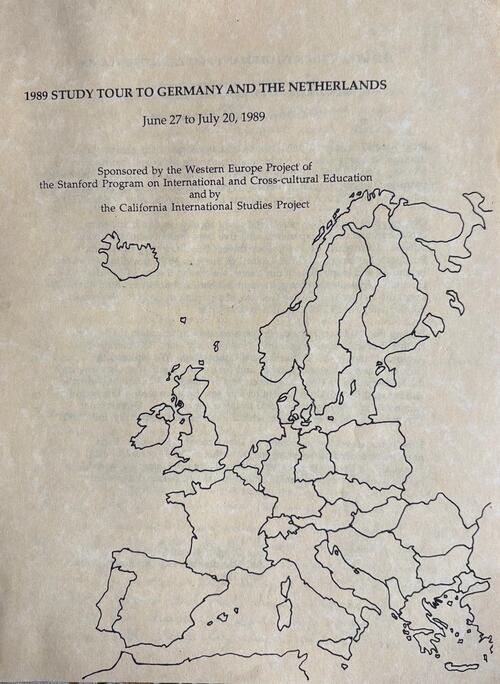
a front page of a study guide with a title and a map


In the summer of 1989, Ron asked me to help coordinate and run a study tour of American teachers to Western Europe. SPICE and the California International Studies Project (CISP) sponsored the tour. I had experience having co-founded the “Berlin-California Teachers Exchange” in 1985 with friend, colleague, and teacher Flex Ninow from the Internationale Lehrerkonferenz Berlin. In our 1989 tour (photo above courtesy of Sue Duggan), 12 brave teachers spent 24 intense days in Berlin; southern Germany (Weinstadt); Strasbourg; and on to Zeeland, Amsterdam and North Holland in the Netherlands. 

The participants focused on two main themes for eventual curriculum development: “Communities, Regions, Nations” and “Conflict and Cooperation.” Mind you, this was the summer of 1989. The study tour focused on Western Europe and what would evolve, eventually, into the European Union. They heard, of course, analyses and speculation about Eastern Europe and Soviet aspirations. In retrospect, what an honor it was to hear from so many European teachers, politicians, political scientists, and regular folk about their perceptions of a 1989 version of Western Europe. No one among our many European interlocutors imagined that the Berlin Wall would fall just a few months after our departure creating a huge change in the political, economic and educational landscape of all of Europe.

In the early months of 1990, I felt compelled to return to Berlin to gather fresh insights about the Fall of the Berlin Wall (which had happened on November 9, 1989, just three and a half months after our return from the SPICE Study Tour). I imagined how hearing from real Germans about an actual historical event could inspire American high school students studying German. I pitched the idea to Judy Wooster along the lines of “Where were you when Kennedy was killed?” I wanted to hear from a variety of Berliners—from the East and West—about where they were when they heard the news of the Berlin Wall being taken down. Remember, there were two parallel walls that bisected the city of Berlin. For some, they only knew the existence of a divided city. For others, they had strong memories of the Wall being built, starting on August 13, 1961. I bought a Sony Walkman and a ticket to Berlin. I was able to line up interviews with various people, from politicians, to teachers, to a pub owner, and even a Berliner in her 60s who not only remembered when the Wall was built, but what happened during the Berlin Airlift (1948–1949) in her hometown. I came back to SPICE with precious recordings of remembrances and personal connections to one of the biggest changes in the latter part of 20th century Europe. 

Possibly because of the Study Tour and the inspiration to record the voices of Berlin after the Wall fell, I felt drawn to return to Germany. The Alexander von Humboldt Stiftung (Foundation) created a new program in 1990 called the “Chancellor Scholars” bringing young, professional Americans to Germany to witness the unfolding of a new version of Europe. I was recruited to be in the initial group. I could not turn that down. With reluctance mixed with anticipation to experience a “whole” Germany, I left my position at SPICE in September 1990. I was pleased to leave the Berlin Perspectives curriculum unit in the capable hands of my successor, and even more pleased that that unit still exists today. 

I have always considered myself lucky to have been part of the developing times of CRIS, IIS, and SPICE. I enjoyed smart, fun, creative colleagues who really cared about the world, education, and each other. Dr. Steve Thorpe, formerly the coordinator of the SPICE China Project, and I finished our PhDs around the same time and have stayed in touch all these years. Dr. Ron Herring is “Uncle Ron” to my daughter, Coral. Gosh, even the SPICE folks survived the Loma Prieta Quake together in the basement of Littlefield Center at 5:04 p.m. on October 17, 1989! 
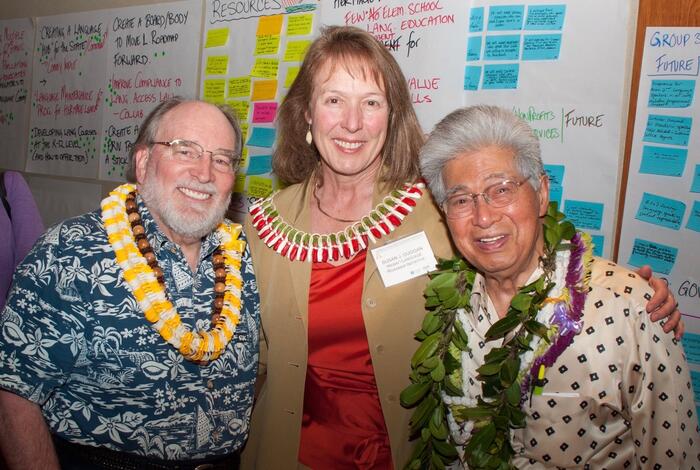
three people with leis smiling Photo above: Governor Neil Abercrombie of Hawai‘i, Dr. Susan Duggan, Executive Director of the Hawai‘i Language Roadmap Initiative, and Senator Daniel Akaka, 2013 | courtesy of Susan Duggan.


I have enjoyed a career mostly in international education. After SPICE and the Humboldt year, I started an international study abroad program in formerly Eastern European countries. I became the Senior Research and Policy Consultant to the National Security Education Program and ended up on the founding team that created the Boren Scholarship Program. Later, as Senior Strategist, I helped shaped The Language Flagship, now comprised of 14 U.S. universities with language and cultural studies in South Korea, Taiwan, Brazil, Morocco, and Kazakhstan. Toward the end of my career, I had the great pleasure of re-connecting with the K–12 sector as I created and ran many state Language Summits to create Language Roadmaps for those states. At times I have branched into the areas of high tech and agricultural tech innovations, but always with an international connection. I feel my early years at SPICE prepared me well for working with a variety of people in education, business, and government, all with creativity and integrity. 

With gratitude, I wish SPICE—and all those involved with this wonderful program—a very happy 50th anniversary!

To stay updated on SPICE news, join our email list and follow us on Facebook, X, and Instagram.

Read More

three people standing at the great wall in China
Blogs

Celebrating SPICE’s 50th: SPICE’s Roots in the Bay Area China Education Project (BAYCEP)

BAYCEP was the predecessor program to SPICE, which was established 50 years ago in 1976.
Celebrating SPICE’s 50th: SPICE’s Roots in the Bay Area China Education Project (BAYCEP)
a family photo at the Japanese Tea Garden in Golden Gate Park
Blogs

Celebrating SPICE’s 50th: Adding SPICE to My Life

Professor Emeritus Steve Thorpe reflects on his years at SPICE from the late 1970s to the 1980s.
Celebrating SPICE’s 50th: Adding SPICE to My Life
Hero Image
9 people posing for a photo in Germany
Sue Duggan, on left, with members of the SPICE Study Tour in Germany, Summer 1989 | Photo courtesy of Sue Duggan
All News button
1
Subtitle

Stanford alum and former Coordinator of the Western Europe Project Dr. Susan J. Duggan shares reflections on her career.
Date Label
Display Hero Image Wide (1320px)
No

Encina West 410
616 Jane Stanford Way
Stanford, CA 94305

0
Lecturer, Political Science
Associate Director of the Capstone Program, Political Science
Affiliated scholar, CDDRL
paci_headshot_-_simone_paci.jpg

Simone Paci is a lecturer in Political Science at Stanford University. His research focuses on political economy across public policy domains. His three main areas of interest include taxation, AI, and gender politics.

Simone's research has been published in the American Journal of Political Science, PS: Political Science & Politics, the UN WIDER Working Paper Series, and the Journal of Interdisciplinary History.

Before Stanford, Simone held a Postdoctoral Research Associate position at Princeton University. Simone received a PhD in Political Science from Columbia University and a BA in Political Science and Economics from Yale University.

Date Label
Authors
News Type
News
Date
Paragraphs

Motivation


Political parties have long reflected  dividing lines between groups in a society, often called political ‘cleavages’. Examples include workers vs. business owners, Protestants vs. Catholics, and urban vs. rural constituents. Civil society organizations (CSOs) — such as unions, churches, and chambers of commerce — have historically shaped the content and strength of these cleavages.

However, both CSOs and cleavages have changed in recent decades. For one, traditional cleavages have declined in importance, and new divides have emerged, such as between the so-called winners and losers of globalization or between those on one side or the other of the culture wars. In addition, formal CSOs have seen declining membership and reduced political influence, while informal groups and more episodic activism have grown. While CSOs and political parties used to have highly formalized relationships, they now tend to engage with each other more opportunistically and sometimes antagonistically. It seems clear that CSOs continue to influence political cleavages — both old and new — in the 21st century. But how exactly does this occur?

Contribution


In “Cleavage Theory Meets Civil Society,” Alex Mierke-Zatwarnicki, Endre Borbáth, and Swen Hutter examine the varied historical and contemporary relationships between CSOs, cleavages, and political parties in Western Europe. The authors develop a general framework for understanding the relationship between CSOs and cleavage development, providing insights into how contemporary politics reflects long-term changes in the structure of civil society. 

The paper is set against social science research on cleavages, which can be divided into two broad streams. First, classical scholarship emphasized the importance of early 20th-century mass associations, such as unions, in shaping cleavages and party politics. By contrast, newer work, written against the backdrop of a changing CSO landscape, has viewed CSOs as largely irrelevant, arguing that opposition parties shape cleavages via direct interactions with voters. Neither body of previous work provides a compelling framework for understanding how contemporary CSOs — given their fragmentation, informationalization, and politicization -- matter for cleavages.

The authors also shed light on the phenomenon of polarization, which is a key part of democratic backsliding. Indeed, electorates are polarized around several cleavages — economic, religious, and cultural — that populist leaders have used to justify excluding their opponents from politics, portraying them as existential threats to a specific way of life.

Processes and Mechanisms


The authors suggest that cleavage development can be seen as the culmination of three processes, which CSOs may influence in key ways. The first is “group formation,” which concerns how individuals come to identify as workers, congregants, or otherwise. The second process is “political institutionalization,” which entails cleavages being embodied in party competition. The third is “political stabilization,” whereby cleavages are reinforced over time by parties.


Stage of cleavage developmentImportance of political linkageImportance of social closure
I. Group formationLowHigh
II. Political institutionalisationHighMedium
III. Electoral stabilisationHighHigh


Table 1. Role of civil society across stages of cleavage development.


To understand how CSOs might shape these three processes, the authors outline two mechanisms. The first is “linkage,” whereby CSOs communicate group demands and pressure political parties to represent them. Linkage is hypothesized to be more important during the latter processes of institutionalization and stabilization; it was historically important in group formation but less so today because of the aforementioned decline of formal CSOs.

The second mechanism is “social closure,” which concerns how group boundaries are solidified. CSOs are hypothesized to contribute to social closure by bringing group members together and organizing them around shared demands, increasing their sense of ingroup identification. This mechanism is important for group formation as well as  political stabilization.

CSOs still appear to facilitate linkage and social closure, albeit in different ways than in the early 20th century. For example, CSOs are less likely to have formal links to parties but continue to exert pressure by organizing around individual issues, candidates, and elections. Voters’ relationships to CSOs are also more varied, creating divisions within the electorate between highly-active individuals who have a strong sense of group identity and people who are less ‘anchored’ to the cleavage. The authors also hypothesize that some of these dynamics may produce asymmetric changes across the left and right, as the strength and tactics of CSOs vary.


Trend in civil societyImplications for political linkageImplications for social closure
FragmentationCivil society groups have less capacity to present unified demands to parties and are more likely to compete for influence and adherents. Groups that persist are likely to be highly mobilised and ideologically distinct, exerting targeted pressure on priority issues and succeeding when they find points of cross-organisational consensus.Groups and identities likely to be more heterogeneous; individuals tend to form multiple, competing group attachments which vary over time in their personal salience. Likely to produce pockets of high social closure amongst ‘untethered’ masses.
InformalizationCivil society organisations less likely to have ongoing formal relationships with parties; influence comes through mobilisation in moments of political crisis or indecision.Interactions between group members become less frequent and more spontaneous, reducing social closure for most people while increasing it amongst committed adherents.
PoliticisationLandscape of civil society organisations is more differentiated and issue-specific, with groups pursuing alternate (and occasionally competing) linkage strategies; pressure on parties comes from different sources during different periods of mobilisation and is most effective in moments of coordination.Salience of voters’ group identities changes across different moments, depending on how parties and civil society groups invoke them. ‘Groupishness’ of the population as a whole may become very high in particular critical moments.
Overall effectMove towards more volatile forms of linkage, operating through punctuated equilibrium moments of mobilisation and contestation rather than stable formal ties.Proliferation of multiple identities leads social closure to bifurcate; ‘tight’, mobilised groups coexist alongside heterogeneous masses who become sporadically activated.
 Combination of the three trends widens the number and types of civil society actors that intervene in processes of political linkage, leading different groups to exert influence at different times and ‘successful’ pressure to hinge on effective cross-group coordination.Combination of the three trends simultaneously widens and blurs possibilities for participation, leading to a growing gap between people who are activated consistently and those whose group identification is more fluid and context-dependent.


Table 2. Implications of the changing structure of civil society.


Cross-National and Case Study Evidence


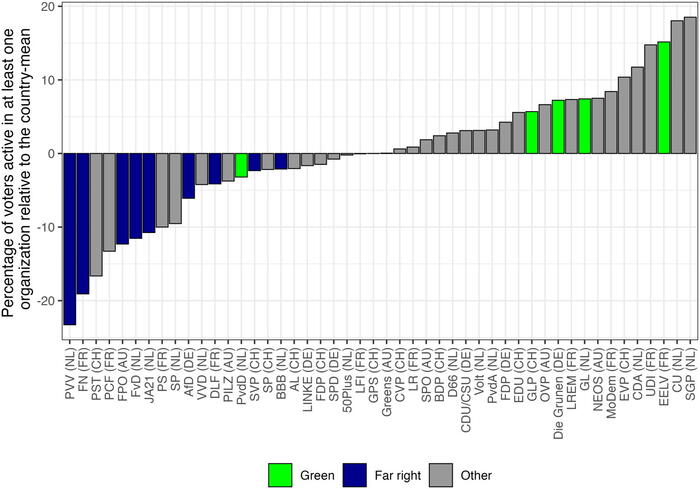
The authors then analyze cross-national data on political parties and voters in Austria, France, Germany, the Netherlands, and Switzerland. One data source concerns the extent to which political parties are tied to CSOs and whether they receive large-scale CSO donations. A second source looks at whether party supporters are active in CSOs. Preliminary findings point to important differences between old, class-based parties (especially Social Democrats) and newer parties, with the latter much less tied to CSOs. However, within the new party families, Green parties are more tightly linked to CSOs than far-right parties, but there also exists variation within far-right parties. These patterns demand a more fine-grained analysis of specific cases.


Image
Figure 2. Members of civil society organizations among the electorate of political parties in Austria, France, Germany, the Netherlands, and Switzerland.


Figure 2. Members of civil society organizations among the electorate of political parties in Austria, France, Germany, the Netherlands, and Switzerland.

Note: The figure is based on the Joint EVS/WVS 2017-2022 Dataset (2022). It uses the battery of membership in organizations and partisanship questions. In the WVS, partisanship is measured with ‘Which party would you vote for?’; in the EVS, with ‘Which political party appeals to you most?’ For this figure, the two items are treated as functional equivalents. The percentage of members is calculated from all respondents indicating sympathy towards the respective party.


Finally, the authors qualitatively analyze three distinct cases: one New Left party and both old and new far-right populist parties — the German Green Party, the Swiss People’s Party (SVP), and the Alternative for Germany (AfD). Their analysis reveals key differences as regards the importance of CSOs in fostering linkage and social closure. CSOs played a key role in consolidating the Greens and SVP, whereas in the case of AfD, antipathy from German CSOs helped generate a more outsider identity.

The Greens emerged via linkages with left-libertarian social movements in the 1970s and 80s. This included groups supportive of environmental protection and feminism and opposed to nuclear proliferation. CSOs provided ideas and personnel, which helped build a sense of social closure among party supporters. This identity still persists in spite of the subsequent fragmentation of civil society.

By contrast, SVP emerged through connections to Swiss farmers' associations, rural economic networks, and local interest groups. SVP has been radicalizing since the 1990s, becoming one of Europe’s most successful far-right parties and aligning itself with Euroscepticism. SVP’s long history of rural and community penetration has helped strengthen social closure among its electorate.

Finally, AfD emerged in a more fragmented context, via its ties to right-wing protest networks. The party was a top-down vehicle that organized in response to what it saw as Germany’s mismanagement of the Eurozone crisis. AfD lacks dense connections to CSOs and has instead built informal and often volatile alliances with protesters. Many German CSOs — as well as German society more generally — explicitly oppose AfD, which has ironically helped AfD build an outsider identity because its supporters feel isolated and stigmatized.

The case studies vividly illustrate how varied CSO relationships shape cleavages and partisanship in three of the most important Western European parties.

*Research-in-Brief prepared by Adam Fefer.

Hero Image
Brown and white concrete building under white clouds during daytime
Sorin Gheorghita
All News button
1
Subtitle

CDDRL Research-in-Brief [4-minute read]

Date Label
0
CDDRL Postdoctoral Fellow, 2024-25
alex_mierke-zatwarnicki_2.jpg

Alex Mierke-Zatwarnicki is a postdoctoral fellow at the Center on Democracy, Development and the Rule of Law (CDDRL) at the Freeman Spogli Institute for International Studies (FSI) at Stanford University. She holds a Ph.D. in Government from Harvard University and was previously a Max Weber Fellow at the European University Institute.

Alex’s work focuses on political parties and group identity in Western Europe, in macro-historical perspective. A core theme of her research is understanding how different patterns of political and social organization combine to shape the ‘arena’ of electoral politics and the opportunity space for new competitors.

In her ongoing book project, Alex studies the different ways in which outsider parties articulate group identities and invoke narratives of social conflict in order to gain a foothold in electoral competition. Empirically, the project employs a mixed-methods approach — including qualitative case studies and quantitative text analysis — to compare processes of party-building and entry across five distinct ‘episodes’ of party formation in Western Europe: early twentieth-century socialists, interwar fascists, green and ethno-regionalist parties in the post-war period, and the contemporary far right.

Date Label
Authors
News Type
News
Date
Paragraphs


This article originally appeared in The Stanford Daily.

European Union (EU) High Representative for Foreign Affairs and Security Policy Josep Borrell M.S. ’75 visited the Hoover Institution on Monday for an event hosted by the Freeman Spogli Institute for International Studies (FSI).

In a keynote speech followed by a conversation with the institute’s director and former ambassador to Russia, Michael McFaul, Borrell delved Europe’s crucial role and responsibilities in addressing ongoing war in Ukraine and Gaza, as well as geopolitical security and emerging technology more broadly.

Borrell emphasized the need for EU countries to collectively adapt to the changing geopolitical landscape and increase their strategic responsibility. He stressed the importance of European unity in the face of challenges posed by Russia’s aggression in Ukraine and the ongoing Israel-Gaza war, noting that the security landscape has “dramatically changed.”

“Europe has to learn to speak the language of power,” Borrell said, emphasizing the need for Europe to increase its military capacities while utilizing all available tools to face global challenges.

Listen to Representative Borrell's full discussion with Michael McFaul below on a special episode of World Class podcast.

Follow the link for a transcript of "Strategic Responsibility in the EU, United States, and Beyond."

Regarding the Israel-Gaza war, Borrell called for a political process that would empower the Palestinian Authority and reach a solution for peace, describing the current state as “a stain on human consciousness.” He urged the international community to push for a ceasefire, secure the release of hostages, and ensure better access to humanitarian aid in the region.

“It is not a natural catastrophe what is happening in Gaza. It is not an earthquake, it is not a flood when you come and help people suffering the consequences. [It] is a manmade disaster, is a manmade catastrophe,” Borrell said.

Among the other global challenges Borrell called for Europe to address was the continent’s dependence on China for critical materials and technologies. He emphasized the importance of coordinating with the US to counter China’s growing influence in the global economic and political sphere.

“More coordination in front of China should be one of the most important things that the Europeans and the Americans should do in order to balance the challenges of this world,” Borrell said.

More broadly, Borrell spoke to the importance of coordination between the US and EU to work globally to protect “political freedom, economic prosperity, and social cohesion.”

Borrell acknowledged that the United States is a global leader in emerging technologies, particularly artificial intelligence, and stressed the importance of cooperation on trade and technological innovation. He expressed concern that regulatory hurdles may be hindering the EU’s ability to catch up with the U.S. in the technology sector and emphasized the significance of transatlantic collaboration in shaping the future of technology.

“I am happy to know that we are partners in building a responsible and human-centric technological innovation,” Borrell said.

The importance of partnership across countries was a throughline in Borrell’s speech, as he concluded with a reminder of the interconnectedness of global security and social well-being. “You cannot be secure at home if your neighbor is not eating dinner.”


Watch High Representative Borrell's full keynote remarks below. Video courtesy of the European Commission.

Read More

Dr. Salam Fayyad, former prime minister of the Palestinian Authority, in conversation with Larry Diamond, FSI's Mosbacher Senior Fellow in Global Democracy, at an event hosted by CDDRL's Program on Arab Reform and Democracy.
News

Palestinian Statehood and the War in Gaza

Salam Fayyad, former prime minister of the Palestinian Authority, spoke about the quest for peace and Palestinian statehood during a conversation on the Palestinian people, the Gaza War, and the conflict’s implications for stability in the Middle East, hosted by CDDRL’s Program on Arab Reform and Democracy.
Palestinian Statehood and the War in Gaza
Michael McFaul listens to President Zuzana Čaputová speak during the Q&A portion of her fireside chat at the Freeman Spogli Institute for International Studies at Stanford University.
News

Slovak President Optimistic about Democracy, but Warns about Russian Misinformation

During a visit to the Freeman Spogli Institute for International Studies, Slovak President Zuzana Čaputová reminded the Stanford community that the stakes of the war in Ukraine are high and will impact democracies far beyond Eastern and Central Europe.
Slovak President Optimistic about Democracy, but Warns about Russian Misinformation
Will Dobson, book cover of "Defending Democracy in an Age of Sharp Power," and Chris Walker
News

How Can Democracies Defend Against the Sharp Power of Autocrats?

Christopher Walker, Vice President for Studies and Analysis at the National Endowment for Democracy, and Will Dobson, co-editor of the Journal of Democracy, discussed their new book, “Defending Democracy in an Age of Sharp Power” (Johns Hopkins University Press 2023).
How Can Democracies Defend Against the Sharp Power of Autocrats?
Hero Image
Michael McFaul [left], the director of the Freeman Spogli Institute for International Studies, speaks with Josep Borrell [right], High Representative of the European Union for Foreign Affairs and Security Policy, during an event at Stanford University on May 13, 2024.
European Union High Representative Josep Borrell visited Stanford University to discuss Europe's strategic responsibility in Ukraine, Gaza, and the digital sphere. | Melissa Morgan
All News button
1
Subtitle

Borrell emphasized the need for EU countries to adapt to the changing geopolitical landscape and increase their strategic responsibility, whether in responding to Russian aggression in Ukraine, the crisis in Gaza, or competition with China.

Authors
News Type
Commentary
Date
Paragraphs

President Volodymyr Zelensky reportedly will soon travel to Paris to meet with French President Emmanuel Macron. That is a trip very much worth making. After German Chancellor Angela Merkel steps down this fall, Zelensky may find himself more dependent on Macron, both in the Normandy format and for leadership in the European Union regarding the conflict that Russia has inflicted on his country.

The sooner Zelensky gets to Paris, the better.

First, he could ask Macron to call explicitly on Vladimir Putin to deescalate the tensions Russia has caused by its large and continuing build-up of military forces near Ukraine.

On April 3, the German and French foreign ministries issued a statement calling for restraint on “all sides”—a wrongly balanced appeal given that Russian actions provoked the crisis.  Merkel corrected this on April 8, when she spoke with Putin and “demanded that this [Russian] build-up be unwound in order to de-escalate the situation.” Macron has yet to speak in such clear terms.

Second, Zelensky should strengthen Macron’s understanding of the conflict and Ukraine’s position.  The Germans and French have for six years sought to broker a settlement between the Ukrainians and Russians in the Normandy format, with Merkel playing the lead role.  Later this year, when she steps down, the leadership of that process may well pass from Berlin to Paris.

Ukrainians often express frustration with the Normandy format and the Minsk II agreement that it produced in February 2015.  The terms of the agreement were never fully implemented, and thousands of Ukrainians have since died.  Berlin and Paris have not found the key to getting Russian and Russian proxy forces to leave Donbas, to say nothing of occupied Crimea.  (In fairness, it is not clear that anyone could have.)

However, the Normandy process has kept the two large continental European powers engaged in trying to resolve the conflict. That is to Kyiv’s advantage. The Minsk II agreement has provided the basis for sustaining European Union sanctions on Russia, sanctions that have proven far more resilient than many would have predicted when EU member states first approved them in 2014.

Merkel and German diplomats deserve credit for maintaining EU unity on sanctions, despite calls from some member states to move back toward business as usual with Moscow.  She has taken a greater interest in the Russia-Ukraine conflict than Macron or his predecessor.  That reflects in part her background, having been raised in the German Democratic Republic, her understanding of Russia, and her command of Russian.

But Merkel steps down this fall after 16 years as chancellor. While the German election is still more than five months off, most predictions suggest one of two coalitions will result: a combination of the Christian Democratic Union/Christian Socialist Union and Greens Party, or a grouping of the Greens, the Social Democratic Party, and Free Democratic Party.

In the first combination, the likely candidates for chancellor are Armin Laschet and Markus Soeder.  Both come from what was West Germany.  Neither has real experience with or appears to have shown particular interest in the Russia-Ukraine conflict.  Either might question the investment that Merkel put into the Normandy discussions, given that they have not succeeded and offer little pay-off in terms of German domestic politics.

In the second combination, the chancellor likely would come from the Greens.  That could bode well for Kyiv, as the Greens are skeptical about Russia, criticize Moscow’s human rights record, and oppose the Nord Stream 2 gas pipeline.  However, the Greens have been out of government since 2005, and they might need time to get up to speed.

If the new German chancellor is uninterested in or needs time to engage in a meaningful manner, leadership within the Normandy format will move to Paris, something the Kremlin likely would welcome.  Macron has taken a less harsh tone on Russian misbehavior.  He has sought to regenerate links with Moscow.  For example, before the 2019 G7 summit in France, he hosted Putin for a bilateral meeting, seemingly seeking to make Paris a bridge between Moscow and the rest of the G7.

A pro-Russian tilt, even a small one, in the duo heading up the Normandy format process is hardly in Kyiv’s interest.  Zelensky needs to make his strongest possible case to Macron as regards the realities of the Russia-Ukraine conflict, for continuing to steward the Normandy format with Merkel’s steadiness, and for not succumbing to Putin’s blandishments, which would come at Ukraine’s expense.


Originally for Kyiv Post

Hero Image
Ukraine's President Volodymyr Zelenskiy (L) and French President Emmanuel Macron
Ukraine's President Volodymyr Zelenskiy (L) and French President Emmanuel Macron | AFP
All News button
1
Subtitle

President Volodymyr Zelensky reportedly will soon travel to Paris to meet with French President Emmanuel Macron. That is a trip very much worth making.


This presentation is part of the French Culture Workshop Series


Co-sponsored by:
The Department of French and Italian, The Europe Center, the France-Stanford Center for Interdisciplinary Studies, and the Department of History

A History From Within: When Historians Write About Their Own Kin (DRAFT)

Online via Zoom: JOIN THE WEBINAR

Stéphane Gerson Professor of French, French Studies, and History New York University
Workshops
0
hazelton.jpg PhD

Jacqueline L. Hazelton is the executive editor of the journal International Security. She was previously an associate professor at the U.S. Naval War College and an associate of the International Security Program at the Belfer Center, Harvard Kennedy School. Hazelton's research ranges from grand strategy, great power military intervention, and U.S. foreign and military policy to counterinsurgency, terrorism, and the uses of military power. She recently published Bullets Not Ballots: Success in Counterinsurgency Warfare and is working on a manuscript about great powers, liberal values, and military intervention.

Prior to her faculty appointment at the Naval War College, Hazelton was a visiting assistant professor in the Department of Political Science at the University of Rochester and a research fellow with the Belfer Center's International Security Program. Earlier experience included a stint as an international journalist with the Associated Press where she analyzed and reported on world events from Tokyo to Kabul and covered U.S. news as well. She received M.A.’s in English Literature and in International Relations from the University of Chicago and her Ph.D. from Brandeis University's Department of Politics.

Affiliate
Authors
Herbert Lin
News Type
Commentary
Date
Paragraphs

On Feb. 12, White House National Security Adviser Robert O’Brien announced that the U.S. government has “evidence that Huawei has the capability secretly to access sensitive and personal information in systems it maintains and sells around the world.” This represents the latest attempt by the Trump administration to support an argument that allied governments—and the businesses they oversee—should purge certain telecommunications networks of Huawei equipment. The position reflects the preferred approach in the United States, which is to issue outright bans against select companies (including Huawei) that meet an as-yet-unknown threshold of risk to national security.


Read the rest at Lawfare Blog


Hero Image
lin herbert
All News button
1
Subscribe to Western Europe