The atomic bombs had been dropped on Hiroshima and Nagasaki just before 18-year-old William J. Perry landed in Japan during the War of Occupation as a mapping specialist. He saw the devastation left behind by American firebombers on Tokyo and Okinawa.
The young man quickly understood the staggering magnitude of difference in the destruction caused by traditional firepower and these new atomic bombs. He would go on to devote his life to understanding, procuring and then trying to dismantle those weapons.
But that was seven decades back. And many young Americans today believe the threat of nuclear weapons waned alongside the Cold War and Cuban Missile Crisis.
So as faculty at Stanford and the Center for International Security and Cooperation evolve with the digital age by taking their lessons online, one of the university’s oldest professors is also adapting to online teaching in an effort to reach the youngest audience, urging them to take on the no-nukes mantle that he’s held for many years.
“The issue is so important to me that I tried all sorts of approaches from books and courses and lectures and conferences to try to get my contemporaries and the generations behind me engaged – all with limited success,” says the 86-year-old Perry, a CISAC faculty member and the Michael and Barbara Berberian Professor (emeritus) at the center’s parent organization, the Freeman Spogli Institute for International Studies.
“First – which is a sine qua non – they must become seriously concerned that there is a nuclear danger, which most of these kids don’t understand at all,” said Perry. “Secondly, we want to convince them that there is something they can actually do about it.”
To reach those students, he believes he must go digital. So Perry – who co-teaches with CISAC’s Siegfried Hecker the popular Stanford course, “Technology and National Security” – began to map out a classroom course that would be videotaped and serve as a pilot for an online class that would be free and open to the public.
That course, “Living at the Nuclear Brink: Yesterday & Today” included lectures by some of the best people working in the field of nuclear nonproliferation today. Among those who will be highlighted in the online course are Perry and Hecker; Joe Martz of the Los Alamos National Laboratory; Stanford nuclear historian David Holloway; Stanford political scientist Scott Sagan; and Ploughshares Fund president, Joseph Cirincione.
The Perry Project will produce short-segment videos highlighting key information and stories from the course, packaging them in an online course available in multiple platforms and possibly offered by the university.
Perry used his personal journey as a young soldier during WWII, a mathematician and later a developer of weapons for the U.S. nuclear arsenal as undersecretary of defense for the Carter administration – and then trying to dismantle those weapons as secretary of defense for President Bill Clinton.
“I’m not doing this simply because I want to put a notch on my belt, to say that I’ve done a MOOC,” Perry said. “I’m doing it because I really want to get across to hundreds of thousands of young people.”
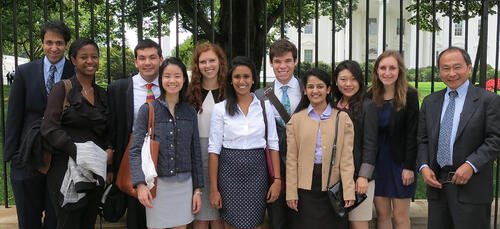
Last summer, he launched the Perry Project by inviting a dozen high school and college students to campus for a nuclear weapons boot camp so that they could take back to campus the message that nuclear annihilation is still a real, contemporary possibility.
He asked them: How do I get through to your generation?
“They said, `We don’t get our information by books or even by television, we get it through social media and YouTube, the various social media platforms. And you want to make the message relevant and relatively compact,’” he recalls.
Perry listened. “Living at the Nuclear Brink: Yesterday and Today” is in production now and a short-segment pilot video should be made available in the fall.
And lectures from CISAC's signature course, “International Security in a Changing World” (PS114S) will soon go up on YouTube as lecture modules entitled, “Security Matters.”
“Online learning offers a way to expand CISAC's reach to new audiences, geographies, and generations,” says CISAC Co-Director Amy Zegart, who has co-taught the popular course for the past few years with CISAC’s Martha Crenshaw.
“At the same time, the PS114 online modules will give us a living lecture library so that future Stanford students can compare faculty lectures on similar topics across time – learning, for example, how Martha Crenshaw assessed the terrorist threat in 2010 vs. 2015,” Zegart said.
Guest lecturers whose presentations will be included for the YouTube package include:
Jack Snyder of Columbia University: Democratization and Violence
Francis Fukuyama of Stanford: The Changing Nature of Power
Zegart: Understanding Policy Decisions: The Cuban Missile Crisis
Scott Sagan of CISAC: The Nuclear Revolution; and Why Do States Build/Forego Nuclear Weapons?
Abbas Milani, director of Iran Studies at Stanford: Historical Perspective on Iran
Former FBI Director Robert Mueller: the FBI’s Transformation Post 9/11
U.S. Army Lt. Gen. Karl Eikenberry (Ret.) and former U.S. ambassador to Afghanistan: The War in Afghanistan and the Future of Central Asia
Jane Holl Lute, former deputy secretary of Homeland Security: Emerging Threats in Cybersecurity
Perry: Security Issues in Russia, Yesterday and Today
Brad Roberts: former U.S. Deputy Assistant Secretary of Defense for Nuclear and Missile Defense Policy: Ensuring a (Nuclear) Deterrence Strategy that is Effective for 21st Century Challenges
CISAC Co-Director David Relman: Doomsday Viruses
And lectures at CISAC’s Cybersecurity Boot Camp for senior congressional aids will also be videotaped and packaged for YouTube and online consumption later this year.
“We are excited to enter into this phase of experimentation to see what works, what doesn't, and how we can further CISAC's teaching mission both here at Stanford and around the world,” Zegart said.
MANILA, Philippines – When Victor Corpus was an idealistic young military officer, he turned on his country to join the communist New People’s Army. He headed for the mountains and would face years of armed struggle, imprisonment and then a sentence to death.
What made the highly trained Philippine Army first lieutenant lead a bold raid to capture the weapons from his own armory at the Philippine Military Academy – one that would go on to make him a living legend and lead to a movie about his life?
“It was my realization that our society at that time was structured like a pyramid, where the wealth of the nation is controlled by about 100 families on top, where less than 1 percent of the population controls everything,” recalls Corpus, who is now 70.
When the Army ordered the 26-year-old officer and his soldiers to train the private militia of a wealthy warlord in the northern Philippines, a trigger was pulled.
“If you are a member of the Armed Forces and you realize that you are just being used as an instrument of the elite, to preserve and protect their interests, it makes you want to rise up and fight for what you believe are the true interests of the people,” he said.
“That is what made me go to the rebel side.”
Image
It’s still a factor that makes young Filipino men and women pick up arms today: The gap between rich and poor, the government corruption, the dynasties that still rule the impoverished countryside.
By understanding this former rebel’s story – and thousands of others his team of researchers have collected over the last decade – CISAC Senior Research Scholar Joe Felter believes he can help scholars dive deeper into the causes of insurgency. He hopes to aid policy makers and military planners in determining how to best curb these conflicts and help reduce casualties and economic devastation.
“You were a real inspiration for me and made me want to learn more about insurgency and then study it and write about it,” Felter told Corpus over a recent breakfast in Manila. “I met Victor soon after I moved to the Philippines for a three-year assignment. It’s such an amazing story, and it captures so many of the challenges I’m researching."
The Southeast Asian nation is home to some of the most protracted insurgencies in the world. Muslim separatist groups on the southern island of Mindanao and Sulu Sea, known collectively as Bangsamoro, have resisted Christian rule since Spanish colonization of the archipelago began after Magellan arrived in the early 1500s. The Communist People’s Party and its armed wing in the New Peoples Army (NPA) continue to wage a classic Maoist revolutionary war across the country; and the extremist Abu Sayyaf Group – known to have links with al-Qaida and other international terrorist groups – is actively conducting terrorist attacks as well as kidnappings for ransom across the country’s restive south.
Felter, a career Army Special Forces officer, was a U.S. military attaché in Manila from 1999-2002. He traveled extensively throughout the Philippines and could see how widespread and debilitating the long-running insurgencies and internal conflicts were. After a spate of kidnappings by the Abu Sayyaf Group in 2000 and 2001 that involved American citizens and other foreign nationals, he helped persuade U.S. authorities to increase its support for America’s former colony and Pacific ally.
The 9/11 terrorist attacks reinforced the U.S. commitment to build the capacity of the Philippine military to prevent their country from becoming a haven for extremists who might use the country to stage and plot another attack against United States’ interests.
Felter helped the Philippine Army Special Operations Command (SOCOM) set up the country’s first counterterrorist unit. That elite Light Reaction Battalion has now been expanded to a regiment of 1,500 soldiers. Felter traveled to the Philippines in February to receive a medal in honor of his work in establishing this force.
His work with the Armed Forces of the Philippines (AFP) as a military attaché, and dozens of trips back since, allowed him to get behind the scenes and make friends in the military and government. Those close relationships provided him unprecedented access to thousands of sensitive documents chronicling in micro-level detail the history of Philippine military and government efforts to combat insurgency and terrorism in the field.
“All counterinsurgency is local,” says Felter. “You need to study it at the local level to really understand it. And the Philippines is like a Petri dish for studying both insurgency and counterinsurgency because you have multiple, long-running insurgencies, each with distinct characteristics, and with an array of government and military responses to address these threats over time.”
Felter was in the Philippines in 2004 conducting field research as part of his Stanford Ph.D. dissertation when he was first able to gain access to what would become a trove of detailed incident-level data on insurgency and counterinsurgency in this conflict prone country. After bringing back the data and meeting with his faculty advisors – Stanford political science professors David Laitin and James Fearon – he realized the extensive incident-level data could be coded in a manner that would make it a tremendous resource for scholars studying civil wars, insurgencies and other forms of politically motivated violence.
“This comprehensive conflict dataset, when it becomes public later this year, is going to be the Holy Grail of micro-level conflict data,” Felter says. “It promises to be an unprecedented resource for scholars and policy analysts studying the foundations and dynamics of conflict. It has the potential to drive a significant number of publications, reports and analyses, and enable conflict researchers to develop insights and test theories that they would not have been able to do before.”
They also hope to help journalists do a better job of analyzing conflict.
Jim Gomez, the AP’s chief correspondent in the Philippines, says there is little access to detailed data about the conflicts he has been covering for two decades.
“There is a natural contradiction between military, police, intelligence and other security agencies which, by nature, operate in secrecy,” says Gomez, who has been on the front lines of many battles in his homeland. “The database is one step toward satisfying the need of journalists to be able to write stories with more accurate and in-depth detail and context. It allows for better comparative analysis and can give insights to emerging patterns like those found in the southern Philippines. Better access to information, to my mind, is always a boon to better security policies.”
CISAC Senior Research Scholar Joe Felter awaits a pledge of honor by the Philippines Armed Forces.
Coding Out the Data
Felter coordinated with senior leaders in the Armed Forces of the Philippines to gain approval to access and code the unclassified details from tens of thousands of individual conflict episodes reported by Philippine military units in the field dating back to 1975. Most of data were gleaned from the original hand-typed records maintained by the Philippine Army. Felter worked with contacts in the Philippine military to build a team of military and civilian coders to scan and input data from the only existing copies of these original incident reports.
In 2009 – while a National Security Affairs Fellow at the Hoover Institution prior to his final deployment in Afghanistan – Felter invited his colleague, Navy veteran Jake Shapiro, an assistant professor of politics and international affairs at Princeton University, to join him as ESOC’s co-director. Shapiro and Felter were graduate school classmates and worked together at West Point’s Combating Terrorism Center where the vision for ESOC was first articulated. Felter and Shapiro formally established the Empirical Studies of Conflict (ESOC) project and began to build comprehensive databases on multiple political conflict cases around the world.
Eli Berman, a veteran of the Israeli Defense Forces, joined the team soon after. Today he is research director for international security studies at University of California Institute on Global Conflict and Cooperation and professor of economics at UC San Diego.
“I'm fascinated by how economic development is best achieved in places where property and people are insecure. Unfortunately, that's true of many Philippines communities,” Berman said. “Joe is the perfect partner for that research. He brings insights that come from years of thoughtful experience and local knowledge. The team he has assembled and the data they bring are a joy to work with.”
Image
ESOC members also include David Laitin, James Fearon and Jeremy Weinstein, all from Stanford’s political science department, as well as affiliates and a growing cadre of current and former post-doctoral fellows.
The Empirical Studies of Conflict Project website was launched last year. It highlights some of the key initial findings from ongoing data collection efforts in the Philippines as well as Afghanistan, Colombia, Iraq, Mexico, Pakistan and Vietnam. The site includes geospatial and tabular data as well as thousands of documents, archives and interviews. Ultimately, nearly all of the releasable data Felter is compiling on the Philippines case will be made available via the ESOC website. The non-digitize materials such as hardcopy records and taped interviews will be housed in the Hoover Institution’s Library and Archives.
“This will be the gold standard for micro-level conflict data. The planets aligned for us in many cases,” Felter said. The team also has had unprecedented access to data sources in Iraq and to some degree from Afghanistan, Columbia, and Mexico.
“What’s unique about ESOC is that we’re trying hard to make it easier for others to study conflict by pulling together everything we can on the conflicts we’ve studied,” says Shapiro. “On Iraq, for example, the ESOC website provides data on conflict outcomes, politics, and demographics, in addition to maps, links to other useful information sources, and all the files ESOC members have used in their research on Iraq.”
Shapiro says researchers working for the Canadian Armed Forces, the World Bank and the U.S. military have already turned to ESOC as a resource for data on Iraq “because it’s so useful to have everything in one place.”
The West Point Connection
Many of these documents, some dating back to 1975, were withering in the heat and humidity of an old building at army headquarters before Felter and his Philippine military team arrived to scan and record them.
Felter’s chief Filipino partner in compiling and analyzing the data is another West Point grad, Lt. Col. Dennis Eclarin, an Army Scout Ranger commander who led many of the counterinsurgency missions that he would later come to analyze. Eclarin conducted 1,500 hours of videotaped interviews with rebels who gave up their arms and surrendered.
Eclarin recalls being a lieutenant fresh out of West Point and negotiating the surrender of 20 communist rebels.
“I got the chance to interview the rebel commander of this very elite group, against whom I had been fighting in 2000, and when I interviewed him he said: `You know what? If you had just given us one water buffalo each, we would not have been fighting you, we would have just gone out and tilled our land,’” Eclarin recalls.
He would go on to interview hundreds of rebels and their commanders, such as the Islamic militant chief who talked tactics with him, then revealed that his greatest tool was his men’s belief that Allah was waiting for them on the other side.
There was the Roman Catholic nun who was running guns and money for the communists and the young college freshman recruited with the promise of $40 a month to support her family. Eclarin heads up the team of coders supporting ESOC in the Philippines. Erwin Agustin, a Staff Sergeant in the Scout Rangers, does data entry – when he’s not out fighting rebels.
“The interviews and the coding has changed me – and it’s changed the perception of the Armed Forces, too,” Eclarin says. “We just appreciate data; we see it in a new light. We were just thinking short term, but the data allows us to look long-term and more strategically. Where are the hot zones we must avoid? What time of day are they likely to attack?”
Eclarin heads up the team of coders supporting ESOC in the Philippines. Erwin Agustin, a Staff Sergeant in the Scout Rangers, does data entry – when he’s not out fighting rebels.
“One time I was coding and was amazed to see the records of some of our comrades who had been ambushed and killed,” Agustin says. “Being a member of the Scout Rangers and seeing those who are missing – you hurt. But you must push through because you’re giving them a voice. They gave their lives for the Army, they sacrificed their lives for their families – and we are going to give them a voice.”
Erwin Olario, a civilian and the lead coder of Eclarin’s team, says the data is agnostic.
“We don’t take sides; we’re not out to prove anything. But, hey, if we could possibly contribute to bringing about peace one day – that would be something.”
The coders are now doubling back over the dataset from 1975 to 2012, to make sure it’s accurate and cleaned of classified details before it goes public. The data are the basis for two of Felter’s ongoing book projects and multiple journal articles, including a recent article in the American Economic Review entitled, “Aid Under Fire: Development Projects and Civil Conflict.”
Another of Felter’s longtime Filipina friends is Corazon “Dinky” Soliman, cabinet secretary for the Philippine government’s Department of Social Welfare and Development. They go back to 1997, when the two were classmates working on their master’s in public administration at the Harvard Kennedy School of Government.
The two caught up on classmate gossip during a recent meeting in her Manila office. She was on a rare break from her work in the south, where Typhoon Haiyan had claimed more than 6,200 lives in November.
Soliman tells Felter she used a study based on ESOC data to help demonstrate the efficacy of her department’s conditional cash transfer (CCT) program. This flagship development program attempts to reduce poverty by giving cash to families falling under poverty thresholds, conditional on enrolling kids in school and getting them regular medical checkups and vaccines.
Soliman and her staff used the study conducted by Felter – and Benjamin Crost at the University of Illinois and Patrick B. Johnston at the RAND Corporation – in which they took an existing World Bank experiment in the Philippines that separated villages into those that would receive the cash transfers and those that would not. The scholars incorporated measures of violence from the ESOC data to estimate the effect of the CCT program on conflict intensity. They found cash transfers caused a substantial decrease in conflict-related incidents and, using their data on local insurgent influence, they determined the program significantly reduced insurgent influence in the villages that received the cash transfers compared with those that did not.
“Your results were very, very important and it had such a strong impact with the legislators, and in particular the budget, because they saw the program is not just about education and health,” Corazon tells Felter. “They saw it even has impact on peace and security.”
“That’s just great,” Felter says. “That’s what motivates our team to engage in this type of work and really what you want to hear. It’s such a privilege for us to support you in this capacity.”
A Rebel’s Redemption
Felter led the Counterinsurgency Advisory and Assistance Team (CAAT) in Afghanistan, reporting directly to Gens. Stanley McChrystal and David Petaeus, before becoming a senior research scholar at CISAC and retiring from the military in 2012.
While he misses his time on active duty and the sense of purpose that comes with serving in combat, he believes his ESOC research will make a difference and have an impact in stabilizing conflict areas and setting conditions for development and governance efforts to be effective.
“In the last decade, the United States and the international community have devoted tens of billions of dollars towards rebuilding social and political order in troubled countries,” Shapiro says. “Thousands of families today are mourning loved ones lost in those efforts. ESOC is devoted to learning from that experience, and to making it easier for others to do so as well, so that we can all do a better job helping such places in the future.”
Traveling back to the Philippines often to meet with Eclarin and his coders keeps him tied to the men and women who are on the ground. And close to old colleagues such as Corpus, who was pardoned by President Corazon Aquino and went on to become the nation’s head of intelligence.
“Here’s the irony: The intelligence service was one of the organizations that was running after me, and then I was eventually assigned to head this very organization. Only in the Philippines,” says Corpus, whose counterinsurgency plan drafted in 1989 was hugely successful.
The communist New People’s Army is estimated to have approximately 5,000 rebels today, down from its high of 26,000 in the mid-1980s. And the government signed a hard-sought peace deal with the Moro Islamic Liberation Front in last spring, which grants the Muslim areas of the southern Mindanao region greater political autonomy.
Still, many don’t believe the accord will hold and separatists from Moro National Liberation Front and the Abu Sayyef Group continue to threaten stability in the south.
“As long as the root forces remain – the income gap between the rich and the poor – there will always be rebellion,” says Corpus.
Hero Image
CISAC Senior Research Scholar Joe Felter awaits a pledge of honor by the Philippines Armed Forces.
Jonathan Hunt, a postdoctoral MacArthur Nuclear Security Fellow at CISAC, writes in this commentary in The National Interest that the secret history of Cold War détente offers a case study in how back-channel discussions at multilateral talks might help the United States and Iran resolve their differences.
U.S. Secretary of State John Kerry and foreign ministers from the six-nation group negotiating a nuclear agreement with Iran will resume talks in Vienna this weekend. The foreign ministers are trying to forge a a comprehensive nuclear deal by a July 20 deadline.
“The annals of nuclear diplomacy between the United States and the Soviet Union might afford a useful case study from which American and Iranian leaders could learn,” writes Hunt, who has a Ph.D. in History and wrote his dissertation on nuclear internationalism during the Cold War.
“In contrast to the conventional wisdom that Nixon and Kissinger masterminded Soviet-American détente, those who brokered the Nuclear Nonproliferation Treaty (NPT) during the presidency of Lyndon Baines Johnson in fact laid the groundwork for superpower cooperation,” he writes.
Martha Crenshaw, a senior fellow at CISAC and FSI and one of Stanford's leading experts on terrorism, says the terrorist group known as ISIS poses a danger to the United States if it grows more powerful. But that organization, she adds, may be overreaching in its ruthlessness and religious zealotry. Crenshaw answers questions in this Stanford Report interview with the Stanford News Service.
Meanwhile, the U.S. government has not found a way to deal with the larger Iraq conflict that now involves ISIS, says Crenshaw, who founded and runs the Mapping Militant Organizations project.
Hero Image
Shiite volunteers secure the area from predominantly Sunni militants from the Islamic State, formerly called the Islamic State in Iraq and Syria (ISIS) in the desert region south of Baghdad on July 3, 2014.
According to a new study co-authored by Stanford professor David Lobell, the chance of a worldwide slowdown in agricultural yield growth in the next two decades is significantly higher due to global warming.
Lobell and co-author Claudia Tebaldi, a senior researcher at the National Center for Atmospheric Research, set out to estimate the odds of a steep drop in global wheat and corn yield progress under several climate scenarios. The study, “Getting caught with our plants down: the risks of a global crop yield slowdown from climate trends in the next two decades” appeared in Environmental Research Letters.
Lobell said he was motivated to pursue the study based on questions posed by stakeholders and decision makers in governments and the private sector.
“I’m often asked whether climate change will threaten food supply, as if it’s a simple yes or no answer,” Lobell said. “The truth is that over a 10 or 20 year period, it depends largely on how fast the Earth warms, and we can’t predict that very precisely. So the best we can do is try to determine the odds.”
Lobell and Tebaldi calculated the chance of a 10 percent global yield loss from climate change over the next 20 years, which would represent a severe impact on food supply, enough to roughly halve the rate of yield growth.
The short time frame of the study was deliberate, Lobell said. “Many studies have looked at climate and agriculture trends over the coming 50 or 100 years. But the next two decades are when most of the global population growth, and dietary shifts driven by a growing middle class, will occur. The growth rate of food demand will be higher during this time than at any other time in the next century.”
Without human-induced global warming – in other words, in a world with only natural climate variability – the likelihood of a yield drop that large is only 1 in 200. But when the team accounted for global warming, they saw the odds jump to 1 in 10 for corn and 1 in 20 for wheat. “In this study, we did not try to estimate the most likely impacts of climate change on crops,” Lobell said. “Rather, we estimated the likelihood of a really major impact, not because we want to scare people, but because there are many people who want to be prepared for all contingencies.”
“The point of the paper is to move from hand-waving about scenarios of what could go wrong, to specific and transparent estimates of the actual odds,” Lobell said. “The odds are not very high, but they are significant and a lot bigger than they used to be. The people asking these questions are accustomed to planning for scenarios with much less than a 10 percent chance of happening, so it will be interesting to see whether this study has any effect on how they operate.”
Lobell adds that organizations working toward global food security, and related issues such as conflict prevention, are most interested in the next 20 years because their decisions rarely consider the more distant future. “As scientists, we might prefer to work on time scales in which the answers are clearer, but we also want to be responsive to the actual concerns and questions that decision makers have.”
CISAC Consulting Professor Thomas Hegghammer writes in this Lawfare Foreign Policy Essay: Calculated Caliphate that the move by the Islamic State in Iraq and Syria (ISIS) to declare itself an Islamic State with a caliphate as its leader is a "bold and unprecedented" move.
Hegghammer, director of terrorism research at the Norwegian Defence Research Establishment and a leading scholar of the jihadist movement, explores the motivations, both strategic and ideological, behind the recent ISIS revelations in Iraq.
The new president of the International Rescue Committee, David Miliband, has taken on the challenge of the largest refugee crisis in recent history. The former UK foreign secretary talks with CISAC affiliate Anja Manuell about the most pressing refugee issues today, including those in Syria, Iraq and South Sudan.
Research by CISAC's Joseph Felter shows that insurgents try to derail government-delivered aid programs in poor areas because they fear successful programs will boost the government's credibility. Preventive measures include providing greater security around aid projects and limiting advance knowledge about them.
A research paper, published in the American Economic Review, involved an analysis of a large community-driven development program in the Philippines. In 2012, the World Bank supported more than 400 of these projects in 94 countries with about $30 billion in aid.
Conventional wisdom assumes that development aid is a tool to help reduce civil conflict. But some aid projects may actually exacerbate the violence, the research showed.
In an interview, Joseph Felter, a senior research scholar at Stanford's Center for International Security and Cooperation, said, "A 'winning hearts-and-minds' strategy for disbursing development aid may lead to an increase in insurgent attacks in the world's poorest areas. The study's takeaway is not to stop aid delivery, but to appreciate and plan for the possibility of unintended consequences."
Felter co-wrote the article, "Aid Under Fire: Development Projects and Civil Conflict," along with Benjamin Crost of the University of Colorado-Denver and Patrick Johnston of the RAND Corporation. Their research relied on conflict data from the Philippines military from between 2002 and 2006 that allowed them to precisely estimate how the implementation of aid affected violence levels in ongoing insurgencies against the government.
Spotlight on the Philippines
These issues are particularly important in poor and conflict-ridden countries like the Philippines, Felter said. The Philippines is home to some of the most protracted insurgencies in the world. Islamic separatist groups struggle for an independent Muslim state; a communist group continues to wage a classic Maoist revolutionary war; and the extremist Abu Sayyaf Group conducts kidnappings and terrorist attacks.
The aid program Felter and his colleagues studied was the Kapit-Bisig Laban sa Kahirapan Comprehensive Integrated Delivery of Social Service – or KALAHI-CIDSS – the largest of its kind in the Philippines. Through it, poor communities receive projects to address their most pressing needs. According to Felter, this typically involved funding for projects like roads, schools, health clinics and other infrastructure.
"This is government funding for projects that citizens in these areas have expressly asked for," Felter said.
The researchers noted that community-driven development projects, also known as "CDD" projects, are popular because evidence suggests they enhance social cohesion among citizens. But sometimes they draw the wrong kind of attention from anti-government groups, as the research illustrated.
Felter and his colleagues found an increase of 110-185 percent in insurgent attacks in communities where aid projects commenced, the authors wrote. If this effect is extrapolated across all of the Philippines' municipalities, the authors estimate that the program resulted in between 550 and 930 additional casualties during three years.
"Taken together, this detailed evidence sheds new light on the mechanisms that link aid and conflict, which may eventually help design more effective aid interventions that alleviate poverty without exacerbating conflict," they wrote.
When the insurgent groups destroy such a project, it has the effect of weakening the perception that the government can actually deliver on community projects, the scholars wrote. For example, the communist rebels in the Philippines have issued public statements denouncing the KALAHI-CIDSS program as "counterrevolutionary and anti-development." If a successful aid program shifts the balance of power in favor of the government, it reduces insurgents' bargaining power and their political leverage.
As a result, insurgents tended to engage in conflict in the earlier stages of a project in order to keep it from succeeding, according to the research. In fact, conflict increased when municipalities were in the early or "social preparation" stages of publicizing an aid program, Felter and his colleagues wrote.
Sometimes rebel groups divert aid to fund their own operations – aid shipments are often stolen or "taxed" by these groups, according to the paper.
The Next Step
What can be done to prevent attacks?
"Greater security around the aid projects and limiting advance knowledge of the particular projects are good measures to start with," Felter said.
He noted that governments and aid organizations need to be discreet in how they identify aid projects and their locations, and how they disburse the aid itself. More research on this issue needs to be done, Felter said.
"One lesson is not to give insurgents too long a lead time to plan attacks," he said.
Unfortunately, as the researchers noted, poverty and violence are often linked: "The estimated one-and-a-half billion people living in conflict-affected countries are substantially more likely to be undernourished, less likely to have access to clean water and education, and face higher rates of childhood mortality."
Continued progress – in the form of international aid – is urged toward eradicating poverty. "To help achieve this, governments and multilateral donor organizations are increasingly directing development aid to conflict-affected countries worldwide," Felter and his co-authors pointed out.
Felter, also a research fellow at Stanford's Hoover Institution, retired from the U.S. Army as a colonel in 2012 following a career as a Special Forces and foreign area officer. He has conducted foreign internal defense and security assistance missions across East and Southeast Asia and has participated in combat deployments to Panama, Iraq and Afghanistan. In 2010-11, he commanded the International Security and Assistance Force Counter Insurgency Advisory and Assistance Team in Afghanistan.
"I saw this dynamic (insurgent attacks on aid projects) firsthand in Afghanistan and Iraq. This research paper confirms it," Felter said.
He devoted much of his Stanford doctoral dissertation and his work at CISAC and Hoover to build what he hopes will be the largest and most detailed micro-conflict database – the Empirical Studies of Conflict – ever assembled.
Felter said there is only so much that the military can do to win over people in areas ravaged by war and conflict.
"The military can 'lease' hearts and minds by creating a safe environment for aid projects," he said, "but ultimately it's up to the government to win them over."
Shorenstein APARC
Stanford University
616 Serra Street, E301
Encina Hall
Stanford, CA 94305-6055
0
zcb@stanford.edu
Corporate Affiliate Visiting Fellow
MBA
Changbao Zhang is a corporate affiliate visiting fellow at the Walter H. Shorenstein Asia-Pacific Research Center (Shorenstein APARC) for 2014-15. He has worked at PetroChina for 18 years. Currently, he is the Assistant President and HR Director at PetroChina International Iraq Company. Zhang received his bachelor's degree in Petroleum Geology from North East Petroleum University in China, his MBA from Beijing Science & Technology University and his master's degree in Law from Peking University in China.
Prince Moulay Hicham Ben Abdallah, a consulting professor at the Center on Democracy, Development and the Rule of Law is leaving Stanford at the end of this academic year to pursue research in Islamic studies in the United Kingdom.
Ben Abdallah joined CDDRL – a center at the Freeman Spogli Institute for International Studies – as a visiting scholar in 2007, and then became a consulting professor. In 2010, Ben Abdallah worked with CDDRL Director Larry Diamond to launch one of the center’s principal research programs, the Program on Arab Reform and Democracy (ARD). Examining political and democratic reform in the Arab world, ARD is a multidisciplinary program that brings together policy-makers, academics and civil society members to advance policy-relevant research.
“We are very proud to have been able to engage Prince Moulay Hicham and provide him an intellectual home during this past formative period for the Program on Arab Reform and Democracy, and for his own scholarship and reflection. He has had a profound and enduring impact in helping to launch and shape a significant program of research on Arab politics and society at Stanford, and through that in stimulating the broader growth of Arab studies at Stanford,” said Diamond. “In giving so generously of his time, knowledge, and resources to our students, he has also supported and inspired many of them to make what I expect will be a lifelong commitment to study of and engagement with the Arab World. We wish him every success in this next phase of his intellectual journey.”
Written during his residence at CDDRL, Ben Abdallah's memoir entitled Journal d’un Prince Banni or the Diary of a Banished Prince debuted this spring. The autobiography shares his life story as a member of Morocco's royal family. The first cousin of Morocco's King Mohammed VI, Diary of a Banished Prince traces Ben Abdallah's evolution as a political activist against the historical backdrop of Morocco's authoritarian politics.
“At CDDRL, I found an intellectual community that was tightly knit, yet diverse enough to foster the cross-fertilization of ideas," said Ben Abdallah "Its cutting-edge research and classical scholarly debates provided an environment that broadened my expertise and offered opportunities to engage in real introspection.. All these elements were crucial in allowing me to write my book as well as explore new frontiers of research.”
Ben Abdallah has served on the FSI advisory board since November 2009, and has stepped down from that role this year.
Ben Abdallah will continue to stay engaged at Stanford through his role on the board of advisors for the American Middle Eastern Network for Dialogue at Stanford, a student group on campus. He will also stay involved with the ARD program as a principal advisor and supporter of the initiative.