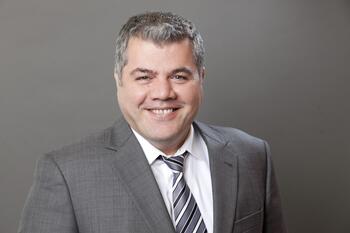
Roz Naylor, Director of the Center on Food Security and the Environment talks how technology will help meet the growing demand for food and water in the developing world and why tech companies should invest in Africa.
Hero Image
Roz Naylor and Russ Altman talk the future of food security. | Stanford Radio
As a senior policy advisor on the Middle East at the Pentagon and the White House, Colin Kahl has witnessed struggles in the region first-hand. From working to shape the U.S.-led campaign against the Islamic State and the long-term partnership with Iraq to limiting Iran’s nuclear activities to helping craft the U.S. response to the Arab Spring, Kahl knows better than most how important it is to understand this rapidly changing region.
Now that he has joined the Freeman Spogli Institute for International Studies (FSI) as its inaugural Steven C. Házy Senior Fellow, Kahl wants to improve understanding of how developments in the Middle East impact people in the region and security around the globe.
The launch of FSI’s Middle East Initiative provides a first step toward this objective. As the initiative’s first director, Kahl plans to create “connective tissue” for efforts already underway across Stanford.
“There are a number of disparate efforts around campus working on Middle East issues,” said Kahl. “There is a lot of terrific research and engagement going on. My hope is that the Middle East Initiative will serve as a focal point to expose the Stanford community to ongoing work and foster new conversations that are not happening now.”
Many of the Middle East activities already occurring on campus happen at FSI, making it a natural home for the initiative.
“Our scholars are already studying the dynamics of authoritarian regimes in the Middle East, prospects for reform and democracy in the Arab world, ways to counter terrorist activities and promoting economic development,” said FSI Director Michael McFaul. “Stanford students want to dive more deeply into the region’s political, social, economic and technological development. We want to give them that opportunity.”
Kahl also plans to bring more Middle East scholars from outside Stanford to share their ideas and research.
“I look forward to helping Stanford students and scholars connect and collaborate in ways that enrich our understanding of this vital region,” said Kahl. “Stanford has much to contribute to some of the most pressing policy challenges we face.”
On April 13, the United States Institute of Peace hosted a panel discussion titled “Ending Civil Wars: How Can We Succeed with Limited Opportunities?” The session was moderated by the director of the U.S.-Asia Security Initiative, Ambassador Karl Eikenberry.
USIP recently posted video and audio-only recordings of the 90-minute session for public view. Watch/Listen here >>
The session focused on insights from “Civil Wars, Violence, and International Responses”, a project co-directed by Ambassador Eikenberry and FSI Senior Fellow Stephen Krasner. Through the efforts of 36 U.S. and international project participants (8 of whom were affiliated with FSI), the American Academy of Arts and Sciences dedicated two issues of its quarterly journal Daedalus to their writings (see below).
Joining Ambassador Eikenberry and Professor Krasner on the dais were Nancy Lidborg (President of USIP), Dr. Stephen Biddle (Professor, Georgetown University), Barry Posen (Professor, Massachusetts Institute of Technology), and Clear Lockhart (Director and Co-Founder of the Institute for State Effectiveness).
The availability of climate model experiments under three alternative scenarios stabilizing at warming targets inspired by the COP21 agreements (a 1.5 ºC not exceed, a 1.5 ºC with overshoot and a 2.0ºC) makes it possible to assess future expected changes in global yields for two staple crops, wheat and maize. In this study an empirical model of the relation between crop yield anomalies and temperature and precipitation changes, with or without the inclusion of CO2 fertilization effects, is used to produce ensembles of time series of yield outcomes on a yearly basis over the course of the 21st century, for each scenario. The 21st century is divided into 10 year windows starting from 2020, within which the statistical significance and the magnitude of the differences in yield changes between pairs of scenarios are assessed, thus evaluating if, and when, benefits of mitigations appear, and how substantial they are. Additionally, a metric of extreme heat tailored to the individual crops (number of days during the growing season above a crop-specific threshold) is used to measure exposure to harmful temperatures under the different scenarios. If CO2 effects are not included, statistically significant differences in yields of both crops appear as early as the 2030s but the magnitude of the differences remains below 3% of the historical baseline in all cases until the second part of the century. In the later decades of the 21st century, differences remain small and eventually stop being statistically significant between the two scenarios stabilizing at 1.5 ºC, while differences between these two lower scenarios and the 2.0ºC scenario grow to about 4%. The inclusion of CO2 effects erases all significant benefits of mitigation for wheat, while the significance of differences is maintained for maize yields between the higher and the two lower scenarios, albeit with smaller benefits in magnitude. Changes in extremes are significant within each of the scenarios but the differences between any pair of them, even by the end of the century are only on the order of a few days per growing season, and these small changes appear limited to a few localized areas of the growing regions. These results seem to suggest that for globally averaged yields of these two grains the lower targets put forward by the Paris agreement does not change substantially the expected impacts on yields that are caused by warming temperatures under the pre-existing 2.0ºC target.
FSI and the Ford Dorsey IPS program will be hosting Mercy Corps as they visit campus to speak about their Global Internship Program.
The Mercy Corps Global Internship Program offers exploration into future careers in international relief and development while supporting our beneficiaries in their local communities in 25 countries around the world. Their internships revolve around a particularly demanding mission - to help people on the ground turn the crises they confront into the opportunities they deserve. Driven by local needs, our programs provide communities in the world’s most challenging places with the tools and support they need to transform their lives.
Mercy Corps is an international relief and development organization working in over 40 countries worldwide helping people build secure, productive and just communities. From poverty and malnutrition to natural disasters and global warming, Mercy Corps sees an opportunity to create transformative change. In crisis, we believe in the power of human potential. Mercy Corps connects people to the resources they need to build better, stronger lives.
The following are remarks delivered by Professor Thomas Fingar at the John Lewis Legacy conference on January 13, 2018.
We've heard many characterizations and word picture descriptions of John. My own image is that of John as the Energizer Bunny wearing a Nike tee shirt that says, “Just Do It.” The bunny is also wearing a huge grin. My memory of John Lewis includes all of the scholarly and other attributes described by previous speakers, but at the core there is a wonderful human being who touched many lives in many ways. Things that others have said today prompt me to use my time to relate a series of little vignettes that I think help capture who and what John was.
The first was prompted by the discussion of getting Siri to call Bob Carlin. The world entered an exciting new era when John Lewis was mated with a cell phone. From that time on, it was possible for John to act instantaneously whenever he had an idea or wanted to do something. I've traveled a lot, and for many years had worried that when the phone rang in the middle of the night, it probably was to report bad news from home. John’s acquisition of a cell phone changed that. Time and time again, the 3:00 am phone calls were from John. He seemed never to remember—or never to care—that I was traveling. When he had an idea, telling me about it was always more important than the fact that I was in New Zealand or some other distant land. This happened so often that I was almost surprised and disappointed when I made it through the night without a call from John.
John didn't watch the clock. With John, everything was urgent. His unique combination of vision, passion, commitment, and urgency came with a blind spot for the possibility that not everyone might share the vision, the passion, or the urgency. And, as was noted earlier, if you didn't share John’s vision, passion, and urgency, you might as well head to the outer darkness.
There is much about John that I admired greatly, but my long and wonderful relationship with him never clarified when or why he would switch from all-in exuberance to total disinterest. I have been described by a former boss as having an emotional range that goes from A almost all the way to B. I don’t get very excited about anything. John was either very excited about an idea or opportunity, or utterly dismissive. But with the ideas that excited him, he was quite prepared to give them away so others could take credit or figure out how to act on the idea. Over the years, when John would call me in, or phone me on the other side of the world, my normal response was to listen. The excitement in his voice caused me to visualize him hovering a few inches from the ceiling. He had long ago figured out that we had different scales of excitement and that I would treat the idea seriously until I had determined that it simply would not fly. Or would not fly without more effort than I was willing to expend. If I said, “let me think about it,” John would move on to something else because we both knew that I had effectively made a commitment to run with the idea. If I did so more slowly than he thought necessary, he would prod me with a question about where things stood. He cared about the idea, not who had proposed it. Addressing the underlying problem was more important than the specific way in which it was to be addressed.
John’s de facto delegation of tasks to me and to others, and greater focus on developing ways to deal with problems than on specific solutions reminds me of one of his favorite Chinese words and concepts. That word is jizhi or mechanism. John was always looking for ways to build connections and arrangements that would endure beyond a one-time meeting or conference. His constant query asking “How are we going to solve this problem?” was always followed by some version of “How do we put in place arrangements-- people, procedures, relationships—that are enduring? That don't solve the problem once, but that are there when that solution proves to be inadequate or when a new challenge comes up?”
The people in this room, and many, many more who are not here today, are part of the activist network that John developed. I don't know how conscious or self-conscious it was on his part. Regardless of how deliberately John tried to instill in us a model approach to tackling problems, the fact is, we found a model worthy of emulation. We saw what worked for John and thought it was a good idea to try something approximating what he did. As I look around at friends in this room, I see not just fantastically successful academic scholars. I also see people who have run things—run big organizations and made significant things happen.
John created a network of people. We're all part of it. And I think he probably left feeling pretty good about that aspect of his legacy. He had an uncanny ability to spot people with abilities and potential—he often saw more in us that we saw in ourselves—but he was also remarkably effective at putting people in place to “do something important.” Along the way, he taught us how to approximate doing what he did.
Mention was made of his first Rottweiler. It was an enormous dog. I think his name was Amigo. I was in awe of John from the time I first encountered him as an undergraduate until the last time I saw him. But awe was infused with a degree of intimidation when I was a junior graduate student. I had a meeting with John in his Owen House office. Amigo was there, alertly lying under the conference table. The dog was even more intimidating than John, probably because he looked like he would eat anything smaller than he was. Something on or in the sole of my shoe caught Amigo’s attention. I was sitting at the table discussing a research paper with John. Amigo was underneath. And he was eating my shoe. That dog was so damn big, I certainly wasn't going to kick him. I thought to myself, the dog is going consume my shoe and eat my leg. To say the least, I was distracted, but I was not about to tell the professor that his dog was eating my shoe. We finished our conversation and I departed with a very unbalanced pair of shoes. If I had told John, he would have laughed like hell, told Amigo to stop, and would not have been upset that I was dismayed by his dog. But I did not realize that in 1969.
I want to shift gears in the remainder of my time to provide illustrations of the way John built teams and institutions to refine and implement his ideas. Several have mentioned the book on the United States and Vietnam that John wrote with George Kahin. I was introduced to the arguments in that book in a classroom lecture before the book was published. The lecture and the book evolved into a series of teach-ins on the Vietnam War. It also led to the establishment of the Stanford chapter of the Committee of Concerned Asian Scholars, and to a much larger series of teach-ins and the incorporation of more information on Asia into national security courses across the United States.
I think it was in 1968 that the US was about to deploy the Safeguard anti-ballistic missile system. The stated purpose was to protect us from the Chinese, who, it was asserted, had no respect for human life. The basis for the assertion was a statement by Mao Zedong about how many deaths China could sustain in a nuclear war. Debate about whether deployment of the ABM system would increase security more than it increased uncertainty and instability was conducted during China’s “Cultural Revolution,” which certainly looked pretty irrational to the outside world. It is easy to find echoes of statements about China in the 1960s in contemporary arguments about the need for missile defense to protect us from “irrational” leaders in Iran and North Korea. John worried that the proposed “solution” would make the situation less stable and more dangerous. Acting on that concern, he reached out to physicists and others who knew more than he did about the situation and the systems. This led, again, to a series of teach-ins. The teach-ins led to a team-taught multidisciplinary course. And that led to a book on arms control compiled by Chip Blacker and Gloria Duffy. The story continues. Later fruits of John’s initial efforts to “do something” include the CISAC Honors Program and Post-Doctoral Fellows. Today what John launched includes a very large and diverse group that continues to build upon John’s idea, and missions.
Earlier speakers have mentioned SPICE. SPICE is the descendant of BACEP—the Bay Area China Education Project. Another dimension of John’s reaction to assertions that Chinese don't care about human life that played out in a public debate about the need for an anti-missile system was his effort to address the poor quality, indeed the almost total absence, of information about China and Asia more broadly, in American textbooks. World history was all about Europe. John was determined to “fix” that. He raised money from the Wingspread Foundation to convene a meeting to talk about what needed to be done. He enlisted the assistance of more people here at Stanford, notable David Grossman and others in the school of education. Asian Studies grad students deployed around the Bay Area and beyond to do public panels, public lectures, and workshops for teachers. The initial focus was on California, because that is where we are but also because it is the gateway to Asia and, more strategically, because the California textbook market is so large that changes to California textbooks are likely to be incorporated into books used in many other states. The program has evolved, is now much larger, and has had a tremendous impact.
Would these—and many other—things have happened without John? Maybe. But maybe not. In the event, the way that they happened bears the imprint of John's activism and organizational skills..
My final observation is to underscore a point made by others, John was almost always more interested in results than in who got credit. But he sometimes craved more recognition for his role than he, in fact, received. There was always an element of ambiguity here. Getting it done, accomplishing the goal, solving the problem—these were always first and foremost in his thinking. Except for those times where it would have been easier to tackle the next problem if he had received greater recognition for what he had already done. John could—and did—harbor resentments that sometimes got in the way of accomplishing even more.
Despite flaws and foibles, John’s legacy of seminal books, new courses, mechanisms to ensure continuing work on a problem, etc. is extraordinary. So are the interdisciplinary friendships, collaborative relationships, and international ties that he helped establish. So too was his ability to raise money. He made the time to cultivate and inform funding organizations about what he was doing and always had a proposal ready to go. When he saw a problem, he had a template, wrote a proposal, and phoned the potential funder to make it a part of the process. The lessons he taught were not difficult to learn. A number of people in this room learned them and apply them. The activist and organizational parts of John’s legacy will live on. Thank you.
The following are remarks delivered by Professor David Holloway at the John Lewis Legacy conference on January 13, 2018.
John was a founder – CISAC, APARC, and Center for East Asian Studies at Stanford, to name but a few of his creations. And we honor founders. There is a passage somewhere in Montesquieu where he explains why we do so. It goes something like this: When institutions are first founded, it is the men who make the institutions; once the institutions have been created, it is they that make the men. In other words the founder’s ideas and values, embodied in the institution, shape those who come later. In that way John’s values are transmitted not only by his students, but also by the institutions he created.
One of the crucial values John embedded in CISAC was the need for dialogue with adversaries of the United States. It was important to talk to one’s potential enemies and to try to understand how they thought and why they thought the way they did. Only then could one pursue genuine cooperation. And John acted on this belief with great determination in arranging meetings and dialogues with Chinese, North Koreans, and Russians. This is a tradition that CISAC continues to this day. Tom Fingar and Bob Carlin and I are continuing work that John began in his last round of Track 2 efforts.
I first met John at the very end of 1982. He came on a visit to Edinburgh where I was teaching at the time. I had already accepted an invitation to spend three years at CISAC. The invitation had come from Condi Rice, whom I knew, but John must have approved the invitation. Jackie was with John in Edinburgh. I invited them to our home for a haggis dinner, but John declined, so I did not meet Jackie until we arrived in Palo Alto in August 1983.
I was bowled over by CISAC when I came to Stanford. John and Sid Drell had created a very active interdisciplinary community. I had never come across anything like it. It was a real treat to be working there. I feel very fortunate to have been able to spend a large part of my career here at Stanford, connected to CISAC.
John Lewis at his 80th birthday party.
I was struck when I first met John by how much he fitted my image of a certain type of American: tall and broad-shouldered, with a friendly manner and a big smile. He was almost a comic-book character. But of course he knew a great deal and he had a subtle mind. I used to watch with interest how Chinese and Russian specialists would respond to him. Those who knew him well knew, of course, what kind of mind he had, but it was interesting to watch Chinese and Russian interlocutors come to that realization. I know mainly from Russian colleagues how much they appreciated John’s genuine attempts to understand Russian views. He avoided the all too common trap of conveying to them that he knew better than they did what their true interests were.
here is an amusing short essay by CISAC’s first fellow from the Soviet Union. Arsenii Berezin, a physicist from Leningrad, came to CISAC in the fall of 1989. John and I had travelled to Moscow three times in the mid-1980s in an effort to build contacts with Soviet institutions, and Berezin’s stay at CISAC was a result of that. Berezin did not continue with work on arms control and went into business when he returned to Leningrad. He achieved modest fame as a writer of feuilletons. I want to quote two passages from an essay entitled “Keep Smiling Attitude.” Berezin captures a certain side of John’s character. It’s a slightly ironic but also affectionate tribute to John and to America (or at least California).
“After a week, the director of the Center, Professor Lewis, called me to his office. He sat me down in an armchair, offered me a cup of coffee, made a worried face, and asked:
‘Bad news from home?
‘No, nothing bad.’
‘Then jetlag?
I had no jetlag. A couple of bottles of Californian wine over two evenings and my biorhythms had adjusted.
‘Which wine?’ John Lewis wanted to know.
‘Chardonnay from Sonoma Valley.’
‘That’s fine. A good wine. Then it must be the climate. It’s hot. The eucalyptus trees give off a scent, everything is strange.’
‘No, no again. The scent of the eucalyptus is in general healthy. I walk in the grove on purpose to breathe.
‘So everything is fine? John asked gloomily.
‘Simply great!’
‘Then, if all at home are well, the jetlag has passed, the climate suits you, and in general everything is wonderful, why are you so sad, so gloomy? Look at yourself – my colleagues can’t work. ‘Why is Arsenii so sad here? What has happened to him, how can we help him? If nothing bad has happened, don’t traumatize people, smile – smile. It’s even written in our Rules of the Road: Be friendly! Keep a smiling attitude! The first policeman will take you to the police station for breaking that rule.
Look out the window! The sky is blue, the sun is shining, the hummingbirds are flying, your office is comfortable, the coffee tastes good, the stipend is good – smile, for God’s sake, just the way I’m doing.’
He stretched out his jaw in an immense smile. I also, with a creak, drew my cheeks up to my ears and like that left him, holding the smile the whole length of the corridor to my office door. After that, every morning, going out to work, I looked in the mirror, stretched my mouth, grinned and continued that exercise in mimicry for several minutes. It was as strange for me as holding awkward positions when I took up fencing. But in the end I got used to it and even had some success. This was a task I couldn’t shirk! After two weeks I was already walking around like a normal Californian. I kept my idiotic smiling attitude and didn’t inspire in anyone the desire to give me humanitarian first aid.”
Berezin was here during the Loma Prieta earthquake. He describes in the essay how people responded. They were disciplined. The traffic lights weren’t working, so people got out of cars and took off their red and green shirts to direct the traffic – and drivers followed their instructions. Shopkeepers offered free food for victims of the earthquake. At one point Berezin acquired a trolley full of fruit and other food and brought it to Galvez House, where CISAC was then housed. He was even given a box of Pedigree dog food, so he was able to feed John’s dog.
Berezin concludes his essay as follows:
“And so, when someone somewhere says how greedy Americans are, how soulless, how cruel, I remember the San Francisco earthquake, the volunteers at the crossroads naked to the waist, the shopkeepers of the small shops who, not waiting for appeals or orders, wheeled out their goods to give them to victims for free. The words ‘Are you a victim of the earthquake? Take this, whatever you want.’ still ring in my ears. They write, and they say, that it was different in New Orleans. I don’t know. I wasn’t in New Orleans. I was in the San Francisco Bay Area in 1989 and remember with wonder what I witnessed. The most astonishing thing was that, in spite of the terrible natural disaster, they kept their smiling attitude, in accordance with the Rules of the Road of the state of California.”
I think this essay brings out several things: John’s concern for visiting fellows at the Center; his American-ness, as seen by Russian eyes; and also his wholeness – this is the same John Lewis that his former students have been describing. The same John Lewis who cared for those of us who fell under his wing and whom we all admired so much.