Is democracy heading toward a depression? CDDRL Director Larry Diamond answers in a recent Foreign Policy piece, assessing the challenges of overcoming a global, decade-long democratic recession. With much of the world losing faith in the model of liberal democracy, Diamond believes the key to setting democracy back on track involves heavy reform in America, serious crackdowns on corruption, and a reassessment of how the West approaches its support for democratic development abroad.
Hero Image
'Protect your Republic Protest' in Anıtkabir, Ankara, Turkey. 14 April 2007. | Selahattin Sönmez, Wikimedia Commons
Department of History Stanford University Stanford, CA 94305-2024
(650) 723-1884
(650) 725-0597
0
jolluck@stanford.edu
Senior Lecturer in History
Senior Fellow of the WSD HANDA Center for Human Rights and International Justice
k_jolluck_webpage_photo.jpg
PhD
Katherine R. Jolluck is Senior Lecturer and Coordinator of the Public History/Public Service Track in the Department of History at Stanford University. She is also a Senior Fellow at the Center for Human Rights and International Justice. She has also taught at the University of North Carolina at Chapel Hill and the Naval Post-Graduate School in Monterey. A specialist on the history of twentieth-century Eastern Europe and Russia, she focuses on the topics of women and war, women in communist societies, nationalism, the Soviet Gulag, and human trafficking. Her books include: Exile and Identity: Polish Women in the Soviet Union during WWII, and Gulag Voices: Oral Histories of Soviet Incarceration and Exile (with Jehanne M Gheith). She has also written articles on Poland in World War II, antisemitism, and human trafficking in Europe. Jolluck serves on the Faculty Steering Committee of the Haas Center for Public Service, offers service-learning courses, and is active in the Bay Area anti-trafficking community. She is a Steering Committee member of No Traffick Ahead, a multi-county, multi-disciplinary workgroup dedicated to combating human trafficking in all forms.
Affiliated Senior Lecturer at The Europe Center
Affiliated Senior Lecturer at the Program on Human Rights
About the topic: PSI is a global social marketing NGO that approaches clients as consumers in 60 developing countries. What do the private sector and marketing have to teach us about saving and improving the lives of the most vulnerable? A lot, it turns out.
About the speaker: Karl Hofmann is the President and CEO of PSI (Population Services International), a non-profit global health organization based in Washington, D.C. PSI operates in 60 countries worldwide, with programs in family planning and reproductive health, malaria, child survival, HIV, maternal and child health, and non-communicable diseases. Prior to joining PSI, Mr. Hofmann was a career American diplomat. He served as U.S. Ambassador to the Republic of Togo, and Executive Secretary of the Department of State.
Cosponsors: Stanford School of Medicine, Stanford Center for Innovation in Global Health, Stanford Center for International Development
*Please note the date has changed from September 23 to September 22*
A talk by Arnold Suppan, author of Hitler - Beneš - Tito: Conflict, War and Genocide in East Central and South East Europe. The monograph explores the development of the political, legal, economic, social, cultural and military “communities of conflict” within Austria-Hungary (especially in the Bohemian and South Slav lands); the convulsion of World War I and the Czech, Slovak and South Slav break with the Habsburg Monarchy; the difficult formation of successor states and the strong discussions at Paris 1919/20; the domestic and foreign policies of Czechoslovakia and Yugoslavia and the question of national minorities (Sudeten Germans, Magyars in Slovakia and the Vojvodina, Danube Swabians, Germans in Slovenia); Hitler’s destruction of the Versailles order; the Nazi policies of conquest and occupation in Bohemia, Moravia, Serbia, Bosnia-Herzegovina, and Slovenia; the genocide committed against the Jews in the Protectorate, Slovakia, the Ustaša-state and Serbia; the collaboration of the Tiso- and Pavelić-regime with Nazi Germany; the retaliation against and expulsion of the Germans from Czechoslovakia and Yugoslavia; and finally the issue of history and memory east and west of the Iron Curtain as well as in the post-communist states at the end of the 20th century.
Sponsored by The Center for Russian, East European and Eurasian Studies and co-sponsored by The Europe Center and the Department of History.
Free and open to the public.
Pigott Hall (Building 260) Room113
Arnold Suppan
Professor of History
University of Vienna
Distinguished Austrian Chair Professor (2013-2014)
Visiting Professor, Stanford Law School
Professor of Law, University of Vienna, Austria
manfred_nowak.jpg
Manfred Nowak graduated from the Vienna Law School (Dr. iur. 1973) and from Columbia University New York (LL.M. 1975). He has been professor at the Institute of Constitutional and Administrative Law at the University of Vienna since 1986. He was member of the Austrian Delegation to the U.N. Commission on Human Rights (1986 and 1993) as well as director of the Netherlands Institute of Human Rights (SIM) at the University of Utrecht (1987-1989). In 1989, he founded the Austrian Ludwig Boltzmann Institute of Human Rights in Vienna and coordinated NGO-parallel events during the 1993 UN Conference for Human Rights in Vienna while he also was Professor of Law at the Austrian Federal Academy of Public Administration in Vienna until 2002.
As U.N. expert on missing persons in the former Yugoslavia he started a process aiming at the identification of missing persons through exhumation of mortal remains between 1994 and 1997.
From 1996-2003, Manfred Nowak was a judge at the Human Rights Chamber in Bosnia. Since 2000, he is head of an independent human rights commission at the Austrian Interior Ministry. From 2002 to 2003 he was visiting professor at the Raoul Wallenberg of Human Rights and Humanitarian Law at the University of Lund. He has been a UN expert on legal questions on enforced disappearances since 2002 and was appointed UN Special Rapporteur on Torture and other Cruel, Inhuman or Degrading Treatment in 2004 with a mandate until 2010.
In addition, Manfred Nowak is also Chairperson of the European Masters Degree in Human Rights and Democratisation (since 2000). Manfred Nowak has published more than 400 books and articles on international, constitutional, administrative, and human rights law, including the standard commentary on the International Covenant on Civil and Political Rights. He was awarded the UNESCO Prize for the Teaching of Human Rights in 1994 and the Bruno Kreisky Prize for Human Rights in 2007.
The Obama administration’s policy of “re-balance” toward Asia, that began as early as 2009, is now increasingly under stress, as those in the region question American staying power and China emerges as a challenger to U.S. dominance. As the territorial disputes in the East and South China Seas in recent months have demonstrated, China’s relations with the region and the United States have become visibly strained, bringing the U.S. re-balance policy into question and raising concerns about security tensions and the danger of conflict.
U.S.-China relations are heading, for the foreseeable future, into “a very scratchy time,” predicted Kenneth Lieberthal, a respected senior China scholar at The Brookings Institution, in his keynote speech delivered at the annual Oksenberg Lecture on June 3 at the Shorenstein Asia-Pacific Research Center.
Lieberthal told a standing room audience in Encina Hall that while the U.S. attempt to temper its relations with China and others has “worked quite well over time,” now, “at a geostrategic level, we seem to be sliding with increasing speed toward an inflection point in U.S.-China relations.”
The discussion was part of the Oksenberg Lecture, an annual dialogue that functions as a policy workshop on U.S.-Asia relations, named in honor of late professor and senior fellow Michel Oksenberg (1938–2001). Oksenberg was a noted China specialist, who served as a senior member of the National Security Council and is credited as the architect of the normalization of relations with China under the Carter administration in the late 1970s.
Points of tension in the U.S.-China relationship have been increasingly visible. Senior American officials have assailed China for its aggressive actions toward its neighbors over the Diaoyu/Senkaku Islands and in South China Sea, including its latest altercations with Vietnam and the Philippines. The United States recently indicted five members of China’s People’s Liberation Army for carrying out cyber espionage against U.S. technology companies.
Incidents like these have prompted both countries to throw harsh words at each other, leading to a situation of brinkmanship. However, Lieberthal pointed out that tense relations between the United States and China are certainly not new. Most notably, relations took a nosedive in 1989 when China cracked down on democratization protests at Tiananmen Square, in 1999 after the accidental bombing of the Chinese Embassy in Serbia, and in 2008, in response to the global financial crisis.
The U.S.-China relationship has been riddled with periods of distrust in the past. But now, “the speed and scale of China’s economic growth, especially over the last two decades, has also increased concerns, on all sides, that the evolving distribution of power may create new frictions and suspicions,” Lieberthal said.
Yet, refusing to work with each other is not an option, the senior scholar, who also served in the Clinton administration, told the audience. Without the United States and China in conversation, progress in multilateral areas such as climate change and trade would falter, he argued. Given the two countries’ position as the world’s largest economies, the international system would effectively be constrained if the two were entrenched in long-term bitterness.
Lieberthal recognized the common admonition, “if we treat China as an enemy, it will surely become one,” saying this warning could be applied to both sides. China and the United States must make greater efforts to manage and mitigate tensions.
“The question is whether we can prevent bad things, not only specific conflicts, but the political tensions and politics that make cooperation on major issues very, very difficult at best.”
He then outlined a few steps that could help China and the United States sort out their disputes. His recommendations began with the need for strong determination on the part of top political leaders to move things forward and the importance of clear, consistent use of vocabulary when discussing issues.
As a final point, but one that was offered as a contingent factor to success, Lieberthal said U.S.-China relations and both countries’ roles in greater Asia will depend on “how effective each of us is in dealing with domestic reforms,” because, “that will determine how dynamic, how vibrant, how innovative, and how secure we feel.”
During the lecture, Ret. Lt. Gen. Karl Eikenberry shared his observations from the Shangri-La Dialogue, an inter-governmental security forum held from May 30 – June 1 in Singapore. The Dialogue has in recent years become a gathering of premiere defense ministers to discuss security issues in Track I and “quasi-track” meetings.
Afterward, Eikenberry talked with Shorenstein APARC about key highlights and implications that emerged from the Dialogue:
Shangri-La Dialogue
Photo credit: Flickr/The International Institute for Strategic Studies
Media reported a tense environment overlaid the Dialogue. What was the general atmosphere there?
The remarks at the Shangri-La Dialogue by Japanese Prime Minister Abe and U.S. Defense Secretary Hagel on the one hand, and Chinese General Wang Guanzhong, made clear very different views on the causes for tension surrounding various maritime sovereignty claims in the East and South China Seas. Still, if you read the full text of all three speeches and the Q&As that followed, there is still great emphasis placed on dialogue and common interests. And in the many meetings that took place between national delegations on the margins of the conference events, the emphasis was on cooperation.
What revelations at the Dialogue were surprising?
I think the degree to which dissatisfaction with China’s assertive behavior in pursuing its maritime claims was expressed by many of the participants – not just the United States and Japan. Vietnam, the Philippines and India were explicit. Analysts have said the only China (through threatening behavior) could contain China by catalyzing a counterbalancing response. From the results of the Dialogue, I think this is correct.
Japanese Prime Minister Shinzo Abe emphasized values and international law throughout his keynote speech. What is your take on this?
The Prime Minister did emphasize both democracy and rule of law during his prepared remarks and answers to questions from conference participants. He was drawing an obvious distinction between Japan’s and China’s political systems and commitment to approaches to resolving territorial disputes. I think the Prime Minister is trying to establish Japan as a leader in East and Southeast Asia, and wanted to make clear what he views as important differences between the Japanese and Chinese “models.”
U.S. Defense Secretary Chuck Hagel referenced China’s suspension of the U.S.-China Cyber Working Group. What direction do you think the cybersecurity dialogue will go now?
It was unfortunate that China suspended its participation in the U.S.-China Cyber Working Group after the U.S. Government’s indictment of five People’s Liberation Army officers for alleged cyber theft. The U.S. Government has been providing the PRC Government with evidence of cyber theft being conducted by entities in China and has failed to receive any meaningful response so the indictments seem warranted. It would seem that the Cyber Working Group is precisely the forum to discuss this matter and the many related to managing the cyber domain with agreed rules and procedures. Working Groups provide a forum to address disagreement and disputes. I think China’s response was counterproductive and hope the government will indicate a willingness to resume the dialogues in the near future.
Where do you see the regional security conversation heading next?
The risk is that security dialogues will be divided into two camps – one led by the United States and its close allies and partners, and the other by China – somewhat isolated at this time but seeking to entice Asian nations to bandwagon to its side. Perhaps further regional economic integration can facilitate a more common approach to security, but this year’s Shangri-La Dialogue is perhaps a warning that trends, for now, are not heading in a positive direction.
Hero Image
Kenneth Lieberthal of The Brookings Institution delivered the keynote speech at the annual Oksenberg Lecture on June 3. | Irene Bryant/Debbie Warren
Mark von Hagen teaches the history of Eastern Europe and Russia, with a focus on Ukrainian-Russian relations, at Arizona State University, after teaching 24 years at Columbia University, where he also chaired the history department and directed the Harriman Institute. At the Harriman Institute, he developed Ukrainian studies in the humanities and social sciences. He was elected President of the International Association for Ukrainian Studies in 2002 and presided over the Congress in Donetsk in 2005. He also served as President of the Association for Slavic, East European and Eurasian Studies (2009). During his New York years, he was a member of the Council on Foreign Relations, and remains a member of the Advisory Board for Europe and Asia at Human Rights Watch. He has worked with historians, archivists, and educators in independent Ukraine and with diaspora institutions. He has served on the advisory board of the European University in Minsk (in exile in Vilnius, Lithuania), to the Open Society Institute; on the Board of Directors of the National Council for Eurasian and East European Research, and the International Fellowship Committee of the Social Science Research Council.
Ambassador Vlad Lupan has been the Ambassador, Permanent Representative of the Republic of Moldova to the United Nations, in New York, since January 2012, where he is focusing on development issues, rule of law and human rights, and conflict resolution. He has held a variety of diplomatic posts since 1996 till 2008, last one being Head of Political-Military Cooperation Department and was a negotiator on Transnistrian conflict settlement. He also worked with OSCE field Missions in in Georgia, Albania and Croatia. In 2008 Mr. Lupan joined the civil society, and became a member of the advisory board to the Ministry of Defense. During this time he was also the host of the “Euro-Atlantic Dictionary” radio talk show. In 2010 he became the Foreign Policy Advisor to the Acting President of the Republic of Moldova, and was later elected as a Member of the Parliament.
Educated at the State University of Moldova and at the National School of Political Science and Public Administration in Bucharest, Romania, Ambassador Lupan earned his international relations degree, and later a master’s degree in journalism and public communications from the Free Independent Moldovan University in Chisinau. Ambassador Lupan has published mainly in Romanian, though he also published in Russian or English, on foreign and domestic politics issues, including international security matters, Security Sector Reform, Transnistrian conflict settlement and European Union Eastern Partnership.
Dr. Yaroslav Prytula is an Associate Professor at the Department of International Economic Analysis and Finance at Lviv Ivan Franko National University (LIFNU) and a Professor at the Lviv Business School of the Ukrainian Catholic University in Lviv, Ukraine. Previously he served as an Academic Secretary of LIFNU and a Vice-Dean of the Faculty of International Relations at LIFNU. He is a member of the Supervisory Board of Lviv Ivan Franko National University. His scholarly interests are in macroeconomic modelling, quantitative methods in social science and higher education in transitional societies. His current research is related to socio-economic regional development in Ukraine. During 2001 he spent a semester in The George Washington University Elliott School of International Affairs under William and Helen Petrach scholarship and continued his research during 2003-04 in The George Washington University Research Program in Social and Organizational Learning under the U.S. Department of State funded Junior Faculty Development Program. During 2004-07 he was a fellow of the Open Society Institute Academic Fellowship Program. During 2007-09 Yaroslav was a fellow of the Global Policy Fellowship Program of the Institute for Higher Education Policy (Washington, DC). In 2011 Dr. Prytula was a visiting scholar at the George Mason University under the University Administration Support Program funded by the Carnegie Corporation of New York and administered by the International Research and Exchanges Board (IREX). Currently Dr. Prytula is a Fulbright Research Scholar at the George Washington University School of Business. Dr. Prytula was awarded his PhD in Mathematical Analysis from LIFNU in 2000. He graduated from the Faculty of Mechanics and Mathematics of LIFNU. Yaroslav Prytula has received numerous awards and scholarships.
Presented by the Center for Russian, East European and Eurasian Studies, and co-sponsored by The Europe Center and the Stanford Humanities Center.
Levinthal Hall
Mark von Hagen
Professor of History
Speaker
Arizona State University
Ambassador Vlad Lupan
Permanent Representative of the Republic of Moldova to the UN
Speaker
Yaroslav Prytula
Associate Professor
Speaker
Lviv Ivan Franko National University
Robert Crews
Associate Professor of History
Moderator
Stanford University
Tina Olteanu is a post-doc at the Department for Political Science at the University of Vienna. She completed her PhD on “Democracy and Corruption: Austria and Romania compared” in 2011 and was awarded with the best dissertation (2011) by the Austrian Political Science Association (ÖGPW). She is currently working on a project comparing political participation in East and West in times of multiple crises in Europe.
Olteanu studied East European Studies in Berlin and Bucharest and was a researcher at the WZB Berlin Social Science Center. She has taught at the FernUniversität in Hagen, at the University of Bucharest, Romania, at the Alpen-Adria University in Klagenfurt and at the University of Vienna, Austria.
Olteanu recently published "Religious Pluralism in Europe − Orthodox Churches and their Members in the Process of European Integration" (IPW Working Papers No. 2/2013 together with Dorothée de Nève.) Her other publications include Korrupte Demokratie?: Diskurs und Wahrnehmung in Österreich und Rumänien im Vergleich (Wiesbaden, 2012) and an edited volume on Politische Partizipation jenseits der Konventionen (Leverkusen 2013, together with Dorothée de Nève).
How can international organizations influence behavior at the level of the individual? This paper tests whether incentive-based and norm promoting strategies have effects that trickle down to individuals and affect their behavior at the ground level. The study uses a hard case, that of discrimination against the Roma (commonly known by the disfavored term "Gypsies"), and spans three towns, Murska Sobota and Novo mesto in Slovenia and Cakovec in Croatia. Levels of discrimination were estimated via trust games played with money, which are particularly appropriate because the Roma are widely stereotyped as cheaters and thieves. The findings suggest that the EU accession process, widely regarded as an exceptionally strong incentive-based mechanism of rights diffusion, does not severely reduce discrimination on the ground. Instead, they suggest that ground level organizing aimed at improving relations between Roma and non-Roma helps reduce discrimination.
Speaker Bio:
Ana Bracic is a postdoctoral fellow at CDDRL. She received her PhD from NYU in May 2013, and was a Junior Visiting Fellow at the Human Rights Program at Harvard Law School in 2012-13. Her research aims to identify and understand mechanisms that tangibly improve the lives of people whose rights are violated, whether through measures are best applied at the state level or on the ground. Her dissertation consists of three related projects: a micro-level fieldwork study of discrimination against the Roma in Slovenia and Croatia, a macro-level study of cross-country diffusion of human rights practices, and a macro-level comparison of physical integrity rights violations in failed and stable autocracies. Her work has been funded in part by the American Political Science Association.
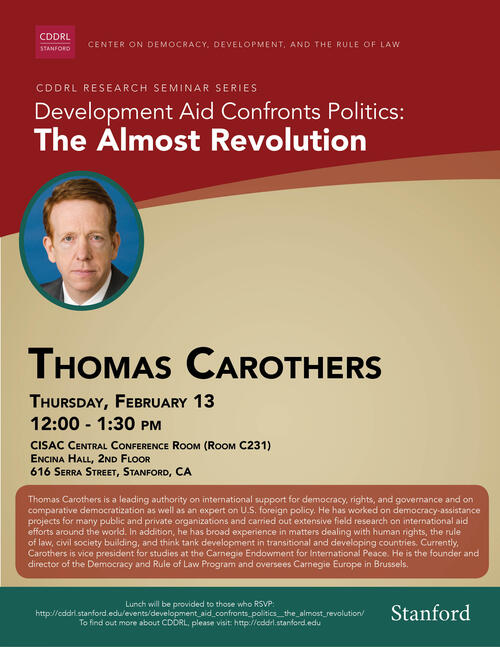
Thomas Carothers is vice president for studies at the Carnegie Endowment for International Peace. He is the founder and director of the Democracy and Rule of Law Program and oversees Carnegie Europe in Brussels.
Carothers is a leading authority on international support for democracy, rights, and governance and on comparative democratization as well as an expert on U.S. foreign policy. He has worked on democracy-assistance projects for many public and private organizations and carried out extensive field research on international aid efforts around the world. In addition, he has broad experience in matters dealing with human rights, the rule of law, civil society building, and think tank development in transitional and developing countries.
He is the author of six critically acclaimed books as well as many articles in prominent journals and newspapers. Carothers has also worked extensively with the Open Society Foundations (OSF), including currently as chair of the OSF Think Tank Fund and previously as chair of the OSF Global Advisory Board. He is an adjunct professor at the Central European University in Budapest and was previously a visiting faculty member at Nuffield College, Oxford University, and Johns Hopkins SAIS.
Prior to joining the Endowment, Carothers practiced international and financial law at Arnold & Porter and served as an attorney adviser in the Office of the Legal Adviser of the U.S. Department of State.
Carothers is the co-author (with Diane de Gramont) of Development Aid Confronts Politics: The Almost Revolution (Carnegie, 2013) and author of Confronting the Weakest Link: Aiding Political Parties in New Democracies (Carnegie, 2006); Promoting the Rule of Law Abroad: In Search of Knowledge (Carnegie, 2006); Uncharted Journey: Promoting Democracy in the Middle East, co-edited with Marina Ottaway (Carnegie, 2005); Critical Mission: Essays on Democracy Promotion (Carnegie, 2004); Funding Virtue: Civil Society Aid and Democracy Promotion, co-edited with Marina Ottaway (Carnegie, 2000); Aiding Democracy Abroad: The Learning Curve (Carnegie, 1999); and Assessing Democracy Assistance: The Case of Romania (Carnegie, 1996).
Image
CISAC Conference Room
Thomas Carothers
Vice President for Studies
Speaker
Carnegie Endownment for International Peace


 Shangri-La Dialogue