Paragraphs

The politics of economic crises bring distributive economic conflict to the fore of national political debates. How policy should be used to transfer resources between citizens becomes a central political question and the answers chosen often influence the trajectory of policy for a generation. This context provides an ideal setting for evaluating the importance of self-interest and other-regarding preferences in shaping public opinion about economic policy. This paper investigates whether self-centered inequity aversion along with self-interest influences individual tax policy opinions. We conduct original survey experiments in France and the United States and provide evidence that individuals care both about how policy alternatives affect their own interests and how they influence the welfare of others relative to themselves. Our estimates suggest that in France both disadvantageous inequality aversion---utility losses when others have better economic outcomes---and advantageous inequality aversion---utility losses when others have worse economic outcomes---are important determinants of tax policy preferences. In the United States, we find strong evidence of disadvantageous inequality aversion but not advantageous inequality aversion. The results for both countries suggest that self-interest and other-regarding preferences influence tax policy preferences and the findings in France are strongly consistent with self-centered inequity aversion.

All Publications button
1
Publication Type
Working Papers
Publication Date
Authors
Authors
News Type
News
Date
Paragraphs

To predict how agriculture will be affected by future climate change, scientists often rely on a single crop model – a computer simulation of how a specific crop’s yield responds to temperature changes. By combining 30 such models into a single study, and comparing each model against data from existing experimental wheat fields around the world, a team of researchers including Stanford professor David Lobell have developed a more powerful and accurate way to predict future wheat yields.

In a new analysis published in Nature Climate Change, the team’s results support previous work suggesting that wheat yields around the world are sensitive to rising temperatures. Using the new method of analysis, the team estimates an average six percent future yield loss for every one degree Celsius rise in global mean temperature.

“Combining 30 models gives us a much greater ability to predict future impacts and understand past impacts,” said Lobell. “This is a clear step forward.”

Lobell is professor of environmental earth system science in the School of Earth Science at Stanford and the deputy director of the Center on Food Security and the Environment. He is a senior fellow at the Stanford Woods Institute for the Environment and at the Freeman Spogli Institute for International Studies.

The estimated six percent yield loss for every degree increase is equivalent to about a quarter of the current volume of wheat traded globally in 2013. Yields at some sites, notably those in Mexico, Brazil, India and Sudan, show simulated wheat yield losses of more than 20 percent - in Sudan’s case, more than 50 percent - under a scenario in which global mean temperature rises by two degrees Celsius.

With higher temperatures also comes an increase in the variability of wheat yields, both by location and between years. More fluctuation in wheat yields could mean greater global price volatility for the staple crop.

Approximately 70 percent of the wheat produced today is grown either on irrigated plots or in rainy regions. The research team accounted for this factor by focusing its simulations on multiple regional-specific varieties of wheat that are commonly grown under these conditions.

The new paper includes several suggestions for avoiding some of the predicted yield losses. For example, some varieties of wheat are more heat tolerant than others, and farmers in the places hardest hit by rising temperatures could switch varieties to capitalize on this heat resistance. The effects of rising temperatures could also be managed, in part, by adjusting sowing and harvesting dates, or changing the way fertilizers are applied to crops.


Contact: David Lobell, dlobell@stanford.edu

Hero Image
wheat closeup
All News button
1
-

This event is open to Stanford undergraduate students only. 

The Center on Democracy, Development, and the Rule of Law (CDDRL) is currently accepting applications from eligible juniors due February 27, 2015 who are interested in writing their senior thesis on a subject touching upon democracy, economic development, and rule of law (DDRL) from any university department. CDDRL faculty and current honors students will be present to discuss the program and answer any questions.

For more information on the CDDRL Senior Honors Program, please click here.


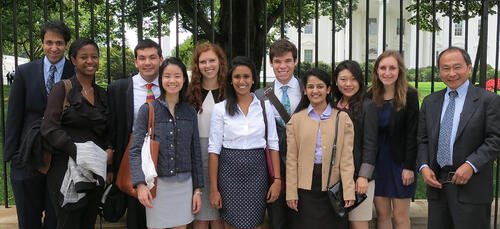
CDDRL Class of 2015 Class of 2015 in front of the White House with Francis Fukuyama.


[[{"fid":"217337","view_mode":"crop_870xauto","fields":{"format":"crop_870xauto","field_file_image_description[und][0][value]":"SHP15 Info Session Flyer","field_file_image_alt_text[und][0][value]":"","field_file_image_title_text[und][0][value]":"","field_credit[und][0][value]":"","field_caption[und][0][value]":"SHP15 Info Session Flyer","field_related_image_aspect[und][0][value]":"","thumbnails":"crop_870xauto","pp_lightbox":false,"pp_description":false},"type":"media","attributes":{"height":1056,"width":870,"class":"media-element file-crop-870xauto"}}]]

Encina Hall, C148
616 Jane Stanford Way
Stanford, CA 94305

0
Olivier Nomellini Senior Fellow at the Freeman Spogli Institute for International Studies
Director of the Ford Dorsey Master's in International Policy
Research Affiliate at The Europe Center
Professor by Courtesy, Department of Political Science
yff-2021-14290_6500x4500_square.jpg

Francis Fukuyama is the Olivier Nomellini Senior Fellow at Stanford University's Freeman Spogli Institute for International Studies (FSI), and a faculty member of FSI's Center on Democracy, Development and the Rule of Law (CDDRL). He is also Director of Stanford's Ford Dorsey Master's in International Policy, and a professor (by courtesy) of Political Science.

Dr. Fukuyama has written widely on issues in development and international politics. His 1992 book, The End of History and the Last Man, has appeared in over twenty foreign editions. His book In the Realm of the Last Man: A Memoir will be published in fall 2026.

Francis Fukuyama received his B.A. from Cornell University in classics, and his Ph.D. from Harvard in Political Science. He was a member of the Political Science Department of the RAND Corporation, and of the Policy Planning Staff of the US Department of State. From 1996-2000 he was Omer L. and Nancy Hirst Professor of Public Policy at the School of Public Policy at George Mason University, and from 2001-2010 he was Bernard L. Schwartz Professor of International Political Economy at the Paul H. Nitze School of Advanced International Studies, Johns Hopkins University. He served as a member of the President’s Council on Bioethics from 2001-2004. He is editor-in-chief of American Purpose, an online journal.

Dr. Fukuyama holds honorary doctorates from Connecticut College, Doane College, Doshisha University (Japan), Kansai University (Japan), Aarhus University (Denmark), the Pardee Rand Graduate School, and Adam Mickiewicz University (Poland). He is a non-resident fellow at the Carnegie Endowment for International Peace. He is a member of the Board of Trustees of the Rand Corporation, the Board of Trustees of Freedom House, and the Board of the Volcker Alliance. He is a fellow of the National Academy for Public Administration, a member of the American Political Science Association, and of the Council on Foreign Relations. He is married to Laura Holmgren and has three children.

(October 2025)

CV
Date Label
Honors Program Director

Encina Hall, C150
616 Jane Stanford Way
Stanford, CA 94305

0
Center Fellow, Freeman Spogli Institute for International Studies
didi_kuo_2023.jpg

Didi Kuo is a Center Fellow at the Freeman Spogli Institute for International Studies (FSI) at Stanford University. She is a scholar of comparative politics with a focus on democratization, corruption and clientelism, political parties and institutions, and political reform. She is the author of The Great Retreat: How Political Parties Should Behave and Why They Don’t (Oxford University Press) and Clientelism, Capitalism, and Democracy: the rise of programmatic politics in the United States and Britain (Cambridge University Press, 2018).

She has been at Stanford since 2013 as the manager of the Program on American Democracy in Comparative Perspective and is co-director of the Fisher Family Honors Program at CDDRL. She was an Eric and Wendy Schmidt Fellow at New America and is a non-resident fellow with the Carnegie Endowment for International Peace. She received a PhD in political science from Harvard University, an MSc in Economic and Social History from Oxford University, where she studied as a Marshall Scholar, and a BA from Emory University.

Date Label
Mentor
-

Professor Dincecco will present research which shows that the long-run consequences of historical warfare are different for Sub-Saharan Africa than for the rest of the Old World. Identifying the locations of over 1,750 conflicts in Africa, Asia, and Europe from 1400 to 1799, they find that historical warfare predicts greater state capacity today across the Old World, including in Sub-Saharan Africa. There is no significant correlation between historical warfare and current civil conflicts across the rest of the Old World. However, this correlation is strong and positive in Sub-Saharan Africa. Thus, while a history of conflict predicts higher per capita GDP for the rest of the Old World, this positive consequence is overturned for Sub-Saharan Africa.

This talk is part of the Comparative Politics Workshop in the Department of Political Science and is co-sponsored by The Europe Center.

Image
Mark Dincecco, assistant professor in the Department of Political Science and a faculty affiliate of the Program in International and Comparative Studies at the University of Michigan.

Mark Dincecco is an assistant professor in the Department of Political Science and a faculty affiliate of the Program in International and Comparative Studies. His research and teaching interests include political economy, economic and political history, comparative politics, and public finance. His book, Political Transformations and Public Finances: Europe, 1650-1913, was published by Cambridge University Press. His current research tests the long-run relationships between military conflicts, state formation and capacity, and economic and political development.

Graham Stuart Lounge
Encina Hall West, Room 400


Mark Dincecco Assistant professor of political science Speaker University of Michigan
Workshops
-

If we are to feed by 2050 a growing population that is increasingly adopting western style diets we will  have to intensify food production - producing more but on the same amount or less of land and with the same  amount or less of water. Moreover this has to be done in a sustainable manner, i.e. with much lower environmental impact and greater resilience. We can do this with ecological approaches, genetic approaches and socio-economic approaches. Each has its pros and cons.

Sir Gordon Conway is a Professor of International Development at Imperial College, London and Director of Agriculture for Impact, a grant funded by the Bill & Melinda Gates Foundation, which focuses on European support of agricultural development in Africa.

From 2005-2009 he was Chief Scientific Adviser to the Department for International Development. Previously he was President of The Rockefeller Foundation and Vice-Chancellor of the University of Sussex. 

He was educated at the Universities of Wales (Bangor), Cambridge, West Indies (Trinidad) and California (Davis).  His discipline is agricultural ecology.  In the early 1960's, working in Sabah, North Borneo, he became one of the pioneers of sustainable agriculture.

He was elected a Fellow of the Royal Society in 2004 and an Honorary Fellow of the Royal Academy of Engineering in 2007. He was made a Knight Commander of the Order of Saint Michael and Saint George in 2005.  He was recently President of the Royal Geographical Society.

He has authored The Doubly Green Revolution: Food for all in the 21st century (Penguin and University Press, Cornell) and co-authored Science and Innovation for Development (UK Collaborative on Development Sciences (UKCDS)).  His most recent book One Billion Hungry: Can we Feed the World? was published in October 2012. 

Can Sustainable Intensification Feed the World?
Download pdf

Oksenberg Conference Room
Encina Hall, 3rd floor
616 Serra St.
Stanford University
Stanford, CA 94305

Directions and parking information are available here

Professor Sir Gordon Conway Speaker

The Jerry Yang and Akiko Yamazaki
Environment and Energy Building
Stanford University
473 Via Ortega, Office 363
Stanford, CA 94305

(650) 723-5697 (650) 725-1992
0
Senior Fellow, Stanford Woods Institute and Freeman Spogli Institute for International Studies
William Wrigley Professor of Earth System Science
Senior Fellow and Founding Director, Center on Food Security and the Environment
Roz_low_res_9_11_cropped.jpg PhD

Rosamond Naylor is the William Wrigley Professor in Earth System Science, a Senior Fellow at Stanford Woods Institute and the Freeman Spogli Institute for International Studies, the founding Director at the Center on Food Security and the Environment, and Professor of Economics (by courtesy) at Stanford University. She received her B.A. in Economics and Environmental Studies from the University of Colorado, her M.Sc. in Economics from the London School of Economics, and her Ph.D. in applied economics from Stanford University. Her research focuses on policies and practices to improve global food security and protect the environment on land and at sea. She works with her students in many locations around the world. She has been involved in many field-level research projects around the world and has published widely on issues related to intensive crop production, aquaculture and livestock systems, biofuels, climate change, food price volatility, and food policy analysis. In addition to her many peer-reviewed papers, Naylor has published two books on her work: The Evolving Sphere of Food Security (Naylor, ed., 2014), and The Tropical Oil Crops Revolution: Food, Farmers, Fuels, and Forests (Byerlee, Falcon, and Naylor, 2017).

She is a Fellow of the Ecological Society of America, a Pew Marine Fellow, a Leopold Leadership Fellow, a Fellow of the Beijer Institute for Ecological Economics, a member of Sigma Xi, and the co-Chair of the Blue Food Assessment. Naylor serves as the President of the Board of Directors for Aspen Global Change Institute, is a member of the Scientific Advisory Committee for Oceana and is a member of the Forest Advisory Panel for Cargill. At Stanford, Naylor teaches courses on the World Food Economy, Human-Environment Interactions, and Food and Security. 

CV
Rosamond L. Naylor Chair

Energy and Environment Building
473 Via Ortega
Stanford CA 94305

(650) 721-6207
0
Professor, Earth System Science
Senior Fellow at the Freeman Spogli Institute for International Studies
Senior Fellow at the Stanford Woods Institute for the Environment
Senior Fellow at the Stanford Institute for Economic Policy Research (SIEPR)
Affiliate, Precourt Institute of Energy
shg_ff1a1284.jpg PhD

David Lobell is the Benjamin M. Page Professor at Stanford University in the Department of Earth System Science and the Gloria and Richard Kushel Director of the Center on Food Security and the Environment. He is also the William Wrigley Senior Fellow at the Stanford Woods Institute for the Environment, and a senior fellow at the Freeman Spogli Institute for International Studies (FSI) and the Stanford Institute for Economic Policy and Research (SIEPR).

Lobell's research focuses on agriculture and food security, specifically on generating and using unique datasets to study rural areas throughout the world. His early research focused on climate change risks and adaptations in cropping systems, and he served on the Intergovernmental Panel on Climate Change (IPCC) Fifth Assessment Report as lead author for the food chapter and core writing team member for the Summary for Policymakers. More recent work has developed new techniques to measure progress on sustainable development goals and study the impacts of climate-smart practices in agriculture. His work has been recognized with various awards, including the Macelwane Medal from the American Geophysical Union (2010), a Macarthur Fellowship (2013), the National Academy of Sciences Prize in Food and Agriculture Sciences (2022) and election to the National Academy of Sciences (2023).

Prior to his Stanford appointment, Lobell was a Lawrence Post-doctoral Fellow at Lawrence Livermore National Laboratory. He holds a PhD in Geological and Environmental Sciences from Stanford University and a Sc.B. in Applied Mathematics from Brown University.

CV
Date Label
David Lobell Moderator
Lectures
Authors
News Type
News
Date
Paragraphs


American deterrence, though traditionally centered on the nuclear triad, is becoming ever more integrated and dependent on other technologies in space and the cyber world, Admiral Cecil D. Haney, commander of the U.S. Strategic Command, told a Stanford audience.

Haney, appointed to lead USSTRATCOM by President Barack Obama last year, made a daylong visit to Stanford on Tuesday, holding seminars and private meetings with faculty, scholars and students at the Hoover Institution and the Center for International Security and Cooperation. His seminar at CISAC focused on strategic deterrence in the 21st century.

Admiral Haney has made it USSTRATCOM’s goal, in accordance with the Nuclear Nonproliferation Treaty (NPT) and the 2010 START Treaty, to reduce America’s nuclear weapons stockpile. But he sees a world where maintaining a deterrent is still necessary.

“As we work to continue our nation’s goal of reducing the role of our nation’s nuclear weapons, we find other nations not only modernizing their strategic capabilities but also promoting them,” he said. Russia, Iran, and China attracted particular concern. Haney declined to estimate how much the U.S. can reduce its stockpile without hurting its deterrent posture.

While the nuclear triad is still the foundation of American deterrence, space and cyberspace technology are now fully integrated with nuclear platforms, making cyber and space security indispensable.

“Deterrence is more than just the triad,” said Haney. “We are highly dependent on space capabilities, more so than ever before. Space is fully integrated in our joint military operations as well as in our commercial and civil infrastructure. But space today is contested, congested, and competitive.” 

Haney said there are more than 20,000 softball-sized objects orbiting Earth.


Image
dsc 9384


“Only about 1,000 of those objects are satellites, the rest is debris, increasing threats to our operational satellites as they travel at speeds exceeding 17,000 mph,” he said. The Joint Space Operation Center receives an average of 30 collision alerts per day.

Damage to some of our satellites could have devastating impacts on our economy, communications and infrastructure. Rival nations also pose space security challenges.

According to the U.S. government, China recently tested an anti-satellite missile. This follows a 2007 test when China successfully destroyed one of its satellites, and consequently created a cloud of debris that still poses a threat to international satellites.

“Keeping assured access to the space domain is a full-time job,” Haney said.

Likewise cybersecurity. America’s increasing reliance on cyberspace for both military and civilian purposes has created security vulnerabilities that can be exploited by both state and non-state actors. Haney cited the recent attacks on J.P. Morgan and Sony, Russia and China’s attacks on regional rivals, and non-state terror groups.

“We have benefited enormously from advanced computer capabilities, but it has opened up threat access to our critical infrastructure,“ Haney said. “As we confront terrorist groups we all know that they are not only using cyber for recruiting and messaging – but also to seek weapons of mass destruction.”

In a Q&A session after his talk during the CISAC seminar, a variety of concerns were raised about the USSTRACOM mission, including triad modernization, the ongoing personnel issues that have been in the news, and missile defense.

FSI Senior Fellow Scott Sagan asked about the recent spate of personnel problems at U.S. nuclear silos. Haney said a full review of personnel and procedures, ordered by Defense Secretary Chuck Hagel, was completed and changes have been enacted.

“We are trying to positively reinforce our workforce and I am getting a lot of positive feedback from operators,” Haney said. “We are having monthly conversations that include operational officers. When I visit sites I don’t just meet with commanders, I have meals with smaller groups of lower-ranking personnel.”

Haney previously served as commander of the Pacific Fleet. A graduate of the U.S. Naval Academy, he has personal experience with America’s nuclear deterrent as he served in submarines armed with nuclear ballistic missiles, which, in addition to land-based intercontinental ballistic missiles (ICBMs) and strategic bombers, make up part of the United States’ nuclear triad.

USSTRATCOM is one of nine unified commands that have control of forces from all four branches of the U.S. military. The command’s well-known responsibility is command and control of America’s nuclear arsenal, a role it inherited from the Cold War-era Strategic Air Command. Since its establishment in 1992, USSTRATCOM has been assigned additional responsibilities, most notably cyberspace and outer space.


You can listen to the audio of his presentation here.


Joshua Alvarez was a CISAC Honors Student during the 2011-2012 academic year.


Hero Image
dsc 9057 Rod Searcey
All News button
1
Authors
News Type
News
Date
Paragraphs

Appeared in Stanford Report, December 8, 2014.

German studies professor Adrian Daub examines the social mores of 19th-century Europe through a study of "four-handed monsters" - when the hands of two layers intermingled on the same piano.  It was a phenomenon that both fascinated and repelled.  

In 19th-century Europe – long before LPs, CDs or mp3s – there were only two ways to listen to, say, the latest Beethoven symphony: either you were lucky enough to hear it performed at the local concert hall, or you played it at home yourself.

Not with a full orchestra, of course, but in a piano transcription, an arrangement that compressed symphonic violins, oboes and tubas onto a single keyboard score. And, to really mimic the range of a whole orchestra, amateurs played "four-handed," with two pianists sitting side-by-side.

These close-contact duets took off among the nascent middle class. Historian Edward Cone dubbed the players "four-handed monsters," both for the style's raging popularity and for its scandalous stigma.

"Piano four hands represented a safe space in which touching and nearness were permitted or even desired – something that was unusual at the time," said Adrian Daub, associate professor of German studies and affiliated faculty of The Europe Center at Stanford

Daub takes Cone's descriptor as the title of his new book exploring this largely forgotten phenomenon, Four-Handed Monsters: Four-Hand Piano Playing and Nineteenth-Century Culture.

Four-hand playing "bridged the divide between serious musicians and total amateurs," Daub said.

"This was a welcome vehicle for the greatest composers of the 19th century and at the same time it was the much-maligned party game – the equivalent of Twister – for the 'philistine' bourgeois."

Using a range of musical and literary sources, Daub's study is the first to examine the cultural valences of this strikingly intimate tradition.

Drawing from novels, memoirs and letters, Daub's survey reveals, for instance, how 19th-century anxieties surrounding creativity, industrialization, sex, virtue and politics were exercised through the act of four-hand piano playing.

Daub's previous research projects, one on Richard Wagner and sexuality, and another on the metaphysics of marriage in the 19th century, put him in a unique position to examine the phenomenon of four-hand playing and how "the dangers and the utopian promises it seemed to make … tell us much about the 19th century."

As Daub put it, "it's almost incredible how much people were able to read into what to modern eyes seems a pretty harmless pursuit." Whether this was a fear of moral dissoluteness or a "promise of a better way of engaging with the other sex or other people more generally," four-hand playing "was asked to do a lot, far more than comparable modes of performance."

Heather Hadlock, associate professor of music at Stanford, sees Daub's study as an important contribution to music scholarship. "Until recently, transcriptions and arrangements were dismissed as having little artistic value or historical significance," Hadlock said.

Daub's study, however, is the first step toward rectifying this oversight, revealing how four-hand piano duets in the 19th century resounded far beyond the parlor.

Romantic undertones

As pianos became increasingly affordable over the course of the century, more and more middle-class families made the instrument a centerpiece of domestic life. While solo piano playing never went out of style, the increased musical range and social interaction offered by four-hand playing caught on.

"Four-hand arrangements became the standard vehicle for the private, or semi-private, consumption of music of all kinds," said Daub. "Symphonies, operas, chamber music, dance music and so on, from trivial waltzes to apocalyptic Mahler symphonies."

"The collaboration of four hands across the whole range of the modern piano allowed two players to reproduce virtually any repertoire within the privacy of the home," said Stanford music Professor Thomas Grey.

Well-versed in both music and literature, Daub amassed a staggering number of allusions to four-hand playing from 19th-century sources. He also collected references from four-hand practitioners and mined digital databases.

From William Thackeray to Charles Dickens to Thomas Mann, four-hand playing makes appearances in famous novels of the period.

Even the philosopher Friedrich Nietzsche wrote on – and composed – four-hand pieces, saying that they "may be taken as a divining rod for a good marriage."

Cumulatively, Daub said, these "short, often banal episodes are transformed into fleeting glimpses of a larger phenomenon, which in itself was too quotidian and ubiquitous to merit discussion in its own day."

In large part, Daub said, the popularity of the activity was driven by the romantic undertones of four-hand playing.

Daub quotes the composer Robert Schumann, for instance, who reported, "a four-hand piece allows us reveries together with our beloved, provided she plays the piano."

"Togetherness on the keyboard was to become a symbol for togetherness in marriage," Daub said.

Forced intimacy

Four-hand playing, though, also had a dark side: the erotic possibilities created when fingers touched, bodies sidled and harmony was made.

Composers, well aware of the situation, took advantage of the forced intimacy by crafting pieces that caused the hands to overlap and interlock, generating as much contact as possible.

Daub quotes novelist William Thackeray, who wrote of a "pretty little duet à quatre mains, where the hands cross over, and hop up and down the keys, and the heads get so close, so close. Oh, duets. Oh, regrets."

At the same time, literary treatments of four-hand playing projected notions of propriety and virtue. Daub cites a telling passage in Dickens's David Copperfield to comment on how four-hand piano playing reflected such social mores.

The novel's eponymous narrator, watching a recital by two young women, begins to rethink his opinion of one's moral standing:

"The innocent beauty of her face was not as innocent to me as it had been; I mistrusted the natural grace and charm of her manner; and when I looked at Agnes by her side, and thought how good and true Agnes was, suspicions arose within me that it was an ill-assorted friendship."

In Daub's reading, the narrator's shifting perceptions of his beloved is mediated by watching her play four-hand piano, the music laying bare her "true" character.

Four-hand playing also emerged as a potent political symbol because of the collaboration and unity inherent in the practice.

Music scholar Hans Moldenhauer, writing in 1950 after having been exiled from Nazi Germany, looked back at four-hand playing wistfully: "Dictatorial practices have no place in [four-hand] pianism."

Daub comments on the writer's "clear sense that four-hand piano playing doesn't allow for a Führer principle." For Moldenhauer, there was something beautifully communal about the four-hand "republic."

But by the time Moldenhauer extolled its virtues, the practice was quickly losing popularity. The practice continues today (all of the Stanford scholars quoted in this article are four-hand players), but people no longer attach as much interest to it.

Still, Daub, who has attended a number of four-hand concerts, says that seeing two people at one keyboard "instills a surprising sense of intimacy."

"What other mode of performance has the onlooker asking themselves: 'Should I be watching this?'"

Nate Sloan is a doctoral candidate in musicology and writes about the humanities at Stanford.

Media Contact

Corrie Goldman, director of humanities communication: (650) 724-8156, corrieg@stanford.edu

Dan Stober, Stanford News Service: (650) 721-6965, dstober@stanford.edu

Hero Image
14625 monsters banner
All News button
1
News Type
News
Date
Paragraphs

Gerhard Casper, president emeritus of Stanford and a senior fellow at the Freeman Spogli Institute for International Studies and the Stanford Institute for Economic Policy Research, has been appointed president of the American Academy in Berlin.

Casper's appointment was announced Wednesday by the academy board of trustees. He will assume his duties in Berlin in July 2015. He will be the first president-in-residence in the academy's history. In an email to Stanford friends and colleagues, Casper said his appointment "will be limited in time."

Among those making the announcement was former U.S. Secretary of State Henry Kissinger, a founding chairman of the American Academy, who said, "Gerhard Casper, whose leadership at Stanford University I greatly admired, is an inspired choice."

The academy was founded under the leadership of Kissinger; the late Richard Holbrooke, former U.S. ambassador to the United Nations and to Germany; and Richard von Weizsäcker, former president of the Federal Republic of Germany. Casper served on the academy board from 2000 to 2009.

The American Academy in Berlin, established in 1994, is a center for advanced study and, according to Casper, "has become a significant contributor to intellectual exchange between the United States and Germany."

Casper said, "The institution makes it possible for American scholars from various disciplines and for artists to spend time in Berlin to pursue their work. At the same time, the Academy has come to play a noticeable role in public life, especially as concerns U.S.-German relations."

Casper served as Stanford's ninth president from 1992 to 2000. He joined Stanford after having served as provost and dean of the Law School at the University of Chicago.

Casper grew up in Hamburg, Germany, and studied law at the
 universities of Freiburg and Hamburg. He attended Yale Law School, where he obtained his Master of Laws degree in 1962. He returned to Freiburg, where he earned his doctorate in 1964. In the fall of 1964, he immigrated to the United States, and spent two years as an assistant professor of political science at the University of California, Berkeley, before joining the Chicago faculty.

Hero Image
14609 casper news
Stanford President Emeritus Gerhard Casper will assume his duties as president-in-residence at the American Academy in Berlin in July 2015.
L.A. Cicero
All News button
1
Subscribe to Europe