Please join us for a workshop discussion of Dr. Minayo Nasiali's draft book chapter, "A Working Alias: African Sailors and Fungible Identities across France and Great Britain’s Maritime Empires (1920-1939).


The French Culture Workshop is co-sponsored by the Stanford Humanities Center, the DLCL Research Unit, the France-Stanford Center, and the Europe Center at the Freeman Spogli Institute.

Lectures
-

RSVP for this event

The annual Eurovision Song Contest is one of the world’s longest-running and most popular television shows, having been first staged in 1956. The European Broadcasting Union, the Eurovision Song Contest’s organiser, has always maintained that the contest is a non-political event that promotes cooperation among the European Broadcasting Union’s members, national public service broadcasting organisations from Europe and the Mediterranean rim. Yet, as entries in it represent states, the Eurovision Song Contest has always reflected political relations in Europe and has been appropriated by governments in their cultural diplomacy. For example, as a Western European event during the Cold War, the Eurovision Song Contest inspired the formation of and was challenged by an Eastern European equivalent, the Intervision Song Contest. In his talk, Dr. Dean Vuletic, the world’s leading academic expert on the history of the Eurovision and Intervision song contests, will address why these two song contests have been so politically significant for Europe. He will also discuss how this year’s Eurovision Song Contest reflects contemporary politics in Europe, especially with regards to East Europe.

Dean Vuletic is a historian of contemporary Europe based in the Research Center for the History of Transformations at the University of Vienna. After receiving his doctoral degree in history from Columbia University, he designed the world’s first-ever university course on the Eurovision Song Contest, which he began teaching at New York University. He is the author of Postwar Europe and the Eurovision Song Contest (London: Bloomsbury, 2018), the only scholarly monograph on the history of the contest, which he produced under a Marie Skłodowska-Curie Intra-European Fellowship. As a Lise Meitner Fellow, he has also led a research project on the history of the Intervision Song Contest. Dean is a leading media commentator and public speaker on the Eurovision Song Contest, and more information about his work can be found on his website www.deanvuletic.com.

 
News Type
News
Date
Paragraphs

Laitin has made “culture,” often the junk drawer of political science studies, studiable and concrete by identifying various cultural components of a nation’s inner life; language is one aspect of culture, religion another, art and literature a third, how private family life is organized a fourth. Central to his thinking is that these cultural components do not have to easily reinforce each other or pull in the same direction. These “spheres” can co-exist without coinciding.

Hero Image
David D. Laitin
All News button
1
Subtitle

The Johan Skytte Prize in Political Science, known by many as the “Nobel Prize in Political Science,” is being awarded for the 27th consecutive year. This year’s recipient is David D. Laitin, for his “original and objective explanation of how politics shapes cultural strategies in heterogeneous societies.”

Authors
News Type
Commentary
Date
Paragraphs

President Volodymyr Zelensky reportedly will soon travel to Paris to meet with French President Emmanuel Macron. That is a trip very much worth making. After German Chancellor Angela Merkel steps down this fall, Zelensky may find himself more dependent on Macron, both in the Normandy format and for leadership in the European Union regarding the conflict that Russia has inflicted on his country.

The sooner Zelensky gets to Paris, the better.

First, he could ask Macron to call explicitly on Vladimir Putin to deescalate the tensions Russia has caused by its large and continuing build-up of military forces near Ukraine.

On April 3, the German and French foreign ministries issued a statement calling for restraint on “all sides”—a wrongly balanced appeal given that Russian actions provoked the crisis.  Merkel corrected this on April 8, when she spoke with Putin and “demanded that this [Russian] build-up be unwound in order to de-escalate the situation.” Macron has yet to speak in such clear terms.

Second, Zelensky should strengthen Macron’s understanding of the conflict and Ukraine’s position.  The Germans and French have for six years sought to broker a settlement between the Ukrainians and Russians in the Normandy format, with Merkel playing the lead role.  Later this year, when she steps down, the leadership of that process may well pass from Berlin to Paris.

Ukrainians often express frustration with the Normandy format and the Minsk II agreement that it produced in February 2015.  The terms of the agreement were never fully implemented, and thousands of Ukrainians have since died.  Berlin and Paris have not found the key to getting Russian and Russian proxy forces to leave Donbas, to say nothing of occupied Crimea.  (In fairness, it is not clear that anyone could have.)

However, the Normandy process has kept the two large continental European powers engaged in trying to resolve the conflict. That is to Kyiv’s advantage. The Minsk II agreement has provided the basis for sustaining European Union sanctions on Russia, sanctions that have proven far more resilient than many would have predicted when EU member states first approved them in 2014.

Merkel and German diplomats deserve credit for maintaining EU unity on sanctions, despite calls from some member states to move back toward business as usual with Moscow.  She has taken a greater interest in the Russia-Ukraine conflict than Macron or his predecessor.  That reflects in part her background, having been raised in the German Democratic Republic, her understanding of Russia, and her command of Russian.

But Merkel steps down this fall after 16 years as chancellor. While the German election is still more than five months off, most predictions suggest one of two coalitions will result: a combination of the Christian Democratic Union/Christian Socialist Union and Greens Party, or a grouping of the Greens, the Social Democratic Party, and Free Democratic Party.

In the first combination, the likely candidates for chancellor are Armin Laschet and Markus Soeder.  Both come from what was West Germany.  Neither has real experience with or appears to have shown particular interest in the Russia-Ukraine conflict.  Either might question the investment that Merkel put into the Normandy discussions, given that they have not succeeded and offer little pay-off in terms of German domestic politics.

In the second combination, the chancellor likely would come from the Greens.  That could bode well for Kyiv, as the Greens are skeptical about Russia, criticize Moscow’s human rights record, and oppose the Nord Stream 2 gas pipeline.  However, the Greens have been out of government since 2005, and they might need time to get up to speed.

If the new German chancellor is uninterested in or needs time to engage in a meaningful manner, leadership within the Normandy format will move to Paris, something the Kremlin likely would welcome.  Macron has taken a less harsh tone on Russian misbehavior.  He has sought to regenerate links with Moscow.  For example, before the 2019 G7 summit in France, he hosted Putin for a bilateral meeting, seemingly seeking to make Paris a bridge between Moscow and the rest of the G7.

A pro-Russian tilt, even a small one, in the duo heading up the Normandy format process is hardly in Kyiv’s interest.  Zelensky needs to make his strongest possible case to Macron as regards the realities of the Russia-Ukraine conflict, for continuing to steward the Normandy format with Merkel’s steadiness, and for not succumbing to Putin’s blandishments, which would come at Ukraine’s expense.


Originally for Kyiv Post

Hero Image
Ukraine's President Volodymyr Zelenskiy (L) and French President Emmanuel Macron
Ukraine's President Volodymyr Zelenskiy (L) and French President Emmanuel Macron | AFP
All News button
1
Subtitle

President Volodymyr Zelensky reportedly will soon travel to Paris to meet with French President Emmanuel Macron. That is a trip very much worth making.

Authors
News Type
Commentary
Date
Paragraphs

Nord Stream 2 is an almost-finished natural gas pipeline from Russia to Germany. The Biden administration opposes it and has come under congressional pressure to invoke sanctions to prevent its completion, in large part because the pipeline seems a geopolitical project targeted at Ukraine. The German government, however, regards the pipeline as a “commercial project” and appears committed to its completion, perhaps in the next few months. U.S. sanctions applied on Russian entities to date have failed to stop Nord Stream 2, raising the question of whether the U.S. government would sanction German and other European companies for servicing or certifying the pipeline. Such sanctions would provoke controversy with Germany at a time when both Berlin and the Biden administration seek to rebuild good relations. The two sides have work to do if they wish to avoid Nord Stream 2 becoming a major point of U.S.-German contention.

Read the rest at Brookings

Hero Image
Banner of Nord Stream
Getty Images
All News button
1
Subtitle

Nord Stream 2 is an almost-finished natural gas pipeline from Russia to Germany. The Biden administration opposes it and has come under congressional pressure to invoke sanctions to prevent its completion, in large part because the pipeline seems a geopolitical project targeted at Ukraine.

Authors
News Type
News
Date
Paragraphs
Hero Image
Jonathan Rodden
All News button
1
Authors
News Type
News
Date
Paragraphs
Hero Image
Vincent Barletta
All News button
1
-

Based on past and current ethnographic research in the Parisian metropolitan region, I discuss how racial and ethnic minorities understand and respond to their racialization in a context in which race and ethnicity are not legitimate or acknowledged, and how a suspect citizenship is created. I will discuss how racial and ethnic minorities are “citizen outsiders” as evident of France’s “racial project” (Omi and Winant 1994), which marks distinctions outside of explicit categorization. I explore not only how race marks individuals outside of formal categories, but also how people respond to these distinctions in terms of a racism-related issue, here, police violence and brutality against racial and ethnic minorities. I will also discuss how activists frame their growing social problem given the constraints of French Republican ideology.

Jean Beaman
Jean Beaman is Associate Professor of Sociology, with affiliations with Political Science, Feminist Studies, Global Studies, and the Center for Black Studies Research, at the University of California, Santa Barbara. Previously, she was faculty at Purdue University and held visiting fellowships at Duke University and the European University Institute (Florence, Italy). Her research is ethnographic in nature and focuses on race/ethnicity, racism, international migration, and state-sponsored violence in both France and the United States. She is author of Citizen Outsider: Children of North African Immigrants in France (University of California Press, 2017), as well as numerous articles and book chapters. Her current book project is on suspect citizenship and belonging, anti-racist mobilization, and activism against police violence in France. She received her Ph.D. in Sociology from Northwestern University. She is also an Editor of H-Net Black Europe, an Associate Editor of the journal, Identities: Global Studies in Culture and Power, and Corresponding Editor for the journal Metropolitics/Metropolitiques.

Online via Zoom

Jean Beaman speaker University of California, Santa Barbara
Seminars
Authors
News Type
Commentary
Date
Paragraphs

BERLIN — Over the past week, Russia has reinforced its military presence on the Crimean peninsula, moved military units close to the Russia-Ukraine border and announced military “readiness checks.” Most likely, this is just a ploy to unnerve the government in Kyiv and test the West’s reaction. 

But it could be something worse. If the Kremlin is weighing the costs and benefits of a military assault on Ukraine, Europe and the United States should ensure that Moscow does not miscalculate because it underestimates the costs. 

Read the rest at Politico

Hero Image
Destroyed tank
Getty Images
All News button
1
Subtitle

Europe and the United States must ensure that Moscow does not underestimate the costs of a military assault.

-

Image
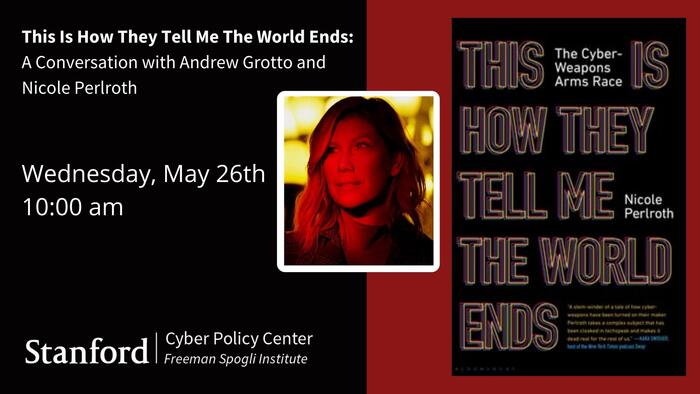
this is how they tell me the world ends event at cyber policy center

On Wednesday, May 26 at 10 am pacific time, please join Andrew Grotto, Director of Stanford’s Program on Geopolitics, Technology and Governance, for a conversation with Nicole Perlroth, New York Times Cybersecurity Reporter, about the underground market for cyber-attack capabilities.

In her book This Is How They Tell Me the World Ends: The Cyberweapons Arms Race,” Perlroth argues that the United States government became the world's dominant hoarder of one of the most coveted tools in a spy's arsenal, the zero-day vulnerability. After briefly cornering the market, in her account, the United States then lost control of its hoard and the market.

Perlroth and Grotto, a former Senior Director for Cybersecurity Policy at the White House in both the Obama and Trump Administrations, will talk about the development and evolution of this market, and what it portends about the future of conflict in cyberspace and beyond.

This event is co-sponsored by the Freeman Spogli Institute for International Studies and the Cyber Policy Center.

Praise for “This Is How They Tell Me the World Ends”: “Perlroth's terrifying revelation of how vulnerable American institutions and individuals are to clandestine cyberattacks by malicious hackers is possibly the most important book of the year . . . Perlroth's precise, lucid, and compelling presentation of mind-blowing disclosures about the underground arms race a must-read exposé.” —Booklist, starred review

CISAC
Stanford University
Encina Hall, C428

Stanford, CA 94305-6165

(650) 723-9866
0
Andrew Grotto

Andrew J. Grotto is a research scholar at the Center for International Security and Cooperation at Stanford University.

Grotto’s research interests center on the national security and international economic dimensions of America’s global leadership in information technology innovation, and its growing reliance on this innovation for its economic and social life. He is particularly interested in the allocation of responsibility between the government and the private sector for defending against cyber threats, especially as it pertains to critical infrastructure; cyber-enabled information operations as both a threat to, and a tool of statecraft for, liberal democracies; opportunities and constraints facing offensive cyber operations as a tool of statecraft, especially those relating to norms of sovereignty in a digitally connected world; and governance of global trade in information technologies.

Before coming to Stanford, Grotto was the Senior Director for Cybersecurity Policy at the White House in both the Obama and Trump Administrations. His portfolio spanned a range of cyber policy issues, including defense of the financial services, energy, communications, transportation, health care, electoral infrastructure, and other vital critical infrastructure sectors; cybersecurity risk management policies for federal networks; consumer cybersecurity; and cyber incident response policy and incident management. He also coordinated development and execution of technology policy topics with a nexus to cyber policy, such as encryption, surveillance, privacy, and the national security dimensions of artificial intelligence and machine learning. 

At the White House, he played a key role in shaping President Obama’s Cybersecurity National Action Plan and driving its implementation. He was also the principal architect of President Trump’s cybersecurity executive order, “Strengthening the Cybersecurity of Federal Networks and Critical Infrastructure.”

Grotto joined the White House after serving as Senior Advisor for Technology Policy to Commerce Secretary Penny Pritzker, advising Pritzker on all aspects of technology policy, including Internet of Things, net neutrality, privacy, national security reviews of foreign investment in the U.S. technology sector, and international developments affecting the competitiveness of the U.S. technology sector.

Grotto worked on Capitol Hill prior to the Executive Branch, as a member of the professional staff of the Senate Select Committee on Intelligence. He served as then-Chairman Dianne Feinstein’s lead staff overseeing cyber-related activities of the intelligence community and all aspects of NSA’s mission. He led the negotiation and drafting of the information sharing title of the Cybersecurity Act of 2012, which later served as the foundation for the Cybersecurity Information Sharing Act that President Obama signed in 2015. He also served as committee designee first for Senator Sheldon Whitehouse and later for Senator Kent Conrad, advising the senators on oversight of the intelligence community, including of covert action programs, and was a contributing author of the “Committee Study of the Central Intelligence Agency’s Detention and Interrogation Program.”

Before his time on Capitol Hill, Grotto was a Senior National Security Analyst at the Center for American Progress, where his research and writing focused on U.S. policy towards nuclear weapons - how to prevent their spread, and their role in U.S. national security strategy.

Grotto received his JD from the University of California at Berkeley, his MPA from Harvard University, and his BA from the University of Kentucky.

Research Scholar, Center for International Security and Cooperation
Director, Program on Geopolitics, Technology, and Governance
Date Label
Nicole Perlroth
Subscribe to Europe