-

Image
jacob ward photo with the loop book cover next to him on a blue background

Join us on Tuesday, April 19 from 12 PM - 1 PM PT for a book talk on “The Loop: How Technology is Creating a World without Choices and How to Fight Back” featuring Jacob Ward from NBC News, in conversation with Nate Persily of the Cyber Policy Center.  This weekly seminar series is jointly organized by the Cyber Policy Center’s Program on Democracy and the Internet and the Hewlett Foundation’s Cyber Initiative.

In The Loop: How Technology is Creating a World without Choices and How to Fight Back, Jake argues that AI is about to do to our ability to make decisions for ourselves what Google maps did to our ability to navigate. Drawing on interviews with over 100 scientists and 10-years of front-line reporting from the cutting edge of behavior-shaping technology, Jake’s book is a warning about our growing reliance on AI, and an encouragement to protect the best parts of being human.

Jacob Ward is a correspondent for NBC News, reporting for the TODAY show, Nightly News, MSNBC, and NBC News Now on the unanticipated consequences of science and technology in our lives. From 2018 to 2019, Jacob was a fellow at Stanford University’s Center for Advanced Study in the Behavioral Sciences, along with its partner the Berggruen Institute, which gave him space and companionship on the Stanford campus to write The Loop, his book about the effects of artificial intelligence on human decision making, with Hachette Book Group. Between 2016 and 2020, Jacob hosted a landmark four-hour television series on the science and implications of bias. Prior to that, he was a television correspondent for Al Jazeera, covering science and technology in the US and around the world. He was also editor-in-chief of Popular Science, the world’s largest science and technology publication.

Nathaniel Persily is the James B. McClatchy Professor of Law at Stanford Law School, with appointments in the departments of Political Science, Communication, and FSI.  Prior to joining Stanford, Professor Persily taught at Columbia and the University of Pennsylvania Law School, and as a visiting professor at Harvard, NYU, Princeton, the University of Amsterdam, and the University of Melbourne. Professor Persily’s scholarship and legal practice focus on American election law or what is sometimes called the “law of democracy,” which addresses issues such as voting rights, political parties, campaign finance, redistricting, and election administration. He has served as a special master or court-appointed expert to craft congressional or legislative districting plans for Georgia, Maryland, Connecticut, New York, North Carolina, and Pennsylvania.  He also served as the Senior Research Director for the Presidential Commission on Election Administration. His current work, for which he has been honored as a Guggenheim Fellow, Andrew Carnegie Fellow, and a Fellow at the Center for Advanced Study in the Behavioral Sciences, examines the impact of changing technology on political communication, campaigns, and election administration.  He is codirector of the Stanford Cyber Policy Center, Stanford Program on Democracy and the Internet, and the Stanford-MIT Healthy Elections Project, which supported local election officials in taking the necessary steps during the COVID-19 pandemic to provide safe voting options for the 2020 election. He is also a member of the American Academy of Arts and Sciences, and a commissioner on the Kofi Annan Commission on Elections and Democracy in the Digital Age.

Nathaniel Persily
Jacob Ward
Seminars

This is event is Stanford-only; please use your Stanford email to register.

The rise of right-wing populism has emerged as one of the most significant threats to democracy and liberal values worldwide. While populism is increasingly viewed as a global phenomenon, it takes on many forms and has different causes and consequences in diverse contexts. This presentation addresses the potential of populist civilizationalism to transform political cleavage structures in the Baltic states, notably by downplaying and transcending deeply entrenched post-Soviet political cleavages (geopolitical, mnemopolitical and ethnic ones). Construing ‘self’ and ‘other’ in civilizational, as opposed to narrowly national or ethnic terms, expands the notion of ‘self’ to include various internal others, notably Russian-speaking minorities, and shifts the focus from historical grievances, the Russian threat and the demographic legacies of Soviet occupation to alleged current threats to the European civilization, such as immigration, Islam, and global liberalism.

This transformation of cleavages entails a significant shift in the position assigned to the European Union: instead of being seen as the guarantor of the (post-Soviet) national ‘self,’ the EU is construed as a liberal globalist threat to the civilizational ‘self’. These claims are supported with examples of rhetoric used by the Conservative People’s Party of Estonia (EKRE). This analysis leads to the conclusion that, paradoxically, the rise of right-wing populism has rendered Estonian politics more global and less post-Soviet.

Image
Piret Ehin

Piret Ehin is Professor of Comparative Politics and Deputy Head for Research at the Johan Skytte Institute of Political Studies, University of Tartu. Her main research interests include democracy, elections and voting behavior, legitimacy and political support, as well as European integration and Europeanization. Her work has appeared in the European Journal of Political Research, Journal of Common Market Studies, Cooperation and Conflict, Politics, Journal of Elections, Public Opinion and Parties, and the Journal of Baltic Studies. Prof Ehin has been awarded the 2022 Short-Term Research Fellowship at Stanford University for Estonian Scholars, hosted by Stanford University Libraries’ Baltic Studies Program and co-hosted by the Europe Center/Stanford Global Studies.

*If you need any disability-related accommodation, please contact: Shannon Johnson (sj1874@stanford.edu) by May 19, 2022.

Co-sponsored by  

Image
Stanford Libraries logo

This event is part of Global Conversations, a new series of talks, lectures, and seminars focusing on the benefits and fragility of freedom. The series is co-sponsored by Stanford Libraries and Vabamu.

Image
CREEES logo


Piret Ehin, University of Tartu in Estonia Professor of Comparative Politics speaker University of Tartu in Estonia
Workshops
-

LECTURE RECORDING

Bechtel Conference Center
Encina Hall
616 Jane Stanford Way
Stanford, CA 94305

Congressman Ted Lieu
Seminars

The rise of far-right populism in European Union (EU) member states such as Poland and Hungary has posed challenges to democracy and the rule of law few had anticipated as recently as a decade ago. European Commission action to counter rule of law violations has been weak. This panel will discuss the recent democratic backsliding in Poland and Hungary and the EU's (lack of) response to it. Particular attention will be paid to the April 3 Hungarian elections and the impact of the war in Ukraine.

Panel

Image
Anna Grzymala-Busse
Anna Grzymala-Busse is a professor in the Department of Political Science, the Michelle and Kevin Douglas Professor of International Studies, senior fellow at the Freeman Spogli Institute for International Studies and the director of The Europe Center. Her research interests include political parties, state development and transformation, informal political institutions, religion and politics, and post-communist politics. Anna's most recent book project, "Nations Under God," examines why some churches have been able to wield enormous policy influence. Others have failed to do so, even in very religious countries. Where religious and national identities have historically fused, churches gained great moral authority, and subsequently covert and direct access to state institutions. It was this institutional access, rather than either partisan coalitions or electoral mobilization, that allowed some churches to become so powerful.

Image
R. Daniel Kelemen
R. Daniel Kelemen is Professor of Political Science and Law, and Chair of the Department of Political Science at Rutgers University. An internationally renowned expert on European Union politics and law, he is author or editor of six books including Eurolegalism: The Transformation of Law and Regulation in the European Union (Harvard University Press), which won the Best Book Award from the European Union Studies Association, and author of over one hundred articles and book chapters. Kelemen is a member of the Council on Foreign Relations, and he is a frequent commentator on EU affairs in US and international media. Prior to Rutgers, Kelemen was Fellow in Politics, Lincoln College, University of Oxford. He has been a Member of the Institute for Advanced Study at Princeton, visiting fellow in the Program in Law and Public Affairs (LAPA) at Princeton University, and a Fulbright Fellow at the Centre for European Policy Studies in Brussels.

Image
Kim Lane Scheppele
Kim Lane Scheppele is the Laurance S. Rockefeller Professor of Sociology and International Affairs at Princeton University. Scheppele's work focuses on the intersection of constitutional and international law, particularly in constitutional systems under stress. After 1989, Scheppele studied the emergence of constitutional law in Hungary and Russia, living in both places for extended periods. After 9/11, she researched the effects of the international "war on terror" on constitutional protections around the world. Since 2010, she has been documenting the rise of autocratic legalism first in Hungary and then in Poland within the European Union, as well as its spread around the world. Her many publications in law reviews, in social science journals and in many languages cover these topics and others. She is a commentator in the popular press, discussing comparative constitutional law, the state of Europe, the rule of law and the rise of populism.

Moderator

Image
Christophe Crombez
Christophe Crombez is Interim Director and Senior Research Scholar at The Europe Center at the Freeman Spogli Institute for International Studies. He is also Professor of Political Economy at the Faculty of Economics and Business at KU Leuven in Belgium. He specializes in European Union (EU) politics and business-government relations in Europe.

Christophe Crombez

Encina Hall
616 Jane Stanford Way
Stanford, CA  94305


(650) 723-4270
0
Senior Fellow at the Freeman Spogli Institute for International Studies
Michelle and Kevin Douglas Professor of International Studies
Professor of Political Science
Senior Fellow, Hoover Institution
anna_gb_4_2022.jpg

Anna Grzymała-Busse is a professor in the Department of Political Science, the Michelle and Kevin Douglas Professor of International Studies, senior fellow at the Freeman Spogli Institute for International Studies and the director of The Europe Center. Her research interests include political parties, state development and transformation, informal political institutions, religion and politics, and post-communist politics.

In her first book, Redeeming the Communist Past, she examined the paradox of the communist successor parties in East Central Europe: incompetent as authoritarian rulers of the communist party-state, several then succeeded as democratic competitors after the collapse of these communist regimes in 1989.

Rebuilding Leviathan, her second book project, investigated the role of political parties and party competition in the reconstruction of the post-communist state. Unless checked by a robust competition, democratic governing parties simultaneously rebuilt the state and ensured their own survival by building in enormous discretion into new state institutions.

Anna's third book, Nations Under God, examines why some churches have been able to wield enormous policy influence. Others have failed to do so, even in very religious countries. Where religious and national identities have historically fused, churches gained great moral authority, and subsequently covert and direct access to state institutions. It was this institutional access, rather than either partisan coalitions or electoral mobilization, that allowed some churches to become so powerful.

Anna's most recent book, Sacred Foundations: The Religious and Medieval Roots of the European State argues that the medieval church was a fundamental force in European state formation.

Other areas of interest include informal institutions, the impact of European Union membership on politics in newer member countries, and the role of temporality and causal mechanisms in social science explanations.

Director of The Europe Center
spealer
R. Daniel Kelemen spealer Rutgers University
Kim L. Scheppele Princeton University
Seminars
-

Tuesday, April 19

11:30-12:30    Introductions and Lunch

12:30-1:10      Matthias Meyer: Politics and Narration: The Entertaining Side of the Coin. On Intrigues

1:15-1:55        Sara Lehner: Catastrophes in the “Buch von Akkon”

2:00-2:40        Beatrice von Lüpke: The Apocryphal Adam and Eve-Tradition

2:40-3:10        Break

3:10-3:50        Lauren Urbont: Translation of Bodies in Ashkenaz

3:55-4:35        Lane Baker: Chronicling Romani Immigrants in the Holy Roman Empire, 1400–1450

5:00-6:20        Fiona Griffiths & Kathryn Starkey: Medieval Germany (900-1220): Cities and Urban Life


Wednesday, April 20

9:00-9:40        Christina Lutter: Two Sides of the Same Coin: Spiritual and Material Dimensions of Urban Community Building in Medieval Central Europe

9:45-10:25      Herbert Krammer: Sustaining Networks: Multiplex Interrelations of Urban and Spiritual Communities in Late Medieval Towns (c. 14/15)

10:30-11:10    Daniel Frey: Community Building Strategies of Political Elites in Late Medieval Austria: Kinship, Gender and Spiritual Economy (c. 15)

11:10-12:00    Lunch (Box Lunch)

12:00-1:15      CMEMS Lecture by Matthias Meyer: The Austrian Chronicle 1454-1467 and what it tells us about narrative practices and the House of Habsburg

Fiona Griffiths
Workshops
-

Image
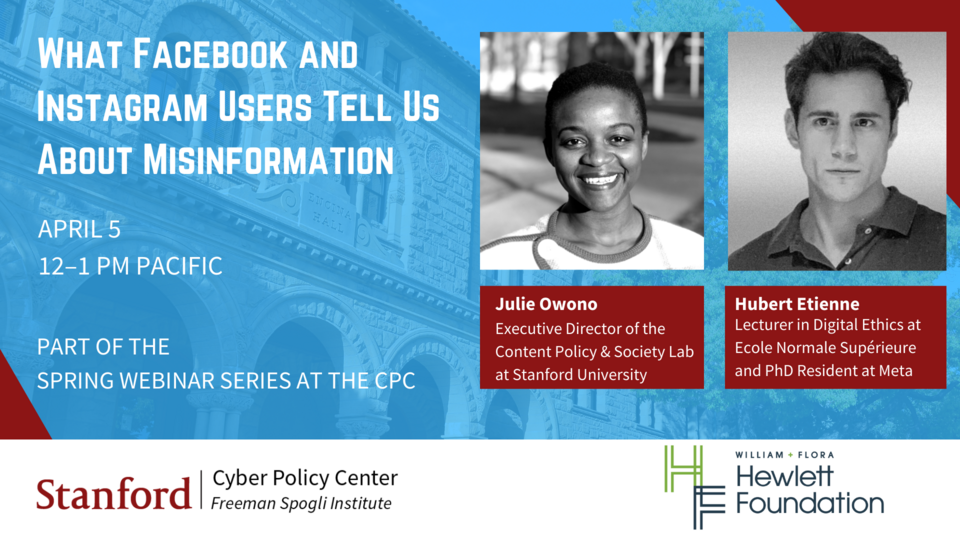
image of julie owono and hubert etienne on flyer
Join us on Tuesday, April 5th from 12 PM - 1 PM PT for “What Facebook and Instagram Users Tell Us About Misinformation” featuring Hubert Etienne, Philosopher and Researcher, Ecole Normale Supérieure and Meta AI in conversation with Julie Owono, Executive Director of the Content Policy & Society Lab. This weekly seminar series is jointly organized by the Cyber Policy Center’s Program on Democracy and the Internet and the Hewlett Foundation’s Cyber Initiative.

About The Seminar: 

Social media users who report content are key allies in the management of online misinformation. However, no research has been conducted yet to understand their role and the different trends underlying their reporting activity. Hubert Etienne presents an original approach to studying misinformation by examining it from the reporting users’ perspective at the content-level and comparatively across regions and platforms. This leads Etienne to propose the first classification of reported content pieces, resulting from a review of items reported on Facebook and Instagram in France, the UK, and the US in June 2020 to observe meaningful distinctions regarding misinformation reporting between countries and platforms as it significantly varies in volume, type, topic, and manipulation technique. Etienne identifies four reporting behaviors, from which he derives four types of noise capable of explaining the majority of the inaccuracy in misinformation reporting. He finally shows that breaking down the user reporting signal into a plurality of behaviors allows us to build a simple classifier trained on a small dataset with a combination of basic users-reports capable of identifying these different types of noise.

Speakers:

Hubert Etienne is a philosopher conducting research in AI ethics and computational philosophy at École Normale Supérieure and Meta AI. His research focuses on social interactions, especially the moderation of problematic interactions in cyberspace. He is a lecturer in AI ethics à Sciences Po, in data economics at HEC Paris and in digital regulation at the National School of Administration. He is currently a visiting fellow at Harvard University.


Julie Owono is the Executive Director of the Content Policy & Society Lab (CPSL) and a fellow of the Program on Democracy and the Internet (PDI) at Stanford University. She is also the Executive Director of digital rights organization Internet Sans Frontières, one of the inaugural members of the Facebook Oversight Board, and an affiliate at the Berkman Klein Center at Harvard University. She holds a Master’s degree in International Law from la Sorbonne University in Paris, and practiced as a lawyer at the Paris Bar.

Hubert Etienne
Seminars

While the number of women in political office around the world is on the rise, men continue to outnumber women at high rates in top leadership positions. There are many reasons why it remains difficult for women to reach, and keep, powerful positions within politics that cover a myriad of electoral, institutional, and individual conditions. Women often become leaders of organizations precisely when leadership conditions are most difficult, and therefore less attractive to powerful men (i.e. the glass cliff). Under these conditions, we might expect women to face greater challenges during their leadership, potentially affecting how long they are able to maintain their leadership roles. Thus, it is impossible to investigate how gender impacts leadership without accounting for selection conditions that place leaders in power. In this paper we take a holistic approach to examining the gendered nature of leadership survival. We investigate how the conditions under which party leaders are chosen, coupled with party performance while in office, impact how long men and women serve as party leaders. In order to do so, we construct a two-stage model that accounts for the endogeneity of the selection process alongside the impact of party performance on the survival of leaders. Using data from 212 leadership terms in eleven industrialized democracies between 1979 and 2018, we find that while women leaders are selected under similar conditions to men, their leadership tenure is more vulnerable to shifts in vote share. Vote share appears to be the main driver of women’s replacement. Men are less susceptible to changes in votes share than women but are also punished for poor poll performance and government loss.


Image
Andrea Aldrich

Andrea S. Aldrich is a lecturer in the Department of Political Science at Yale University and her research interests are focused on political representation, gender, and comparative political institutions. Her work examines the relationship between internal political party dynamics and legislative representation. She is particularly interested in investigating the influence of internal party organization on gender equality in elections and party leadership, and her research has recently been published in JCMS: the Journal of Common Market Studies, Party Politics, and Politics & Gender. Before arriving at Yale, she was a Postdoctoral Research Fellow at the University of Houston with the Political Parties Database under the direction of Dr. Susan Scarrow, a visiting scholar at Texas A&M University, and Fulbright Scholar at the University of Zagreb in Croatia.


*If you need any disability-related accommodation, please contact Shannon Johnson at sj1874@stanford.edu. Requests should be made by April 21, 2022.


Co-sponsored by:

Image
Clayman Institute for Gender Research

Image
WMware Women's Leadership Innovation Lab

Hybrid -- William J. Perry Conference Room and Online via Zoom

Dr. Andrea S. Aldrich, Yale University spealer Yale University
Seminars
0
CDDRL Honors Student, 2021-22
avalonwolfeheadshot_-_nicole_avalon_wolfe.jpeg

Major: Political Science
Minor: Computer Science; Ethics and Technology 
Hometown: Fort Worth, TX
Thesis Advisor: Francis Fukuyama

Tentative Thesis Title: Examining Why Countries With Little Histories of Privacy Enact Data Privacy Laws

Future aspirations post-Stanford: I'm not sure precisely what I want to do after college, but I hope to work at the intersection of technology and law/policy.

A fun fact about yourself: I'm a vegetarian from Texas (and my hometown is actually referred to as Cowtown).

0
CDDRL Honors Student, 2021-22
michal_skreta_-_michal_skreta.jpg

Major: Economics and Political Science   
Hometown: Warsaw, Poland
Thesis Advisor: Larry Diamond

Tentative Thesis Title: Babies, Money, and Power: Estimating Causal Effects of the “Family 500+” Child Benefit Program in Poland using the Synthetic Control Method

Future aspirations post-Stanford: I hope to ultimately pursue a career at the intersection of private and public sectors with a strong international focus as well as to continue my interdisciplinary education in graduate school.

A fun fact about yourself: I once got lost on a volcano in Guatemala.

Subscribe to Europe