News Type
News
Date
Paragraphs

Usually, increasing agricultural productivity depends on adding something, such as fertilizer or water. A new Stanford University-led study reveals that removing one thing in particular – a common air pollutant – could lead to dramatic gains in crop yields. The analysis, published June 1 in Science Advances, uses satellite images to reveal for the first time how nitrogen oxides – gases found in car exhaust and industrial emissions – affect crop productivity. Its findings have important implications for increasing agricultural output and analyzing climate change mitigation costs and benefits around the world.

“Nitrogen oxides are invisible to humans, but new satellites have been able to map them with incredibly high precision. Since we can also measure crop production from space, this opened up the chance to rapidly improve our knowledge of how these gases affect agriculture in different regions,” said study lead author David Lobell, the Gloria and Richard Kushel Director of Stanford’s Center on Food Security and the Environment.

A NOx-ious problem

Nitrogen oxides, or NOx, are among the most widely emitted pollutants in the world. These gases can directly damage crop cells and indirectly affect them through their role as precursors to formation of ozone, an airborne toxin known to reduce crop yields, and particulate matter aerosols that can absorb and scatter sunlight away from crops.

While scientists have long had a general understanding of nitrogen oxides’ potential for damage, little is known about their actual impacts on agricultural productivity. Past research has been limited by a lack of overlap between air monitoring stations and agricultural areas, and confounding effects of different pollutants, among other challenges to ground-based analysis.

To avoid these limitations, Lobell and his colleagues combined satellite measures of crop greenness and nitrogen dioxide levels for 2018-2020. Nitrogen dioxide is the primary form of NOx and a good measure of total NOx. Although NOx is invisible to humans, nitrogen dioxide has a distinct interaction with ultraviolet light that has enabled satellite measurements of the gas at a much higher spatial and temporal resolution than for any other air pollutant.

“In addition to being more easily measured than other pollutants, nitrogen dioxide has the nice feature of being a primary pollutant, meaning it is directly emitted rather than formed in the atmosphere,” said study co-author Jennifer Burney, an associate professor of environmental science at the University of California, San Diego. “That means relating emissions to impacts is much more straightforward than for other pollutants.”

Image
graphic

Calculating crop impacts

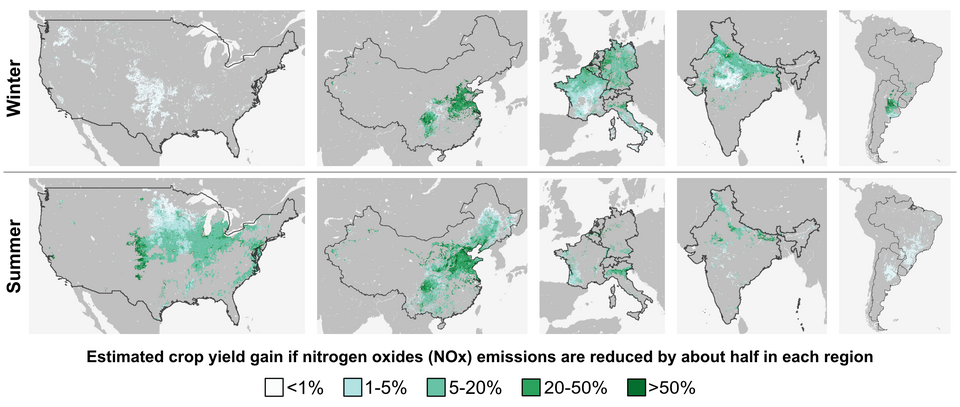
Based on their observations, the researchers estimated that reducing NOx emissions by about half in each region would improve yields by about 25% for winter crops and 15% for summer crops in China, nearly 10% for both winter and summer crops in Western Europe, and roughly 8% for summer crops and 6% for winter crops in India. North and South America generally had the lowest NOx exposures. Overall, the effects seemed most negative in seasons and locations where NOx likely drives ozone formation.

“The actions you would take to reduce NOx, such as vehicle electrification, overlap closely with the types of energy transformations needed to slow climate change and improve local air quality for human health,” said Burney. “The main take-home from this study is that the agricultural benefits of these actions could be really substantial, enough to help ease the challenge of feeding a growing population.”

Previous research by Lobell and Burney estimated reductions in ozone, particulate matter, nitrogen dioxide, and sulfur dioxide between 1999 and 2019 contributed to about 20% of the increase in U.S. corn and soybean yield gains during that period – an amount worth about $5 billion per year.

Future analysis could incorporate other satellite observations, including photosynthetic activity measured through solar-induced fluorescence, to better understand nitrogen dioxide’s effects on crops’ varying degrees of sensitivity to the gas throughout the growing season, according to the researchers. Similarly, more detailed examination of other pollutants, such as sulfur dioxide and ammonia, as well as meteorological variables, such as drought and heat, could help to explain why nitrogen dioxide affects crops differently across different regions, years, and seasons.

“It’s really exciting how many different things can be measured from satellites now, much of it coming from new European satellites,” said study coauthor Stefania Di Tommaso, a research data analyst at Stanford’s Center on Food Security and the Environment. “As the data keep improving, it really drives us to be more ambitious and creative as scientists in the types of questions we ask.”
 

Lobell is also a professor of Earth system science in Stanford’s School of Earth, Energy & Environmental Sciences, the William Wrigley Senior Fellow at the Stanford Woods Institute for the Environment, and a senior fellow at the Freeman Spogli Institute for International Studies and the Stanford Institute for Economic Policy Research. Burney also holds the Marshall Saunders Chancellor’s Endowed Chair in Global Climate Policy and Research at UC San Diego and is a research affiliate at UC San Diego’s Policy Design and Evaluation Laboratory, a fellow at the Stanford Center on Food Security and the Environment, and head of the Science Policy Fellows Program at UC San Diego.

Hero Image
Local people on rice terraces at Longji, Guilin, China.
Getty Images
All News button
1
Subtitle

New analysis shows crop yields could increase by about 25% in China and up to 10% in other parts of the world if emissions of a common air pollutant decreased by about half.

Authors
News Type
News
Date
Paragraphs

When David Relman learned in April that he was elected to the American Academy of Arts and Sciences, he was humbled – and a bit surprised. 

Relman is a senior fellow at the Center for International Security and Cooperation and the Thomas C. and Joan M. Merigan Professor and a professor of medicine and of microbiology & immunology. AAA&S honors exceptional scholars, leaders, artists, and innovators engaged in advancing the public good. 

When he received notification, Relman went to the organization’s web site to check on the discipline area and specialty with which he was affiliated. 

“I looked at the areas and specialties that pertained to my background and expertise (medical sciences, microbiology and immunology, other aspects of the biological sciences), but I could not find my name,” he said. “I thought that maybe the notification was in error.” Then he looked more closely at AAA&S’s letter, and found that his nominators had proposed the “public affairs and public policy section.” 

Arguably that distinction truly reflects Relman’s wide-ranging and serious policy impact in biosecurity, as well as his groundbreaking career work on the nature of the human indigenous microbiota (microbiome). AAA&S’ section of 220 policy luminaries includes former President Barack Obama, former Secretary of Labor Robert Reich, and former Secretary of State Madeleine Albright. Indeed, Relman’s extensive knowledge in microbiology and immunology has played key roles on several critical U.S. and international policy fronts – most recently, the pandemic. 

 Boundless curiosity 

“When you consider the history of the academy and its origins in 1780 during the American Revolution by John Adams and John Hancock, it’s really quite awe-inspiring. You’re joining those who follow in that history,” said Relman, who received an S.B. (Biology) from MIT, M.D. from Harvard Medical School, and joined the faculty at Stanford in 1994. 

Relman’s scholarship is characterized by boundless curiosity – he asks the deeper questions about the pandemic, about human-microbial relationships – both beneficial and harmful, and what they portend for humanity and the future of life on Earth. With grace and diligence, he’s explored the assembly, diversity, stability, and resilience of human microbial communities, while collaborating with other scholars and policy makers on issues paramount to humanity. 

“When I step back and think about the pandemic, it’s clear that it is about much more than just the virus, but also about the social, political, and environmental factors that contribute to the emergence and impact of such pathogens,” said Relman, currently director of a Biosecurity and Global Health initiative at FSI. 

Why do pandemics and more localized outbreaks arise, and how do they uniquely manifest themselves, he ponders. 

“What are the factors that underlie these events, and can we anticipate them better? We much consider three categories of factors: One, is the microbes themselves – and microbes evolve and find ways to do new things. The second category is the hosts – humans, plants, and animals. And humans are undertaking new activities as individuals and as populations that tend to make us more vulnerable, such as immune suppressing ourselves to treat cancer and autoimmune disorders and crowding ourselves into megacities. The third is environmental, and that relates to climate change, and our changing use of land, such as deforestation, intrusion into previously isolated habitats, and other factors,” Relman said. 

Intrusion into new habitats, making contact with animal hosts such as bats that harbor potential disease-causing microbes and viruses, and then bringing these potential pathogens into a lab where we manipulate and alter these agents can lead to human error and accidents, not without grave consequence. “The choices we make in an effort to understand the world around us all come with risk,” he said. 

As far as the microbes and viruses go, “transmissibility is the key,” Relman said. The COVID pandemic reinforced this view for him. 

“When you see what happens when a virus can travel around the globe so quickly, transmissibility has to be viewed as the critical attribute. Viruses evolve and can outrun anything that we might throw in their way, even when we’re already prepared. So, we have to be agile, quick, and shrewd, and we desperately need a far better public health system across the globe that can respond and implement needed measures much more quickly.” 

It’s not just drugs and vaccines and science when it comes to tackling a pandemic. “It’s the social factors, the political factors, and the willingness of humans to work together, and trust, respect and believing in each other. We’ve learned the hard way that this is a tall order. Sometimes we really don’t work together very well,” he said. 

Long-view perspectives 

Relman quotes Joshua Lederberg, a Nobel Prize-winning geneticist and Stanford professor on this age-old war between humanity and viruses: 

“The future of humanity and microbes likely will unfold as episodes of a suspense thriller that could be titled, ‘Our Wits Versus Their Genes,’” Lederberg wrote in an essay, “Infectious History,” in 2000. 

That perspective inspires Relman, who considers this suspense thriller with open eyes and an open mind – digging deeply into complex scientific challenges while understanding long-view perspectives. 

“If you step back in time and consider the history of this planet,” he said, “realize the Earth is about 4.6 billion years old. The earliest life forms we know of were microscopic organisms (microbes) that left signs of their presence in rocks at least 3.7 billion years ago. They have had literally billions of years to diversify, adapt, and secure niches – including on and in animals.” 

On the other hand, modern humans (homo sapiens) have been around for only 200,000 years. “So, we’ve basically been here for the last 3 or 4 seconds of a 24-hour period that started with the formation of Earth. Compare this to microbial life, which has been here for more than 19 hours of this 24-hour period, and will be continue to persist and evolve on this planet for far longer than humanity,” Relman said. 

Relman contemplates and studies the intricacies of the human-microbe relationship, and delves into the issue of how do “favorable” relationships become established, whose interests do they serve, and how can they be supported or restored? 

“This is fundamental to my laboratory work. And why do those relationships sometimes go off the rails? What causes an unusual turn of events such as pandemics? And in what ways and for what reasons do humans mess with these storylines and relationships with these microbes? Those are the puzzles and mysteries that intrigue me,” he said. 

Health equity is a major concern for Relman. Pandemics and public health crises invariably result in harsher consequences for underserved populations than more privileged ones. Many of these communities lack ready access to vaccines, treatments and safeguards, and suffer more disproportionate economic and social turmoil. This is true regardless of how a pandemic arises, including and especially those that might arise because of irresponsible or deliberately malevolent human activities. 

“Subsequent generations are going to be looking at how we’ve handled this pandemic across society, especially for the underserved,” Relman said. “We need to, and can do, much better on this front.” 

Relman was a long-time volunteer for the Rock Medicine program organized by the Haight Ashbury Free Clinics, a free health care service provider serving more than 34,000 people who need access to quality medical care. He served as the chief medical officer for the program for more than a decade. In the 1990s he was featured on MTV for his work providing free medical care at concerts through the program. “Don’t get me started on the dangers of mosh pits,” he once said

Scientific truth-telling 

A pioneer in his field, Relman’s research paper on bacillary angiomatosis and a method for the discovery of new pathogens was selected as “one of the 50 most important publications of the 

past century” by the American Society for Microbiology. In other research, ecological theory and predictions are tested in clinical studies with multiple approaches for characterizing the human microbiome. His work has led to the development of molecular methods for identifying novel microbial pathogens, and the subsequent identification of several historically important microbial disease agents. He was one of the first to characterize microbial diversity in the human body using modern molecular methods. Relman is also the Chief of Infectious Diseases at the Veterans Affairs Palo Alto Health Care System in Palo Alto, California, and served as science co-director at CISAC from 2013-2017. 

During the pandemic, scientific knowledge has been expressed in many ways – but political polarization in the U.S. has sometimes worked against crafting sound policy. 

Relman said, “All good scientists know what they’re good at. You need to be very mindful about what you know and what you don’t know. While people are pretty quick to say what they know, they’re not terribly quick to admit what they don’t know. This goes to the issue of ‘lanes’ and the roles of scientists in policy formulation.” 

Many scientists, he added, may think that scientific information alone determines the ultimate public policy. “But it’s only a piece of it. Lots of other factors go into policy, such as social, cultural, political, and economic considerations,” he said. 

National security policy 

Relman served as vice-chair of the National Academy of Sciences Committee that reviewed the science performed as part of the FBI investigation of the 2001 “Anthrax Letters.” He’s also been a member of the National Science Advisory Board on Biosecurity, and was president of the Infectious Diseases Society of America. He is currently a member of the Intelligence Community Studies Board and the Committee on Emerging Infectious Diseases and 21st Century Health Threats, both at the National Academies of Science, as well as the Science and Security Board of the Bulletin of Atomic Scientists and the Defense Science Board at the Pentagon. He received an NIH Pioneer Award, an NIH Transformative Research Award, and was elected a member of the National Academy of Medicine in 2011

He also chaired and led the work on the National Academies of Science 2020 report on “Havana syndrome,” cases of unexplained health disorders – aka, “anomalous health incidents” – among U.S. government personnel and their families at overseas embassies. Their findings pointed to a “plausible role of directed, pulsed radiofrequency energy,” though “no hypothesis has been proven, and the circumstances remain unclear.” 

Relman said, “I think that we’re going to be facing challenges like this one, that is, complex poorly-explained health problems at the interface of emerging science and national security, more frequently, and that’s what I’ve told our national leadership.” In the report, the scientists wrote, “We as a nation need to address these specific cases as well as the possibility of future cases with a concerted, coordinated, and comprehensive approach.” 

Megan Palmer, the executive director of the Bio Policy & Leadership Initiatives and Relman’s longtime colleague, said, “David is an exceptional scientist, mentor, colleague and friend. He is deeply thoughtful, especially about the role of science and scientists in society, and he is committed to work with integrity for the service of others. He is compelled to tackle the most difficult problems with great care, and he inspires others to follow suit. I am so grateful for his mentorship; he believes in and brings out the best in people.” 

Hero Image
Man smiling
All News button
1
Subtitle

When David Relman learned in April that he was elected to the American Academy of Arts and Sciences, he was humbled – and a bit surprised.

-

Image
image of Julie Owono and Phumzile Van Damme on blue background

Join us on Tuesday, May 31st from 12 PM - 1 PM PT for "A Former South African Politician’s Effort to Combat Misinformation in Elections" featuring Phumzile Van Damme, former Member of Parliament in South Africa, in conversation with Julie Owono of the Content Policy & Society Lab (CPSL). This weekly seminar series is jointly organized by the Cyber Policy Center’s Program on Democracy and the Internet and the Hewlett Foundation’s Cyber Initiative.

About the Seminar: 

Misinformation during elections is a serious concern for democratic systems around the world. This is particularly true in various African countries, cases of electoral violence have been linked to disruptions in the informational realm. Yet, the underinvestment by technology companies in initiatives to limit the existence and impact of disinformation in Africa remains a reality.

Local initiatives have attempted to mitigate this inequality. This week’s webinar will focus on the work of Former South African MP Phumzile Van Damme, who launched a project to tackle the spread of misinformation on social media platforms before and during the local government elections in November 2021. She will share on the methodology used, and results observed. The webinar will also discuss the challenges faced in ensuring that South African users and citizens have access to reliable information.
 

About the Speakers:

Phumzile Van Damme is an independent consultant on disinformation and digital rights. She is a member of the Real Facebook Oversight Board, the International Grand Committee on Disinformation, and an advisory council member of #ShePersisted. Van Damme’s work on misinformation was the subject of a documentary that premiered at Sundance Film Festival in 2020, “Influence.” 
 
A former Member of Parliament in South Africa, Van Damme served on the Communications and Digital Technologies committee as Shadow Minister. She played a pivotal role in holding social media platforms accountable for misinformation on their platforms and spearheaded the summoning of Facebook and other tech giants to Parliament. 
 
In September 2021, she helped found and coordinate South Africa’s first electoral disinformation monitoring project, the ‘Local Government Anti-Disinformation Project’. She has spoken on various platforms on the subject of disinformation including at the UNDP and the UN Commission on the Status of Women.

Julie Owono is the Executive Director of the Content Policy & Society Lab (CPSL) and a fellow of the Program on Democracy and the Internet (PDI) at Stanford University. She is also the Executive Director of digital rights organization Internet Sans Frontières, one of the inaugural members of the Facebook Oversight Board, and an affiliate at the Berkman Klein Center at Harvard University. She holds a Master’s degree in International Law from la Sorbonne University in Paris, and practiced as a lawyer at the Paris Bar. 

With a fluency in five languages, a childhood spent in various countries, and an educational background at the Lyçée Français Alexandre Dumas in Moscow, Julie has a unique perspective to understand the challenges and opportunities of a global Internet. This background has shaped her belief that global and multi stakeholder collaborations can be instrumental in the emergence of rights-based content policies and regulations.

Phumzile Van Damme
Seminars
-

For spring quarter 2022, CISAC will be hosting hybrid events. Many events will offer limited-capacity in-person attendance for Stanford faculty, staff, fellows, visiting scholars, and students in accordance with Stanford’s health and safety guidelines, and be open to the public online via Zoom. All CISAC events are scheduled using the Pacific Time Zone. 

SEMINAR RECORDING

Virtual to Public. Only those with an active Stanford ID with access to William J. Perry Conference Room in Encina Hall may attend in person. 

Rose Gottemoeller
David Holloway
Scott Sagan
Seminars

When the European Peace Project started – 72 years ago – WWII had just ended. It took the great vision and foresight of the “European founding fathers“ – Konrad Adenauer, Robert Schuman, Jean Monnet, and Alcide De Gasperi and others – to bring about the most important change the European continent has ever seen. From a closer economic cooperation (coal and steel) to the founding of the European Communities (treaties of Rome 1957) to the creation of the European Union with its Single Market and the Schengen Area, Europe has experienced an era of peace, stability and prosperity like never before. Preserving these epochal achievements within European borders and extending to Europe’s immediate neighbors lies at the very heart of the Foreign and Security policy of the EU.

Now a brutal war has started, putting at risk lives and livelihoods of many, putting our economies under strain and  demanding quick and resolute political answers. The attacks in Ukraine mark a turning point (in the words of Chancellor Olaf Scholz: “Zeitenwende”) for the German, French and Common Foreign and Security Policy(CFSP). As highlighted by French President Emmanuel Macron at the EU summit in Versailles in March 2022, “As a force of peace, we cannot rely on others to defend ourselves, be it on land, sea, air, space or cyberspace […]. Our European defense must take a new step.” This panel will discuss what a realigned CFSP could possibly look like, what role NATO could play in that context, and how Germany and France could contribute to this new order.

Co-sponsors:

Consulate General of France logoConsulate General of Germany logo

Image
IFA logo

Christophe Crombez

Online via Zoom

Gisela Müller-Brandeck-Bocquet, University of Würzburg
Pierre Haroche, Institute for Strategic Research (IRSEM, Paris)
-

For spring quarter 2022, CISAC will be hosting hybrid events. Many events will offer limited-capacity in-person attendance for Stanford faculty, staff, fellows, visiting scholars, and students in accordance with Stanford’s health and safety guidelines, and be open to the public online via Zoom. All CISAC events are scheduled using the Pacific Time Zone. 

SEMINAR RECORDING

Virtual to Public. Only those with an active Stanford ID with access to William J Perry Conference Room in Encina Hall may attend in person. 

Dean Winslow
Seminars
Paragraphs

Image
Everything Counts: Building a Control Regime for Nonstrategic Nuclear Warheads in Europe
Even before the Russian invasion of Ukraine, addressing arms control policies in Europe and securing a follow-on agreement to the New Strategic Arms Reduction Treaty (New START) was a priority for the Biden administration. The United States has been particularly interested in potential limits on nonstrategic nuclear warheads (NSNW), which have never been subject to an arms control agreement.
 

Because Russia possesses an advantage in the number of such weapons, the U.S. Senate has insisted that negotiators include them in a future agreement, making their inclusion necessary if such an accord is to win Senate approval and ultimately be ratified by Washington. In the wake of Russian nuclear threats in the Ukraine conflict, such demands can only be expected to grow if and when U.S. and Russian negotiators return to the negotiating table.

Such an agreement will face major negotiating and implementation challenges—not only between Washington and Moscow, but also between Washington and NATO European allies. To stimulate this process, four NATO allies (Denmark, Germany, the Netherlands, and Norway) and one NATO partner (Sweden) funded a research team led by the James Martin Center for Nonproliferation Studies and former NATO Deputy Secretary General and New START lead negotiator Rose Gottemoeller. The research focused on the negotiating, policy, legal, and technical issues that allies will likely have to address to reach such an accord.
 

Key Takeaways


  • NATO allies want to keep existing NSNW, and they want an agreement limiting Russian NSNW, and they expect to be substantively consulted before each round of negotiations. A decade ago, some US allies, such as Germany, appeared close to parting with the weapons because of public pressure despite considerable opposition within the alliance, particularly from newer allies with territory closer to Russian borders. While US Secretary of State Hillary Clinton managed to paper over these differences at the time, Russia’s behavior, including the 2014 annexation of Crimea and the 2022 invasion of Ukraine, has helped reinforce allied views that under the present circumstances, maintaining NATO’s current nuclear-sharing arrangements is the right approach. At the same time, the Ukraine invasion may further reinforce some allies’ doubts about the value of such agreements with Russia. All allies will need to be reassured that arms control and deterrence do not clash, but rather complement each other. US leadership and willingness to engage in substantive consultations will be crucial in maintaining unity. The allies’ experience in negotiating the INF Treaty and the Biden administration’s current close work with NATO on Ukraine provide useful models.
     
  • Most of the Russian NSNW arsenal today is designed to support specific missions (as a backup to its emerging long-range conventional capability) and, from the perspective of the Russian military (particularly the Navy), will be tough to bargain away.
     
  • Addressing NSNW will require overcoming operational and technical verification challenges that are made more difficult by issues of information security, definitions, and stockpile disparities. Nuclear-warhead design, composition, and capabilities are among the most closely held secrets of the nuclear-weapon states, and warhead movements pose the most sensitive nuclear-security concerns. Because parts of a nuclear warhead are replaced on a regular basis and warhead configurations can differ greatly, it could prove challenging to establish a universal definition of a warhead, and their size and mobility present major obstacles to accounting for and tracking individual warheads. US and Russian NSNW stockpiles also differ significantly in types and numbers.
     
  • The experience in implementing the INF Treaty provides a useful starting point for considering how the new treaty might be implemented. Other agreements and inspection regimes to which many NATO allies are party also provide useful practical experience in preparing to host Russian inspectors. In advance of negotiations, allies should carry out a legal assessment to determine how domestic laws might need to be amended to carry out on-site inspections and other measures on their territory and a technical-capability assessment to determine how they might need to improve their staffing of national verification entities to implement an agreement.
     
  • Allies also need to enhance the analytical and legal capabilities of their foreign and defense ministries when it comes to NSNW and arms control. In most countries, such expertis has withered in the decades since the end of the Cold War; newer allies were never involved in INF Treaty negotiations or implementation, even indirectly.
     
  • US and allied research on verification measures for NSNW has largely focused on scientific and technical tools to conduct on-site inspections. The research team has developed an original and unique methodology for a data exchange employing historic stockpile data and taking advantage of past US-Russian cooperation and cryptography. This data exchange would serve as the critical backbone for other verification measures, no matter the type of warhead or the type of agreement (freeze, limitation, or reduction).
     
  • Finally, sustained political engagement at the highest level will be essential to the success of any arms control initiative involving allies. If there is a lesson from the past three decades of arms control in the Euro-Atlantic region, it is that a penny-wise and pound-foolish approach has decimated the personnel and the intellectual investment in arms control. When arms control has been pursued in recent years, it often has been done in isolation from security policy, national strategy, and military planning, rendering it at best a curio within foreign ministries. Until this topic is taken seriously as an instrument of hard power, to reinforce deterrence as one of the most important ways nations seek to avoid or limit war, it will not find purchase on the rocky ground of great-power competition.
All Publications button
1
Publication Type
Reports
Publication Date
Subtitle

A team of experts led by Rose Gottemoeller has produced a new report for the James Martin Center for Nonproliferation Studies on non-strategic nuclear warhead policies in Europe, particularly in light of Russia's changing status in the global nuclear community.

Authors
Rose Gottemoeller
-

Image
image of jeff hancock on blue background with ryan moore and ross dahlke

Join us on Tuesday, May 17th from 12 PM - 1 PM PT for “Exposure to Untrustworthy Websites in the 2020 US Election” featuring Jeff Hancock, Ross Dahlke & Ryan Moore of the Social Media Lab. This weekly seminar series is jointly organized by the Cyber Policy Center’s Program on Democracy and the Internet and the Hewlett Foundation’s Cyber Initiative.

About The Seminar: 

Prior research has documented exposure to fake news and online misinformation using large-scale data on individuals’ media use, which has provided important information about the scope and nature of people’s exposure to misinformation online. However, most of this work has made use of data collected during the 2016 US election, and far fewer studies have examined how exposure to misinformation online has changed since 2016. In this paper, we examine exposure to untrustworthy websites in the lead up to the 2020 US election using a dataset of over 7.5 million passively tracked website visits from a nationally representative sample of American adults (N = 1,151). We find that a significantly smaller percentage of Americans were exposed to untrustworthy websites in 2020 compared to in 2016 (as calculated by Guess et al. [2020]). While exposure was concentrated among similar groups of people as it was in 2016, levels of exposure appear to be lower across the board. There were also differences in the role online platforms played in directing people to untrustworthy websites in 2020 compared to 2016. Our findings have implications for future research and practice around online misinformation.

About The Speakers:

Jeff Hancock is the founding director of the Stanford Social Media Lab and is Harry and Norman Chandler Professor of Communication at Stanford University. Professor Hancock and his group work on understanding psychological and interpersonal processes in social media. The team specializes in using computational linguistics and experiments to understand how the words we use can reveal psychological and social dynamics, such as deception and trust, emotional dynamics, intimacy and relationships, and social support. Recently Professor Hancock has begun work on understanding the mental models people have about algorithms in social media, as well as working on the ethical issues associated with computational social science.

Ross Dahlke, from Westfield, Wisconsin, is pursuing a PhD in theory and research in the Stanford Social Media Lab at the Stanford School of Humanities and Sciences. He graduated from the University of Wisconsin-Madison with bachelor’s degrees in journalism and political science. Ross’s research focuses on applying AI and computational techniques to understand how people interact with complex systems. Before graduate school, he was a data scientist at a marketing technology firm where he developed machine learning platforms that helped Fortune 500 companies optimize their digital marketing spend in order to drive sales. He has also consulted on dozens of state-wide and local political campaigns. In high school, Ross started a cheese distribution business which has sold more than $3 million in cheese.

Ryan Moore studies how features of new media platforms and technologies affect the consumption, processing, and sharing of information, especially information about politics and news. In addition, he is interested in the role that age plays in internet and technology use, particularly as it relates to encountering deceptive or misleading content.

Seminars
-
Image
two logos displayed on blue abstract background, Korea Foundation and Stanford's GTG program

Geopolitics of Technology in East Asia


WHEN: May 17 & May 18 
WHERE: Frances C. Arrillaga Alumni Center (IN PERSON) or Live Webcast


AGENDA: 

Day 1 of the workshop will focus on the strategic dimensions of industrial policy relating to digital goods and services. Key topics include national security reviews of inbound and outbound investments, export controls, and supply chain risks, with a view towards identifying areas that are ripe for multilateral alignment as well as points of friction and options for managing those points of friction. Elaborating the respective roles and responsibilities of government and private sector actors will be an important theme.

Day 2 of the workshop will focus on regulatory policy and workforce challenges and opportunities, especially AI and its ecosystem of supporting technologies. 
 

FULL AGENDA

Andrew Grotto

Frances C. Arrillaga Alumni Center or Live Webcast

Seminars
Authors
Rose Gottemoeller
News Type
News
Date
Paragraphs

Executive Summary

Before the Russian invasion of Ukraine, the Biden administration insisted in arms control talks with Russia that a follow-on agreement to the New Strategic Arms Reduction Treaty (New START) should cover all nuclear weapons and that such an agreement should focus on the nuclear warheads themselves. This would represent a significant change from previous agreements, which focused on delivery vehicles, such as missiles. The United States has been particularly interested in potential limits on nonstrategic nuclear warheads (NSNW). Such weapons have never been subject to an arms control agreement. Because Russia possesses an advantage in the number of such weapons, the US Senate has insisted that negotiators include them in a future agreement, making their inclusion necessary if such an accord is to win Senate approval and ultimately be ratified by Washington. In the wake of Russian nuclear threats in the Ukraine conflict, such demands can only be expected to grow if and when US and Russian negotiators return to the negotiating table.

Read the rest at James Martin Center for Nonproliferation Studies

Hero Image
Title page for Everything Counts: Building a Control Regime for Nonstrategic Nuclear Warheads in Europe
All News button
1
Subtitle

Before the Russian invasion of Ukraine, the Biden administration insisted in arms control talks with Russia that a follow-on agreement to the New Strategic Arms Reduction Treaty (New START) should cover all nuclear weapons and that such an agreement should focus on the nuclear warheads themselves.

Subscribe to Europe