-

Abstract:

This paper estimates the effect that successful cocaine interdiction policies in Colombia have had on violence in Mexico. We propose a simple model of the war on drugs that captures the essence of our identification strategy: aggregate supply shocks affect the size of illegal drug markets, which then increases or decreases violence. We estimate the effect of the interaction of cocaine seizures in Colombia with simple geographic features of Mexican municipalities. Our results indicate that aggregate supply shocks originated in drug seizures in Colombia affect homicides in Mexico. The effects are especially large for violence generated by clashes between drug cartels. Our estimates also show that government crackdowns on drug cartels might not be the only explanation behind the rise of illegal drug trafficking and violence observed in the last six years in Mexico: successful interdiction policies implemented in Colombia since 2006 have also played a major role in the worsening of the Mexican situationduring Calderon's sexennium.


Speaker Bio:

Daniel Mejia is Associate Professor in the Department of Economics and Director of the Research Center on Drugs and Security (CESED) at Universidad de los Andes in Bogota, Colombia, where he has taught since 2006. He received a BA and MA in Economics from Universidad de los Andes and a MA and PhD in economics from Brown University. Prior to joining Universidad de los Andes he worked as a researcher at the Central Bank of Colombia and Fedesarrollo. Daniel he has been actively involved in a research agenda whose main objective is to provide an independent, economic evaluation of anti-drug policies implemented under Plan Colombia. His academic work has been published at the Journal of Development Economics, the European Journal of Political Economy, Economics of Governance and Economia: Journal of the Latin America Economic Association. In 2008 he was awarded Fedesarrollos´s German Botero de los Ríos prize for economic research. Also, in 2008, 2010 and 2012 he was awarded with research grants from the Open Society Institute for the study of anti-drug policies in Colombia. Daniel, together with Alejandro Gaviria, recently published the book “Políticas antidroga en Colombia: éxitos, fracasos y extravíos” (Anti-drug policies in Colombia: successes, failures and lost opportunities) at Universidad de los Andes, in Bogota. Between 2011 and 2012, Daniel was a member of the Advisory Commission on Criminal Policy and more recently he is the Chair of the Colombian Government´s Advisory Commission on Drugs Policy.


CISAC Conference Room

Daniel Mejia Londoño Associate Professor in the Department of Economics and Director of the Research Center on Drugs and Security (CESED) Speaker Universidad de los Andes in Bogota, Colombia
Seminars
-

Speaker bio:

Karl Eikenberry is the William J. Perry Fellow in International Security at the Center for International Security and Cooperation and a faculty member of the Shorenstein Asia-Pacific Research Center at Stanford University.  He is also an affiliated faculty member with the Center for Democracy, Development, and Rule of Law, and researcher with The Europe Center.

Prior to his arrival at Stanford, he served as the U.S. Ambassador to Afghanistan from May 2009 until July 2011, where he led the civilian surge directed by President Obama to reverse insurgent momentum and set the conditions for transition to full Afghan sovereignty.

Before appointment as Chief of Mission in Kabul, Ambassador Eikenberry had a thirty-five year career in the United States Army, retiring in April 2009 with the rank of Lieutenant General.  His military operational posts included commander and staff officer with mechanized, light, airborne, and ranger infantry units in the continental U.S., Hawaii, Korea, Italy, and Afghanistan as the Commander of the American-led Coalition forces from 2005-2007. 

He has served in various policy and political-military positions, including Deputy Chairman of the North Atlantic Treaty Organization (NATO) Military Committee in Brussels, Belgium; Director for Strategic Planning and Policy for U.S. Pacific Command at Camp Smith, Hawaii; U.S. Security Coordinator and Chief of the Office of Military Cooperation in Kabul, Afghanistan; Assistant Army and later Defense Attaché at the United States Embassy in Beijing, China; Senior Country Director for China, Taiwan, Hong Kong and Mongolia in the Office of the Secretary of Defense; and Deputy Director for Strategy, Plans, and Policy on the Army Staff.

He is a graduate of the U.S. Military Academy, has master’s degrees from Harvard University in East Asian Studies and Stanford University in Political Science, and was a National Security Fellow at the Kennedy School of Government at Harvard.

Ambassador Eikenberry earned an Interpreter’s Certificate in Mandarin Chinese from the British Foreign Commonwealth Office while studying at the United Kingdom Ministry of Defense Chinese Language School in Hong Kong and has an Advanced Degree in Chinese History from Nanjing University in the People’s Republic of China. 

His military awards include the Defense Distinguished and Superior Service Medals, Legion of Merit, Bronze Star, Ranger Tab, Combat and Expert Infantryman badges, and master parachutist wings.  He has received the Department of State Distinguished, Superior, and Meritorious Honor Awards, Director of Central Intelligence Award, and Chairman of the Joint Chiefs of Staff Joint Distinguished Civilian Service Award.  He is also the recipient of the George F. Kennan Award for Distinguished Public Service and Harvard University Graduate School of Arts and Sciences Centennial Medal.  His foreign and international decorations include the Canadian Meritorious Service Cross, French Legion of Honor, Afghanistan’s Ghazi Amir Amanullah Khan and Akbar Khan Medals, and the NATO Meritorious Service Medal.

Ambassador Eikenberry serves as a Trustee for the International Institute for Strategic Studies, The Asia Foundation, and the National Committee on American Foreign Policy, and is a Fellow of the American Academy of Arts and Sciences.  He is a member of the Council on Foreign Relations, the American Academy of Diplomacy, and the Council of American Ambassadors, and was previously the President of the Foreign Area Officers Association.  His articles and essays on U.S. and international security issues have appeared in Foreign Affairs, The Washington Quarterly, American Foreign Policy Interests, The New York TimesThe Washington Post, Foreign Policy, and The Financial Times.  He has a commercial pilot’s license and instrument rating, and also enjoys sailing and scuba diving.

Reuben W. Hills Conference Room

Karl Eikenberry William J. Perry Fellow in International Security at CISAC, CDDRL, TEC, and Shorenstein APARC Distinguished Fellow; and Former U.S. Ambassador to Afghanistan and Retired U.S. Army Lt. General Speaker FSI
Seminars
-

Speaker bio:

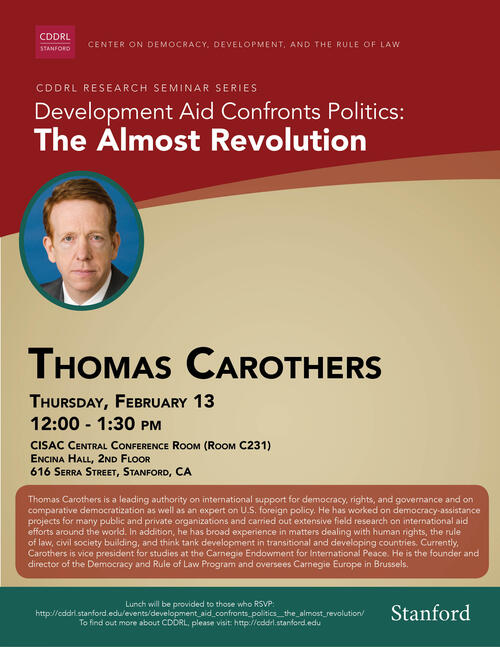
Thomas Carothers is vice president for studies at the Carnegie Endowment for International Peace. He is the founder and director of the Democracy and Rule of Law Program and oversees Carnegie Europe in Brussels.

Carothers is a leading authority on international support for democracy, rights, and governance and on comparative democratization as well as an expert on U.S. foreign policy. He has worked on democracy-assistance projects for many public and private organizations and carried out extensive field research on international aid efforts around the world. In addition, he has broad experience in matters dealing with human rights, the rule of law, civil society building, and think tank development in transitional and developing countries.

He is the author of six critically acclaimed books as well as many articles in prominent journals and newspapers. Carothers has also worked extensively with the Open Society Foundations (OSF), including currently as chair of the OSF Think Tank Fund and previously as chair of the OSF Global Advisory Board. He is an adjunct professor at the Central European University in Budapest and was previously a visiting faculty member at Nuffield College, Oxford University, and Johns Hopkins SAIS.

Prior to joining the Endowment, Carothers practiced international and financial law at Arnold & Porter and served as an attorney adviser in the Office of the Legal Adviser of the U.S. Department of State.

Carothers is the co-author (with Diane de Gramont) of Development Aid Confronts Politics: The Almost Revolution (Carnegie, 2013) and author of Confronting the Weakest Link: Aiding Political Parties in New Democracies (Carnegie, 2006); Promoting the Rule of Law Abroad: In Search of Knowledge (Carnegie, 2006); Uncharted Journey: Promoting Democracy in the Middle East, co-edited with Marina Ottaway (Carnegie, 2005); Critical Mission: Essays on Democracy Promotion (Carnegie, 2004); Funding Virtue: Civil Society Aid and Democracy Promotion, co-edited with Marina Ottaway (Carnegie, 2000); Aiding Democracy Abroad: The Learning Curve (Carnegie, 1999); and Assessing Democracy Assistance: The Case of Romania (Carnegie, 1996).

Image

CISAC Conference Room

Thomas Carothers Vice President for Studies Speaker Carnegie Endownment for International Peace
Seminars

616 Serra Street
Stanford, CA 94305-6044

0
Professor of Political Science
Senior Fellow at the Hoover Institution
Senior Fellow at the Stanford Institute for Economic Policy Research (SIEPR)
Rodden_current_hi-res.jpg

Jonathan Rodden is professor of political science at Stanford, director of the Spatial Social Science Lab, and a senior fellow at the Hoover Institution and the Stanford Institute for Economic Policy Research.  He has written several articles and a pair of books on federalism and fiscal decentralization, and continues to work on issues related to state and local government finance around the world.  His most recent work focuses on economic and political geography in North America, Europe, and beyond.  He published a book on the topic in 2019, entitled Why Cities Lose: The Deep Roots of the Urban-Rural Political Divide

Rodden has several ongoing research projects with collaborators in Europe, including a new project on comparative federalism at the University of Salzburg.  He spent the winter of 2013 as a visiting scholar at the Juan March Institute in Madrid while also teaching in Stanford’s Madrid Bing Overseas Program.

Rodden received his PhD from Yale University and his BA from the University of Michigan, and was a Fulbright scholar at the University of Leipzig, Germany. Before joining the Stanford faculty, he was the Ford Associate Professor of Political Science at MIT. 

Rodden's research was featured in The Europe Center February 2018 Newsletter.

Director of the Spatial Social Science Lab
Affiliated faculty at The Europe Center
CV
-

This interdisciplinary workshop brings together scholars from the fields of law, political science and international relations, history, literature, film and digital humanities to examines the different ways societies address and judge war and conflict-related atrocities in the post-1945 era. 

Departing from the central role legal mechanisms and procedures play in the processed by which societies come to terms with their violent pasts, the workshop explores the various discourses that take part in such processes, and how they react to post-conflict legal institutions and shape different notions of justice that emerge from these transitional periods.

The event is organized and sponsored by the DLCL Research Unit with the support of CISAC, The Europe Center, DLCL, Department of Comparative Literature, Stanford Humanities Center and Jewish Studies.


VIDEOS:

Introduction:


Panel 1:


Panel 2: (Cooppan)


Panel 2:  (Viles)


Panel 3:


Keynote:

CISAC Conference Room

Workshops
-

CISAC Conference Room

Encina Hall, C148
616 Jane Stanford Way
Stanford, CA 94305

0
Olivier Nomellini Senior Fellow at the Freeman Spogli Institute for International Studies
Director of the Ford Dorsey Master's in International Policy
Research Affiliate at The Europe Center
Professor by Courtesy, Department of Political Science
yff-2021-14290_6500x4500_square.jpg

Francis Fukuyama is the Olivier Nomellini Senior Fellow at Stanford University's Freeman Spogli Institute for International Studies (FSI), and a faculty member of FSI's Center on Democracy, Development and the Rule of Law (CDDRL). He is also Director of Stanford's Ford Dorsey Master's in International Policy, and a professor (by courtesy) of Political Science.

Dr. Fukuyama has written widely on issues in development and international politics. His 1992 book, The End of History and the Last Man, has appeared in over twenty foreign editions. His book In the Realm of the Last Man: A Memoir will be published in fall 2026.

Francis Fukuyama received his B.A. from Cornell University in classics, and his Ph.D. from Harvard in Political Science. He was a member of the Political Science Department of the RAND Corporation, and of the Policy Planning Staff of the US Department of State. From 1996-2000 he was Omer L. and Nancy Hirst Professor of Public Policy at the School of Public Policy at George Mason University, and from 2001-2010 he was Bernard L. Schwartz Professor of International Political Economy at the Paul H. Nitze School of Advanced International Studies, Johns Hopkins University. He served as a member of the President’s Council on Bioethics from 2001-2004. He is editor-in-chief of American Purpose, an online journal.

Dr. Fukuyama holds honorary doctorates from Connecticut College, Doane College, Doshisha University (Japan), Kansai University (Japan), Aarhus University (Denmark), the Pardee Rand Graduate School, and Adam Mickiewicz University (Poland). He is a non-resident fellow at the Carnegie Endowment for International Peace. He is a member of the Board of Trustees of the Rand Corporation, the Board of Trustees of Freedom House, and the Board of the Volcker Alliance. He is a fellow of the National Academy for Public Administration, a member of the American Political Science Association, and of the Council on Foreign Relations. He is married to Laura Holmgren and has three children.

(October 2025)

CV
Date Label
Francis Fukuyama Speaker
Conferences

450 Serra Mall, Building 200
Stanford CA 94305-2024

0
Associate Professor of History
Stokes_2012.jpg

Laura Stokes completed their Ph.D. at the University of Virginia in 2006. Their first book, Demons of Urban Reform, examines the origins of witchcraft prosecution in fifteenth-century Europe against the backdrop of a general rise in the prosecution of crime and other measures of social control. In the process they have investigated the relationship between witchcraft and sodomy persecutions as well as the interplay between the unregulated development of judicial torture and innovations within witchcraft prosecution.

Their current research is an examination of quotidian economic culture during the fifteenth through seventeenth centuries. This project, under the working title A Social History of Greed in the Age of the Reformation, is based largely on the examination of court depositions from the city of Basel. Its first fruit will be a microhistory on The Murder of Uly Mörnach, currently in process. Prof. Stokes also directs a digital humanities project "Panic and Pandemic" which maps outbreaks of plague and epidemic in early modern Europe against social and literary responses to disease.


Affiliated faculty at The Europe Center
CV
Authors
News Type
News
Date
Paragraphs

Research grants from the Europe Center’s first “Graduate Student Grant Competition” were awarded this past October to sixteen Stanford students. The bi-annual competition is part of the Europe Center's efforts to support student research focused on Europe. Winning proposals were selected from a wide range of disciplines, including political science, history, literature, anthropology, psychology and music.  “This is a terrific group of energetic scholars with innovative proposals. I am really looking forward to learning about the results of their research,” stated Ken Scheve, Europe Center director.  For the list of awardees and their research project titles, please visit the grant's awardee page.

The second round of the competition will take place in Spring 2014, and is again open to humanities and social science Ph.D. candidates whose dissertation research or approved dissertation projects focus on Europe.   Professional students whose interests focus on some aspect of European politics, economics, history, or culture are also encouraged to apply. 


Hero Image
People study at British Library 6x3
Europe Center grants support student research focused on Europe. For some of the awardees, this means the opportunity to study in European archives, libraries and museums, such as the British Library shown here.
Reuters
All News button
1
News Type
News
Date
Paragraphs

The impact of immigration on Western European demographics will be the topic of Stanford political science professor David Laitin and co-writer Rafaela Dancygier's (Princeton University) soon to be published article "Immigration into Europe: Economic Discrimination, Violence, and Public Policy"

All News button
1
News Type
News
Date
Paragraphs

Stanford associate professor of German Studies, Adrian Daub, presents a new study on German opera in his book Tristan's Shadow: Sexuality and the Total Work of Art after Wagner.

For more information, please visit the publication's webpage by clicking on the book title below.

All News button
1
Subscribe to Europe