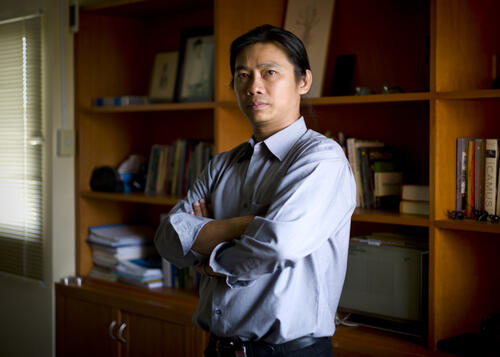
Average life expectancy in Mongolia is 65 years, much shorter than that of other East Asian countries such as South Korea (78.5 years) and China (72.5 years). Furthermore, healthy life expectancy in Mongolia is even shorter, rendering the situation even more tragic. The World Health Organization estimates that the healthy life expectancy is 53 years for males and 58 years for females.
This colloquium will provide an overview of health in Mongolia and its healthcare system, with expertise from two speakers. First, Dr. Gendengarjaa Baigalimaa, Developing Asia Health Policy Fellow at Shorenstein APARC, will discuss her comparative study of how knowledge of cervical cancer risk factors has influenced behavior changes in Mongolia before and after the introduction of the National Cervical Cancer Program.
Second, Dr. Dashdorj will present on overview of the healthcare initiatives of the Onom Foundation, designed to mitigate excess and premature mortality of Mongolians via knowledge transfer and entrepreneurship. He will report on a March national health policy meeting in Mongolia’s capital and recent strides in health improvement made with the support of the Onom Foundation.
Gendengarjaa Baigalimaa joins the Walter H. Shorenstein Asia-Pacific Research Center (Shorenstein APARC) during the 2013-2014 academic year as the Developing Asia Health Policy Fellow. She joins APARC from the Mongolian National Cancer Center, where she serves as a Gynecological Oncologist.
During her appointment as Health Policy Fellow, she is completing her comparative study of how knowledge of cervical cancer risk factors has influenced behavior changes in Mongolia before and after the introduction of the National Cervical Cancer Program.
Baigalimaa is the Executive Director of Mongolian Society of Gynecological Oncologists and is also a member of the International Gynecological Cancer Society (IGCS) in Mongolia, Russia, and France.
Baigalimaa holds a MD from Minsk Belarussia Medical University. She also received a Masters in Health Science from Mongolian Medical University. She is fluent in both Russian and English.
Dr. Dashdorj hails from very humble beginnings. He was born and raised in the southwestern outskirts of Mongolia known as Gobi-Altay province, where the Altay Mountains border with the bare rock covered desert basins of the Gobi. Because of the unique upbringing, Dr. Dashdorj has a profound commitment for making a tangible difference in lives of fellow Mongols. At the same time, he strongly believes that entrepreneurship is the best vehicle for making a difference.
He obtained a Ph.D. in physics from Purdue University in 2005 and was a postdoctoral fellow at the US National Institutes of Health. His research using ultrafast optical spectroscopy and time-resolved x-ray imaging techniques is published in 17 original manuscripts in prominent, peer-reviewed scientific journals, such as the Proceedings of the National Academy of Sciences. In 2010, Dr. Dashdorj became a faculty member at the Argonne National Laboratory. Despite his successes in scientific research, he gave up his academic career in 2013 to pursue his entrepreneurial dreams, since he truly believed that he can make a tangible difference via entrepreneurship, experimenting with a model of subsidizing philanthropic actions by a certain percentage of equity and profits of a for-profit company.
Shorenstein APARC
Encina Hall E332
616 Serra Street
Stanford, CA 94305-6055
(650) 724-5710
(510) 705-2049
(650) 723-6530
0
baigal@stanford.edu
Developing Asia Health Policy Fellow
IMG_4537.jpg
MD
Gendengarjaa Baigalimaa joins the Walter H. Shorenstein Asia-Pacific Research Center (Shorenstein APARC) during the 2013-2014 acedemic year as the Asia Health Policy Program Fellow. She joins APARC from the Mongolian National Cancer Center, where she serves as a Gynecological Oncologist.
During her appointment as Health Policy Fellow, she will conduct a comparative study of how knowledge of cervical cancer risk factors has influenced behavior changes in Mongolia before and after the introduction of the National Cervical Cancer Program.
Baigalimaa is the Executive Director of Mongolian Society of Gynecological Oncologists and is also a member of the International Gynecological Cancer Society (IGCS) in Mongolia, Russia, and France.
Baigalimaa holds a MD from Minsk Belarussia Medical University. She also received a Masters in Health Science from Mongolian Medical University. She is fluent in both Russian and English.
Gendengarjaa Baigalimaa
Developing Asia Health Policy Fellow
Speaker
Stanford University
Naranbaatar Dashdorj
Founder and Chairman of Onom Foundation and a 2014 Sloan Fellow at the Stanford Graduate School of Business
Speaker
South Korean President Park Geun-hye recently made headlines by declaring that Korean unification would represent a huge bonanza for both the Korean people and the international community, rather than pose unacceptable risks and costs, as some have argued. The core goal and ultimate aim of her trustpolitik toward North Korea is in fact the unification of the divided Korean Peninsula. Unification will end a highly abnormal situation, resolve the nuclear issue, and provide a peace dividend not only to the Korean people but also to the United States and countries in the region. Trustpolitik aims to achieve unification by establishing sustainable peace on the Korean Peninsula, inducing positive change in North Korea, and mobilizing international support for unification. Kim Hwang-sik, South Korea’s prime minister from 2010-2013, will lay out President Park’s vision for a unified Korea and her plan to achieve it, and explain why the United States should strongly support the effort.
Born in South Jeolla Province in 1948, Kim Hwang-sik studied law at Marburg University in Germany and graduated from Seoul National University in 1971. He passed the National Judicial Examination in 1972 and then served as judge in district and high courts, becoming president of the Kwangju district court and, from 2005 to 2008, a Supreme Court justice. He served as chairman of the Board of Audit and Inspection from 2008 to 2010, and as President Lee Myung-bak’s prime minister from October 2010 to February 2013.
Philippines Conference Room
Kim Hwang-sik
former Prime Minister of South Korea
Speaker
The world’s leading economic policymakers are “on the right track” to ensure a global financial upturn, the chief of the International Monetary Fund told a Stanford audience on Tuesday.
But she warned the recovery will be derailed without the creation of more jobs, better education systems and a way to shrink the gap between rich and poor. And she cautioned against the potential pitfalls of untested exchanges and digital currencies such as Bitcoin.
“We are on the right track, but we need to ask – the right track to where? And the right track to what growth?” said Christine Lagarde, the IMF’s managing director. “Will it be solid, sustainable, and balanced – or will it be fragile, erratic, and unbalanced? To answer this question, we need to look at the patterns of economic activity in the years ahead, and especially the role of technology and innovation in driving us forward.”
Lagarde’s visit to Stanford was co-sponsored by the Freeman Spogli Institute for International Studies and the Stanford Institute for Economic Policy Research. In addition to delivering public remarks at FSI’s Bechtel Conference Center, Lagarde met privately with faculty and students during the day.
Just returning from the G-20 summit in Sydney, Lagarde said she is optimistic that the world’s economic leaders are committed to taking the steps that will guard against another large-scale financial collapse. She said the G-20 members agreed to complete a set of financial reforms by the end of this year, a move that will make the “financial sector safer and less likely to cause crisis.”
She said the member countries and their central banks have also agreed to better cooperate and be more transparent in their policymaking.
But she’s worried that unless more sustainable jobs are created, economic disparities will increase. And that, she said, will “harm the pace and sustainability of growth over the long term.”
As technology has helped create a more interconnected world, it is playing an increasing role in the economic landscape. Machines have made our lives easier. Artificial intelligence has led to cars that can drive themselves, robots that can do things in place of humans and smartphones that are more powerful than the first supercomputers.
But so far, there’s been no measure of how new technology has increased productivity.
“We certainly need to keep an eye on this,” she said. “One of the biggest worries is how this technological innovation affects jobs. Put simply: will machines leave workers behind?”
She said technology creates “huge rewards for the extraordinary visionaries at the top, and huge anxieties for workers at the bottom.”
Lagarde said it is up to educators to better prepare the next generation of workers.
“Educational systems are not keeping pace with changing technology and the ever-evolving world of work,” she said. “We need to change what people learn, how people learn, when people learn, and even why people learn. We must go beyond the traditional model of students sitting in classrooms, following instructions and memorizing material. Computers can do that.”
Instead, humans must “outclass computers” in cognitive, interpersonal and sophisticated coding skills, she said.
“Think of creative jobs, caring jobs, jobs that entail great craftsmanship – imagination,” she said. “And given the rate and pace of change, we will need the ability to constantly adapt and change through lifelong learning.”
She called on institutions such as Stanford to play a key role in the process.
“Stanford’s model of education was innovative from the very first day—co-educational, non-denominational, and always practical, focusing on the formation of cultured and useful citizens,” she said. “Stanford was ahead of its time back then. I know that it will continue to be ahead of its time as we venture into the exciting period ahead.”
But that exciting period carries with it uncertainty and risk.
Asked about the role that emerging digital currencies such as Bitcoin could have on the evolving economy, Lagarde was skeptical, calling it a “shaky and wobbly” system.
The currency’s trading website went offline this week, spooking investors and calling into question Bitcoin’s future.
“It’s a glamorous, sexy attractive new system,” she said. “But a monetary system is a public good. It has to be supervised and sufficiently regulated so it is accountable. At this point in time, I think Bitcoin is outside that perimeter of both supervision and regulation.”
Lagarde is the 11th managing director of the IMF, and the first woman to lead the 188-country organization. Since she took over the organization in 2011, she has played a role in the world’s most pressing financial matters, working on solutions to a sluggish global economy and the debt crises in Europe.
The IMF gives both policy advice and financing to countries in difficult economic situations. It also helps developing countries reduce poverty and become more economically stable.
The organization is now poised to assist Ukraine, which is at risk of running out of money to pay its bills in the midst of a political crisis. The country is struggling to cobble together a temporary government in the wake of President Viktor Yanukovych leaving Kiev and being removed from power.
But until a provisional government is formed, the country cannot technically ask for help. When it does, Lagarde said the IMF will send “technical assistance.”
“We are ready to engage,” she said.
Hero Image
Christine Lagarde, head of the IMF, expressed optimism about the global economy during a talk at Stanford on Feb. 25, 2014. | Rod Searcey
Here is Gerhard Casper, standing before 7,000 people gathered in Stanford’s Frost Amphitheater to hear him deliver his first speech as the university’s president.
It’s 1992, the second day of October. Stanford is embroiled in a federal lawsuit over indirect research costs. It is struggling with campus-wide budget cuts and saddled with $160 million in damages caused by the 1989 Loma Prieta earthquake. University officials are wrestling with controversies over affirmative action, sex discrimination, free speech and diversity.
“What was I to say at my inauguration,” Casper asks in “The Winds of Freedom: Challenges to the University,” a newly published book of selected speeches and extended commentary about those addresses.
“What was I not to say? What were my tasks?”
Casper spent months wrestling with those questions, writing and rewriting his inaugural address. Rather than focus on the university’s troubles with a promise to make them disappear, he instead emphasized Stanford’s role as an institution devoted to teaching, learning and research. He grounded his remarks in Stanford’s motto – translated from his native German as “the wind of freedom blows” – and charted the freedoms most important to a university.
There are eight, he tells his audience.
Among them: an unrestrained pursuit of knowledge, an ability to challenge long-held beliefs and new ideas, and the “freedom to speak plainly, without concealment and to the point.”
“The research enterprise can easily be smothered by internal and external politics, pressures, and red tape,” he tells the crowd. “The wind of freedom has been a necessary, if not sufficient, condition for making our great universities the envy of the world. Without that freedom, that greatness is imperiled.”
Humor and heft
Academic freedom was a recurring theme during his eight years at the helm of Stanford. It was a time in which he navigated the university through turmoil and debates not only faced by Stanford and other American universities, but by the entire country.
With “The Winds of Freedom,” Casper presents seven speeches from his presidency, along with a commencement address he delivered at Yale in 2003. They delve into free expression, campus diversity and affirmative action. They cover the university’s role as a place of research and its relationship to the politics of the day.
The big, weighty ideas often come wrapped in a sense of humor – sometimes self-deprecating – that was the hallmark of a popular and seemingly very accessible president who surely never spoke to the same audience twice.
Casper has done more than merely dust off and repackage his favorite or most important speeches into a book. These are addresses tied together by those notions of academic freedom. And in detailed commentary following the text of each speech, Casper explains what was on his mind when he was writing them.
“I put a lot of effort into my speeches,” Casper says during a conversation in his office at the Freeman Spogli Institute for International Studies, where he is a senior fellow and served as director from 2012 to 2013. “But if you take the speeches in isolation, you often end up with an abstract notion of what was happening at time. I wanted to use these speeches as an example of the complexity of issues and questions that I had to deal with as president.”
Diversity, identity and valid arguments
So here is Casper welcoming an incoming class in 1993, one year after delivering his inaugural address. It includes white and black and American Indian students. Some are the American children and grandchildren of Mexican and Asian immigrants. Only 5 percent are foreign students, but they hail from 37 countries.
The president is talking about diversity. He shares his own story about coming to America, telling the students about growing up in Germany in the wake of the Nazi regime and moving to California as a 26-year-old in 1964. He pokes fun at the accent he never lost, but reminds the students that “I have acquired an American `cultural identity.’”
He tells them they will all develop their own sense of cultural identity, adding that diversity makes the university a richer place.
“If we at the university were not committed to interactive pluralism, education would become impossible,” he tells the newcomers.
Image
“No university can thrive unless each member is accepted as an individual and can speak and will be listened to without regard to labels and stereotypes,” he says.
Read out of context today, passages of the speech tuck into the timeless tropes of America as both a mosaic and a melting pot. It’s OK to assimilate, he tells us. We can still maintain our own identities.
But In Casper’s rearview mirror, the speech becomes a history lesson, a reminder of the American landscape 20 years ago.
“The early 1990s was probably the decade during which multiculturalism and identity politics were most prominent in the United States in general and on American campuses in particular,” he writes in his new book. “When I came to Stanford in 1992, I was ill equipped to deal with some of these issues.”
He goes on to trace the steps Stanford took to address diversity and he shares his thoughts – some scholarly, some personal – on the issues of social and cultural identity. He parses the differences between multiculturalism and diversity.
He discusses the adoption of a new policy on sexual harassment, moves made to increase the number of women on the faculty, and the tensions arising from the university’s struggle to support on-campus ethnic community centers. He revisits the political and ethnically charged student protests that unfolded in the early 1990s.
While he was dealing with the daily fallout of those matters in the president’s office, he was also searching for opportunities to convey his positions and address the issues in his public speeches.
Welcoming the Class of 1997 gave him one of those chances.
“In a university nobody has the right to deny another person’s right to speak his or her mind, to speak plainly, without concealment and to the point,” he tells the incoming students. “In a university discussion your first question in response to an argument must never be `Does she belong to the right group?’ Instead, the only criterion is `Does she have a valid argument?’”
The lines echo those he used in his inaugural address, and they do so intentionally.
“If you have something you believe in strongly, you must repeat it and repeat it and repeat it,” he says now. “I do that. I plagiarize myself – not because I ran out of things to say, but because it was important to re-emphasize points over and over again.”
Defining academic freedom
So here is Casper in 1998, speaking at Peking University during the school’s centennial celebration. The Chinese government used the occasion to bolster PKU’s standing as a key institution that would lead the country into the 21st Century, and Casper focused his remarks on the role of research-intensive universities and the integrity they must maintain.
“Academic freedom is the sine qua non of the university,” he tells the audience. “Academic freedom means, above all, freedom from politics.” It also means “freedom from pressures to conform within the university,” he says.
Reflecting on that speech in “The Winds of Freedom,” Casper shares an unsettling irony: as he delivered his remarks, he was unaware that a Stanford research associate from China was being held in a Beijing prison under dubious charges of betraying state secrets.
He learned about the matter several months after the event, and writes now about the university’s unsuccessful appeals for the researcher’s release to then-President Jiang Zemin and his subsequent decision not to pursue a plan for Stanford to open a program at PKU at that time.
“I did not think that it was appropriate for me to enter into an agreement with one of China’s most prominent institutions – continue, as it were, as if nothing had happened – while a Stanford researcher was being held in prison without any explanation,” he writes. “I certainly did not take the step to suspend our discussions lightly, since throughout my life, throughout the many years of the Cold War, I had always favored engagement rather than iron curtains.”
“Germans don’t give funny speeches”
Casper gave his first public address at Stanford when he was 53. But he had already spent a lifetime as a speechmaker.
“I had been viewed in high school to have the ability to talk well and address a large audience,” he says. “And clearly, I liked to do it.”
He was elected president of the student council. His principal and history teacher, Erna Stahl, would call him the school’s festredner, or keynote speaker. He was tapped as valedictorian of the Class of 1957.
He discusses his valedictory address – focused on the dearth of German role models – in the preface to “The Winds of Freedom.” He writes about his relationship with Stahl, how he was impressed by her stories of confronting the Gestapo, and the impact that growing up in post-Nazi Germany had on him.
“We hadn’t done any intensive study of the Third Reich by eleventh grade,” Casper says. “That was due to the fact that the Erna Stahl believed very strongly that going into the politics of the moment – the aftermath of the Nazi period – would not be the best method to teach us the values she wanted us to have. It would have become too quickly biographical and personal and she was very insistent that there needed to be positive values instilled in us to balance against what the Nazis had perpetrated.”
The preface is as close as the book comes to reading like a memoir, and Casper condenses his childhood, education, academic career and personal acknowledgments into 15 pages.
Image
Photo Credit: L.A. Cicero
While there are only a few lines devoted to his 26 years at the University of Chicago as a law professor, dean and provost, it was in that city where Casper’s innate ability to connect with an audience meshed with his public persona.
“Germans don’t give funny speeches,” he says. “In Germany, jokes undercut your credibility. My speaking style – the self-deprecation, the humor – that was really honed in Chicago. My friends and colleagues had these characteristics, and those elements were brought into my life.”
He learned that a joke does more than solicit a laugh. It can disarm a critic, humanize a speaker and lighten up an otherwise serious speech.
“After all, you want the audience to keep paying attention if you really do have something important to tell them,” he says.
An era begins
So here again is Casper, new to Stanford on that second day of October in 1992 and about to take on the promises and problems of the university.
He opens with a light touch, addressing “fellow members of the first-year class and fellow transfer students.” He suggests with deadpan delivery that he was hired as Stanford’s president because he could properly pronounce the university’s motto as it appears in German on the president’s seal: Die Luft der Freiheit weht.
“Alas, I have bad news for the board of trustees,” he says, turning to look at the board members seated on the stage behind him. The phrase, he says, was originally written in Latin. Not German.
“If, under these circumstances, the trustees would feel it appropriate to renounce their contract with me, I would understand perfectly,” he says, cracking a wide smile for the first time.
“All I ask for is the opportunity to finish this speech.”
And with his first formal words as Stanford’s ninth president, Casper casts himself as a newcomer – an outsider here to lead, learn and speak his mind.
The Europe Center invites you to the inaugural annual lectures of this series by Adam Tooze, Barton M. Briggs Professor of History, Yale University. On the centenary of the outbreak of the First World War, Adam Tooze will deliver three lectures about the history of the transformation of the global power structure that followed from Imperial Germany’s decision to provoke America’s declaration of war in 1917. Tooze advances a powerful explanation of why the First World War rearranged political and economic structures across Eurasia and the British Empire, sowed the seeds of revolution in Russia and China, and laid the foundations of a new global order that began to revolve around the United States and the Pacific. These lectures will present an argument for why the fate of effectively the whole of civilization changed in 1917, and why the First World War’s legacy continues to shape our world today.
Titles and venues are listed below.
Wednesday, Apr 30, 2014, 4:00 pm - 5:30 pm Location: Koret Taube Room, Gunn-SIEPR “Making Peace in Europe 1917-1919: Brest-Litovsk and Versailles”
Recent events in Ukraine pose the question, is a comprehensive peace for Europe, both East and West, possible? This lecture will address the first moment in which that question was posed, during and after World War I. In light of current events the lecture will focus on the influence of Russian power and powerlessness in shaping both the abortive effort to make peace in the East between Imperial Germany and Soviet Russia at Brest Litovsk - the first treaty to recognize the existence of an independent Ukraine - and the efforts to make peace in the West at Versailles and after. Returning to the period 1917-1923 suggests sobering conclusions about the stability of the order that we have taken for granted since 1991.
Thursday, May 1, 2014, 4:00 pm - 5:30 pm Location: Koret Taube Room, Gunn-SIEPR
“Hegemony: Europe, America and the Problem of Financial Reconstruction, 1916-1933”
Having established itself in the 19th century as the financial center of the world, Europe's sudden impoverishment by World War I came as a dramatic shock. The ensuing trans-Atlantic crises of the 1920s and early 1930s were not only the most severe but the most consequential in the history of Europe and the wider world. But, to this day there is substantial disagreement amongst both social scientists and historians as to the causes of the disaster. Was it American leadership or a failure of cooperation that was to blame? This lecture will argue the case for a revised and historicized version of the hegemonic failure thesis. The absence presence of American influence was crucial in determining Europe's fate.
Friday, May 2, 2014, 4:00 pm - 5:30 pm Location: Bechtel Conference Center Followed by a reeception, 5:30 pm - 6:15 pm “Unsettled Lands: The Interwar Crisis of Agrarian Europe”
Until the middle of the twentieth century Europe, like the rest of the world, was majority agrarian. And yet the most influential accounts of the interwar crisis, framed as they were by the industrial and urban world of the later twentieth-century Europe, tended to ignore this evident fact, focusing instead on workers and business-men, politicians and soldiers. This lecture will illustrate how brining the peasantry back in has the potential not only to throw new light on Europe's great epoch of crisis, but to open that history, beyond the Bloodlands to the wider world.
Tooze is the author of The Wages of Destruction: The Making and Breaking of the Nazi Economy (2006) and Statistics and the German State 1900-1945: The Making of Modern Economic Knowledge (2001), among numerous other scholarly articles on modern European history.
April 30th and May 1st: Koret-Taube Conference Center in the Gunn–SIEPR Building (366 Galvez Street).
May 2nd: Bechtel Conference Center in Encina Hall (616 Serra Street).
Adam Tooze
Barton M. Briggs Professor of History
Speaker
Yale University
Lectures
The Europe Center Lectureship on Europe and the World
On February 10, 2014, Pascal Lamy, the former Director-General of the World Trade Organization, visited Stanford University as a special guest of The Europe Center and the Freeman Spogli Institute for International Studies.
During his two-term tenure at the helm of the WTO (from 2005 to 2013), Mr. Lamy successfully guided the organization through complex changes in the regulation of international trade. Among his many achievements, he oversaw the systematic integration of developing countries into positions of political leadership in the world economic order.
Prior to the WTO, Mr. Lamy served as the European Commissioner for Trade, the CEO of the French bank Crédit Lyonnais, and in the French civil service.
Mr. Lamy has been decorated with medals of honor from countries ranging from France to Mexico, and has received honorary degrees from eight universities around the world. He has authored several books, including recently, The Geneva Consensus: Making Trade Work for All.
In his farewell statement as the Director-General, Mr. Lamy said in July 2013: “Together, we have strengthened the WTO as the global trade body, as a major pillar of global economic governance. Despite the heavy headwinds and the turmoil in the global economy as well as on the geo-political scene, together we have made this organization larger and stronger.”
Mr. Lamy drew on these experiences to offer insights related to the designing of global governance during his visit to Stanford.
He first participated in a lunchtime question and answer roundtable with undergraduate students. Stephen Stedman, Deputy Director of the Center for Democracy, Development, and the Rule of Law, moderated the event. Among other topics, Mr. Lamy spoke about the necessary mix of economic, social, and political policies that determine the efficacy of free trade as an engine of global economic growth.
Mr. Lamy then delivered a public lecture, titled “World Trade and Global Governance,” before an audience of over a hundred members of the Stanford community.
In this talk, Mr. Lamy outlined a statement of his own thinking about the future of global governance and international trade, and described what remains to be done in addressing the challenges of globalization. Additionally, he reflected on the features of modern politics that create governance gridlock and thwart global oversight, and identified how progress can be made in overcoming impediments to policy action at the international level.
Mr. Lamy’s lecture focused on three overarching points. First, notwithstanding some setbacks, governments and international organizations have achieved major successes in regulating the liberalization of global trade. Tariffs are on average lower than ever before, and governments did not raise tariffs during the recent financial crisis as they did during the Great Depression.
The WTO has played a central role in facilitating regulatory convergence in international trade. Institutional features such as the organization’s dispute resolution mechanisms have deterred nations from enacting unilateral forms of protectionism. Additionally, by “naming and shaming” nations that raise tariffs during economic crises, the WTO has prevented reversals to autarky in the global economy.
These policies have had a salutary effect because free trade and open markets enhance economic competitiveness, generate growth, and raise welfare standards around the world.
Second, despite these successes in the governance of international trade, challenges remain. A new feature of the global economy is that protectionism based on economic objectives has been replaced by “precautionism” based on normative prerogatives. For example, competing national perspectives on product standards such as those related to safety or labor norms thwart efforts to achieve consensus on trade regulation.
Genetically modified foods represent one example of globally traded products that are held to different normative standards by different countries. Disputes over regulating the global production and distribution of these products are therefore less likely to be resolved by traditional negotiation mechanisms.
Third, in order to overcome this governance gridlock and achieve regulatory convergence, we need to bring together stakeholders from the public and private sector to build coalitions that jointly negotiate conflicts in matters of global governance.
For example, the “C20-C30-C40 Coalition of the Working” that comprises the 20 largest countries, the 30 largest companies, and the 40 largest cities in the world is currently striving to overcome regulatory gridlock on climate change. This coalition can define carbon emissions targets, supervise urban infrastructure projects, and evaluate progress on energy and environmental objectives.
Mr. Lamy reiterated that trade can only serve as an engine for economic development if governments and international institutions enact economic and social policies that reflect the preferences of a broad swath of global stakeholders. Only by adapting the governance structures of the twentieth century to respond to the challenges of the twenty-first century, can we overcome new forms of policy gridlock at the international level.
For security reasons: ~No backpacks or oversized purses will be allowed ~All persons subject to search ~No food or beverages allowed inside the room
~RSVPs for this event are required and will be strictly enforced at check-in
Born in Paris in 1956, Christine Lagarde completed high school in Le Havre and attended Holton Arms School in Bethesda (Maryland, USA). She then graduated from law school at University Paris X, and obtained a Master’s degree from the Political Science Institute in Aix en Provence.
After being admitted as a lawyer to the Paris Bar, Christine Lagarde joined the international law firm of Baker & McKenzie as an associate, specializing in Labor, Anti-trust, and Mergers & Acquisitions. A member of the Executive Committee of the Firm in 1995, Christine Lagarde became the Chairman of the Global Executive Committee of Baker & McKenzie in 1999, and subsequently Chairman of the Global Strategic Committee in 2004.
Christine Lagarde joined the French government in June 2005 as Minister for Foreign Trade. After a brief stint as Minister for Agriculture and Fisheries, in June 2007 she became the first woman to hold the post of Finance and Economy Minister of a G-7 country. From July to December 2008, she also chaired the ECOFIN Council, which brings together Economics and Finance Ministers of the European Union.
As a member of the G-20, Christine Lagarde was involved in the Group's management of the financial crisis, helping to foster international policies related to financial supervision and regulation and to strengthen global economic governance. As Chairman of the G-20 when France took over its presidency for the year 2011, she launched a wide-ranging work agenda on the reform of the international monetary system.
In July 2011, Christine Lagarde became the eleventh Managing Director of the IMF, and the first woman to hold that position.
Christine Lagarde was named Officier in the Légion d'honneur in April 2012. A former member of the French national team for synchronized swimming, Christine Lagarde is the mother of two sons.
Bechtel Conference Center
Christine Lagarde
Managing Director
Speaker
International Monetary Fund
Mark Peattie, Ph.D., noted scholar of Japanese Imperial history, died peacefully, surrounded by family on January 22, 2014 in San Rafael, California; he was 83.
Peattie was born in Nice, France, to expatriate writers Donald Culross and Louise Redfield Peattie on May 3, 1930. He returned to the United States with his parents and his two brothers, Malcom R. Peattie and Noel R. Peattie. He grew up in Santa Barbara, where he graduated from Laguna Blanca School. He went on to get a B.A. in history at Pomona College. He served in the U.S. Army from 1952 to 1954, including an assignment in counter-intelligence in Europe.
In 1955, after completing his M.A. in history at Stanford University, Peattie began his career as an American cultural diplomat with the U.S. Information Agency. He began his stint in Phnom Penh, Cambodia, where he served for two years. His nine years in Japan started in Sendai; in Tokyo he trained intensively in Japanese language before serving as director of the American Cultural Center in Kyoto.
In 1967, after serving a final year in diplomacy in Washington, D.C., his love of history called him to the world of academia. After earning his Ph.D. in modern Japanese history from Princeton University, he taught at Pennsylvania State University, the University of California – Los Angeles and the University of Massachusetts in Boston. For many years, Peattie was a research fellow at the Edwin O. Reischauer Institute of Japanese Studies at Harvard University. He was also a senior research staff member of the Hoover Institute on War, Revolution, and Peace, before becoming a visiting scholar at the Walter H. Shorenstein Asia-Pacific Research Center at Stanford University.
His publications include The Battle for China: Essays on the Military History of the Sino-Japanese War of 1937–1945, Stanford University Press; Sunburst: The Rise of Japanese Naval Air Power, 1909 –1941, Naval Institute Press; Nan'yō: The Rise and Fall of the Japanese in Micronesia, 1885–1945, University of Hawaii Press; Kaigun: Strategy, Tactics, and Technology in the Imperial Japanese Navy, 1887–1941 (with David C. Evans), U.S. Naval Institute Press; The Japanese Wartime Empire, 1931–1945 (with Peter Duus and Ramon H. Myers), Princeton University Press;The Japanese Colonial Empire, 1895-1945, Princeton University Press;and Ishiwara Kanji and Japan's Confrontation with the West, Princeton University Press.
Peattie was married to the late Alice Richmond Peattie for 52 years and is survived by his daughters Victoria Peattie Helm of Mercer Island, Washington; Caroline Peattie of Mill Valley, California; son David Peattie of Berkeley, California; nieces Dana VanderMey and Hilary Peattie, both of Santa Barbara; and grandchildren, Brendan Shuichi, Marcus Takeshi, Kylie Max, Kai Schorske, and Jessica Susan.
Mark Peattie passionately believed in sensible handgun control laws to reduce deaths and injuries. In lieu of flowers the family requests donations be directed to www.bradycampaign.org.
Services will be held at a later date. Please sign the online guestbook to see updated service information at www.cusimanocolonial.com.
The opening up of Myanmar (Burma) and the steps undertaken taken toward political reform in that formerly isolated dictatorship have been among Asia's most dramatic and least expected events. But the establishment of full democracy is still on the agenda and faces many challenges. How willing is the current government in Burma to allow a full and free exercise of political rights, including media freedom? A panel of experts, including Aung Zaw, the editor and founder of The Irrawaddy and this year's recipient of the Shorenstein Award for Journalism in Asia, will address that question in discussing "Burma's Democracy: How Real?"
Stanford University’s Walter H. Shorenstein Asia-Pacific Research Center (Shorenstein APARC) is pleased to announce Aung Zaw as the 2013 recipient of the Shorenstein Journalism Award. Zaw has been selected for his leadership in establishing independent media in Myanmar (Burma) and his dedication to integrity in reporting on Southeast Asia.
Image
Aung Zaw
Aung Zaw is the founding editor-in-chief and executive director of The Irrawaddy, an independent Burmese media organization operating in Myanmar and northern Thailand. Zaw has been an active campaigner for democratic reform in Burma/Myanmar over the last two decades. He was awarded the 2010 Prince Claus Fund Award for journalism along with two journalists from Iran and Cuba – and is recognized for his active dedication to achieving democratic governance in Burma and his work to uphold press freedom.
Zaw studied Botany at Rangoon University. As a student activist in Burma, he was part of the 1988 protests in Rangoon against the Burmese military regime of General Ne Win. He was arrested and detained for a week in Rangoon’s notorious Insein prison where he was severely tortured during interrogation about his pro-democracy activities. Upon release Aung Zaw continued to work with the resistance movement until the military staged a coup in September that year and he was forced to leave the country for neighboring Thailand.
Two years later, Aung Zaw founded the Burma Information Group (BIG) in Bangkok, to document human rights violations in Burma. He began to write political commentaries for national newspapers in Thailand and internationally, and in late 1993 launched The Irrawaddy News Magazine in Bangkok, covering Burma affairs. He worked in Bangkok for two years producing The Irrawaddy Magazine until relocating to the more secure position in Chiang Mai in the north of Thailand.
In February 2012, Aung Zaw was able to return to his homeland for the first time in more than 20 years for a temporary visit as an independent journalist. By the end of 2012, The Irrawaddy was able to establish a media and news office in central Yangon, returning to Burma/Myanmar to practice independent journalism, whilst retaining a regional office in Thailand.
In 2013, the government lifted ban on The Irrawaddy and other exiled websites, the Irrawaddy English magazine and the Irrawaddy Dateline Current Affairs TV program is available for audiences in Myanmar. Aung Zaw writes for New York Times,International Herald Tribune,Time, The Guardian, Bangkok Post, The Nation and several publications in the Europe. His interviews have also appeared on CN, BBC and Al Jazeera. He is the author of the Face of Resistance and is a recent Visiting Scholar at UC Berkeley, School of Journalism.
Bechtel Conference Center
Aung Zaw
2013 Journalism Prize Winner and Founder and Editor, The Irrawaddy News Magazine
Panelist
Nayan Chanda
Director of Publications and the Editor of YaleGlobal Online Magazine
Panelist
Yale Center for the Study of Globalization
Senior Fellow Emeritus at the Freeman Spogli Institute for International Studies
Affiliated Faculty, CDDRL
Affiliated Scholar, Abbasi Program in Islamic Studies
aparc_dke.jpg
PhD
At Stanford, in addition to his work for the Southeast Asia Program and his affiliations with CDDRL and the Abbasi Program in Islamic Studies, Donald Emmerson has taught courses on Southeast Asia in East Asian Studies, International Policy Studies, and Political Science. He is active as an analyst of current policy issues involving Asia. In 2010 the National Bureau of Asian Research and the Woodrow Wilson International Center for Scholars awarded him a two-year Research Associateship given to “top scholars from across the United States” who “have successfully bridged the gap between the academy and policy.”
Emmerson’s research interests include Southeast Asia-China-US relations, the South China Sea, and the future of ASEAN. His publications, authored or edited, span more than a dozen books and monographs and some 200 articles, chapters, and shorter pieces. Recent writings include The Deer and the Dragon: Southeast Asia and China in the 21st Century (ed., 2020); “‘No Sole Control’ in the South China Sea,” in Asia Policy (2019); ASEAN @ 50, Southeast Asia @ Risk: What Should Be Done? (ed., 2018); “Singapore and Goliath?,” in Journal of Democracy (2018); “Mapping ASEAN’s Futures,” in Contemporary Southeast Asia (2017); and “ASEAN Between China and America: Is It Time to Try Horsing the Cow?,” in Trans-Regional and –National Studies of Southeast Asia (2017).
Earlier work includes “Sunnylands or Rancho Mirage? ASEAN and the South China Sea,” in YaleGlobal (2016); “The Spectrum of Comparisons: A Discussion,” in Pacific Affairs (2014); “Facts, Minds, and Formats: Scholarship and Political Change in Indonesia” in Indonesian Studies: The State of the Field (2013); “Is Indonesia Rising? It Depends” in Indonesia Rising (2012); “Southeast Asia: Minding the Gap between Democracy and Governance,” in Journal of Democracy (April 2012); “The Problem and Promise of Focality in World Affairs,” in Strategic Review (August 2011); An American Place at an Asian Table? Regionalism and Its Reasons (2011); Asian Regionalism and US Policy: The Case for Creative Adaptation (2010); “The Useful Diversity of ‘Islamism’” and “Islamism: Pros, Cons, and Contexts” in Islamism: Conflicting Perspectives on Political Islam (2009); “Crisis and Consensus: America and ASEAN in a New Global Context” in Refreshing U.S.-Thai Relations (2009); and Hard Choices: Security, Democracy, and Regionalism in Southeast Asia (edited, 2008).
Prior to moving to Stanford in 1999, Emmerson was a professor of political science at the University of Wisconsin-Madison, where he won a campus-wide teaching award. That same year he helped monitor voting in Indonesia and East Timor for the National Democratic Institute and the Carter Center. In the course of his career, he has taken part in numerous policy-related working groups focused on topics related to Southeast Asia; has testified before House and Senate committees on Asian affairs; and been a regular at gatherings such as the Asia Pacific Roundtable (Kuala Lumpur), the Bali Democracy Forum (Nusa Dua), and the Shangri-La Dialogue (Singapore). Places where he has held various visiting fellowships, including the Institute for Advanced Study and the Woodrow Wilson International Center for Scholars.
Emmerson has a Ph.D. in political science from Yale and a BA in international affairs from Princeton. He is fluent in Indonesian, was fluent in French, and has lectured and written in both languages. He has lesser competence in Dutch, Javanese, and Russian. A former slam poet in English, he enjoys the spoken word and reads occasionally under a nom de plume with the Not Yet Dead Poets Society in Redwood City, CA. He and his wife Carolyn met in high school in Lebanon. They have two children. He was born in Tokyo, the son of U.S. Foreign Service Officer John K. Emmerson, who wrote the Japanese Thread among other books.
Donald K. Emmerson
Senior Fellow at FSI, Emeritus; Affiliated Faculty, CDDRL; Affiliated Scholar, Abbasi Program in Islamic Studies and Director, Southeast Asia Forum
Panelist
Stanford University
Stanford University
Encina Hall, Room E301
Stanford, CA 94305-6055
0
dsneider@stanford.edu
Lecturer in International Policy at the Ford Dorsey Master’s in International Policy
2011_Dan_Sneider_2_Web.jpg
MA
Daniel C. Sneider is a lecturer in international policy at Stanford's Ford Dorsey Master’s in International Policy and a lecturer in East Asian Studies at Stanford. His own research is focused on current U.S. foreign and national security policy in Asia and on the foreign policy of Japan and Korea. Since 2017, he has been based partly in Tokyo as a Visiting Researcher at the Canon Institute for Global Studies, where he is working on a diplomatic history of the creation and management of the U.S. security alliances with Japan and South Korea during the Cold War. Sneider contributes regularly to the leading Japanese publication Toyo Keizai as well as to the Nelson Report on Asia policy issues.
Sneider is the former Associate Director for Research at the Walter H. Shorenstein Asia-Pacific Research Center at Stanford. At Shorenstein APARC, Sneider directed the center’s Divided Memories and Reconciliation project, a comparative study of the formation of wartime historical memory in East Asia. He is the co-author of a book on wartime memory and elite opinion, Divergent Memories, from Stanford University Press. He is the co-editor, with Dr. Gi-Wook Shin, of Divided Memories: History Textbooks and the Wars in Asia, from Routledge and of Confronting Memories of World War II: European and Asian Legacies, from University of Washington Press.
Sneider was named a National Asia Research Fellow by the Woodrow Wilson International Center for Scholars and the National Bureau of Asian Research in 2010. He is the co-editor of Cross Currents: Regionalism and Nationalism in Northeast Asia, Shorenstein APARC, distributed by Brookings Institution Press, 2007; of First Drafts of Korea: The U.S. Media and Perceptions of the Last Cold War Frontier, 2009; as well as of Does South Asia Exist?: Prospects for Regional Integration, 2010. Sneider’s path-breaking study “The New Asianism: Japanese Foreign Policy under the Democratic Party of Japan” appeared in the July 2011 issue of Asia Policy. He has also contributed to other volumes, including “Strategic Abandonment: Alliance Relations in Northeast Asia in the Post-Iraq Era” in Towards Sustainable Economic and Security Relations in East Asia: U.S. and ROK Policy Options, Korea Economic Institute, 2008; “The History and Meaning of Denuclearization,” in William H. Overholt, editor, North Korea: Peace? Nuclear War?, Harvard Kennedy School of Government, 2019; and “Evolution or new Doctrine? Japanese security policy in the era of collective self-defense,” in James D.J. Brown and Jeff Kingston, eds, Japan’s Foreign Relations in Asia, Routledge, December 2017.
Sneider’s writings have appeared in many publications, including the Washington Post, the New York Times, Slate, Foreign Policy, the New Republic, National Review, the Far Eastern Economic Review, the Oriental Economist, Newsweek, Time, the International Herald Tribune, the Financial Times, and Yale Global. He is frequently cited in such publications.
Prior to coming to Stanford, Sneider was a long-time foreign correspondent. His twice-weekly column for the San Jose Mercury News looking at international issues and national security from a West Coast perspective was syndicated nationally on the Knight Ridder Tribune wire service. Previously, Sneider served as national/foreign editor of the Mercury News. From 1990 to 1994, he was the Moscow bureau chief of the Christian Science Monitor, covering the end of Soviet Communism and the collapse of the Soviet Union. From 1985 to 1990, he was Tokyo correspondent for the Monitor, covering Japan and Korea. Prior to that he was a correspondent in India, covering South and Southeast Asia. He also wrote widely on defense issues, including as a contributor and correspondent for Defense News, the national defense weekly.
Sneider has a BA in East Asian history from Columbia University and an MPA from the John F. Kennedy School of Government at Harvard University.
Daniel C. Sneider
Associate Director for Research, Shorenstein Asia-Pacific Research Center
Moderator
Stanford University
Don Emmerson - Director of the Southeast Asia Forum, Shorenstein Asia-Pacific Research Center; Affiliated Scholar, Abbasi Program in Islamic Studies; Affiliated Faculty, CDDRL
Erik Jensen - Professor of the Practice of Law, Stanford Law School; Senior Advisor for Governance and Law, The Asia Foundation; Senior Research Scholar, CDDRL; Director, Rule of Law Program, Stanford Law School
Norman Naimark - Director of the Stanford Global Studies Division; Professor of History
Diane H. Steinberg (Panel Chair) - Visiting Scholar at Stanford's Program on Human Rights, Center on Democracy, Development, and the Rule of Law (CDDRL)
Image
The Act of Killing visits former Indonesian death squad killers who wreaked havoc in 1965 and 1966 in the aftermath of Indonesia's military coup and yet have never been held accountable for slaughtering between 200,000 to 2 million people in a genocide often forgotten. The dramatic reenactments of the murders in the documentary catalyze an unexpected emotional journey for Anwar Congo from arrogance to regret as he confronts for the first time in his life the full implications of what he has done.
The Act of Killing is an award-winning documentary film directed by Joshua Oppenheimer with co-director Christine Cynn and and an anonymous co-director from Indonesia. It is a Danish-British-Norwegian co-production, presented by Final Cut for Real in Denmark and produced by Signe Byrge Sørensen. It was recently nominated for an Academy Award for Best Documentary Feature.
"Director Joshua Oppenheimer has made a documentary in which he interviews the leaders of Indonesian death squads, who were responsible, collectively, for the deaths of millions of Communists, leftists and ethnic Chinese in 1965 and 1966. But he doesn't just interview them. He has them re-enact their crimes and even invites them to write, perform and film skits dramatizing their murders." Mick LaSalle, San Francisco Chronicle, 8/8/2013
"The Act of Killing is a bold reinvention of the documentary form, as well as an astounding illustration of man's infinite capacity for evil." Rene Rodriguez, The Miami Herald, 8/15/2013
After the screening of the Director's Cut of The Act of Killing (160 minutes), there will be a thirty-minute panel discussion.