Encina Hall, E105 616 Jane Stanford Way Stanford, CA 94305-6055
0
mnagawa@stanford.edu
CDDRL Postdoctoral Fellow, 2025-26
marianagawa_photo_-_maria_nagawa.jpeg
Maria Nagawa is a Postdoctoral Fellow at the Center on Democracy, Development and the Rule of Law (CDDRL) at Stanford University. She studies governance and development in the Global South with a particular focus on aid and bureaucracy. She employs mixed methods and a range of data sources, including survey, experimental, interview, and administrative data.
In her book project, she examines how international aid affects the performance of bureaucrats in aid recipient countries. Her work shows how, in incentivizing select bureaucrats to work on aid projects, aid diverts bureaucrats from routine government programming and erodes organizational cohesion. This work draws on months of fieldwork in Uganda, including interviews with diverse actors in the public and aid sectors and a survey of bureaucrats in Uganda's central government.
Prior to starting her fellowship at CDDRL, Maria was a postdoctoral fellow at the Niehaus Center for Globalization and Governance at Princeton University. She has worked in both the private and public sectors and received her PhD in Public Policy and Political Science from Duke University in 2024.
Virtual participation available via Zoom using the link above. Zoom Meeting ID: 997 4878 4037, Passcode: 998456
We invite our virtual participants to join in celebrating Marcel Fafchamps' distinguished career. Following the keynote address, at 10:00 AM PST, there will be an opportunity for online attendees to offer brief remarks or words of appreciation to honor Professor Fafchamps and his many contributions to scholarship, mentorship, and our academic community. Your reflections are a valued part of this special occasion.
Join us for a full-day academic symposium celebrating the career and contributions of economist Marcel Fafchamps, Satre Family Senior Fellow at the Freeman Spogli Institute for International Studies, on the occasion of his retirement. Featuring a keynote by Marcel himself, this tribute brings together colleagues, collaborators, and students to engage with the themes and ideas that have shaped his influential work in development economics, labor markets, and social networks.
The day will feature in-depth paper presentations, rapid-fire research talks, and engaging discussions with scholars, including Stefano Caria (University of Warwick), Pascaline Dupas (Princeton University), and Simon Quinn (Imperial College London), with more speakers to be announced soon. Topics span management practices, persuasion and diffusion, strategic reasoning, and mutual aid—from field experiments to economic theory.
Come celebrate the distinguished research career of Marcel Fafchamps with us.
Lunch and refreshments will be provided.
The symposium will be held in person, by invitation only. Professor Fafchamps' keynote will be livestreamed via Zoom.
This event is co-sponsored by the Center on Democracy, Development and the Rule of Law and the King Center on Global Development.
8:30 AM — Continental Breakfast available in 2nd Floor Lobby, Encina Hall Central
8:45 AM — General Welcome, Kathryn Stoner
9:00 AM — Keynote Address, Marcel Fafchamps: Behavioral Markets
10:00 AM— Virtual Attendees may join to share brief remarks and words of appreciation
10:15 AM — Morning Break
10:45 AM — Session Speaker: Stefano Caria,Competition and Management
11:45 AM — Rapid Fire Speaker: Tom Schwantje, Management Style Under the Spotlight: Evidence from Studio Recordings
12:15 PM — Lunch Break
1:15 PM — Session Speaker Pascaline Dupas: Keeping Up Appearances: Socioeconomic Status Signaling to Avoid Discrimination
2:15 PM — Rapid Fire Speaker: Deivy Houeix,Eliciting Poverty Rankings from Urban or Rural Neighbors
2:45 PM — Afternoon Break
3:00 PM — Session Speaker: Simon Quinn,Matching, Management and Employment Outcomes: A Field Experiment with Firm Internships
Marcel Fafchamps is a senior fellow at Stanford University’s Freeman Spogli Institute for International Studies (FSI) and a professor of economics. His research focuses on development economics, particularly how institutions, social networks, and market failures impact economic outcomes in low-income countries. He has published extensively on topics like agriculture, labor markets, and entrepreneurship, and has held academic positions at Oxford and Stanford. Fafchamps is known for combining rigorous empirical analysis with an understanding of real-world development challenges.
Stefano Caria is a Professor of Economics at the University of Warwick, affiliated with J‑PAL, CEPR, CAGE, and the IGC, serving as lead academic for Ethiopia. He earned his DPhil (and MPhil) in Economics from the University of Oxford and previously held positions at Oxford’s Department of International Development and the University of Bristol. He combines experimental and structural methods to study labor market frictions, refugee employment, childcare support, and firm-worker matching in low-income settings across Africa and the Middle East.
Tom Schwantje is a Postdoctoral Research Fellow at Bocconi University, where he is affiliated with IGIER and FINAFRICA. In his research, he focuses on the organizational economics and management of firms and banks in low-income countries. He is particularly interested in how managers operate in these settings, and how this is shaped by their environment. Most recently, he has started working on an exciting new research agenda on the organizational economics of banking in Ethiopia. Tom received his undergraduate and graduate degrees from Oxford University.
Deivy Houeix is a Prize Fellow at the Center for History and Economics at Harvard University. His primary field is Development Economics, with secondary interests in Organizational Economics. His research focuses on technology's role in lower-income countries, particularly in West Africa. Houeix explores how digital technologies reshape economic relationships and contract structures within and between firms, uncovering some key drivers and barriers to their adoption. Houeix is a graduate of the Massachusetts Institute of Technology, and has conducted research projects in Côte d'Ivoire, Ethiopia, Senegal, and Togo. In 2027, Houeix will join Columbia Business School as an Assistant Professor of Economics.
Pascaline Dupas is Professor of Economics and Public Affairs at Princeton University. She joined the Princeton faculty in July 2023. She was previously the Kleinheinz Family Professor of International Studies at Stanford University, where she spent 12 years on the faculty. She has also held faculty positions at Dartmouth College and UCLA. Dupas is a development economist studying the challenges facing poor households in lower-income countries and their root causes. Her goal is to identify interventions and policies that can help overcome these challenges and reduce global poverty. She conducts extensive fieldwork. Her ongoing research includes studies of education policy in Ghana, family planning policy in Burkina Faso, and government-subsidized health insurance in India, among others.
Simon Quinnis an Associate Professor of Economics at Imperial College Business School and Academic Director of its MSc in Economics & Strategy for Business. His research lies at the intersection of development and labor economics, with a focus on firms, markets, and institutions in low-income countries, especially in Africa. A Rhodes Scholar, he earned his MPhil and DPhil in Economics from Oxford, where he was also an Examination Fellow at All Souls College. Simon’s work includes field experiments on credit, management, and labor markets.
Kathryn Stoner is the Mosbacher Director of the Center on Democracy, Development and the Rule of Law (CDDRL), and a Senior Fellow at CDDRL and the Center on International Security and Cooperation at FSI. From 2017 to 2021, she served as FSI's Deputy Director. She is Professor of Political Science (by courtesy) at Stanford and she teaches in the Department of Political Science, and in the Program on International Relations, as well as in the Ford Dorsey Master's in International Policy Program. She is also a Senior Fellow (by courtesy) at the Hoover Institution.
Katherine Casey is a professor of political economy at the Stanford Graduate School of Business and Faculty Director of the King Center on Global Development. Her research explores the interactions between economic and political forces in developing countries, with particular interest in the role of information in enhancing political accountability and the influence of foreign aid on economic development. Her work has appeared in the American Economic Review, Journal of Political Economy and Quarterly Journal of Economics, among others. She teaches a course in the MBA program focused on firm strategy vis a vis government in emerging markets.
Melanie Morton, Faculty Affiliate, King Center on Global Development, is a development economist and associate professor in the department of economics at Stanford University. She is a senior fellow at the Stanford Institute for Economic Policy Research and the National Bureau for Economic Research. Dr. Morten is interested in how households respond to risk in developing countries, including using short term and temporary migration. Her work has been published in numerous journals including the Journal of Police Economy and the World Bank Economic Review. She received her PhD from Yale and was a postdoctoral fellow at the Minneapolis Federal Reserve.
The symposium will be held in the William J. Perry Conference Room, 2nd Floor, Encina Hall.
Event Location:
William J. Perry Conference Room Encina Hall, 2nd Floor, C-231 616 Jane Stanford Way Stanford, CA 94305-6165
Visitor Parking
There is no free parking on campus. Visitor and hourly parking permits are required through the ParkMobile app. Please download the app ahead of your visit and follow directions. Pay-by-space parking is available throughout campus; availability is limited. Please note that parking is monitored Monday - Friday, 8 am - 4 pm.
The parking areas closest to Encina Hall are located on surrounding streets and in the following parking garages:
Knight Management Center Parking Garage
Stanford Graduate School of Business (GSB), 655 Knight Way, Stanford, CA 94305
Manzanita Field Garage
742 Campus Drive, Stanford, CA 94305
For parking information, contact the Parking and Transportation Department's Visitor Parking page.
Rideshare Drop-off / Pick-up Address
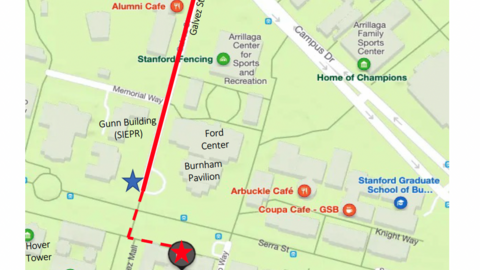
The closest drop-off location is: Gunn Building, 366 Galvez St., Stanford, CA 94305
From Galvez, walk South towards the Hoover Tower, and turn left at the intersection, onto Jane Stanford Way. Encina Hall is the large four-story building on your right. Enter through the main door, at the top of the stairs, and head up to the 2nd floor. An accessible entrance and ramp are located on the right side of Encina Hall, at the West Entrance.
Encina Hall
616 Jane Stanford Way
Stanford, CA 94305-6055
0
fafchamp@stanford.edu
Senior Fellow Emeritus at the Freeman Spogli Institute for International Studies
Professor, by courtesy, of Economics
marcel_fafchamps_2025.jpg
Marcel Fafchamps is a Senior Fellow Emeritus at the Freeman Spogli Institute for International Studies (FSI) and a member of the Center on Democracy, Development and the Rule of Law. Previously, he was the Satre Family Senior Fellow at FSI. Fafchamps is a professor (by courtesy) for the Department of Economics at Stanford University. His research interests include economic development, market institutions, social networks, and behavioral economics — with a special focus on Africa and South Asia.
Prior to joining FSI, from 1999-2013, Fafchamps served as professor of development economics in the Department of Economics at Oxford University. He also served as deputy director and then co-director of the Center for the Study of African Economies. From 1989 to 1996, Fafchamps was an assistant professor with the Food Research Institute at Stanford University. Following the closure of the Institute, he taught for two years at the Department of Economics. For the 1998-1999 academic year, Fafchamps was on sabbatical leave at the research department of the World Bank. Before pursuing his PhD in 1986, Fafchamps was based in Addis Ababa, Ethiopia, for 5 years during his employment with the International Labour Organization, a United Nations agency that oversees employment, income distribution, and vocational training in Africa.
He has authored two books: Market Institutions in Sub-Saharan Africa: Theory and Evidence (MIT Press, 2004) and Rural Poverty, Risk, and Development (Elgar Press, 2003), and has published numerous articles in academic journals.
Fafchamps served as the editor-in-chief of Economic Development and Cultural Change until 2020. Previously, he had served as chief editor of the Journal of African Economies from 2000 to 2013, and as associate editor of the Economic Journal, the Journal of Development Economics, Economic Development and Cultural Change, the American Journal of Agricultural Economics, and the Revue d'Economie du Développement.
He is a research associate of the National Bureau of Economic Research, an affiliated professor with J-PAL, a senior fellow with the Bureau for Research and Economic Analysis of Development, a research fellow with IZA, Germany, and with the Center for Economic and Policy Research, UK, and an affiliate with the University of California’s Center for Effective Global Action.
Fafchamps has degrees in Law and in Economics from the Université Catholique de Louvain. He holds a PhD in Agricultural and Resource Economics from the University of California, Berkeley.
We experimentally test two seminal hypotheses on the impact of competition on firms' management upgrading. In a first experiment, we protect firms from labor market competition by reducing the risk that a freshly trained manager would be poached by a rival firm. We find that this protection does not increase firms' investment in management training. In a second suite of experiments, we boost perceived product market competition by informing firms either that rival firms have received management training or that foreign firms are gaining easier access to the domestic market. Again, we find no evidence that this increases firms' average willingness to invest in management training. To explain why firms do not feel threatened by competition, we present evidence suggesting that, in contrast to commonly held assumptions, firm managers in our setting hold a mental model of competition that posits positive — instead of negative — spillovers, arising primarily from differentiation.
Public sectors that are plagued by corruption and poor performance hinder the development of low-income countries. Populations globally tend to perceive the police as the most corrupt sector of government, partly due to their frequent interactions with citizens. Only once corruption is reduced can trust in institutions be restored, enabling the development of countries.
Therefore, Associate Professor Danila Serra at Texas A&M University and her collaborators decided to investigate whether a training program could incentivize traffic officers to behave more ethically. Their study, presented by Serra at a recent CDDRL seminar, was conducted in Ghana, where almost 60% of people perceive the police as corrupt.
The program, titled “Proud to Belong,” focused on creating a new group identity of officers as ‘agents of change.' It also prompted the officers to focus on their original reasons for joining the police, rebuilding their intrinsic motivations to ultimately reduce their participation in corruption. The training was implemented through a randomized control trial in randomly selected traffic police districts in the Greater Accra Region.
The researchers first measured the program’s effectiveness through an incentivized cheating game played by officers both prior to the training and 20 months afterward. The study found a significant reduction in the unethical behavior of officers playing the game, indicating that the program successfully strengthened their values.
To understand whether these impacts extend to field behavior, Serra and her team measured police field activity in the months before and after the program’s implementation. They analyzed administrative data such as the number of drivers sent to court, those required to pay a fine, and the fine amounts. The team hypothesized that if bribes were acting as substitutes for formal law enforcement, an increase in field activity would indicate a decline in officer corruption.
This data demonstrated that the program had a significant positive impact on officer behavior, but only during the first 3 months post-training. To reconcile the limits of this short-term impact with the long-term benefits implied by the cheating game, researchers determined that this may be because of the need for reinforcements following the program. For example, an award ceremony honoring the officers’ participation in the program, 9 months post-training, revived the positive impact on field behavior. Evidence also suggests that, 20 months after the training, low-rank officers in treatment districts were less likely to have been promoted, hinting at structural problems preventing the end of corruption.
The program designed by Serra and her collaborators demonstrates that it is possible to encourage more ethical behavior among bureaucrats through targeted training, offering a promising tool for reducing corruption. However, sustained training, ongoing reinforcement, and support from higher-ranking officers are necessary to maintain these behavioral changes and ensure lasting impact.
Read More
News
“No Peace in Sight:” Ideology, Territory, and the Stalemate in the Russo-Ukraine War
In a recent REDS Seminar, Syracuse University Professor of Political Science Brian Taylor examined the state of the war, the prospects for peace, and the political dynamics shaping both Ukrainian resistance and Russian aggression.
How Transnational Repression Impacts Exiled Opposition
CDDRL Postdoctoral Fellow Ivetta Sergeeva’s research on the Russian diaspora’s willingness to donate to oppositional organizations demonstrates that the criminalization of groups can incentivize greater donor support among emigrants, contrary to the Putin regime’s intentions.
Does Electoral Affirmative Action Worsen Candidate Quality?
In the wake of widespread challenges to affirmative action policy, Stanford Political Scientist Soledad Artiz Prillaman’s research challenges the notion that electoral quotas for minority representation weaken candidate quality.
Danila Serra presented her research in a CDDRL seminar on May 8, 2025. | Soraya Johnson
All News button
1
Subtitle
Associate Professor at Texas A&M University Danila Serra’s field research on the impacts of police ethics training provides hope for reducing corruption and restoring public faith in state institutions.
Adam is a Researcher at the Center on Democracy, Development and the Rule of Law. His research focuses on democracy and conflict in divided societies, particularly in the Horn of Africa, South Asia, the Levant, and the United States. He received a Ph.D. in Political Science from UC San Diego and a B.A. from UC Berkeley.
We examine how social stigma affects the willingness of low-income individuals to apply for financial support. After completing tasks to earn income in the lab, participants are given the opportunity to apply for a transfer from a social fund earmarked for the lowest earners. We experimentally vary whether the application is public or private and whether the funds come from the experimenters or other participants. We find that making the application public reduces take-up by 31 percentage points. Adding peer funding leads to a further 10 percentage point drop. These effects are strongest when income is earned through effort instead of a lottery, and when both public visibility and peer funding are present. The findings are not driven by altruistic or redistributive preferences, but perspective taking makes participants more sensitive to the public application treatment. Our findings suggest that ensuring privacy in the application process helps increase access to income support programs.
We examine the impact of ethics and integrity training on police officers in Ghana through a randomized field experiment. The program, informed by theoretical work on the role of identity and motivation in organizations, aimed to re-activate intrinsic motivations to serve the public, and to create a new shared identity of "Agent of Change." Data generated by an endline survey conducted 20 months post training, show that the program positively affected officers' values and beliefs regarding on-the-job unethical behavior and improved their attitudes toward citizens. The training also lowered officers' propensity to behave unethically, as measured by an incentivized cheating game conducted at endline. District-level administrative data for a subsample of districts are consistent with a significant impact of the program on officers' field behavior in the short-run.
ABOUT THE SPEAKER
Danila Serra is Associate Professor of Economics at Texas A&M University. She received her PhD in Economics from the University of Oxford. She is an applied behavioral economist employing experimental methods to address policy-relevant questions in political economy, development, education, and gender economics. Her work has been funded by the Alfred P. Sloan Foundation, the Russell Sage Foundation, the Spencer Foundation, the World Bank, the IZA G²LM|LIC program, the Social Science Research Council (SSRC), the Abdul Latif Jameel Poverty Action Lab (JPAL) and the Arnold Foundation. In 2017, she was the inaugural recipient of the Vernon Smith Ascending Scholar Prize, given by the International Foundation for Research in Experimental Economics (IFREE) to an exceptional scholar using experiments in economics research.
Virtual to Public. Only those with an active Stanford ID with access to the William J. Perry Conference Room in Encina Hall may attend in person.
Virtual to Public. If prompted for a password, use: 123456 Only those with an active Stanford ID with access to the William J. Perry Conference Room in Encina Hall may attend in person.
Supply chains can be surprisingly complex. In many low- and middle-income settings, large companies often rely on networks of small, independent distributors who travel by foot to sell consumer goods to otherwise hard-to-reach customers (Kruijff et al. 2024). These ‘micro-distributors’ operate at the far edge of the supply chain, with no formal employment contracts, thin profit margins, and high levels of economic risk.
In a field experiment in Kenya, we partnered with one of the world’s largest food manufacturers (pseudonymously “FoodCo”) to evaluate whether investment-appropriate financing contracts could help their independent distributors improve their business performance. We found that tailoring repayment terms to better share risk and rewards—compared to a standard, rigid debt contract—significantly boosted distributors’ profits. Crucially, these more flexible contracts took advantage of detailed administrative data on monthly performance. These findings underscore the promise of improved observability enabled by digitisation: with richer data, financial contracts can be designed to incorporate greater risk-sharing (Fischer 2013, Meki 2024), potentially opening new opportunities for mutually beneficial investments.
All Publications button
1
Publication Type
Journal Articles
Publication Date
Subtitle
Flexible financing for ‘last-mile’ distributors boosted profits across a food supply chain in Kenya.
For millennia, land has been a symbol of wealth and privilege. But the true power of land ownership is even greater than we might think. Who owns the land determines whether a society will be equal or unequal, whether it will develop or decline, and whether it will safeguard or sacrifice its environment. Modern history has been defined by land reallocation on a massive scale. From the 1500s on, European colonial powers and new nation-states shifted indigenous lands into the hands of settlers. The 1900s brought new waves of land appropriation, from Soviet and Maoist collectivization to initiatives turning large estates over to family farmers. The shuffle continues today as governments vie for power and prosperity by choosing who should get land. Drawing on a career’s worth of original research and on-the-ground fieldwork, Land Power shows that choices about who owns the land have locked in poverty, sexism, racism, and climate crisis—and that what we do with the land today can change our collective fate.
ABOUT THE SPEAKER
Michael Albertus is a Professor of Political Science at the University of Chicago and the author of five books. His research examines democracy and dictatorship, inequality and redistribution, property rights, and civil conflict. His newest book, Land Power: Who Has It, Who Doesn't, and How That Determines the Fate of Societies, was published by Basic Books in January 2025. In addition to his books, Albertus is also the author of nearly 30 peer-reviewed journal articles, including at flagship journals like the American Journal of Political Science, Journal of Politics, and World Politics. The defining features of Albertus' work are his engagement with big questions and puzzles and the ability to join big data and cutting-edge research methods with original, deep on-the-ground fieldwork everywhere from government offices to archives and farm fields. He has conducted fieldwork throughout the Americas, southern Europe, South Africa, and elsewhere. His books and articles have won numerous awards and shifted conventional understandings of democracy, authoritarianism, and the consequences of how humans occupy and relate to the land.
Virtual to Public. Only those with an active Stanford ID with access to the Philippines Conference Room in Encina Hall may attend in person.
This talk will examine how technology can amplify deliberative democracy to foster a more informed and engaged society. Drawing on findings from two nationally representative online Deliberative Polls called America in One Room, the talk will demonstrate how online deliberation is alleviating polarization and producing lasting effects with hopes for a more deliberative society. The talk will also explore how the AI-assisted Stanford Online Deliberation Platform, which has logged over 100,000 deliberation hours in over 35 countries and 25 languages, has been used to facilitate high-quality, structured discussions on complex issues, including democratic reform and the implications of generative AI and metaverse governance. By integrating insights from research and practice, the session will demonstrate how deliberation can empower voters, improve decision-making, and counteract the polarization threatening democracy.
ABOUT THE SPEAKER
Alice Siu received her Ph.D. from the Department of Communication at Stanford University, with a focus in political communication, deliberative democracy, and public opinion, and her B.A. degrees in Economics and Public Policy and M.A. degree in Political Science, also from Stanford.
Siu has advised policymakers and political leaders around the world at various levels of government, including leaders in China, Brazil, and Argentina. Her research interests in deliberative democracy include what happens inside deliberation, such as examining the effects of socio-economic class in deliberation, the quality of deliberation, and the quality of arguments in deliberation.
Virtual to Public. Only those with an active Stanford ID with access to Room E008 in Encina Hall may attend in person.
Hesham Sallam
Hesham Sallam
Virtual to Public. Only those with an active Stanford ID with access to Encina E008 in Encina Hall may attend in person.
Encina Hall, E103
616 Jane Stanford Way
Stanford, CA 94305
0
asiu@stanford.edu
Senior Research Scholar
alice_siu.png
Siu received her Ph.D. from the Department of Communication at Stanford University, with a focus in political communication, deliberative democracy, and public opinion, and her B.A. degrees in Economics and Public Policy and M.A. degree in Political Science, also from Stanford.
Siu has advised policymakers and political leaders around the world, at various levels of government, including leaders in China, Brazil, and Argentina. Her research interests in deliberative democracy include what happens inside deliberation, such as examining the effects of socio-economic class in deliberation, the quality of deliberation, and the quality of arguments in deliberation.