-

**Please note all CDDRL events are scheduled using the Pacific Time Zone

About the Event: This book examines the creation and consequences of executive constraints in authoritarian regimes. How do some dictatorships become institutionalized ruled-based systems, while others remain heavily personalist? Once implemented, do executive constraints actually play an effective role in promoting autocratic stability? To understand patterns of regime institutionalization, I study the emergence of constitutional term limits and succession procedures, as well as elite power-sharing within presidential cabinets. This project employs a wide range of evidence, including an original time-series dataset of 46 countries in Sub-Saharan Africa from 1960 to 2010, formal theory, and case studies. Altogether this book paints a picture of how some dictatorships evolve from personalist strongman rule to institutionalized regimes. 


Image
Anne Meng
About the Speaker: Anne Meng is an Assistant Professor in the Politics Department at the University of Virginia. Her research centers on authoritarian politics, institutions, and elite powersharing. Her new book, Constraining Dictatorship: From Personalized Rule to Institutionalized Regimes, examines how executive constraints become established in dictatorships, particularly within constitutions and presidential cabinets. Her new work focuses on autocratic backsliding and executive aggrandizement in non-democracies. She has also published articles on authoritarian ruling parties, term limit evasion, and leadership succession. She received her Ph.D. in Political Science from the University of California, Berkeley. 

Online, via Zoom: REGISTER

Anne Meng Assistant Professor in the Politics Department at the University of Virginia
Seminars
Paragraphs

The internet economy has produced digital platforms of enormous economic and social significance. These platforms—specifically, Google, Facebook, Amazon, Twitter, and Apple—now play central roles in how millions of Americans obtain information, spend their money, communicate with fellow citizens, and earn their livelihoods. Their reach is also felt globally, extending to many countries around the world. They have amassed the economic, social, and political influence that very few private entities have ever obtained previously. Accordingly, they demand careful consideration from American policymakers, who should soberly assess whether the nation’s current laws and regulatory institutions are adequately equipped to protect Americans against potential abuses by platform companies.

The Program on Democracy and the Internet at Stanford University convened a working group in January 2020 to consider the scale, scope, and power exhibited by the digital platforms, study the potential harms they cause, and, if appropriate, recommend remedial policies. The group included a diverse and interdisciplinary group of scholars, some of whom had spent many years dealing with antitrust and technology issues.

All Publications button
1
Publication Type
White Papers
Publication Date
Authors
Francis Fukuyama
Ashish Goel
Marietje Schaake
Age Range
Secondary - Community College
Paragraphs

ANTITRUST AND PRIVACY CONCERNS are two of the most high-profile topics on the tech policy agenda. Checks and balances to counteract the power of companies such as Google, Amazon, and Facebook are under consideration in Congress, though a polarized political environment is a hindrance. But a domestic approach to tech policy will be insufficient, as the users of the large American tech companies are predominantly outside the United States. We need to point the way toward a transnational policy effort that puts democratic principles and basic human rights above the commercial interests of these private companies.

These issues are central to the eight-week Stanford University course, “Technology and the 2020 Election: How Silicon Valley Technologies Affect Elections and Shape Democracy.” The joint class for Stanford students and Stanford’s Continuing Studies Community enrolls a cross-generational population of more than 400 students from around the world.

All Publications button
1
Publication Type
White Papers
Publication Date
Authors
Marietje Schaake
Rob Reich
Authors
Graham Webster
News Type
Q&As
Date
Paragraphs

Graham Webster leads the DigiChina Project, which translates and explains Chinese technology policy for an English-language audience so that debates and decisions regarding cyber policy are factual and based on primary sources of information.  

Housed within Stanford’s Program on Geopolitics, Technology, and Governance (GTG) and in partnership with New America, DigiChina and its community of experts have already published more than 80 translations and analyses of public policy documents, laws, regulations and political speeches and are creating an open-access knowledge base for policy-makers, academics, and members of the tech industry who need insight into the choices China makes regarding technology.

Q. Why is this work important?

A lot of tech is produced in China so it’s important to understand their policies. And in Washington, D.C., you hear a lot of people say, “Well, you can’t know what China’s doing on tech policy. It’s all a secret.” But while China’s political system is often opaque, if you happen to read Chinese, there’s a lot that’s publicly available and can explain what the Chinese government is thinking and planning.

With our network of experts, DigiChina works at the intersection of two policy challenges. One is how do we deal with high technology, and the questions around economic competitiveness, personal autonomy and the security risks that our dependence on tech creates.

The other challenge is, from a US government, business or values perspective, what needs to be done about the increased prominence and power of the Chinese government and its economic, technological and military capabilities.

These questions cut across tech sectors from IT infrastructure to data-driven automation, and cutting-edge developments in quantum technology, biotech, and other fields of research.

Q: How was DigiChina started?

A number of us were working at different organizations, think tanks, consultancies and universities and we all had an interest in explaining the laws and the bureaucratic language to others who aren’t Chinese policy specialists or don’t have the language skills.  

We started working informally at first and then reached out to New America, which is an innovative type of think tank combining research, innovation, and policy thinking on challenges arising during this time of rapid technological and social change. Under the New America umbrella, and through partnerships with the Leiden Asia Centre, a leading European research center based at the University of Leiden, and the Ethics and Governance of Artificial Intelligence Initiative at Harvard and MIT, we were able to build out the program and increase the number of experts in our network.

Q: Who is involved in DigiChina and what types of expertise do you and others bring to the project?

More than 40 people have contributed to DigiChina publications so far, and it’s a pretty diverse group. There are professors and think tank scholars, students and early-career professionals, and experienced government and industry analysts. Everyone has a different part of the picture they can contribute, and we reach out to other experts both in China and around the world when we need more context.

As for me, I was working at Yale Law School’s China Center when I was roped into what would become DigiChina and had spent several years in Beijing and New Haven working more generally on US-China relations and Track 2 dialogues, where experts and former officials from the two countries meet to take on tough problems. As a journalist and graduate student, I had long studied technology and politics in China, and I took on a coordinating role with DigiChina as I turned back to that pursuit full time.

Stanford is an ideal home because the university is a powerhouse in Chinese studies and an epicenter of global digital development.
Graham Webster
Editor in Chief, DigiChina Project

Q. Are there other organizations involved as well?

We have a strong tie to the Leiden Asia Centre at the University of Leiden in the Netherlands, where one of DigiChina’s cofounders, Rogier Creemers, is a professor, and where staff and student researchers have contributed to existing and forthcoming work. We coordinate with a number of other groups on translations, and the project benefits greatly from the time and knowledge contributed by employees of various institutions. I hope that network will increasingly be a resource for contributors and their colleagues.

The project is currently supported by the Ford Foundation, which works to strengthen democratic values, promote international cooperation and advance human achievement around the world. A generous grant from Ford will keep the lights on for two years, giving us the ability to build our open-access resource and, with further fundraising, the potential to bring on more in-house editorial and research staff.

We hope researchers and policy thinkers, regardless of their approaches or ideologies, can use our translations to engage with the real and messy evolution of Chinese tech policy.
Graham Webster
Editor in Chief, DigiChina Project

Q. Do you have plans to grow the project?

We are working to build an accessible online database so researchers and scholars can review primary source documents in both the original Chinese and in English. And we are working toward a knowledge base with background entries on key institutions, legal concepts, and phrases so that a broader audience can situate things like Chinese legal language in their actual context. Providing access to this information is especially important now and in the near future, whether we have a second Trump Administration or a Biden Administration in the United States.

On any number of policy challenges, effective measures are going to depend on going beyond caricatures like an “AI arms race,” “cyber authoritarianism,” or “decoupling,” which provide useful frameworks for debate but can tend to prejudge the outcomes of a huge number of developments. We hope researchers and policy thinkers, regardless of their approaches or ideologies, can use this work to engage with the real and messy evolution of Chinese tech policy.

Hero Image
Graham Webster Q&A
All News button
1
Subtitle

Webster explains how DigiChina makes Chinese tech policy accessible for English speakers

Authors
News Type
News
Date
Paragraphs

On September 29, the APARC China Program hosted Thomas Fingar and Stephen Stedman for the program “Rebuilding International Institutions.” The program, which was moderated by China Program Director Jean Oi, examined the future of international institutions such as the United Nations (UN), World Trade Organization (WTO), and World Health Organization (WHO) in our evolving global political landscape. While Fingar and Stedman acknowledged that such institutions facilitated attainment of unprecedented peace and prosperity after WWII, they also asked difficult questions: Are these institutions still adequate? And if not, how will we change them?

Shorenstein APARC Fellow Thomas Fingar kicked off the session by asking whether or not US-China tensions would impede cooperation on major global challenges, or if those challenges were so serious as to render such rivalries immaterial. Perhaps the most obvious example of such a crisis is the current COVID-19 pandemic. The efforts to curb the virus’ spread not only by individual countries, but also by international organizations like the WHO, have proven largely inadequate. According to Fingar, our existing institutions need to be reformed or supplemented to deal with these types of threats. However, such an overhaul of our international systems will be difficult, he says.

How, then, will we go about such a massive project? Stephen Stedman, Deputy Director at Stanford’s Center on Democracy, Development, and the Rule of Law (CDDRL), responded by explaining that the current failure of international cooperation makes such undertakings tough. Globalization has been a double-edged sword: On one hand, more contact, perhaps inherently, leads to increased tension. The resurgence of traditional notions of sovereignty in 2010, kickstarted by the opposition of countries like Russia and China to what was seen as UN overreaching, has led to a reduction of international cooperation overall. On the other hand, Fingar posits that our interconnectedness may force us toward cooperation despite rivalries as we face more and more transnational threats. International institutions create rules to organize and manage our many interconnected relationships so that we can deal with our problems effectively and reduce friction.

Stedman also pointed to the upcoming US elections and the major impact their outcome will have on how these problems are addressed—or not. In the last four year, the United States has pulled back significantly from international institutions and agreements, leaving a gap that China has started to fill. Furthermore, despite the US’s retreat from international responsibility, the country still remains a critical actor in global initiatives. China’s embrace of a global leadership role is not inherently negative, but its future relationship with the US will need to be “managed in a way that you get greater cooperation and not just paralysis.” Stedman says that it is likely that progress will need to be made on a bilateral front in order to have productive conversations about international issues with China.

Concluding on an optimistic note, Fingar voiced his hope that the current tensions and negative perceptions between rivals might ultimately “be mitigated by success in dealing with a common problem,” because “experience does shape perceptions.”

A video recording of this program is available upon request. Please contact Callista Wells, China Program Coordinator at cvwells@stanford.edu with any inquiries.

Read More

View of building roof in the Forbidden City complex and the Beijing skyline in the background
News

New Fellowship on China Policy Seeks to Strengthen U.S.-China Relations

Stanford University’s Shorenstein Asia-Pacific Center invites applications for the inaugural 2021-22 China Policy Fellowship from experts with research experience on issues vital to the U.S. China policy agenda and influence in the policymaking process.
New Fellowship on China Policy Seeks to Strengthen U.S.-China Relations
Cover of the book Fateful Decisions: Choices That Will Shape China's Future
News

Thomas Fingar and Jean Oi Analyze the Choices and Challenges Facing China’s Leaders

Fingar and Oi joined the National Committee on U.S.-China Relations to discuss their edited volume, ‘Fateful Decisions: Choices that Will Shape China’s Future.’
Thomas Fingar and Jean Oi Analyze the Choices and Challenges Facing China’s Leaders
Hero Image
Photograph of the UN building in Geneva, Switzerland Image by Mat Reding on Unsplash
All News button
1
Subtitle

Fingar and Stedman spoke as part of the APARC program “Rebuilding International Institutions,” which examined the future of international institutions such as the United Nations (UN), World Trade Organization (WTO), and World Health Organization (WHO) in our evolving global political landscape.

Date Label
Paragraphs

THE EMERGENCE OF A DIGITAL SPHERE where public debate takes place raises profound questions about the connection between online information and polarization, echo chambers, and filter bubbles. Does the information ecosystem created by social media companies support the conditions necessary for a healthy democracy? Is it different from other media? These are particularly urgent questions as the United States approaches a contentious 2020 election during the COVID-19 pandemic.

The influence of technology and AI-curated information on America’s democratic process is being examined in the eight-week Stanford University course, “Technology and the 2020 Election: How Silicon Valley Technologies Affect Elections and Shape Democracy.” This issue brief focuses on the class session on “Echo Chambers, Filter Bubbles, and Polarization,” with guest experts Joan Donovan and Joshua Tucker.

All Publications button
1
Publication Type
Policy Briefs
Publication Date
Authors
Marietje Schaake
Rob Reich
-

This event is open to Stanford undergraduate students only. 

Image
CDDRL Flyer 2021

The Center on Democracy, Development, and the Rule of Law (CDDRL) will be accepting applications from eligible juniors on who are interested in writing their senior thesis on a subject touching upon democracy, economic development, and rule of law (DDRL) from any university department.  The application period opens on January 11, 2021 and runs through February 12, 2021.   CDDRL faculty and current honors students will be present to discuss the program and answer any questions.

For more information on the Fisher Family CDDRL Honors Program, please click here.

**Please note all CDDRL events are scheduled using the Pacific Time Zone

 Online, via Zoom: REGISTER

CDDRL
Encina Hall, C152
616 Jane Stanford Way
Stanford, CA 94305-6055

(650) 725-2705 (650) 724-2996
0
Senior Fellow at the Freeman Spogli Institute for International Studies
Professor, by courtesy, of Political Science
Stedman_Steve.jpg PhD

Stephen Stedman is a Senior Fellow at the Freeman Spogli Institute for International Studies (FSI) and the Center on Democracy, Development and the Rule of Law (CDDRL), an affiliated faculty member at CISAC, and professor of political science (by courtesy) at Stanford University. He is director of CDDRL's Fisher Family Honors Program in Democracy, Development and Rule of Law, and will be faculty director of the Program on International Relations in the School of Humanities and Sciences effective Fall 2025.

In 2011-12 Professor Stedman served as the Director for the Global Commission on Elections, Democracy, and Security, a body of eminent persons tasked with developing recommendations on promoting and protecting the integrity of elections and international electoral assistance. The Commission is a joint project of the Kofi Annan Foundation and International IDEA, an intergovernmental organization that works on international democracy and electoral assistance.

In 2003-04 Professor Stedman was Research Director of the United Nations High-level Panel on Threats, Challenges and Change and was a principal drafter of the Panel’s report, A More Secure World: Our Shared Responsibility.

In 2005 he served as Assistant Secretary-General and Special Advisor to the Secretary- General of the United Nations, with responsibility for working with governments to adopt the Panel’s recommendations for strengthening collective security and for implementing changes within the United Nations Secretariat, including the creation of a Peacebuilding Support Office, a Counter Terrorism Task Force, and a Policy Committee to act as a cabinet to the Secretary-General.

His most recent book, with Bruce Jones and Carlos Pascual, is Power and Responsibility: Creating International Order in an Era of Transnational Threats (Washington DC: Brookings Institution, 2009).

Director, Fisher Family Honors Program in Democracy, Development and Rule of Law
Director, Program in International Relations
Affiliated faculty at the Center for International Security and Cooperation
Date Label
Deputy Director, CDDRL

Encina Hall, C150
616 Jane Stanford Way
Stanford, CA 94305

0
Center Fellow, Freeman Spogli Institute for International Studies
didi_kuo_2023.jpg

Didi Kuo is a Center Fellow at the Freeman Spogli Institute for International Studies (FSI) at Stanford University. She is a scholar of comparative politics with a focus on democratization, corruption and clientelism, political parties and institutions, and political reform. She is the author of The Great Retreat: How Political Parties Should Behave and Why They Don’t (Oxford University Press) and Clientelism, Capitalism, and Democracy: the rise of programmatic politics in the United States and Britain (Cambridge University Press, 2018).

She has been at Stanford since 2013 as the manager of the Program on American Democracy in Comparative Perspective and is co-director of the Fisher Family Honors Program at CDDRL. She was an Eric and Wendy Schmidt Fellow at New America and is a non-resident fellow with the Carnegie Endowment for International Peace. She received a PhD in political science from Harvard University, an MSc in Economic and Social History from Oxford University, where she studied as a Marshall Scholar, and a BA from Emory University.

Date Label
Associate Director for Research, CDDRL
Paragraphs

THE 2020 ELECTION IN THE UNITED STATES will take place on November 3 in the midst of a global pandemic, economic downturn, social unrest, political polarization, and a sudden shift in the balance of power in the U.S Supreme Court. On top of these issues, the technological layer impacting the public debate, as well as the electoral process itself, may well determine the election outcome. The eight-week Stanford University course, “Technology and the 2020 Election: How Silicon Valley Technologies Affect Elections and Shape Democracy,” examines the influence of technology on America’s democratic process, revealing how digital technologies are shaping the public debate and the election.

The eight-week Stanford University course, “Technology and the 2020 Election: How Silicon Valley Technologies Affect Elections and Shape Democracy,” examines the influence of technology on America’s democratic process, revealing how digital technologies are shaping the public debate and the election...


All Publications button
1
Publication Type
Policy Briefs
Publication Date
Authors
Marietje Schaake
Rob Reich
-

Image
election debrief event stanford

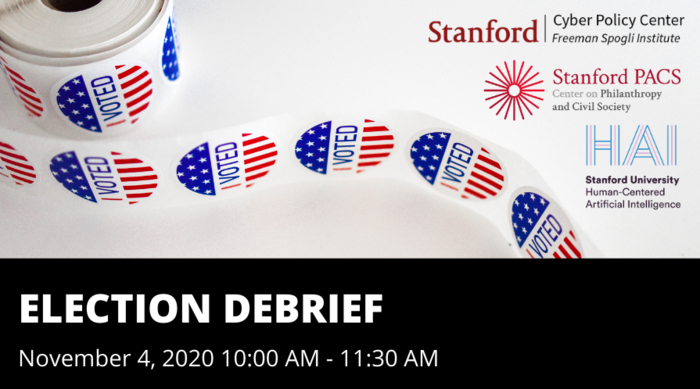
The US 2020 elections have been fraught with challenges, including the rise of "fake news” and threats of foreign intervention emerging after 2016, ongoing concerns of racially-targeted disinformation, and new threats related to the COVID-19 pandemic. Digital technologies will have played a more important role in the 2020 elections than ever before.

On November 4th at 10am PST, join the team at the Stanford Cyber Policy Center, in collaboration with the Freeman Spogli Institute, Stanford’s Institute for Human-Centered Artificial Intelligence, and the Stanford Center on Philanthropy and Civil Society, for a day-after discussion of the role of digital technologies in the 2020 Elections.  Speakers will include Nathaniel Persily, faculty co-director of the Cyber Policy Center and Director of the Program on Democracy and the Internet, Marietje Schaake, the Center’s International Policy Director and International Policy Fellow at Stanford’s Institute for Human-Centered Artificial Intelligence, Alex Stamos, Director of the Cyber Center’s Internet Observatory and former Chief Security Officer at Facebook and Yahoo, Renee DiResta, Research Manager at the Internet Observatory, Andrew Grotto, Director of the Center’s Program on Geopolitics, Technology, and Governance, and Rob Reich, Faculty Director of the Center for Ethics in Society, in conversation with Kelly Born, the Center’s Executive Director.

Please note that we will also have a YouTube livestream available for potential overflow or for anyone having issues connecting via Zoom: https://youtu.be/H2k62-JCAgE


0
renee-diresta.jpg

Renée DiResta is the former Research Manager at the Stanford Internet Observatory. She investigates the spread of malign narratives across social networks, and assists policymakers in understanding and responding to the problem. She has advised Congress, the State Department, and other academic, civic, and business organizations, and has studied disinformation and computational propaganda in the context of pseudoscience conspiracies, terrorism, and state-sponsored information warfare.

You can see a full list of Renée's writing and speeches on her website: www.reneediresta.com or follow her @noupside.


Former Research Manager, Stanford Internet Observatory

CISAC
Stanford University
Encina Hall, C428

Stanford, CA 94305-6165

(650) 723-9866
0
Andrew Grotto

Andrew J. Grotto is a research scholar at the Center for International Security and Cooperation at Stanford University.

Grotto’s research interests center on the national security and international economic dimensions of America’s global leadership in information technology innovation, and its growing reliance on this innovation for its economic and social life. He is particularly interested in the allocation of responsibility between the government and the private sector for defending against cyber threats, especially as it pertains to critical infrastructure; cyber-enabled information operations as both a threat to, and a tool of statecraft for, liberal democracies; opportunities and constraints facing offensive cyber operations as a tool of statecraft, especially those relating to norms of sovereignty in a digitally connected world; and governance of global trade in information technologies.

Before coming to Stanford, Grotto was the Senior Director for Cybersecurity Policy at the White House in both the Obama and Trump Administrations. His portfolio spanned a range of cyber policy issues, including defense of the financial services, energy, communications, transportation, health care, electoral infrastructure, and other vital critical infrastructure sectors; cybersecurity risk management policies for federal networks; consumer cybersecurity; and cyber incident response policy and incident management. He also coordinated development and execution of technology policy topics with a nexus to cyber policy, such as encryption, surveillance, privacy, and the national security dimensions of artificial intelligence and machine learning. 

At the White House, he played a key role in shaping President Obama’s Cybersecurity National Action Plan and driving its implementation. He was also the principal architect of President Trump’s cybersecurity executive order, “Strengthening the Cybersecurity of Federal Networks and Critical Infrastructure.”

Grotto joined the White House after serving as Senior Advisor for Technology Policy to Commerce Secretary Penny Pritzker, advising Pritzker on all aspects of technology policy, including Internet of Things, net neutrality, privacy, national security reviews of foreign investment in the U.S. technology sector, and international developments affecting the competitiveness of the U.S. technology sector.

Grotto worked on Capitol Hill prior to the Executive Branch, as a member of the professional staff of the Senate Select Committee on Intelligence. He served as then-Chairman Dianne Feinstein’s lead staff overseeing cyber-related activities of the intelligence community and all aspects of NSA’s mission. He led the negotiation and drafting of the information sharing title of the Cybersecurity Act of 2012, which later served as the foundation for the Cybersecurity Information Sharing Act that President Obama signed in 2015. He also served as committee designee first for Senator Sheldon Whitehouse and later for Senator Kent Conrad, advising the senators on oversight of the intelligence community, including of covert action programs, and was a contributing author of the “Committee Study of the Central Intelligence Agency’s Detention and Interrogation Program.”

Before his time on Capitol Hill, Grotto was a Senior National Security Analyst at the Center for American Progress, where his research and writing focused on U.S. policy towards nuclear weapons - how to prevent their spread, and their role in U.S. national security strategy.

Grotto received his JD from the University of California at Berkeley, his MPA from Harvard University, and his BA from the University of Kentucky.

Research Scholar, Center for International Security and Cooperation
Director, Program on Geopolitics, Technology, and Governance
Date Label
Stanford Law School Neukom Building, Room N230 Stanford, CA 94305
650-725-9875
0
James B. McClatchy Professor of Law at Stanford Law School
Senior Fellow, Freeman Spogli Institute
Professor, by courtesy, Political Science
Professor, by courtesy, Communication
headshot_3.jpg

Nathaniel Persily is the James B. McClatchy Professor of Law at Stanford Law School, with appointments in the departments of Political Science, Communication, and FSI.  Prior to joining Stanford, Professor Persily taught at Columbia and the University of Pennsylvania Law School, and as a visiting professor at Harvard, NYU, Princeton, the University of Amsterdam, and the University of Melbourne. Professor Persily’s scholarship and legal practice focus on American election law or what is sometimes called the “law of democracy,” which addresses issues such as voting rights, political parties, campaign finance, redistricting, and election administration. He has served as a special master or court-appointed expert to craft congressional or legislative districting plans for Georgia, Maryland, Connecticut, New York, North Carolina, and Pennsylvania.  He also served as the Senior Research Director for the Presidential Commission on Election Administration. In addition to dozens of articles (many of which have been cited by the Supreme Court) on the legal regulation of political parties, issues surrounding the census and redistricting process, voting rights, and campaign finance reform, Professor Persily is coauthor of the leading election law casebook, The Law of Democracy (Foundation Press, 5th ed., 2016), with Samuel Issacharoff, Pamela Karlan, and Richard Pildes. His current work, for which he has been honored as a Guggenheim Fellow, Andrew Carnegie Fellow, and a Fellow at the Center for Advanced Study in the Behavioral Sciences, examines the impact of changing technology on political communication, campaigns, and election administration.  He is codirector of the Stanford Program on Democracy and the Internet, and Social Science One, a project to make available to the world’s research community privacy-protected Facebook data to study the impact of social media on democracy.  He is also a member of the American Academy of Arts and Sciences, and a commissioner on the Kofi Annan Commission on Elections and Democracy in the Digital Age.  Along with Professor Charles Stewart III, he recently founded HealthyElections.Org (the Stanford-MIT Healthy Elections Project) which aims to support local election officials in taking the necessary steps during the COVID-19 pandemic to provide safe voting options for the 2020 election. He received a B.A. and M.A. in political science from Yale (1992); a J.D. from Stanford (1998) where he was President of the Stanford Law Review, and a Ph.D. in political science from U.C. Berkeley in 2002.   

CV
Date Label
Rob Reich
0
marietje.schaake

Marietje Schaake is a non-resident Fellow at Stanford’s Cyber Policy Center and at the Institute for Human-Centered AI. She is a columnist for the Financial Times and serves on a number of not-for-profit Boards as well as the UN's High Level Advisory Body on AI. Between 2009-2019 she served as a Member of European Parliament where she worked on trade-, foreign- and tech policy. She is the author of The Tech Coup.


Non-Resident Fellow, Cyber Policy Center
Fellow, Institute for Human-Centered Artificial Intelligence
Date Label
-

Image
October 28 event reset reclaiming the internet for civil society

Image
Reset: Reclaiming the Internet for Civil Society book cover
Digital technologies are linked to a growing number of social and political maladies, including political repression, disinformation, and polarization. Accountability for these technologies is weak, allowing authoritarian rulers and bad actors to exploit the information landscape for their gain. A largely unregulated surveillance industry, innovations in technologies of remote control, dark PR firms, and “hack-for-hire” services feeding off rivers of poorly secured personal data also muddy the waters. This set of serious, democracy-unfriendly challenges calls for a deeper reexamination of our communications ecosystem. 

On October 28th at 10am Pacific Time, join the team at the Stanford Cyber Policy Center, in collaboration with author Ronald J. DeibertEileen Donahoe, Executive Director of the Global Digital Policy Incubator at Stanford University’s Cyber Policy Center, and Larry Diamond, co-lead for the Global Digital Policy Incubator in conversation with Kelly Born, the Center’s Executive Director.


Encina Hall
616 Jane Stanford Way
Stanford, CA 94305-6055

(650) 721-5345 (650) 724-2996
0
eileen_head_shot_2024.jpeg

Eileen Donahoe is the co-founder and an affiliated scholar at the Global Digital Policy Incubator (GDPI) at Stanford University's Center on Democracy, Development and the Rule of Law. (Previously, she served as GDPI’s executive director.) GDPI is a global multi-stakeholder collaboration hub for the development of policies that reinforce human rights and democratic values in a digitized society. Current research priorities include: international trends in AI governance, technical methods for aligning AI with democratic norms and standards, evolution of digital authoritarian policies and practices, and emerging blockchain and AI-enabled tools to support democracy.

Eileen served in the Biden administration as US Special Envoy for Digital Freedom at the Department of State. She also served in the Obama administration as the first US Ambassador to the UN Human Rights Council in Geneva during a period of significant institutional reform and innovation. After the Obama administration, she joined Human Rights Watch as Director of Global Affairs, where she represented the organization worldwide on human rights foreign policy, with special emphasis on digital rights, cybersecurity, and internet governance. Earlier in her career, she was a technology litigator at Fenwick & West in Silicon Valley.

Eileen serves as Vice Chair of the National Endowment for Democracy Board of Directors; on the Carnegie Endowment for International Peace Board of Directors; and on the Dartmouth College Board of Trustees. She is a member of the Global Network Initiative (GNI), the World Economic Forum AI Governance Alliance, and the Resilient Governance and Regulation working group. Previously, she served on the Transatlantic Commission on Election Integrity, the University of Essex Advisory Board on Human Rights, Big Data and Technology, the NDI Designing for Democracy Advisory Board, and the Freedom Online Coalition Advisory Network. Degrees: BA, Dartmouth; J.D., Stanford Law School; MA East Asian Studies, Stanford; M.T.S., Harvard; and Ph.D., Ethics & Social Theory, GTU Cooperative Program with UC Berkeley. She is a member of the Council on Foreign Relations.

CDDRL Affiliated Scholar
Date Label

CDDRL
Stanford University
Encina Hall, C147
616 Jane Stanford Way
Stanford, CA 94305-6055

(650) 724-6448 (650) 723-1928
0
Mosbacher Senior Fellow in Global Democracy at the Freeman Spogli Institute for International Studies
William L. Clayton Senior Fellow at the Hoover Institution
Professor, by courtesy, of Political Science and Sociology
diamond_encina_hall.png MA, PhD

Larry Diamond is the William L. Clayton Senior Fellow at the Hoover Institution, the Mosbacher Senior Fellow in Global Democracy at the Freeman Spogli Institute for International Studies (FSI), and a Bass University Fellow in Undergraduate Education at Stanford University. He is also professor by courtesy of Political Science and Sociology at Stanford, where he lectures and teaches courses on democracy (including an online course on EdX). At the Hoover Institution, he co-leads the Project on Taiwan in the Indo-Pacific Region and participates in the Project on the U.S., China, and the World. At FSI, he is among the core faculty of the Center on Democracy, Development and the Rule of Law, which he directed for six and a half years. He leads FSI’s Israel Studies Program and is a member of the Program on Arab Reform and Development. He also co-leads the Global Digital Policy Incubator, based at FSI’s Cyber Policy Center. He served for 32 years as founding co-editor of the Journal of Democracy.

Diamond’s research focuses on global trends affecting freedom and democracy and on U.S. and international policies to defend and advance democracy. His book, Ill Winds: Saving Democracy from Russian Rage, Chinese Ambition, and American Complacency, analyzes the challenges confronting liberal democracy in the United States and around the world at this potential “hinge in history,” and offers an agenda for strengthening and defending democracy at home and abroad.  A paperback edition with a new preface was released by Penguin in April 2020. His other books include: In Search of Democracy (2016), The Spirit of Democracy (2008), Developing Democracy: Toward Consolidation (1999), Promoting Democracy in the 1990s (1995), and Class, Ethnicity, and Democracy in Nigeria (1989). He has edited or coedited more than fifty books, including China’s Influence and American Interests (2019, with Orville Schell), Silicon Triangle: The United States, China, Taiwan the Global Semiconductor Security (2023, with James O. Ellis Jr. and Orville Schell), and The Troubling State of India’s Democracy (2024, with Sumit Ganguly and Dinsha Mistree).

During 2002–03, Diamond served as a consultant to the US Agency for International Development (USAID) and was a contributing author of its report, Foreign Aid in the National Interest. He has advised and lectured to universities and think tanks around the world, and to the World Bank, the United Nations, the State Department, and other organizations dealing with governance and development. During the first three months of 2004, Diamond served as a senior adviser on governance to the Coalition Provisional Authority in Baghdad. His 2005 book, Squandered Victory: The American Occupation and the Bungled Effort to Bring Democracy to Iraq, was one of the first books to critically analyze America's postwar engagement in Iraq.

Among Diamond’s other edited books are Democracy in Decline?; Democratization and Authoritarianism in the Arab WorldWill China Democratize?; and Liberation Technology: Social Media and the Struggle for Democracy, all edited with Marc F. Plattner; and Politics and Culture in Contemporary Iran, with Abbas Milani. With Juan J. Linz and Seymour Martin Lipset, he edited the series, Democracy in Developing Countries, which helped to shape a new generation of comparative study of democratic development.

Download full-resolution headshot; photo credit: Rod Searcey.

Former Director of the Center on Democracy, Development and the Rule of Law
Faculty Chair, Jan Koum Israel Studies Program
Date Label
Ron Diebert
Subscribe to Sub-Saharan Africa