Health
News Type
News
Date
Paragraphs

In collaboration with TeachAids, Stanford Medicine, and the University of California, San Francisco, SPICE is helping to develop the CoviDB Speaker Series, which seeks to provide free online videos to educate the general public about the ongoing COVID-19 pandemic. SPICE’s work is focused on the development of teacher guides for the Series. Leading the Series is Dr. Piya Sorcar, CEO & Founder, TeachAids. The first three speakers and their topics are Dr. Anurag Mairal, Director of Global Outreach, Stanford Biodesign, “COVID-19 and Global Health: Facts and Myths”; Shuman Ghosemajumder, Global Head of AI at F5, “Cybersecurity and Privacy in the Era of COVID-19”; and Anne Firth Murray, Founding President, Global Fund for Women, “Violence Against Women.”

Read a recent article from The Stanford Daily about this here.


Related articles:

CrashCourse: The Prevention and Treatment of Concussions

2010 Orientation Celebrates FSI’s Research, Educational, and Policy Endeavors

Hero Image
Poster image with a title, two speakers, and five sponsors logos
CoviDB Speaker Series; photo courtesy, TeachAids
All News button
1
Subtitle

In collaboration with TeachAids, Stanford Medicine, and the University of California, San Francisco, SPICE is helping to develop the CoviDB Speaker Series, which seeks to provide free online videos to educate the general public about the ongoing COVID-19 pandemic.

Paragraphs

Recent dramatic and deadly increases in global wildfire activity have increased attention on the causes of wildfires, their consequences, and how risk from fire might be mitigated. Here we bring together data on the changing risk and societal burden of wildfire in the US. We estimate that nearly 50 million homes are currently in the wildland-urban interface in the US, a number increasing by 1 million houses every 3 years. Using a statistical model that links satellite-based fire and smoke data to pollution monitoring stations, we estimate that wildfires have accounted for up to 25% of PM2.5 in recent years across the US, and up to half in some Western regions. We then show that ambient exposure to smoke-based PM2.5 does not follow traditional socioeconomic exposure gradients. Finally, using stylized scenarios, we show that fuels management interventions have large but uncertain impacts on health outcomes, and that future health impacts from climate-change-induced wildfire smoke could approach projected overall increases in temperature-related mortality from climate change. We draw lessons for research and policy.

All Publications button
1
Publication Type
Working Papers
Publication Date
Journal Publisher
The National Bureau of Economic Research
Authors
Sam Heft-Neal
Authors
Callista Wells
News Type
News
Date
Paragraphs

To celebrate its May Release, the Stanford China Program hosted a virtual book launch event for Fateful Decisions: Choices That Will Shape China’s Future (Stanford University Press) on June 2nd. Joining co-authors Thomas Fingar (Shorenstein APARC Fellow, Stanford University) and Jean C. Oi (Director, Stanford China Program; William Haas Professor of Chinese Politics, Stanford University) were contributors Karen Eggleston (Senior Fellow at FSI; Director of the Asia Health Policy Program, Shorenstein APARC, Stanford University), Barry Naughton (Sokwanlok Chair of Chinese International Affairs, School of Global Policy and Strategy, UC San Diego), and Andrew Walder (Senior Fellow at FSI; Denise O'Leary and Kent Thiry Professor, Stanford University). As Fingar and Oi point out in their volume, despite China’s extraordinary growth over the past 40 years, the country’s future is uncertain. China has enjoyed optimal conditions for development since the 1980s, but new hurdles including an aging populace, the loss of comparative economic advantage, a politically entrenched elite, and a population with rising expectations will test the country’s leaders. With each focusing on a different facet of China’s challenges, the panelists gathered to share their expertise and provide the audience with a glimpse into what the future might hold for this important country.

Following an introduction from Professor Jean Oi, the program kicked off with Professor Barry Naughton of University of California, San Diego, who discussed his chapter entitled “Grand Steerage.” Professor Naughton argued that, as it plans for the future, China’s policymaking is becoming increasingly technology-focused, particularly in the realm of economic policy. Naughton further notes that China’s economy is becoming simultaneously more state-guided and more centered around technology. This decision is a gamble, though: China is investing heavily in high-tech industries, advancing massive, centrally steered projects like the Greater Bay Area initiative and the Xiong’an New District. If they are successful, says Naughton, this will indeed be an incredible success. But, if they are not, China’s losses will be major: “There’s not really a middle ground.”

After Professor Naughton was Professor Karen Eggleston, an expert on health policy in Asia. Professor Eggleston’s chapter, “Demographic and Healthcare Challenges,” deals with emerging obstacles for China’s healthcare system, including population aging and the problems that come with it, like chronic diseases and elder care. Although China’s healthcare system has improved dramatically in recent decades, it has done so unevenly, notes Eggleston: life expectancy has greatly increased, but with disparities according to income, region, and urban vs. rural status; universal healthcare is available, but the benefit level is low, effectively limiting the standard of care many can receive. The ratio of health spending to GDP is also increasing, yet it is still modest compared to high-income countries. The COVID-19 crisis has, of course, introduced even more challenges: Will China be able to distribute future vaccines equitably? Will this crisis negatively affect young people’s decisions to choose healthcare as a career? Will telemedicine, which has seen a surge under the pandemic, improve or exacerbate existing disparities? China faces a multitude of constraints and choices going forward if it hopes to meet its population’s healthcare needs.

The audience then had a chance to hear from co-editor Thomas Fingar, speaking on his chapter, “Sources and Shapers of China’s Foreign Policy.” Fingar noted three key takeaways from both his chapter and his talk: Firstly, China’s foreign policy is a fundamental part of its national policy. Secondly, the global political environment plays an important role in shaping both foreign and domestic policy which, thirdly, plays an important role in shaping foreign policy. The conditions that allowed China to flourish over the past 40 years, emphasized Fingar, are very different from those of the present. In the 1970s and 80s, China was able to take advantage of Cold War bipolarity, globalization was in its infancy, and “China was the only significant developing country willing to embark, at that time, on the export-led path of development.” In recent years, though, China’s behavior internationally has alienated other countries; there are many competitors pursuing its style of development; and its needs and aspirations have changed, requiring more raw materials and depending upon multi-national economic agreements. Fingar suggests two potential foreign policy options: China could continue with its wolf warrior diplomacy, which has “alienated essentially all China’s neighbors to some degree,” or it could return to a style more similar to that of the 1980s and 90s Reform and Opening era. It remains to be seen which style will win out.

Finally, Professor Andrew Walder concluded the program with his discussion of China’s political future at large. His chapter, “China’s National Trajectory,” follows China’s remarkable advancement in recent years and “tr[ies] to divine what a lower growth era will mean for China’s political future.” The last 40 years of rapid growth have generated support for China’s political system, more patriotism, the near eradication of democracy movements, and an elite unity not seen in the 1970s and 80s. However, low growth rates could mean a reversal for many of these trends, says Walder. While the aforementioned support for and stability of the Chinese government was maintained by ever-improving living standards and upward mobility, a low growth period (coupled with an aging population) means the government will no longer be able to rely on these trends for popular support. Rather, it will need to improve its provision of public services to address present-day challenges. Regardless, argues Walder, the low growth era will undoubtedly lead to “dynamic changes underneath the façade of stability of Chinese politics….”

For more insights on the modern obstacles China faces and what they mean for the country’s future, check out Fateful Decisions: Choices That Will Shape China's Future, available for purchase now.

Read More

Elderly Chinese citizens sit together on a park bench.
Q&As

Karen Eggleston Examines China’s Looming Demographic Crisis, in Fateful Decisions

Karen Eggleston Examines China’s Looming Demographic Crisis, in Fateful Decisions
Quote from Thomas Fingar and Jean Oi from, "China's Challeges: Now It Gets Much Harder"
Commentary

Now It Gets Much Harder: Thomas Fingar and Jean Oi Discuss China’s Challenges in The Washington Quarterly

Now It Gets Much Harder: Thomas Fingar and Jean Oi Discuss China’s Challenges in The Washington Quarterly
Hero Image
Fateful Decisions book cover
All News button
1
Authors
News Type
Q&As
Date
Paragraphs
Hero Image
Paula Findlen, Ubaldo Pierotti Professor of Italian History
Paula Findlen is the Ubaldo Pierotti Professor of Italian History in the School of Humanities and Sciences.
Photo credit: Sunny Scott
All News button
1
Subtitle

The inability of 14th-century medicine to stop the plague from destroying societies throughout Europe and Asia helped advance scientific discovery and transformed politics and health policy, says Stanford historian Paula Findlen.

Authors
Noa Ronkin
News Type
News
Date
Paragraphs

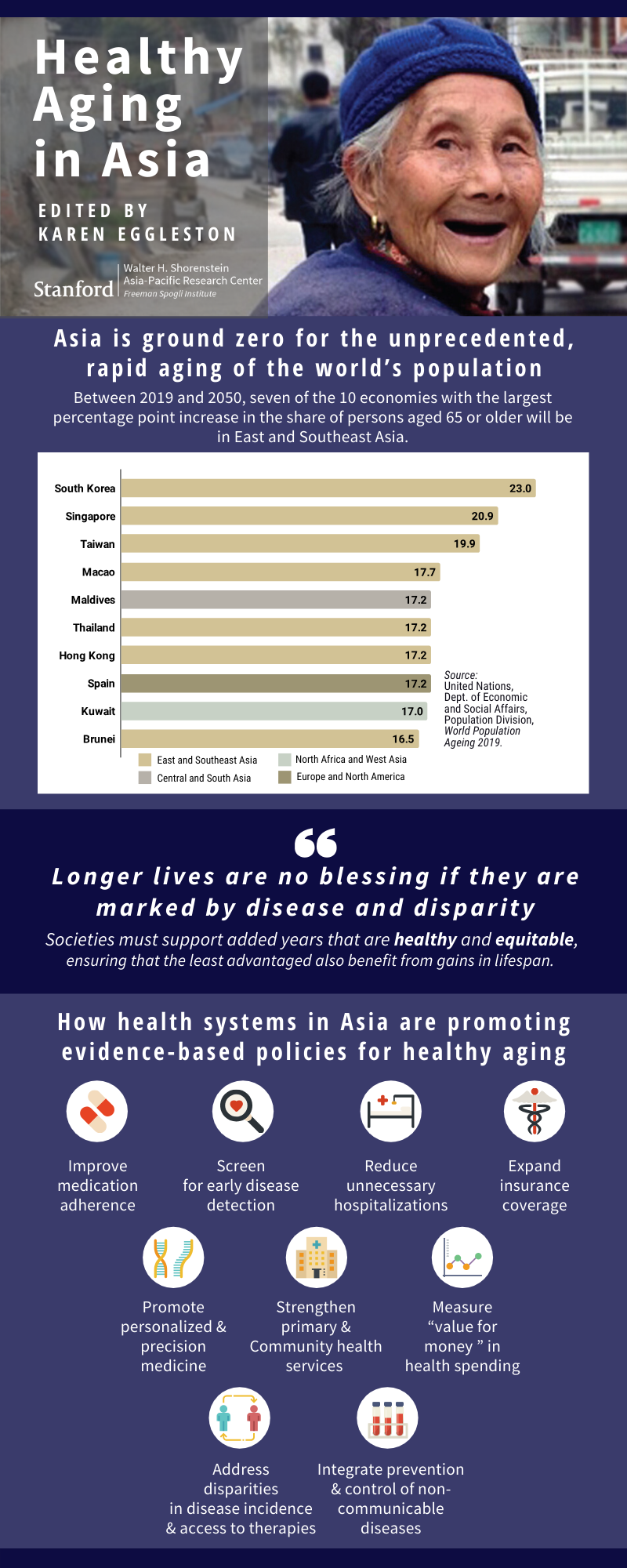
Rapid population aging is transforming societies around the world, and the Asia-Pacific region is on the frontlines of this unprecedented demographic shift. Life expectancy in Japan, South Korea, and much of urban China has now outpaced that of the United States and other high-income countries. With this triumph of longevity, however, comes a host of health, social, and economic challenges.

Longer lifespans will necessitate working to older ages, “but extending work lives will only be feasible if the added years are healthy ones, and will only be equitable if the least advantaged also benefit from healthy aging,” writes APARC Deputy Director and Asia Health Policy Program Director Karen Eggleston in her new book, Healthy Aging in Asia. “The great blessing of longer lives dims when clouded by pain, disability, and loss of dignity.”

[Listen to our conversation with Eggelston about the book and continue reading below. To receive stories like this directly in your inbox sign up for APARC newsletters]

Shorenstein APARC · Healthy Aging In Asia | Karen Eggleston

Image
Poster featuring the book Healthy Aging in Asia


Societies around the world must reduce disparities in health outcomes and address the older age-associated rise in the burden of noncommunicable diseases (NCDs) such as diabetes, hypertension, and cancer. Indeed, the COVID-19 pandemic has underscored the vulnerability of older adults suffering from NCDs to newly emerging pathogens and the importance of building long-term, resilient health systems.


How are health systems in Asia promoting evidence-based policies for healthy aging? What strategies have they used to prevent NCDs, screen for early disease detection, raise the quality of care, improve medication adherence, reduce unnecessary hospitalizations, and increase “value for money” in health spending?

The concise chapters in Healthy Aging in Asia examine these questions, covering multiple aspects of policy initiatives and economic research on healthy longevity in diverse Asian economies — from cities such as Singapore and Hong Kong to powerhouses such as Japan, India, and China — as they transform their health systems to support wellbeing in older age. Eggleston edited and contributed multiple chapters to this new volume, now available via Brookings Institution Press. This publication is part of APARC’s in-house series with the Brookings Institution.

Dr. Karen Eggleston

Karen Eggleston

Senior Fellow at the Freeman Spogli Institute for International Studies, Director of the Asia Health Policy Program, and Deputy Director of the Shorenstein Asia-Pacific Research Center
Full Biography

Read More

Karen Eggleston speaking to an online panel.
News

Karen Eggleston Testifies on China’s Healthcare System to Congressional Review Commission

Asia health policy expert Karen Eggleston provides testimony for a U.S.-China Economic and Security Review Commission hearing on China's domestic healthcare infrastructure and the use of technology in its healthcare system amid COVID-19.
Karen Eggleston Testifies on China’s Healthcare System to Congressional Review Commission
Elderly Chinese citizens sit together on a park bench.
Q&As

Karen Eggleston Examines China’s Looming Demographic Crisis, in Fateful Decisions

Karen Eggleston Examines China’s Looming Demographic Crisis, in Fateful Decisions
Michael McFaul, Xueguang Zhou, Karen Eggleston, Gi-Wook Shin, Don Emmerson, and Yong Suk Lee
News

FSI Hosts APARC Panel on COVID-19 Impacts in Asia

Scholars from each of APARC's programs offer insights on policy responses to COVID-19 throughout Asia.
FSI Hosts APARC Panel on COVID-19 Impacts in Asia
All News button
1
Subtitle

Asia health policy expert Karen Eggleston’s new volume, ‘Healthy Aging in Asia,’ examines how diverse Asian economies – from Singapore and Hong Kong to Japan, India, and China – are preparing for older population age structures and transforming health systems to support patients who will live with chronic disease for decades.

Authors
News Type
News
Date
Paragraphs

COVID-19, combined with the effects of ongoing civil conflicts, hotter and drier weather in many areas, and an unfolding locust invasion in Africa and the Middle East, could cut off access to food for tens of millions of people. The world is “on the brink of a hunger pandemic,” according to World Food Program (WFP) Executive Director David Beasley, who warned the United Nations Security Council recently of the urgent need for action to avert “multiple famines of biblical proportions.”

(Watch Beasley’s conversation on food insecurity as a national security threat with his WFP predecessor, Ertharin Cousin, a visiting scholar with Stanford’s Center of Food Security and the Environment.)

Understanding how these conditions – alone or in combination – might affect crop harvests and food supply chains is essential to finding solutions, according to David Lobell, the Gloria and Richard Kushel Director of the Center on Food Security and the Environment. Below, Lobell discusses the connection between immigration and U.S. food security, a counter-intuitive effect of COVID-19 and more.


How could COVID-19 affect global food security?

I think the biggest effects will probably be related to lost incomes for many low-income people. Even if food prices don’t change, potentially hundreds of millions could be pushed into a much more precarious food situation. I’d be especially worried about remittances – the money immigrants in wealthy nations send home to developing nations – falling, since these are a surprisingly large source of stability for many poor people. Beyond the income effects, there are definitely prospects for reduced supply of foods, but I think these are secondary, especially because global stocks right now are quite large.

Another counter-intuitive effect is that the drop in gasoline demand due to social distancing may be a big driver of changes in food prices. A lot of corn demand is for use in ethanol fuel, and corn prices can affect the prices of many other crops. The price of corn has dropped by about 20 percent since February.


What are the biggest risks in terms of food supply?

Three things come to mind. First, for crops that require a lot of labor, there are some indications that planting and harvest activities are being affected. Even though these are usually included as essential activities, they often rely on migrant populations that can no longer cross state or national borders. California is going to be a prime case study in this.

Second, some countries, like Russia, have started to restrict food exports in an effort to calm domestic consumers worried about food shortages. Even if there is enough global supply, there is a risk that supply for importing countries could be curtailed. This was a big part of the food price spikes a decade ago. Now, we have the added potential that exports will be limited by a lack of mobility to get products to the port – for instance, there are reports from South America that towns won’t let trucks through for fear of the virus.

Third, COVID-19 could really limit the ability of governments and international groups to address other crises that emerge. Nearly every year there are at least a few surprises around the world affecting food that are usually handled before they make big news. Things like livestock diseases and crop pest outbreaks, for example. But without the ability to deploy people to assess and fix problems, there is more scope for issues to go unchecked. Right now, the biggest example of this is the desert locust outbreak in Eastern Africa.


What current and/or likely future weather conditions might have significant impacts on food production?

As the globe warms, we continue to see more “surprises” in most years in terms of record hot or dry growing seasons. It’s a bit too soon to say if and where those will emerge this year. Since global food stocks are high, we have some ability to cope with a shock, but if governments are already nervous it may take less to induce export bans and all of the negative effects those entail.


Ahead of the summer harvest, what is the prospect for controlling locust swarms in threatened countries, and how might the swarms further complicate the global food security picture?

If not for COVID-19, this would likely be the biggest development related to food this year. My understanding is that they are spreading fast in Africa and the Middle East, and while they haven’t yet had big effects in the main production regions, the next couple of months will be critical. The hope is that the winds change and drive them back toward the desert areas they came from. If not, there are at least 20 million people at risk of major food security impacts in the region.


Could we see locust swarms in the U.S.? What can we do to prevent them?

Locusts can occur anywhere. A few years back there was a major outbreak in Israel. They haven’t been a big issue in the U.S. because control methods are available, such as widespread spraying. But again, in a time of COVID-19, these types of responses are harder.


What does history teach us about the situation we are in with multiple threats to food security, and how to deal with it?

I think it comes down to a combination of investing in science-based solutions to avoid problems to begin with, and then having good social safety nets for when problems arise. At that level, it’s not really any different than dealing with infectious disease. The absence of any problems is our goal. At the same time, that absence always seems to breed complacency and neglect. Hopefully, the experiences of 2020 will help strengthen support for a society based on facts, science and compassion.


Media Contacts

David Lobell, Center on Food Security and the Environment: (650) 721-6207; dlobell@stanford.edu

Rob Jordan, Stanford Woods Institute for the Environment: (650) 721-1881; rjordan@stanford.edu

Hero Image
dry corn
All News button
1
Subtitle

COVID-19 and other looming threats could make it much harder for people to access food. David Lobell, director of Stanford’s Center on Food Security and the Environment, outlines likely scenarios and possible solutions.

Paragraphs
Cover of Healthy Aging in Asia that shows an elderly woman in a Chinese village.
Life expectancy in Japan, South Korea, and much of urban China has now outpaced that of the United States and other high-income countries. With this triumph of longevity, however, comes a rise in the burden of noncommunicable diseases (NCDs) like diabetes and hypertension, reducing healthy life years for individuals in these aging populations, as well as challenging the healthcare systems they rely on for appropriate care.  
 
The challenges and disparities are even more pressing in low- and middle-income economies, such as rural China and India. Moreover, the COVID-19 pandemic has underscored the vulnerability to newly emerging pathogens of older adults suffering from NCDs, and the importance of building long-term, resilient health systems. 
 
What strategies have been tried to prevent NCDs—the primary cause of morbidity and mortality — as well as to screen for early detection, raise the quality of care, improve medication adherence, reduce unnecessary hospitalizations and increase “value for money” in health spending? 
 
Fourteen concise chapters cover multiple aspects of policy initiatives for healthy aging and economic research on chronic disease control in diverse health systems — from cities such as Singapore and Hong Kong to large economies such as Japan, India, and China. 
 

Desk, examination, or review copies can be requested through Stanford University Press.

All Publications button
1
Publication Type
Books
Publication Date
Authors
Karen Eggleston
Book Publisher
Shorenstein APARC
Paragraphs

Deforestation and landscape fragmentation have been identified as processes enabling direct transmission of zoonotic infections. Certain human behaviors provide opportunities for direct contact between humans and wild nonhuman primates (NHPs), but are often missing from studies linking landscape level factors and observed infectious diseases.

All Publications button
1
Publication Type
Journal Articles
Publication Date
Journal Publisher
Landscape Ecology
Authors
Eric Lambin
Paragraphs

Previous studies reflect a high prevalence of depressive symptoms among Taiwanese adolescents (ages 13–18), but there is an absence of literature related to the risk of depression of children in Taiwan (ages 6–12), particularly among potentially vulnerable subgroups. To provide insight into the distribution of depressive symptoms among children in rural Taiwan and measure the correlation between academic performance, we conducted a survey of 1655 randomly selected fourth and fifth-grade students at 92 sample schools in four relatively low-income counties or municipalities. Using the Center for Epidemiological Studies-Depression Scale (CES-D) we assessed the prevalence of depressive symptoms in this sample, in addition to collecting other data, such as performance on a standardized math test as well as information on a number of individual and household characteristics. We demonstrate that the share of children with clinically significant symptoms is high: 38% of the students were at risk of general depression (depression score ≥ 16) and 8% of the students were at risk of major depression (depression score > 28). The results of the multivariate regression and heterogeneous analysis suggest that poor academic performance is closely associated with a high prevalence of depressive symptoms. Among low-performing students, certain groups were disproportionately affected, including girls and students whose parents have migrated away for work. Results also suggest that, overall, students who had a parent who was an immigrant from another country were at greater risk of depression. These findings highlight the need for greater resource allocation toward mental health services for elementary school students in rural Taiwan, particularly for at-risk groups. 

All Publications button
1
Publication Type
Journal Articles
Publication Date
Journal Publisher
International Journal of Environmental Research and Public Health
Authors
Yue Ma
Scott Rozelle
Paragraphs
BACKGROUND
Childhood malnutrition is commonplace among poor rural communities in China. In 2012, China launched its first nationwide school‐feeding program (SFP) to address this problem. This study examines the prevalence of malnutrition before and after the SFP and identifies possible reasons for the trends observed.
 
METHODS
Ordinary least squares regression and propensity score matching were used to analyze data from 2 cross‐sectional surveys of 100 rural primary schools in northwestern China. Participants were fourth‐and fifth‐grade students. Outcome measures include anemia rates, hemoglobin levels, body mass index, and height for age Z scores.
 
RESULTS
Three years after implementation of the SFP, malnutrition rates among sample students had not fallen. The SFP had no statistically significant effect on either anemia rates or BMI, but was linked to an increase in the proportion of students with below normal height for age Z scores. Meals provided to students fell far short of national recommendations that the SPF should provide 40% of the recommended daily allowance of micronutrients.
 
CONCLUSIONS
Despite significant budgetary outlays between 2012 and 2015, China's SFP has not reduced the prevalence of malnutrition among sample students. To make the SFP more effective, funding and human resources both need to be increased.
All Publications button
1
Publication Type
Journal Articles
Publication Date
Journal Publisher
Journal of School Health
Authors
Huan Wang
Matthew Boswell
Scott Rozelle
Subscribe to Health