Terrorism
-

CISAC Conference Room

Freeman Spogli Institute for International Studies
Stanford University
Encina Hall
616 Serra Street, C137
Stanford, CA 94305-6055

(650) 725-5368 (650) 723-3435
0
Senior Fellow Emeritus at the Freeman Spogli Institute for International Studies
Olivier Nomellini Professor Emeritus in International Studies at the School of Humanities and Sciences
coit_blacker_2022.jpg PhD

Coit Blacker is a senior fellow emeritus at the Freeman Spogli Institute for International Studies, the Olivier Nomellini Professor Emeritus in International Studies at the School of Humanities and Sciences, and a Bass University Fellow in Undergraduate Education. He served as director of FSI from 2003 to 2012. From 2005 to 2011, he was co-chair of the International Initiative of the Stanford Challenge, and from 2004 to 2007, served as a member of the Development Committee of the university's Board of Trustees.

During the first Clinton administration, Blacker served as special assistant to the president for National Security Affairs and senior director for Russian, Ukrainian and Eurasian affairs at the National Security Council (NSC). At the NSC, he oversaw the implementation of U.S. policy toward Russia and the New Independent States, while also serving as principal staff assistant to the president and the National Security Advisor on matters relating to the former Soviet Union.

Following his government service, Blacker returned to Stanford to resume his research and teaching. From 1998 to 2003, he also co-directed the Aspen Institute's U.S.-Russia Dialogue, which brought together prominent U.S. and Russian specialists on foreign and defense policy for discussion and review of critical issues in the bilateral relationship. He was a study group member of the U.S. Commission on National Security in the 21st Century (the Hart-Rudman Commission) throughout the commission's tenure.

In 2001, Blacker was the recipient of the Laurence and Naomi Carpenter Hoagland Prize for Undergraduate Teaching at Stanford.

Blacker holds an honorary doctorate from the Russian Academy of Sciences' Institute of Far Eastern Studies for his work on U.S.-Russian relations. He is a graduate of Occidental College (A.B., Political Science) and the Fletcher School of Law and Diplomacy (M.A., M.A.L.D., and Ph.D).

Blacker's association with Stanford began in 1977, when he was awarded a post-doctoral fellowship by the Arms Control and Disarmament Program, the precursor to the Center for International Security and Cooperation at FSI.

Faculty member at the Center for International Security and Cooperation
Faculty member at the Center on Democracy, Development, and the Rule of Law
Date Label
Coit D. Blacker Senior Fellow; Olivier Nomellini Professor in International Studies, School of Humanities and Sciences; CISAC and CDDRL Faculty Member Moderator
Martha Crenshaw Senior Fellow at FSI; Professor of Political Science (by courtesy) Moderator
Seminars
-

About the Speaker: Richard English is the Wardlaw Professor of Politics in the School of International Relations, and Director of the Handa Centre for the Study of Terrorism and Political Violence (CSTPV), at the University of St Andrews. His research focuses on political violence and terrorism, Irish and British politics and history, and the history and politics of nationalism and the state. His books include Armed Struggle: The History of the IRA (which won the 2003 UK Political Studies Association Politics Book of the Year Award),Irish Freedom: The History of Nationalism in Ireland (which won the 2007 Christopher Ewart-Biggs Memorial Prize, and the 2007 Political Studies Association of Ireland Book Prize), and Terrorism: How to Respond (OUP, 2009). His latest book, Modern War: A Very Short Introduction, is published by Oxford University Press. Professor English's current research project is for another OUP book, Does Terrorism Work? A History. He is a Fellow of the British Academy and a Member of the Royal Irish Academy. Richard English is in residence as an International Visitor at the Stanford Humanities Center this April and was nominated by the Center for International Security and Cooperation (CISAC) at the Freeman Spogli Institute for International Studies (FSI)


About the Topic: Debates on the effectiveness of terrorism have become prominent in recent years, across a spectrum running from declarations that terrorism represents a deeply ineffective means of pursuing political change, to equally assertive arguments that terrorism works all too frequently. In this talk, Richard English reflects on why the question is important, why it has so far proved extremely difficult to answer in persuasive fashion, how we might better frame our reflections on the subject in future, and on what might be gleaned from deep consideration of the emergence, armed struggle, and eventual departure from the stage of one of the world's most sustainedly serious terrorist organizations - the Provisional Irish Republican Army.

CISAC Conference Room

Richard English Wardlaw Professor of Politics in the School of International Relations Speaker University of St Andrews
Seminars
Paragraphs

The problems of terrorism and counterterrorism are closely related to other themes stressed in this volume: sovereignty; state building, nation building, and peacebuilding; norms; responsibility to prevent and protect; legitimacy of the use of force; failed, failing, and fragile states; and democratic transitions. In the second decade of the twenty-first century, the threat of terrorism emanated principally from proponents of radical Islamism, as it did during the first decade. Finding an effective response remained a challenge. Although terrorism receded as a global threat, it contributed to state failure and civil war and continued to provoke military intervention from targeted states. 

All Publications button
1
Publication Type
Books
Journal Publisher
USIP Press (Forthcoming)
Authors
Authors
News Type
News
Date
Paragraphs

CABANATUAN, Philippines – CISAC Senior Research Fellow Joe Felter co-teaches the popular class, “Face of Battle,” which dissects several of the great American battles such as Gettysburg and Little Bighorn.

Few of his students, however, likely know of his connection to the little-known, ongoing battles raging across the world in southern Philippines.

Felter was awarded the Assaulter Badge on Feb. 8 by the Philippines Army in recognition of his support in forming the country’s first counterterrorism unit. The Light Reaction Battalion has been battling terrorists and rebels in the Southeast Asian nation for a decade.

Felter, a retired U.S. Army Special Forces colonel, worked closely with Brig. Gen. Dionisio Santiago, the now-retired Philippine Armed Forces chief of staff, to form the elite unit during his stint as a U.S. military attaché in Manila.

Brig. Gen. (Ret.) Dionisio Santiago, former chief of staff of the Armed Forces of the Philippines, looks on as Felter receives his award.

Brig. Gen. (Ret.) Dionisio Santiago, former chief of staff of the Armed Forces of the Philippines, looks on as Felter receives his award.
Photo Credit: James Christopher Tee

The battalion, which fights communist and Islamic militants in the restive south – where more than 40 years of insurgency has taken thousands hostage and claimed more than 150,000 lives – will be expanded to a regiment of 1,500 soldiers.

Felter received the honor during a 10th anniversary celebration of the unit, which was initially trained, equipped and sustained by the U.S. Special Forces.

“It was a real privilege to help the Philippine military establish this counterterrorist unit,” Felter said. “I have so much respect for all they do here and the challenging missions they take on, so it feels great to receive this honor on this special day.”

The ceremony was held at Fort Magsaysay in Cabanatuan, the storied city where the Japanese imprisoned Filipino and American survivors of the brutal Bataan Death March. Filipino and U.S. forces liberated some 500 POWs at the end of World War II in what has become known as The Great Raid. The two militaries remain closely allied today.

The certificate that accompanied his badge of honor says Felter “exerted tremendous effort” in convincing the U.S. government of the need for a counterterrorism unit in the Philippines. Once he did so, he helped activate and train the unit – and kept on the U.S. Special Forces to remain involved.

“Col. Felter has exemplified the essence of soldiery in the fight against terrorism, earning him the admiration, gratitude and respect of the officers, men and women of the Light Reaction Battalion and making him worthy of the honor of being a member of the Counter Terrorist Brotherhood,” reads the certificate.

Felter has spent a decade building an unprecedented database with Filipino military colleagues and coders which tracks tens of thousands of terrorist attacks in the Philippines since 1975. His Empirical Studies of Conflict project is also building insurgency data in Afghanistan, Colombia, Iraq, Pakistan and Vietnam.


Hero Image
flowers ricky
Flowers in honor of the nine Light Reaction Battalion soldiers killed by Islamic militants in the southern port of Zamboanga last September.

Flowers in honor of the nine Light Reaction Battalion soldiers killed by Islamic militants in the southern port of Zamboanga last September.

Flowers in honor of the nine Light Reaction Battalion soldiers killed by Islamic militants in the southern port of Zamboanga last September.

Flowers in honor of the nine Light Reaction Battalion soldiers killed by Islamic militants in the southern port of Zamboanga last September.

Flowers in honor of the nine Light Reaction Battalion soldiers killed by Islamic militants in the southern port of Zamboanga last September.

Flowers in honor of the nine Light Reaction Battalion soldiers killed by Islamic militants in the southern port of Zamboanga last September.
Ricky GayRicky GayRicky GayRicky GayRicky GayRicky Gay
All News button
1
-

ABOUT THE SPEAKER:

Shiri Krebs is a JSD Candidate at Stanford Law School, specializing in international criminal and humanitarian law. She was recently awarded the Christiana Shi Stanford Interdisciplinary Graduate Fellowship in International Studies, and was also named the Zukerman Fellow, and Law and International Security Predoctoral Fellow at Stanford Center on International Security and Cooperation (CISAC).

Her doctoral dissertation focuses on war crimes investigations and fact-finding during armed conflicts. This interdisciplinary research project combines theories and methods from law, psychology, sociology and political science, including online survey experiments.

From 2005 to 2010 Shiri served as legal advisor on international law matters in the Chief-Justice's chambers, the Israeli Supreme Court. During that time she has taught public international law at the Hebrew University of Jerusalem, a teaching assistantship which granted her the Dean's award for excellent junior faculty members, as well as 'best teacher' award. After leaving the Supreme Court, Shiri joined the Israeli Democracy Institute as a researcher, working on 'Terrorism and Democracy' projects, and publishing frequent op-eds in various newspapers and blogs.

In September 2010 Shiri started her graduate studies at Stanford Law School. Her Masters thesis - an empirical analysis of preventive detention cases - was presented in several international conferences and has won the Steven M. Block Civil Liberties Award. 

In 2012, while working on her dissertation, Shiri was appointed as a Teaching Scholar at Santa Clara University School of Law, teaching international criminal law and international humanitarian law. She is currently serving as a Teaching Assistant for CISAC's Interschool Honors Program in International Security Studies.

CISAC Conference Room

Shiri Krebs Zukerman Fellow, Law and International Security Fellow, CISAC Speaker
Mark Kelman James C. Gaither Professor of Law and Vice Dean, Stanford Law School Commentator
Seminars

The Empirical Studies of Conflict Project (ESOC) addresses critical challenges to international security through methodologically rigorous, evidence-based analyses of insurgency, civil war and other sources of politically motivated violence. The project is comprised of leading scholars from across the country from a variety of academic disciplines. ESOC aims to empower high quality of conflict analysis by creating and maintaining a repository of micro-level data across multiple conflict cases and making these data available to a broader community of scholars and policy analysts.

-

Image


Abstract:

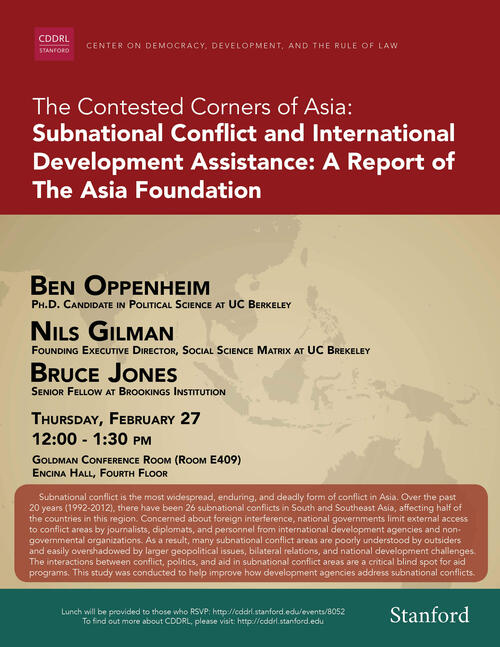
Subnational conflict is the most widespread, enduring, and deadly form of conflict in Asia. Over the past 20 years (1992-2012), there have been 26 subnational conflicts in South and Southeast Asia, affecting half of the countries in this region. Concerned about foreign interference, national governments limit external access to conflict areas by journalists, diplomats, and personnel from international development agencies and non-governmental organizations. As a result, many subnational conflict areas are poorly understood by outsiders and easily overshadowed by larger geopolitical issues, bilateral relations, and national development challenges. The interactions between conflict, politics, and aid in subnational conflict areas are a critical blind spot for aid programs. This study was conducted to help improve how development agencies address subnational conflicts.


Speaker Bios:

Ben Oppenheim is a Fellow (non-resident) at the Center on International Cooperation at New York University. His research spans a diverse set of topics, including fragile states, transnational threats (including pandemic disease risks and terrorism), and the strategic coherence and effectiveness of international assistance in fragile and conflict-affected areas.

Oppenheim has consulted for organizations including the World Bank, the United Nations, the Asia Foundation, the Institute for the Future, and the Fritz Institute, on issues including organizational learning, strategy, program design, foresight, and facilitation. In 2009, he served as Advisor to the first global congress on disarmament, demobilization, and reintegration, supported by the World Bank and the UN.

In 2013, Oppenheim was a visiting fellow at the Uppsala University Forum on Democracy, Peace, and Justice. His research has been supported by a Simpson Fellowship, and a fellowship with the Institute on Global Conflict and Cooperation. He was also a research fellow with UC Berkeley's Institute of International Studies, affiliated with the New Era Foreign Policy Project.


Nils Gilman is the Executive Director of Social Science Matrix. He holds a B.A., M.A. and Ph.D. in History from the University of California, Berkeley. Gilman’s first scholarly interest was in American and European intellectual history, with a particular focus on the institutional development of the social sciences, the lateral transfer and translation of ideas across disciplinary boundaries, and the impact of social scientific ideas on politics and policy.

Gilman is the author of Mandarins of the Future: Modernization Theory in Cold War America (Johns Hopkins University Press, 2004), the co-editor of Staging Growth: Modernization, Development, and the Global Cold War (University of Massachusetts Press, 2003) and Deviant Globalization: Black Market Economy in the 21st Century (Continuum Press, 2011), as well as the founding Co-editor of Humanity: An International Journal of Human Rights, Humanitarianism, and Development. He also blogs and tweets.

Prior to joining Social Science Matrix in September 2013, Gilman was research director at Monitor 360, a San Francisco consultancy that addresses complex, cross-disciplinary global strategic challenges for governments, multinational businesses, and NGOs. He has also worked at a variety of enterprise software companies, including Salesforce.com, BEA Systems, and Plumtree Software. Gilman has taught and lectured at a wide variety of venues, from the Harvard University, Columbia University, and National Defense University, to PopTech, the European Futurists Conference, and the Long Now Foundation.


Bruce Jones is a senior fellow and the director of the Project on International Order and Strategy in the Foreign Policy program at the Brookings Institution. He is also the director of the Center on International Cooperation at New York University.

Jones served as the senior external advisor for the World Bank’s 2011 World Development Report, Conflict, Security and Development, and in March 2010 was appointed by the United Nations secretary-general as a member of the senior advisory group to guide the Review of International Civilian Capacities. He is also consulting professor at the Center for International Security and Cooperation at Stanford University and professor (by courtesy) at New York University’s department of politics.

Jones holds a Ph.D. from the London School of Economics, and was Hamburg fellow in conflict prevention at Stanford University.

He is co-author with Carlos Pascual and Stephen Stedman of Power and Responsibility: Building International Order in an Era of Transnational Threats (Brookings Press, 2009); co-editor with Shepard Forman and Richard Gowan of Cooperating for Peace and Security (Cambridge University Press, 2009); and author of Peacemaking in Rwanda: The Dynamics of Failures(Lynne Reinner, 2001).

Jones served as senior advisor in the office of the secretary-general during the U.N. reform effort leading up to the World Summit 2005, and in the same period was acting secretary of the Secretary-General’s Policy Committee. In 2004-2005, he was deputy research director of the High-level Panel on Threats, Challenges and Change. From 2000-2002 he was special assistant to and acting chief of staff at the office of the U.N. special coordinator for the Middle East peace process. 

Richard and Rhoda Goldman Conference Room

Ben Oppenheim Ph.D. Candidate in Political Science Speaker UC Berkeley
Nils Gilman Founding Executive Director, Social Science Matrix Speaker UC Berkeley
Bruce Jones Senior Fellow Speaker Brookings Institution
Seminars
-

Abstract:
Armed conflict causes profound and widespread adverse consequences for health and human rights. It directly causes death as well as physical and mental disabilities among combatants and increasingly among non-combatants. It damages the health-supporting infrastructure of society, including public health services and medical care. It forces people to leave the safety and security of their homes and communities. It diverts human and financial resources away from activities that benefit society. It leads to further violence. And, in these and other ways, armed conflict violates human rights.  This presentation will provide examples of these adverse consequences of armed conflict and what can be done to minimize these consequences and to prevent armed conflict.


Dr.Barry Levy is a physician and epidemiologist who has edited books, written papers, and spoken widely on these issues. He is an Adjunct Professor of Public Health at Tufts University School of Medicine. Previously, he served as a medical epidemiologist for the CDC, a tenured professor at the University of Massachusetts Medical School, USAID coordinator for AIDS prevention in Kenya, executive director of the International Physicians for the Prevention of Nuclear War, and in other roles. He is a past president of the American Public Health Association and a recipient of its Sedgwick Memorial Medal. He has written more than 200 published papers and book chapters, many on the adverse effects of war. He has co-edited 17 books, including, with co-editor Dr. Victor Sidel and many contributing authors, two editions each of the books War and Public Health, Terrorism and Public Health, and Social Injustice and Public Health.    

Building 200 (History Corner)
Room 205
Stanford University

Barry S. Levy, M.D., M.P.H. Adjunct Professor of Public Health Speaker Tufts University School of Medicine
Seminars
Subscribe to Terrorism