Speaking at the Shorenstein Asia-Pacific Research Center on Tuesday, U.S. Secretary of the Navy Ray Mabus underscored the importance of partnerships in the Asia-Pacific region and need for an adaptable force to meet the rapidly changing security environment around the world.
Mabus began by recognizing William J. Perry, a Stanford emeritus professor and former U.S. secretary of defense, with a Distinguished Public Service Award for his exceptional record of public service and collaboration on alternative energy initiatives, and set the stage for a conversation on innovation in the Navy and Marine Corps.
Throughout his remarks, Mabus highlighted the challenges of preparing for today’s security landscape and offered examples of how the Navy engages them.
The Navy must not be complacent in its ways, he said, especially in a context of eroding trust in multilateral institutions, unpredictable threats, and increasing competition for resources as sea levels rise.
“You’re not going to be able to tell what those next threats are. You never will. But what you can do is make sure that whatever they are you can respond,” he said. “You’ve got to be flexible.”
Mabus, who has led the Navy administration for the past seven years, said four “Ps” – people, platforms, power and partnerships – have guided his approach to improve force capabilities and rapid-response time.
Reviewing his own record as secretary, he cited updates to policies that extend family leave time, boost diversity in the force, and explore alternative energy sources for Navy aircraft and ships, including the earlier launch of the “Great Green Fleet,” a carrier strike group that uses biofuels.
Partnerships in Asia
Implementing the U.S. rebalance to Asia strategy has been a focus of the Navy’s interaction in the region.
“We’re doing it diplomatically, we’re doing it economically, we’re doing it in every region that we as a government are active in,” said Mabus, who formerly served as U.S. ambassador to Saudi Arabia and governor of Mississippi.
Sixty percent of the United States naval presence is located in the Asia-Pacific region and it is poised toward growth, Mabus said. Three more guided missile destroyers will be stationed in Japan and be "on station when North Korea launches one of its missiles," he said.
“If something does happen, if a crisis does erupt, we’re already there,” Mabus said, emphasizing the importance of force readiness.
Responding to crises effectively, however, requires an awareness and interoperability between many countries, he said. To practice and prepare, around 500 naval exercises occur between the United States and other countries each year, including Malabar, a trilateral exercise between India, Japan and the United States, and the biannual 27-nation Rim of the Pacific “RIMPAC” exercise, which China joined last year.
South China Sea issues
Answering a question from the audience about fortifications being built by China on land features in the South China Sea, Mabus said, “We don’t think any one country should try and change the status quo.”
Mabus reaffirmed the United States’ commitment to both sail and fly over the land features in accordance with international law. The American naval presence in the region has been there for 70 years and will remain steadfast, he said.
He noted the importance of upholding international law and warned of the dangers of setting a precedent of reinterpreting the U.N. Convention on the Law of the Sea regarding the South China Sea, attempting to do so would have “a really dramatic impact, not just there, but around the world."
A main goal for the U.S. Navy is to continue engagement between China and the United States, he said. The two countries already collaborate on a number of bilateral measures, such as scheduled passing exercises and visits by the navies to each other’s ports of call.
“What we want China to do is to assume the responsibilities of a naval power, to work with us, and to make sure that freedom of navigation is ensured.”
Gi-Wook Shin, a Stanford professor of sociology and director of Shorenstein APARC, concluded the event by thanking Mabus, and recognized the secretary’s friendship with the late Walter H. Shorenstein, after whom the center was named.
Hero Image
U.S. Secretary of the Navy Ray Mabus talks about the importance of partnerships in the Asia-Pacific region and need for an adaptable force during remarks at the Shorenstein Asia-Pacific Research Center, Oct. 18, 2016.
North Korea conducted its fifth nuclear test in the wake of the G20 summit earlier this month. The United States immediately condemned North Korea’s behavior in a statement delivered by the White House, and a few days later, flew a set of bombers near the U.S. military base in Osan, South Korea.
Writing for Toyo Keizai, Daniel Sneider, associate director for research at the Shorenstein Asia-Pacific Research Center, said a consistent strategic and military reasoning drives the North Korean regime’s decision to test nuclear missiles. His analysis piece can be viewed in English and Japanese.
Sneider also spoke with Slate about how the next U.S. administration could respond, suggesting that a deployment of additional nuclear-capable aircraft at U.S. bases in Asia would send a strong signal to Pyongyang. The Slate article is available at this link.
South Korea has been seeking stronger international sanctions against North Korea since the test. As the country’s biggest trading partner, China is considered an important actor in the ability to influence North Korea. In the Korea Times, Sneider said a way to motivate China to augment their role in sanctions against North Korea is to remind Beijing that a continuation of North Korea's nuclear program would only lead to greater scale and capability of American military presence in the region. The Korea Times article is available at this link.
Hero Image
A television shows breaking news about North Korea's long-range rocket launch in February 2016, Seoul, South Korea. | Getty Images - Han Myung-Gu
With nuclear policy an increasingly serious issue in the world today, a Stanford scholar suggests in a newly published paper that the U.S. presidential candidates explain their viewpoints on these topics to the American people.
The journal article in the Bulletin of Atomic Scientists includes six questions on nuclear terrorism, proliferation, weapons policy and energy developed by Siegfried Hecker, a nuclear scientist and senior fellow at Stanford’s Center for International Security and Cooperation (CISAC) and the Freeman Spogli Institute for International Studies.
Hecker served as a director of the Los Alamos National Laboratory before coming to Stanford. He is a world-renowned expert in plutonium science, global threat reduction and nuclear security. Hecker suggests that journalists and the public ask the candidates for the U.S. presidency the following questions:
• "Do you believe that nuclear terrorism is one of the greatest threats facing the United States, and, if so, what will you do to invigorate international cooperation to prevent it?
• How will you attempt to roll back North Korea’s increasingly threatening and destabilizing nuclear weapon program?
• Will you continue to support the (Iranian nuclear) deal and, if so, how will you work with Iran, quell dissent among our allies in the region, and answer criticism here at home?
• Do you plan to continue building a strategic partnership with India, and, if so, how will you reassure Pakistan that the U.S. insistence on nuclear restraint in South Asia includes not just Pakistan, but India as well?
• Will you continue to push for a reduced role for nuclear weapons in U.S. defense policy? If so, will you promote further nuclear arms reductions and ratification of the Comprehensive Test Ban Treaty? And if Russia and China stay their current course, how will you deal with US nuclear modernization, and how will you reassure America’s allies?
• What are your plans for the domestic nuclear power industry and for the role the United States will play in this sector internationally?"
In his article, Hecker describes the context surrounding many of these questions. For example, he noted that the alarming acceleration of North Korea’s nuclear arsenal in the last six years indicates that the current U.S. policy approach to that country needs to be revisited.
Also, Hecker points out the complexity of the current nuclear arms situation worldwide. Both Russia and China have expanded their nuclear systems and are pursuing a more aggressive foreign policy. On the other hand, every president of the post-Cold War era has reduced U.S. reliance on nuclear weapons for its national security.
Hero Image
A Chinese-made Hongqi-2 missile on display at the Military Museum in Beijing in 2011. China then announced a double-digit increase in its secretive military budget. | FREDERIC J. BROWN/AFP/Getty Images
Stanford nuclear scientist and CISAC senior fellow Siegfried S. Hecker explains in this article in 38 North why North Korea's recent nuclear test is "deeply alarming" and what Washington's possible policy options are going forward. An excerpted passage is below:
On September 9, 2016, seismic stations around the world picked up the unmistakable signals of another North Korean underground nuclear test in the vicinity of Punggye-ri. The technical details about the test will be sorted out over the next few weeks, but the political message is already loud and clear: North Korea will continue to expand its dangerous nuclear arsenal so long as Washington stays on its current path.
Preliminary indications are that the test registered at 5.2 to 5.3 on the Richter scale, which translates to an explosion yield of approximately 15 to 20 kilotons, possibly twice the magnitude of the largest previous test. It appears to have been conducted in the same network of tunnels as the last three tests, just buried deeper into the mountain. This was the fifth known North Korean nuclear explosion; the second this year, and the third since Kim Jong Un took over the country’s leadership in December 2011. Continue reading
Hero Image
People watch a news report on North Korea's first hydrogen bomb test at a railroad station in Seoul on January 6, 2016. | JUNG YEON-JE/AFP/Getty Images
When the Soviet Union collapsed in 1991, the worry in the West was what would happen to that country’s thousands of nuclear weapons. Would “loose” nukes fall into the hands of terrorists, rogue states, criminals – and plunge the world into a nuclear nightmare?
Fortunately, scientists and technical experts in both the U.S. and the former Soviet Union rolled up their sleeves to manage and contain the nuclear problem in the dissolving Communist country.
One of the leaders in this relationship was Stanford engineering professor Siegfried Hecker, who served as a director of the Los Alamos National Laboratory before coming to Stanford as a senior fellow at the Center for International Security and Cooperation. He is a world-renowned expert in plutonium science, global threat reduction and nuclear security.
Hecker cited one 1992 meeting with Russian scientists in Moscow who were clearly concerned about the risks. In his new book, Doomed to Cooperate: How American and Russian scientists joined forces to avert some of the greatest post-Cold War nuclear dangers, Hecker quoted one Russian expert as saying, “We now need to be concerned about terrorism.”
Earning both scientific and political trust was a key, said Hecker, also a senior fellow at Stanford’s Freeman Spogli Institute for International Studies. The Russians were proud of their scientific accomplishments and highly competent in the nuclear business – and they sought to show this to the Americans scientists, who became very confident in their Russian counterparts’ technical capabilities as they learned more about their nuclear complex and toured the labs.
Economic collapse, political turmoil
But the nuclear experts faced an immense problem. The Soviets had about 39,000 nuclear weapons in their country and in Eastern Europe and about 1.5 million kilograms of plutonium and highly enriched uranium (the fuel for nuclear bombs), Hecker said. Consider that the bomb that the U.S. dropped on the Japanese city of Nagasaki in 1945 was only six kilograms of plutonium, he added. Meanwhile, the U.S. had about 25,000 nuclear weapons in the early 1990s.
Hecker and the rest of the Americans were deeply concerned about the one million-plus Russians who worked in nuclear facilities. Many faced severe financial pressure in an imploding society and thus constituted a huge potential security risk.
“The challenge that Russia faced with its economy collapsing was enormous,” he said in an interview.
The Russian scientists, Hecker said, were motivated to act responsibly because they realized the awful destruction that a single nuclear bomb could wreak. Hecker noted that one Russian scientist told him, “We arrived in the nuclear century all in one boat, and a movement by anyone will affect everyone.” Hecker noted, “Therefore, you know, we were doomed to work together to cooperate.”
All of this depended on the two governments involved easing nuclear tensions while allowing the scientists to collaborate. In short order, the scientists developed mutual respect and trust to address the loose nukes scenario.
The George H.W. Bush administration launched nuclear initiatives to put the Russian government at ease. For example, it took the nuclear weapons off U.S. Navy surface ships and some of its nuclear weapons off alert to allow the Russians to do the same. The U.S. Congress passed the Nunn-Lugar Cooperative Threat Reduction legislation, which helped fund some of the loose nuke containment efforts.
While those were positive measures, Hecker said, it was ultimately the cooperation among scientists, what they called lab-to-lab-cooperation, that allowed the two former superpower enemies to “get past the sensitivity barriers” and make “the world a safer place.”
Since the end of the Cold War, no significant nuclear event has occurred as a result of the dissolution of the Soviet Union and its nuclear complex, Hecker noted.
Lesson: cooperation counts
One lesson from it all, Hecker said, is that government policymakers need to understand that scientists and engineers can work together and make progress toward solving difficult, dangerous problems.
“We don’t want to lose the next generation from understanding what can actually be done by working together,” he said. “So, we want to demonstrate to them, Look, this is what was done when the scientists were interested and enthusiastic and when the government gave us enough room to be able to do that.”
Hecker said this scientific cooperation extended to several thousand scientists and engineers at the Russian sites and at U.S. nuclear labs – primarily the three defense labs: Lawrence Livermore, Los Alamos, and Sandia national laboratories. Many technical exchanges and visits between scientists in Russia and the United States took place.
He recalled visiting some of the nuclear sites in Russian cities shrouded by mystery. “These cities were so secret, they didn’t even appear on Soviet maps.”
Change of threat
When the Soviet Union collapsed, the nature of the nuclear threat changed, Hecker said. The threat before was one of mutual annihilation, but now the threat changed to what would happen if nuclear assets were lost, stolen or somehow evaded the control of the government.
“From an American perspective we referred to these as the ‘four loose nuclear dangers,'” he said.
This included securing the loose nukes in the Soviet Union and Eastern Europe; preventing nuclear materials or bomb fuel from getting into the wrong hands; the human element involving the people who worked in the Soviet nuclear complex; and finally, the “loose exports” problem of someone trying to sell nuclear materials or technical components to overseas groups like terrorists or rogue nations.
For Hecker, this is not just an American story. It is about a selfless reconciliation with a longtime enemy for the greater global good, a relationship not corrupted by ideological or nationalistic differences, but one reflective of mutual interests of the highest order.
“The primary reason,” he said, “why we didn’t have a nuclear catastrophe was the Russian nuclear workers and the Russian nuclear officials. Their dedication, their professionalism, their patriotism for their country was so strong that it carried them through these times in the 1990s when they often didn’t get paid for six months at a time … The nuclear complex did its job through the most trying times. And it was a time when the U.S. government took crucial conciliatory measures with the new Russian Federation and gave us scientists the support to help make the world a safer place.”
Hero Image
Siegfried Hecker (second from left) takes a tour of a secret Russian nuclear facility in the city of Sarov in February, 1992. Hecker was serving as director of the Los Alamos National Laboratory during his visit. | CISAC
If provoked, many Americans might well back nuclear attacks on foes like Iran and al Qaeda, according to new collaborative research from CISAC senior fellow Scott Sagan and Dartmouth professor Benjamin Valentino.
You can read more about their latest public opinion polling data, and its implications for the debate surrounding President Obama's upcoming visit to Hiroshima, in a column they co-authored for the Wall Street Journal.
Hero Image
Candles and paper lanterns float on the Motoyasu River in front of the Atomic Bomb Dome at the Peace Memorial Park, in memory of the victims of the bomb on the 62nd anniversary of the Hiroshima bomb, on August 6, 2007 in Hiroshima. Japan. | Junko Kimura / Getty Images
Plans to dispose of radioactive waste in a deep geologic repository have been stalled for the last five years, so the U.S. Department of Energy is now trying to develop a strategy for the siting of nuclear facilities, such as for interim storage and final geologic disposal.
Key to DOE’s strategy is “consent-based siting,” an approach which aims to minimize the political controversy from local communities and the state.
But how would such a process work in practice? And can the diverse range of stakeholders involved realistically be expected to reach a consensus on such a controversial issue?
Critical questions like these were the main focus of the third Reset of U.S. Nuclear Waste Management Strategy and Policy Series meeting held at Stanford last week.
Scientific experts, government officials and stakeholders at the state, tribal, national and international levels were all invited to discuss strategies to move forward a program that is now in stalemate as the growing inventories of spent nuclear fuel from commercial power plants and high-level defense waste continues to accumulate at sites across the country. Moving forward with the concept that communities and states have a say in the process requires considerable input from the concerned and affected parties, many of whom were represented at this meeting.
The Gordian Knot: Nuclear Waste Management in the United States
In 2008, the Department of Energy submitted a license application for a proposed repository at Yucca Mountain in Nevada. Politics, changes in legislation, lawsuits and ultimately a lack of public trust were among many reasons that plans for the Yucca Mountain repository were not realized. In the absence of a way forward, spent nuclear fuel from nuclear power reactors remains stranded at over 70 sites around the country.
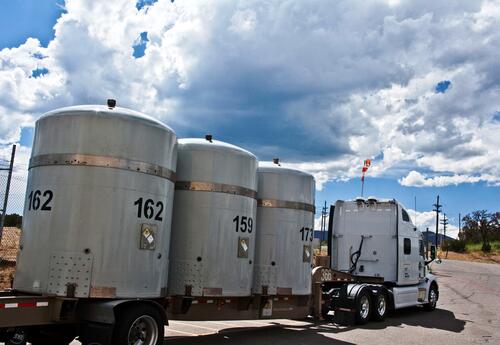
And in another recent blow to America’s nuclear waste storage program, the government’s only deep geological repository for high-level transuranic nuclear (TRU) military waste stopped receiving waste two years ago. A release of radioactivity due to unanticipated chemical reactions in a drum of waste lead to the temporary closure of the Waste Isolation Pilot Plant (WIPP) in Carlsbad, New Mexico after 15 years of operation.
A Question of Consent
Last March, President Obama directed the DOE to start planning for the development of a defense-only repository for high-level nuclear waste. At the same time, the DOE announced that it would proceed in parallel to address storage and disposal of spent nuclear fuel from commercial nuclear power plants around the country.
A shipment of transuranic waste from the defense industry heads for long-term storage at the Waste Isolation Pilot Plant in this photo from 2012.
“We envision an integrated waste management system that may contain one or more facilities,” said John Kotek, Acting Assistant Secretary for the DOE’s Office of Nuclear Energy, who was in attendance at the meeting.
Kotek served as staff director to the Blue Ribbon Commission on America’s Nuclear Future from 2010–2012, which recommended the consent-based strategy for locating nuclear waste facilities, such as a geologic repository. He acknowledged that previous top-down approaches haven’t worked and said the DOE is now seeking public input on how to design a consent-based siting approach by which communities are recognized as partners in the management and disposal of the waste.
“We aim to implement such a system incrementally, to ensure safe and secure operations, to build and maintain public trust and confidence, and to adapt our approach based on lessons learned,” Kotek said.
“As a first step, we will work collaboratively with the public, with interested communities, and with Congress to begin identifying potential partners in this effort.”
The Allocation of Power
States, tribes and local communities all want to have a major say over federal decisions concerning waste repositories, and they want the clear-cut ability to say “no” or “yes” to repositories or nuclear facilities in their jurisdiction.
John Heaton with the Carlsbad Department of Development in New Mexico said he believed the scientific work at Sandia National Laboratories was key to the community’s initial consent to build the Waste Isolation Pilot Plant (WIPP) in their region, and their willingness to reopen the plant in the near future.
“We already had independent monitoring in place at WIPP, and we are expecting to reopen by the end of the year with better safety measures,” said Heaton.
In contrast, for decades, the Shoshone Bannock Tribe in Idaho never made any agreements with the DOE on radioactive waste shipments traveling through their land. Instead, the DOE worked directly with the state, without dealing with the tribe.
“The state does not speak for the tribes, any more than we speak for the state,” said Talia Martin, DOE program director for the Shoshone Bannock Tribe.
“We’re waiting to hear how the DOE is going to interact with the tribes. Will it be a partnership or will they repeat the past where they negotiated with the state and not with us?”
In Nevada, the state consistently opposed the proposed geological repository at Yucca Mountain, but local communities were generally supportive. Nye County officials in Nevada are concerned that the consent-based siting effort by the DOE will only delay waste disposal progress. Nye County is committed to the resumption of Yucca Mountain licensing hearings.
“I believe an individual, well-informed on the ins and outs of waste repositories are generally of the opinion that Yucca Mountain would be the least expensive and fastest resolution to move the ultimate disposal of nuclear waste and high level defense waste,” said Cash Jaszczak, staff consultant for the Nye County Nuclear Waste Repository Project Office.
Finding a resolution for the different positions of state, tribal and local communities is at the heart of the design of a consent-based process.
An International Perspective
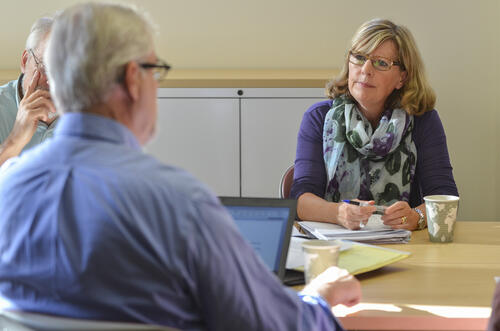
A panel of international speakers from Canada, Finland, France, Sweden and the United Kingdom shared the stories of their own national programs and their successes and failures.
Kathryn Shaver from Canada's Nuclear Waste Management Organization listens to a speaker during a steering committee meeting for the Reset of U.S. Nuclear Waste Management Strategy and Policy Series.
Experience internationally has shown that a consent-based approach to dealing with the waste has been effective in Canada, Finland and Sweden. Finland is on pace to become the first country in the world to begin construction of a final repository for spent nuclear fuel, after switching from a “decide-announce” process to a consent-based process with public engagement, according to a paper from Timo Äikäs, former vice president of the nuclear waste management company Posiva.
In Sweden, the industry producing the waste takes full responsibility for its disposal.
“I find it almost exotic that the utilities in the United States, the producers, can pay their way out of responsibility to the state,” said Saida Engstrom, vice president of SKB, the organization that manages Sweden’s nuclear waste.
“One has to find the incentives to have utilities committed to working towards a solution. I think if you produce waste, you should not be given a free pass.”
France and the U.K. are also pursuing public engagement as an integral part of the strategy for their national programs. But it hasn’t always been a smooth process. U.K. Head of Geologic Disposal Bruce Cairns described a consent-based process that failed in obtaining the consent of all involved parties, but he also described a new process that will give it another try.
Hope for a Solution
Rod Ewing, a senior fellow at Stanford’s Center for International Security and Cooperation, said that it is essential to have these extended discussions so that a new strategy has a greater chance of success.
“In another 30 years, the U.S. cannot afford to find itself in the same place that it is now,” said Ewing, who also serves as Frank Stanton professor in nuclear security at Stanford University.
Ewing said it was also important to include students in the conversation, so they understand that they will inherit the problem, and they are part of the future hope to find a safe, trustworthy, consent-based siting solution.
Stanford PhD candidate Katlyn Turner, who’s studying Geological and Environmental Sciences at Stanford, said the nuclear waste issue was just as critical as global warming.
“Regardless of how you feel about it, we have to deal with it,” said Katlyn Turner, a PhD student in Geological and Environmental Sciences at Stanford.
“My generation should frame it as this is waste that needs to be taken care of the same way we need to take care of C02, global warming, coal and other pollutants.”
The Steering Committee will use the input from this meeting, as well as its own extensive experience in waste management issues, to provide advice and recommendations on how the consent-based process might be applied to the U.S. program. It will also make recommendations on other issues such as the question of creating a new, independent waste management organization to oversee the consent-based process.
The Reset meeting was supported by the Precourt Institute for Energy and hosted by Stanford’s Center for International Security and Cooperation.
The next meeting of the Reset series will be In Washington, D.C. in May at George Washington University and will focus on the integration of the waste management system from the production of the waste to its final disposal in a geologic repository.
Hero Image
Inside the Waste Isolation Pilot Plant (WIPP) in Carlsbad, New Mexico. | U.S. Department of Energy
It has been five years since the emergency sirens sounded at Japan's Fukushima Daiichi power plant following the massive 2011 earthquake and subsequent devastating tsunami. The partial meltdown of three reactors caused approximately 170,000 refugees to be displaced from their homes, and radiation releases and public outcry forced the Japanese government to temporarily shut down all of their nuclear power plants. The events at Fukushima Daiichi sent waves not only through Japan but also throughout the international nuclear industry. Rodney Ewing, Frank Stanton professor of nuclear security at Stanford's Center for International Security and Cooperation, outlines three key lessons to be taken from the tragedy at Fukushima.
Lesson One: Avoid characterizing the Fukushima tragedy as an 'accident'
One of the biggest lessons to be learned from Fukushima Daiichi revolves around the language used to describe nuclear disasters. In the media and in scientific papers, the event was frequently described as an accident, but this does not properly capture the cause of the event, which was a failure of the safety analysis.
As an example, Ewing points specifically to the domino chain of events that led to the partial meltdown at reactors 1 and 3. Following the powerful magnitude 9.0 earthquake, the power plant automatically shut down its reactors, as designed. Emergency generators immediately started in order to maintain circulation of coolant over the nuclear fuel, a critical process to avoid heating and eventual meltdown. But the tsunami that followed flooded the diesel engines that were supplying power, and so cooling could no longer be maintained.
"The Japanese people and government were certainly well acquainted with the possibility of tsunamis," said Ewing, the Frank Stanton Professor in Nuclear Security and senior fellow at the Center for International Security and Cooperation in the Freeman Spogli Institute. "Communities had alert systems. But somehow, this risk didn't manifest itself in the preparation and protection of the backup power for the Fukushima reactors. The backup power systems, the diesel generators for reactors 1 through 5, were low along the coast where they were flooded and failed. They could have been located farther back and higher, like they were at reactor 6. These were clearly failures in design, not an accident.
"This is why when I refer to the tragedy at Fukushima, it was not an accident," said Ewing, who is also a professor of geological sciences in Stanford's School of Earth, Energy & Environmental Sciences. "When some speak of such an event as an 'act of God,' this has the effect of avoiding the responsibility for the failed safety analysis. We need to use language that doesn't seek to place blame, but does establish cause and responsibility."
Lesson Two: Rethink the meaning of 'risk'
Shortly following the disaster at Fukushima, Tokyo Electric Power Company (TEPCO) received heavy criticism for its lack of planning and response. For Ewing, this criticism speaks to a larger issue: "We need to rethink what we mean by 'risk' when we perform risk assessments. Risk is more than the loss of life and property."
Reassessing risk also begins with changing our language, Ewing said. When we say a risk like an earthquake or tsunami is rare or unexpected, even when the geological record shows it has happened and will happen again, it greatly lessens the urgency with which we ought to act and prepare.
"It can be that the risk analysis works against safety, in the sense that if the risk analysis tells us that something's safe, then you don't take the necessary precautions," he said. "The Titanic had too few lifeboats because it was said to be 'unsinkable.' Fukushima is similar in that the assumption that the reactors were 'safe' during an earthquake led to the failure to consider the impact of a tsunami."
When evaluating risk, Ewing recommends that we carefully consider the way in which we frame the question of risk. For example, a typical risk assessment usually only considers the fate of a single reactor at a specific location. But perhaps that question should be asked in a different way. "You could ask, 'What if I have a string of reactors along the eastern coast of Japan? What is the risk of a tsunami hitting one of those reactors over their lifetime, say, 100 years?'" he said. "In this case, the probability of a reactor experiencing a tsunami is increased, particularly if one considers the geologic record for evidence of tsunamis."
Ewing acknowledges that incorporating geological hazards into a standard risk assessment has proved to be difficult because of the long recurrence intervals of damaging events. But ongoing research at Stanford Earth continues to analyze the seismic and tsunami risks around Japan and over the entire world. Professor Paul Segall and graduate student Andreas Mavrommatis analyze dense GPS networks and small repeating earthquakes to better understand unprecedented accelerating fault slip that took place in advance of the surprisingly large 2011 earthquake. Associate Professor Eric Dunham, graduate student Gabe Lotto and alum Jeremy Kozdon create mathematical models to better understand the relationships between fault motions, ocean floor properties and tsunami generation. And Assistant Professor Jenny Suckale is working to improve tsunami early warning messages that will allow populations in Indonesia to receive the specific information they need to prepare. This research, and more, helps quantify some of the geological risks that should have been considered.
Lesson Three: Nuclear energy is strongly linked to the future of renewables
In the five years since the tragedy at Fukushima, Ewing has seen a number of ripple effects throughout the nuclear industry that will have a great impact on the future of renewable energy resources.
In the United States, the Nuclear Regulatory Commission has required that all reactor sites reassess risks from natural disasters. This includes not only earthquakes and tsunamis, but also flooding risks, particularly in the central United States. But this reaction wasn't shared globally.
"In countries like Germany and Switzerland, the Fukushima tragedy was the last straw," Ewing said. "This was particularly true in Germany, where there has always been a strong public position against nuclear power and against geologic waste disposal. Politically, Germany announced that it will shut down its nuclear power plants."
In a region like Germany, which is far more seismically stable than Japan, this move away from nuclear power marks an important – and expensive – transition for global energy systems. During the recent 21st Conference of the Parties meeting in Paris, Germany and a large number of other countries pledged to reduce carbon emissions.
"To me, Germany is a wonderful experiment," Ewing said. "Germany is a very technologically advanced country that is going to try to do without nuclear energy while simultaneously reducing its carbon emissions. This will require a significant investment in renewable energy sources, and that will be costly. But it's a cost that many Germans seem willing to pay."
As recently as 10 years ago, nuclear energy was quickly gaining support as a carbon-free power source. While the costs of renewables such as solar and wind remain more expensive than some fossil fuels, the steady decline in their costs and the boom of natural gas combined with the tragedy at Fukushima has once again muddied the waters of many countries' energy future.
"The biggest need for the U.S. right now is to have a well-defined energy policy," Ewing said. "With an energy policy, we would have a clear picture of how our country will address its energy needs."
Hero Image
An International Atomic Energy Agency inspector examines Reactor Unit 3 at the Fukushima Daiichi Nuclear Power Plant on May 27, 2011, to assess tsunami damage and study nuclear safety lessons that could be learned from the tragedy. | IAEA
The Critical Infrastructure Initiative builds the cyber-resilience of critical infrastructure through methodologically diverse outputs-oriented research and engagement with end users and homeland security practitioners. The initiative was launched in 2016 in the recognition of the need to address growing threat that cyber-incidents pose to the functioning of the basic infrastructure that societies depend upon. For this initiative, Stanford has partnered with 11 other institutes to found the Critical Infrastructure Resilience Institute (CIRI), an institute focused on research and education to designed enhance the resiliency of the nation’s critical infrastructures. CIRI is led by the University of Illinois at Urbana-Champaign and funded by the Department of Homeland Security.



 A shipment of transuranic waste from the defense industry heads for long-term storage at the Waste Isolation Pilot Plant in this photo from 2012.
 Kathryn Shaver from Canada's Nuclear Waste Management Organization listens to a speaker during a steering committee meeting for the Reset of U.S. Nuclear Waste Management Strategy and Policy Series.

