Health and the Environment
Authors
Noa Ronkin
News Type
News
Date
Paragraphs

Southeast Asia, home to over 640 million people across 10 countries, is one of the world’s most dynamic and fastest growing regions. APARC just concluded the year 2019 with a Center delegation visit to two Southeast Asian capital cities, Hanoi and Bangkok, where we spent an engaging week with stakeholders in the academic, policy, business, and Stanford alumni communities.

Led by APARC Director Gi-Wook Shin, the delegation included APARC Deputy Director and Asia Health Policy Program Director Karen Eggleston, Southeast Asia Program Director Donald Emmerson, and APARC Associate Director for Communications and External Relations Noa Ronkin. Visiting Scholar Andrew Kim joined the delegation in Bangkok.

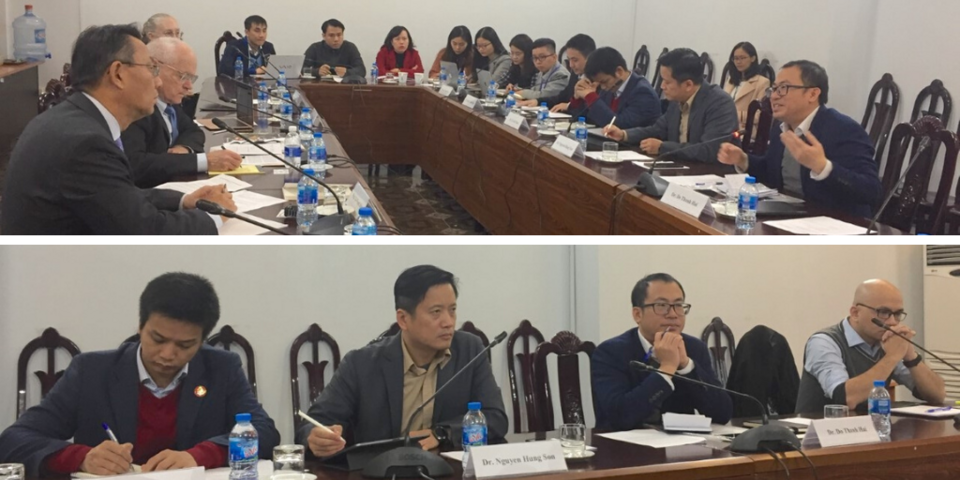
With a focus on health policy, our first day in Hanoi included a visit to Thai Nguyen University, a meeting with government representatives at the Vietnam Ministry of Health, and a seminar on healthy aging and innovation jointly with Hanoi Medical University.

Image
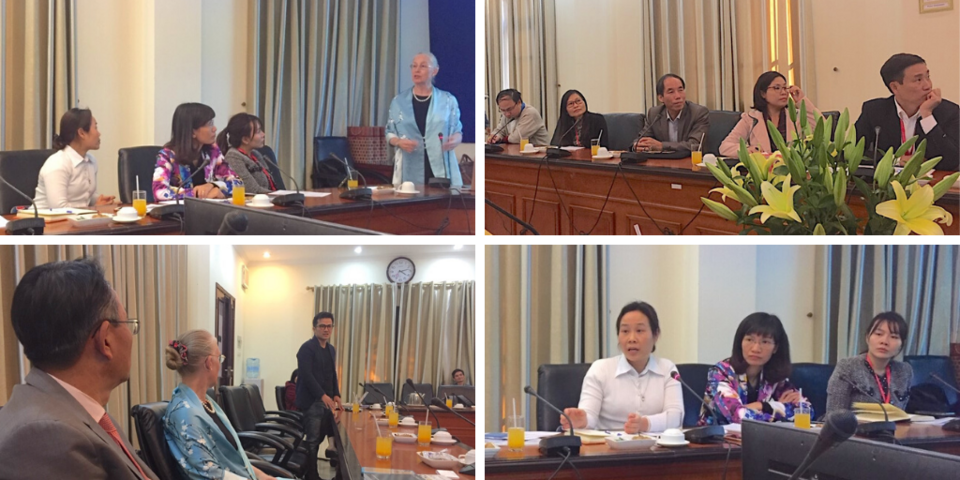
Collage of four images showing participants at a roundtable held at Hanoi Medical University with APARC delegation members

Karen Eggleston and participants at the roundtable held at Hanoi Medical University, December 9, 2019.

Throughout the day, Eggleston presented some of her collaborative research that is part of two projects involving international research teams: one that assesses public-private roles and institutional innovation for healthy aging and another that examines the economics of caring for patients with chronic diseases across diverse health systems in Asia and other parts of the world. We appreciated learning from our counterparts about the health care system and health care delivery in Vietnam.

Shifting focus to international relations and regional security, day 2 in Hanoi opened with a roundtable, “The Rise of the Indo-Pacific and Vietnam-U.S. Relations,” held jointly with the East Sea Institute (ESI) of the Diplomatic Academy of Vietnam (DAV). Following a welcome by ESI Director General Nguyen Hung Son, the program continued with remarks by Shin, Emmerson, ESI Deputy Director General To Anh Tuan, and Assistant Director General Do Thanh Hai.

Image
Participants at a roundtable held at the Diplomatic Academy of Vietnam with APARC delegation members

Roundtable at the Diplomatic Academy of Vietnam, December 10, 2019.

The long-ranging conversation with DAV members included issues such as the future of the international order in Asia; the U.S. withdrawal from multilateralism; the concern about a lack of U.S. engagement in Southeast Asia, sparked by President Trump’s absence from the November 2019 summit of the Association of Southeast Asian Nations (ASEAN) at a time when China is bolstering its influence in the region and when ASEAN hopes to set a code of conduct with China regarding disputed waters in the South China Sea; the priorities for Vietnam as it assumes the role of ASEAN chair in 2020; and the challenges for the Vietnam-U.S. bilateral relationship amid the changing strategic environment in Southeast Asia.

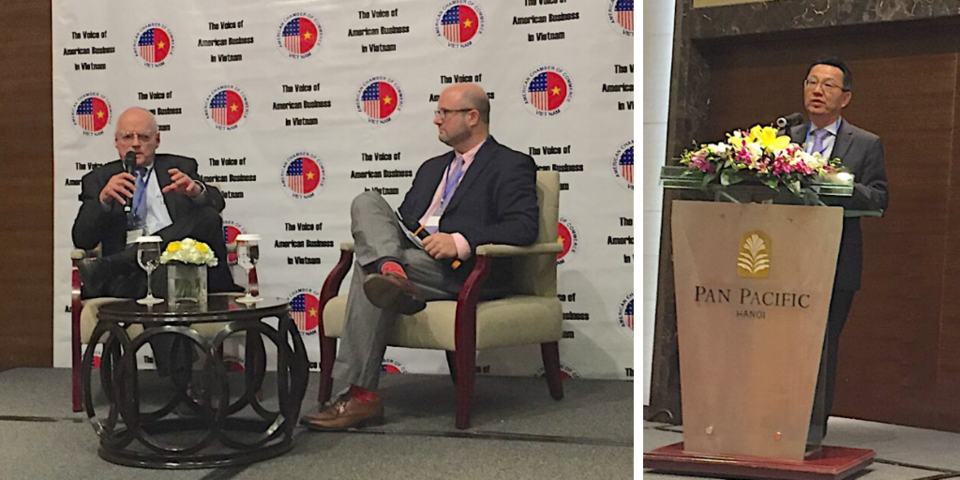
In the afternoon we were joined by members of the American Chamber of Commerce in Hanoi at an AmCham-hosted Lunch ‘n’ Learn session on Vietnam's challenges and opportunities amid the U.S.-China rivalry. The event featured Emmerson in conversation with AmCham Hanoi Executive Director Adam Sitkoff.

Image
Two men in conversation seated on stage and a man speaking at a podium

(Left) Donald Emmerson in conversation with Adam Sitkoff; (right) Gi-Wook Shin welcomes AmCham Hanoi members; December 10, 2019. 

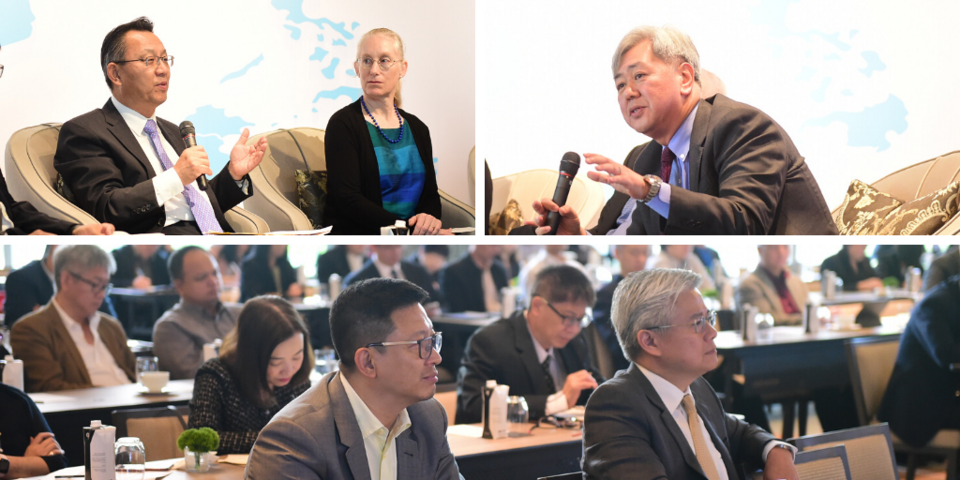
Moving to Bangkok, delegation members Shin, Eggleston, Emmerson, and Kim spoke on a panel for executives of the Charoen Pokphand Group (C.P. Group), one of Thailand’s largest private conglomerates, addressing some of the core issues that lie ahead for Southeast Asia in 2020 and beyond in the areas of geopolitics, innovation, and health.

Image
Participants at a panel discussion with APARC delegation hosted by the C.P. Group, Thailand

Top, from left to right: Gi-Wook Shin, Karen Eggleston, Andrew Kim; bottom: C.P. Group executive listening to the panel, December 12, 2019.

We also enjoyed a tour at True Digital Park, Thailand’s first startup and tech entrepreneur’s campus. Developed by the C.P. Group, True Digital Park aspires to be an open startup ecosystem that powers Thailand to become a global hub for digital innovation.

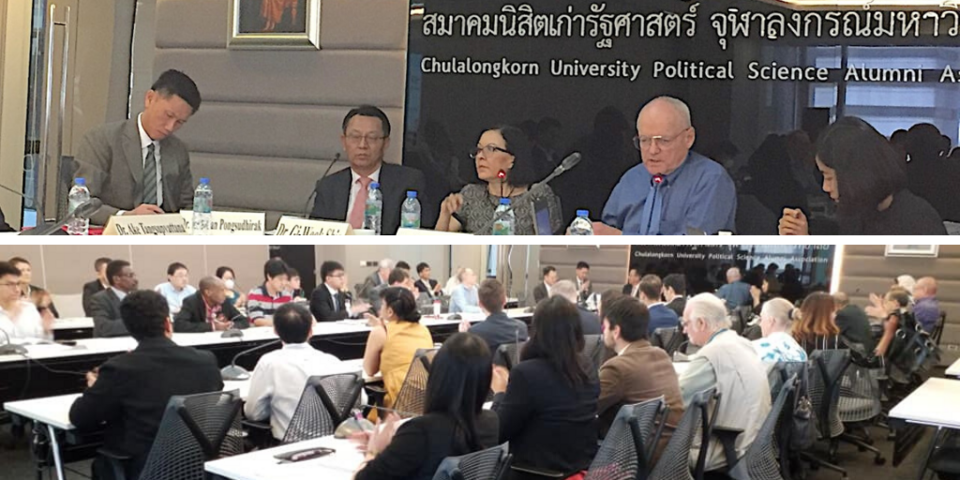
The following day, Shin and Emmerson participated in a public forum hosted by Chulalongkorn University’s Institute of Security and International Studies (ISIS Thailand), "Where Northeast Asia Meets Southeast Asia: The Great Powers, Global Disorder and Asia’s Future.” They were joined by ISIS Thailand Director Thitinan Pongsudhirak and Chulalongkorn University Faculty of Political Science Associate Dean for International Affairs and Graduate Studies Kasira Cheeppensook. The panel was moderated by Ms. Gwen Robinson, ISIS Thailand senior fellow and editor-at-large of the Nikkei Asian Review.

Image
Panelists and participants at a public forum held at Chulalongkorn University

ISIS Thailand forum participants and panelists, from left: Pngsukdhirak, Shin, Robinson, Emmerson, Cheeppensook; December 13, 2019.

As part of that discussion, Emmerson speculated that – driven by deepening Chinese economic and migrational involvement in Southeast Asia’s northern tier – Cambodia and Laos, less conceivably Myanmar, and still less conceivably Thailand could become incorporated de facto into an economically integrated “greater China” that could eventually reduce ASEAN to a more-or-less maritime membership in the region’s southern tier. Emmerson’s speculation was made in the context of his critique of ASEAN’s emphasis on its own “centrality” to the neglect of its lack of the proactivity that would serve as evidence of centrality and of a desire not to be rendered peripheral by the growing centrality-cum-proactivity of China. The event was covered by the Bangkok Post (although that report’s headline and quote of Emmerson are inaccurate, as neither the panel nor Emmerson predicted the “break-up of ASEAN.”)

Our delegation visit in Bangkok concluded with a buffet dinner reception and panel discussion jointly with the Stanford Club of Thailand.

Image
alumni event

Stanford and IvyPlus alumni listening to the panel, December 13, 2019.

Moderated by Mr. Suthichai Yoon, a veteran journalist and founder of digital media outlet Kafedam Group, the conversation focused on the changing geopolitics of Southeast Asia, innovation and health in the region, and the opportunities and challenges facing Thailand-U.S. relations. It was a pleasure to meet many new and old friends from the Stanford and IvyPlus alumni communities.

APARC would like to thank our partners and hosts in Hanoi and Bangkok for their hospitality, collaboration, and the stimulating discussions throughout our visit. We look forward to keeping in touch!

Hero Image
APARC delegation speaking to Stanford and IvyPlus alumni, Bangkok
All News button
1
-

Fighting to End Hunger at Home & Abroad:  Ambassador Ertharin Cousin shares her journey & lessons learned

A Conversation in Global Health with Ertharin Cousin

FSI Payne Distinguished Lecturer | Former Executive Director of the World Food Programme | TIME's 100 Most Influential People

RSVP for conversation & lunch: www.tinyurl.com/CIGHErtharinCousin (please arrive at 11:45 am for lunch)

Professor Ertharin Cousin has been fighting to end global hunger for decades. As executive director of the World Food Programme from 2012 until 2017, she led the world’s largest humanitarian organization with 14,000 staff serving 80 million vulnerable people across 75 countries. As the US ambassador to the UN Agencies for Food and Agriculture, she served as the US representative for all food, agriculture, and nutrition related issues.

Prior to her global work, Cousin lead the domestic fight to end hunger. As chief operating officer at America’s Second Harvest (now Feeding America), she oversaw operations for a confederation of 200 food banks across America that served more than 50,000,000 meals per year.

Stanford School of Medicine Senior Communications Strategist Paul Costello will interview Professor Cousin about her experiences, unique pathway, and the way forward for ending the global hunger crisis.

cid:image002.png@01D509A2.91178F90cid:image003.png@01D509A2.91178F90cid:image004.png@01D509A2.91178F90cid:image005.jpg@01D50A42.AF28BEA0

Li Ka Shing Room 320 

Seminars

Y2E2 Bldg, 473 VIA ORTEGA
Dept. Center on Food Security - Room 349
Stanford, CA 94305


0
img_3988.jpg

Stefania joined FSE as a research data analyst in March 2018 where she works with David Lobell on designing, implementing, and applying new satellite-based monitoring techniques to study several aspects of food security. 

Her current focuses include estimates of crop yields, crop classification, and detection of management practices in Africa and India using a variety of satellite sensors including Landsat (NASA/USGS), Sentinel 1 and 2 (ESA), combined with crop modeling and machine learning techniques.

Research Data Analyst
Date Label
Authors
News Type
News
Date
Paragraphs

Scientists have already warned that climate change likely will impact the food we grow. From rising global temperatures to more frequent "extreme" weather events like droughts and floods, climate change is expected to negatively affect our ability to produce food for a growing human population.

But new research is showing that climate change is expected to accelerate rates of crop loss due to the activity of another group of hungry creatures — insects. A paper published Aug. 31 in the journal Science reports that insect activity in today's temperate, crop-growing regions will rise along with temperatures. Researchers project that this activity, in turn, will boost worldwide losses of rice, corn and wheat by 10-25 percent for each degree Celsius that global mean surface temperatures rise. Just a 2-degree Celsius rise in surface temperatures will push the total losses of these three crops each year to approximately 213 million tons.

"Global warming impacts on pest infestations will aggravate the problems of food insecurity and environmental damages from agriculture worldwide," said co-author Rosamond Naylor, a professor in the Department of Earth System Science at Stanford University and founding director of the Center on Food Security and the Environment. "Increased pesticide applications, the use of GMOs, and agronomic practices such as crop rotations will help control losses from insects. But it still appears that under virtually all climate change scenarios, pest populations will be the winners, particularly in highly productive temperate regions, causing real food prices to rise and food-insecure families to suffer."

In 2016, the United Nations estimated that at least 815 million people worldwide don't get enough to eat. Corn, rice and wheat are staple crops for about 4 billion people, and account for about two-thirds of the food energy intake, according to the UN Food and Agriculture Organization. 

To investigate how insect herbivory on crops might affect our future, the team looked at decades of laboratory experiments of insect metabolic and reproductive rates, as well as ecological studies of insects in the wild. Unlike mammals, insects are ectothermic, which means that their body temperature tracks the temperature of their environment. Thus, the air temperature affects oxygen consumption, caloric requirements and other metabolic rates.

The past experiments that the team studied show conclusively that increases in temperature will accelerate insect metabolism, which boosts their appetites, at a predictable rate. In addition, increasing temperatures boost reproductive rates up to a point, and then those rates level off at temperature levels akin to what exist today in the tropics.

"We expect to see increasing crop losses due to insect activity for two basic reasons," said co-lead and corresponding author Curtis Deutsch, a University of Washington associate professor of oceanography. "First, warmer temperatures increase insect metabolic rates exponentially. Second, with the exception of the tropics, warmer temperatures will increase the reproductive rates of insects. You have more insects, and they're eating more."

The researchers found that the effects of temperature on insect metabolism and demographics were fairly consistent across insect species, including pest species such as aphids and corn bores. They folded these metabolic and reproductive effects into a model of insect population dynamics, and looked at how that model changed based on different climate change scenarios. Those scenarios incorporated information based on where corn, rice and wheat — the three largest staple crops in the world — are currently grown.

For a 2-degree Celsius rise in global mean surface temperatures, their model predicts that median losses in yield due to insect activity would be 31 percent for corn, 19 percent for rice and 46 percent for wheat. Under those conditions, total annual crop losses would reach 62, 92 and 59 million tons, respectively.

The researchers observed different loss rates due to the crops' different growing regions, Deutsch said. For example, much of the world's rice is grown in the tropics. Temperatures there are already at optimal conditions to maximize insect reproductive and metabolic rates. So, additional increases in temperature in the tropics would not boost insect activity to the same extent that they would in temperate regions – such as the United States' "corn belt."

The team notes that farmers and governments could try to lessen the impact of increased insect metabolism, such as shifting where crops are grown or trying to breed insect-resistant crops. But these alterations will take time and come with their own costs.

"I hope our results demonstrate the importance of collecting more data on how pests will impact crop losses in a warming world — because collectively, our choice now is not whether or not we will allow warming to occur, but how much warming we're willing to tolerate," said Deutsch.

Co-lead author is Joshua Tewksbury, director of Future Earth at the University of Colorado, Boulder. Additional co-authors are Michelle Tigchelaar, a UW research scientist in the Department of Atmospheric Sciences; David Battisti, a UW professor of atmospheric sciences; Scott Merrill, a research assistant professor of agriculture and life sciences at the University of Vermont; and Raymond Huey, a UW professor emeritus of biology. The research was funded by the National Science Foundation and the Gordon and Betty Moore Foundation.

By James Urton, University of Washington


Hero Image
corn borer
Image of a European corn borer (Ostrinia nubilalis).
Frank Peairs/Colorado State University
All News button
1
News Type
News
Date
Paragraphs

During the 2017–18 academic year, SPICE’s Jonas Edman worked with six community college instructors from Las Positas College and Foothill College on their plans for integrating global issues into their classrooms. These six instructors were among ten Education Partnership for Internationalizing Curriculum (EPIC) Fellows to work collaboratively with colleagues at Stanford on projects aimed at internationalizing course curricula and producing innovative curricular materials for use in community college classrooms.

On May 19, 2018, an EPIC Symposium, “Integrating Global Issues into Community College Curricula,” was held at Stanford University that featured presentations by the EPIC Fellows as well as presentations from Stanford faculty. Community college faculty and administrators from across California gathered at Stanford University to discuss ways to prepare students for a world that is increasingly interconnected.

The six EPIC Fellows, with whom Edman worked, and their presentation topics are:

  • Brian Evans, Foothill College: The Latin American Lost Decade
  • Ann Hight, Las Positas College: Using Global Lifestyles as a Platform to Teach Gene Expression and Longevity
  • Natasha Mancuso, Foothill College: Using Online Games to Teach Business and Marketing from a Global Perspective
  • Kali Rippel, Las Positas College: Internationalizing the Research Project Using Wikipedia
  • Colin Schatz, Las Positas College: Globalized and Inclusive: Redesigning a Community College Honors Program
  • Antonella Vitale, Las Positas College: Global Voices in American History

Since 2010, Stanford Global Studies (SGS) has partnered with community colleges through innovative projects such as the Stanford Human Rights Education Initiative (SHREI) and EPIC to bring together faculty and administrators committed to developing global and international studies. Fellows join a growing network of EPIC alumni from across the state who are developing innovative programs to internationalize curricula. SPICE as well as Stanford’s Lacuna Stories have been working with SGS National Resource Centers—Center for East Asian Studies, Center for Latin American Studies, Center for Russian, East European and Eurasian Studies—on these efforts.


Hero Image
2017–18 EPIC Fellows Colin Schatz, Antonella Vitale, and Kali Rippel (Las Positas College) with SPICE Director Gary Mukai
All News button
1
0
Affiliated scholar
pam.jpg

Pamela Ronald was a Visiting Professor at the Center on Food Security and the Environment in 2018 and remains an FSE affiliate. She is also a Distinguished Professor in the Department of Plant Pathology and the Genome Center at UC Davis and serves as Director of Grass Genetics at the Joint Bioenergy Institute in Emeryville, California and Faculty Director of the UC Davis Institute for Food and Agricultural Literacy.

Ronald’s laboratory studies the genetic basis of resistance to disease and tolerance to stress in rice. Together with her collaborators, she has engineered rice for resistance to disease and tolerance to flooding, which seriously threaten rice crops in Asia and Africa. For example, Ronald and collaborators discovered the rice XA21 immune receptor and the rice Sub1A submergence tolerance transcription factor. In 2015, five million farmers planted Sub1 rice varieties developed by breeders at the International Rice Research Institute. In 1996, she established the Genetic Resources Recognition Fund, a mechanism to recognize intellectual property contributions from less developed countries.

She and her colleagues were recipients of the USDA 2008 National Research Initiative Discovery Award for their work on rice submergence tolerance. She was awarded a Guggenheim Fellowship, the Fulbright-Tocqueville Distinguished Chair and the  National Association of Science Writers Science in Society Journalism Award. She is an elected fellow of the American Association for the Advancement of Science. In 2011, she was selected as one of the 100 most creative people in business by Fast Company Magazine. In 2012, Ronald was awarded the Louis Malassis International Scientific Prize for Agriculture and Food and the Tech Award for innovative use of technology to benefit humanity. In 2015 Scientific American selected Ronald as one of the world’s 100 most influential people in biotechnology. In 2016, Grist magazine named Ronald as one of 50 innovators who will lead us toward a more sustainable future.

-

Abstract: Humans and natural ecosystems are exposed to toxic metals from many sources and following many exposure pathways. In this seminar, Dr. Blum will explain how small variations in the isotopic compositions of lead and mercury are created and how they can be used to unravel many of the mysteries of the exposure of these metals to people and ecosystems.

Speaker bio: Joel Blum holds the MacArthur and Keeler Professorships in Earth and Environmental Sciences at the University of Michigan. He earned his B.A. from CWRU, M.S. from the University of Alaska, and Ph.D. from Caltech. Professor Blum’s research focuses on the sources, fate, and cycling of metals and on the application of stable and radiogenic isotopes across earth sciences, chemistry and ecology. He has studied topics that include granite petrogenesis, ore deposits, meteorites, impacts, soils, forest nutrient cycling, hydrogeochemistry, terrestrial and aquatic foodwebs, animal migration, atmospheric chemistry and chemical oceanography. Blum is a past editor of Chemical Geology and Elementa and is currently the editor of the American Chemical Society’s journal Earth and Space Chemistry. He is a Fellow of the Geochemical Society, the American Geophysical Union, the Geological Society of America, and the AAAS. He was awarded the Patterson Medal of the Geochemical Society for his work on the application of mercury isotopes in the environment. 

Joel D. Blum Professor of Earth & Environmental Sciences; Chemistry; Ecology & Evolutionary Biology University of Michigan
Seminars
Paragraphs

Food retailers and manufacturers are increasingly committing to address agricultural sustainability issues in their supply chains. In place of using established eco-certifications, many companies define their own supply chain sustainability standards. Scholars remain divided on whether we should expect such company-led programs to affect change. We use a major food retailer as a critical case to evaluate the effectiveness of a company-led supply chain standard in improving environmental farm management practices. We find that the company-led standard increases the adoption of most environmental best management practices among the company's fruit, vegetable and flower growers in South Africa. This result is robust across two identification strategies: a panel analysis of over 950 farm audits and a cross-sectional matching analysis using original survey data. In-depth interviews suggest that the program's unique focus on capacity building through audit visits by highly trained staff, coupled with a close business relationship between the retailer and their growers help to explain the increased effectiveness of the program as compared to other private environmental standards. Contrary to the argument that company-led initiatives are mere window dressing, this study provides a critical example of the positive role private governance mechanisms can play in improving environmental farm management practices globally.

All Publications button
1
Publication Type
Journal Articles
Publication Date
Journal Publisher
Global Environmental Change
Authors
Eric Lambin
Authors
Beth Duff-Brown
News Type
News
Date
Paragraphs

There is plenty of research on how the rapid warming of the planet is going to have growing adverse impacts on global economies, health, food supplies and natural disasters.

A new study now suggests that as temperatures continue to rise — particularly with more and more 90-plus-degree days — more fetuses and infants will experience economic loss by age 30.

“There is a growing body of evidence that finds that shocks to the fetus and young child — whether nutritional, environmental, economic or stress-related — have long-term consequences on health, education and economic outcomes throughout the life cycle,” said Maya Rossin-Slater, an assistant professor of health research and policy at Stanford Medicine and a faculty fellow at the Stanford Institute for Economic Policy Research.

Rossin-Slater published her study Dec. 4 in the Proceedings of the National Academy of Sciences, indicating early-life exposure to extreme temperatures is linked to potential losses in human capital. Her co-authors are Adam Isen, an economist with the U.S. Department of Treasury, and Reed Walker, an assistant professor at University of California, Berkeley.

The researchers used data from the U.S. Census Bureau’s Longitudinal Employer Household Dynamic Files, which contain information on adult labor market outcomes linked to county and exact date of birth. They looked at weather in counties in 24 states on any given day, and then measured how many days with average temperatures above 90 degrees a child born on that day in that county would have experienced during gestation and during the first year of life. They then compared the earnings of individuals who were exposed to different numbers of such hot days, but who were of the same race and gender, and born in the same county and on the same day of the year (but in different years).

Each day a fetus or infant experiences 90-plus-degree temperatures, Rossin-Slater and her co-authors found that he made $30 less a year on average, or $430 over the course of his lifetime. While that may not seem like a huge loss of income, the authors point out that their study is best understood from a population-level perspective rather than from an individual one.

“There is a lot of research already showing that extreme heat has immediate effects on labor market productivity and GDP,” she said. “What we are saying is that there is another wrinkle to this — that there can be consequences many years later, on cohorts who are still in the womb.”

Most Americans today only experience one day a year that is 90 degrees or hotter. But the Climate Impact Lab has indicated that if countries continue to take only moderate action on climate change, by the end of this century there will be about 43 such days a year.

So, if you multiple a $30 annual loss a day by 43 days, you come up with an average $1,290 a year — and compounded in large populations of pregnant women in hot climates.

“Prior research shows that exposure to extreme heat in utero leads to lower birth weight and increases infant mortality,” said Rossin-Slater, who is also a core faculty member at Stanford Health Policy. She said poor fetal and infant health could impact adult earnings in three ways: cognitive impairment, poor health that causes people to miss school or work, and less non-cognitive skill development such as self-control.

“With regard to exposure to heat specifically, fetuses and infants are especially sensitive because their thermoregulatory systems are not fully developed and they have less capacity to self-regulate when their bodies are exposed to extreme temperatures,” Rossin-Slater said.

Hot Zones and Air Conditioners

The obvious questions that arise from such research: What happens to the babies of women who already live in very high temperatures? And why not just ensure that all pregnant women have air conditioners, at least in the developed world where it would be more affordable?

Women in warm zones such as parts of Africa and South Asia, as well as U.S. cities like Phoenix and Washington, D.C., shouldn’t worry too much. The loss of income is relatively little and people living in hot climates may actually adapt over time to exposure to extreme heat.

“Our study is not saying that individual people should be doing something differently to avoid exposure to extreme heat,” Rossin-Slater said. “Instead, we think we are providing additional evidence for the possible population-level consequences of climate change and the projected increase in the number of days with extreme temperatures.”

And what about those air conditioners? The cohorts in the study are actually born in the 1970s, during a period of rapid expansion in air conditioning across American households. The researchers found the earning losses went away in areas where most people got air conditioners installed.

“If we think that there is something biological going on as a result of the fetus being overheated, then it makes sense that AC, which prevents the overheating, can mitigate this negative effect,” Rossin-Slater said.

But it’s important to recognize, she said, that air conditioners come with costs, both financial from the perspective of individuals and households who can and can’t afford such systems, and environmental from the perspective of the country or planet as a whole.

“So this is not a `free’ solution and any cost-benefit calculations related to climate change should take into account this adaption response,” Rossin-Slater said. “But we ought to think about what these results imply at the global level — in many countries that are much hotter than the United States and still don’t have AC. So if we are trying to understand global inequality and the impacts of climate change on developing countries, our results suggest that climate change could play a role in perpetuating global inequality across generations.”

 

Hero Image
pregnancy Getty Images
All News button
1
0
CDDRL Postdoctoral Scholar, 2017-2019
monica.jpg

Dr. Monica Teran has experience in the analysis focus on the domains of disparities in health services and response to population health needs of the health system governance using spatial statistical methodology and Geography of health approach that takes into account spatial variation in socioeconomic factors and accessibility to services. Since September 2017 she is a member of Sistema Nacional de Investigadores, SNI (National System of Researcher) in Mexico, CONACYT.

CV
Subscribe to Health and the Environment