
Anti-Semitism surge in Europe reflects loss of values, historical awareness, says Stanford scholar
Appeared in Stanford Report, August 29, 2014
A worrying spike in anti-Semitism in Europe is a stark reminder that prejudice against Jewish people is still a reality there today, say Stanford scholars. Anti-capitalism has been a particular source of anti-Semitism, according to Professor Russell Berman.
European leaders need to speak out more strongly against the escalation of anti-Semitism, a Stanford professor says.
"They should be willing to enforce the law," said Russell Berman, a Stanford professor of German studies and of comparative literature who is affiliated with the Europe Center on campus.
In recent weeks, slogans invoking anti-Semitism have been heard during European protests against the Palestinian deaths in the Palestinian-Israeli conflict. In France and Germany, synagogues and Jewish community centers have been firebombed. In Britain, a rabbi was attacked near a Jewish boarding school.
"Protesters who storm synagogues should be arrested and prosecuted. Too often police have shown a blind eye when political protests have transformed into anti-Semitic mob actions," said Berman, the Walter A. Haas Professor in the Humanities and a senior fellow at the Hoover Institution and the Freeman Spogli Institute for International Studies.
He said that European societies in the long run have to find a way to grapple with their failed immigration policies and achieve more effective integration, he said. This includes more efficiently integrating immigrants into the cultural expectations of their new societies.
"Post–World War II Europe had as a core value a rejection of the anti-Semitism that led to the Holocaust. Europeans have to develop a pedagogy that can pass that value on to the new members of their communities," said Berman.
Roots of hatred
The recent eruption of anti-Semitism in Europe has multiple causes, according to Berman. The continent's lagging economy, the influx of immigrants from Muslim countries and the ongoing Israeli and Palestinian conflict are large factors.
And as last year's European parliament elections revealed, right-wing extremism has grown across Europe, he said.
"The far right is historically a home of anti-Semitism wrapped in nationalism and xenophobia. Some of this development can be attributed to the ongoing economic crisis, but some is certainly also a reaction against what is sometimes called the 'democracy deficit' in the European Union," Berman said.
Some Europeans believe their national political life has been subordinated to a "transnational bureaucracy" in the form of the European Union, Berman said. He added that this breeds resentment, and one expression of that is anti-Semitism, which is coinciding with traditional European nationalism.
Berman added, "Clearly this does not apply to all Muslims in Europe, but it has become an unmistakable feature in those population cohorts susceptible to radicalization as a response to a sense of social marginalization."
In Europe, immigrant populations are often clustered in de facto segregated neighborhoods, forming a parallel society, Berman said.
"While policies of multiculturalism have in the United States often contributed to productive integration, in Europe they have worked differently and undermined social cohesion. In that context, anti-Semitism has festered," he said.
Ongoing conflicts in the Middle East have also fanned the flames of European anti-Semitism, Berman said. Meanwhile, protests did not arise in Europe when Muslims and Christians were massacred in recent months in Syria and Iraq.
"A year ago, one could still make an at least conceptual distinction between anti-Zionism [criticism of Israel] and anti-Semitism [hatred of Jews]," he said.
The events in the past months in the streets of Europe have erased that distinction, Berman said.
"The politics of criticizing Israel have been fully taken over by anti-Semites, whether from the traditional European far right, the extremist left or parts of the immigrant communities," he said.
Anti-capitalism, economic downturns
When the European economy soured, leaving many young people unemployed at a time of surging globalism – all against a "residual" communist backdrop that still exists in parts of Europe – anti-Semitism was the result, according to Berman.
"That inherent anxiety and free-floating animosity in Europe turns into hostility to minorities," he said. "It can generate both anti-Jewish and anti-Muslim prejudices, but anti-capitalism is today, as it has been historically, a particular source of anti-Semitism."
Berman calls this left-wing anti-Semitism – the targeting Jews as the symbols of capitalism – which he says has a long history. "A socialist leader of the 19th century once called anti-Semitism 'the anti-capitalism of fools,' and that's part of what we still see today," Berman said.
Opportunity, education, the future
Amir Eshel, a professor of German studies and of comparative literature and affiliated faculty member of The Europe Center, said Europe needs to do a better job of integrating Muslim immigrants into their new societies. In particular, he said, more economic opportunities must be given to people from disenfranchised communities.
"Nothing is as important as giving people opportunities to make their lives better," said Eshel, the Edward Clark Crossett Professor in Humanistic Studies. He is also an affiliated faculty member at the Europe Center in the Freeman Spogli Institute for International Studies.
Eshel points to important roles for the media and educational systems to play in clamping down on anti-Semitism. There are programs in place – International Holocaust Remembrance Day, for example – to remind people about the evil inflicted on Jews in Europe more than 60 years ago.
"What has changed is that young people are less biographically connected to these crimes of the past," said Eshel.
"When this happens, as the Holocaust drifts further in time, a certain sensibility arises that one should not be bound by the lessons of the past," he said.
Anti-Semitism in Europe, he said, is the worst he's seen or known about since the end of World War II. He's especially worried about the large numbers of Muslims from Britain and France who have joined the jihadist movements in places like Syria and Iraq.
"It's not going to be easy to track them if they return," Eshel noted, "and it'll be a challenge for many years in Europe."
Fear among Jews
History Professor Norman Naimark said that some French Jews are leaving the country because of ongoing anti-Semitic violence.
"Germany has also experienced an ongoing problem on both the extreme left and right, but there the authorities and the Jewish community seem to have the situation under control," added Naimark, the Robert and Florence McDonnell Professor in Eastern European Studies.
Naimark, the director of the Stanford Global Studies Division and a senior fellow at the Hoover Institution and the Freeman Spogli Institute for International Studies, described European anti-Semitism as following an oscillating curve up and down, especially in times of Middle East crises.
"England seems particularly susceptible to these kinds of oscillations," he said.


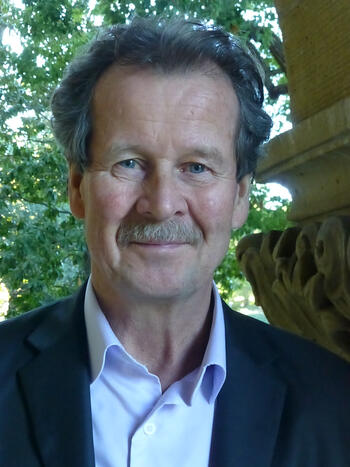
 Thomas Blom Hansen (Moderator/Speaker) is the Reliance-Dhirubhai Ambani Professor of Anthropology at Stanford University. He is also the director of the Center for South Asia at Stanford. He has worked extensively on Hindu-Muslim relations, communal violence and the rise of Hindu nationalism in India. His books include The Saffron Wave. Hindu Nationalism and Democracy in Modern India (Princeton University Press 1999) and Wages of Violence, Naming and identity in postcolonial Bombay (Princeton University Press 2001).
 Harish S. Wankhede (Speaker) research interest is to imagine theoretical spaces by interconnecting certain approaches and themes of social science mainly, Justice, politics of recognition and redistribution, secularism, nationalism and the Caste identity. The emphasis of his work is on the marginalized communities in India especially the Muslims, Dalits and the Tribals.
 Alexander Lee (Speaker) is a postdoctoral fellow at the Center on Democracy, Development, and the Rule of Law. In the fall of 2014 he will be an assistant professor of political science at the University of Rochester. His research focuses on the historical factors governing the success or failure of political institutions, particularly in South Asia and other areas of the developing world. His work has been published in World Politics and the Quarterly Journal of Political Science. Alex earned his PhD from Stanford in 2013. More information on his work can be found on his


