Peacekeeping
-


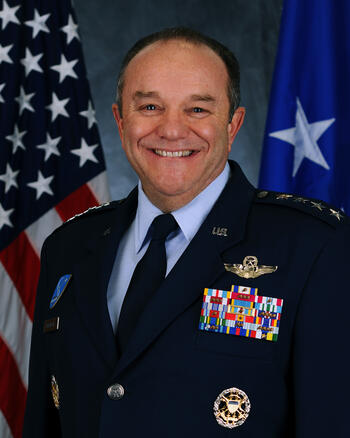
General Philip M. Breedlove will discuss the rapidly evolving geopolitical climate in Europe. Additionally, he will highlight many of the current and future security challenges which the United States and NATO must be prepared for.

Image
Photo of General Philip M. Breedlove


Gen. Breedlove is Commander, Supreme Allied Command, Europe, SHAPE, Belgium and Headquarters, U.S. European Command, Stuttgart, Germany.   

The General was raised in Forest Park, Ga., and was commissioned in 1977 as a distinguished graduate of Georgia Tech's ROTC program. He has been assigned to numerous operational, command and staff positions, and has completed nine overseas tours, including two remote tours. He has commanded a fighter squadron, an operations group, three fighter wings, and a numbered air force. Additionally, he has served as Vice Chief of Staff of the U.S. Air Force, Washington, D.C. Operations Officer in the Pacific Command Division on the Joint Staff; Executive Officer to the Commander of Headquarters Air Combat Command; the Senior Military Assistant to the Secretary of the Air Force; and Vice Director for Strategic Plans and Policy on the Joint Staff. 

Prior to assuming his current position, General Breedlove served as the Commander, U.S. Air Forces in Europe; Commander, U.S. Air Forces Africa; Commander, Air Component Command, Ramstein; and Director, Joint Air Power Competence Centre, Kalkar, Germany.  He was responsible for Air Forces activities, conducted through 3rd Air Force, in an area of operations covering more than 19 million square miles.  This area included 105 countries in Europe, Africa, Asia and the Middle East, and the Arctic and Atlantic oceans.  As Vice Chief, he presided over the Air Staff and served as a member of the Joint Chiefs of Staff Requirements Oversight Council and Deputy Advisory Working Group. He assisted the Chief of Staff with organizing, training, and equipping of 680,000 active-duty, Guard, Reserve and civilian forces serving in the United States and overseas. General Breedlove has flown combat missions in Operation Joint Forge/Joint Guardian. He is a command pilot with 3,500 flying hours, primarily in the F-16.

Koret Taube Conference Center (Room 130)
Gunn-SIEPR Building
366 Galvez Avenue


General Philip M. Breedlove Commander, Supreme Allied Command, Europe, SHAPE, Belgium and Headquarters, U.S. European Command, Stuttgart, Germany Speaker
Lectures
News Type
Commentary
Date
Paragraphs

North Korea today threatened military action against South Korea if it did not end its propaganda broadcasts along the Demilitarized Zone (DMZ) within 48 hours. The broadcasts against the North are being systematically blared by loudspeakers over the border.   

South Korea resumed the broadcasts earlier this week after an 11-year hiatus, in retaliation for North Korea’s planting landmines just outside a South Korean DMZ guard post that crippled two South Korean soldiers on Aug. 4.

David Straub, associate director of the Korea Program at the Walter H. Shorenstein Asia-Pacific Research Center and a former Korean affairs director at the U.S. Department of State, offers insights on the situation. Straub also spoke on PRI's "The World" radioshow on Aug. 20, the audioclip and summary can be accessed by clicking here.

What’s behind the current tensions on the Korean Peninsula?

Fundamentally, the current situation is just another symptom of the underlying problem, which is the division of Korea into two competing states, with one of them—North Korea—having a Stalinist totalitarian system and a Maoist-style cult of personality. Since North Korea can’t compete with the South economically and diplomatically, it uses the threat of force or the actual use of it to try to intimidate South Korea. The North Koreans know that South Korea tends to “blink first” and step back because it is democratic and its leaders are concerned about civilian casualties.

The current situation is also related to the leadership transition in North Korea, with leader Kim Jong Un succeeding his father Kim Jong Il three years ago. Kim Jong Un still feels insecure, which is clearly evidenced by his execution of his powerful uncle Jang Seong-taek in 2013 and many other leaders there as well. To solidify support for his rule, he also manufactures a South Korean threat to rally his people behind him.

What does North Korea want?

North Korea’s immediate demand is that South Korea stop its propaganda broadcasts across the DMZ. The South Korean broadcasts criticize the North Korean system and its leaders, which is something that the North, with its cult of personality, can’t accept. But the South resumed the broadcasts only because the North Koreans recently snuck into the South Korean side of the DMZ and viciously planted landmines just outside a South Korean guard post. These were clearly intended to maim South Korean soldiers. They did just that, blowing the legs off two young men.

The North Korean regime’s long-term aim is not just to survive but also to get the upper hand on South Korea, and eventually try again to reunify the peninsula on its own terms. That explains why North Korea behaves as it does, rather than reform its system and reconcile with the South.

The North also demands an end to all U.S. and South Korean military exercises on the peninsula—even though the North has a much larger military than the South and U.S. forces there combined and is developing nuclear weapons and other weapons of mass destruction. Ultimately, the North wants to end the U.S.-South Korean alliance and see U.S. forces withdrawn from the peninsula, in the belief that it will open the way to eventual victory over the South.

Why did the South resume the broadcasts? Was it a good idea?

South Korea resumed the loudspeaker broadcasts in retaliation for the maiming of two of its soldiers on August 4th. Rather than retaliate by attacking militarily, the South resumed the loudspeaker broadcasts because the South Korean military knows that North Korean leaders hate them.

The South Korean military believes that North Korean leaders hate the broadcasts because they are effective in educating young North Korean soldiers and civilians in earshot about the nature of the regime and its leaders. The South Korean military seems to assume that the broadcasts are effective in that regard because they anger the North Korean leaders so much. But I think the reason the broadcasts anger the North Korean leaders is due to the cult of personality. The North Korean system can’t accept the idea of its leaders being criticized.

So I don’t think it was necessarily a wise step on the part of the South Korean military to resume the broadcasts. On the other hand, politically, by crippling two South Korean soldiers, the North Koreans had left South Korea with no option but to respond in some way. After the North Koreans killed fifty South Koreans in two separate sneak attacks five years ago, the South Korean government warned that it was not going to sit back the next time. The resumption of the broadcasts has further raised tensions but, frankly, given the danger of war on the peninsula, the South doesn’t have a lot of good ways to respond to North Korean provocations.

How serious is the situation?

North Korea has now threatened military action in 48 hours if South Korea doesn’t end the propaganda broadcasts. The North often makes threats. Usually, it doesn’t carry them out, but sometimes it does.

The United States and South Korea are conducting an annual military exercise together in the South until the end of August—something else that the North Koreans are demanding an end to. Most experts feel that the North is unlikely to launch a major provocation while the American presence is bolstered and the U.S. and South Korean militaries are paying full attention. The North Korean leaders know they are weaker than our side, so they usually avoid frontal assaults and instead engage in sneak attacks, at times and places and in ways of their own choosing.

There is more uncertainty in recent years because of the aggressive and threatening behavior thus far of Kim Jong Un, who is young and inexperienced. He seems anxious about his position in the North and prepared to take risks to bolster it, including rallying the people behind him by raising tensions with the South. We also don’t know if the North feels freer to engage in major provocations because it has developed at least a handful of nuclear devices since its first nuclear test in 2006.

So I myself wouldn’t be afraid to visit Seoul now but the situation bears even closer watching than usual.

Hero Image
dmz flickr stephan
North Korean soldiers stand guard at the Demilitarized Zone, 2008.
Flickr/(stephan)
All News button
1
Authors
News Type
News
Date
Paragraphs

CISAC's Honors Program in International Studies recently awarded three prizes to some of its students, instead of the traditional two. “At the end of the year we award prizes to three of the thesis writers. It’s always a hard decision to make because they are all really good,” said FSI Senior Fellow and Honors Co-director Martha Crenshaw.

Taylor Grossman, Patrick Cirenza, and Teo Lamiot were awarded the Firestone Medal for Excellence in Undergraduate Research, the William J. Perry Prize, and the John Holland Slusser World Peace Prize, respectively. They presented their work in front of faculty, advisors, and friends at a packed seminar in early June.

The Perry Prize, named after former Defense Secretary and current FSI Senior Fellow William Perry, is awarded to a student for excellence in policy-relevant research in international security studies. Cirenza’s thesis, “An Evaluation of the Analogy between Nuclear and Cyber Deterrence,” examined whether cyber weapons can be accurately understood by comparing them to nuclear weapons.

Image
Patrick Cirenza

“My thesis topic definitely evolved over time,” Cirenza said. “I really did not know that much about cyber weapons. I initially wanted to look at non-state actors in cyber space and I asked Professor Scott Sagan about that and he asked what I knew about cyber and the reality was I really did not know anything. But I still really wanted to study it and at the time I was in Condoleezza Rice’s seminar and she suggested examining the analogy between nuclear and cyber weapons, which was being used a lot at the time. I went through several different topics and ultimately landed on deterrence.”

Cirenza was advised by FSI Senior Fellow Coit Blacker, who co-directs the honors program with Crenshaw, and by consulting professor Phil Taubman. Next fall he will attend Cambridge for a one year M.Phil program in international relations. After that he hopes to join the Marine Corps infantry.

“I never wanted a desk job in my twenties and I think it’s the best way to serve my country at this time,” he said.

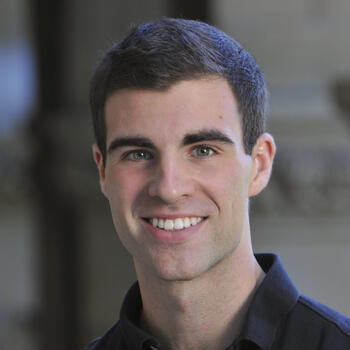
The newly created Slusser Prize goes to the thesis that best contributes to the development of “permanent world peace.” Lamiot’s thesis, “When Blue Helmets Do Battle: Civilian Protection in the Democratic Republic of the Congo” examined whether the use of force against rebel groups in the DRC by UN peacekeepers had any effect on atrocities committed against civilians. He was advised by FSI Senior Fellow Stephen Stedman, who formerly served as Assistant Secretary-General and Special Advisor to the Secretary-General of the United Nations.

Lamiot started formulating his thesis topic when he was working in the U.S. embassy in the DRC. “I worked in the unit that is tasked with monitoring the conflict in the eastern part of the country. Part of my work was investigating a massacre that had taken place in that region about a month before I arrived in country. The massacre was of interest to the U.S. government because the Congolese and U.N. peacekeeping forces stationed nearby did not respond to the massacre despite knowing that it was going on,” he recounted.

Image
Teo Lamiot

“This sparked my interest and, at first, I wanted to answer the question why do peacekeepers use force in some cases but not in others, but I ultimately decided on answering what happens when they do use force. I’m hoping that my argument that in some cases using force has positive effects and decreases rebel violence against civilians informs these decision-makers on the ground when they are choosing what to do.”

After graduation Lamiot will be on a Center for Democracy, Development, and Rule of Law fellowship in Uganda doing development work. “I’ll likely be working on democratic and political development. I’m trying to learn something about how outside actors can try to bring about these development outcomes in foreign countries.”

The Firestone Medal is a Stanford-wide prize awarded to the top ten percent of all honors theses in social science, science, and engineering. Grossman, who will also graduate with a B.A. Political Science, wrote hers on homeland security and the evolution of terrorism advisory systems. She was advised by CISAC Co-Director Amy Zegart.

“I really wanted to look at effectiveness of communication and intelligence sharing, but in a way that I could actually see government information. That led me to public warning systems for terrorism where there is a lot of public information available. Not a lot has been written on how effective they are, how they operate, or how they have evolved,” Grossman said.

Image
Taylor Grossman

After graduation she plans on joining the Hoover Institution as a research assistant.

“I feel like I majored in CISAC. Ever since I took the class ‘The Face of Battle’ with Professor Scott Sagan and Colonel Joe Felter, I’ve been hooked on international security and the issues CISAC focuses on. I think the honors program has been the defining part of my undergraduate career. It was really rewarding and challenging and I’m glad I did it.”

Grossman and Cirenza were also elected to the Phi Beta Kappa Society in May 2015, as was Geo Saba, a political science major. Phi Beta Kappa is a nationwide society honoring students for the excellence and breadth of their undergraduate scholarly accomplishments.

Additionally, the Stanford Alumni Association (SAA) selected Cirenza, Grossman, and Akshai Baskaran, who majored in chemical engineering, to receive an Award of Excellence. 

Congratulations to all graduates of the Class of 2015: Akshai Baskaran, Patrick Cirenza, Kelsey Dayton, Taylor Grossman, Sean Hiroshima, Annie Kapnick, Sarah Kunis, Teo Lamiot, Austin Lewis, Sam Rebo, Geo Saba, Eliza Thompson, and Adrienne von Schulthess.

Hero Image
Honors Class of 2015
Program co-directors Martha Crenshaw (front) and Coit Blacker (right), along with T.A. Shiri Krebs (far left) are on hand to congratulate the CISAC Honors Class of 2015
Rod Searcey
All News button
1

BACKGROUND

In attempts to complement the ongoing work on police use of violence and the pacification policy conducted by the Program on Poverty and Governance for the past three years (for this specific project, PovGov analyzed an extensive database on police work - including information on homicide rates and ammunition usage - applied a questionnaire to over 5,000 police officers, and conducted several interviews and case studies with police commanders and officers), we now aim to carry out a research project that can advance the understandin

BACKGROUND

Since 2008, Rio de Janeiro has implemented a new public security policy called the “Pacification”, a police strategy with full support from the Federal government that aims to improve the overall levels of security in the city and retake areas previously dominated by criminal organizations. Based on this new model of policing - that takes an approach on community policing initiatives – “Pacifying Police Units (UPPs)” are implemented in different poor communities in the city (shanty towns).

-

At the NATO Summit in Wales in September 2014, NATO leaders were clear about the security challenges on the Alliance’s borders. In the East, Russia’s actions threaten our vision of a Europe that is whole, free and at peace.  On the Alliance’s southeastern border, ISIL’s campaign of terror poses a threat to the stability of the Middle East and beyond.  To the south, across the Mediterranean, Libya is becoming increasingly unstable. As the Alliance continues to confront theses current and emerging threats, one thing is clear as we prepare for the 2016 Summit in Warsaw: NATO will adapt, just as it has throughout its 65-year history.

Image
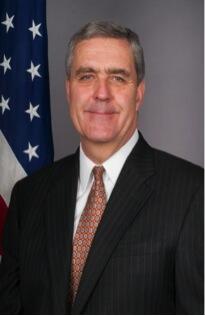
Douglas Lute, Ambassador of the United States to NATO


In August 2013, Douglas E. Lute was sworn-in as the Ambassador of the United States to the North Atlantic Treaty Organization (NATO).  From 2007 to 2013, Lute served at the White House under Presidents Bush and Obama, first as the Assistant to the President and Deputy National Security Advisor for Iraq and Afghanistan, and more recently as the Deputy Assistant to the President focusing on Afghanistan, Pakistan and India.  In 2010, AMB Lute retired from the U.S. Army as a Lieutenant General after 35 years on active duty.  Prior to the White House, he served as the Director of Operations on the Joint Staff, overseeing U.S. military operations worldwide. He served multiple tours in NATO commands including duty in Germany during the Cold War and commanding U.S. forces in Kosovo.  He holds degrees from the United States Military Academy and Harvard University.

A light lunch will be provided.  Please plan to arrive by 11:30am to allow time to check in at the registration desk, pick up your lunch and be seated by 12:00 noon.

Co-sponsored by The Europe Center, the Freeman Spogli Institute for International Studies, the Center for International Security and Cooperation and the Center for Russian, East European and Eurasian Studies.


Douglas Lute United States Ambassador to NATO Speaker
Lectures
Authors
News Type
News
Date
Paragraphs


Stanford political science professor Scott Sagan, a senior fellow at the Center for International Security and Cooperation and the Freeman Spogli Institute for International Studies, has been honored with a prestigious award from the National Academy of Sciences for his pioneering work addressing the risks of nuclear weapons and the causes of nuclear proliferation.

“Sagan's work has become an integral part of the nuclear debate in the United States and overseas,” the NAS said in a statement. “He has shown, for example, that a government's decision to pursue nuclear weapons can be prompted not only by national security concerns but also because of domestic political interests, parochial bureaucratic infighting, or concerns about international prestige.”

The William and Katherine Estes Award recognizes research in any field of cognitive or behavioral science that advances the understanding of issues relating to the risk of nuclear war. Sagan and other NAS award winners will be honored in a ceremony on April 26 during the academy’s 152nd annual meeting.

The academy noted that Sagan has developed theories about why different types of political regimes behave differently once they acquire “the bomb.”

“Sagan and his colleagues have also investigated U.S. public attitudes about nuclear weapons and found that few Americans actually believe that there is a taboo against their use in conflicts,” the NAS said. “The possession of nuclear weapons also raises the risk of nuclear weapons accidents, and Sagan has shown that even though there has never been an accidental nuclear war, there have been many more close-calls and near-accidents than was previously known.”

Sagan and co-authors Daryl G. Press and Benjamin A. Valentino, examined the taboos, traditions and non-use of nuclear weapons in this article in the American Political Science Review. He continues to work on an original survey experiment that examines the public attitudes about the “unthinkable” use of the nuclear bomb.

Siegfried Hecker – one of the world’s leading experts on plutonium science and a senior fellow at FSI – said that he has learned greatly from Sagan over the years as colleagues and former co-directors of CISAC. The two represent the center’s foundational spirit of combing the social and hard sciences to build a safer world.  

“The beauty of Scott’s work is that he has combined rigorous political science thinking with a practical knowledge of the limits of humans and organizations to deal with the complexities and dangers of nuclear weapons,” Hecker said. “Scott’s work has convinced me that there is real science in the political science of nuclear weapons. It is appropriate that this honor comes from the National Academy of Sciences.”

Sagan said he is honored to follow in the footsteps of previous recipients of the William and Katherine Estes Award, calling them “some of my intellectual heroes.”

Among those who have won the award are Thomas C. Schelling, Alexander L. George, Robert Jervis, Robert Powell and Graham Allison.

Allison, director of the Belfer Center for Science and International Affairs at Harvard University, called Sagan's honor a "well-deserved recognition of a scholar who has illuminated the intersection of organizational behavior and nuclear danger."

The National Academy of Sciences is a private, nonprofit institution that was established under a congressional charter signed by President Abraham Lincoln in 1863. It recognizes achievement in science and provides science, engineering, and health policy advice to the federal government and other organizations.

Hero Image
perry sagan
Former Secretary of Defense William J. Perry, left, and Political Science Professor Science Professor Scott Sagan talk during a break in Perry's Stanford class, "Living at the Nuclear Brink."
©Light at 11B
All News button
1
Authors
News Type
News
Date
Paragraphs

Understanding the nature of violent conflict in the world's most dangerous flashpoints may help find ways to peace and stability, according to a Stanford expert.

Once a soldier, now a scholar, Joe Felter knows better than most the intrinsic meaning of war and conflict – he served on the front lines in the U.S. Special Forces in places such as Iraq, Afghanistan and the Philippines.

Today, the senior research scholar at Stanford's Center for International Security and Cooperationand research fellow at the Hoover Institution is on a different kind of mission: building knowledge on the subject of politically motivated conflict.

For example, how are the most casualties suffered and under what conditions? Are there patterns to why rebels are surrendering? And how do armed battles affect development and education in local communities?

Answers to these and other questions are found in the Empirical Studies of Conflict project database, which is led by Felter and Jacob Shapiro, his former Stanford political science classmate, now a professor at Princeton University. The effort focuses on insurgency, civil war and other sources of politically motivated violence worldwide. Launched last year, it currently covers the Philippines, Afghanistan, Colombia, Iraq, Northern Ireland, Mexico, the Israeli-occupied territories, Pakistan and Vietnam. The site includes geospatial and tabular data as well as thousands of documents, archives and interviews.

Since 2009, Felter has collaborated with colleagues at Princeton, the University of California, San Diego, and other institutions in developing the database. Today, they are advising policymakers and military leaders on how best to curb conflict, reduce civilian casualties and promote prosperity. Felter and his colleagues have outlined some of their work in this Foreign Affairs article published in January 2015.

Felter's research on Filipino insurgencies, for instance, has produced significant results. The senior officials there have invited him to brief their military on battlefield trends and counterinsurgency strategy, as Felter and his colleagues have interviewed thousands of combatants as part of the project.

What do they learn about the insurgent mindset? One Islamic militant chief talked tactics with him, then revealed that his greatest tool was his men's belief that Allah was waiting for them on the other side. Others included a Roman Catholic nun who was running guns and money to help the poor and a young college freshman recruited with the promise of $40 a month to support her family.

Pathways to peace

In the case of the Philippines, Felter had access to more than 100,000 individual reports of conflict episodes dating back to 1975 and more than 13,000 interview transcripts from rebels who were captured or had surrendered over the last 30 years. That information was coded in detail and compiled as part of the Empirical Studies of Conflict Project database. The Philippines is home to some of the most protracted Muslim separatist and communist insurgencies in the world, and that is precisely why the government is interested in learning how to thwart it.

L.A. Ciceroscholar Joe Felter and student research assistant Crystal Lee

Crystal Lee, a Stanford senior and history major, has been Joe Felter’s research assistant since her freshman year.

"For me, it's kind of validating all the thousands and thousands of hours that went into all our coding," said Felter, adding that the information will help the Philippines government find ways to ease the costs and human suffering in the conflicts it faces.

It has been a transformational journey for Felter, who retired in 2012 from the U.S. Army as a colonel following a career as a Special Forces and foreign area officer with missions and deployments across Asia, Panama, Iraq and Afghanistan. In 2010-11, he commanded the International Security and Assistance Force Counter Insurgency Advisory and Assistance Team in Afghanistan.

"I spent a long time in the military deployed to environments where you could appreciate that what you were doing was having an impact," Felter said.

In higher education now, his vantage point is different from what it was on the front lines. Today, both perspective and policy are two of his main goals.

"Since I transitioned to academia, I haven't lost my commitment to trying to help practitioners in the field to better understand conflict – by using data," Felter said.

Stanford senior Crystal Lee, a history major, has been working with Felter as a research assistant since her freshman year, helping him code and compile the datasets.

"It's been really interesting for me to think about the implications that this type of data analysis has on governments and broader policy work," said Lee, who also has analyzed and reconstructed hundreds of interviews with former rebels for Felter's upcoming book.

She said that a romantic notion exists in Silicon Valley that if one uses a huge database, one can wave a magic wand and believe that so-called "big data" will solve everything. "But it's a really messy field and we've had to use best practices to make sense of the increasingly complicated picture of counterinsurgency and terrorism," she said.

Study at the local level

Felter pointed out that to truly comprehend the nature of counterinsurgency in places like the Philippines, Iraq or Afghanistan, one must realize that its roots are in local communities.

"You need to study it at the local level to really understand it," Felter said. "And the Philippines is like a petri dish for studying both insurgency and counterinsurgency because you have multiple, long-running insurgencies, each with distinct characteristics, and with an array of government and military responses to address these threats over time."

The coders are now doubling back over the dataset from 1975 to 2012 to make sure it's accurate and cleaned of any potentially sensitive details before it goes public. The data are the basis for two of Felter's ongoing book projects and dozens of working papers and journal articles.

Roots of research

A Stanford alum, Felter was in the Philippines in 2004 conducting field research as part of his doctoral dissertation when he was first able to gain access to what would become a trove of detailed incident-level data on insurgency and counterinsurgency.

John Troncoscholar Joe Felter with members of the First Scout Ranger Regiment, Philippine Army

Stanford scholar Joe Felter with members of the First Scout Ranger Regiment, Philippine Army. His research in the Philippines helps inform the Empirical Studies of Conflict database.

After bringing back the data and meeting with his faculty advisers – Stanford political science Professors David Laitin and James Fearon – he realized the extensive incident-level data could be coded in a manner that would make it a tremendous resource for scholars studying civil wars, insurgencies and other forms of politically motivated violence.

"This comprehensive conflict dataset is going to be the holy grail of micro-level conflict data," Felter said. "It has the potential to drive a significant number of publications, reports and analyses, and enable conflict researchers to develop insights and test theories that they would not have been able to do before."

The network is expanding. A dozen young scholars who were supported by funding for the Empirical Studies of Conflict (ESOC) project as postdoctoral fellows have now been placed in tenure-track positions at universities.

"What's unique about ESOC is that we're trying hard to make it easier for others to study conflict by pulling together everything we can on the conflicts we've studied," said Jake Shapiro, an associate professor of politics and international affairs at Princeton University and the project's co-director.

On Iraq, for example, the website provides data on conflict outcomes, politics and demographics, in addition to maps, links to other useful information sources and other types of research on Iraq, he said.

Shapiro says researchers working for the Canadian Armed Forces, the World Bank and the U.S. military have already turned to the database for help. Insurgencies cost human lives and dollars, enough so that the United States and the international community are now focused on rebuilding social and political orders in those troubled countries.

As Felter put it, "We are devoted to learning from all those experiences and to making it easier for others to do so as well, so that we can all live more peacefully and safely in the future."

Research highlights

The Empirical Studies of Conflict project includes the following scholarly advances:

• Research on insurgent compensation paid during the U.S. Iraq conflict shows that pay was not based on risk factors.
• Findings show rebel violence will decrease when projects are secure and valued by community members and when implementation is conditional on the behavior of non-combatants.
• A journal article describes the preference for "certainty" in the relationship between violence and economic risk in wartime Afghanistan.

Media Contact

Beth Duff-Brown, Center for International Security and Cooperation: (650) 725-6488,bethduff@stanford.edu

Clifton B. Parker, Stanford News Service: (650) 725-0224, cbparker@stanford.edu

Hero Image
conflict joe
CISAC Senior Research Scholar Joe Felter with members of the First Scout Ranger Regiment, Philippine Army. His research in the Philippines helps inform the Empirical Studies of Conflict Project database.
John Tronco
All News button
1
Paragraphs
The global cities of Latin America - Rio de Janeiro, Ciudad Juarez, Tijuana, Mexico City and Medellin - have become engines of economic growth. These cities attract remarkable talent across all levels and build extensive networks that allow for innovation and the circulation of ideas. But crime, violence and the dissolution of the social fabric threaten the main attraction of these cities and significantly undermine development prospects. The challenge of providing policing that protects citizens, especially those living in the poorest neighborhoods where gangs and other criminal organizations tend to concentrate, is daunting. The conference on violence and policing in Latin America and US cities brought together academics, policy makers, NGOs, and citizens to reflect on how cities in Latin America are meeting the challenges of rising
criminal violence. Particular focus was given to the “policing” processes in cities that have experienced and successfully reduced civil war-like levels of violence. The goal was to reflect on the dynamics and varieties of security strategies, police reform and efforts to rebuild the social fabric of major cities. The conference was hosted by the Program on Poverty and Governance (PovGov) at Stanford's Center on Democracy, Development, and the Rule of Law (CDDRL). Other centers and institutions at Stanford University that co-sponsored the conference include the Center for Latin American Studies (CLAS), the Bill Lane Center for the American West, the Mexico Initiative’ at the Freeman Spogli Institute for International Studies (FSI), and the Center for International Security and Cooperation (CISAC).
 
For a complete conference overview, please click here
 
All Publications button
1
Publication Date
Authors
Veriene Melo
News Type
News
Date
Paragraphs


Former U.S. Ambassador to Afghanistan Karl Eikenberry also commanded the U.S.-led coalition forces there, as a three-star Army general during the height of the war in the mid-2000s. In this in-depth story by the National Journal, the consulting professor at FSI and William J. Perry Fellow in International Security at CISAC, tells that writer that as he lectures college students today, he recognizes that few of them will ever serve in the U.S. Armed Forces.

With the last troops now leaving Afghanistan – ending the longest war in American history – the former commander has deeply mixed feelings about the state of the all-volunteer military, since the draft of young American men ended in 1973.

He says thousands of young men and women, all of whom had volunteered to fight, lost their lives in Iraq and Afghanistan. Yet the American people don’t seem to know much – nor much care about – the wars fought over there, beyond thanking those soldiers for their service when they bump into them returning home from duty at airports and bus stations.

“Somehow, we have to find ways to reconnect the American people and their armed forces,” Eikenberry says, “so that there is a more direct and visceral understanding of the political, social, and economic costs of war.”

Hero Image
dodgateseikenberry DoD photo by Cherie A. Thurlby
All News button
1
Subscribe to Peacekeeping