Military

Shorenstein APARC

Encina Hall, E301

Stanford, CA 94305-6055
0
Senior Military Fellow
chu_3x4.jpg

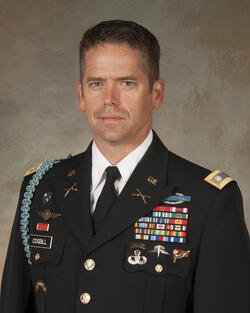
John Chu was born in Seoul, Korea in 1972. The son of an immigrant, he grew up in California where he calls home.  John attended West Point and graduated with honors in 1995 and a commission as a Military Intelligence officer. John has held critical leadership and staff positions at every echelon, from platoon to Army staff. John has deployed twice to Iraq and once to Bosnia, with multiple overseas assignments to Korea, Germany, and Turkey. Prior to the start of his Senior Military Fellowship at Stanford’s Freeman Spogli Institute for International Studies (at the Walter H. Shorenstein Asia-Pacific Research Center), John served on the Department of the Army, Intelligence (G-2) staff as the Chief of Intelligence Training. He hopes to deploy to Afghanistan for his follow-on assignment.

At Stanford, Chu is researching the Korean armistice agreement and the United Nations mission to South Korea. He will also examine U.S. policy toward North Korea, particularly analyzing the “brink of war” tension and developing strategic deterrence measures to reduce risk of unwanted military escalation on the Korean Peninsula. For both research streams, Chu aims to produce analyses and recommendations that could inform a policy audience.

-


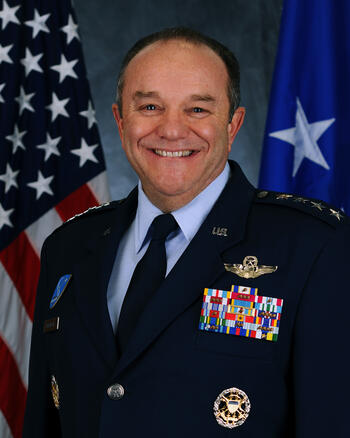
General Philip M. Breedlove will discuss the rapidly evolving geopolitical climate in Europe. Additionally, he will highlight many of the current and future security challenges which the United States and NATO must be prepared for.

Image
Photo of General Philip M. Breedlove


Gen. Breedlove is Commander, Supreme Allied Command, Europe, SHAPE, Belgium and Headquarters, U.S. European Command, Stuttgart, Germany.   

The General was raised in Forest Park, Ga., and was commissioned in 1977 as a distinguished graduate of Georgia Tech's ROTC program. He has been assigned to numerous operational, command and staff positions, and has completed nine overseas tours, including two remote tours. He has commanded a fighter squadron, an operations group, three fighter wings, and a numbered air force. Additionally, he has served as Vice Chief of Staff of the U.S. Air Force, Washington, D.C. Operations Officer in the Pacific Command Division on the Joint Staff; Executive Officer to the Commander of Headquarters Air Combat Command; the Senior Military Assistant to the Secretary of the Air Force; and Vice Director for Strategic Plans and Policy on the Joint Staff. 

Prior to assuming his current position, General Breedlove served as the Commander, U.S. Air Forces in Europe; Commander, U.S. Air Forces Africa; Commander, Air Component Command, Ramstein; and Director, Joint Air Power Competence Centre, Kalkar, Germany.  He was responsible for Air Forces activities, conducted through 3rd Air Force, in an area of operations covering more than 19 million square miles.  This area included 105 countries in Europe, Africa, Asia and the Middle East, and the Arctic and Atlantic oceans.  As Vice Chief, he presided over the Air Staff and served as a member of the Joint Chiefs of Staff Requirements Oversight Council and Deputy Advisory Working Group. He assisted the Chief of Staff with organizing, training, and equipping of 680,000 active-duty, Guard, Reserve and civilian forces serving in the United States and overseas. General Breedlove has flown combat missions in Operation Joint Forge/Joint Guardian. He is a command pilot with 3,500 flying hours, primarily in the F-16.

Koret Taube Conference Center (Room 130)
Gunn-SIEPR Building
366 Galvez Avenue


General Philip M. Breedlove Commander, Supreme Allied Command, Europe, SHAPE, Belgium and Headquarters, U.S. European Command, Stuttgart, Germany Speaker
Lectures
Authors
News Type
News
Date
Paragraphs

The Freeman Spogli Institute for International Studies has welcomed five new senior military fellows, including three active duty lieutenant colonels from the U.S. Air Force and two from the U.S. Army, who will spend the next academic year at Stanford pursuing self-directed study of important national issues.

Former U.S. Secretary of Defense and CISAC faculty member Bill Perry created the program to give military officers the opportunity to take a deep dive into an area of strategic interest.

The fellows will be considering a diverse range of topics, from how to adapt Silicon Valley’s innovative work culture to the Army, to China’s actions in the South China Sea, and the effectiveness of U.S. economic sanctions against North Korea.

You can learn more about our fellows’ military backgrounds and the intended focus of their studies from the brief bios below.

John Cogbill and Scott Maytan will be assigned to the Center for International Security and Cooperation.

John Chu, Ryan Blake and Jose Sumangil will be based at the Walter H. Shorenstein Asia-Pacific Research Center.


LTC John Cogbill

LTC John Cogbill was commissioned as an Infantry officer from the United States Military Academy in 1994 and has held a variety of positions in both conventional and special operations units. John’s first assignment was as a Platoon Leader and Executive Officer in the 82nd Airborne Division. John then served two years in the 1st Battalion, 75th Ranger Regiment as a Platoon Leader and Civil-Military Affairs Officer. Next, John served three years in Alaska as an Airborne Rifle Company Commander and the Aide-de-Camp to the Commanding General. After earning his MPA from the Harvard Kennedy School, John taught Economics in the Social Sciences Department at West Point. Following the Command and General Staff College, he spent two years as a Combined Arms Battalion Executive Officer in the 1st Cavalry Division. He then served as the Strategic Plans and Requirements Officer for the 75th Ranger Regiment. Most recently, John commanded the Reconnaissance and Surveillance Squadron for the U.S. Army Third Corps. John has deployed on three combat and two peacekeeping missions, including two tours in Iraq, one tour in Afghanistan, one tour in Haiti, and a recent tour in Kosovo. He will be exploring how the Army can encourage innovation and use emerging technologies to achieve and maintain a competitive advantage on the battlefield.


lt col scott maytan 5x7 Lt Col Scott Maytan, U.S. Air Force

Lt Col Scott Maytan was the commander of a B-52H operational bomb squadron, responsible for ensuring combat mission readiness for any worldwide nuclear or conventional tasking. Lt Col Maytan is a navigator with over 2500 flying hours, primarily in the B-52H, and is a graduate of both the Command and General Staff College (U.S. Army) and the U.S. Air Force Weapons School. He has served four operational assignments, as an advanced tactics instructor, and also a tour at the Pentagon where he developed Air Force positions concerning long-range strike and aircraft nuclear requirements. Lt Col Maytan has served three combat deployments for Operations Desert Fox (Southern Watch), Allied Force and Iraqi Freedom and has also deployed four times supporting USPACOM’s Continuous Bomber Presence mission. Maytan will be studying the “red-lines” that shape Western deterrence posture, and how strategic action and deterrence posture in one region affects others.


LTC John Chu, U.S. Army

LTC John Chu is an active duty officer in the United States Army. Chu has held a variety of leadership and staff positions in his 20 year career. Most recently, he served as the Chief of Intelligence Training at the Department of the Army. Chu has twice been deployed to Iraq and once to Bosnia, with multiple assignments to South Korea, Germany and Turkey. Born in Seoul, he grew up in California and graduated from West Point in 1995. At Stanford, Chu is researching the Korean armistice agreement and the United Nations mission to South Korea. He will also examine U.S. policy toward North Korea, particularly analyzing the “brink of war” tension and developing strategic deterrence measures to reduce risk of unwanted military escalation on the Korean Peninsula. For both research streams, Chu aims to produce analyses and recommendations that could inform a policy audience.


Lt Col Ryan Blake, U.S. Air Force

Lt Col Ryan Blake is an active duty officer in the United States Air Force. Blake was the commander of a flight test squadron where he was responsible for the flight test of new Air Force programs. He has over 2,400 flying hours in over 40 types of aircraft, and has held two operational F-15E assignments, including combat deployments in support of Operations Southern Watch, Iraqi Freedom and Enduring Freedom. He had also been positioned at the Pentagon in defense acquisition and the Office of Security Cooperation in Baghdad. At Stanford, Blake is researching the U.S. policy toward China and its relation to Northeast Asia. He aims to discover areas of cooperation between the U.S. and Chinese militaries.


Lt Col Jose “Ed” Sumangil, U.S. Air Force

Lt Col Jose “Ed” Sumangil is an active duty officer in the United States Air Force. During his career, Sumangil has served in a range of operational assignments, including joint staff officer at U.S. Strategic Command where he was a lead planner of the command’s space campaign. Before coming to Stanford, he was the commander of a B-1 squadron and led airmen through combat deployments in support of Operations Enduring Freedom, Inherent Resolve and Freedom’s Sentinel. At Stanford, Sumangil is examining China’s actions in the South China Sea and the Philippines arbitration case regarding Chinese actions there. He seeks to offer perspectives and policy and strategy options to maintain peace and stability in the South China Sea.


Hero Image
ennica hall exterior ws
All News button
1
Authors
News Type
News
Date
Paragraphs

U.S. Senator John McCain told a select group of Stanford undergraduate students that technological innovation had created both unparalleled opportunities for the United States as well as new national security risks, during a visit to Silicon Valley this week.

“This has changed the world,” Senator McCain told the students as he held up his smart phone.

“This is the biggest change in our ability to inform and educate than any invention since the printing press.”

However, McCain told students that he believed the United States needed to develop a clearer policy for responding to cyber attacks from foreign nations.

Image
img 3458
“You’ve got to accept a fundamental premise, that cyber attacks are an act of war…but that doesn’t mean you’re going to war in a conventional fashion,” he said.

“The people who are doing these cyber attacks have to realize that the costs will be higher than the benefits of the attack. Everybody has to know that there will be a price to pay for it.”

McCain called on the students, who included several computer science majors, to step up and defend the United States in cyber space.

“I would call on the people here to help us develop defensive capabilities, and frankly, offensive capabilities,” McCain said.

In the wide-ranging conversation, McCain fielded questions from students and shared his views on the conflict in Syria, the Iran nuclear deal, Russia’s imperial ambitions and the pullout of U.S. troops from Afghanistan.

“I study international security, and I feel that his dedication to national security and to veterans have been fundamental, and it was an honor to meet him and hear him talk about these issues,” said Chelsea Green.

The forty students who met with McCain were selected for their special interest in international affairs and politics, and included representatives from the Center for International Security and Cooperation’s honors program, Hoover Institution National Security Mentees and Stanford in Government student group.

International relations major Kayla Bonstrom said she was excited to meet the Senator from her home state of Arizona.

“He was very easy to talk to,” she said.

Bonstrom said McCain’s casual style, which included the occasional joke, helped put the students at ease.

“It was nice to see him in a different setting.”

Mathematical and computation science major Varun Gupta said he was touched by the empathy McCain showed when he shared his experiences visiting refugee camps in war zones.

[[{"fid":"220696","view_mode":"crop_870xauto","fields":{"format":"crop_870xauto","field_file_image_description[und][0][value]":"","field_file_image_alt_text[und][0][value]":"","field_file_image_title_text[und][0][value]":"U.S. Senator John McCain gives an impassioned presentation to students about American foreign policy, as CISAC faculty member Coit Blacker looks on.","field_credit[und][0][value]":"Rod Searcey","field_caption[und][0][value]":"","field_related_image_aspect[und][0][value]":"","thumbnails":"crop_870xauto"},"type":"media","attributes":{"title":"U.S. Senator John McCain gives an impassioned presentation to students about American foreign policy, as CISAC faculty member Coit Blacker looks on.","width":"870","style":"width: 400px; height: 267px; float: left; margin-right: 15px","class":"media-element file-crop-870xauto"}}]]“It was good to see his concern, his actual visceral concern for these issues,” Gupta said.

“It was really great to see the more human side.”

Other students were also impressed by McCain’s sincerity.

“He seems to sincerely believe in all of his views,” said Alexa Andaya, a political science major.

“You can tell when he says something he’s genuine about it.”

Matt Nussbaum, another political science major, said that while he disagreed with many of McCain’s hawkish positions on national security, he welcomed the opportunity to hear the opinions of such a seasoned veteran of foreign policy.

“A lot of times, we’re looking at the academic side of things, and I think that’s very interesting, but Senator McCain and other policy makers use the theory to create policy, so it’s useful to see what they think, how they think and why they think that way,” Nussbaum said.

McCain ended his talk by urging the students to get more involved in politics, whether they were “Democrat or Republican, libertarian or vegetarian.”

He told them that he believed the next presidential election was going to be the most important decision point for the country since 1980, when Republican Ronald Regan defeated Democratic incumbent Jimmy Carter.

“Pick the cause that you want to support, pick the candidate you want to support, and be engaged,” he said.

“It’s your future. You’re the ones that are going to live with the person that you choose to be president of the United States.”

Hero Image
img 3457
Rod Searcey
All News button
1
-

The fate of a soldier serving in the Russian army in the First World War largely depended on luck and circumstances. But even though his own means of influencing his fate were limited, there were available certain active choices – such as shirking and desertion – that could turn his life around in both positive and negative ways. For Russian civil and military authorities, of course, desertion was a nuisance that was fought against by all available means. Sometimes, such as with physical punishment, these means only succeeded in lowering the already low morale and increasing the number of deserters.

Dr. Mart Kuldkepp's presentation will focus on a small and somewhat exceptional group of deserters from the Russian army: the soldiers who served in the border guard regiments in Northern Finland and deserted alone or in small groups over the border to neutral Sweden. He will consider their motivation in doing so, and their subsequent fate, as much as it is known. At the same time, he will also look at how Sweden administratively handled this very unforeseen phenomenon and how the deserters were treated by Swedish authorities.

Mart Kuldkepp completed his PhD dissertation at University of Tartu, Estonia, in 2014 and joined University College London in 2015. Dr. Kuldkepp has been active as an academic in the field of Scandinavian Studies since 2007. Dr. Kuldkepp’s primary research focus is on 20th century Scandinavian political history, with a particular interest in contacts between the Scandinavian and the Baltic states, but also has interest in the history of secret services and espionage and Old Norse-Icelandic literature and culture. His teaching has mostly concerned the history of Scandinavian culture, society, and politics from the earliest times up to today. He has taught subjects related to Old Norse studies and overview courses in humanities.

Organized by the Center for Russian, East European and Eurasian Studies and co-sponsored by The Europe Center and Stanford University Libraries

Mart Kuldkepp Lecturer Speaker Scandinavian Studies, University College London
Lectures
-
This is the second meeting of the workshop series on Civility, Cruelty, Truth. A one-day event hosted by the Stanford Humanities Center, the workshop will explore the genealogies, promises, and limits of civic virtue—at the heart of which is the city, the classical polis, itself— as a universal ideal. European in its moral contours, constituted by a deep fascination with the rule of law, borders, and security, at once coercive and oblique in whom it excludes and includes, how it punishes and protects, the city held out the promise of a humane center for ethical and sovereign life, one upon which anticolonial struggles against European empires too were first conceived and mounted. This workshop will examine the ambiguous foundations and resolutions of that vision in Asia, Europe, and the fatal waters in between; a vision that has come to be marked today by extreme violence and tragic displacements, and which now presses new questions against the very limit of modern political imagination.
 
Faculty Organizer: Aishwary Kumar (Department of History)
Student Assistant: Ahoo Najafian (Department of Religious Studies)
 
Schedule (coming soon)
 

Co-sponsored by the Department of History, Department of Religious Studies, The Europe Center, The France- Stanford Center for interdisciplinary Studies, Program in Global Justice, McCoy Family Center for Ethics in Society, Stanford Global Studies, School of Humanities and Sciences, Stanford Humanities Center, Center for South Asia


Stanford Humanities Center
424 Santa Teresa St.
 

Conferences
Authors
News Type
News
Date
Paragraphs

In a new book, David Straub explains why massive anti-American protests erupted across South Korea in 2002 and considers whether it could happen again.

South Korea is often seen as a pro-American ally, a model country that went from a poor, postwar nation into a maturing democracy in just four short decades.

But despite a historic alliance between South Korea and the United States, anti-Americanism flared throughout the Asian nation between 1999-2002 when a series of events and longstanding tensions aligned, according to Stanford researcher David Straub.

“It was a sort of venting of steam,” said Straub, an associate director at Stanford’s Walter H. Shorenstein Asia-Pacific Research Center.

“Many Koreans at the time were grossly overinterpreting issues and incidents involving the United States. And this was because they were viewing the U.S.-Korea relationship through a lens of historic victimization by other nations, including the United States,” he added.

Straub, who held a thirty-year diplomatic career in the State Department, headed the political section of the American embassy in Seoul during those years and was deeply involved in managing problems in the bilateral relationship.

Boiling point

Since the end of the Korean War, the United States Forces Korea (USFK) has been stationed in Seoul – now about 28,500 uniformed personnel.

In June 2002, a USFK vehicle struck two Korean students in a tragic accident. In December of that same year, after a U.S. court martial found the drivers of the vehicle not guilty of wrongdoing, hundreds of thousands of people protested in Seoul and other major Korean cities. Not only did activists partake but ordinary citizens too, he said.

Straub said the South Korean public had been “unintentionally primed” for such a reaction to the USFK traffic accident; it was the “spark that lit the firestorm” after years of escalation. A series of events led-up to the mass protests, they included:

  • A few months before the USFK traffic accident, a Korean athlete was disqualified at the Winter Olympics in Salt Lake City during a speed skating competition. American athlete Apolo Anton Ohno instead won gold after a disputed call.
  • A non-governmental organization in May 2000 revealed that USFK personnel dumped formaldehyde into a drain that ran into the Han River in Seoul.
  • In Sept. 1999, the Associated Press published its first investigative story examining the Nogun-ri incident of 1950, when hundreds of Korean refugees were killed in an alleged massacre by U.S. service members.

Asymmetry of attention

Straub said the shaping of Koreans’ views of Americans and fanning of tensions could be attributed in part to an “asymmetry of attention” on the part of the Korean and American publics to the U.S.-Korean relationship.

While the Korean public put tremendous focus on U.S.-Korean relations and the presence of U.S. military personnel in Korea, the American public was unaware of Korean attitudes and feelings, he said.

Similarly during the 1999-2002 period, Korean media reported hypercritical views of the United States and USFK, while the American media paid far less attention.

In negotiating with U.S. officials, South Korean officials would often allude to strong Korean public opinion and demand U.S. concessions. With no American public opinion on Korea issues to point to, U.S. officials were at a major disadvantage, Straub said.

U.S. officials would sometimes note opinions shared by members of Congress, he said, “however, for Korean officials, those claims weren’t as powerful as having a social movement literally on the front doorstep.”

In plain terms, the United States is much larger than South Korea. This very imbalance – which translates to military and economic power – added to Koreans’ assumption that they were “getting the worse end of the bargain,” he added.

“Most Koreans saw Korea as a victim of great powers,” Straub said. “It’s not just the media. It’s more than that, it was – and still is – a shared national narrative.”

Koreans’ sense of national vulnerability is magnified by their historic victimization to neighbors. South Koreans do not want to become a de facto tributary state of China or a colony of Japan again, he said.

Will anti-Americanism return?

USFK incidents were a main focus of Korean attention during the 1999-2002 period, and while there is always a possibility of problems arising, the intensity is gone now, Straub said.

“Some steam is under the lid again,” Straub said. “But I don’t think it’s nearly at the level like it was back then. I’m doubtful that we’d see an exact repeat.”

The media landscape in South Korea has improved and shifted away from its earlier position of “criticize the United States first and ask questions later,” Straub said.

Today, South Korea and the United States are in good standing at the government-level and among the people. President Obama and Korean President Park Geun-hye have an established rapport.   

What troubles Koreans now is North Korea, a Japan focused on collective defense, and the strategic rivalry between the United States and China and its possible implications for Korea, he said.

“South Korea being sandwiched between the United States and China – based on a perception that China is going to be the world’s dominant power – is a real worry for many Koreans,” Straub said, and a large number of Koreans – albeit still a minority – feel that their country must find a more equidistant ground between the two.

Most Koreans, however, still believe in the need for the continued presence of USFK personnel, at least for the time being, said Straub, and must be reassured of their strategic alliance with the United States.

Obama and Park are expected to meet in Washington in mid-October, and Straub said it will be used as an opportunity for both sides to reinforce the importance they attach to the alliance and to pressing North Korea to abandon its nuclear weapons and long-range missile programs.

Links to related articles

NK News: South Korean anti-Americanism dwindles, but roots remain: diplomat

NK News: South Korean anti-Americanism: a thing of the past?

Anti-Americanism in Democratizing South Korea, July 2015

Asia Times: American faces Seoul court over infamous unsolved murder

The Christian Science Monitor: South Korea: 20 years later, Californian son faces trial for Seoul murder

JoongAng Ilbo: Is anti-Americanism dead?

JoongAng Ilbo (Korean): 한미동맹은 빈틈없이 튼실한가 전 미국 국무부 한국과장의 진단

Hero Image
rtrpaj1
A South Korean protestor holds an American flag on which protesters left their footprints at a Seoul rally in June 2003. | Reuters/Lee Jae-Won
All News button
1
-

Sponsored by the Taiwan Democracy Project and the U.S. Asia Security Initiative at the Asia-Pacific Research Center (APARC)

Abstract

During the recent meeting between PRC President Xi Jinping and Taiwan President Ma Ying-jeou, the “1992 One China Consensus” served as a mutually acceptable paradigm for maintaining “peaceful and stable” conditions across the Taiwan Strait.  For Xi Jinping, the warmth of the visit thinly veiled a message to Taiwan’s leaders and electorate, as well as to onlookers in Washington.  Chinese officials and media clearly link the talks and confirmation of the 1992 Consensus to “the great rejuvenation of the Chinese nation”—a concept that is increasingly unpalatable to many in Taiwan.  Xi hopes to keep DPP presidential candidate Tsai Ing-wen (and perhaps even future KMT leaders) in the 1992 Consensus “box” and to co-opt the U.S. in this effort, but perhaps underestimates the political transformation underway on Taiwan. 

The Xi administration has also hardened its position regarding “core interests” such as Taiwan, embodied in a “bottom line principle” policy directive that eschews compromise.  Although many commentators and most officials across the region have shied away from stating that the PRC and Taiwan are at the crossroads of crisis, the collision of political transformation on Taiwan and the PRC’s “bottom line principle” will challenge the fragile foundations of peaceful cross-Strait co-existence.  Changes in the regional balance of military power brought about by a more muscular People’s Liberation Army compounds the potential for increased friction, providing Beijing with more credible options for coercion and deterrence.

This talk will consider the politics and principles involved in cross-Taiwan Strait relations in light of the upcoming 2016 Taiwan elections and the policies of the Xi Jinping administration; and will discuss some of the possible implications for China’s national security policy, regional stability, and the future of cross-Strait relations.

Bio

Image
Cortez Cooper
Mr. Cortez A. Cooper III joined RAND in April 2009, providing assessments of security challenges across political, military, economic, cultural, and informational arenas for a broad range of U.S. government clients.  Prior to joining RAND, Mr. Cooper was the Director of the East Asia Studies Center for Hicks and Associates, Inc.  He has also served in the U.S. Navy Executive Service as the Senior Analyst for the Joint Intelligence Center Pacific, U.S. Pacific Command.  As the senior intelligence analyst and Asia regional specialist in the Pacific Theater, he advised Pacific Command leadership on trends and developments in the Command’s area of responsibility.  Before his Hawaii assignment, Mr. Cooper was a Senior Analyst with CENTRA Technology, Inc., specializing in Asia-Pacific political-military affairs.  Mr. Cooper’s 20 years of military service included assignments as both an Army Signal Corps Officer and a China Foreign Area Officer.  In addition to numerous military decorations, the Secretary of Defense awarded Mr. Cooper with the Exceptional Civilian Service Award in 2001.

2016 Taiwan Elections and Implications for Cross-Strait and Regional Security
Download pdf
Cortez Cooper Senior International Policy Analyst RAND Corporation
Seminars
Subscribe to Military