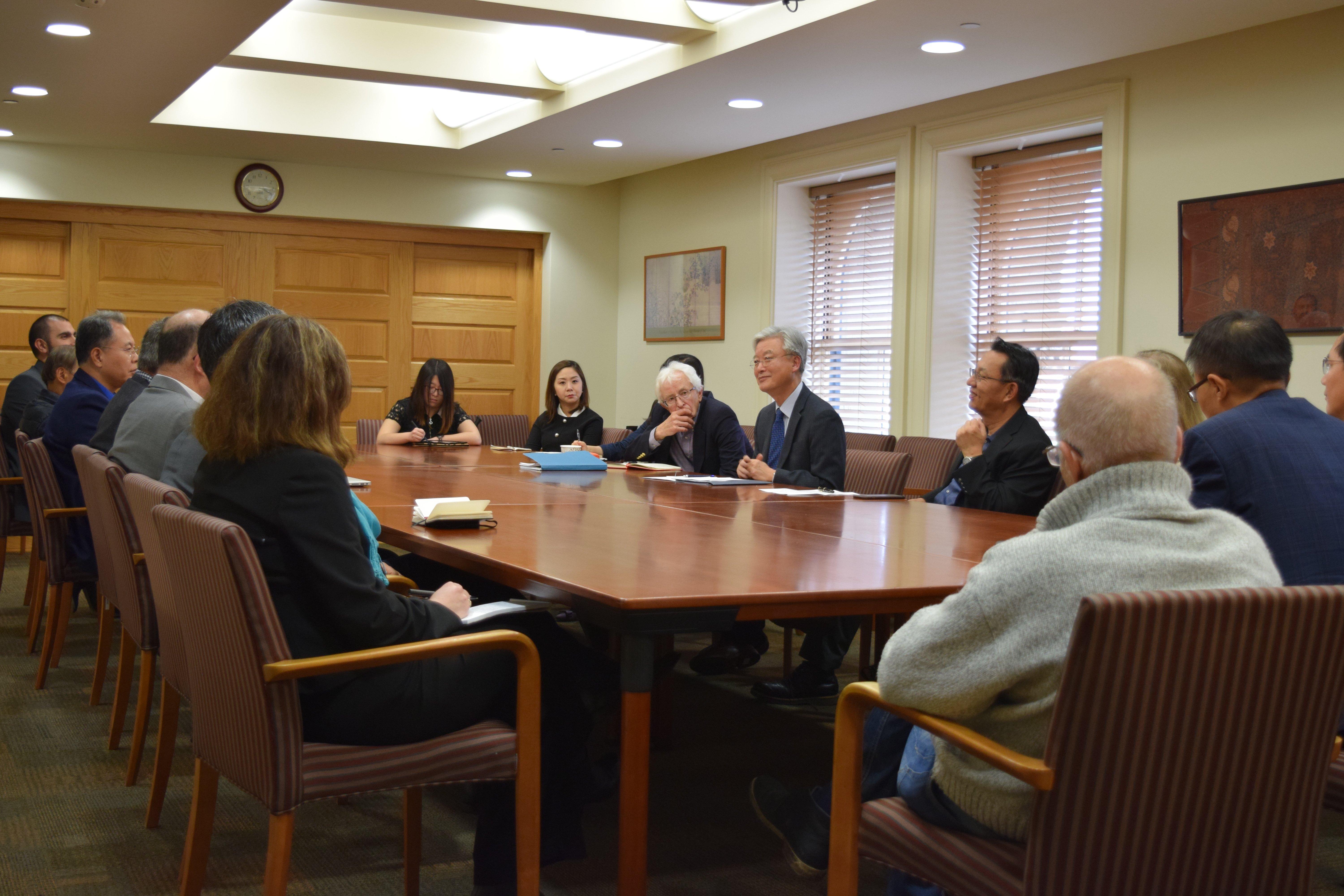
Nuclear Risk
-

Abstract: The quotation in the title is taken from the memoirs of Boris Chertok, a leading Soviet missile designer.  In my talk I will examine significant shifts in Soviet thinking about nuclear war and military strategy in the 1960s and 1970s and discuss some of the implications of those shifts for strategic stability in the 1980s.  I will also explore the influence of the McNamara Pentagon on Soviet military strategy and Soviet thinking about deterrence and war-fighting.    

Speaker bio: David Holloway is the Raymond A. Spruance Professor of International History, a professor of political science, and an FSI senior fellow. He was co-director of CISAC from 1991 to 1997, and director of FSI from 1998 to 2003. His research focuses on the international history of nuclear weapons, on science and technology in the Soviet Union, and on the relationship between international history and international relations theory. His book Stalin and the Bomb: The Soviet Union and Atomic Energy, 1939-1956 (Yale University Press, 1994) was chosen by the New York Times Book Review as one of the 11 best books of 1994, and it won the Vucinich and Shulman prizes of the American Association for the Advancement of Slavic Studies. It has been translated into seven languages. The Chinese translation is due to be published later in 2018. Holloway also wrote The Soviet Union and the Arms Race (1983) and co-authored The Reagan Strategic Defense Initiative: Technical, Political and Arms Control Assessment (1984). He has contributed to the Bulletin of the Atomic Scientists, Foreign Affairs, and other scholarly journals.

Since joining the Stanford faculty in 1986 -- first as a professor of political science and later (in 1996) as a professor of history as well -- Holloway has served as chair and co-chair of the International Relations Program (1989-1991), and as associate dean in the School of Humanities and Sciences (1997-1998). Before coming to Stanford, he taught at the University of Lancaster (1967-1970) and the University of Edinburgh (1970-1986). Born in Dublin, Ireland, he received his undergraduate degree in modern languages and literature, and his PhD in social and political sciences, both from Cambridge University.

CISAC
Stanford University
Encina Hall, E214
Stanford, CA 94305-6165

(650) 723-1737 (650) 723-0089
0
Senior Fellow Emeritus at the Freeman Spogli Institute of International Studies
Raymond A. Spruance Professor of International History
0820stanford-davidholloway-238-edit.jpg PhD

David Holloway is the Raymond A. Spruance Professor of International History, a professor of political science, and an FSI senior fellow. He was co-director of CISAC from 1991 to 1997, and director of FSI from 1998 to 2003. His research focuses on the international history of nuclear weapons, on science and technology in the Soviet Union, and on the relationship between international history and international relations theory. His book Stalin and the Bomb: The Soviet Union and Atomic Energy, 1939-1956 (Yale University Press, 1994) was chosen by the New York Times Book Review as one of the 11 best books of 1994, and it won the Vucinich and Shulman prizes of the American Association for the Advancement of Slavic Studies. It has been translated into seven languages, most recently into Chinese. The Chinese translation is due to be published later in 2018. Holloway also wrote The Soviet Union and the Arms Race (1983) and co-authored The Reagan Strategic Defense Initiative: Technical, Political and Arms Control Assessment (1984). He has contributed to the Bulletin of the Atomic Scientists, Foreign Affairs, and other scholarly journals.

Since joining the Stanford faculty in 1986 -- first as a professor of political science and later (in 1996) as a professor of history as well -- Holloway has served as chair and co-chair of the International Relations Program (1989-1991), and as associate dean in the School of Humanities and Sciences (1997-1998). Before coming to Stanford, he taught at the University of Lancaster (1967-1970) and the University of Edinburgh (1970-1986). Born in Dublin, Ireland, he received his undergraduate degree in modern languages and literature, and his PhD in social and political sciences, both from Cambridge University.

Faculty member at the Center for International Security and Cooperation
Affiliated faculty at the Center on Democracy, Development, and the Rule of Law
Affiliated faculty at The Europe Center
CV
Date Label
David Holloway Professor of Political Science, Professor of History CISAC, Stanford University
Seminars
Authors
News Type
Q&As
Date
Paragraphs

In March 2011, a post-earthquake tsunami triggered nuclear meltdowns, hydrogen-air explosions and the release of radioactive materials from the Fukushima Daiichi Nuclear Power Plant in Fukushima Prefecture, Japan. The Fukushima disaster has been called the most significant nuclear incident since the 1986 Chernobyl disaster. Professor Rodney C. Ewing, Frank Stanton Professor in Nuclear Security and co-director at the Center for International Security and Cooperation (CISAC) in the Freeman Spogli Institute for International Studies (FSI), as a member of a team of Japanese researchers, today published a report on the details of what exactly — at the particle level — was released into the air after the disaster.

In the discussion that follows, Ewing explains the team’s findings and why they are important for health and environmental safety.

Why did you decide to study the Fukushima disaster?

The Fukishima Daiichi event surprised me. I now teach a freshman seminar on this event. I am particularly interested to understand why the accident occurred and what the long-term impact will be on the environment. This research paper reflects my interest in answering these questions.

We’ve heard lots about possible health effects from contaminated water after the Fukushima disaster, but less about particulates in the air. What did you find?

During the core melt-down events at Fukushima Daiichi, radioactivity was released as fine particulates that traveled in the air, sometime for distances of tens of kilometers, and settled onto the surrounding countryside.

In order to understand the health risk, it is very important to understand the form and chemistry of these particulates.

Recently, in a previous paper we have described a new type of particulate that is Cs-rich (some Cs isotopes are highly radioactive). The highly radioactive Cs-rich particles formed in the reactor by condensation from a silica-rich vapor, formed from the melting of core and concrete structures. In this paper, we describe the first identification of fragments of the melted core that were entrapped by the Cs-particles and transported away from the reactor site, some 4 kilometers. This is an important discovery because this provides us with samples of the fuel and melted core.

This is a special contribution because it uses very advanced electron microscopy techniques that allow for imaging of individual atoms or clusters of atoms. This advanced technique is required because the particles are so small — nanometers in size.

How did you come to work with your collaborators in Japan?

I have had long standing collaborations with Japanese scientists for decades. The lead researcher for the group, Professor Satoshi Utusunomiya, was once a member of my research group when I was at the University of Michigan. We have always collaborated on topics that involve radioactive materials and the use of electron microscopy. This collaboration is an entirely natural outgrowth of previous collaborations.

What, if any, policy recommendations would you suggest based on your findings?

The most direct result would be to design monitoring systems so that we have a good record of released particulates. Also, we need to push the development of advanced analytical techniques so that these particulates can be quickly identified and characterized.

Hero Image
gettyimages nuclearsmokestacks1 7cnjkfma broe4a8wwlg q
Getty Images
Getty Images
All News button
1
Authors
News Type
News
Date
Paragraphs

Rodney C. Ewing, Frank Stanton professor in nuclear security and co-director at the Center for International Security and Cooperation (CISAC) in the Freeman Spogli Institute for International Studies (FSI) was named winner of the 2018 Robert Cahn Award by the Journal of Nuclear Materials and the committee of NuMat 2018, the Nuclear Materials Conference.

The annual award recognizes a scientist with a high scientific profile in the field of nuclear materials who has both the ability to communicate science to a broad audience and demonstrated interest in breaking down barriers between different scientific disciplines.

Rod EwingEwing, also a professor in the Department of Geological Sciences in the School of Earth, Energy and Environmental Sciences at Stanford, the Edward H. Kraus Distinguished University Professor Emeritus in the Department of Earth & Environmental Sciences at the University of Michigan, and a Regents' Professor Emeritus at the University of New Mexico, primarily researches the study of radiation effects in materials. His body of work defined a new research field involving radiation-induced damage in solids from the radioactive elements present in their crystal structures, and has been recognized for its significant impact on the design of nuclear waste forms for containing high-level radioactive waste. Professor Ewing will receive the award in Seattle at the Nuclear Material Conference (NuMat) in October 2018 where he will open the conference with the Robert Cahn Award Keynote Lecture.

Read more about the 2018 Robert Cahn Award on the Elsevier website.

About the Center for International Security and Cooperation (CISAC)

The Center for International Security and Cooperation tackles the most critical security issues in the world today. Founded in 1983, CISAC has built on its research strengths to better understand an increasingly complex international environment. It is part of Stanford’s Freeman Spogli Institute for International Studies (FSI). Though scholarly research, fellowships, and teaching, CISAC is educating the next generation of leaders in international security and creating policy impact on a wide variety of issues to help build a safer world.

Hero Image
Rod Ewing Rod Searcey
All News button
1
-

Abstract: Founded in 1945 by Manhattan Project scientists who “could not remain aloof to the consequences of their work,” the Bulletin of the Atomic Scientists aimed to chronicle the dawn of the nuclear age through the words of the men and women who built the atomic bomb. In 1947, Bulletin supporters—including a veritable Who’s Who of nuclear physics, from Einstein and Fermi to Szilard and Oppenheimer—expanded their four-page newsletter into a magazine that featured a minimalist clock, ticking toward the midnight of nuclear Armageddon, on its cover. More than 70 years later, the now-famous Doomsday Clock is set each January to reflect the world’s security situation. That event is now covered by thousands of media outlets around the world, and today’s Bulletin is hardly your grandfather’s niche magazine. It has become a global multimedia platform that deals with a host of manmade threats to civilization—from nuclear weapons to climate change and on to a host of emerging technologies—and reaches a worldwide digital audience of millions each year.     

Speaker bio: John Mecklin is the editor-in-chief of the Bulletin of the Atomic Scientists. Previously, he was editor-in-chief of Miller-McCune (since renamed Pacific Standard), an award-winning national magazine that focuses on research-based solutions to major policy problems, and the top editor of High Country News, a nationally acclaimed magazine that reports on the politics, environment, and culture of the American West. Writers working at his direction have won many major journalism prizes, including the George Polk Award, the Investigative Reporters and Editors certificate, and the Sidney Hillman Award for social justice journalism. Beyond his columns for the magazines he has edited, Mecklin’s writing has been published by Foreign Policy, The Columbia Journalism Review, and the Reuters international news service, among other media outlets. Before his magazine work, Mecklin was an investigative newspaper reporter and covered the Persian Gulf War from Saudi Arabia and Iraq. He holds a master in public administration degree from Harvard's John F. Kennedy School of Government.

John Mecklin Bulletin of the Atomic Scientists
Seminars
News Type
News
Date
Paragraphs

Former U.S. ambassador to South Korea Kathleen Stephens spoke on the "PBS News Hour" about the first high-level talks between North Korea and South Korea in more than two years. The two nations agreed to hold future military talks aimed at easing border tensions and the North pledged to send a delegation to the Olympic Games next month.

Stephens called it a good first step and an “all-too-rare positive development” on the peninsula. The decrease in potential for disruptions to next month’s games could—according to Stephens-be seen as the first deliverable by South Korea’s new president, Moon Jae-In, on a promise to reengage with the North.

Ambassador Stephens said it was not surprising that denuclearization did not come up during Tuesday’s talks, noting North Korea’s position that the issue is one to be dealt with the United States. Ambassador Stephens speculated that once the Olympics closed, the peninsula might experience a period of reduced tensions along with confidence building. However, she believes that come the spring there would still remain important questions about military exercises as well as nuclear weapons.

Asked about news reports of discussions within the Trump administration on the possibility of targeted strikes against North Korean military sites, Ambassador Stephens described it as a very risky strategy, adding that the discussions alone could prove unnerving in South Korea as well as North Korea.

The full interview is available on PBS.

Hero Image
Former Ambassador Stephens discusses talks between North and South Korea on PBS News Hour
All News button
1
-

Abstract: It has been more than a decade since the UN Security Council enacted Resolution 1540—the most far-reaching of international instruments to counter Weapons of Mass Destruction (WMD) terrorism. It requires states to adopt and enforce effective laws to keep WMD materials outside the reach of terrorists. Scholars and policy makers compliment 1540 for making WMD trafficking illegal, for raising awareness of threats and increasing states’ capacity to reduce them. In 2017, one hundred and seventy-six states reported to the UN on domestic measures they took to comply with 1540. These numbers may produce a false sense of confidence in universal implementation of 1540. The threat of WMD terrorism remains potent. Allegations of ISIS using mustard agents against the Kurds, North Korea shipping chemicals to Syria or middlemen trafficking nuclear materials via Moldova suggest that the international response to WMD smuggling has not achieved its desired results. It is, therefore, important to evaluate the UN’s role in preventing WMD terrorism, and explore ways to further strengthen it. Drawing on interviews, fieldwork and observation data, this talk will examine the 1540 regime’s setup and its performance. It will outline policy options to improve the international counter-proliferation and counter-terrorism regime.

Speaker  bio:  Sarah Shirazyan is a Nuclear Security Postdoctoral Fellow at CISAC. Her research is funded by the MacArthur Foundation. She received her Doctor of Juridical Sciences Degree from Stanford Law School. Her dissertation empirically analyzes the effectiveness of the UN Security Council Resolution 1540 in preventing terrorists from accessing Weapons of Mass Destruction. Sarah designed Interpol-Stanford policy lab and serves as a Lecturer in Law at Stanford Law School. For her outstanding research, teaching and community service, Stanford named Ms. Shirazyan as one of the recipients of Gerald J. Lieberman Award.

In addition to her academic experience, Sarah has held multiple posts with leading tech companies and international organizations. Sarah worked at Facebook’s Global Policy Team, where she developed company’s engagement strategies with inter-governmental organizations. Ms. Shirazyan also designed the data protection and privacy curricula for legal professionals at the Council of Europe. Prior to that, Ms. Shirazyan was a Drafting Lawyer for the European Court of Human Rights; worked on nuclear security issues at the U.N. Office for Disarmament Affairs; and handled international drug cartel investigation cases at the INTERPOL Secretariat. 

0
sarahshirazianrsd17_076_0298a.jpg J.S.D.

Sarah Shirazyan is a leading expert in technology law and policy, misinformation, and responsible AI development. She is a Lecturer in Law at Stanford Law School, where she teaches a course on combating misinformation online. She also serves as a Director and Head of Meta's GenAI Product Policy work, overseeing the development and implementation of company-wide policies governing the responsible use of generative AI technologies. In this role, Dr. Shirazyan advises product and engineering teams to ensure trust, safety, and ethical innovation across Meta's platforms. Previously, she led the company’s efforts to inform its misinformation and algorithmic ranking policies through engaging with experts across the globe.

Prior to joining tech industry, Dr. Shirazyan held multiple posts with leading international organizations—she was a data protection consultant for the Council of Europe; served as human right lawyer for the European Court of Human Rights; worked on nuclear security issues at the U.N.; and handled international drug cartel investigation cases at INTERPOL.

From 2017-2020, she designed and ran Interpol-Stanford Policy Lab at Stanford Law. From 2017-2018, Dr. Shirazyan was a Nuclear Security Postdoctoral Fellow at CISAC. Her research was funded by the MacArthur Foundation. She received her Doctor of Juridical Sciences Degree from Stanford Law School. Her dissertation empirically analyzes the effectiveness of the UN Security Council’s response to WMD terrorism. For her outstanding research, teaching and community service, Stanford named Ms. Shirazyan as one of the recipients of the Gerald J. Lieberman Award.

Her work has been published in Journal for National Security Law and Policy, Lawfare, Just Security, Stanford Journal of Online Trust and Safety, Arms Control Today, and Project on Nuclear Issues by Center for Strategic and International Studies (CSIS).

Publications

CISAC Affiliate
Date Label
Sarah Shirazyan CISAC
Seminars
-

Abstract: In the last 30 years I have been actively involved in various safety assessment exercises for high level and low and intermediate level nuclear waste disposal sites, mainly for the Swedish SKB programme but also for a number of European programmes (Spain, France, Finland and the UK). During this time some of these programmes have evolved from pure concepts to actual implementation, some others have remained in the limbo of the generic conceptual projects. The different degrees of development are basically the result of the way the scientific and technical issues have been tackled and more importantly how the implication from society has been implemented in the programmes. In my presentation I will attempt to discuss the various levels of scientific, technological and societal development of the various programmes and their potential correlation with the fulfilment of their objectives.

Speaker bio: Jordi Bruno has a PhD in Inorganic Chemistry by the Royal Institute of Technology (KTH), Stockholm and an Executive MBA from Stanford University. He has over 30 years of experience in the field of nuclear waste management, risk analysis and environmental management strategies. The main areas of expertise include: evaluation of performance and safety of nuclear waste repositories, sustainability, chemical risk assessment and, toxic / hazardous and geological storage of CO2.

From 2008 on, he has been the CEO and Chairman of the Board of Amphos 21 Consulting and from 2009, he has been the CEO and Chairman of the Board of Amphos 21 Group. From 2000 to 2014 he was Director of the Chair Enresa-Amphos 21 on Sustainability and Waste Management in the Universitat Politècnica de Catalunya (UPC).

He is author or co-author of more than 130 peer reviewed papers and five books, as well as many communications to international conferences and technical reports.

Dr. Jordi Bruno Chief Executive Officer Amphos 21 Group
News Type
News
Date
Paragraphs

Commenting on President Trump's twelve-day trip to Asia, FSI senior fellow and director of the Southeast Asia Program at Shorenstein Asia-Pacific Research Center Donald K. Emmerson noted that Trump "failed . . . to significantly alter the calculus brings to bear on North Korea."

Trump's approach to foreign policy, one based on forming personal relationships, might have caused him to get the mistaken idea "that he had made a real impact and everybody was getting along," Emmerson suggested.

Emmerson likewise questioned any substantial trade-related results coming out of the trip, saying that many touted achievements were either "already on the table" or were non-binding memoranda of understanding.

That said, Emmerson stressed that if in time President Trump were to realize the dearth of interest in bilateral trade deals, and that the "U.S. is making China great again," he could shift U.S. policy.

The full article is available from the Sinclair Broadcast Group.

Hero Image
xi and trump
Presidents Trump and Xi take part in a business event in Beijing during Trump's twelve-day Asia tour.
WhiteHouse.gov
All News button
1
News Type
News
Date
Paragraphs

Former U.S. ambassador to South Korea Kathleen Stephens spoke on "Bloomberg Daybreak: Asia" about President Trump's Asia trip on the eve of his arrival in China.

Stephens noted that in canceling a trip to the DMZ--more or less a presidential tradition on visits to Korea--Trump did the "right thing" by instead focusing on the "must-do" on this first trip of reassuring South Koreans on the U.S. commitment to its alliance with the Republic of Korea.

Both North Korean and Trump administration rhetoric seems to have cooled off in recent days; Stephens noted that Trump seems to have "gotten the message" about the importance of the relationship with South Korea and the level of nervousness in the country. 

Ambassador Stephens commented on the feasibility of beginning talks with North Korea and what additional pressure might be required to get the North to the table. She noted that if denuclearizing were a precondition for talks, they wouldn't happen.

She speculated on what President Trump might ask the Chinese to do to up the pressure on North Korea, for example, cutting off oil exports. She also suggested that when it comes to talking about trade, the emphasis might be on announcing deals and Trump might act as "salesman-in-chief."

The full interview is available on Bloomberg TV.

All News button
1
Authors
George Krompacky
News Type
Commentary
Date
Paragraphs

NBC Bay Area spoke with Shorenstein APARC director Gi-Wook Shin following a press conference held by DPRK foreign minister Ri Yong-Ho on September 25, in which Ri asserted that recent comments by President Donald Trump amounted to a "declaration of war."

The verbal barrage between North Korea and the United States has sharply escalated, with increased U.S. bomber flights near and around North Korea being met by North Korean threats to shoot down such flights, even those outside its borders.

While Shin still holds that the war of words will not turn into war, he is concerned that the escalation of rhetoric is dangerous.

"The South Korean people are really worried about the possibility of a military conflict," noted Shin. He further advised the president to deescalate personal attacks on Kim Jong-un, pointing out that Kim's "god-like" status in North Korea was effectively forcing the DPRK leader to respond to White House threats.

Hero Image
gettyimages 853681832
North Korea's foreign minister Ri Yong-Ho departs after speaking to reporters at the UN Millenium Plaza hotel on September 25, 2017 in New York City.
Amir Levy/Getty Images
All News button
1
Subscribe to Nuclear Risk