


Paris attacks add to debate on Syria and immigration
News Type
Q&As
Date
Paragraphs
Last Friday's multiple terrorist attacks in Paris that killed 129 people and injured over 350 was the topic of KQED Radio’s “forum with Michael Krasny" (Monday, Nov. 16, 2015). The discussion centered around the potential impact to US and European strategy for fighting ISIS, immigration policy, and to French nationalism, values and public discourse on multiculturalism and open borders.
Participating in the panel was French literature associate professor and TEC faculty affiliate Cécile Alduy. Alduy is the author of the recent book Marine Le Pen's Words: Deciphering the New National Front's Discourse.
Joining Alduy were Bloomberg Paris bureau chief Geraldine Amiel, UC Berkeley professor of public policy Michael Nacht, and Brookings’ Center for Middle East Policy fellow William McCants.
Visit KQED Radio's Forum web article “France Closes Borders After Multiple Terror Attacks in Paris" to download a recording of this interview.
Hero Image

All News button
1
ARD welcomes Egyptian intellectual Amr Hamzawy as a visiting scholar
News Type
News
Date
Paragraphs
The Program on Arab Reform and Democracy at Stanford’s Center on Democracy, Development, and the Rule of Law is pleased to welcome Egyptian academic and Former Member of Parliament Amr Hamzawy as a visiting scholar for the 2015-16 academic year. Hamzawy, who teaches political science at Cairo University and the American University in Cairo, brings to the program a deep knowledge of Middle East politics and specific expertise on democratization and reform processes in the region. A former Senior Associate at the Carnegie Endowment for International Peace, Hamzawy’s research focuses on questions of political change, human rights, and the rule of law in Egypt. He is a daily columnist for Al-Sherouk, an independent Egyptian newspaper, and writes regularly on the role of civil society actors and parties in Egypt’s often restricted political arena. Hamzawy is a former member of the Egyptian National Council for Human Rights, and was elected to serve in Egypt’s first parliament after the outset of the January 25 Revolution before it was dissolved in the summer of 2012.
Hamzawy will spend his residency at CDDRL working on a research project on the liberal elite and reemergence of autocracy in Egypt. His residency is generously funded by a grant from the Carnegie Corporation to support scholars from the Arab world. In the interview below, Hamzawy describes his current project and research plans. Hamzawy will be sharing his research findings with the CDDRL community in a seminar on October 27.
What are your research goals and priorities?
While at CDDRL, my research objective is to analyze contemporary liberal discourses on democracy and human rights in Egypt. The fact that the majority of Egyptian liberals called on the military establishment - prior to the July 3, 2013 coup which deposed the elected president Mohamed Morsi - to interfere in politics and terminate the emerging pluralist dynamics warrants an in-depth examination. Equally puzzling, is the readiness of Egyptian liberals to allow the former minister of defense and current president Abdel-Fattah al-Sisi’s rise to power, to accept a subordinate role in an increasingly restricted public space, and to tolerate without any noticeable resistance the emergence of a new autocracy in Egypt.
What has your research uncovered?
The research journey has been going in some fascinating directions and yielding some interesting answers. For instance, one set of factors pertains to the formation of the modern Egyptian state and the long-standing dependency of liberal elites on successive autocratic rulers and governments. Another revolves around historical legacies of mistrust and fear towards religious-based social movements and political actors. These legacies have contributed to the tendency of liberals to side with autocrats against popular opposition currents. Finally, the predominance of rent-seeking tendencies inside the state bureaucracy and among economic elites has limited the integration of liberals into Egypt’s social fabric. While there are fascinating historical analogies between the current moment and previous experiences in Egypt from the nineteenth and twentieth centuries, my research will remains focused on the contemporary era.
How is your experience in Egyptian politics informing your current projects?
Throughout the last four years, and while putting on different institutional hats and operating in very different contexts, I have collected first-hand insights on liberal narratives on the formation of the Egyptian state and state-society relations. These experiences also deepened my understanding of liberals’ discourses on their historical encounters with religious forces, their social and political preferences, and their views on the wider public—which some key liberal figures have been willing to disenfranchise to avoid Islamist victories in the polls. These insights, as well as my own experiences as an elected member of the Egyptian People’s Assembly of 2012, the first legislature that was elected freely and without government manipulation, will inform the research.
What are the most important factors that undermined the movement that supported the January 25, 2011 Revolution in Egypt?
That is a tough question. It is easy to state that neither the military establishment nor the vastly entrenched security apparatus wanted the January 25, 2011 Revolution. They feared that it could lead to a democratic transition in which their roles, benefits, and privileges would have been limited or at least subjected to greater scrutiny. Also, there is no doubt that the rent-seeking economic elites and various forces of the Mubarak regime were heavily invested in blocking an orderly transition to democracy. These are facts that have been well documented and researched.
However, no less significant is the recurrent retreat of liberal elites from pluralist processes and procedures. It appears as if Egyptian liberals have never been ready to support a democratic opening that could bring Islamists to power. Liberals have also been reluctant to shoulder the burden of standing against the autocratic ways of the military and the security establishment, or to help civil society and human rights groups garner more popular support. To explain the root causes and impacts of Egypt’s illiberal liberals is the task of my current research project.
Hero Image

All News button
1
Migration crisis divides European policymakers
News Type
News
Date
Paragraphs
The recent discovery of at least 50 dead migrants aboard a boat off the shores of Libya sparked a discussion on KQED Radio’s “forum with Michael Krasny" about the escalating crisis (Thurs., Aug. 27, 2015). Cécile Alduy, Stanford associate professor of French literature and affiliated faculty at The Europe Center was one of those asked to weigh in on Europe’s migration policy struggle.
Also joining the discussion was Gregory Maniatis, senior European Policy Fellow at the Migration Policy Institute and Tom Nuttall, Charlemagne columnist for The Economist.
Visit KQED Radio's Forum web article “More Migrants Found Dead as Hundreds of Thousands Flee to Europe” to download a recording of this interview.
Hero Image

All News button
1
Stanford scholar unpacks the rhetoric behind extremist politician's mainstream success
News Type
News
Date
Paragraphs
Appeared in Stanford Report, April 16, 2015
A pioneering textual analysis of French political speeches led by Stanford Professor of French Cécile Alduy reveals how Marine Le Pen, leader of France's surging far-right National Front, has made extremism palatable in a land of republican values.
French politician Marine Le Pen carried her father's right-wing fringe political party to first place in the country's latest elections for European Parliament.
Stanford scholar Cécile Alduy says Le Pen's success at the helm of France's right-wing National Front can be attributed to a combination of sophisticated rebranding and skillfully crafted moderate rhetoric that sells a conservative agenda that borders on extreme.
An associate professor of French at Stanford and a faculty affiliate of The Europe Center, Alduy conducted a qualitative and quantitative analysis of more than 500 speeches by Marine Le Pen and her father, Jean-Marie Le Pen, to find out what has made their party surge in the polls.
Alduy's word-for-word analysis of National Front political speeches, published in the book Marine Le Pen prise aux mots: Décryptage du nouveau discours frontiste (Seuil, 2015) has become a flashpoint of political discourse in France.
The resulting research is the first study of Marine Le Pen's discourse, the first to compile a corpus of this magnitude of political speeches by a French political organization.
After sifting through the data and performing extensive close readings of the corpus, Alduy found that the stylistic polish of Marine Le Pen's language conceals ideological and mythological structures that have traditionally disturbed French voters. Her research reveals how radical views can be cloaked in soothing speech.
"Marine Le Pen's language is full of ambiguities, double meanings, silences and allusions," Alduy said.
 This diagram shows the spatial lay out of Marine Le Pen's discursive universe. Using factorial analysis in Hyperbase, one can create a "map" of all the most used words and how they correlate to one another: the closer they are spatially, the stronger their correlation, or how often they appear together.
Courtesy of Cécile Alduy |
This diagram shows the spatial lay out of Marine Le Pen's discursive universe. Using factorial analysis in Hyperbase, one can create a "map" of all the most used words and how they correlate to one another: the closer they are spatially, the stronger their correlation, or how often they appear together. Image Courtesy of Cécile Alduy |
But in terms of political agenda and ideological content, Alduy said the continuity between the younger and elder Le Pen is striking. "What is different is the words and phrases she uses to express the same agenda," Alduy said.
Alduy, whose research centers on the history and mythology of national and ethnic identities since the European Renaissance, conducted the research with the help of Stanford graduate and undergraduate students and with communication consultant Stéphane Wahnich. Academic technology specialist Michael Widner of Stanford Libraries and the Division of Literatures, Cultures and Languages, provided technical expertise throughout and trained students in the art of indexing the database.
With a grant from Stanford's Vice Provost for Undergraduate Education, Alduy and her team transcribed and analyzed more than 500 speeches by Marine and Jean-Marie Le Pen dating from 1987 to 2013.
Alduy's team used text analysis software such as Hyperbase or Voyant Tools to measure precisely how Marine's language differs from that of Jean-Marie.
They found, for example, that Marine Le Pen used the word "immigrants" 40 times in speeches, compared to 330 times for Jean-Marie, or 0.6 percent versus 1.9 percent, respectively. Instead, she used the more impersonal "immigration" or "migration policy" to discuss the issue and present this hot-topic issue as a matter of abstract economic policy rather than an ideological anti-immigration stance.
While Jean-Marie paired "immigrants" or "immigration" with words like "danger," "threat" or "loss," yielding phrases that scapegoat or even demonize France's large immigrant population, Marine used more technocratic pairings such as "protection," "cost," "euro" or "pay."
The effect, Alduy contended, is a repositioning of immigration from the racial and cultural problem Jean-Marie claimed it was to an economic one. Yet the actual policy agenda changed little from father to daughter, Alduy observed.
New language, same story
Jean-Marie Le Pen founded the National Front in 1972 to unite under the same political banner several extremist groups, from royalists to conservative Catholics nostalgic of the Vichy régime and the colonial Empire.
Since 1987 and his polemical statement about the Holocaust being a "detail" in the history of World War II, Jean-Marie has employed shock value to get media coverage. When asked about his daughter's new "normalization" strategy, which smoothes out the old xenophobic rhetoric in favor of a mainstream lingua, he routinely declares: "Nobody cares about a nice National Front."
But the party polled in the low double digits until Marine Le Pen took the helm in 2011. As she rose in the polls, Alduy began studying her speeches to understand what powered the politician's steady ascent.
In May 2014, Le Pen's National Front stunned the French political establishment by pulling 25 percent of the vote in European parliamentary elections, becoming the top French vote-getter in a multiparty system. President François Hollande's Socialists came in third. Last month, the party equaled that percentage in elections for local councilors. Such results make Marine Le Pen a credible contender for France's presidency as the country looks ahead to its 2017 presidential cycle.
To demonstrate how Marine Le Pen's language presents formerly unpopular ideas in a new light, Alduy pointed to the party's policy of préférence nationale (national preference,) the cornerstone of its platform since the late 1970s. This policy would give priority for jobs, social services and benefits to French citizens, and would strip from children of legally resident noncitizens the family benefits now available to all children in France.
As touted by Jean-Marie Le Pen, however, Alduy noted, "The phrase préférence nationale has negative connotations in the French mind."
"'Preference' sounds arbitrary, potentially unfair, and goes against the republican principle of equality in the eye of the law," Alduy noted. "So Marine Le Pen has renamed this measure priorité nationale (national priority) or even sometimes patriotisme social (social patriotism). Both new phrases sound positive and don't evoke discrimination as the former did.
"'Priority' evokes action, responsibility, leadership – all the qualities one would like an effective chief executive to embody," Alduy said. "Patriotism is a noncontroversial word that can rally across the political spectrum. Who wants to be called anti-patriotic by opposing 'social patriotism'? Yet both phrases refer to exactly the same measures."
In the same vein, Alduy observed, Marine Le Pen eschews the word "race" while her father stated unequivocally "races are unequal."
"Instead," Alduy said, "Marine Le Pen explains that 'cultures,' 'civilizations' and 'nations' have a right to remain separate and different, or else risk disappearing, overwhelmed by hordes of outsiders with a different, incompatible culture.
"The word 'race' has disappeared, but the same peoples are the target of this fear of the other."
Listening between the lines
Alduy's findings hint at ways voters everywhere can critically evaluate political thought and make sound political decisions in times of stress.
She observed that other far-right European movements, such as Geert Wilders' Party for Freedom in the Netherlands, have similarly rebranded themselves to expand their base.
"Like the National Front, the Party for Freedom now adopts the posture of a champion of Western liberal values and the defense of 'minorities' – gays and women – against the alleged homophobia and misogyny of Islam," Alduy said. "Yet the Party for Freedom is a typical xenophobic, far-right, anti-immigration, anti-Europe party in every other respect.
"I hope that people will start to pay attention to the meaning of words in political speeches and in the media."
In 2015-16, Alduy said, she hopes to convey to students the nuances of political code words such as laïcité (secularism), "the Republic" or "immigration" in a Stanford course titled How to Think About the Charlie Hebdo Attacks: Political, Social and Literary Contexts.
"We all have to be careful and listen to what is left between the lines," Alduy said.
"When we hear someone speak about equality or democracy, we have to pay attention not just to what we want to hear, or to what we assume these words mean, but to decipher what they mean in the context of this speaker's worldview.
"The positive or negative connotations of certain words can mislead us to think that we share the same definition of them with the politicians that use them to gain our vote."
Marine Le Pen prise aux mots is currently available only in French. Analyses and graphs taken from the book are available in English on the website www.decodingmarinelepen.stanford.edu.
Media Contact
Corrie Goldman, director of humanities communication: (650) 724-8156, corrieg@stanford.edu
Dan Stober, Stanford News Service: (650) 721-6965, dstober@stanford.edu
Hero Image

All News button
1
Pious Neoliberalism and Islamic Charity in Egypt
-
Abstract:
Islamic charities occupied a critical space in Mubarak-era Egypt. While there are a plethora of organizational types and activities, Mona Atia describes a particular type of work performed by Islamic charities as a merging of religious and capitalist subjectivity, or pious neoliberalism. Pious neoliberalism describes how Islamism works in conjunction with neoliberalism rather than as an alternative to it. It represents a new compatibility between business and piety that is not specific to any religion, but rather is a result of the ways in which religion and economy interact in the contemporary moment. In Egypt, pious neoliberalism produces new institutions, systems of knowledge production and subjectivities. This lecture explores the relationship between Islamic charity and Egypt’s variegated religious landscape. The author will discuss how Islamic charities helped spread Islamic practices outside the space of the mosque and into everyday life/spaces and their impact on development in Egypt.
Speaker Bio:
Image
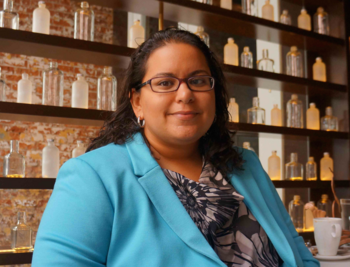
Mona Atia is Associate Professor of Geography and International Affairs at the George Washington University. She received her PhD in Geography at the University of Washington, where she received the 2008 Distinguished Dissertation Award. She holds a MSc in Cities, Space and Society from the London School of Economics and a BS in Business Administration from the University of California at Berkeley. Professor Atia is a critical development geographer whose areas of expertise include Islamic charity and finance, philanthropy and humanitarianism, and the production of poverty knowledge. She is author of Building a House in Heaven: Pious Neoliberalism and Islamic Charity in Egypt (University of Minnesota Press, 2013). She currently holds an NSF CAREER Award for her project "The Impact of Poverty Mapping on the Geography of Development."
This event is co-sponsored by the Sohaib and Sara Abbasi Program in Islamic Studies.
[[{"fid":"218621","view_mode":"crop_870xauto","fields":{"format":"crop_870xauto","field_file_image_description[und][0][value]":"Mona Atia flyer","field_file_image_alt_text[und][0][value]":"","field_file_image_title_text[und][0][value]":"","field_credit[und][0][value]":"","field_caption[und][0][value]":"","field_related_image_aspect[und][0][value]":"","thumbnails":"crop_870xauto","pp_lightbox":false,"pp_description":false},"type":"media","attributes":{"height":"540","width":"870","class":"media-element file-crop-870xauto"}}]]
Reuben Hills Conference Room
2nd Floor East Wing E207
Encina Hall
616 Serra Street
Stanford, California 94305
Mona Atia
Associate Professor
The George Washington University
Seminars
Paris attack raises concerns for religious integration
News Type
News
Date
Paragraphs
Thousands rally across France and other nations in solidarity against the January 7, 2015 attack on the Charlie Hebdo offices in Paris by gunmen shouting “Allahu Akbar” or “Allah is [the] Greatest.” What does this tragedy, called one of the worst terror attacks on French soil, portend for the future of religious integration in France?
Cecile Alduy, Stanford associate professor of French literature and affiliated faculty at Stanford's Europe Center in the Freeman Spogli Institutes for International Studies and Stanford Global Studies Division, was in Paris during the attack on the Charlie Hebdo offices.
Currently writing a book on Marine Le Pen and the far-right National Front, Alduy discussed the impact of the attack on French society and politics on KQED Radio's "Forum with Michael Krasny" (Thurs., Jan. 8, 2015). She was joined by David Pryce-Jones, author and senior editor of the National Review, Hatem Bazian of Zaytuna College, BBC News Paris correspondent Hugh Schofield, and Jack Citrin, professor of political science and director of the Institute of Governmental Studies at UC Berkeley.
Visit KQED Radio's Forum web article "Thousands Rally Across France After Attack Kills 12 in Paris" to download a recording of this interview.
Hero Image

All News button
1
FSI scholars on Paris terror attack
News Type
Q&As
Date
Paragraphs
The terrorist shootings in Paris have brought a new round of attention to issues of immigration, political polarization, religious discrimination and threats to global security. Scholars at Stanford’s Freeman Spogli Institute for International Studies are following the developments and talking about the attacks.
Cécile Alduy, is an associate professor of French literature writing a book on France’s far-right National Front political party and is an affiliated faculty member of FSI’s Europe Center. She is in Paris, where she wrote an opinion piece for Al Jazeera America and spoke with KQED’s Forum.
David Laitin is a professor of political science and also an affiliated faculty member of The Europe Center as well as FSI’s Center for International Security and Cooperation. His co-authored book, Why Muslim Integration Fails: An Inquiry in Christian-Heritage Societies, examines Muslim disadvantages and discrimination in Europe.
Christophe Crombez is a consulting professor at TEC specializing in European Union politics. And Martha Crenshaw, a senior fellow at FSI and CISAC, is an expert on political terrorism.
How are Parisians reacting to the tragedy?
Alduy: The mood here is of grief, disgust, anger, and fear. We were all in a state of shock: a sense of disbelief and horror, as if we had entered a surreal time-space where what we hear from the news happening in far away places—Iraq, Afghanistan, Pakistan, Nigeria—had been suddenly catapulted here, on our streets, in our everyday. The shock has given way to mourning. Lots of crying, swallowed tears and heavy hearts. But there’s also revolt and determination to not let that get to us and to not let it succeed in reviving internal wounds.
I was surprised by the spontaneous quiet demonstrations and collective mourning happening all over France: that people would go out rather than hide in spite of the fact that two heavy armed gunmen were on the loose. It was such a naturally humane, human, compassionate response. It was a real consolation to witness this getting together, this flame of humanity and solidarity braving the fear and silencing the silencers.
What can we say about the brothers who allegedly carried out the attack?
Crenshaw: Apparently they are French citizens of Algerian immigrant origin, who had moved into the orbit of French jihadist networks some years ago. They were both known to French and American authorities, just as the 7/7 London bombers were known to the British police. One had spent time in a French prison for his association with a jihadist network that sent young men to fight in Iraq, and the other is said to have recently trained in Yemen. In that case, he would almost certainly have come into contact with operatives of Al Qaeda in the Arabian Peninsula (known as AQAP). AQAP is an extremely dangerous organization in Yemen and abroad. The U.S. has regarded it as a number one threat for some time – this is the group that sent the infamous Christmas or underwear bomber on a flight to Detroit in 2009. Its chief ideologue, the American Anwar al-Awlaki, was killed in an American drone strike in 2012. The fact that the terrorists were two brothers also brings to mind the case of the Tsarnaev brothers and the Boston Marathon bombing.
What are the cultural and societal implications of the shooting?
Alduy: The event highlights a menace that had been rampant, and duly acknowledged by the French government: that of French-born radicalized Muslims going to Syria, Afghanistan or Iraq to be trained as jihadist and then coming back to conduct terrorist attacks on French soil (this was already the case for Mohammed Merah, but he was not part of an Al-Qaeda cell and acted all alone, as did the man who attacked the Jewish Museum in Bruxells). The cultural and societal implication is that we are now talking of being a country at war, with al-Qaida recruiting among us our potential enemies. In other words, France has to come to terms with the fact that its own values, its own political system, and its own people have been shot execution style in the name of the jihad by our own children.
Explain the extent to which Muslims are disenfranchised and discriminated against in France.
Laitin: Our book documents that Muslims, just for being Muslims, face rather significant discrimination in the French labor market. We sent out CVs to employers, comparing two identically qualified applicants, one named Khadija Diouf and the other Marie Diouf. Both were from Senegalese backgrounds but were French citizens and well educated. Marie received a significantly larger number of “call backs.” From a survey, we know that controlling for race, for gender, and for education, Muslims from one of the two Senegalese language communities we study have much lower household income than matched Christians. We connect this finding to that of the discrimination in the labor market. In our book, we search for the reasons that sustain discrimination against Muslims in France. Here we find that the rooted French population prefers not to have Muslims in their midst, and not to have a lot of Muslims in their midst. Tokens are O.K.
Meanwhile, Muslims exhibit norms concerning gender and concerning public displays of religious devotion that are threatening to the norms of the rooted French. We therefore see a joint responsibility of both the French and the immigrant Muslim communities in sustaining what we call a “discriminatory equilibrium”.
Can these shootings be attributed to those inherent tensions?
Laitin: There is no evidence that this discriminatory equilibrium is in any way responsible for the horrendous criminal behavior exhibited in the offices of Charlie Hebdo. There is a viral cult that is attractive to a small minority of young Muslims inducing them to behavior that is inhuman. The sources of this cult are manifold, but it would be outrageous to attribute it to the difficulties that Muslims face in fully integrating into France.
How will the shootings affect the standing of right-leaning political parties that have been gaining traction?
Crombez: I think the shootings in Paris will provide a further boost to the electoral prospects of France's extreme-right, anti-immigrant party, the National Front. Opinion polls in recent months already showed that it could emerge as France's largest political party at the departmental elections in March – as far as vote share is concerned – and that the Front's candidate for the Presidency in 2017 is likely to make it into, but lose, the second round run-off with the candidate of the moderate right, as was the case in 2002. The shootings will only have improved the Front's chances. Even if the election results are consistent with the polls taken prior to the shootings, and the Front doesn't do even better than the polls predicted, the dramatic results are likely to be attributed to the shootings.
And the long-term political fallout?
Crombez: The effects will reverberate throughout Europe. But as time passes and the shootings become but a distant memory, the effects will disappear. I would draw a parallel here with what happened after the Fukushima nuclear plant disaster in Japan in 2011. In the following months Green parties did very well in elections in Europe at various levels, but after a year or so that effect seems to have dissipated. I would expect this to be the case with the shootings also, except if there are more such incidents to follow.
Hero Image

All News button
1

