FSI researchers work to understand continuity and change in societies as they confront their problems and opportunities. This includes the implications of migration and human trafficking. What happens to a society when young girls exit the sex trade? How do groups moving between locations impact societies, economies, self-identity and citizenship? What are the ethnic challenges faced by an increasingly diverse European Union? From a policy perspective, scholars also work to investigate the consequences of security-related measures for society and its values.
The Europe Center reflects much of FSI’s agenda of investigating societies, serving as a forum for experts to research the cultures, religions and people of Europe. The Center sponsors several seminars and lectures, as well as visiting scholars.
Societal research also addresses issues of demography and aging, such as the social and economic challenges of providing health care for an aging population. How do older adults make decisions, and what societal tools need to be in place to ensure the resulting decisions are well-informed? FSI regularly brings in international scholars to look at these issues. They discuss how adults care for their older parents in rural China as well as the economic aspects of aging populations in China and India.
CDDRL director Francis Fukuyama believes America's increased political polarization can be traced back to a universal desire for recognition. His latest book, "Identity," digs into the factors that gave rise to President Trump, Brexit and even violent extremist groups. Fukuyama joins Forum to discuss identity politics, the road back to a united American identity and how the world has changed since the publication of his best-selling "The End of History." Listen here.
Under the title “Political Contestation and New Social Forces in the Middle East and North Africa,” the Program on Arab Reform and Democracy convened its 2018 annual conference on April 27 and 28 at Stanford University. Bringing together a diverse group of scholars from across several disciplines, the conference examined how dynamics of governance and modes of political participation have evolved in recent years in light of the resurgence of authoritarian trends throughout the region.
Image
Delivering the opening remarks of the conference, Freeman Spogli Institute (FSI) and Hoover Institution Senior Fellow Larry Diamond reflected on the state of struggle for political change in the Middle East and North Africa (MENA) region. In a panel titled “Youth, Culture, and Expressions of Resistance,” FSI Scholar Ayca Alemdaroglu discussed strategies the Turkish state has pursued to preempt and contain dissent among youth. Adel Iskandar, Assistant Professor of Communications at Simon Fraser University, explained the various ways through which Egyptian youth employ social media to express political dissent. Yasemin Ipek, Assistant Professor of Global Affairs at George Mason University, unpacked the phenomenon of “entrepreneurial activism” among Lebanese youth and discussed its role in cross-sectarian mobilization.
The conference’s second panel, tilted “Situating Gender in the Law and the Economy,” featured Texas Christian University Historian Hanan Hammad, who assessed the achievements of the movement to fight gender-based violence in Egypt. Focusing on Gulf Cooperation Council states, Alessandra Gonzales, a Visiting Postdoctoral Fellow at the Stanford Institute for Economic Policy Research, analyzed the differences in female executive hiring practices across local and foreign firms. Stanford University Political Scientist and FSI Senior Fellow Lisa Blaydes presented findings from her research on women’s attitudes toward Female Genital Mutilation (FGM) in Egypt.
Image
Speaking on a panel titled “Social Movements and Visions for Change,” Free University of Berlin Scholar Dina El-Sharnouby discussed the 2011 revolutionary movement in Egypt and the visions for social change it espouses in the contemporary moment. Oklahoma City University Political Scientist Mohamed Daadaoui analyzed the Moroccan regime’s strategies of control following the Arab Uprisings and their impact on various opposition actors. Nora Doaiji, a PhD Student in History at Harvard University, shared findings from her research examining the challenges confronting the women’s movement in Saudi Arabia.
The fourth panel of the conference, “The Economy, the State, and New Social Actors,” featured George Washington University Associate Professor of Geography Mona Atia, who presented on territorial restructuring and the politics governing poverty in Morocco. Amr Adly, an Assistant Professor of Political Science at the American University in Cairo, analyzed the relationship between the state and big business in Egypt after the 2013 military coup. Rice University Professor of Economics Mahmoud El-Gamal shared findings from his research on the economic determinants of democratization and de-democratization trends in Egypt during the past decade.
Image
The final panel focused on the international and regional dimensions of the struggle for political change in the Arab world, and featured Hicham Alaoui, a Research Fellow at Harvard University’s Weatherhead Center for International Affairs, Georgetown University Political Scientist Daniel Brumberg, and Nancy Okail, the Executive Director of the Tahrir Institute for Middle East Policy.
The conference included a special session featuring former fellows of the American Middle Eastern Network at Stanford (AMENDS), an organization dedicated to promoting understanding around the Middle East, and supporting young leaders working to ignite concrete social and economic development in the region. AMENDS affiliates from five different MENA countries shared with the Stanford community their experiences in working toward social change in their respective countries.
Hero Image
ARD 2018 Annual Conference participants.
Front row (from left): Hanan Hammad, Hamza Arsbi, Ayca Alemdaroglu, Mahdi Lafram, Lior Lapid.
Second to front row (from left): Dina El-Sharnouby, Daniel Brumberg, Radidja Nemar, Mona Atia.
Third to front row (from left): Hesham Sallam, Joel Beinin, Nora Doaiji, Hicham Alaoui, Mohamed Daadaoui, Salma Takky, Larry Diamond, Amr Adly, Sultan Al Amer, Heba Al-Hayek.
Back row (from left): Amr Gharbeia, Mahmoud El-Gamal, Amr Hamzawy
During the U.S.-Japan Council annual conference that was held in Tokyo on November 8 and 9, 2018, Rylan Sekiguchi was elected chair of the TOMODACHI Emerging Leaders Program (ELP). The ELP identifies, cultivates, and empowers a new generation of leaders in the U.S.–Japan relationship. Emerging Leaders participate in leadership education, design and implement original USJC programming, and develop powerful, lifelong personal and professional friendships. A new cohort of leaders aged 24–35 is selected annually through a highly competitive process. USJC Senior Vice President Kaz Maniwa, who oversees the ELP, commented, “We are delighted that Rylan Sekiguchi will lead the Emerging Leaders Program next year as the chair of the Steering Committee. Rylan has shown great passion, dedication, and commitment to the Emerging Leaders Program and we look forward to his leadership.”
Secretary Norman Mineta and Rylan Sekiguchi
During the conference, Sekiguchi gave an overview of the ELP and shared reflections of how his professional and personal lives have embraced the mission of the ELP. Sekiguchi spoke specifically about his current work at SPICE with USJC Vice Chair Norman Mineta, former Secretary of Commerce under President Bill Clinton and Secretary of Transportation under President George W. Bush. Mineta is the subject of a new documentary—An American Story: Norman Mineta and His Legacy—co-produced by Dianne Fukami and Debra Nakatomi, and Sekiguchi is finalizing web-based lesson plans that focus on the film’s key themes, including immigration, civil liberties, and leadership. The documentary was screened at the conference and is anticipated to air on PBS.
A short video that Sekiguchi shared during his speech brought applause from the audience. The video captured a snippet of a performance that he and other members of San Jose Taiko presented last year. The performance celebrated “swing music and the role it played in lifting people’s spirits amid the harsh reality of the Japanese-American internment,” shared Sekiguchi. “Through music and theater, we transported people back to a 1940s-era ‘camp dance’ to educate audiences about the painful, agonizing choices that incarcerees faced.” Mineta was a young boy when his family was uprooted from San Jose, California, and incarcerated in a camp for Japanese Americans in Heart Mountain, Wyoming. Mineta later became mayor of San Jose in 1971.
Through Sekiguchi’s reflections, audience members from both sides of the Pacific were prompted to reflect upon civil liberties during times of crisis—in this case, the incarceration of Japanese Americans following the Japanese attack on Pearl Harbor. My father was a high school student in a camp in Poston, Arizona, and the video prompted me to recall one of the few things that he shared with me about his life behind barbed wire—that camp dances and baseball brought some sense of normalcy to the lives of Japanese-American youth. By showing the video, Sekiguchi’s implicit message was clear: young Americans today—including of course, ELP members—must be aware of the sometimes fragile nature of civil liberties. I have the good fortune of working with another ELP member, Naomi Funahashi, and during the conference, it was rewarding for me to meet many ELP alumni and members of the newest cohort and to witness the beginnings of personal and professional friendships amongst them. Sekiguchi’s speech set the tone for the year ahead—like a “camp dance,” he wants the ELP members to have fun but to always remember the serious nature of what the ELP represents.
This study focused on an important but often overlooked aspect of safety in medicine: physician safety. In China, patients may violently protest against doctors via disruptive behaviors when facing unsatisfying results, jeopardizing physicians’ security, affecting their diagnostic reasoning, and ultimately harming patient safety. We investigated the relationship between disruptive behaviors, government intervention, and protest results. Statistical analyses reveal that the ‘paying for peace’ mechanism can create distorted incentives for patients and encourage more riots. Efforts should be made to improve service quality and channel medical disputes into the legal framework.
Image
Lingrui Liu is an Associate Research Scientist at the Yale School of Public Health, Department of Health Policy and Management. Prior to joining the YSPH faculty in fall of 2018, she obtained an ScD from Harvard University (2018). Her research interests include health care organizations, quality improvement, patient safety, organizational design and culture, and implementation of evidence-based practices.
Future Visions: Challenges and Possibilities of Korean Studies in North America — Social Science panel. From left to right: UC Berkeley's Laura Nelson, University of Michigan's Jordan Siegel, Stanford's Yong Suk Lee, USC's David Kang, Harvard's Paul Chang.
How can Korean studies faculty cultivate supportive and critical scholarly communities with graduate students? What can be done to overcome the severe constraints on Korean language training in North America? Why is there a dearth of Korea scholarship in academic literature? And how should Korean studies librarians prepare for the future in the light of new technologies and young researchers’ increasing interest in digital scholarship?
These were some of the questions examined at a two-day conference, “Future Visions: Challenges and Possibilities of Korean Studies in North America,” convened by the Korea Program of Stanford’s Shorenstein Asia-Pacific Research Center (APARC) on November 1-2. Co-sponsored by the Seoul-based Foundation Academia Platonica, the conference, the first of its kind, gathered distinguished Korean studies scholars from twelve North American institutions to consider the state of the field, assess its challenges, and carry forward a vision for its future direction and potential. Its six unique panels focused not only on the major disciplines of Korean studies—history, literature, and the social sciences—but also on language education, library collections and services, and Korean Wave.
“The presentations and discussions by our fellow experts reflected the breadth and depth of Korean studies in North America,” says APARC Director and the Korea Program Director Gi-Wook Shin. “Our program was established at Stanford in 2001 and has since become a leader in Korean studies in North America, so it is a special privilege for us to bring together colleagues from eminent institutions around the continent to further advance Korean studies education and research in the academic and policy worlds, and to build upon our track record of action and achievements.”
“The field of Korean studies, however,” notes Shin, “has significantly changed over the past seventeen years and it isn’t without its challenges. This is our opportunity to consider frankly where we go next and how we could explore the path ahead together.”
Conference participants indeed engaged in deep conversations and shared ideas and dilemmas regarding teaching in the different disciplines of Korean studies in North America. Harvard sociologist Paul Chang listed three types of challenges facing the field: publication, academic, and professional challenges. David C. Kang, professor of international relations and director of the Korean Studies Institute at the University of Southern California, emphasized the publication challenge: why is it, asked Kang, that top academic journals in the discipline of political science and international relations publish so much more scholarship about Europe than they do about Korea and Asia at large, even while the rise of Asian nations is surely one of the most consequential issues of the twenty-first century? The onus, Kang argued, comes back to East Asia scholars “to produce better and more compelling scholarship, and to better train graduate students.”
University of British Columbia's Ross King and conference participants.
Yet complex issues surround the question of how to broaden graduate coursework—and whether to do so. Korean language and linguistics expert Ross King, head of the department of Asian Studies at the University of British Columbia in Vancouver, Canada, was one of several panelists who considered the obstacles to graduate training, among different aspects of academic challenges facing the field of Korean studies. King probed into how Sinocentrism and what he called the “Mandarin conceit”—that is, the notion that training in Literary Sinitic should be predicated on a near-native proficiency in modern Mandarin Chinese—are emerging as a major stumbling block to the study of premodern Korean literary culture. He also pointed to the constraints on language training in both Korean and hanmun in North America, which, he claimed, is why we can probably anticipate continued decrease in the number of ethnically non-Korean (non-Korea-educated) graduate students undertaking graduate study in Korean literature.
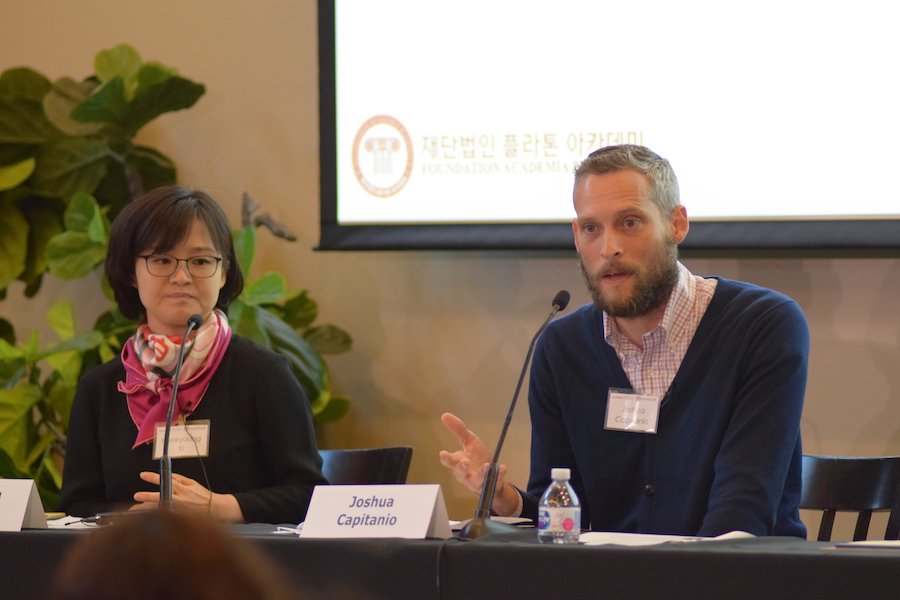
University of Washington's Hyokyoung Yi (left) and Stanford's Joshua Capitanio at a panel on library collections and service.
Sung-Ock Sohn, who coordinates the Korean language program in the department of Asian languages and cultures at the University of California – Los Angeles, further shed light on King’s prediction. She explained that while enrollments in Korean language classes have shown a sharp increase in American higher education institutions in the past decade, particularly at the introductory level and among ethnically non-Korean students, there is a high attrition rate of students from an introductory to advanced Korean classes nationwide.
How should the field move forward?
Participants proposed a host of ideas to that end. These included helping graduate students collaborate with colleagues in Korea; dedicating funding for junior faculty to spend periods of time before tenure conducting research and honing language skills in Korea at appropriate institutions, and for mid-career scholars to spend a year in Korea; emphasizing the application of social science theories and methods to premodern and modern East Asia; motivating scholars to apply a comparative lens to the study of the historical and contemporary experience of East Asia; and integrating linguistic and cultural diversity in Korean language classes by, for example, incorporating service learning in authentic contexts and extending the content spectrum to include topics such as Korean popular culture.
Image
K-pop star Siwon Choi (left) highlights closing panel on Korean Wave.
Korean Wave was the focus of the conference’s widely attended closing panel that featured K-pop star Siwon Choi, a member of Korean boy band Super Junior, and multi-platinum music producer Dominique Rodriguez, managing director of SM Entertainment USA. They spoke about the global reach of Korean pop music and some of the ways in which Korean popular culture could stimulate interest in Korean studies. Dafna Zur, assistant professor in Stanford’s department of East Asian languages and cultures, who chaired the panel, challenged her students to consider “what it means not just to monetize culture but to design culture with specific markets and audience in mind.” The Stanford Daily published a detailed article on the panel.
“We are grateful to Foundation Academia Platonica for its generous support of Stanford’s Korea Program at Shorenstein APARC and for making this conference possible through our shared vision for the future of Korean studies in North America,” said Gi-Wook Shin. “Our thanks also go to our many other friends and partners, including the Korea Foundation that has helped achieve great results through its commitment to promoting understanding of Korea in academia and beyond and its support of the overseas Korean Studies Program since its establishment in 1991.”
South Korean TV company SBS NBC filmed the conference that will be featured in an upcoming documentary about Korean studies in the United States.
Read the conference report or listen to the audio recordings of the sessions, below.
At 11am on November 11, 1918, the armistice that effectively ended the First World War was signed. What came to be known as “The Great War” had a profound and lasting impact on the cultural fabric of the nations involved: as Paul Fussell wrote, “its dynamics and iconography proved crucial to the political, rhetorical, and artistic life of the years that followed; while relying on inherited myth, war was generating new myth.” Over the course of the 20th century, the concept of war evolved beyond historically traceable moments and events to include the consideration of war as site and influence shaping every aspect of lived experience. This conference seeks to examine ways in which literature and the arts have taken up and taken apart war and the myths surrounding it -- grappling with it both as subject and context while also considering the ways in which the experience of war molded, mutilated, and morphed artistic forms. Though the word “centennial” often rings of monolithic celebration, it is equally an opportunity to highlight the attempts of writers and artists to contain, contend, or survive war and to question and problematize preconceptions and existing views of war by investigating their inherently bipolar nature.
November 10, 2018 (Day 2) SCHEDULE:
9 – 11am - 2nd PANEL Chair: Jennifer Scappettone (University of Chicago, Associate Professor)
Aubrey Knox (CUNY, PhD Student) "The Regulated Body: The Grand Palais as Military Hospital in World War I"
Joanna Fiduccia (Reed College, Assistant Professor) "A Destructive Character: Alberto Giacometti’s Crisis of the Monument"
Hadrien Laroche (INHA, France, Philosopher and Researcher) "Duchamp's waste: Trauma, Violence and Aesthetics"
11 - 11.30am – COFFEE BREAK
11.30am - 12.45pm – KEYNOTE ADDRESS
Jay Winter (Yale University, Emeritus Professor) "All the Things We Cannot Hear: Silences of the Great War"
Martin Löschnigg (University of Graz, Austria, Professor) "‘The extreme fury of war self-multiplies’: First World War Literature and the Aesthetics of Loss"
Ron Ben-Tovim (Ben Gurion University, Israel, Post-Doc), Boris Shoshitaishvili (Stanford University, PhD Student) "Re-Enchanting the World after War: J. R. R. Tolkien, David Jones, and the Revision of Epic"
Anna Abramson (MIT, Post-Doc) "Atmospheric Myths of The Great War"
Isaac Blacksin (UC Santa Cruz, PhD Student) Senseless Encounter, Immutable Sense: The Contradictions of Reporting War
4.30 – 4.45pm – COFFEE BREAK
4.45 – 6pm – KEYNOTE ADDRESS
Alexander Nemerov (Stanford University, Professor) "A Soldier Killed in the First World War"
Sponsored by: the Division of Literatures, Languages, and Cultures; Stanford Department of Art and Art History; Theater and Performance Studies; Stanford Humanities Center; The Europe Center; Dept. of French and Italian; Dept. of History; Dept. of German Studies; and the Dean's Office of Humanities and Sciences.
Stanford Humanities Center 424 Santa Teresa Street Stanford, CA 94305
Author Yochai Benkler sits down with Kelly Born to discuss Network Propaganda: Manipulation, Disinformation, and Radicalization in American Politics. According to the New Yorker, the Washington conventional wisdom presupposes a kind of symmetry between our polarized political parties. Liberals and conservatives, it is said, live in separate bubbles, where they watch different television networks, frequent different Web sites, and absorb different realities. The implication of this view is that both sides resemble each other in their twisted views of reality. Network Propaganda challenges that received wisdom through the most comprehensive study yet published on media coverage of American presidential politics from the start of the election cycle in April 2015 to the one year anniversary of the Trump presidency. Analyzing millions of news stories together with Twitter and Facebook shares, broadcast television and YouTube, the book provides a comprehensive overview of the architecture of contemporary American political communications. Through data analysis and detailed qualitative case studies of coverage of immigration, Clinton scandals, and the Trump Russia investigation, the book finds that “the right-wing media ecosystem differs categorically from the rest of the media environment,” and has been much more susceptible to “disinformation, lies and half-truths.”
Register for this free event online at: pacscenter.stanford.edu/event
6:00—6:30 PM Doors Open and Pre-Reception
6:30—7:30 PM Program 7:30—8:00 PM
Q&A 8:00—8:30 PM Book Signing and Post-Reception
PAUL BREST HALL 555 SALVATIERRA WALK STANFORD, CA 94305
Yochai Benkler
Berkman Professor of Entrepreneurial Legal Studies at Harvard Law School
Kelly Born
Program Officer, Madison Initiative, William and Flora Hewlett Foundation
Delphine Red Shirt is a lecturer at the Special Language Program of Stanford University. She served as the Chairperson of the United Nations NGO Committee on the International Decade of the World's Indigenous People, and as the United Nations Representative for the Four Directions Council: International Indigenous Organization with access to the UN. She received her Master of Arts in Liberal Studies in Creative Writing from Wesleyan University and her Ph.D. from Arizona University. She is the author of Bead on an Anthill: A Lakota Childhood, Turtle Lung Woman’s Granddaughter, and George Sword's Warrior Narratives: Compositional Processes in Lakota Oral Tradition, which has been translated into Chinese for distribution in November 2018. Delphine is dedicated to the historical narrative and promotion of oral literature.
Sociologists have struggled to come up with systematic ways of thinking about, and defining, the important concept of taken for grantedness. It remains unclear what exactly gets taken for granted and what this means. A recent theoretical work, Concepts and Categories: Foundations for Sociological and Cultural Analysis, proposes a new approach tied closely to research on cognition. Hannan will discuss how the new line of research builds on a probabilistic notion of concepts, and how people use their concepts to form expectations about what kinds of features an instance of a concept is likely to have. He will also examine the use of concepts to make judgements about individual objects, whether an object is or is not an instance of the concept.
A matrix with m rows and n columns looks like a rectangle filled with tiny boxes: m times n boxes, to be exact. But after visiting the Stanford Center at Peking University (SCPKU) for three months, my mental matrix of the world looked more like a weird trapezoid. New acquaintances added rows and their unique perspectives added columns. My brain drew lines from geography to economics to politics, but the lines were on crumpled paper. Ah and don't forget history. So multiply the rectangle by time t and out comes a 3D trapezoid.
How do we mentally travel through odd shapes with any sense and efficiency? China Studies in Beijing classes at the SCPKU sharpened our tools for the endeavor. On day one, Thomas Fingar emphasized that the goal of a foreign policy class is not to remember a list of facts, but to build a personal matrix of relations and to learn tricks for traversing the matrix. Jean Oi demonstrated how people's ideals can constrain the goals of business and political leaders. Scott Rozelle showed how economic developments in China changed real lives. Clarity reduces the dimensions we care about. Sometimes we need to melt and reshape the whole matrix. Other times we just need to prune a few rows and columns. We have the algorithms, technologies, "intelligences." Our tools, both natural and artificial, can be useful for navigating political spheres and leading to action.
But tools are not all we have. Other people's matrices sometimes slam into our own. Warping it, filling it. At Peking University (PKU), I met students with different stories and missions. One student transfers industrial expertise from China to Southeast Asia. Another connects Stanford and PKU students to openly discuss US-China relations. I also collaborated with PKU researchers. The scientists are fast learners and deeply curious. The clinicians are hard working and harder feeling. They all faithfully give their time and spirit. Despite the different bases of our matrices, language in particular, we could cooperate and together build a fuller model of the world.
What was the visiting graduate student's place in all of this? As a psychologist, I study humans and their brains. The brain itself is a messy matrix. Figuratively, a life history of data to curate; literally, cells that code spacetime. Maybe the psychology and geometry of every other brain is not so foreign from each of our own. Our science can keep digging deeper and tilling truer in search of common ground. We can build an empirical basis for humans to flourish together.
Sometimes, after long times, a complex matrix can instead be depicted as a fractal. Like flakes of snow. Each one is unique, starting with the same properties of H2O but morphing through many phases. Maybe with study and reflection we will look back at both China studies and brain studies and, rather than see a messy matrix, find a fractal. Hopefully such a model can also be useful to guide our way forward.
About the author Josiah Leong: Awarded a SCPKU Predoctoral fellowship for research from August to November 2018. He is a doctoral candidate in psychology and his research is about how brain creates emotions and makes decisions. During his visit, he started a neuroimaging study with the Peking psychology department and taught neuroimaging data analyses to addiction researchers at the Peking Sixth Hospital. He also engaged with researchers in anthropology, history, and political science, and he audited courses from the China Studies in Beijing overseas program. These experiences clarified his vision for how psychological science can guide the policies that govern everyday life. He has seen how scientific collaboration builds communities across borders, and he remains optimistic that the practice of science can lead people to question their assumptions and reshape their matrices, so to speak.

 FSI researchers work to understand continuity and change in societies as they confront their problems and opportunities. This includes the implications of


 Secretary Norman Mineta and Rylan Sekiguchi