FSI researchers work to understand continuity and change in societies as they confront their problems and opportunities. This includes the implications of migration and human trafficking. What happens to a society when young girls exit the sex trade? How do groups moving between locations impact societies, economies, self-identity and citizenship? What are the ethnic challenges faced by an increasingly diverse European Union? From a policy perspective, scholars also work to investigate the consequences of security-related measures for society and its values.
The Europe Center reflects much of FSI’s agenda of investigating societies, serving as a forum for experts to research the cultures, religions and people of Europe. The Center sponsors several seminars and lectures, as well as visiting scholars.
Societal research also addresses issues of demography and aging, such as the social and economic challenges of providing health care for an aging population. How do older adults make decisions, and what societal tools need to be in place to ensure the resulting decisions are well-informed? FSI regularly brings in international scholars to look at these issues. They discuss how adults care for their older parents in rural China as well as the economic aspects of aging populations in China and India.
Livestream: This event will not be live-streamed or recorded.
Abstract: When U.S. Senator Arthur Vandenberg famously told President Harry Truman that he’d have to “scare the hell out of the American people” to secure support for the coming Cold War, Vandenburg was tapping into a tried and true tradition of strategically cultivating fear to influence attitudes and change behavior. While this tactic has a long history of use, strikingly little has been written on precisely how, why, and when it actually works. In this talk, Professor Kelly M. Greenhill offers just such an explanation. Drawing upon findings from her next book, Fear and Present Danger: Extra-factual Sources of Threat Conception and Proliferation, Greenhill describes how and why cognitive and psychological biases can be triggered and strategically manipulated as means to political and military ends.
Greenhill further explains why actors engaged in this particular kind of cognitive hacking frequently eschew fact-based arguments in favor of “truthier” alternatives, such as rumors, conspiracy theories, propaganda, fiction and so-called fake news, sources she collectively refer to as “extra-factual information” (EFI). She identifies the conditions under which policymakers and the public tend to find EFI-infused threat narratives persuasive, and, drawing upon a wide array of historical examples, show that while information content and delivery platforms have changed, the underlying mechanisms that make this tool such an effective instrument of political influence, and EFI, such a useful handmaiden to it, have not. Greenhill highlights the implications of historical cases for our contemporary, EFI-saturated political environment and what current trends may portend for the future.
Speaker’s Biography: Kelly M. Greenhill (PhD, MIT) is a professor and Director of International Relations at Tufts University and Research Fellow at Harvard University’s Kennedy School. Greenhill has published four books, including Weapons of Mass Migration: Forced Displacement, Coercion, and Foreign Policy (winner of ISA’s Best Book of the Year Award); Sex, Drugs, and Body Counts: The Politics of Numbers in Global Crime and Conflict; The Use of Force: Military Power and International Politics; and Coercion: The Power to Hurt in International Politics. Outside of academia, Greenhill has consulted for the US government, UN, UNHCR, World Bank and Ford Foundation and worked as an analyst for the U.S. Defense Department.
Kelly Greenhill
Professor and Director of International Relations
Tufts University
The annual award, which carries a US $10,000 cash prize, is sponsored by Stanford University’s Walter H. Shorenstein Asia-Pacific Research Center. It recognizes outstanding journalists and journalism organizations for excellence in coverage of the Asia-Pacific region. News editors, publishers, scholars, journalism associations, and organizations focused on Asia research and analysis are invited to submit nominations for the 2020 award through Friday, February 14.
STANFORD, CA, December 3, 2019 — The Walter H. Shorenstein Asia-Pacific Research Center (APARC), Stanford University’s hub for interdisciplinary research, education, and engagement on contemporary Asia, invites nominations for the 2020 Shorenstein Journalism Award. The award recognizes outstanding journalists who have spent their careers helping audiences around the world understand the complexities of the Asia-Pacific region. The 2020 award will honor a journalist whose work has mostly been conveyed through American news media. The deadline for nomination submissions is Friday, February 14, 2020.
An annual tradition since 2002, the Shorenstein Journalism Award is sponsored by APARC and carries a cash prize of US $10,000. It honors the legacy of APARC benefactor, Mr. Walter H. Shorenstein, and his twin passions for promoting excellence in journalism and understanding of Asia. “In the face of a shifting geopolitical landscape and amid global declines of democracy, political rights, and civil liberties, it is more crucial than ever before to support independent journalism that seeks accuracy, deep reporting, and nuanced U.S.-Asia dialogue,” said APARC Director Gi-Wook Shin.
Over the course of its history, the award has recognized world-class journalists who push the boundaries of coverage of the Asia-Pacific region and help advance mutual understanding between audiences in the United States and their Asian counterparts. Recent honorees include Maria Ressa, Anna Fifield, Siddharth Varadarajan, Ian Johnson, and Caixin Media. The award alternates between recipients whose work has mostly been published through Asian news media and those whose work has mostly been conveyed through American news media. The 2020 award will recognize a recipient from the latter category.
For the award, the Asia-Pacific region is defined broadly to include Northeast, Southeast, South, and Central Asia and Australasia. Both individual journalists with considerable body of work and journalism organizations are eligible for the award. Nominees’ work may be in traditional forms of print or broadcast journalism and/or in new forms of multimedia journalism. The Award Selection Committee, whose members are experts in journalism and Asia research and policy, presides over the judging of nominees and is responsible for the selection of honorees.
APARC is seeking 2020 award nomination submissions from news editors, publishers, scholars, journalism associations, and entities focused on researching and interpreting the Asia-Pacific region. The Center will announce the winner by April 2020 and present the award at a public ceremony at Stanford in autumn quarter of 2020.
Nominations are accepted electronically through Friday, February 14, 2020 at 11:59 PM PST. For information about the nomination procedures and to submit nominations please visit the award nomination entry page.
About the Walter H. Shorenstein Asia-Pacific Research Center The Walter H. Shorenstein Asia-Pacific Research Center (Shorenstein APARC) addresses critical issues affecting the countries of Asia, their regional and global affairs, and U.S.-Asia relations. As Stanford University’s hub for the interdisciplinary study of contemporary Asia, APARC produces policy-relevant research, provides education and training to students, scholars, and practitioners, and strengthens dialogue and cooperation between counterparts in the Asia-Pacific and the United States. Founded in 1983, APARC today is home to a scholar community of distinguished academics and practitioners in government, business, and civil society, who specialize in trends that cut across the entire Asia-Pacific region. Learn more about APARC and about the Shorenstein Journalism Award.
The Democrats are facing a dilemma: If they defend democratic norms by acting to remove President Trump from office, they risk getting dragged into a polarizing style of politics that works to his political advantage. Read here.
In today’s Egypt, commitment to democracy appears scarce among actors both within the regime and in civil society, and public-opinion polls further suggest that demands for democratic governance have been abandoned. An undemocratic political understanding and disenchantment with the concept of democracy seemingly prevail among a majority of the population. Rather than seeking a return to democratic government, Egyptians are once again hoping that an authoritarian regime will succeed in raising the standard of living. Only a few groups of activists are gradually articulating a peaceful democratic culture of resistance, found in universities and professional associations as well as on social media and in the underground music scene. Their efforts offer grounds for hope. Read here.
Since November 2018, a grassroots revolt of the forgotten lower middle classes from France’s far-flung suburbs and rural areas has risen against high taxes; social injustice; and the elites, President Emmanuel Macron foremost among them. Although this “Yellow Vest” movement is not dead, it is now weakened by internal feuds, excessive violence, a takeover by the far left, and Macron’s deft handling. Yet this revolt of “la France profonde” has underscored the fragility of Macron’s narrow sociological and political base. Macron’s decisive 2017 election victory owed more to his outsider status, the collapse of the traditional political establishment, and the rejection of the far right (led by Marine Le Pen) than to his free-market and pro-European agenda. In part, the Yellow Vest version of populism was a response to the “populism of the elites” embodied by Macron in 2017. The Yellow Vest movement further illustrates the central class and polarized ideological cleavages that shape the politics of a growing number of advanced democracies. Read here.
While the Internet has revolutionized many aspects of our lives, there are still no online alternatives for making democratic decisions at large scale as a society. In this talk, we will describe algorithmic and market-inspired approaches towards large scale decision making that our research group is exploring. We will start with a model of opinion dynamics that can potentially lead to polarization, and relate that to commonly used recommendation algorithms. We will then describe the algorithms behind Stanford's participatory budgeting platform, and the lessons that we learnt from deploying this platform in over 70 civic elections. We will use this to motivate the need for a modern theory of social choice that goes beyond voting on candidates. We will then describe ongoing practical work on an automated moderator bot for civic deliberation (in collaboration with Jim Fishkin's group), and ongoing theoretical work on deliberative approaches to decision making. We will conclude with a summary of open directions, focusing in particular on fair advertising.
Ashish Goel is a Professor of Management Science and Engineering and (by courtesy) Computer Science at Stanford University, and a member of Stanford's Institute for Computational and Mathematical Engineering. He received his PhD in Computer Science from Stanford in 1999, and was an Assistant Professor of Computer Science at the University of Southern California from 1999 to 2002. His research interests lie in the design, analysis, and applications of algorithms; current application areas of interest include social networks, participatory democracy, Internet commerce, and large scale data processing. Professor Goel is a recipient of an Alfred P. Sloan faculty fellowship (2004-06), a Terman faculty fellowship from Stanford, an NSF Career Award (2002-07), and a Rajeev Motwani mentorship award (2010). He was a co-author on the paper that won the best paper award at WWW 2009, and an Edelman Laureate in 2014.
Professor Goel was a research fellow and technical advisor at Twitter, Inc. from July 2009 to Aug 2014.
Ashish Goel
Professor of Management Science and Engineering
A project 20 years in the making officially came to completion with the dedication of the restoration of Encina Commons and new Bechtel Courtyard on November 7.
The new space will be shared by the Freeman Spogli Institute for International Studies and two departments in the School of Humanities and Sciences: Stanford Global Studies and the Department of Political Science. Philanthropic support played a key role in the renovations.
“I am thrilled that we now have this stunning courtyard for our faculty and students to use and enjoy,” said FSI Director Michael McFaul, professor of political science. “There is no doubt that FSI needs the space, as do our partners in the School of Humanities and Sciences, and I am confident that our Master’s in International Policy students will make the most of it.” Professor McFaul is also the Ken Olivier & Angela Nomellini Professor in International Studies.
The space will help establish an international studies hub at FSI by connecting Encina Commons and Encina Hall: the large courtyard is accessible by stairs from Bechtel Conference Room in Encina Hall and from a new lobby area in Encina Commons.
In her remarks during the dedication ceremony, Dean Debra Satz, Vernon R. and Lysbeth Warren Anderson Dean of the School of Humanities and Sciences and Marta Sutton Weeks Professor of Ethics in Society, emphasized how the new area reflects Stanford’s commitment to promoting collaboration between academic departments and interdisciplinary research.
“The space people are in can really facilitate or inhibit what happens,” Satz said. “At Stanford, we place a strong emphasis on interdisciplinary research and teaching, and I think of this space as a material embodiment of that commitment. We have a lot of faculty who are shared between the School of Humanities and Sciences and FSI and this symbolizes and valorizes that sharing of people.”
Provost Persis Drell and Vice Provost and Dean of Research Kathryn Moler also made remarks at the ceremony, while University Architect and Director of Campus Planning David Lenox spoke about the history of Encina Hall, which was originally a men’s dorm, and described the transformation of the once “not-so-nice-looking” courtyard to the new and improved present-day space.
Also new to Encina Commons is an atrium and bridge across the new open lobby, which connects both of the second-floor wings. Several conference rooms have also been added to the first floor as part of the new Moghadam Conference Center.
Across the courtyard, in Encina Hall, the main lobby has been renamed the Coit D. Blacker lobby in honor of FSI’s director, affectionately known as Chip, from 2003 to 2012, who championed the renovation project.
“Chip understood that we needed a space for international studies, and that we needed a space to allow FSI to grow,” said McFaul. “It was his vision and his dedication to working with campus partners that got us here today.”
The space around Encina Commons and the Bechtel Courtyard is a material embodiment of Stanford’s commitment to interdisciplinary research. Today we inaugurated this beautiful space, a project 20-years in the making. pic.twitter.com/mvehzOtwY9
A New Look for MIP and International Relations The ground floor of Encina Hall, which houses the Ford Dorsey Master’s in International Policy (MIP) program, has been remodeled and is now open. Renovations to the academic space, which is adjacent to the Bechtel Courtyard, will allow students more space for collaboration and will bring all of the MIP staff offices together in a centralized location.
Another big change for the MIP program was announced last summer: Professor Francis Fukuyama, one of the most well-known and respected social scientists in the world, took over as the program’s director in August.
The International Relations program also has a new space on the ground floor of Encina Hall, which will foster academic collaboration and enhance the MIP student experience, and the space is also home to the Center for Human Rights and International Justice within the Stanford Global Studies division.
“This is a critical time to prepare our students to be policy leaders in government, civic society, and the private sector,” said Fukuyama, who is the Mosbacher Director at the Center for Democracy, Development and the Rule of Law and Olivier Nomellini Senior Fellow at FSI. “Our curriculum aims to be among the best in international policy education, and continues to get stronger with new faculty, courses, and terrific students.”
The following donors made the Bechtel Courtyard and Encina Commons renovation possible: The S.D. Bechtel, Jr. Foundation and Stephen D. Bechtel, Jr. Laurie Dachs Ken Olivier and Angela Nomellini Hamid and Tina Gwatkin Moghadam
Watch the evening’s complete dedication ceremony on the FSI YouTube channel:
Hero Image
A dedication ceremony was held on November 7, 2019 to celebrate the opening of Bechtel Courtyard and Encina Commons at the Freeman Spogli Institute for International Studies. Photo: Rod Searcey
616 Jane Stanford Way
Encina Hall, E005
Stanford, CA 94305-6060
0
kasumi@stanford.edu
kasumi_yamashita.jpeg
AM
Kasumi Yamashita is an Instructor for the Stanford Program on International and Cross-Cultural Education (SPICE), currently teaching an online course for high school students in Oita Prefecture, Japan, called Stanford e-Oita. Kasumi’s academic interests are in cultural anthropology, international education, and language technologies, and her research focuses on the Japanese diaspora in the United States and Latin America. While conducting fieldwork for her PhD in Anthropology at Harvard University, she spent a year at the University of São Paulo, as a Fulbright Scholar. She explored narrations of memory and migration, and community involvement in the emergence of Japanese diaspora museums throughout Brazil, including the Museu Histórico da Imigração Japonesa no Brasil (Historical Museum of Japanese Immigration to Brazil). Kasumi researched Nikkei Latin American communities in Japan while at Hitotsubashi University on a Japanese government scholarship. She earned an AM in Regional Studies–East Asia from Harvard University.
Kasumi received a BS in Studio Art from New York University. She was a University Scholar and spent her junior year in Spain at the Instituto Internacional in Madrid. After graduating from NYU, she taught English as an Assistant Language Teacher (ALT) and later worked as a Coordinator for International Relations (CIR) on the Japan Exchange and Teaching (JET) Program. As a CIR at Yukuhashi City Hall, Fukuoka Prefecture, she founded a Japan–U.S. student and teacher exchange program between middle schools in Yukuhashi City and the Grace Church School in New York. More than 500 students and teachers from the United States and Japan have participated in the program since she launched it in 1994. That year, she published a book of essays chronicling her experiences as a Japanese American woman in a small Japanese town, Kasumi no Yukuhashi Nikki (Kaichosha Press).
In New York, she served as a member of the local staff of the Permanent Mission of Japan to the United Nations under the leadership of Ambassador Hisashi Owada. She also served on the Executive Committee of the Convención Panamericana Nikkei (COPANI XI) in New York and has been involved in past conferences across the Americas, most recently COPANI XX in San Francisco (CA) in 2019.
Kasumi also teaches and develops web-based curricula for the Translation and Interpretation Program at Bellevue College (WA). Kasumi frequently interprets for Japanese delegations in various fields (including education, technology, international relations, film, art, and museums) and serves on the Board of the Japanese Cultural and Community Center of Washington (JCCCW).
Abstract: Joshua Busby, University of Texas-Austin, will present the main argument and empirical work from his draft book manuscript. Over the past decade, a rich literature on the connections between climate change and security emerged, much of it quantitative on the links between climate change and violent internal conflict. In this book manuscript, Busby seeks to widen the aperture of security concerns to include major humanitarian emergencies. Through the study of paired cases, he explores why countries that face similar physical exposure to climate hazards experience different outcomes. His argument combines state capacity, the degree of political inclusion, and the role of international assistance to explain differences between countries as well as within countries over time. Countries with low state capacity, high political exclusion, and where assistance is denied or delivered in a one-sided manner are expected to have the worst security outcomes in the wake of exposure to climate hazards. While assistance can sometimes compensate for weak state capacity, improvements in capacity and inclusion can diminish the risks of climate-related emergencies and conflict. In this talk, Busby will compare the experience of Bangladesh, India, and Myanmar to cyclones.
Joshua Busby is an Associate Professor at the LBJ School of Public Affairs at the University of Texas-Austin. He is also a Senior Research Fellow at the Center for Climate and Security. He has been part of two U.S. Department of Defense-funded research projects on climate and security and his work on the topic has been published in Foreign Affairs, World Development, Climatic Change, Political Geography, International Security, Security Studies, among other publications.
Joshua Busby
Associate Professor
University of Texas-Austin
Around the world, democracy is in retreat. In its Freedom in the World 2019 report, the independent watchdog organization Freedom House records the 13th consecutive year of global declines in political rights and civil liberties. “More authoritarian powers are now banning opposition groups or jailing their leaders, dispensing with term limits, and tightening the screws on any independent media that remain,” and “even long-standing democracies have been shaken by populist political forces,” shows the annual study. Internet freedom, too, continues to decline globally amid the crisis of social media, unveils Freedom House’s newly released Freedom on the Net 2019 report. Social media platforms – once considered liberation technologies – have become a conduit for surveillance, disinformation, and electoral manipulation, and “are now tilting dangerously toward illiberalism, exposing citizens to an unprecedented crackdown on their fundamental freedoms.”
These troubling developments are also manifested throughout the Asia-Pacific, where continuous scaling back in U.S. engagement and leadership is raising doubts about American power and purpose in the region, thus empowering forces that undermine democratic norms and processes.
At Shorenstein APARC, we are committed to building a solid foundation of education, knowledge, and dialogue about the critical challenges facing Asian nations and U.S.-Asia relations. That’s why we are dedicating a major portion of our programming this fall quarter and throughout the entire year to elucidating the threats to rights and liberties in the Asia-Pacific region.
The Battle for Truth and Press Freedom in the Philippines
“This is an existential moment for global power structures, turned upside down by technology. When journalists globally are under attack, democracy is under attack.” With these words, the internationally-esteemed investigative journalist and press freedom champion Maria Ressa opened her keynote address upon receiving the 2019 Shorenstein Journalism Award.
As CEO and executive editor of Rappler, she has led the Philippine independent news platform in shining critical light on the Duterte administration's drug war and unprecedented number of killings in the country. President Duterte in turn has made no secret of his dislike for Ressa and Rappler, accusing the platform for carrying "fake news." Ressa has been arrested twice this year, accused of corporate tax evasion and of violating security laws, and slapped with charges of cyber libel for a report that was published before the libel law came into effect. Since Duterte’s election in summer 2016, the Philippine government has filed at least 11 cases and investigations against Ressa and Rappler. “And all because I’m a journalist,” she says.
Ressa detailed the devastating effects that disinformation has had on press freedom, democracy, and civic discourse in the Philippines. “Our dystopian present is your dystopian future if nothing significant is done,” she cautioned. She was joined on the 18th annual Journalism Award panel by Stanford’s Larry Diamond, senior fellow at FSI and the Hoover Institution, and Raju Narisetti, director of the Knight-Bagehot Fellowship in Economics and Business Journalism and professor of professional practice at Columbia Journalism School.
Watch Ressa’s keynote and the entire panel proceedings:
North Korea continues to be one of the world’s worst human rights violators, ranking at the bottom of Freedom House’s list of countries designated as Not Free with the worst aggregate scores for political rights and civil liberties. Although North Korea has experienced some degree of social and economic change in recent years, the Kim Jong Un regime continues to tightly control access to information, suppress all dissent, heavily surveil residents, and subject political prisoners to torture, forced labor, and other atrocities.
As momentum for U.S.-DPRK diplomatic negotiations has ebbed and flowed since summer 2018, all eyes have been on the questions surrounding the North Korean nuclear problem, while the human rights problem has received little attention. However, argues APARC’s Koret Fellow in Korean Studies Robert R. King, addressing the North Korean human rights problem is essential to moving the country on denuclearization and security issues.
Ambassador King, former special envoy for North Korean human rights issues at the Department of State, recently spoke at a seminar hosted by APARC’s Korea Program. Creating pressure on the North Korean government from within by its own people is the only way we’re going to make progress on the security front, he claimed. “If we can help generate greater interest on the part of the people in what is happening with their own government, we can create the kind of constraints that democracy imposes on its leadership […] and that is why we need to focus attention, as well as on negotiating with North Korea, on access to information and human rights.”
Listen to highlights from Ambassador King’s talk:
Hong Kong: City in Turmoil
In Hong Kong, millions of people have been protesting for months against rights violations and increasing interference by the Chinese government in local affairs. On October 1, while the People’s Republic of China celebrated its 70th anniversary with a massive National Day parade in Beijing, on the other side of the border, Hong Kong experienced one of its most violent and chaotic days.
With those contrasting images still fresh on everyone’s minds, APARC and the China Program, along with FSI And the Center for East Asian Studies, co-hosted an expert panel that explained the root causes of Hong Kong’s unremitting protests, examined the future of “one country, two systems,” and considered how the United States and the international community should best respond.
Former Chief Secretary for Administration of the Hong Kong Government (1993-2001), the Honorable Anson Chan, delivered a piercing keynote address, followed by a discussion featuring Harry Harding, Professor of Public Policy at the University of Virginia, David M. Lampton, APARC/FSI Oksenberg-Rohlen Fellow, and Professor Ming Sing of Hong Kong University of Science and Technology.
Since 1997, Chan asserted, Hong Kong SAR’s successive chief executives have progressively failed to reassure the Hong Kong people that they would do their utmost to uphold “one country, two systems” and to defend Hong Kong’s autonomy. Instead, she argued, they have increasingly come across as “mouthpieces of the central government, towing the Beijing line.” Chan also suggested that “some years back, Beijing began to both lose confidence in the judgment and competence of the Hong Kong administration and to fear that growing sense of people’s identity as ‘Hong Kongers’ rather than Chinese citizens could pose a threat to the long-term, successful integration of Hong Kong into the motherland.” She closed her speech urging the Beijing leadership “to act with greater confidence and to trust us more completely with stewardship of our own future by allowing us to elect our own leaders.”
China’s mass internment of Uighurs and other Muslims in “reeducation” camps and detention facilities and its deployment of high-tech surveillance and police tactics in Xinjiang Uyghur Autonomous Region have been interpreted as a superpower’s attempt to annihilate the distinct identities of minority groups. Approximately ten million Muslim minorities in the region are under tight control, and over one million Uyghurs and other Turkic Muslims have allegedly disappeared into internment camps. While Beijing characterizes the camps as vocational training centers and has claimed that most of the detainees have been released, evidence for these claims is difficult to verify, as information dissemination regarding the region to the outside world is closely guarded.
To shed light into the crisis in Xinjiang, APARC convened a multidisciplinary panel of experts who provided historical context and critical social scientific analysis of the events unfolding in the region.
Image
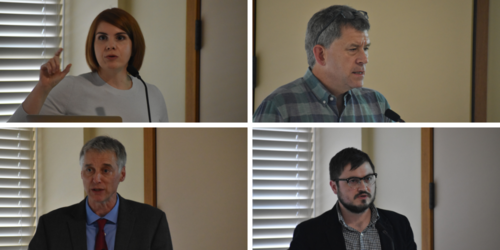
From top left, clockwise: Lauren Hansen Restrepo, James Millward,, Darren Byler and Gardner Bovingdon.
James Millward, professor of Inter-societal history at Georgetown University’s Walsh School of Foreign Service, reviewed the historical background for the PRC assault on non-Han or non-Chinese culture in Xinjiang. Beginning in the early 2000s, the assault has included the razing of old Kashgar; the discouraging and then illegalizing of Muslim symbols such as head gear, prayer, and fasting in Ramadan; the disappearance of Uyghur script; and the securitization of the province by using police patrol, surveillance technologies, facial recognition, and biodata monitoring. The PRC hasn’t applied a single, top-down ethnic policy in Xinjiang, said Millward, but rather has rolled out different tactics it experimented with on local levels in different areas.
Lauren Hansen Restrepo, assistant professor in growth and structure of cities at Bryn Mawr College and an expert on Chinese development planning and urbanization in Xinjiang, explained how we got to the current crisis in the region by connecting seemingly disparate phenomena. She described the shifts in state power in Xinjiang and how, since 2014, “regional planning has broken every logic of urban planning in China,” resulting in the isolation and subordination of Uyghur-dominated urban centers and in the ossification of cities, as control has been seized from local governments and given to socialist land masters.
Anthropologist Darren Byler, whose research focuses on Uyghur dispossession and "terror capitalism" in the city of Ürümchi, the capital of Xinjiang, explained how, amid mass migration of Han people into the resource-rich region, Uyghurs had mostly been excluded from the new economy and how their identity as contemporary Muslims supported a vibrant public sphere not controlled by the state. The Chinese state, in turn, has merged Islamism with radicalism extremism. From the Chinese state and industry perspective, Byler said, the repression of Xinjiang’s Muslims promises stability and the detention camps are used as carriers of economy and new sources of cheap labor.
Indiana University’s Gardner Bovingdon, whose research focuses on politics in contemporary Xinjiang and the region’s modern history, reverted to the question of how we got to the current crisis, which he characterized as “one of the great state-engineered human rights disasters of our time.” He argued that, in the case of Xinjiang, the Chinese party transported and exacerbated a set of policies that had previously been applied to dealing with the Tibet problem. These policies, Bovingdon suggested, “are signs of a flailing, terrified party that doesn’t know what to do with Uighurs, but also feels no constraints from the international community on its behavior. And so the biggest problem now is to find a way to put constraints on a system that has operated untrammeled with devastating consequences.”
The panel "Xinjiang’s Muslims and the PRC" was cosponsored with the Center for Democracy, Development and the Rule of Law.
Hero Image
Clockwise from upper left: Relatives of alleged extrajudicial killings wear veils as they take part in a protest versus the drug war killings outside the military and police headquarters on July 17, 2019 in Manila, Philippines (Photo credit: Ezra Acayan/Getty Image); Workers pass propaganda posters as they cycle through Hungnam Fertilizer Complex on February 4, 2019 in Hamhung, North Korea (Photo credit: Carl Court/Getty Images); Pro-democracy protesters react as police fire tear gas during a demonstration on October 20, 2019 in Hong Kong (photo credit: Anthony Kwan/Getty Images); A mix of ethnic Uyghur and Han shopkeepers hold large wooden sticks as they are trained in security measures on June 27, 2017 next to the old town of Kashgar, in the far western Xinjiang province, China (photo credit: Kevin Frayer/Getty Images).

 FSI researchers work to understand continuity and change in societies as they confront their problems and opportunities. This includes the implications of