
Society

FSI researchers work to understand continuity and change in societies as they confront their problems and opportunities. This includes the implications of migration and human trafficking. What happens to a society when young girls exit the sex trade? How do groups moving between locations impact societies, economies, self-identity and citizenship? What are the ethnic challenges faced by an increasingly diverse European Union? From a policy perspective, scholars also work to investigate the consequences of security-related measures for society and its values.
The Europe Center reflects much of FSI’s agenda of investigating societies, serving as a forum for experts to research the cultures, religions and people of Europe. The Center sponsors several seminars and lectures, as well as visiting scholars.

Societal research also addresses issues of demography and aging, such as the social and economic challenges of providing health care for an aging population. How do older adults make decisions, and what societal tools need to be in place to ensure the resulting decisions are well-informed? FSI regularly brings in international scholars to look at these issues. They discuss how adults care for their older parents in rural China as well as the economic aspects of aging populations in China and India.

-

This event is co-sponsored with The Europe Center

Abstract:

Ruby Gropas is a lecturer in international relations at the law faculty of the Democritus University of Thrace (Komotini) and research fellow at the Hellenic Foundation for European and Foreign Policy (ELIAMEP). Gropas was in residence at CDDRL in 2011 as a visiting scholar. In this seminar she will discuss the ongoing Greek economic and political crisis, and what it means for the future of the European Union and monetary system. Is the crisis in Greece ‘internal’ or is it symptomatic of a wider European failure? Is the Greek crisis the result of failed modernity, or rather a precursor of things to come? Why has Greece become so important and why has it dominated global politics and world news for the past two years?  Are its malignancies purely domestic or are they representative of a wider malaise within Europe and possibly beyond? The collapse and orderly default of a eurozone country at the heart of the Western financial system arguably marks the end of an era. It has brought with it the deepest social and political crisis that modern Greecehas faced since the restoration of democracy and it has also led to Europe's deepest existential crisis. With the EU struggling to effectively managing the eurozone crisis and the burst of recent movements opposing neo-liberal orthodoxy and the “Occupy” movements – what does this mean for Europe? And what is next?

Speaker Bio: 

Ruby Gropas has worked on asylum and migration issues for UNHCR in Brussels and worked for McKinsey & Co. in Zurich and Athens (2000-2002). As part of the ELIAMEP team, her research concentrates on European integration and foreign policy, Transatlantic relations, human rights, migration and multiculturalism. She was Managing Editor of the Journal of Southeast European and Black Sea Studies (Taylor & Francis) between January 2006 and October 2009. Ruby has taught at the University of Athens and at College Year in Athens. She was Southeast Europe Policy Scholar at the Woodrow Wilson International Center for Scholars in Washington DC in 2007 and again in 2009. She is Vice-President of the Alexander S. Onassis Public Benefit Foundation Scholars' Association since June 2009, and was Member of the Academic Organisation Committee of the Global Forum for Migration and Development, Civil Society Days, Athens 2009.

Ruby studied Political Science at the Université Libre de Bruxelles (1994) and undertook graduate studies at the University of Leuven (MA in European Studies) and at Cambridge University (MPhil in International Relations). She holds a PhD in History from Cambridge University (New Hall, 2000).

Encina Ground Floor Conference Room

Encina Hall
Stanford, CA 94305-6055

0
R_Gropas.jpg PhD

Ruby Gropas is Lecturer in International Relations at the Law Faculty of the Democritus University of Thrace (Komotini) and Research Fellow at the Hellenic Foundation for European and Foreign Policy (ELIAMEP).

Ruby has worked on asylum and migration issues for UNHCR in Brussels and worked for McKinsey & Co. in Zurich and Athens (2000-2002). As part of the ELIAMEP team, her research concentrates on European integration and foreign policy, Transatlantic relations, human rights, migration and multiculturalism. She was Managing Editor of the Journal of Southeast European and Black Sea Studies (Taylor & Francis) between January 2006 and October 2009. Ruby has taught at the University of Athens and at College Year in Athens. She was Southeast Europe Policy Scholar at the Woodrow Wilson International Center for Scholars in Washington DC in 2007 and again in 2009. She is Vice-President of the Alexander S. Onassis Public Benefit Foundation Scholars' Association since June 2009, and was Member of the Academic Organisation Committee of the Global Forum for Migration and Development, Civil Society Days, Athens 2009.

Ruby studied Political Science at the Université Libre de Bruxelles (1994) and undertook graduate studies at the University of Leuven (MA in European Studies) and at Cambridge University (MPhil in International Relations). She holds a PhD in History from Cambridge University (New Hall, 2000).

CV
Ruby Gropas Lecturer in International Relations at the Law Faculty of the Speaker Democritus University of Thrance (Komotini)
Seminars
Authors
News Type
Q&As
Date
Paragraphs

A Wake-up Call for America: We Must Connect with the World

Former U.S. Sen. Russ Feingold, currently the Mimi and Peter E. Haas Distinguished Visitor at Stanford’s Haas Center for Public Service, uses an anecdote in his new book, While America Sleeps: A Wake-up Call for the Post-9/11 Era, to illustrate his concern that Americans have become too insular as a result of the 2001 terrorist attacks. While teaching at Marquette University Law School during the Arab Spring of last year, an undergraduate penned a column lamenting that so many students not only could not find Tunisia on the map – they could spell Kardashian before Kazakhstan.

Feingold writes that he admired this student for his confession about his lack of knowledge on global affairs, then quotes the final thought of the young columnist: “We are connected to the rest of the world in ways few of us can fully fathom, from the shoes we wear and coffee we drink to the cell phones we carry and the tweets we post.”

In a recent interview, CISAC Co-Director Mariano-Florentino Cuéllar and Feingold discuss steps to be taken to ensure that all Americans – young and old, inside the Washington beltway and out on the farm in Wisconsin – take a patriotic stand by engaging with the world to restore our national unity and regain global respect.    

Senator Feingold, what prompted you to write this book now?

Feingold: For me, as for many Americans, 9/11 was a life-changing event, the wake-up call in which we all understood that we no longer could be safe just assuming the world would take care of itself. We got misdirected with things like Iraq and we developed this sort of invade-one-country-at-a-time approach. There was also exploitation of the fears from 9/11 for domestic agendas, from the Patriot Act to the way that Muslims and Arabs are treated in this country. And then, finally, with the rise of the tea party, I feel like we went back to sleep. But there are signals all over the place, of the continued presence of al-Qaida and the continued potency of al-Qaida, not to mention so many other trends from the Chinese influence in Africa to the Iranian influence in Latin America. We aren’t connecting as a government or as a people in a way that I think is commensurate with our place in the 21st century. I’m trying to issue a warning that we’re going to get fooled or surprised again if we think we can just go back to being just sort of safely over here across the oceans. That’s just not the world anymore.

So how do you wake up Americans and make them realize we cannot, as you say, survive as a nation without being active and aware of global events and trends? 

Feingold: It’s at all levels. I happen to think we have a good president and I think he’s going to be a great president by the end of his second term. And I think he’s started the process of alerting Americans to the need to connect to all places in the world; he’s leading us toward a global vision of the kind that I think we have to have to be safe and to be competitively successful and to be well perceived by the rest of the world. The president and other leaders should call on each of us to try and become citizen diplomats. Three hundred million people should be urged as part of their patriotic duty not just to go to the moon as we once were, but go to the rest of the world. This isn’t Pollyanna; this is about being safe. I don’t think this country is geared up to make that connection and I think it’s a fatal flaw. The Russians, the Chinese and the Iranians, they’re all over the world and they have a plan for what they’re doing. We don’t.

What do you see as the most pressing global security issues today?

Cuéllar:  The United States is confronting a changing world, where countries like India, Brazil, and China are evolving and assuming greater importance. Engaging these countries to address problems like nuclear proliferation will be critical in the years ahead.  The world also faces a persistent problem involving failed or failing states. In places like Somalia, piracy is not only a regional problem in the Gulf of Aden.  The problem is an example of how threats can affect multiple countries and impact flows of commodities, disrupting the rule of law, highlighting the challenges of governing common resources such as international sea lanes. Another challenge is the enormous potential of technology to change people’s lives for the better, coupled with risks that arise which we are only in a very imperfect and incomplete way managing; risks of vulnerabilities in our infrastructure; risks of theft of intellectual property, risks of disruption of organizations.

Feingold: I like this answer because Prof. Cuéllar did not just say, “Well, it’s Russia and Iran and Colombia.” There’s this tendency to just speak of countries. We’re just trained to say, “OK what’s the hot spot and let’s just worry about that.” Like right now it’s Iran; a few months ago it was Yemen. In my book what I’m trying to point out is that you have to look at trends and overall tendencies around the world and somehow we have to have the capacity to deal with more than one thing at a time.

Senator Feingold, you called the Bush Administration’s terrorist surveillance program – the wiretapping and surveillance of emails and financial records without court approval – one of the worst assaults on the Constitution in American history. How does the government protect our constitutional rights to privacy and probable cause while monitoring criminal and terrorist networks in a digital age?

Feingold: The assault on the Constitutional by the administration was not about whether we could do those things, its whether or not the president would basically make up his own laws just because we’re in a crisis. That to me is completely unconstitutional. We understand that a president might have to take emergency action and he may have to come to Congress and say, you know I did this, it may be beyond the law, would you please pass a law to approve it, or I’ll stop doing it. That’s not what Bush did. Bush hid it. Bush hid what he was doing on torture; Bush hid what he was doing on wiretapping. That’s a very dangerous thing that completely saps our strength from within and is completely unnecessary to stop the terrorists.

Cuéllar: The challenge of living up to our constitutional values while we secure the country is always critical. It requires organizations that can learn from their mistakes to be honest with each other enough and recognize when they have overstepped their bounds, that make good use of entities like inspectors-general, that leverage the ability of Congress to do oversight. These are all elements of making our constitutional values relevant. So me the challenge has always been how to you leverage all the information technology and all our ability to make smart, thoughtful, careful decisions – including decisions that do permit appropriate degrees of surveillance and intelligence – in order to avoid superficial reactions against individuals who simply appear threatening.

What key steps should the U.S. government take to improve its counter-terrorism efforts both at home and abroad?

Feingold: The first thing is to recognize the nature of the threat. One of the chapters in the book is called A Game of Risk, where we seem to think the way to counter terrorism is to invade a country and stay there forever and say we have to stay there or the terrorist are going to come back. But this isn’t the nature of al-Qaida or similar organizations. President Bush used to say there were 60 countries where al-Qaida was operating and, of course, one thing that was embarrassing about it was that Iraq wasn’t one of them. But we’re still in this place today. Al-Shabab in Somalia; al-Qaida and the Islamic Maghreb in northern Africa; a group called Boko Haram in Nigeria, which looks very much like an al-Qaida group, has pulled off some 70 attacks in the last year. So this is an international organization that communicates with each other and they’re not done just because Osama bin Laden is gone. So let’s not get caught unawares again.

Senator Feingold, what was your most memorable, defining challenge in Congress and how did that change the way you see yourself and the world around you?

It had to do with recognizing when 9/11 occurred that there really was a group of people out there who would love to kill all of us and, despite the fact that I’m progressive and I voted against most military interventions, just saying to myself: look, there are times when threats are real. And it caused me to actually seek to be on the Intelligence Committee which is something I never wanted to do; I was not sure of the importance of intelligence in the post Cold War era and it was a real change for me. I remember having an emotional response, saying, “You know what? This is real; what these folks did was real and they have intimidated an entire country if not the world.” I wanted to know everything I could about how they came to be and what they were planning next, and to be a person who could try to think ahead for other kinds of threats so we as Americans can get ahead of threats instead of being the people who are reacting.


All News button
1

Center for Chinese Agricultural Policy,
Chinese Academy of Sciences
Room 3830, Anwai Datun Road, 11A
Beijing, 100101, P. R. China

0
REAP Project Manager for Keeping Kids in School
JC_REAP.jpg MA

James Chu manages the Keeping Kids in School projects at REAP. He has five years of experience researching educational issues in China. His research experience involves extensive quantitative and qualitative fieldwork in Shaanxi province and Beijing migrant schools. He has also designed and implemented several projects in Beijing benefiting migrant students. He is fluent in Mandarin and received his MA in Sociology at Stanford University.

Authors
Scott Rozelle
Karen Eggleston
Jean C. Oi
Xueguang Zhou
Ang Sun
News Type
News
Date
Paragraphs

Full text available at YaleGlobal.

Children of China's Future – Part II

 
Aging population and poverty require stronger investment in China’s rural youth
Karen Eggleston, Jean Oi, Scott Rozelle, Ang Sun, Xueguang Zhou
YaleGlobal, 14 March 2012
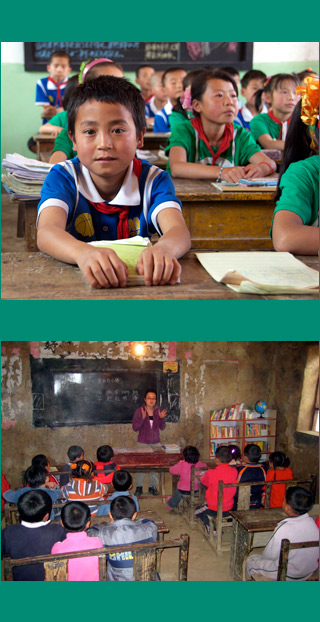
Poor education mortgaging the future? Students in a Gansu province school, where many are anemic (top); another class room in Loess Plateau. (Top Photo: Adam Gorlick)

DINGXI PREFECTURE: Wang Hongli, 8 years old, lives in a remote rural village on the Loess Plateau in one of China’s poorest and most agricultural provinces, Gansu. His prospects for living the good life are as bleak as the landscape. He is not on track to become part of China’s emerging middle class, the free-spending, computer-savvy, person-of-the-world often featured in the western media.

Hongli is a pseudonym. His parents work in a faraway industrial zone, coming home for only three weeks at Chinese New Year. His grandmother takes care of him and his siblings on the weekends, and during the week he lives in a dorm, three to a bed with 36 other students in an unheated room 4 by 4 meters.

Hongli suffers from iron-deficient anemia, but neither his family nor his teacher knows he is sick. Even if his anemia is discovered and treated by the researchers who have documented 30 percent anemia among children in poor rural areas, it likely will recur after he finishes the study, with furnished dietary supplements. Despite educational pamphlets, he’ll likely revert to a diet of staple grains and bits of pickled vegetables.

Unsurprisingly, Hongli’s grades are not good. In China’s competitive school system, he has only a slight chance of attending high school, much less college. In China’s future high-wage economy, all Hongli can hope for is a menial job in the provincial capital, Lanzhou, or as a temporary migrant elsewhere. Without urban permanent residency, hukou, he will have limited access to urban social services. He may suffer chronic unemployment, or resort to the gray economy or crime. He also may never marry – one of the millions of “forced bachelors” created by China’s large gender imbalance.

In China’s future high-wage economy, 
all the rural poor can hope for is menial jobs in a provincial capital.

Hongli is not alone. In fact, he’s one of 50 million school-age youth in China’s vast poor rural hinterlands. Recent studies by Stanford and Chinese collaborators show that 39 percent of fourth-grade students in Shaanxi Province are anemic, with similarly high rates elsewhere in the northwest; up to 40 percent of rural children in the poor southwest regions, e.g., Guizhou, are infected with intestinal worms. Millions of poor rural students throughout China are nearsighted, but do not wear glasses.

Because China’s urbanites have fewer children, poor rural kids like Hongli represent almost a third of China’s school-aged children, a large share of the future labor force. These young people must be healthy, educated and productive if China is to have any chance of increasing labor productivity to offset the shrinking size of its aging workforce.

Many observers presume that China’s growth will continue unabated, drawing upon a vast reservoir of rural labor to staff manufacturing plants for the world. In fact, to a considerable extent, China’s rural areas have already been emptied out, leaving many villages with only the old and the very young. The growth of wages for unskilled workers exceeds GDP growth.

Better pay should be good news for poverty alleviation. However, rising wages push up the opportunity cost of staying in school – especially since high school fees, even at rural public schools, are among the highest in the world.

It’s myopic to allow rural students to drop out of junior high and high school – mitigating the current labor shortage, but mortgaging their futures. Recent studies demonstrate that eliminating high school tuition – or reducing the financial burden on poor households – improves junior high achievement and significantly increases continuation on to high school. Yet unlike many other developing countries, China does not use incentives to keep children in school, such as conditional cash transfers. The public health and educational bureaucracies also do not proactively cooperate to remedy nutritional and medical problems – including mental health – that school-based interventions could address cost effectively.

Less than half of youth in China’s poor rural areas go to academic high school; less than 10 percent head to college.

The educational system, based on rote memory and drill, doesn’t teach children how to learn. The vocational education system is ineffective. Instead, China’s schools tend to focus resources on elite students. Tracking starts early, and test scores are often the sole criterion for success. A recent comparative study documents that China’s digital divide, with lower access to computers in poor rural areas, is among the widest in the world.

China’s government is increasing expenditures for school facilities and raising teacher salaries. However, these steps are far from adequate. During South Korea’s high growth, almost all Korean students finished high school. Today, less than half of youth in China’s poor rural areas go to academic high school, and the percent going to college remains in the single digits.

Greater investment in public health and education for the young people in China’s poor rural areas is urgent. If the government waits 10 years, it may be too late to avert risks for China’s stability and sustained economic growth.

Surely China could easily address this problem? A third of Chinese were illiterate in the early 1960s; now, fewer than 5 percent are. By 2010, about 120 million Chinese had completed a college degree. Chinese also enjoy a relatively long life expectancy compared to India and many other developing countries, and basic health insurance coverage is almost universal.

But the pace of change and citizens’ expectations are higher as well. Most Chinese assume that basic nutritional problems and intestinal worms were eradicated in the Mao era. China’s mortality halved in the 1950s; fertility halved in the 1970s. As a result, China will get old before it gets rich. Population aging, rapid urbanization and a large gender imbalance represent intertwined demographic challenges to social and economic governance. The policy options are complicated, the constraints significant, the risks of missteps real and ever-present.

China’s prosperity depends on youth mastering skills to thrive in a technology-driven world.

Timely policy response is complicated by competition for resources – pensions, long-term care, medical care for the elderly and more – as well as significant governance challenges arising from a countryside drained of young people. The well-intentioned programs for what government regards a “harmonious society” create large unfunded mandates for local authorities. Attempts to relocate rural residents to new, denser communities provoke anger at being uprooted and skepticism that local authorities simply want to expropriate land for development.

Millions of migrant workers – like Wang Hongli’s parents – return to their rural homes during economic downturns. Urbanization weakens this capacity to absorb future economic fluctuations. Government efforts at “social management” – strengthening regulatory control of informal social groups and strategies for diffusing social tensions – expand the bureaucratic state, a central target of popular discontent.

Premier Wen Jiabao’s announcement of a 7.5 percent growth target – the lowest in two decades – has been expected. Future economic growth will moderate partly because of demographics, but mostly because productivity gains slow as an economy runs out of surplus rural labor and converges on the technological frontier. Costly upgrading of industrial structure will squeeze the government’s ability to deliver on its promise of a better future for all, stoking social tensions.

China’s stability and prosperity, and that of the region and the globe, depends on how well today’s youth master the knowledge and skills that enable them to thrive in the technology-driven globalized world of the mid-21st century. Resilient public and private sector leaders of the future must be able to think creatively. Therefore, China’s government should respond to population aging by acting now to invest more in the health and education of youth, especially the rural poor.


Hero Image
5734696609 a3b10b4c8f z
All News button
1
-

Please join the Stanford Baha'i Club, in collaboration with the Center on Democracy, Development, and the Rule of Law; the Center on Philanthrophy and Civil Society, Stanford Amnesty International, Stanford Six Degrees in defending Article 26 of the UN's Universal Declaration of Human Rights on

Friday, April 6 from 7:00-9:00pm

We will be screening Education Under Fire, a moving documentary about this issue. Following the screening, we will be having a panel discussion.

Imagine you are sitting in class at Stanford University when armed guards come into the classroom and arrest everyone in your class. Your professor is sentenced to five years in prison; you are expelled not only from Stanford, but from any institution of higher education in the country. Your crime? Gaining a higher education. Your professor’s crime? Providing higher education. Fortunately, this is not happening today at Stanford, but it is happening right now to many young people in Iran.

Since its inception, the Baha’i community of Iran has been suffering different forms of human rights violations, from intense persecution to being denied employment, the ability to bury their dead, access to higher education. Their crime? Being a Baha’i. The Bahá'í Institute for Higher Education (BIHE) was founded in 1987 in response to the Iranian government's continuing campaign to deny Iranian Bahá'ís access to higher education. The need to create a new university for those who were denied access to higher education captivated the talents and minds of exceptional faculty and staff from within Iran and abroad. For twenty years they have dedicated their efforts to building an exemplary institution and cultivating a student body prepared for fulfilling careers, future study, and social responsibility. But this has come with constant struggles and limited resources. In May 2011, the government launched a coordinated attack against the BIHE–raiding dozens of homes, confiscating computers and materials and detaining eighteen professors and administrators. Seven of those arrested received four or five-year prison terms. Their only crime: educating the youth in their community.

We also have a facebook event here - http://www.facebook.com/events/291432670928509/


CEMEX AUDITORIUM, Stanford

Conferences
-

Abstract:

Tamara Cofman Wittes, who helped manage the State Department's response to the Arab Awakening and now directs the Saban Center for Middle East Policy at the Brookings Institution, will reflect on the US government's reactions to the dramatic change underway in the Arab world -- how the Obama Administration viewed the uprisings, and how its policy evolved over time as different cases emerged from Tunisia to Libya and Syria. What were the key concerns shaping the US policy response to events? How much difference did American policy make to outcomes on the ground? And, given the complex variety of outcomes now visible in the region, where is American policy toward Arab political change headed over time? 

Speaker Bio:

Tamara Cofman Wittes directs the Middle East Democracy and Development (MEDD) Project at the Saban Center for Middle East Policy, a regional policy center at The Brookings Institution. The MEDD Project conducts research into political and economic reform in the region and US efforts to promote democracy there. It also hosts visiting fellows from the Middle East.


Before joining the Saban Center in December 2003, Dr. Wittes served as Middle East specialist at the US Institute of Peace and previously as director of programs at the Middle East Institute in Washington. She has also taught courses in International Relations and Security Studies at Georgetown University. Dr. Wittes was one of the first recipients of the Rabin-Peres Peace Award, established by President Bill Clinton in 1997.

 
Dr. Wittes’s latest book is Freedom’s Unsteady March: America’s Role in Building Arab Democracy (Brookings Press). She is also editor of How Israelis and Palestinians Negotiate: A Cross-Cultural Analysis of the Oslo Peace Process (USIP, 2005). Her recent work includes “What Price Freedom? Assessing the Bush Administration’s Freedom Agenda,” and “Back to Balancing in the Middle East,” co-authored with Martin Indyk.

 Her analyses of US democracy promotion, Arab politics, the Middle East peace process, and other policy topics have been published in the Washington Post, Policy Review, Political Science Quarterly, the American Interest, the Weekly Standard, and the Chronicle of Higher Education, among others. Dr. Wittes holds a B.A. in Judaic and Near Eastern Studies from Oberlin College; her M.A. and Ph.D. in Government are from Georgetown University. She is a member of the Council on Foreign Relations.

CISAC Conference Room

Tamara Wittes Director, Middle East Democracy and Development (MEDD) Project Speaker Saban Center for Middle East Policy at the Brookings Institution
Seminars
-

 Abstract:

Systemic corruption undermines state capacity, imperils socio-economic development, and diminishes democracy. In his Nairobi speech as a U.S. senator in August 2006, Barack Obama described the struggle to reduce corruption as "the fight of our time". An international conference in Lagos, Nigeria, in September 2011 was devoted to Richard Joseph's influential 1987 book, Democracy and Prebendal Politics in Nigeria: The Rise and Fall of the Second Republic.Transforming prebendalist systems must be at the center of strategies to strengthen democracy and achieve poverty-reducing economic growth in Africa and other regions.

 Speaker Bio: 

Richard Joseph is John Evans Professor of International History and Politics at Northwestern University and Non resident Senior Fellow in Global Economy and Development at the Brookings Institution. As a Fellow of The Carter Center, he participated in democracy and peace initiatives in Ghana, Zambia, Ethiopia, Liberiaand Sudan. He has written extensively on issues of democracy, governance and political economy. His books include Radical Nationalism in Cameroun (1977), Democracy and Prebendal Politics in Nigeria (1987) and edited books, Gaullist Africa: Cameroon under Ahmadu Ahidjo (1978), State, Conflict and Democracy in Africa (1999), and (with Alexandra Gillies), Smart Aid for African Development (2009). He served as Principal Investigator of the Research Alliance to Combat HIV/AIDS (REACH), a collaborative program in Nigeria, 2006–2011. His current writing and policy projects concern growth, democracy and security. To address these issues, he is designing a collaborative project, AfricaPlus (http://africaplus.wordpress.com/), whose first focus country is Nigeria.

Here is the link to Richard Joseph remarks and the PowerPoint for the talk.

http://africaplus.wordpress.com/author/africaplus/

CISAC Conference Room

Richard Joseph John Evans Professor of International History and Politics Speaker Northwestern University
Seminars
News Type
News
Date
Paragraphs

“A postdoctoral program is crucial to the intellectual development of any strong academic institution. I am proud the Shorenstein Asia-Pacific Research Center will serve as a home next year for these four talented emerging Asia scholars. Not only will they benefit from taking part in our vibrant research and publishing activities, but they will also bring new expertise and perspectives to our Center.”

-Gi-Wook Shin, Director, Shorenstein APARC

 
In the coming academic year, the Shorenstein Postdoctoral Fellowship program will double in size.

The four incoming fellows represent the best of the next generation of contemporary Asia scholars. Their research ranges from civil society and authoritarian governance in China to ethnic conflict in South Asia, and Korean migration and identity to election politics in Japan.

During their time at the Shorenstein Asia-Pacific Research Center (Shorenstein APARC), the fellows will conduct their own research and writing, present their work at public seminars, and take part in the research and publishing activities of the Center. Postdoctoral fellows will also have the chance to exchange ideas with Shorenstein APARC experts and interact with the many distinguished visitors who visit each year from throughout the Asia-Pacific region.

In addition, the Asia Health Policy Program at Shorenstein APARC will welcome two postdoctoral fellows in the 2012–13 academic year: an Asia Health Policy Fellow and a Developing Asia Fellow.

Postdoctoral fellows are a vital part of the academic life of the Center, and their relationships with Shorenstein APARC will continue throughout their entire careers.

The Shorenstein Postdoctoral Fellowship Program is made possible through the generosity of Walter H. Shorenstein.

“This fellowship has changed the trajectory of my academic career. It has given me the intellectual space to be highly productive and the freedom to expand my understanding of world events in order to enhance my future teaching and research. Thanks in large part to the fellowship, I was able to obtain an appointment as an assistant professor in the Department of International Relations at Boston University.”

-Jeremy Menchik, 2011–12 Shorenstein Postdoctoral Fellow


2012–13 Shorenstein PostDoctoral Fellows

Image
Diana Fu

Diana Fu will be joining Shorenstein APARC from Oxford University’s Department of Politics and International Relations, and from the Massachusetts Institute of Technology where she recently served as a political science research fellow. Her research interests encompass state-society relations in authoritarian regimes, civil society, governance, and labor contention. She will be completing a series of journal articles about civil society and authoritarian governance in China. Fu holds an MPhil in international development from Oxford University where she studied as a Rhodes Scholar, and a BA in global studies and political science from the University of Minnesota.

Image
Jaeeun Kim
Jaeeun Kim is a postdoctoral research associate at the Center for the Study of Religion at Princeton University. She is interested in issues of identity within the context of international migration, which she explores in her dissertation Colonial Migration and Transborder Membership Politics in Twentieth-Century Korea. She is also developing a project focusing on ethnic Korean migrants from northeast China to the United States, including issues such as legalization strategies and conversion patterns. Kim holds an MA and a PhD in sociology from the University of California, Los Angeles, and a BA in law from Seoul National University.

Image
Daniel M. Smith
Daniel M. Smith, a PhD candidate with the Department of Political Science at the University of California, San Diego (UCSD), is completing his dissertation on the causes and consequences of political dynasties in developed democracies, with particular focus on Japan. He has conducted research in Japan as a Japanese Ministry of Education research scholar (2006–2007), and as a Fulbright dissertation research fellow (2010–2011). Smith holds an MA in political science from UCSD, and a BA in political science and Italian from the University of California, Los Angeles. After completing his fellowship at Shorenstein APARC, he will join the Department of Government at Harvard University as an assistant professor.

Image
Ajay Verghese
Ajay Verghese is a PhD candidate in the Department of Political Science at The George Washington University. His work focuses on comparative politics and international relations, and his research interests include South Asia, ethnicity, ethnic conflict, historical analysis, and qualitative methods. Verghese has conducted language training and fieldwork in India, with support from organizations such as the American Institute of Indian Studies and the U.S. State Department Critical Language Scholarship Program. He will be turning his dissertation into a book entitled The Colonial Origins of Ethnic Violence: India and the Indian Ocean Region. Verghese holds a BA in political science and French from Temple University.

Hero Image
EncinaSkyLOGO
Encina Hall, Stanford University campus | George Krompacky
All News button
1
-

More than two decades after the cold war ended elsewhere, it continues undiminished on the Korean Peninsula. The division of the Korean nation into competing North and South Korean states and the destructive war that followed gave rise to one of the great, and still unresolved, tragedies of the twentieth century.

Published for the first time in English, Peacemaker is the memoir of Lim Dong-won, former South Korean unification minister and architect of Nobel Peace Prize winner Kim Dae-jung’s Sunshine policy toward North Korea. Lim will present a talk at Stanford in conjunction with the book’s U.S. release, highlighting major themes from it and discussing them within the context of recent developments on the peninsula.

As both witness and participant, Peacemaker traces the process of twenty years of diplomatic negotiations with North Korea, from the earliest rounds of inter-Korean talks through the historic inter-Korean summit of June 2000 and beyond. It offers a fascinating inside look into the recent history of North-South Korea relations and provides important lessons for policymakers and citizens who seek to understand and resolve the tragic—and increasingly dangerous—situation on the Korean Peninsula.

About the Speaker

Following a thirty-year career in the South Korean military, Lim Dong-won’s government service began with his tenure as ROK ambassador to Nigeria and then Australia; under the Roh Tae-woo administration, he served as chancellor of the Institute of Foreign Affairs and National Security and director of arms control planning. During the Kim Dae-jung administration Lim held numerous key national-level posts, including head of the National Intelligence Service and minister of unification. He currently is chairman of the Korea Peace Forum and the Hankyoreh Foundation for Reunification and Culture.

This event is made possible by the generous support from the Koret Foundation.

Philippines Conference Room

Dong-won Lim former Minister of Unification, South Korea Speaker
Seminars
Subscribe to Society