Society

FSI researchers work to understand continuity and change in societies as they confront their problems and opportunities. This includes the implications of migration and human trafficking. What happens to a society when young girls exit the sex trade? How do groups moving between locations impact societies, economies, self-identity and citizenship? What are the ethnic challenges faced by an increasingly diverse European Union? From a policy perspective, scholars also work to investigate the consequences of security-related measures for society and its values.

The Europe Center reflects much of FSI’s agenda of investigating societies, serving as a forum for experts to research the cultures, religions and people of Europe. The Center sponsors several seminars and lectures, as well as visiting scholars.

Societal research also addresses issues of demography and aging, such as the social and economic challenges of providing health care for an aging population. How do older adults make decisions, and what societal tools need to be in place to ensure the resulting decisions are well-informed? FSI regularly brings in international scholars to look at these issues. They discuss how adults care for their older parents in rural China as well as the economic aspects of aging populations in China and India.

Authors
News Type
News
Date
Paragraphs

Lili Li, Program Coordinator at SCPKU, spoke with Graduate School of Business Assistant Professor Szu-Chi Huang about her research and the contributions SCPKU made to her research in China.

Q: How did your interest in consumer behavior and motivation develop?

Szu-Chi Huang: After receiving my undergraduate degrees in Business and in Financial Law from National Taiwan University, I pursued a career in advertising. While I enjoyed early success in the advertising industry, I found many managerial decisions puzzling. There are many things we don't know about consumers, such as what motivates them to make a purchase, to pursue a goal, to make donations etc. Therefore, after a few years working in the industry, I decided to pursue a PhD degree and conduct research to answer my questions related to consumer behavior and motivation.

Q: Could you give us a brief introduction to your research on “motivation in different stages of goal pursuit”?

Szu-Chi Huang: Through various projects, my collaborators and I examine the changes in the determinants of consumer motivation in different stages of goal pursuit and their impact on consumers' behaviors. When people first begin to pursue a goal, they are less certain about how to approach the goal and whether they can even attain the goal; however, after they have made a significant amount of progress and are getting near the end point of the pursuit, these uncertainties are alleviated, and they focus more on reducing the remaining discrepancy to attain the goal in a timely manner. Because of this switch in people's concerns during the course of goal pursuit, people are in turn motivated by different types of feedback and interact differently as they move from early stages to later stages of the pursuit.


Q: How does understanding motivation change help the motivators and consumers?

Szu-Chi Huang: Our findings provide valuable insights for marketers and organizations that aim to motivate consumers. By choosing the appropriate goal structure for consumers, providing relevant feedback that answers their concerns at the moment, and implementing relevant social infrastructures, organizations can continue to motivate consumers as they advance across various stages of goal pursuit.

Q: In what field/areas do you anticipate seeing the most impact from your research?

Szu-Chi Huang: Our work has important implications for rewards programs and loyalty programs, pro-social events (donation drives, fundraising), and joint goal pursuit programs such as weight-loss programs and smoke-cessation programs.

Q: Describe your research and its connection to China?

Szu-Chi Huang: My research focuses on what motivates people to pursue their goals. I conducted field study in a Chinese dining hall to capture people's food consumption behaviors. I've also collected charity data from China. We found that what motivates people from different cultures may be different -- while Chinese people may be more motivated by temporal impact such as leaving a legacy, US donors are more motivated by scale-based impact. In addition, we suspect that they are motivated to eat different types of "healthy" food, as defined by culture; we are still analyzing the data for this part.

Q: Why did you decide to apply for an SCPKU Faculty Fellowship?

Szu-Chi Huang: I wanted to collect data in China, and also start building collaborative relationships with scholars in China.
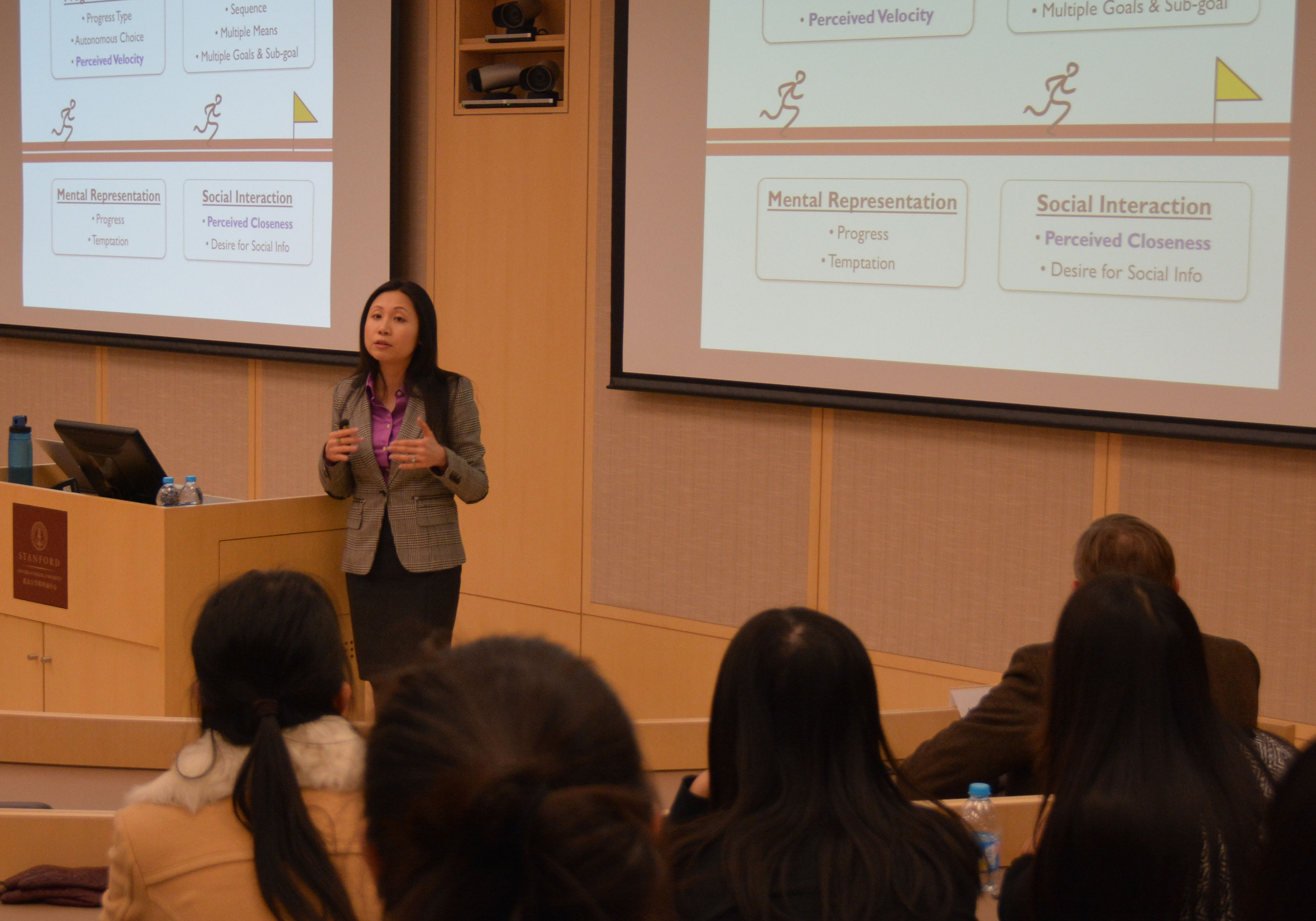
Professor Huang's presentation at SCPKU (Photo courtesy of Lili Li)

Q: How valuable was SCPKU's team in supporting your fellowship at SCPKU?

Szu-Chi Huang: Extremely valuable - they provided a nice office equipped with great IT as well as research and staff supports. Also, I had the opportunity to interact with faculty from other departments for collaborations.

Q: What were your fellowship objectives and were they met?

Szu-Chi Huang: My fellowship objectives were to conduct research and collaborate with scholars in China -- they are all successfully realized. SCPKU helped me achieve my objectives by providing facilities and support, but also giving me the flexibility to visit other departments (e.g., the management school) and work with the scholars there as well as in other schools.

Q: What did you learn during your stay and what were the most interesting experiences you had?

Szu-Chi Huang: My stay was wonderful. Chinese scholars are extremely productive and have great connections with the industry for field data. Also, the business environment in China is very different from the US -- it has its own infrastructure and culture. I would encourage my students to visit China and observe these differences themselves. This experience also inspired me to start developing a course that could capture and communicate these important insights and differences.

Q: List at least THREE words that come to mind which best describe your experience at SCPKU.

Szu-Chi Huang: Unique, creative, productive.

Q: Any future plans in China?

Szu-Chi Huang: I'd like to visit again in summer as well as next year, to further cultivate the research relationships I've built during this trip.

Hero Image
szu chi huang headshot
Stanford University
All News button
1
News Type
News
Date
Paragraphs

Rennie J. Moon has been selected as the 2016-17 Koret Fellow in the Korea Program at Stanford’s Shorenstein Asia-Pacific Research Center (APARC). She will join the center next January to study diversity in higher education and teach a student course.

Image
rennie moon

Moon is an associate professor at the Underwood International College at Yonsei University in Seoul, South Korea. Her research explores the interrelationships among globalization, migration and citizenship, and internationalization of higher education.

Moon, a graduate of Stanford’s Graduate School of Education, Ph.D. ‘09, has collaborated with Stanford professor Gi-Wook Shin on a multiyear research project that examines diversity in higher education in East Asia. She co-edited the book Internationalizing Higher Education in Korea: Challenges and Opportunities in Comparative Perspective published earlier this year.

Stanford professor Francisco O. Ramirez, an expert on international comparative education and sociology of education, recognized her scholarly contributions to the field.

“Moon is a creative contributor to the ‘world society perspective’ in the social sciences,” said Ramirez, noting that Moon's work has been published in leading journals of international comparative education, Comparative Education Review and Comparative Education.

Supported by the Koret Foundation, the Koret Fellowship brings professionals to Stanford to conduct research on contemporary Korean affairs. In 2015, the fellowship expanded its focus to include social, cultural and educational issues in North and South Korea, and aims to identify emerging scholars working on those areas.

During her fellowship, Moon will also give public talks and be a lead organizer of the Koret Workshop, an international conference held annually at Stanford.

“As an alum, I’m very pleased and excited to spend my sabbatical year at Stanford,” Moon said. “Over the last few years, I’ve been collaborating on various research projects with Professor Shin and other colleagues at APARC. I’m looking forward to a productive fellowship during which I hope to bring these evolving projects to fruition.”

Moon holds a doctorate and master’s degree in international comparative education from Stanford and a bachelor’s degree in French from Wellesley College.

Hero Image
rennie moon crop
All News button
1
-

Abstract:

Sunil Khilnani’s new book, Incarnations, tells India’s history through 50 biographical essays, ranging from the Buddha to a contemporary billionaire. Building on rich recent scholarship about Indian history and culture, Khilnani’s work ventures to integrate the fragmented character of disciplinary knowledge of India, and to suggest an alternative to both popular religious and secular nationalist accounts of India’s past. Recovering the stories of remarkable individuals, his talk will highlight experiments in living and radical, dissenting ideas as drivers of Indian history, and contend that many of India’s choices about its future depend on which historical lessons get drawn from its past.


Speaker Bio:

Sunil Khilnani is currently Avantha Professor and Director of the India Institute, established by him at King’s College London in 2011. From 2002 to 2011 he was Starr Foundation Professor and Director of South Asia Studies at the Nitze School of Advanced International Studies, Johns Hopkins University, in Washington D.C.; and before that, Professor of Politics at Birkbeck College, University of London. He received his BA and PhD from the University of Cambridge, and he has been a Fellow of Christ’s College Cambridge; the Woodrow Wilson International Center for Scholars; the Institute for Advanced Study in Berlin; and the American Academy in Berlin, as well as holding a Leverhulme Fellowship.

His publications include: Arguing Revolution: The Intellectual Left in Postwar France (Yale, 1993), The Idea of India (Penguin/FSG, 7th edn. 2016), and several collaborative volumes, including: Civil Society: History and Possibilities (Cambridge, 2000); NonAlignment 2.0: a Foreign Policy for India in the 21st Century (Penguin, 2013); An Indian Social Democracy (Academic, 2013); and Comparative Constitutionalism in South Asia (Oxford, 2013). His most recent book is Incarnations: A History of India in Fifty Lives (Penguin/FSG 2016), accompanied by his 50-part BBC radio and podcast and radio series.

Sunil Khilnani Avantha Professor and Director of the India Institute, King's College, London
Seminars
-

By 2050, two out of three people will live in cities worldwide. The addition of 2.5 billion urban dwellers requires cities to accommodate the needs of a rapidly growing population. As Chinese and American cities confront environmental problems, housing costs, congestion, and widening social inequity, the Stanford Human Cities Initiative (HCI) works to address these urgent issues by advancing a human-centered approach to cities in order to benefit the environment, economy, and society at large.


The Stanford Human Cities Initiative is an interdisciplinary effort based out of the Program on Urban Studies. Recognizing that cities are complex, the HCI works to cultivate a 21st-century century mindset and tools to address urban challenges. Drawing from rigorous methods from engineering, architecture, planning, and design, its mission is to combine these approaches and enable cities to reach their full potential beyond the siloed approach of one discipline. The HCI works simultaneously at the global and local scales to ensure that these approaches are complementary, while prioritizing human relationships and social inclusion.


Join Deland Chan and Kevin Hsu, co-founders of the Stanford Human Cities Initiative, in a conversation about the future of cities. They will discuss the framing of the “human city” and the benefits of an interdisciplinary and multi-sector approach. Learn how you can get involved with the Initiative’s efforts to engage departments from within and outside Stanford, as well as partnerships with international NGOs, community-based organizations, and the private sector.


The talk will follow student presentations from the International Urbanization Seminar, a Human Cities course offered in long-term collaboration with Tsinghua University.


Learn more about Stanford Human Cities Initiative

http://www.humancities.org


FOR REGISTRATION: Email: sanjiu39@stanford.edu; Tel: 10-62744163


Stanford Center at Peking University

The Lee Jung Sen Building, Langrun Yuan, Peking University

(Please bring a photo ID and enter Peking University through the NE Gate)


Lectures
-

Image
How do weak organizations engage in mobilization under duress? Based on ethnographic work inside labor organizations in China, this talk makes the case that in a repressive environment, civil society organizations can mobilize through a counter-intuitive mechanism. Instead of amassing the crowds to take to the streets, groups can mobilize without the masses. Rather than citizens forming groups in order to trigger larger-scale contention, they form groups in order to better contend as individuals or as small bands of the aggrieved. The clear advantage of this strategy is that it lowers the cost of activism in an authoritarian state. Because it is highly risky for civil society groups to organize large-scale contention, they must devise ways to work around this constraint. Civil society groups coach citizens to adopt a grammar of contention that effectively threatens local social stability and challenges the moral authority of officials. However, at the point of contention, these groups disperse. By sending out only a sole contender or a limited number of contenders to confront state authorities, organizations minimize their risk of being targeted by authorities.


Diana Fu is an assistant professor of Asian Politics at the University of Toronto. Her research examines the relationship between popular contention, state power, and civil society, with an emphasis on contemporary China. Her book manuscript, Mobilizing Without the Masses in China examines state control and civil society contention under authoritarian rule. Based on two years of ethnographic research that tracks the development of informal labor organizations, the book explores counterintuitive dynamics of organized contention in post-1989 China.  

Prior to joining the Univeristy of Toronto, Professor Fu was a Walter H. Shorenstein Postdoctoral Fellow at the Shorenstein Asia-Pacific Research Center, Stanford University and a Predoctoral Fellow at the Massachusetts Institute of Technology, Political Science. She holds a D.Phil. in Politics and an M.Phil. in Development Studies with distinction from Oxford University, where she studied as a Rhodes Scholar. 

Diana Fu <i>Assistant Professor, Department of Political Science, University of Toronto</i>
Seminars
News Type
News
Date
Paragraphs

The 12th annual Draper Hills Summer Fellows Program gathered 25 democracy leaders from around the developing world for a three-week training program on democracy, good governance, and the rule of law reform. Selected from a large pool of applicants, the fellows have diverse backgrounds across sectors and geographies, working in civil society, public service, social enterprise, media and technology.

Fellows were instructed by an all-star roster of Stanford scholars and policy experts, including former U.S. Secretary of State Condoleezza Rice; FSI Director and former U.S. Ambassador to Russia Michael McFaul; CDDRL Mosbacher Director Francis Fukuyama and Larry Diamond, senior fellow at the Freeman Spogli Institute for International Studies. Fellows also met industry leaders such as Eric Schmidt of Google, democracy leaders such as Carl Gershman of the National Endowment for Democracy and others. During the program, they shared their personal stories about the struggle in their home countries, but also stories of their fight for justice, equality, and democracy, stories of optimism and endurance.

You can find some of their talks below and for more videos visit our YouTube channel. 


Kasha Nabagesera (Uganda)

The founding member of Uganda's LGBTI Movement

"I am the only founding member of Uganda's LGBTI movement who is still based in the country"


Kasha Nabagesera is the executive director of Kuchu Times Media Group, the first LGBTI media platform in Africa. She is known as the “founding mother” of the LGBTI movement in Uganda - where homosexuality is illegal - advocating for equal rights and the eradication of all forms of discrimination based on sexual orientation. Listen to her story about big losses and big wins, everyday dangers and hope.


Rafael Marques de Morais (Angola)

Investigative reporter, MakaAngola

"Why the government is after you when you are sleeping so much?"

Rafael Marques de Morais is an award-winning journalist and human rights activist in Angola, working to investigate corruption and abuse of power by the country’s ruling family. He founded Makaangola, a watchdog website dedicated to exposing corruption and human rights abuses in Angola. Find out why his son thinks that his father is harmless for the government.


Belabbes Benkredda (Algeria)

The founder of Munathara Initiative

"Debate is the central part of the democratic equation."

Belabbes Benkredda is an award-winning social innovator and the founder of the Munathara Initiative, the Arab world’s largest online and television debate forum highlighting voices of youth, women, and marginalized communities. Operating in 11 Arab countries, Munathara’s monthly prime-time TV debates are the only civil society-run, independent political talk program on Arabic television. Munathara Initiative organized over 650 workshops with more than 10 thousand participants from 12 countries. They have around 90 thousand of registered users. More importantly, Munathara Initiative provided safe public space for young women to voice their opinions and mark their presence in public, traditionally dominated by the middle-aged men.  


Hero Image
dhsf16collagesmall01
All News button
1
-

Abstract:

China's government alternately appears in western scholarship as an idealized meritocracy or a corrupt cohort of venal officials. Yet empirical attempts to place China's government in comparative perspective are limited. We develop and exploit a new empirical source--survey testimony from political insiders--to measure three Weberian qualities of Chinese bureaucracy: meritocracy, autonomy, and morale. By translating questions from a major survey of U.S. officials, we place the responses of Chinese officials in comparative perspective. In contrast to claims that political connections dominate official promotions in China, Chinese bureaucrats are markedly more likely than U.S. bureaucrats to report that their agencies recruit people with the right skills and promote people based on performance. Responses from municipal governments in China resemble those of high-performing federal bureaucracies in the United States, such as NASA and the Nuclear Regulatory Commission. However, the Chinese advantage shrinks in autonomy and nearly disappears in workplace morale.


Speaker(s) Bio:

Image
francis fukuyama

Francis Fukuyama is the Olivier Nomellini Senior Fellow at the Freeman Spogli Institute for International Studies (FSI) and the Mosbacher Director of FSI's Center on Democracy, Development, and the Rule of Law (CDDRL).  He is also a professor by courtesy in the Department of Political Science. He was previously at the Paul H. Nitze School of Advanced International Studies (SAIS) of Johns Hopkins University, where he was the Bernard L. Schwartz Professor of International Political Economy and director of SAIS' International Development program.


Image
greg distellhorst

Greg Distelhorst is the Mitsubishi Career Development Professor and an Assistant Professor of Global Economics and Management at the MIT Sloan School of Management. He studies contemporary Chinese politics and public policy, as well as the social impacts of multinational business. He was a CDDRL Predoctoral Fellow in 2012-2013.


Image
margaret boittin


Margaret Boittin is Assistant Professor at Osgoode Hall Law School, York University, Canada. She studies Chinese law and politics. She was a predoctoral and postdoctoral fellow at CDDRL (2012-2015).

Encina Hall, C148
616 Jane Stanford Way
Stanford, CA 94305

0
Olivier Nomellini Senior Fellow at the Freeman Spogli Institute for International Studies
Director of the Ford Dorsey Master's in International Policy
Research Affiliate at The Europe Center
Professor by Courtesy, Department of Political Science
yff-2021-14290_6500x4500_square.jpg

Francis Fukuyama is the Olivier Nomellini Senior Fellow at Stanford University's Freeman Spogli Institute for International Studies (FSI), and a faculty member of FSI's Center on Democracy, Development and the Rule of Law (CDDRL). He is also Director of Stanford's Ford Dorsey Master's in International Policy, and a professor (by courtesy) of Political Science.

Dr. Fukuyama has written widely on issues in development and international politics. His 1992 book, The End of History and the Last Man, has appeared in over twenty foreign editions. His book In the Realm of the Last Man: A Memoir will be published in fall 2026.

Francis Fukuyama received his B.A. from Cornell University in classics, and his Ph.D. from Harvard in Political Science. He was a member of the Political Science Department of the RAND Corporation, and of the Policy Planning Staff of the US Department of State. From 1996-2000 he was Omer L. and Nancy Hirst Professor of Public Policy at the School of Public Policy at George Mason University, and from 2001-2010 he was Bernard L. Schwartz Professor of International Political Economy at the Paul H. Nitze School of Advanced International Studies, Johns Hopkins University. He served as a member of the President’s Council on Bioethics from 2001-2004. He is editor-in-chief of American Purpose, an online journal.

Dr. Fukuyama holds honorary doctorates from Connecticut College, Doane College, Doshisha University (Japan), Kansai University (Japan), Aarhus University (Denmark), the Pardee Rand Graduate School, and Adam Mickiewicz University (Poland). He is a non-resident fellow at the Carnegie Endowment for International Peace. He is a member of the Board of Trustees of the Rand Corporation, the Board of Trustees of Freedom House, and the Board of the Volcker Alliance. He is a fellow of the National Academy for Public Administration, a member of the American Political Science Association, and of the Council on Foreign Relations. He is married to Laura Holmgren and has three children.

(October 2025)

CV
Date Label
Mosbacher Director of the Center on Democracy, Development, and the Rule of Law

Encina Hall
616 Serra Street
Stanford, CA 94305-6055

0
Research Affiliate
Distelhorst_HS.jpg

Greg Distelhorst is a Ph.D. candidate in the MIT Department of Political Science and a predoctoral fellow at Stanford University's Center on Democracy, Development, and the Rule of Law. His dissertation addresses public accountability under authoritarian rule, focusing on official responsiveness and citizen activism in contemporary China. This work shows how citizens can marshal negative media coverage to discipline unelected officials, or "publicity-driven accountability." These findings result from two years of fieldwork in mainland China, including a survey experiment on tax and regulatory officials. A forthcoming second study measures the effects of citizen ethnic identity on government responsiveness in a national field experiment. His dissertation research has been funded by the U.S. Fulbright Program, the Boren Fellowship, and the National Science Foundation. A second area of research is labor governance under globalization, where he has examined private initiatives to improve working conditions in the global garment, toy, and electronics supply chains.

For more on Greg's research, please visit:
Governance Project Pre-doctoral Fellow 2012-2013
Assistant Professor of Global Economics and Management at the MIT Sloan School of Management

Encina Hall
616 Serra Street
Stanford, CA 94305-6055

0
The Governance Project Postdoctoral Fellow, 2013-15
Boittin_HS.jpg

Margaret Boittin has a JD from Stanford, and is completing her PhD in Political Science at UC Berkeley. Her dissertation is on the regulation of prostitution in China. She is also conducting research on criminal law policy and local enforcement in the United States, and human trafficking in Nepal.

The Governance Project Postdoctoral Fellow, 2013-15
CV
Assistant Professor at Osgoode Hall Law School, York University, Canada
Seminars
-

Korea’s economic development trajectory is well known. From an impoverished war-torn nation, the country has progressed on all fronts. In the 1950s the country’s per capita income was estimated to be lower than India’s. Today the income difference is fifteen-fold in favor of Korea. It stands out internationally when it comes to education. Politically it has moved away from authoritarian to more spirited, people-driven democratic system. This presentation will shift the debate to the question what does a country do after it has achieved prosperity. Using the concept of capitalist maturity, do we look for answers in the OECD experience or should we treat Korea on its own terms? What are the development challenges for Korea in the post-development era? Given that there are both external and internal issues that merit appropriate responses, the presentation focuses on Korea’s regional (Asian) economy, business and institutional responses to expanding Asia, and the societal adjustment issues to increasing flows of Asian students, professionals, and unskilled workers. The presentation concludes by briefly indicating the many unfinished domestic reforms at multiple levels, which could reinforce Korea’s external engagement and potentially resolve the development conundrum arising from capitalist maturity.

Image
anthony dcosta
Anthony P. D’Costa is Chair and Professor of Contemporary Indian Studies, Development Studies at the University of Melbourne. He was the A.P. Møller Mærsk Foundation Professor of Indian Studies, Copenhagen Business School and Professor of Comparative International Development for 18 years at the University of Washington. He also taught at National University of Singapore, Indian Institute of Management, Calcutta, and Bordeaux École de Management. He has published widely on the political economy of development, global capitalism, labor, and industrial restructuring using the steel, auto, and IT sectors. His most recent book is International Mobility, Global Capitalism, and Changing Structures of Accumulation: Transforming the Japan-India IT Relationship (2016). His edited books include Transformation and Development: The Political Economy of Transition in India and China (2012), Globalization and Economic Nationalism in Asia (2012), After-Development Dynamics: South Korea's Contemporary Engagements with Asia (2015), and The Land Question in India: State, Dispossession, and Capitalist Transition (2017), all by Oxford University Press. He edits Dynamics of Asian Development book series and has held several fellowships: Fulbright-Hays, American Institute of Indian Studies, Korea Foundation, Abe - Japan Foundation, and POSCO at the East West Center.

Anthony P. D’Costa <i>Chair and Professor of Contemporary Indian Studies, University of Melbourne</i>
Seminars
-

Abstract: Margaret Levi attempts to understand the conditions under which individuals act beyond their narrow economic interests in situations where logic suggests that self-interest should triumph. In this paper she investigates what kinds of governance arrangements make it possible for leaders to successfully ask members to undertake costly actions in the interest of others.  The answer has two parts:  first, creating confidence in information that then is the basis for beliefs about the state of the world; second, the development of an expanded community of fate, in which individuals understand their own well-being as implicated with that of others beyond their narrow circle of family and tribe.  Both factors affect what individuals understand as the facts of the case and, therefore, the kinds of actions they are willing to undertake. 

About the Speaker: Margaret Levi is a comparative political economist who focuses on what creates productive relationships between governments and citizens, organizations and their members. She is Director of the Center for Advanced Study in the Behavioral Sciences (CASBS) and Professor of Political Science, Stanford University.  She is Jere L. Bacharach Professor Emerita of International Studies, Department of Political Science, University of Washington, where she was director of the CHAOS (Comparative Historical Analysis of Organizations and States) Center and formerly the Harry Bridges Chair and Director of the Harry Bridges Center for Labor Studies. She earned her BA from Bryn Mawr College in 1968 and her PhD from Harvard University in 1974. She is a fellow of the American Academy of Arts and Sciences, a John Simon Guggenheim Fellow, and a member of the National Academy of Sciences. She is a past president of the American Political Science Association. In 2014 she received the William H. Riker Prize for Political Science.  Levi and her husband, Robert Kaplan, are avid collectors of Australian Aboriginal art. They have promised or given over 150 pieces of Australian Aboriginal art to major American art museums, including the Seattle Art Museum and the Metropolitan Museum of Art.  

Encina Hall, 2nd floor

Margaret Levi Director of the Center for Advanced Study in the Behavioral Sciences (CASBS) and Professor of Political Science Stanford University
Seminars
News Type
News
Date
Paragraphs

The Korea Program at Stanford’s Walter H. Shorenstein Asia-Pacific Research Center is soliciting papers for the Koret Workshop entitled “Korea’s Migrants: From Homogeneity to Diversity” held at Stanford University on April 21, 2017.

This ninth annual conference seeks to examine major issues related to recent migrants in Korea. Korea has long promoted a sense of ethnic unity but in recent years has seen an influx of ethnic and non-ethnic Koreans, making the country more diverse. The government has promoted multiculturalism to deal with such diversity; however, migrants, either permanent or temporary, continue to face discrimination. New approaches are needed to create better social cohesion.

We are looking for empirical papers that address the following questions for one of the following groups of migrants: North Korean refugees, Chosonjok, foreign brides, migrant labor (skilled or unskilled), and Korean returnees.

  • What are the real and perceived contributions of this group to Korean society?
  • What are the remaining challenges and concerns associated with this group as a migrant living in Korea? Have these challenges worsened or improved over time?
  • How have Korean perceptions of your migrant group changed over time, if at all? Why or why not?
  • Do you think this particular group has been more or less discriminated against compared to other migrant groups? Is there any change over time?
  • Based on your study, do you think that boundaries between various migrant groups are blurring, remaining distinct, or becoming more salient?
  • Based on your study, what is the most important barrier to social integration in Korean society? Is it ethnicity, citizenship, class, or something else?
  • Has multiculturalism as a policy and social discourse adequately addressed the concerns of your migrant group?  If not, then do we need a new framework? What would you suggest?
  • Do you think the influx of your migrant group can lessen the looming demographic crisis that will reduce the working-age population?
  • In recent years, there has been growing anti-immigrant sentiment in the United States and Europe. Do you think this will be an issue in Korea as well?
  • Based on your study of your migrant group, do you think Korea is ready for large-scale mass migration? Why or why not? If not, what would be an alternative to migration?

Submission for the conference
Upload papers in PDF (6,000-8,000 words) here. Inquiries can be made to Dr. Yong Suk Lee at yongslee@stanford.edu. The submission deadline is Dec. 31, 2016.

The authors of the accepted papers will be invited to and asked to present their studies at the conference. After the workshop, selected papers will be published as a special issue at a top Asian studies journal and/or as an edited volume. Travel (domestic or international economy class) and accommodation costs for the presenters will be reimbursed.

About the Koret Workshop
The Koret Workshop is organized by the Korea Program to bring together an international panel of experts in Korean affairs. The Korea Program established the Koret Fellowship in 2008 with generous funding from the Koret Foundation.

 
Hero Image
encinascenery
All News button
1
Subscribe to Society