Maria Polyakova, an assistant professor of health research and policy at the Stanford School of Medicine, is this year’s recipient of the Ernst-Meyer Prize, which recognizes original research about risk and health insurance economics.
Polyakova, who wrote her thesis, “Regulation of Public Health Insurance,” while working on her Ph.D. in economics at MIT, was given the award by The Geneva Association, an international insurance economics think tank based in Switzerland.
Image
Christophe Courbage, research director of the health and aging and insurance economics programs at the association, made the announcement Tuesday. He called Polyakova’s work “an important and insightful thesis on a set of first order – but understudied – issues in insurance: namely the regulation of privately provided social insurance.”
Courbage said the topic not only had considerable academic interest, but also was “an important public policy issue in both the United States and Europe.
“This work makes extremely useful insights about an important area of public policy that has yet to get the attention it needs: the interaction of regulation with important demand and supply-side features of private insurance markets.”
Polyakova said she was honored to receive the award and thanked her thesis committee for their “unbounded support” of her work.
“I am especially grateful to Amy Finkelstein for inspiring my interest in social insurance in general, and health insurance, in particular,” she said. “I hope to continue my work in this area."
A summary of Polyakova’s thesis will be published in the July 2015 issue of The Geneva Association’s Insurance Economics newsletter.
Stanford School of Medicine Dean Lloyd Minor told a distinguished group of visiting physicians, engineers, economists and businessmen from India that it was the perfect time to be collaborating with the world’s largest democracy.
As India’s economy heats up once again and biomedical research scales across the South Asian nation, Stanford intends to remain a key partner in this growth.
“India is on a journey to overcome its challenges,” Minor said. “Despite the substantial gaps in healthcare infrastructure and a shortfall of skilled healthcare workers, there’s enormous opportunity and enormously good work going on today – most of it being done by the people in this room.”
“I’m really eager to explore ways that we can deepen the collaboration and interactions between Stanford and India,” Minor said. “As I’m sure everyone here is aware, India is the world’s most populous democracy, one of the fastest growing major economies and a rising power with growing international influence – led by a prime minister who has great ambitions for the country.”
Prime Minister Narendra Modi has said his core mission is the revival of the Indian economy – once a powerhouse destined to rival that of China. Since taking office last year, when economic growth stood at 5 percent, the IMF forecasts India’s economy will grow to 7.5 percent by the end of this year.
Stanford has many partnerships with India, such as the Stanford-India Biodesign project to train the next generation of medical technology innovators in India. In 2007, Stanford joined with the nonprofit GVK Emergency Management Research Institute, based in Hyderabad, India, to train the country’s first corps of paramedics.
Minor noted that the Stanford-India Biodesign program has led to the founding of 37 biotech companies. “And the technologies that they have invented have been used in the care of over 300,000 patients – and that’s only the beginning,” he said.
Stanford physicians developed an educational curriculum and have trained thousands of paramedics and emergency instructors in India. EMRI says that since the training program began, more than 150,000 healthcare professions have been trained at its training center.
“These paramedics instructors have played a crucial role in the development of emergency medicine in India,” he said. “It’s been a true collaboration with a curriculum developed here in the U.S. and then standardized and implemented in a way that’s meaningful for people in India.”
“This year’s India Conference was new for SCID in that it was a cross-campus collaboration, partnering us with the business school and schools of medicine and engineering,” said Miller, also a core faculty member at CHP/PCOR.
“We feel that there is great potential for more campus-wide activity focused on India, enabling Stanford to develop new partnerships in India as well as across parts of our own university.”
Last year the SIHPI fellows spent the summer investigating the factors that motivate formal and informal healthcare providers. This summer, three Stanford undergrads and a medical student will do fieldwork on the outskirts of Mumbai for seven weeks to document the impact of existing pharmaceutical networks on formal and informal provider practices.
“Health improvement is of course a critical objective of broad-based social and economic development, and we are very excited to see Stanford’s potential to make interdisciplinary contributions to health improvement in India,” Miller said on the sidelines of the India conference.
The conference featured four panel sessions in which perspectives from economics, business, engineering and medical sectors were debated. Discussions focused on how best to combine these to ensure sustained high growth in the Indian economy.
Each session featured a distinguished panel of speakers, and was followed by a lengthy floor discussion. Among the speakers were Nandan Nilekani, the co-founder of Infosys, one of India’s most successful IT services companies; Stanford President John Hennessy; Montek Ahluwalia, former deputy chairman of India’s Planning Commission, and Mr. K. Ram Shriram, managing partner at the venture capital firm, Sherpalo Ventures.
Ashok Alexander, former founding country director of the Bill and Melinda Gates Foundation in India, said too many India observers tout the incredible growth of its economy and highly educated and skilled technology innovators. Yet they ignore the majority of the country’s 1.2 billion people still lack adequate public healthcare and that 70 percent of medical spending comes out of pocket.
Image
“We cannot ignite India nor can we sustain India unless we think about the ways to fix public health problems,” Alexander said. “The solution to most public health problems in India are absurdly simple; it’s all about scaling up of well-known solutions.”
Only 1.3 percent of India’s GDP was devoted to public health in 2014, according to the World Bank. That is one of the world’s lowest rates. The risk of dying during childbirth is one in 43, whereas the rate in developed countries is one in 4,000.
“While India is making such great strides in its energy and business sectors, how come there is no great debate on public health?” he asked.
Amit Sengupta, a senior biomedical consultant at Tata Memorial Center and adjunct professor at ITT/AIIMS in New Delhi, told the medical panel that modern medicine is still not the first preference in rural Indian and the urban slums.
“Health is not only a biomedical issue, but also sociocultural issue,” he said. “Fifty percent of the world’s tribal population lives in India; it’s a rich heritage but they eschew Western medicine.”
Sengupta said rural India is plagued by physical and psychological stress, alcoholism and domestic violence. Meanwhile, he said, the government continues to cut the healthcare budget – a cycle that always leads back to poverty.
And, he said, remember Gandhi’s memorable saying: “Poverty is the worst form of violence.”
Dr. Francis Collins, director of the National Institutes of Health, highlights in a NIH blog post the research of CHP/PCOR's David Chan, who is exploring the impact of electronic health record reminders on the quality of primary care.
Chan, an assistant professor of medicine in the Department of Medicine and a core faculty member at CHP/PCOR, received an NIH Early Independence Award last year for his work in the area of electronic health records.
Collins writes in his blog post:
Is 5 too few and 40 too many? That’s one of many questions that researcher David Chan is asking about the clinical reminders embedded into those electronic health record (EHR) systems increasingly used at your doctor’s office or local hospital. Electronic reminders, which are similar to the popups that appear when installing software on your computer, flag items for healthcare professionals to consider when they are seeing patients. Depending on the type of reminder used in the EHR—and there are many types—these timely messages may range from a simple prompt to write a prescription to complex recommendations for follow-up testing and specialist referrals.
China was for hundreds of years almost entirely an agricultural society, but modern industrialization changed that dynamic, and the impact on health has been startling.
Urbanization, population aging and changes in lifestyle (from mobile to sedentary) have led a transition from an acute to chronic disease-ridden society. Now, 10 percent of China’s adult population is diabetic or pre-diabetic—holding the number one place in the world.
Feng Lin and a team of researchers want to change that reality.
Lin is part of the Corporate Affiliates Program at the Shorenstein Asia-Pacific Research Center. A visiting fellow, Lin leads a research project focused on innovations in primary health care systems in China, a topic that is also the core of his work at ACON Biotechnology. Throughout his research, Lin has worked with health policy expert Karen Eggleston.
“Thirty to forty years ago, people were talking about infectious disease,” Lin says, referring to Chinese society. “Non-communicable diseases (NCDs) like diabetes didn’t even register. They were like the black sheep in the flock.”
Now, though, Lin says that China has reached a critical stage. NCDs have a noticeable presence, and the challenge for China is to create an effective healthcare system to serve its population of 1.3 billion. Its health delivery systems are not equipped to address and prevent diseases at such a high demand.
Lin believes that improving access to care by increasing the relevance of community health care centers, improving the quality of care and integrating IT infrastructure could provide pathways forward.
In pursuit of this, he is part of the team developing an open source health index with Yaping Du, a professor at Zhejiang University, and Randall Stafford, a professor of medicine at the Stanford Prevention Research Center.
The index is one of many activities that Lin is involved with at Stanford. Forging a new type of partnership with the Asia Health Policy Program, his company sponsored a public seminar series this past year.
Determining how to restructure China’s healthcare system is a tough challenge because it’s a bureaucratic hierarchy – multiple divisions traverse each province, prefecture, township and village.
In 2009, the Chinese government laid out aggressive reforms to its healthcare policy. Lin says he believes the most essential part of that plan is the empowerment of grassroots-level community healthcare centers.
“You cannot just deal with primary level, you must look at the secondary and tertiary segments, too—a whole system approach,” he says.
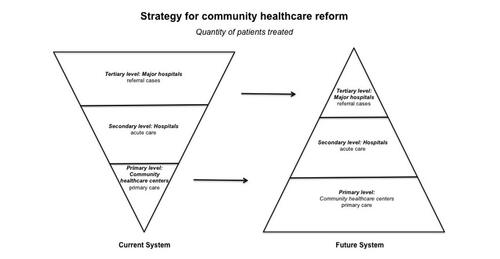
Resembling a pyramid, China’s system has a finite number of top physicians who are mostly located at major hospitals. Patients who pursue services are likely to go to major hospitals in urban areas, instead of their local health community centers. About 90 percent of health care is delivered in hospitals—leading to overcrowding. Moreover, patients choose to self-treat or self-medicate which can lead to misdiagnosis.
Collecting data in Hangzhou, a coastal city just south of Shanghai (shown in map photo), Lin discovered that these trends could be explained by two reasons.
Patients have a low level of trust in community health centers, and local facilities lack capacity (e.g. having only 20 bed spaces) and expertise (e.g. employing medical personnel with sometimes outdated training). His analysis reinforced earlier outcomes found by Karen Eggleston.
Lin says the solution lies in increasing access to highly skilled physicians and organizing the system more efficiently.
Comparing China to the United States, Lin believes community healthcare centers should become main hubs for service delivery. The centers would operate as the first and last touchpoint for patient care, like “gatekeepers” in the U.S. system, administering advanced services and prevention programs like wellness education.
And while local centers are becoming more prevalent—China has more than 34,081 centers—development isn’t fast enough, not enough physicians exist, and patients aren’t actively choosing to redirect their services to community healthcare centers.
Courtesy: Feng Lin
Figure 1. Strategy for community healthcare center reform advocates "strength at the grassroots." Currently patients seek care at major hospitals as their first stop, but in the future system, patients will go primarily to grassroots community healthcare centers. Courtesy: Feng Lin
Creating ease
Chinese people are typically leery of the quality of health care available at community healthcare centers, and overcoming that trust deficit won’t be an easy task. However, Lin says it’s a matter of informing citizens about local services and training more physicians to deliver quality care.
To address quality concerns, the Chinese government has set out to expand medical training programs. Enhancing the expertise of current and future physicians in rural community healthcare centers is essential, Lin says.
The health index aims to empower patients so that they can determine the best medical accommodation available, and also create a mechanism that rewards good work.
The key is to create a participatory system, one that incentivizes the patient and the physician, he says.
Hosted digitally and in the public domain, the index will list all physicians throughout Zhejiang province. Patients and healthcare professionals can login and share their experience, providing a “satisfaction rating” of hospitals and community health care centers.
Beyond external contributions, the index will support data provided by China’s national Center for Disease Control and Prevention, and local centers for disease control, to include mortality rate and cause of death and many other indicators sourced from publicly available data.
“It will build up a kind of system that people can trust – something that people can rely on,” Lin says.
Similar platforms have been implemented in advanced industrialized nations. Lin hopes that the index will offer a model that could be applied nationwide.
“It’s nearly impossible to have a single policy apply,” he says. “But, if there’s a success in one area or a few areas, the central government will pick up that approach.”
Lin expects that his team will unveil the pilot program at a conference on general practice in October 2015. The conference aims to provide practical ways to improve primary care services and the education and training of general practitioners.
Avik Roy is a Senior Fellow at the Manhattan Institute and the Opinion Editor at Forbes. His research interests include the Affordable Care Act, universal coverage, entitlement reform, international health systems, veterans' health care, and FDA policy. In 2012, Roy served as a health care policy adviser to Mitt Romney. He is the author of Transcending Obamacare: A Patient-Centered Plan for Near-Universal Coverage and Permanent Fiscal Solvency and How Medicaid Fails the Poor, published by Encounter Books in 2013.In addition, Roy writes regularly for National Review Online on politics and policy. He is a frequent guest on television news programs, including appearances on Fox News, Fox Business, NBC, MSNBC, CNBC, Bloomberg, PBS, CBS, and HBO. His work has also appeared in The Wall Street Journal, The Atlantic, USA Today, Health Affairs, and National Affairs, among other publications. Roy is a member of the Advisory Board of the National Institute for Health Care Management, and co-chairs the Fixing Vertans Health Care Policy Taskforce. At the Manhattan Institute, Roy is the founder of Roy Healthcare Research, an investment research firm in New York. Previously, he served as an analyst and portfolio manager at Bain Capital, J.P. Morgan, and other firms.
As the new director of the Center for Policy, Outcomes and Prevention (CPOP), C. Jason Wang’s goal is to improve child health by bringing people together. Since Paul Wise founded the center 10 years ago, CPOP has shaped child health policy by trying to make effective healthcare not only available but easily accessible to everyone. By creating preventive strategies to decrease the risk of getting sick and to avert complications so that patients can return to their former quality of life, CPOP aims to improve quality of care and to make people healthier overall. Wang wants to further promote these goals by encouraging scholars to work together and by applying the latest consumer technology to deliver high quality care.
What are your goals for CPOP?
When I became director, I had a renewed vision for CPOP 2.0: to lead the way in child health policy through innovation and improvement in systems performance across the life course. We have three specific missions that I would like to accomplish:
To conduct transdisciplinary team science research between different divisions within pediatrics and different centers across Stanford.
To train scholars in health policy and health services research.
To support the Center for Health Policy and the Center for Primary Care and Outcomes Research (CHP/PCOR) in its effort in global health and in transition of child to adult health services.
We hope to build bridges. We start by connecting departments at Stanford and beyond. We also want to improve transitions between care for kids and adults and between domestic and global policy to increase health worldwide.
What are some of the big issues in child health that you would like to address?
One of the big issues that we are particularly interested in is the management of chronic disease from childhood to adulthood. We want to make sure that people are not falling through the cracks. Another area that we're particularly interested in is the impact of health insurance, particularly the Affordable Care Act, on access and utilization of health services for children with medical complexities. We want to make sure that health care reform itself is not harmful to the most medically complex children. The third area, equally important, is to help people understand how to promote good habits for children across their life course. We have done this by creating a HABIT laboratory, which stands for Health Analytics, Behavioral Interventions, and Technology. A lot of the health issues in adulthood stem from childhood behaviors. For instance, obesity leads to diabetes and heart disease, and if one could prevent diabetes by reducing obesity, then we would have a lot fewer problems when kids become adults.
How will CPOP evolve to meet your goals?
We would like to move into the area of driving health innovation. In particular, we'd like to understand what motivates patients and providers. We'd like to rethink the healthcare delivery models to strategically create cost-effective resources in the delivery process and to eliminate waste so that the system provides the highest value. To do this, we're going to try to develop more regular policy briefs and try to disseminate health information using multimedia and social networks. We want to take advantage of the technological innovations available here in Silicon Valley.
How can working with people in Silicon Valley improve healthcare?
Everyone, even vulnerable populations, uses cell phones now, so we're going to use that to re-envision how to drive health behavioral changes, to improve communication with our patients and to improve care coordination. We are rethinking how we could drive delivery innovations using mobile devices. But technology still has its challenges. Healthcare technology requires security, and we need to make sure that we can adequately protect people's personal health information. Technology is a tool, and every time you get a new tool you have to understand its advantages and the issues that might come up. It's going to be easier for us because we work very closely with a lot of very smart people here in Silicon Valley.
Noncommunicable diseases (NCDs) have become the leading causes of death worldwide and China's increased NCD prevalence is of growing concern. Randall Stafford, Professor of Medicine in the Stanford Center for Research in Disease Prevention and SCPKU Faculty Fellow, led a symposium at the center last fall. Entitled "Tackling China's Noncommunicable Diseases: Shared Origins, Costly Consequences, and the Need for Action," the symposium focused on China's NCD threats to public health and the urgent need for solutions. The symposium summary was published earlier this month in the Chinese Medical Journal.
About the Speaker: Michael E. Chernew is the Leonard D. Schaeffer Professor of Health Care Policy at Harvard Medical School. Dr. Chernew’s research examines several areas related to controlling health care spending growth while maintaining or improving quality of care. His work on consumer incentives focuses on Value-Based Insurance Design (VBID), which aligns patient cost sharing with clinical value. His work on payment reform involves the evaluation of bundled payment initiatives, including global payment models that include pay-for-performance components. Related research examines the effects of changes in Medicare Advantage payment rates. Additional research explores the causes and consequences of rising health care spending, and geographic variation in spending, spending growth and quality.
A rapidly aging population poses serious challenges for many countries around the world, particularly in Asia, home to the most populous countries. China and India account for nearly 36% of the world’s population, and are expected to face social and economic complications from demographic change in the next decades.
A special issue of the Journal of the Economics of Ageing explores these trends in a comparative perspective, “The Economic Implications of Population Ageing in China and India” (December 2014), co-edited by David Bloom, a professor at Harvard University’s School of Public Health, and Karen Eggleston, a Center Fellow at the Shorenstein Asia-Pacific Research Center.
“Population ageing represents uncharted waters for China and India,” Bloom and Eggleston write in their coauthored introduction.
The special issue is a collection of 10 articles that examine the economic benefits and potential dilemmas arising from decreased fertility and increased life expectancy, two trends that will impact the development and future trajectories of China and India at the micro- and macroeconomic levels.
Dropping or continued low birth rates imply fewer young people to refresh the labor market. But will this cause the workforce to shrink to an unsustainable level? Demand will increase for health care, long term care, and other social services that support the elderly. What must the government do to ensure adequate access to care?
Empirical data and commentary presented in the special issue seek to inform stakeholders about emerging patterns, and to provide insight on how to best address related policy challenges going forward.
“By adopting responsive behaviors and consultative institutions that address the challenges of population ageing in ways that are appropriate to their unique circumstances, China and India could reap the full economic and social benefits of longer, healthier lives,” they write.
The special issue includes an introduction by Bloom and Eggleston, a feature interview with Richard Suzman, and additional analysis by noted global health experts following each article. The titles and authors of the 10 original research articles are listed below:
Intergenerational co-residence and schooling (Anjini Kochar)
Regional disparities in adult height, educational attainment, and late-life cognition: Findings from the Longitudinal Aging Study in India (LASI) (Jinkook Lee, James P. Smith)
Healthy aging in China (James P. Smith, John Strauss, Yaohui Zhao)
Gender differences in cognition in China and reasons for change over time: Evidence from CHARLS (Xiaoyan Lei, James P. Smith, Xiaoting Sun, Yaohui Zhao)
Reprint of: Health outcomes and socio-economic status among the mid-aged and elderly in China: Evidence from the CHARLS national baseline data (Xiaoyan Lei, Xiaoting Sun, John Strauss, Yaohui Zhao, Gonghuan Yang, Perry Hu, Yisong Hu, Xiangjun Yin)
Should China introduce a social pension? (Bei Lu, Wenjiong He, John Piggott)
China’s age of abundance: When might it run out? (Yong Cai, Feng Wang, Ding Li, Xiwei Wu, Ke Shen)
The macroeconomic impact of non-communicable diseases in China and India: Estimates, projections, and comparisons (David E. Bloom, Elizabeth T. Cafiero-Fonseca, Mark E. McGovern, Klaus Prettner, Anderson Stanciole, Jonathan Weiss, Samuel Bakkila, Larry Rosenberg)
Economic development and gender inequality in cognition: A comparison of China and India, and of SAGE and the HRS sister studies (David Weir, Margaret Lay, Kenneth Langa)
Comparing the relationship between stature and later life health in six low and middle income countries (Mark E. McGovern)
The special issue of the Journal of the Economics of Ageing, vol. 4, pages 1-154 (December 2014) is available through Elsevier’s online platform ScienceDirect.
Hero Image
Asia health policy scholar Karen Eggleston (Center Right) learns about a digital health information system in a visit to a primary care center in Hangzhou, China in Oct. 2014.
Abstract: Foreign aid for health in low- and middle-income countries has increased five-fold over the past 25 years. Between 2005 and 2010, health aid made up more than 30% of all health spending in low-income countries. Global health is also an increasingly important component of U.S. foreign aid, rising steadily from under 4% of all U.S. non-military aid in 1990 to 22.7% in 2011. There is growing evidence for the role of health aid in improving health among recipient countries, but is that it? In this talk I will address the arguments for and against health as a focus of aid efforts and present initial evidence on the role of health aid on human capital and economic development.
Encina Commons, Room 102,
615 Crothers Way,
Stanford, CA 94305-6019
(650) 723-0984
(650) 723-1919
0
ebd@stanford.edu
Professor, Medicine
Professor, Health Policy
Senior Fellow, by courtesy, Freeman Spogli Institute for International Studies
Senior Fellow, Woods Institute for the Environment
eran_bendavid
MD, MS
My academic focus is on global health, health policy, infectious diseases, environmental changes, and population health. Our research primarily addresses how health policies and environmental changes affect health outcomes worldwide, with a special emphasis on population living in impoverished conditions.
Our recent publications in journals like Nature, Lancet, and JAMA Pediatrics include studies on the impact of tropical cyclones on population health and the dynamics of SARS-CoV-2 infectivity in children. These works are part of my broader effort to understand the health consequences of environmental and policy changes.
Collaborating with trainees and leading academics in global health, our group's research interests also involve analyzing the relationship between health aid policies and their effects on child health and family planning in sub-Saharan Africa. My research typically aims to inform policy decisions and deepen the understanding of complex health dynamics.
Current projects focus on the health and social effects of pollution and natural hazards, as well as the extended implications of war on health, particularly among children and women.
Specific projects we have ongoing include:
What do global warming and demographic shifts imply for the population exposure to extreme heat and extreme cold events?
What are the implications of tropical cyclones (hurricanes) on delivery of basic health services such as vaccinations in low-income contexts?
What effect do malaria control programs have on child mortality?
What is the evidence that foreign aid for health is good diplomacy?
How can we compare health inequalities across countries? Is health in the U.S. uniquely unequal?