
Human Rights
-

Abstract
The most important post-Nuremberg health-related human right and bioethics principle is informed consent. A series of post-9/11 developments, including quarantine and forced vaccination proposals, "altered standards of care" for disaster responders, eliminating consent for "emergency research," the post-ACA rise of "standard of care research," whole genome screening guidelines for adults and children, and proposals for newborns, gene bank proposals for "broad" or no consent, and the force-feeding of hunger strikers at Guantanamo and in US prisons, all suggest that informed consent should be seen as optional, and judged by a physician-determined standard of care. It's time to kill these zombies, and save the life of informed consent, and thus of the individual person who retains dignity and human rights.

George Annas is the cofounder of Global Lawyers and Physicians, a transnational professional association of lawyers and physicians working together to promote human rights and health.  He has degrees from Harvard College (A.B. economics, '67), Harvard Law School (J.D. '70) and Harvard School of Public Health (M.P.H. '72).

Professor Annas is the author or editor of 18 books on health law and bioethics, including Worst Case Bioethics:  Death, Disaster, and Public Health(2010),Public Health Law (2007),American Bioethics: Crossing Human Rights and Health Law Boundaries(2005),The Rights of Patients(3d ed. 2004),Some Choice: Law, Medicine, and theMarket (1999), Standard of Care: The Law of American Bioethics (l993), and Judging Medicine (1987), and a play entitled Shelley's Brain, that has been presented to bioethics audiences across the U.S. and in Australia. Professor Annas wrote a regular feature on "law and bioethics" for the Hastings Center Report from 1976 to 199l, and a regular feature on "Public Health and the Law" in the American Journal of Public Health from 1982 to 1992 and since 1991 has written a regular feature for the NewEngland Journal of Medicine (“Health Law, Ethics & Human Rights”).

He  is a fellow of the American Association for the Advancement of Science, a member of the Institute of Medicine, a member of the National Academies’ Human Rights Committee, and co-chair of the American Bar Association's Committee on Health Rights and Bioethics (Individual Rights and Responsibilities Section). He has also held a variety of government regulatory posts, including Vice Chair of the Massachusetts Board of Registration in Medicine, Chair of the Massachusetts Health Facilities Appeals Board, and Chair of the Massachusetts Organ Transplant Task Force.


Building 200 (History Corner)
Room 205
Stanford University
George J. Annas, JD, MPH Professor Speaker Boston University Schools of Public Health, Medicine, and Law
Seminars
-

Speaker bio:

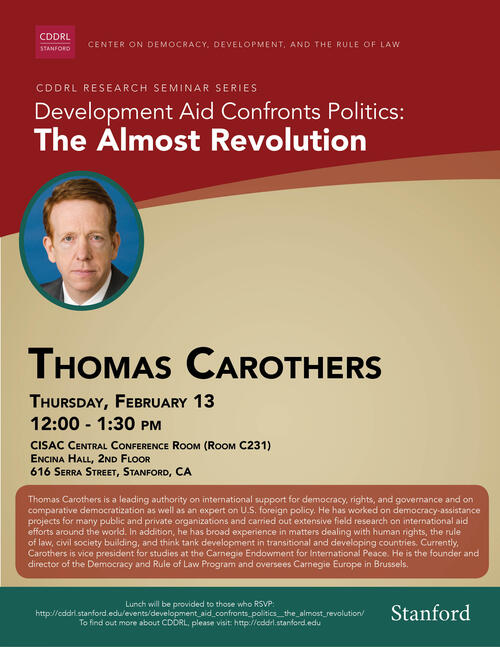
Thomas Carothers is vice president for studies at the Carnegie Endowment for International Peace. He is the founder and director of the Democracy and Rule of Law Program and oversees Carnegie Europe in Brussels.

Carothers is a leading authority on international support for democracy, rights, and governance and on comparative democratization as well as an expert on U.S. foreign policy. He has worked on democracy-assistance projects for many public and private organizations and carried out extensive field research on international aid efforts around the world. In addition, he has broad experience in matters dealing with human rights, the rule of law, civil society building, and think tank development in transitional and developing countries.

He is the author of six critically acclaimed books as well as many articles in prominent journals and newspapers. Carothers has also worked extensively with the Open Society Foundations (OSF), including currently as chair of the OSF Think Tank Fund and previously as chair of the OSF Global Advisory Board. He is an adjunct professor at the Central European University in Budapest and was previously a visiting faculty member at Nuffield College, Oxford University, and Johns Hopkins SAIS.

Prior to joining the Endowment, Carothers practiced international and financial law at Arnold & Porter and served as an attorney adviser in the Office of the Legal Adviser of the U.S. Department of State.

Carothers is the co-author (with Diane de Gramont) of Development Aid Confronts Politics: The Almost Revolution (Carnegie, 2013) and author of Confronting the Weakest Link: Aiding Political Parties in New Democracies (Carnegie, 2006); Promoting the Rule of Law Abroad: In Search of Knowledge (Carnegie, 2006); Uncharted Journey: Promoting Democracy in the Middle East, co-edited with Marina Ottaway (Carnegie, 2005); Critical Mission: Essays on Democracy Promotion (Carnegie, 2004); Funding Virtue: Civil Society Aid and Democracy Promotion, co-edited with Marina Ottaway (Carnegie, 2000); Aiding Democracy Abroad: The Learning Curve (Carnegie, 1999); and Assessing Democracy Assistance: The Case of Romania (Carnegie, 1996).

Image

CISAC Conference Room

Thomas Carothers Vice President for Studies Speaker Carnegie Endownment for International Peace
Seminars
-

Koret Distinguished Lecture Series: Lecture II

If East Asia is to make its anticipated much greater contribution to the world political and economic order in the coming years, the states and the peoples of the region will have to make continuous efforts to maintain and increase respect for the common values of humanity. Key to this is building mutual trust through historical reconciliation and rectification, which is necessary to ensure regional peace and prosperity and contribute to the global good. In the process of constructing a "civil consensus" resting on such universal human values as democracy, human rights, development cooperation, environmental protection, and ensuring peace, we must consider the role that the intellectual community in Asia should play alongside other world citizens. In his talk, President Oh will re-examine the responsibility of education in general and universities in particular in cultivating future world citizens who share the goal of upholding humanity’s common values. 

Dr. Oh received his BA in Political Science from Seoul National University, and his MPA and PhD in Public Administration from New York University.

The Koret Distinguished Lecture Series was established in 2013 with the generous support of the Koret Foundation

Philippines Conference Room

Oh Yeon-Cheon President, Seoul National University Speaker
Lectures
Authors
News Type
News
Date
Paragraphs

The Program on Human Rights at Stanford's Center on Democracy, Development, and the Rule of Law, in partnership with the McCoy Family Center for Ethics in Society, is offering up to three summer fellowships to talented Stanford undergraduates interested in gaining practical experience at human rights organizations around the world. The fellowship will award grants of up to $5,000 for students undertaking a human rights project for a minimum of eight weeks during the summer. The deadline to apply is Dec. 9, 2013. 

Students have the opportunity to focus on issues that include freedom of speech; discrimination against women; the rights of children, elderly and minorities; and access to food, health, education and housing. Past fellows have identified and worked with a number of different organizations based in the U.S. and abroad that promote, monitor, evaluate, or advance human rights work.

Image
Photo Credit: Adrian Bonifacio

Former Human Rights Fellows include computer science major Firas Abuzaid (’14), who spent the summer of 2013 in Amman, Jordan working with Visualizing Justice, an organization that is dedicated to empowering people worldwide to create visual stories for social justice and human rights. In 2011, Adrian Bonifacio (’13) worked with the Asian Pacific Mission for Migrants, a non-governmental organization based in Hong Kong, China that promotes and defends the rights of migrant workers. Garima Sharma (’15), an economics major, spent this past summer working with Apne Aap: Women Worldwide, an anti-trafficking NGO based in Forbesganj, India.

In order to apply to the fellowship, students must submit a proposal that identifies a partner organization, a project that would contribute towards the organization’s mission and a tentative budget. The application period for the summer fellowship is now open to Stanford undergraduates through Dec. 9. To view profiles of the four 2013 fellows please click here. Additional information about the fellowship - including the application - is available here.

For more information, please contact Joan Berry, the executive director at the McCoy Family Center for Ethics in Society at joanberry@stanford.edu or Ana Bracic, the fellowship mentor at the Program on Human Rights at bracic@stanford.edu

Hero Image
100 0983 headliner logo
All News button
1
-

The Program on Human Rights (PHR), in partnership with the Stanford Program on International and Cross-Cultural Education (SPICE) and the Stanford Human Rights Education Initiative (SHREI), is working to develop a human rights curriculurm to be implemented by college and high school educators wishing to incorporate human rights into their teaching.

As part of the Stanford Human Rights Education initiative, the PHR helps organize a series of workshops with Bay area community college instructors to enable the implementation of the human rights curricula in community colleges. Under this project, the PHR also supervises students from Stanford School of Education to develop teaching modules that include PHR's areas of research, such as human trafficking and indigenous populations rights, in accessible reference materials for informing and helping community college educators in their lesson plans.

All workshops and activities on this vital pedagogical initiative are documented and available online on SHREI's website: http://shrei.stanford.edu

All workshops and activities on this vital pedagogical initiative are documented and available online on SHREI's website: http://shrei.stanford.edu

Helen Stacy Senior Fellow at the Freeman Spogli Institute for International Studies (FSI) and Director of the Program on Human Rights at CDDRL Speaker
Lectures

Asylum Access
1611 Telegraph Avenue
Suite #1111
Oakland, CA 94612

0
PSE Visiting Practitioner in Residence, 2013-14
emily_hs.jpg

Emily Arnold-Fernández was a social entrepreneur in residence during the fall 2012 quarter with CDDRL's Program on Social Entrepreneurship. She will be spending the 2013/14 academic year as a practitioner-in-residence with the Program on Social Entrepreneurship.

She is the founder and executive director of Asylum Access, is a social entrepreneur and human rights pioneer. Recognizing that refugees throughout Africa, Asia and Latin America – some of whom flee with nothing more than the clothes on their backs – were almost always unequipped to go into a legal proceeding in a foreign country, alone, and explain why they should not be deported, Emily founded Asylum Access to advocate on behalf of refugees seeking to assert their rights.

“For half a century, international law has given refugees the rights to live safely,
seek employment, send children to school and rebuild their lives. But those rights are
meaningless unless they are respected on the ground,” she says. “Asylum Access
provides a rare opportunity to fill a gaping hole in our human rights system – by making
refugee rights a reality for real people.”

For her innovative approach to the global refugee crisis, Emily was honored by the
Dalai Lama as one of 50 “Unsung Heroes of Compassion” from around the world (2009)
and Waldzell Institute’s Architects of the Future Award (2012). She has also been
recognized as Pomona College’s Inspirational Young Alumna (2006), awarded the
prestigious Echoing Green fellowship (2007), and recognized as the New Leaders
Council’s 40 Under 40 (2010), among others. Emily’s ground-breaking work with
Asylum Access has earned her international speaking invitations and widespread media
attention, including the Rotary International Peace Symposium (2008, 2009), the UN
High Commissioner for Refugees’ Annual Consultations (2008, 2009), a cover feature in
the Christian Science Monitor (September 2009), and the San Francisco Examiner’s
Credo column (July 2011). She holds a B.A. cum laude from Pomona College and a J.D.
from Georgetown University Law Center.

Committed to sharing her knowledge with young and aspiring social
entrepreneurs, Emily serves as an adjunct professor at the University of San Francisco,
teaching a course in social entrepreneurship. In Fall 2012, Emily was selected as one of
three Social Entrepreneurs in Residence at Stanford where she participated as “expert
respondent” in Stanford Law School’s Law, Social Entrepreneurship and Social Change
course, and in Spring 2013, Emily led an intensive skills-building course on social
entrepreneurship at Pomona College.

A visionary human rights activist, Emily Arnold-Fernández takes her inspiration
from a line in a June Jordan poem: “We are the ones we have been waiting for.”

-

Abstract: 

Do human rights institutions work? To answer this question we examine the effect of these institutions on two kinds of outcomes: physical integrity rights (freedom from torture, government-sponsored killing, political imprisonment, and the like) and civil and political rights (freedoms of speech, assembly, movement, and religion, as well as voting and workers' rights). Our analysis covers up to 143 countries, including some of the world's worst abusers, over the period 1981 to 2004. We arrive at two main conclusions. First, national human rights institutions improve physical integrity outcomes but not civil and political rights practices. This finding reflects a greater worldwide focus on extreme violations such as torture, but also points to widespread resistance among non-Western governments to "Western" civil and political rights standards. Second, we find that time matters: the establishment of a human rights institution contributed initially to greater reports of physical integrity abuses, but practices improved significantly after only four or five years. These institutions shine a bright spotlight on countries negative practices, making it more likely that abuses are detected and cataloged. Over time, however, they help to curb egregious human rights violations. Our findings suggest that human rights institutions are not just futile exercises in governmental hypocrisy; rather, they work to improve human rights practices regardless of the intent of governments.

Speaker bios: 

Image
Francisco Ramirez is Professor of Education and (by courtesy) Sociology at Stanford University where he is also the Associate Dean for Faculty Affairs in the Graduate School of Education. His current research interests focus on the rise and institutionalization of human rights and human rights education, on the worldwide rationalization of university structures and processes, on terms of inclusion issues as regards gender and education, and on the scope and intensity of the authority of science in society. His comparative studies contribute to sociology of education, political sociology, sociology of gender, and sociology of development. His work has contributed to the development of the world society perspective in the social sciences. Ramirez received his BA in social sciences from De La Salle University in the Philippines and his MA and PhD in sociology from Stanford University. 

His recent publications include “Conditional Decoupling: Assessing the Impact of National Human Rights Institutions” (with W. Cole) American Sociological Review 702-25 2013; “National Incorporation of Global Human Rights: Worldwide Expansion of National Human Rights Organizations, 1966-2004” (with Jeong-Woo Koo).  Social Forces. 87:1321-1354. 2009; “Human Rights in Social Science Textbooks: Cross-national Analyses, 1975-2008” (with J. Meyer and P. Bromley). Sociology of Education 83: 111-134.  2010; “The Worldwide Spread of Environmental Discourse in Social Science Textbooks, 1970-2010 (with P. Bromley and J. Meyer) Comparative Education Review 55, 4; 517-545. 2011; ‘The Formalization of the University: Rules, Roots, and Routes” (With T. Christensen) Higher Education 65: 695-708 2013; and “The World Society Perspective: Concepts, Assumptions, and Strategies” Comparative Education 423-39 2012.


Image
Wade Cole is Assistant Professor of Sociology at the University of Utah. His current work focuses on (1) the impact of global human rights norms, treaties, and institutions on a range of country-level practices including bodily integrity rights, civil and political rights, labor rights, women’s rights, racial discrimination, measures of wellbeing, and governmental redistributive efforts; and (2) the rise and possible demise of minority-serving and women’s colleges in the United States, with an interest in how the varied and often contradictory ways that African Americans, American Indians, Hispanics, and women were incorporated into the American polity shaped the emergence, development, and purposes of postsecondary institutions catering to these groups. Cole holds a BA in political science from Western Washington University and a PhD in sociology from Stanford University. 

Recent publications include “Conditional Decoupling: Assessing the Impact of National Human Rights Institutions, 1981 to 2004,” American Sociological Review 78(4):702–725 (with Francisco Ramirez); “Strong Walk and Cheap Talk: The Effect of the International Covenant of Economic, Social, and Cultural Rights on Policies and Practices,” Social Forces 92(1):165–194; “Government Respect for Gendered Rights: The Effect of the Convention on the Elimination of Discrimination against Women on Women’s Rights Outcomes, 1981–2004,” International Studies Quarterly 57(2):233–249; and “Human Rights as Myth and Ceremony? Reevaluating the Effectiveness of Human Rights Treaties, 1981–2007,” American Journal of Sociology 117(4):1131–1171. He is also author of Uncommon Schools: The Global Rise of Postsecondary Institutions for Indigenous Peoples (Stanford University Press, 2011).

Reuben W. Hills Conference Room

Wade Cole Assistant Professor of Sociology Speaker University of Utah
Francisco Ramirez Professor of Education and CDDRL faculty Speaker Stanford
Seminars
-

Abstract:

In less than three decades, Taiwan has transformed from a repressive, authoritarian state into a vibrant democracy. Changes to the legal system, and particularly the criminal justice system, have played a central role in this story. Reform-minded politicians, lawyers, judges, prosecutors, and scholars have been crucial advocates for strengthening human rights protections, as has Taiwan’s Constitutional Court. Since the end of martial law, the Court has vigorously given heft to rights enshrined in the Republic of China’s constitution. Now that Taiwan has adopted the contents of the International Covenant on Civil and Political Rights as domestic law, it is an opportune moment to reflect on Taiwan’s journey towards embracing international human rights norms and to confront remaining challenges. The situation across the strait is markedly different. Today, Taiwan’s Constitutional Court has no counterpart on the Mainland and analogues to Taiwan’s former police-controlled punishments remain in full effect. As calls for reform on the Mainland become increasingly vocal, how might Taiwan’s experience inform efforts to increase human rights protections in the People’s Republic of China? 

Speaker Bio:

Image
margaret lewis1
Maggie Lewis joined Seton Hall Law School as an Associate Professor in 2009. She is a Term Member of the Council on Foreign Relations, a Public Intellectuals Program Fellow with the National Committee on U.S.-China Relations, and an Affiliated Scholar of NYU School of Law’s U.S.-Asia Law Institute. Her recent publications have appeared in the Columbia Journal of Transnational Law, NYU Journal of International Law and Politics, Columbia Journal of Asian Law, and Virginia Journal of International Law. She is also the co-author of the book Challenge to China: How Taiwan Abolished Its Version of Re-Education Through Labor with Jerome A. Cohen. 

Most recently before joining Seton Hall, Professor Lewis served as a Senior Research Fellow at NYU School of Law’s U.S.-Asia Law Institute where she worked on criminal justice reforms in China. Following graduation from law school, she worked as an associate at the law firm of Cleary, Gottlieb, Steen & Hamilton in New York City. She then served as a law clerk for the Honorable M. Margaret McKeown of the U.S. Court of Appeals for the Ninth Circuit in San Diego. After clerking, she returned to NYU School of Law and was awarded a Furman Fellowship.

Professor Lewis received her J.D., magna cum laude, from NYU School of Law, where she was inducted into the Order of the Coif and was a member of Law Review. She received her B.A., summa cum laude, from Columbia University. In addition, she has studied at the Hopkins-Nanjing Center for Chinese and American Studies in Nanjing, China, and Bucerius Law School in Hamburg, Germany. 

Philippines Conference Room

Margaret Lewis Associate Professor Speaker Seton Hall Law School
Seminars
Subscribe to Human Rights