Human Rights
-

Abstract:

Public health is widely understood to be both inherently political and easily politicized, yet few studies have examined how global health interventions actively, if unintentionally, co-constitute local political systems and practices of governance in the developing world. Three examples from rural Malawi offer insight into how health promotion campaigns in the areas of sanitation, reproductive health, and immunization have helped to make and expand local structures of authority from village heads to police. The consequences of these intersections are explored with respect to key normative development constructs including community participation, human rights, and women’s empowerment. Ms. West’s talk draws on 18 months of ethnographic fieldwork with community outreach workers and rural households in Malawi, as well as archival research on colonial public health and the development of the national health system in the early post-independence period.

Bio:

Anna West is a 2013-14 pre-doctoral fellow at CDDRL and a PhD candidate in the Department of Anthropology at Stanford. Her dissertation research in Malawi examines how modular global health interventions engage local power structures, patronage systems, and political cultures. Anna combines ethnographic fieldwork and archival research on encounters between government outreach workers, village heads, and rural households to trace the salience of health promotion strategies for the formation and consolidation of ideas, values, and processes of governance and democracy in Malawi. Her work focuses in particular on traditional authorities' involvement in rural health promotion and the significance of chiefly governance for local and national discourse on community participation, human rights, and citizenship. Anna's research has been supported by the National Science Foundation, the Fulbright U.S. Student Program, a U.S. State Department FLAS Fellowship, and Stanford's Center for African Studies.

Encina Ground Floor Conference Room

Encina Hall
616 Serra Street
Stanford, CA 94305-6055

0
CDDRL Pre-doctoral Fellow, 2013-14
West_HS.jpg

Anna West is a 2013-14 pre-doctoral fellow at CDDRL and a PhD candidate in the Department of Anthropology at Stanford. Her dissertation research in Malawi examines how modular global health interventions engage local power structures, patronage systems, and political cultures. Anna combines ethnographic fieldwork and archival research on encounters between government outreach workers, village heads, and rural households to trace the salience of health promotion strategies for the formation and consolidation of ideas, values, and processes of governance and democracy in Malawi. Her work focuses in particular on traditional authorities' involvement in rural health promotion and the significance of chiefly governance for local and national discourse on community participation, human rights, and citizenship. Anna's research has been supported by the National Science Foundation, the Fulbright U.S. Student Program, a U.S. State Department FLAS Fellowship, and Stanford's Center for African Studies.

Anna West 2013-14 Pre-Doctoral Fellow Speaker CDDRL
Seminars
-

Abstract:

It is almost too obvious to state, but access to public services and the nature of governance varies hugely within countries, regions and cities. Nevertheless, most work on the “quality of government”, rule of law, corruption, etc. focuses on between-country comparisons. After providing some evidence that within-country variation belies any notion of a national “quality of government”, I lay out a framework for explaining why outcomes vary so much across localities within countries. I explore the usefulness of the framework by providing evidence from three ongoing projects. The first relies on surveys designed to examine the role of slum-level social and political networks in conditioning access to basic public services in Udaipur, India. The second project relies on four post-civil war settings to understand why authorities target some localities with electrification projects but not others.  The third project involves a field experiment embedded in an aid program that compares alternative means of improving accountability in Ghana’s district governments. I will conclude with some reflections on the costs and benefits of working with donors on governance programming.

Speaker Bio: 

Erik Wibbels is an Associate Professor of Political Science at Duke University. His research focuses on development, decentralized governance and other areas of political economy. He has also spent considerable time working with USAID's Center of Excellence on Democracy, Human Rights and Governance in an effort to improve the quality of aid programs aimed at decentralized governance and service provision.


Encina Ground Floor Conference Room

Erik Wibbels Associate Professor of Political Science Speaker Duke University
Seminars
Paragraphs

"People with Disabilities in a Changing North Korea" details the situation that people with disabilities face in the Democratic People's Republic of North Korea (DPRK). Despite its reputation as a repressive, closed society where human rights are routinely abused, there are in fact institutions in the DPRK that work to address the needs of the disabled, and a number of non-governmental organizations providing aid to disabled people are active in the country. In this paper, Katharina Zellweger attempts to provide "an informed and balanced view of what it means to live with disabilities in North Korea and current work to assist the disabled."

Katharina Zellweger, a senior aid worker with over thirty years of experience working in Asia, twenty of those years focused on aiding North Korea, was the Pantech Fellow at Shorenstein Asia-Pacific Research Center's Korea Program from 2011 to 2013.

All Publications button
1
Publication Type
Working Papers
Publication Date
Journal Publisher
Shorenstein Asia-Pacific Research Center
Authors
Number
978-1-931368-37-7
-


*This event is free and open to the public.*


Image

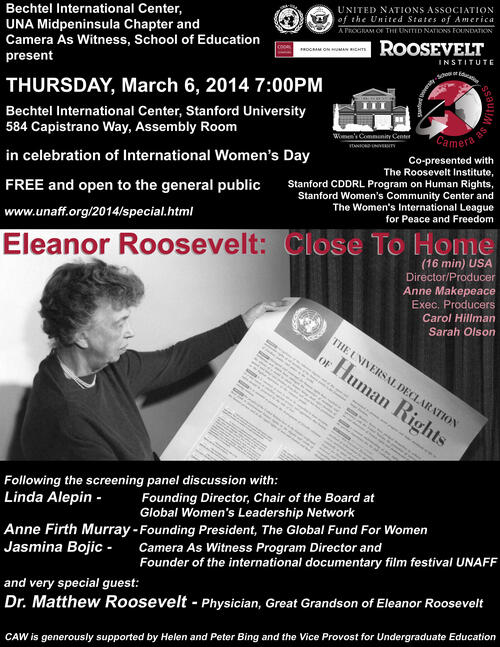
Eleanor Roosevelt: Close to Home is an overview of the inspirational life of Eleanor Roosevelt and highlights her dedication as champion of social justice and racial equality. The film introduces viewers to Val-Kill, the home of this extraordinary American who became a world leader in human rights and creator of the Universal Declaration of Human Rights. The remarkable modesty, independence and humanitarian leadership that made Eleanor Roosevelt the "First Lady of the World" are reflected in the Cottage's rooms, furnishings and surroundings. No other place allows visitors to connect with, rediscover and appreciate anew this woman whose influence is still so widely felt.

Following the screening, there will be a panel discussion.

This event is co-presented with the CDDRL Program on Human Rights, Roosevelt Institute, Stanford Women's Community Center and Women's International League for Peace and Freedom and sponsored by the Bechtel International Center, UNA Midpeninsula Chapter and Camera As Witness, Stanford Graduate School of Education in celebration of International Women's Day. 

Bechtel International Center
Assembly Room
Stanford University
584 Capistrano Way

Linda Alepin Founding Director, Chair of the Board Speaker Global Women's Leadership Network
Anne Firth Murray Founding President Speaker The Global Fund For Women
Jasmina Bojic Camera As Witness Program Director and Founder of the international documentary film festival UNAFF Speaker
Dr. Matthew Roosevelt Physician Speaker Great Grandson of Eleanor Roosevelt
Conferences
News Type
News
Date
Paragraphs

At a CDDRL event on February 3, human rights activist Virak Ou, president of the Cambodian Center for Human Rights, discussed the recent protests in Cambodia, addressing the potential conditions for revolution.

Hero Image
OU LOGO
Virak Ou, human rights activist, speaks on the prospect of revolution in Cambodia. Photo taken in Encina Hall at Stanford University.
Christian Ollano
All News button
1
-

The opening up of Myanmar (Burma) and the steps undertaken taken toward political reform in that formerly isolated dictatorship have been among Asia's most dramatic and least expected events.  But the establishment of full democracy is still on the agenda and faces many challenges.  How willing is the current government in Burma to allow a full and free exercise of political rights, including media freedom?  A panel of experts, including Aung Zaw, the editor and founder of The Irrawaddy and this year's recipient of the Shorenstein Award for Journalism in Asia, will address that question in discussing "Burma's Democracy:  How Real?"

Stanford University’s Walter H. Shorenstein Asia-Pacific Research Center (Shorenstein APARC) is pleased to announce Aung Zaw as the 2013 recipient of the Shorenstein Journalism Award. Zaw has been selected for his leadership in establishing independent media in Myanmar (Burma) and his dedication to integrity in reporting on Southeast Asia.

Image
 Aung Zaw

Aung Zaw is the founding editor-in-chief and executive director of The Irrawaddy, an independent Burmese media organization operating in Myanmar and northern Thailand. Zaw has been an active campaigner for democratic reform in Burma/Myanmar over the last two decades. He was awarded the 2010 Prince Claus Fund Award for journalism along with two journalists from Iran and Cuba – and is recognized for his active dedication to achieving democratic governance in Burma and his work to uphold press freedom.

Zaw studied Botany at Rangoon University. As a student activist in Burma, he was part of the 1988 protests in Rangoon against the Burmese military regime of General Ne Win. He was arrested and detained for a week in Rangoon’s notorious Insein prison where he was severely tortured during interrogation about his pro-democracy activities. Upon release Aung Zaw continued to work with the resistance movement until the military staged a coup in September that year and he was forced to leave the country for neighboring Thailand.

Two years later, Aung Zaw founded the Burma Information Group (BIG) in Bangkok, to document human rights violations in Burma. He began to write political commentaries for national newspapers in Thailand and internationally, and in late 1993 launched The Irrawaddy News Magazine in Bangkok, covering Burma affairs. He worked in Bangkok for two years producing The Irrawaddy Magazine until relocating to the more secure position in Chiang Mai in the north of Thailand.

In February 2012, Aung Zaw was able to return to his homeland for the first time in more than 20 years for a temporary visit as an independent journalist. By the end of 2012, The Irrawaddy was able to establish a media and news office in central Yangon, returning to Burma/Myanmar to practice independent journalism, whilst retaining a regional office in Thailand.

In 2013, the government lifted ban on The Irrawaddy and other exiled websites, the Irrawaddy English magazine and the Irrawaddy Dateline Current Affairs TV program is available for audiences in Myanmar. Aung Zaw writes for New York Times, International Herald Tribune, Time, The Guardian, Bangkok Post, The Nation and several publications in the Europe. His interviews have also appeared on CN, BBC and Al Jazeera. He is the author of the Face of Resistance and is a recent Visiting Scholar at UC Berkeley, School of Journalism.

Bechtel Conference Center

Aung Zaw 2013 Journalism Prize Winner and Founder and Editor, The Irrawaddy News Magazine Panelist
Nayan Chanda Director of Publications and the Editor of YaleGlobal Online Magazine Panelist Yale Center for the Study of Globalization
0
Senior Fellow Emeritus at the Freeman Spogli Institute for International Studies
Affiliated Faculty, CDDRL
Affiliated Scholar, Abbasi Program in Islamic Studies
aparc_dke.jpg PhD

At Stanford, in addition to his work for the Southeast Asia Program and his affiliations with CDDRL and the Abbasi Program in Islamic Studies, Donald Emmerson has taught courses on Southeast Asia in East Asian Studies, International Policy Studies, and Political Science. He is active as an analyst of current policy issues involving Asia. In 2010 the National Bureau of Asian Research and the Woodrow Wilson International Center for Scholars awarded him a two-year Research Associateship given to “top scholars from across the United States” who “have successfully bridged the gap between the academy and policy.”

Emmerson’s research interests include Southeast Asia-China-US relations, the South China Sea, and the future of ASEAN. His publications, authored or edited, span more than a dozen books and monographs and some 200 articles, chapters, and shorter pieces.  Recent writings include The Deer and the Dragon: Southeast Asia and China in the 21st Century (ed., 2020); “‘No Sole Control’ in the South China Sea,” in Asia Policy  (2019); ASEAN @ 50, Southeast Asia @ Risk: What Should Be Done? (ed., 2018); “Singapore and Goliath?,” in Journal of Democracy (2018); “Mapping ASEAN’s Futures,” in Contemporary Southeast Asia (2017); and “ASEAN Between China and America: Is It Time to Try Horsing the Cow?,” in Trans-Regional and –National Studies of Southeast Asia (2017).

Earlier work includes “Sunnylands or Rancho Mirage? ASEAN and the South China Sea,” in YaleGlobal (2016); “The Spectrum of Comparisons: A Discussion,” in Pacific Affairs (2014); “Facts, Minds, and Formats: Scholarship and Political Change in Indonesia” in Indonesian Studies: The State of the Field (2013); “Is Indonesia Rising? It Depends” in Indonesia Rising (2012); “Southeast Asia: Minding the Gap between Democracy and Governance,” in Journal of Democracy (April 2012); “The Problem and Promise of Focality in World Affairs,” in Strategic Review (August 2011); An American Place at an Asian Table? Regionalism and Its Reasons (2011); Asian Regionalism and US Policy: The Case for Creative Adaptation (2010); “The Useful Diversity of ‘Islamism’” and “Islamism: Pros, Cons, and Contexts” in Islamism: Conflicting Perspectives on Political Islam (2009); “Crisis and Consensus: America and ASEAN in a New Global Context” in Refreshing U.S.-Thai Relations (2009); and Hard Choices: Security, Democracy, and Regionalism in Southeast Asia (edited, 2008).

Prior to moving to Stanford in 1999, Emmerson was a professor of political science at the University of Wisconsin-Madison, where he won a campus-wide teaching award. That same year he helped monitor voting in Indonesia and East Timor for the National Democratic Institute and the Carter Center. In the course of his career, he has taken part in numerous policy-related working groups focused on topics related to Southeast Asia; has testified before House and Senate committees on Asian affairs; and been a regular at gatherings such as the Asia Pacific Roundtable (Kuala Lumpur), the Bali Democracy Forum (Nusa Dua), and the Shangri-La Dialogue (Singapore). Places where he has held various visiting fellowships, including the Institute for Advanced Study and the Woodrow Wilson International Center for Scholars. 


Emmerson has a Ph.D. in political science from Yale and a BA in international affairs from Princeton. He is fluent in Indonesian, was fluent in French, and has lectured and written in both languages. He has lesser competence in Dutch, Javanese, and Russian. A former slam poet in English, he enjoys the spoken word and reads occasionally under a nom de plume with the Not Yet Dead Poets Society in Redwood City, CA. He and his wife Carolyn met in high school in Lebanon. They have two children. He was born in Tokyo, the son of U.S. Foreign Service Officer John K. Emmerson, who wrote the Japanese Thread among other books.

Selected Multimedia

Date Label
Donald K. Emmerson Senior Fellow at FSI, Emeritus; Affiliated Faculty, CDDRL; Affiliated Scholar, Abbasi Program in Islamic Studies and Director, Southeast Asia Forum Panelist Stanford University

Stanford University
Encina Hall, Room E301
Stanford, CA 94305-6055

0
Lecturer in International Policy at the Ford Dorsey Master’s in International Policy
2011_Dan_Sneider_2_Web.jpg MA

Daniel C. Sneider is a lecturer in international policy at Stanford's Ford Dorsey Master’s in International Policy and a lecturer in East Asian Studies at Stanford. His own research is focused on current U.S. foreign and national security policy in Asia and on the foreign policy of Japan and Korea.  Since 2017, he has been based partly in Tokyo as a Visiting Researcher at the Canon Institute for Global Studies, where he is working on a diplomatic history of the creation and management of the U.S. security alliances with Japan and South Korea during the Cold War. Sneider contributes regularly to the leading Japanese publication Toyo Keizai as well as to the Nelson Report on Asia policy issues.

Sneider is the former Associate Director for Research at the Walter H. Shorenstein Asia-Pacific Research Center at Stanford. At Shorenstein APARC, Sneider directed the center’s Divided Memories and Reconciliation project, a comparative study of the formation of wartime historical memory in East Asia. He is the co-author of a book on wartime memory and elite opinion, Divergent Memories, from Stanford University Press. He is the co-editor, with Dr. Gi-Wook Shin, of Divided Memories: History Textbooks and the Wars in Asia, from Routledge and of Confronting Memories of World War II: European and Asian Legacies, from University of Washington Press.

Sneider was named a National Asia Research Fellow by the Woodrow Wilson International Center for Scholars and the National Bureau of Asian Research in 2010. He is the co-editor of Cross Currents: Regionalism and Nationalism in Northeast Asia, Shorenstein APARC, distributed by Brookings Institution Press, 2007; of First Drafts of Korea: The U.S. Media and Perceptions of the Last Cold War Frontier, 2009; as well as of Does South Asia Exist?: Prospects for Regional Integration, 2010. Sneider’s path-breaking study “The New Asianism: Japanese Foreign Policy under the Democratic Party of Japan” appeared in the July 2011 issue of Asia Policy. He has also contributed to other volumes, including “Strategic Abandonment: Alliance Relations in Northeast Asia in the Post-Iraq Era” in Towards Sustainable Economic and Security Relations in East Asia: U.S. and ROK Policy Options, Korea Economic Institute, 2008; “The History and Meaning of Denuclearization,” in William H. Overholt, editor, North Korea: Peace? Nuclear War?, Harvard Kennedy School of Government, 2019; and “Evolution or new Doctrine? Japanese security policy in the era of collective self-defense,” in James D.J. Brown and Jeff Kingston, eds, Japan’s Foreign Relations in Asia, Routledge, December 2017.

Sneider’s writings have appeared in many publications, including the Washington Post, the New York Times, Slate, Foreign Policy, the New Republic, National Review, the Far Eastern Economic Review, the Oriental Economist, Newsweek, Time, the International Herald Tribune, the Financial Times, and Yale Global. He is frequently cited in such publications.

Prior to coming to Stanford, Sneider was a long-time foreign correspondent. His twice-weekly column for the San Jose Mercury News looking at international issues and national security from a West Coast perspective was syndicated nationally on the Knight Ridder Tribune wire service. Previously, Sneider served as national/foreign editor of the Mercury News. From 1990 to 1994, he was the Moscow bureau chief of the Christian Science Monitor, covering the end of Soviet Communism and the collapse of the Soviet Union. From 1985 to 1990, he was Tokyo correspondent for the Monitor, covering Japan and Korea. Prior to that he was a correspondent in India, covering South and Southeast Asia. He also wrote widely on defense issues, including as a contributor and correspondent for Defense News, the national defense weekly.

Sneider has a BA in East Asian history from Columbia University and an MPA from the John F. Kennedy School of Government at Harvard University.

Daniel C. Sneider Associate Director for Research, Shorenstein Asia-Pacific Research Center Moderator Stanford University
Panel Discussions
-

*This event is free and open to the public.*


PANELISTS

Don Emmerson - Director of the Southeast Asia Forum, Shorenstein Asia-Pacific Research Center; Affiliated Scholar, Abbasi Program in Islamic Studies; Affiliated Faculty, CDDRL

Erik Jensen - Professor of the Practice of Law, Stanford Law School; Senior Advisor for Governance and Law, The Asia Foundation; Senior Research Scholar, CDDRL; Director, Rule of Law Program, Stanford Law School

Norman Naimark - Director of the Stanford Global Studies Division; Professor of History

Diane H. Steinberg (Panel Chair) - Visiting Scholar at Stanford's Program on Human Rights, Center on Democracy, Development, and the Rule of Law (CDDRL)


Image

 
The Act of Killing visits former Indonesian death squad killers who wreaked havoc in 1965 and 1966 in the aftermath of Indonesia's military coup and yet have never been held accountable for slaughtering between 200,000 to 2 million people in a genocide often forgotten.  The dramatic reenactments of the murders in the documentary catalyze an unexpected emotional journey for Anwar Congo from arrogance to regret as he confronts for the first time in his life the full implications of what he has done.
 
The Act of Killing is an award-winning documentary film directed by Joshua Oppenheimer with co-director Christine Cynn and and an anonymous co-director from Indonesia. It is a Danish-British-Norwegian co-production, presented by Final Cut for Real in Denmark and produced by Signe Byrge Sørensen. It was recently nominated for an Academy Award for Best Documentary Feature.

"Director Joshua Oppenheimer has made a documentary in which he interviews the leaders of Indonesian death squads, who were responsible, collectively, for the deaths of millions of Communists, leftists and ethnic Chinese in 1965 and 1966. But he doesn't just interview them. He has them re-enact their crimes and even invites them to write, perform and film skits dramatizing their murders." Mick LaSalle, San Francisco Chronicle, 8/8/2013
 
"The Act of Killing is a bold reinvention of the documentary form, as well as an astounding illustration of man's infinite capacity for evil." Rene Rodriguez, The Miami Herald, 8/15/2013
 
After the screening of the  Director's Cut of The Act of Killing (160 minutes), there will be a thirty-minute panel discussion.
 
For more information regarding the film, please visit: http://theactofkilling.com/.
 
This event is presented and sponsored by Stanford Global Studies, CDDRL's Program on Human Rights, and the Vice Provost of Undergraduate Education.

Cubberley Auditorium

Conferences
-
We invite you to join Gary Haugen, former director of the UN investigation of the Rwanda Genocide and President and CEO of the International Justice Mission, to discuss his latest book The Locust Effect: Why the End of Poverty Requires the End of Violence. Haugen will discuss the devastating impact that everyday violence is having on the global fight to reduce poverty and how we can help make the poor safe enough to thrive. Haugen has been recognized by the U.S. State Department as a Trafficking in Persons “Hero” – the highest honor given by the U.S. government for anti-slavery leadership. Book purchase and signing available.
 

Book purchase and signing available.

Image


This event is sponsored by: IJM, Bay Area Anti-Trafficking Coalition & the Stanford Program on Human Rights.


For more Information please contact:

Betty Ann Boeving   bettyann@baatc.org


Bechtel Conference Center

Gary Haugen President and CEO of International Justice Mission Speaker
Conferences
-

This event is co-sponsored by the Stanford Center for East Asian Studies.


Abstract: 

Virak Ou will discuss the possibility and demographic underpinnings of a so-called “Cambodian Spring” — and will offer suggestions for what the international community can do to assist Cambodians during this transitional, tense time.   


Speaker Bio: 

Human rights activist and intellectual Virak Ou is the president of the Cambodian Center for Human Rights (CCHR), one of Cambodia’s most prominent human rights organizations. Ou is the recipient of the 2007 Reebok Human Rights Award for his campaign to free activists and decriminalize defamation in Cambodia. He is also the founder of the Alliance for Freedom of Expression in Cambodia, otherwise known as AFEC. He is a survivor of the Cambodian Khmer Rouge era and was a child refugee before settling in the United States in 1989. Ou holds an MA in economics from San Jose State University.   

Cambodia is currently experiencing unprecedented social upheaval, in the wake of the hotly contested elections of last summer. Ou’s CCHR has been at the forefront of advocating for human rights protections and free speech for both sides of the political debate. 


Oksenberg Conference Room

Virak Ou Human Rights Activist Speaker
Seminars
-

Speaker Bio:

John Prendergast is Co-founder of the Enough Project, an initiative to end genocide and crimes against humanity. During the Clinton administration, John was involved in a number of peace processes in Africa while he was director of African Affairs at the National Security Council and special advisor at the Department of State. John has also worked for members of Congress, the United Nations, humanitarian aid agencies, human rights organizations, and think tanks.


Image

CISAC Conference Room

John Prendergast Founder Speaker Enough Project
Seminars
Subscribe to Human Rights